💍 Glass, Bangles & Perfume Heritage
Study Firozabad's glass bangle industry and Kannauj's traditional perfume (attar) distillation — their history, techniques, GI tags, and cultural significance in UP.
Introduction
Two of Uttar Pradesh's most culturally significant industries centre on seemingly simple products — glass bangles and natural perfume. Firozabad is one of India's most important glass-bangle centres, while Kannauj is widely known as India's perfume capital. Both crafts carry deep social, religious, and economic importance far beyond their material value.
Firozabad — Glass City / Suhag Nagari
History & Significance
Firozabad in Uttar Pradesh is called the "Glass City" and "Suhag Nagari" (City of Marital Fortune), as bangles symbolise married women's suhag (marital blessings) in Indian culture.
Glass-making in Firozabad dates back over 200 years, reportedly started by local craftsmen who learned the technique from European travellers. The industry expanded rapidly in the 19th and 20th centuries as demand for affordable glass bangles grew across India.
Production Facts
| Parameter | Detail |
|---|---|
| India's share | Very large share of India's glass-bangle production |
| Daily output | Very large-scale continuous production |
| Factories/units | 1,000+ glass factories and thousands of cottage units |
| Employment | Very large workforce directly and indirectly |
| Annual turnover | Large glass-industry turnover |
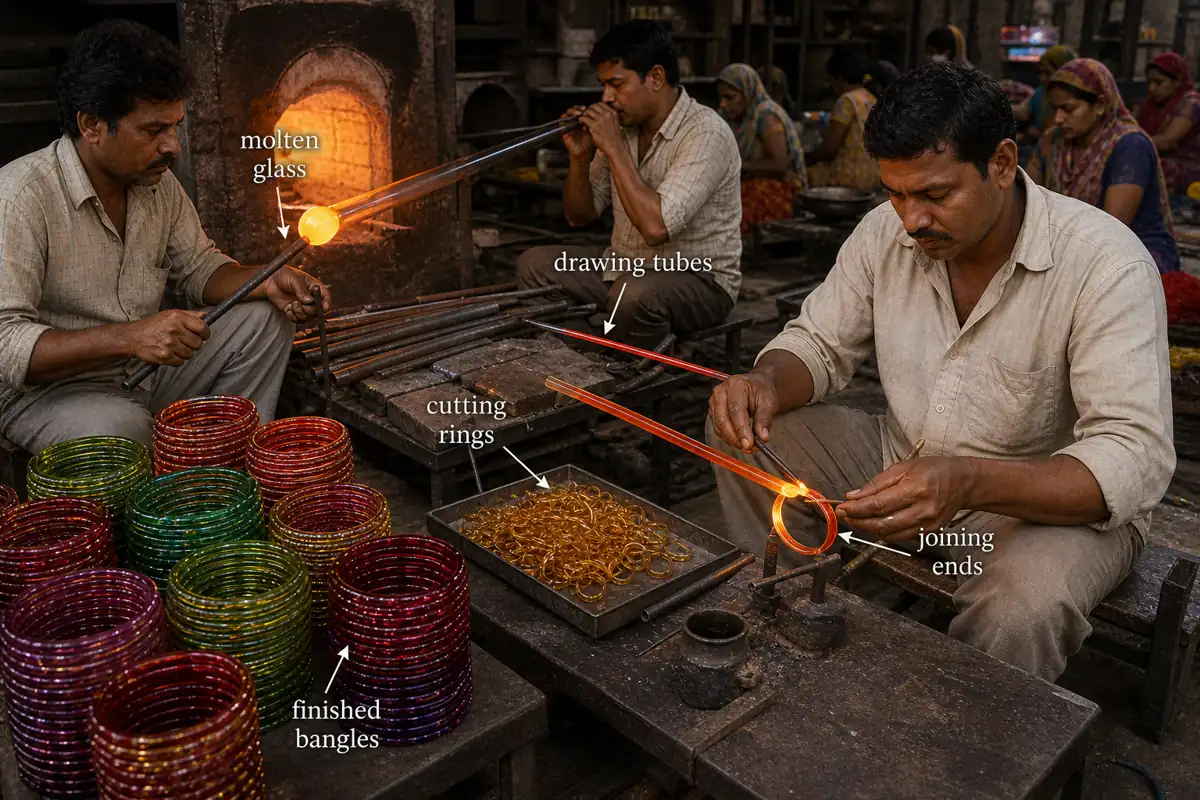
Manufacturing Process
- Melting — raw materials (silica sand, soda ash, lime, colours) melted in furnaces at 1500°C+
- Drawing — molten glass drawn into thin tubes or rods
- Cutting — tubes cut into bangle-sized rings
- Joining — ends fused together by re-heating
- Decorating — adding designs via painting, glitter (chamak), stone-setting, or lacquer work
- Finishing — polishing and size sorting
Beyond Bangles
Firozabad also produces:
- Glass beads for jewellery and embroidery
- Decorative glassware — vases, lamps, chandeliers
- Laboratory glassware — test tubes, beakers
- Optical glass — lenses and prisms
- Christmas ornaments — significant export item
Challenges
- Extreme heat — furnace workers endure 40-50°C ambient temperatures year-round
- Health hazards — silicosis, burns, eye damage from glass splinters and heat
- Child labour — historically widespread; NGOs and government crackdowns have reduced but not eliminated it
- Environmental pollution — coal-fired furnaces emit heavy particulate matter
- Competition — cheap Chinese glass imports and plastic bangles threaten the market
Kannauj — Perfume Capital of India
History
Kannauj is called the "Perfume Capital of India" and the "Grasse of the East" (after the French perfume capital). The town's attar (natural perfume) industry dates back over 400 years, with roots in the Mughal period when emperors and nobility were lavish consumers of natural fragrances.
Historical references to the wider Kannauj region's fragrance culture are often traced back much earlier, which is why the town is remembered not just as a Mughal attar centre but as a place with a much older aromatic heritage.
The Deg-Bhapka Method
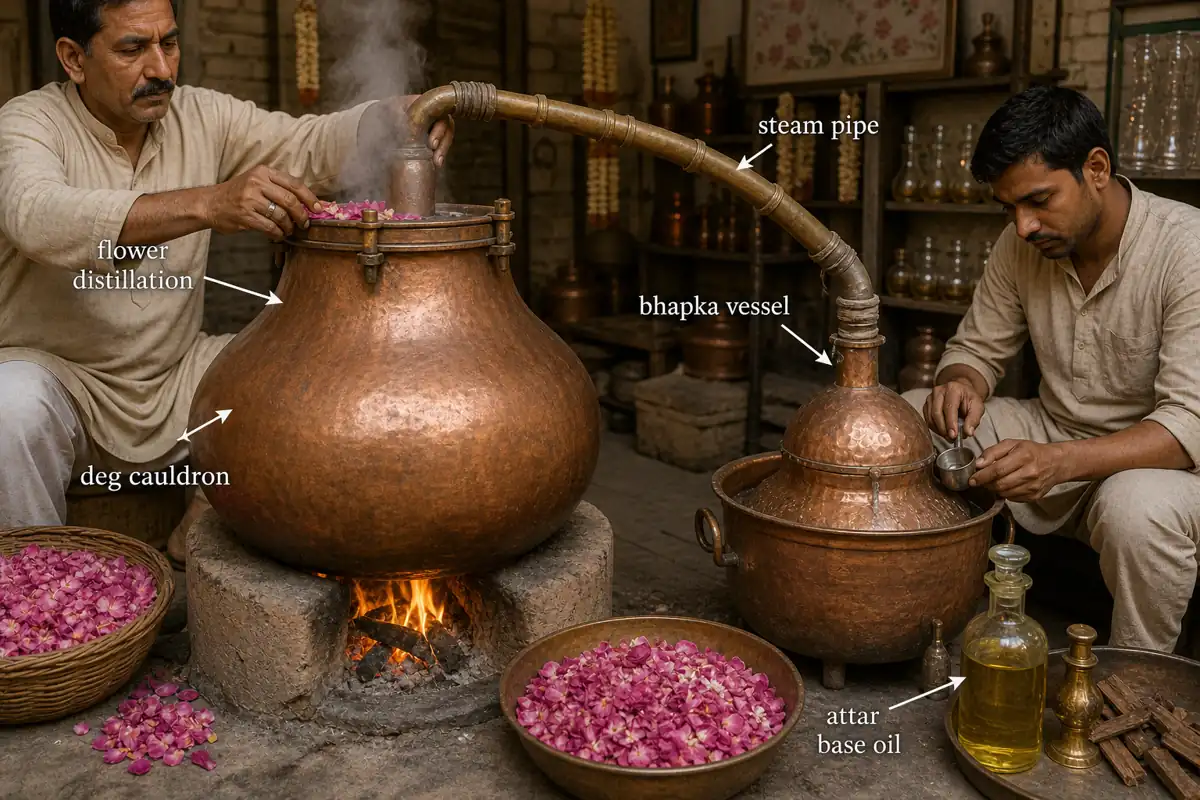
Kannauj's signature contribution is the ancient deg-bhapka hydro-distillation method, a traditional technique unchanged for centuries.
| Component | Description |
|---|---|
| Deg | Large copper cauldron where flowers/herbs are boiled with water |
| Bhapka | Copper receiving vessel connected to the deg via a bamboo pipe (chonga) |
| Process | Steam carrying essential oils travels through the pipe and condenses in the bhapka |
| Base | Sandalwood oil (traditionally) placed in the bhapka absorbs the fragrance |
| Duration | One distillation cycle takes 10-15 hours |
| Fuel | Cow dung cakes (low, steady heat ideal for delicate flowers) |
This method is valued because the slow distillation process helps preserve delicate fragrance notes that traditional attar makers consider essential.
Famous Attars of Kannauj
| Attar | Source | Season |
|---|---|---|
| Gulab | Rose petals | Spring (March-April) |
| Khus (Vetiver) | Vetiver grass roots | Summer |
| Keora (Kewda) | Pandanus flowers | Monsoon |
| Chameli | Jasmine flowers | Summer |
| Mitti | Baked earth/clay | Pre-monsoon |
| Shamama | Blend of 20-40 ingredients | Year-round (complex compound attar) |
| Hina | Blend of herbs and flowers | Year-round |
Mitti attar (fragrance of first rain on dry earth — petrichor) is Kannauj's most unique product, capturing the essence of baked clay distilled into sandalwood oil.
Shamama is the most complex attar, blending 20-40 aromatic ingredients in a single distillation — its recipe is a closely guarded family secret.
GI Tag & Recognition
- Kannauj Perfume (Attar) received a GI tag, protecting its traditional regional identity
- Kannauj has a large number of mostly family-run distillation units
- The Fragrance and Flavour Development Centre (FFDC), a Government of India institution, is located in Kannauj
Challenges
- Synthetic competition — chemical perfumes are 10-100x cheaper to produce
- Sandalwood scarcity — traditional base oil is extremely expensive; artisans increasingly use paraffin-based alternatives
- Declining flower supply — agricultural land conversion reduces locally grown flowers
- Low awareness — younger consumers unfamiliar with traditional attars
- Export potential — untapped international demand for natural, alcohol-free perfumes (especially in Middle Eastern and luxury organic markets)
Firozabad vs Kannauj — Quick Comparison
| Parameter | Firozabad | Kannauj |
|---|---|---|
| Nickname | Glass City, Suhag Nagari | Perfume Capital, Grasse of the East |
| Product | Glass bangles, glassware | Natural attars (perfumes) |
| History | 200+ years | 400+ years |
| India's share | Very large bangle-producing centre | Leading attar centre |
| GI tag | Firozabad Glass | Kannauj Perfume |
| Key technique | High-temperature glass melting | Deg-bhapka hydro-distillation |
| Employment | Very large workforce | Important artisan and small-industry workforce |
Summary Cheat Sheet
| Fact | Detail |
|---|---|
| Firozabad nickname | Glass City / Suhag Nagari |
| Bangle role | One of India's major glass-bangle centres |
| Furnace temperature | 1500°C+ |
| Kannauj nickname | Perfume Capital / Grasse of the East |
| Key method | Deg-bhapka hydro-distillation |
| Unique attar | Mitti (earth scent), Shamama (40 ingredients) |
| Attar base (traditional) | Sandalwood oil |
| Key institution | FFDC (Fragrance & Flavour Development Centre) |
| Both have GI tags | Yes |
Lesson Doubts
Ask questions, get expert answers