📿 Bhakti & Sufi Poets of UP
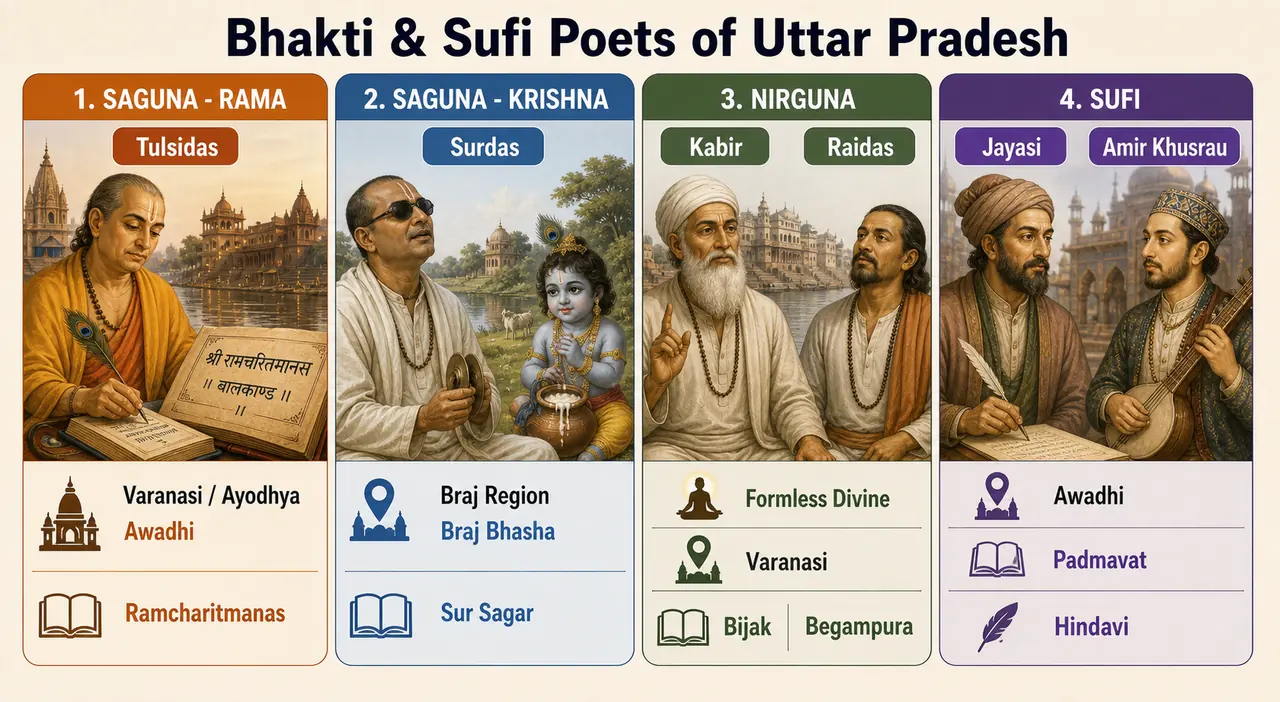
Tulsidas, Surdas, Kabir, Jayasi, Raidas, and Amir Khusrau — the great Bhakti and Sufi saint-poets of Uttar Pradesh, their works, languages, and legacy for Uttar Pradesh GK.
The Bhakti Movement in UP
The Bhakti movement (roughly 14th-17th centuries) transformed Indian spiritual and literary culture by making devotion accessible to wider sections of society. Uttar Pradesh was one of its most important centres, especially because many major poet-saints are strongly associated with the region.
The movement had two broad streams:
- Saguna Bhakti — devotion to a personal God with form (Rama or Krishna). Examples: Tulsidas, Surdas.
- Nirguna Bhakti — devotion to a formless, attribute-less divine. Examples: Kabir, Raidas.
Parallel to the Bhakti saints, Sufi poets composed allegorical love poetry in Awadhi and Hindavi, blending Islamic mysticism with Indian storytelling traditions.
Tulsidas (1532-1623)
Goswami Tulsidas is one of the most influential poets in the Hindi tradition. He is associated with Rajapur (Banda), while some traditions also link him with Soron. He spent an important part of his life in Varanasi.
| Detail | Fact |
|---|---|
| Born | 1532 CE (traditional date) |
| Died | 1623 CE, Varanasi |
| Language | Awadhi and Braj Bhasha |
| Greatest work | Ramcharitmanas (epic retelling of Ramayana in Awadhi) |
| Other works | Hanuman Chalisa, Vinay Patrika, Kavitavali, Dohavali |
| Sect | Ramanandi (Saguna — Rama devotion) |
- The Ramcharitmanas is traditionally associated with Tulsidas's work in Varanasi.
- The Hanuman Chalisa — 40 verses praising Hanuman — is the most recited Hindu prayer text in north India.
- Tulsidas is strongly associated with the spread and prestige of Ramlila in north India.
Surdas (1478-1583)
Surdas was a blind poet-saint of the Braj region, devoted to Lord Krishna. He is widely regarded as one of the greatest poets of Braj Bhasha.
| Detail | Fact |
|---|---|
| Born | 1478 CE (approximate) |
| Region | Braj (Mathura-Agra belt) |
| Language | Braj Bhasha |
| Greatest work | Sur Sagar (large collection of poems on Krishna devotion) |
| Other works | Sur Saravali, Sahitya Lahiri |
| Sect | Pushti Marg (Vallabhacharya) |
- Surdas was one of the Ashtachhap poets — the eight poets designated by Vallabhacharya and his son Vitthalnath to sing in the Shrinathji temple.
- His poetry describing bal-leela (Krishna's childhood pranks) and viraha (separation in devotion) is among the most admired in Hindi literature.
Kabir (1398-1518)
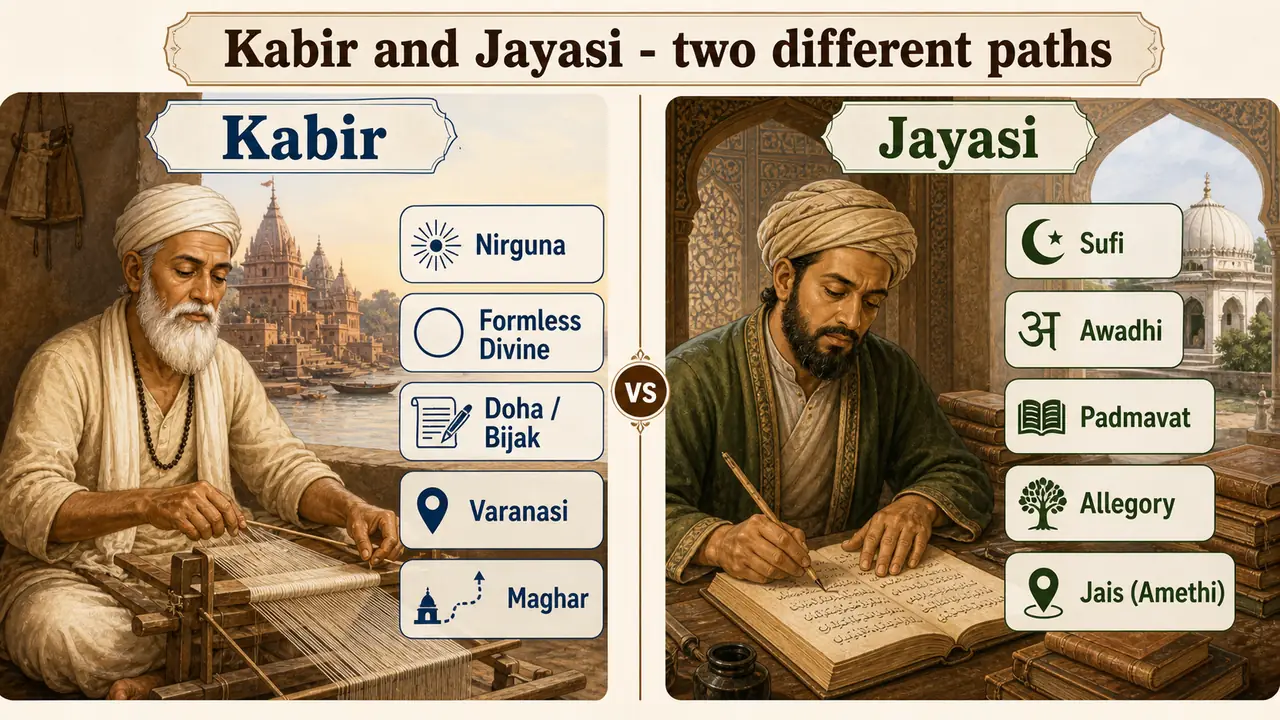
Sant Kabir is traditionally associated with Varanasi and the Julaha weaving community. He is one of the foremost poets of the Nirguna Bhakti tradition.
- Kabir rejected both Hindu ritualism and Islamic orthodoxy, preaching a formless divine beyond religious boundaries.
- His compositions — Kabir Dohe (couplets), Sakhis, and Sabads — are preserved in traditions including the Bijak.
- Kabir's verses are also included in the Guru Granth Sahib of the Sikhs.
- The Kabir Panth preserves and propagates Kabir's teachings across many parts of India.
- Famous disciple: Dharmadas.
Exam Tip: Kabir is claimed by both Hindu and Muslim traditions. Legend says that after his death at Maghar (near Gorakhpur), his body was found transformed into flowers — half taken by Hindus, half by Muslims.
Malik Muhammad Jayasi (c. 1477-1542)
Jayasi was a Sufi poet from Jais (Amethi district) who composed the Padmavat in 1540 CE.
| Detail | Fact |
|---|---|
| Language | Awadhi |
| Work | Padmavat — story of Rani Padmini of Chittor |
| Genre | Sufi allegorical romance (Prem-akhyan) |
| Poetic form | Doha-chaupai pattern |
- The Padmavat uses the love story of Ratansen and Padmini as an allegory for the soul's quest for God.
- It is regarded as one of the most important Sufi narrative poems in Awadhi.
Raidas / Ravidas (c. 1450-1520)
Sant Raidas (also called Ravidas) is associated with Varanasi. He is often described in tradition as a disciple of Ramananda and a contemporary of Kabir.
- He preached Nirguna Bhakti and opposed caste discrimination.
- 41 of his hymns are included in the Guru Granth Sahib.
- He envisioned a casteless utopia called "Begampura" (city without sorrow).
- The Ravidassia community reveres him as their founding saint.
Amir Khusrau (1253-1325)
Though born in Patiali (Kasganj region, historically Etah area, UP) and based largely in Delhi, Amir Khusrau had deep UP roots and is an important figure in the region's literary memory.
- Known as the "Parrot of India" (Tuti-e-Hind).
- Traditionally credited in popular culture with innovations in music, though such claims are debated by historians.
- Pioneer of Hindavi poetic expression — his riddles (paheliyan) and verses blend local speech with Persian literary culture.
- Disciple of Sufi saint Nizamuddin Auliya.
Master Table of Bhakti & Sufi Poets
| Poet | Period | Place | Language | Key Work | Stream |
|---|---|---|---|---|---|
| Tulsidas | 1532-1623 | Rajapur / Varanasi association | Awadhi | Ramcharitmanas | Saguna (Rama) |
| Surdas | 1478-1583 | Braj | Braj Bhasha | Sur Sagar | Saguna (Krishna) |
| Kabir | 1398-1518 | Varanasi association | Sadhukkadi / early Hindi tradition | Bijak | Nirguna |
| Jayasi | 1477-1542 | Jais (Amethi) | Awadhi | Padmavat | Sufi |
| Raidas | 1450-1520 | Varanasi association | Sadhukkadi / saint-poetic tradition | Hymns in Guru Granth | Nirguna |
| Amir Khusrau | 1253-1325 | Patiali/Delhi | Hindavi/Persian | Paheliyan, verses, Sufi legacy | Sufi |
Summary Cheat Sheet
| Exam Fact | Answer |
|---|---|
| Ramcharitmanas author & language | Tulsidas, Awadhi |
| Sur Sagar author & language | Surdas, Braj Bhasha |
| Kabir's main UP association | Varanasi |
| Kabir's compilation | Bijak |
| Padmavat author & genre | Jayasi, Sufi allegory |
| Begampura concept | Sant Raidas |
| "Tuti-e-Hind" | Amir Khusrau |
| Ashtachhap poets' language | Braj Bhasha |
Lesson Doubts
Ask questions, get expert answers