🍬 Sugarcane & Sugar Industry
Sugarcane production, sugar mills, SAP vs FRP, ethanol blending, and jaggery industry of Uttar Pradesh for Uttar Pradesh GK.
Introduction
The sugar industry is one of the most important agro-based industries of Uttar Pradesh. For exam purposes, the key point is that UP is India's leading sugarcane-producing state, and its rural economy in many western districts is closely tied to cane cultivation, sugar mills, jaggery production, and now ethanol diversification.
As of June 3, 2026, recent official agriculture data for 2024-25 show UP producing about 2208 lakh tonnes of sugarcane out of an all-India total of about 4546 lakh tonnes, which means the state's share is roughly close to half of national production. This is a stronger and safer fact than memorizing one rigid percentage for every year.
Sugarcane Production Overview
| Parameter | Value |
|---|---|
| Sugarcane production (2024-25 official) | ~2208 lakh tonnes |
| National position | Leading sugarcane-producing state |
| National share | Roughly close to half in recent years |
| Area under sugarcane | Very large area, mainly in western and central-northern UP |
| Yield pattern | Good total output, but yield comparisons vary by region and year |
| Sugar industry importance | Major source of farm income, mill employment, gur, and ethanol |
The lesson should be understood like this: UP's strength is not only sugar production. Its real strength is the entire sugarcane economy built around farmers, mills, cane societies, transport, jaggery units, distilleries, and by-products like bagasse and molasses.
Historical Background
The sugar industry in UP has a long history dating back to the early 20th century.
- A sugar industry began developing in UP in the early 20th century
- By independence (1947), UP had over 30 operational sugar mills
- Post-independence expansion through cooperative and private sector mills
- The industry became the backbone of western UP's rural economy
For most exams, the exact identity of the first mill is less important than the broader historical fact that western UP became the core cane-mill belt because of fertile alluvial soil, irrigation, transport links, and a strong market network.
Sugar Belt of Uttar Pradesh
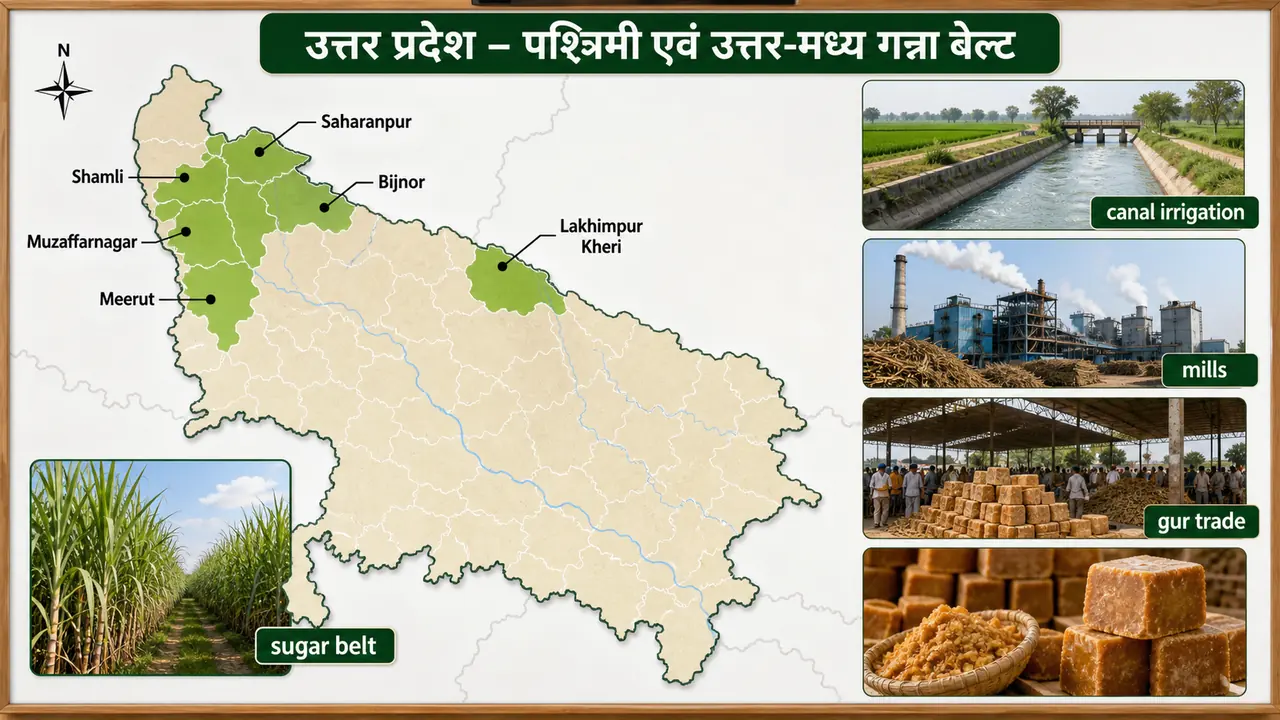
The western UP sugar belt is the most productive sugarcane region, benefiting from fertile soil, canal irrigation, and proximity to markets.
| District | Significance |
|---|---|
| Muzaffarnagar | Major sugar belt district; strongly associated with mills and gur trade |
| Shamli | Dense concentration of mills |
| Saharanpur | Northern belt, canal-irrigated |
| Meerut | Major milling hub |
| Bijnor | Eastern fringe of sugar belt |
| Moradabad | Expanding sugarcane area |
| Lakhimpur Kheri | Very important sugarcane-growing district by area |
Students should remember the broader pattern: western UP is the classic sugar belt, while districts like Lakhimpur Kheri are also repeatedly highlighted in UP GK because of their large cane area and close link with sugar mills.
Sugar Mills in UP
UP has a large network of sugar mills across cooperative, private, and public sectors. The exact number can change with shutdowns, revivals, mergers, and seasonal operations, so it is safer to remember the structure than one rigid count.
| Category | Count (approx.) | Key Examples |
|---|---|---|
| Private sector | Large share of operational capacity | Bajaj Hindusthan, Balrampur Chini, Dhampur Sugar |
| Cooperative sector | Important in many districts | Cooperative mills under UP sugar institutions |
| Public sector / state-linked | Smaller relative share today | Older state-owned or state-linked mills |
Major sugar companies associated with UP include Bajaj Hindusthan, Balrampur Chini Mills, and Dhampur Sugar Mills.
SAP vs FRP — Pricing Mechanism
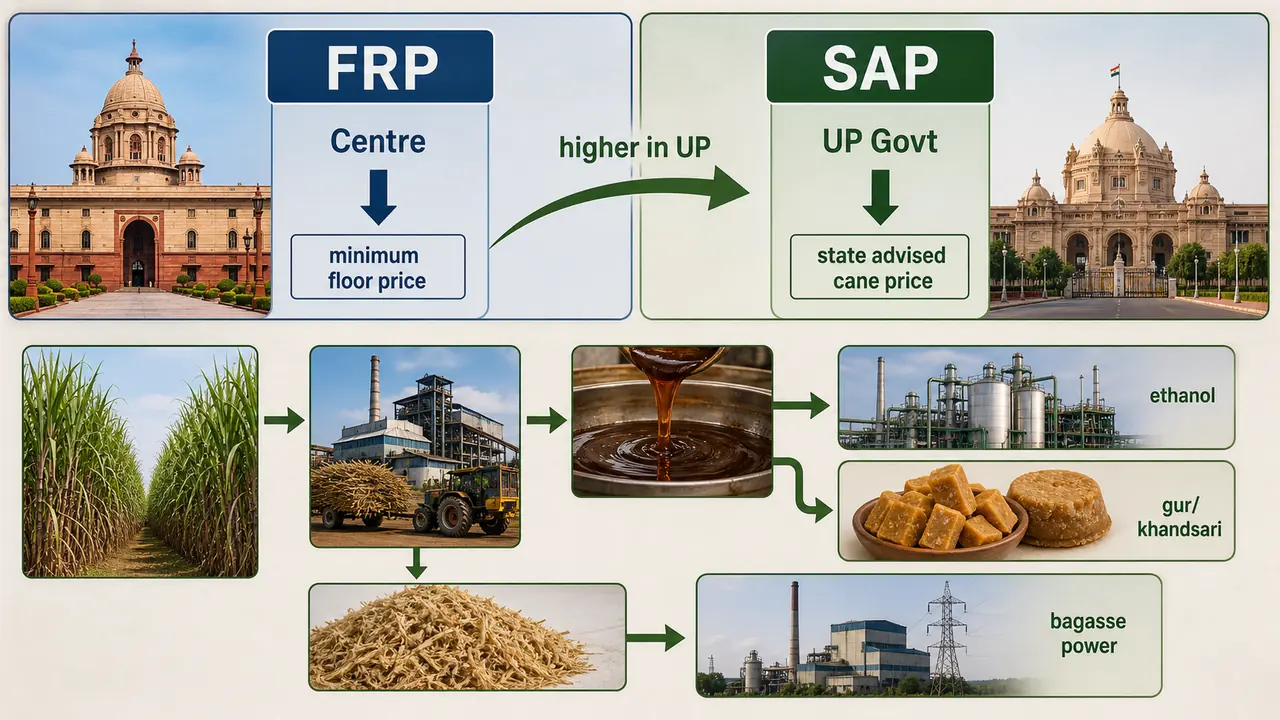
Sugarcane pricing in India involves two parallel mechanisms, and UP follows the higher state-level cane price model.
| Feature | FRP (Fair & Remunerative Price) | SAP (State Advised Price) |
|---|---|---|
| Set by | Central Government (CACP recommendation) | State Government |
| Applicability | All India (minimum) | UP, Uttarakhand, Punjab, Haryana |
| UP practice | Used as floor | SAP is always higher than FRP |
| 2024-25 price context | FRP ₹340/quintal | UP continued with a higher state-level cane price |
This distinction is extremely important for UP GK:
- FRP is the national minimum price for sugarcane.
- SAP is the higher state price advised by the UP government.
- In exam language, remember the core answer as: UP follows SAP, which is higher than FRP.
SAP helps farmers, but it can also increase pressure on mills, especially when sugar prices are weak or cane dues accumulate.
Cane Payment Arrears
A persistent problem in UP's sugar industry is delayed payment of cane dues to farmers. Mills often owe hundreds of crores, and the government intervenes with deadlines and penalties.
Gur (Jaggery) and Khandsari
Besides white sugar, UP is also one of the most important states in the gur (jaggery) and khandsari economy.
- Gur is produced in small-scale kolhus (crushers) across rural UP
- Muzaffarnagar is widely associated in GK with the gur trade and mandi network
- Khandsari (unrefined centrifuged sugar) is produced in many small units
- These cottage and semi-processed activities widen rural employment beyond large mills
This is why the cane economy of UP should not be reduced to only big mills. It also includes gur markets, crushers, khandsari units, transport workers, and village-level processing chains.
Ethanol Blending and Diversification
The ethanol blending policy has opened a major new revenue stream for UP's sugar industry.
- Government target: 20% ethanol blending in petrol in ESY 2025-26
- UP is one of the most important states in sugarcane-linked ethanol production
- B-heavy molasses and sugarcane juice based ethanol production increasing
- Bagasse-based cogeneration: Sugar mills use bagasse (cane fibre) to generate power and, in some cases, supply surplus electricity
This diversification matters because it reduces dependence on only sugar sales. In modern policy terms, the cane economy now links to sugar + ethanol + power cogeneration + by-products.
Important Sugarcane Varieties in UP
| Variety | Characteristics |
|---|---|
| CoS 767 | Early maturing, widely grown |
| CoSe 92423 | High sucrose content |
| Co 0238 | Most popular variety in UP, high yield |
| CoLk 94184 | Suitable for waterlogged areas |
| CoS 8436 | Late maturing, good ratoon |
The Sugarcane Breeding Institute (SBI), Coimbatore and IISR Lucknow develop these varieties. The "Co" prefix stands for Coimbatore.
Summary Cheat Sheet
| Fact | Answer |
|---|---|
| UP in sugarcane production | India's leading sugarcane-producing state |
| Recent official production anchor | ~2208 lakh tonnes in 2024-25 |
| Main sugar belt | Western Uttar Pradesh |
| High-yield cane districts to remember | Muzaffarnagar, Shamli, Saharanpur, Meerut, Bijnor, Lakhimpur Kheri |
| SAP vs FRP | SAP is higher |
| FRP for 2024-25 | ₹340/quintal |
| UP cane-price model | State Advised Price (SAP) |
| Gur trade association | Muzaffarnagar |
| Ethanol blending policy target | E20 in ESY 2025-26 |
| Ethanol feedstocks in cane sector | Molasses and sugarcane juice |
| Power by-product | Bagasse-based cogeneration |
| Most popular cane variety | Co 0238 |
| Research link in UP | IISR Lucknow |
Lesson Doubts
Ask questions, get expert answers