📰 UP Current Affairs — How to Stay Updated
Strategy for tracking UP current affairs, 5 categories to monitor, revision framework, and exam-day tips for Uttar Pradesh GK preparation.
Why UP Current Affairs Matter
The UPSSSC AGTA exam consistently includes 18-20 questions on UP General Knowledge, and a significant portion tests recent events and current affairs. A systematic approach to tracking current affairs can be the difference between qualifying and missing the cutoff.
The 5-Category Framework
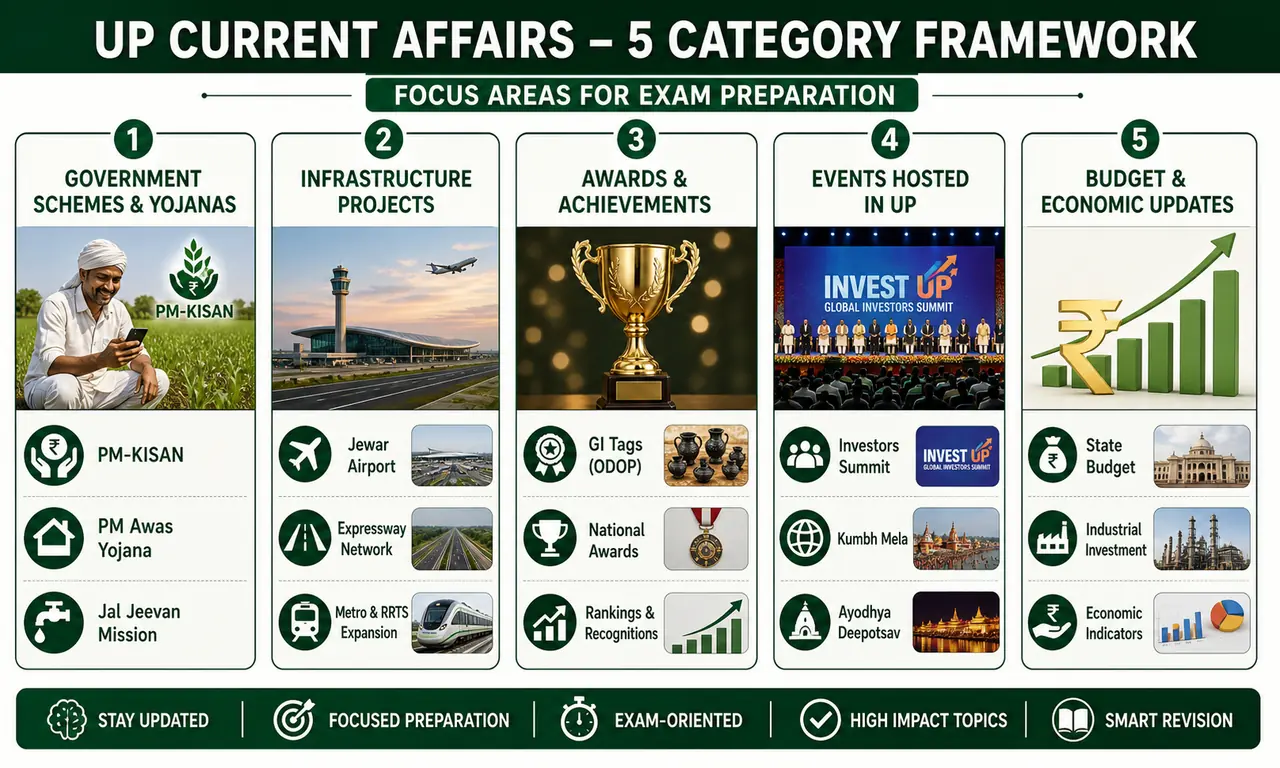
Organize your current affairs preparation into 5 clear categories. This ensures comprehensive coverage without information overload.
Category 1: Government Schemes & Yojanas
| What to Track | Examples |
|---|---|
| New scheme launches | UP Kanya Sumangala Yojana, UP Bhulekh Portal upgrades |
| Modifications to existing schemes | Changes in MNREGA implementation, ration card updates |
| Central schemes with UP focus | PM Awas Yojana allocations, Jal Jeevan Mission progress |
| Agricultural schemes | PM-KISAN disbursements in UP, crop insurance updates |
Key tip: Note the launch date, beneficiary group, implementing department, and purpose for each scheme.
Category 2: Infrastructure Projects
| What to Track | Examples |
|---|---|
| Expressway updates | Ganga Expressway completion milestones, new link expressways |
| Airport developments | Jewar airport construction phases, new UDAN routes |
| Metro progress | Kanpur Metro opening, Agra Metro updates |
| Railway projects | New Vande Bharat routes, station upgrades |
| Smart City projects | Lucknow, Varanasi, Agra Smart City developments |
Key tip: Remember project name, location, purpose, and current status. Cost figures change often, so they are lower priority unless the exam source stresses them.
Category 3: Awards & Achievements
| What to Track | Examples |
|---|---|
| UP-born achievers | Padma awards to UP natives, sports medals |
| State-level awards | Yash Bharti, UP Ratna, literary awards |
| GI Tags | New Geographical Indication tags for UP products |
| Institutional achievements | University rankings, research breakthroughs |
| Guinness/National records | Any records set in/by UP |
Recent GI Tags from UP — exam favourites:
| Product | Location |
|---|---|
| Banarasi Paan | Varanasi |
| Lucknow Chikankari | Lucknow |
| Firozabad Glass | Firozabad |
| Agra Petha | Agra |
| Banaras Saree | Varanasi |
| Aligarh Lock | Aligarh |
| Moradabad Metalware | Moradabad |
| Meerut Scissors | Meerut |
| Kannauj Perfume (Attar) | Kannauj |
Category 4: Events Hosted in UP
| What to Track | Examples |
|---|---|
| Summits & conferences | UP Investors Summit, Defence Expo |
| Sports events | National/international tournaments in UP |
| Cultural festivals | Kumbh Mela scheduling, International Ramayana festival |
| Religious events | Major temple inaugurations, yatras |
| Diplomatic visits | Foreign leaders visiting UP sites |
UP Investors Summit is important because it links current affairs with economy, infrastructure, and industry. Track the venue, year, major sectors highlighted, and the broad investment theme rather than trying to memorize every MoU number.
Category 5: Budget & Economic Updates
| What to Track | Examples |
|---|---|
| UP State Budget | Total size, key allocations (agriculture, education, health) |
| GSDP growth | Gross State Domestic Product figures |
| Industrial policies | New industrial corridors, SEZ updates |
| Agricultural output | Record production of sugarcane, wheat, rice |
| Employment data | UP government recruitment drives, vacancy figures |
Monthly Revision Strategy
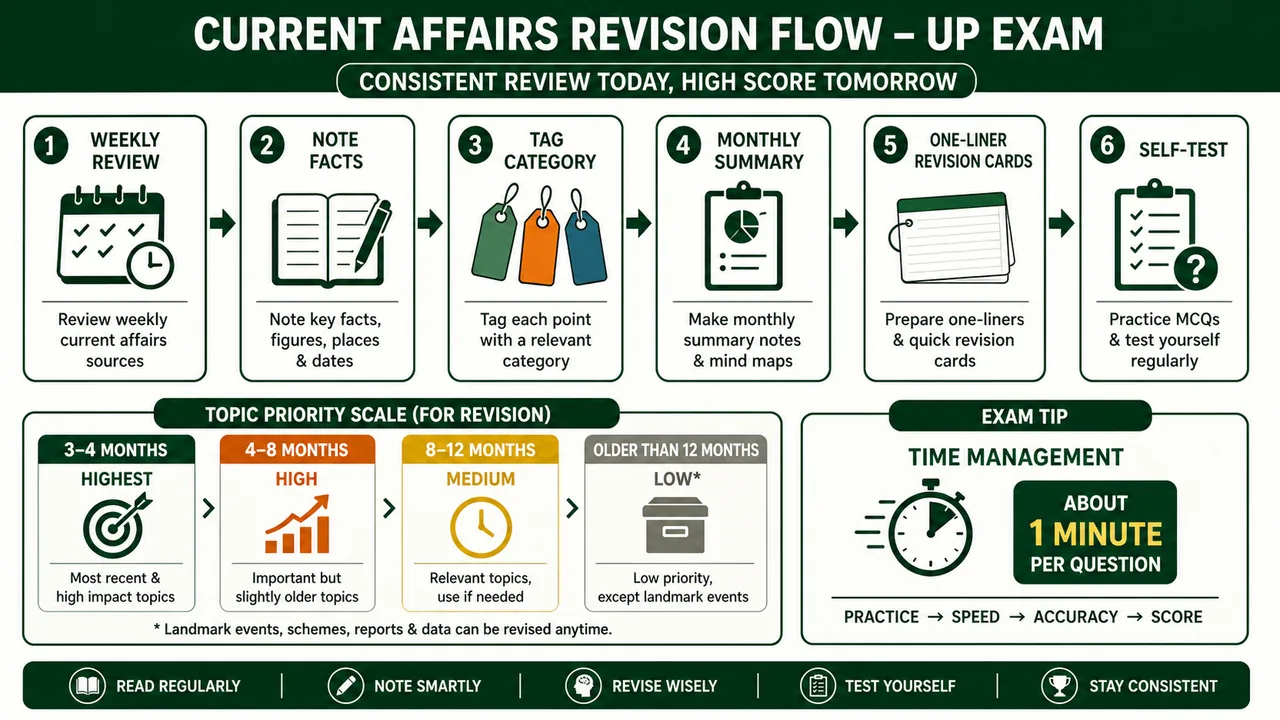
Follow this structured approach for current affairs revision:
Weekly Routine (30 minutes/week)
- Sunday review: Scan the week's UP news from one reliable source
- Note 3-5 key facts per week in a dedicated notebook/app
- Tag each fact under one of the 5 categories above
Monthly Routine (2 hours/month)
- Consolidate weekly notes into monthly summary
- Create 10 one-liner facts from each month — these are your revision cards
- Test yourself: Can you recall the key number/date/name associated with each?
- Discard items older than 12 months unless they are landmark events, major inaugurations, or very famous state milestones
The 6-12 Month Rule
Events from the last 6 to 12 months before the exam are usually the most relevant, with the most recent few months often carrying the highest recall value.
| Priority | Time Period | Weight in Exam |
|---|---|---|
| Highest | Last 3-4 months | Highest recall priority |
| High | 4-8 months ago | Strong revision priority |
| Medium | 8-12 months ago | Review for landmark items |
| Low | Older than 12 months | Mostly only very famous events |
Reliable Sources for UP Current Affairs
| Source | Type | Best For |
|---|---|---|
| UP Government Press Releases | Official | Scheme launches, policy announcements |
| PIB (Press Information Bureau) UP | Official | Central government UP-related news |
| Dainik Jagran | Hindi daily | Comprehensive UP news |
| Amar Ujala | Hindi daily | UP-focused reporting |
| Monthly exam digests | Secondary | Consolidated revision after you verify major items |
| UPSSSC Official Website | Official | Exam notifications, syllabus updates |
| UP Budget Documents | Official | Budget allocations and priorities |
How to Convert News into Exam Facts
Do not memorize every newspaper paragraph. Convert each news item into one small exam fact:
| News Type | Convert It Into |
|---|---|
| Scheme launch | Name + department + target group |
| Infrastructure update | Project + location + status |
| Award / achiever | Person / institution + field + district/state link |
| Budget item | Sector + broad allocation priority |
| Festival / event | Place + year + significance |
Landmark Examples Students Should Know
Some events remain worth remembering because they became state-level landmarks, not just short-lived headlines.
| Landmark Example | Why It Matters |
|---|---|
| Ayodhya Ram Temple Pran Pratishtha (22 January 2024) | Religion + tourism + infrastructure |
| Maha Kumbh 2025, Prayagraj | Religious gathering + administration + infrastructure |
| Jewar / Noida International Airport | Aviation + NCR connectivity + investment |
| UP Budget and Economic Survey | Economy + governance + sector priorities |
| GI tag additions | Culture + economy + district-product identity |
| Major expressway / metro / RRTS updates | Infrastructure + geography linkage |
These should be revised as examples of the kind of events to track, not as a permanently fixed list.
Exam-Day Tips for UP GK Section
Time Management
- Allocate 18-20 minutes for 18-20 UP GK questions
- Approximately 1 minute per question
- Do NOT spend more than 90 seconds on any single question
Elimination Strategy for MCQs
- Read all 4 options before selecting
- Eliminate obviously wrong answers first (usually 1-2 can be eliminated immediately)
- Look for absolute words (always, never, only) — these are often wrong
- If two options are very similar, one of them is likely correct
- When unsure between 2 options, go with your first instinct
- Do NOT leave questions blank unless there is negative marking
Common Exam Traps
| Trap | Example |
|---|---|
| Switched locations | Asking about Lucknow but answer is actually Varanasi |
| Wrong dates | 1983 vs 1986 for UNESCO sites |
| Renamed places | Mughalsarai vs Pt. DDU Junction |
| Approximate vs exact numbers | 302 km vs 300 km for expressway length |
Building Your Current Affairs Database
Create a simple table format for each month:
| Date | Event | Category | Key Number/Name |
|---|---|---|---|
| DD/MM | Brief description | 1-5 | The one fact to remember |
This format makes revision extremely efficient — you can scan 50 events in 10 minutes.
Summary Cheat Sheet
| Strategy | Action |
|---|---|
| Framework | 5 categories: Schemes, Infra, Awards, Events, Budget |
| Weekly | 30 min review, note 3-5 facts |
| Monthly | 2-hour consolidation, 10 one-liners |
| Priority | Last 6-12 months, especially recent months |
| Sources | Official releases + good Hindi news + monthly revision digest |
| Exam Time | 1 min/question, eliminate first, don't skip |
| Database | Date + Event + Category + Key Number |
- Current affairs should be organized, not collected randomly.
- Convert every news item into one exam fact: name, place, date/year, department, or significance.
- Prioritize recent months, but keep landmark events separately so they are not discarded too early.
- Official sources are best for schemes, budget, and policy; newspapers are better for daily tracking; revision digests are best for monthly consolidation.
Lesson Doubts
Ask questions, get expert answers