📋 BSc Agriculture Eligibility 2026 — Admission, Entrance Exams & Process
BSc Agriculture eligibility 2026: who can apply after 12th, whether PCM or PCB students are eligible, and how CUET (ICAR-UG), state CETs, age rules, and college-wise admission work.
This lesson explains key concepts in a structured way and connects them to practical agricultural applications and exam-oriented understanding.
BSc Agriculture Eligibility
To be eligible for BSc Agriculture (Bachelor of Science in Agriculture), a candidate must have completed 10+2 (Class 12) with the required subject combination and minimum percentage required by the target college or counselling route. Admission can happen through CUET (ICAR-UG), state-level agriculture entrance systems, university-specific counselling, or direct merit-based selection in some private colleges.
Academic Eligibility
Minimum qualification
- Class 12 (10+2) from a recognized board (CBSE, ICSE, State Boards)
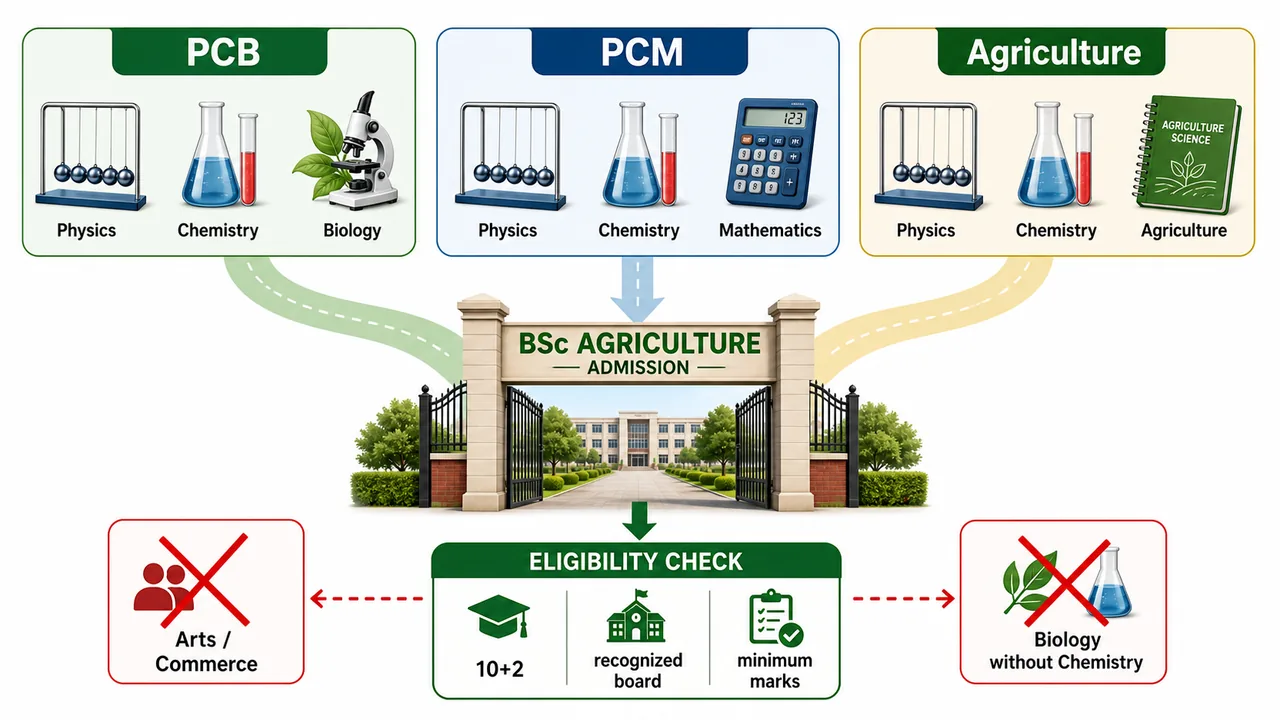
- Subjects required: Physics, Chemistry with any ONE of — Biology / Agriculture / Mathematics / Biotechnology
- Minimum marks: Often around 50% aggregate, but the actual cutoff and relaxation depend on the target university or counselling system
Accepted subject combinations
| Stream | Subjects | Eligible? |
|---|---|---|
| PCB | Physics + Chemistry + Biology | ✅ Yes |
| PCM | Physics + Chemistry + Mathematics | ✅ Yes (most universities) |
| PCA | Physics + Chemistry + Agriculture | ✅ Yes |
| PCBio | Physics + Chemistry + Biotechnology | ✅ Yes |
| Biology only (without Chemistry) | — | ❌ Not eligible |
| Arts / Commerce | — | ❌ Not eligible |
Note: Some universities or specific programmes apply stricter subject-combination rules than the general summary above. Always read the exact university bulletin before assuming eligibility.
Age Limit
There is no single all-India BSc Agriculture age rule that safely fits every college.
- The broader CUET (UG) 2026 exam itself has no age limit for appearing.
- Some agricultural universities and specific programmes still define their own minimum or upper-age rules.
- In practice, many students should verify the age note in the exact programme-level bulletin instead of relying on generic coaching summaries.
Entrance Exams for BSc Agriculture Admission
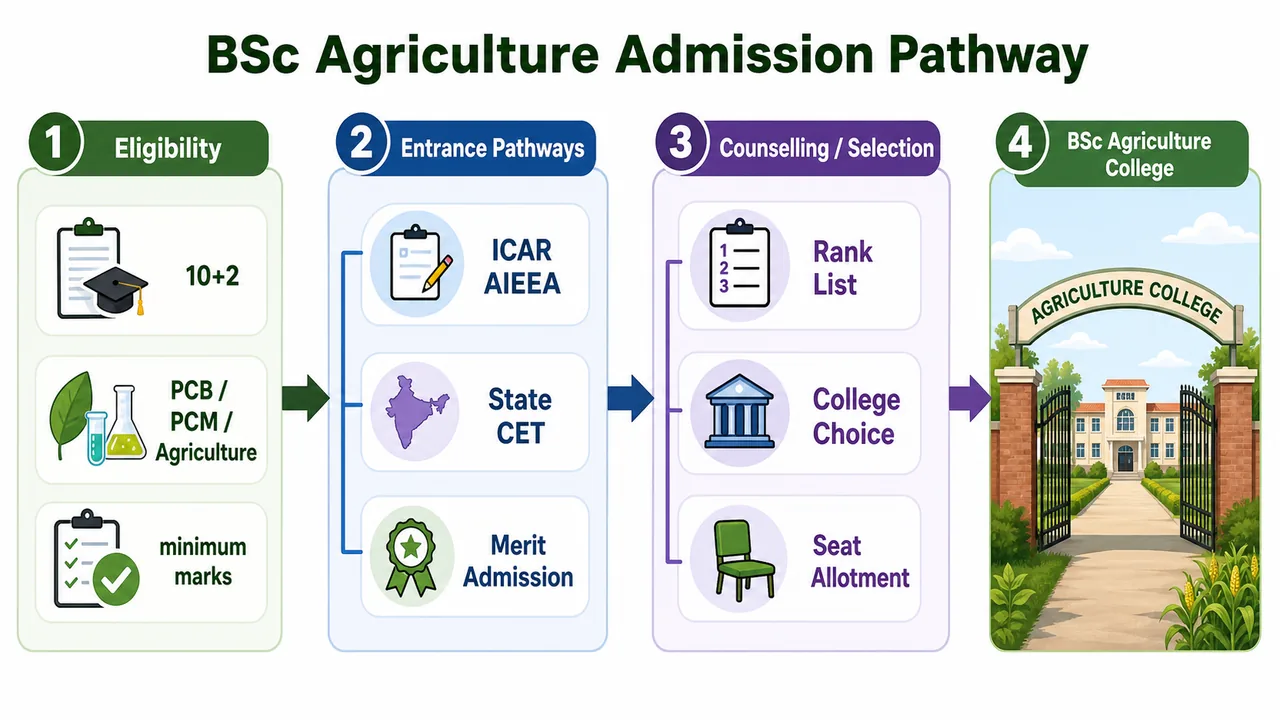
1. CUET (ICAR-UG) — Current ICAR UG route
Full form: Common University Entrance Test linked ICAR UG admission route Conducting body: National Testing Agency (NTA), with ICAR UG counselling using the qualifying route Level: National Seats: ICAR counselling share of seats at participating agricultural universities; the current bulletin explains that this is 20% of university seats in many participating universities, with 100% through ICAR counselling in a few specifically listed institutions
| Parameter | Details |
|---|---|
| Route type | National ICAR-linked UG admission route |
| Official bulletin | CUET (ICAR-UG) 2026 bulletin on ICAR |
| Admission scope | Agriculture and allied bachelor programmes covered under ICAR counselling |
| Direct nomination | Not allowed without qualifying CUET (ICAR-UG) |
| Official site | ICAR bulletin page |
Students still search for ICAR AIEEA, but that wording is outdated for the current UG cycle. If your target is the official ICAR UG counselling route, follow the latest CUET (ICAR-UG) notice and not older exam-name references.
2. State-Level Agriculture Entrance Exams
Many states have their own CET or counselling logic for non-ICAR seats:
| State | Exam Name | Conducting Body |
|---|---|---|
| Uttar Pradesh | UPCATET (UP Combined Agriculture & Technology Entrance Test) | Acharya Narendra Deva University |
| Madhya Pradesh | MP PAT (Pre Agriculture Test) | Vyapam / MP Professional Exam Board |
| Rajasthan | RAJUVAS / Agriculture CET | Rajasthan Universities |
| Kerala | KEAM (Kerala Engineering Agriculture Medical) | CEE Kerala |
| Maharashtra | MHT CET (for Agriculture) | MHT CET Authority |
| Karnataka | KCET (Karnataka CET) | KEA Karnataka |
| Punjab | PUCAT | Punjab Agricultural University |
| Odisha | OUAT Entrance | Odisha University of Agriculture & Technology |
| Gujarat | GUJCET + University CET | Gujarat universities |
| Haryana | HSTES Agriculture CET | Haryana State Technical Education Society |
| Tamil Nadu | TNAU Entrance | Tamil Nadu Agricultural University |
| Andhra Pradesh | ANGRAU / APSCHE CET | APSCHE |
| Bihar | Bihar Agriculture University Entrance | Bihar Agriculture University |
| West Bengal | WB Agriculture Entrance | Bidhan Chandra Krishi Viswavidyalaya |
3. Merit-Based Admission (Private Colleges)
Many private agricultural colleges admit students directly on Class 12 marks:
- No separate entrance exam required
- Apply directly to college during admission season (May–July)
- Documents required: Class 12 marksheet, school leaving certificate, ID proof
Admission Process — Step by Step
For the ICAR UG route
- Track the latest CUET (ICAR-UG) bulletin
- Register through the current notified exam/counselling process
- Appear in the required exam route
- Track result and counselling notices
- Participate in ICAR counselling if eligible
- Choose university and programme based on your rank and eligibility
- Complete document verification and fee payment
For State Entrance Exams
Process varies by state but generally:
- Register on state exam portal (March–May)
- Appear for exam (May–June)
- State counseling (July)
- College allotment
Documents Required for Admission
- Class 10 Marksheet and Certificate
- Class 12 Marksheet and Certificate
- Transfer Certificate (TC) / School Leaving Certificate
- Character Certificate
- Medical Fitness Certificate
- Category Certificate (if applicable — SC/ST/OBC/PwD)
- Domicile Certificate (for state quota)
- Passport-size photographs (10–15 copies)
- Aadhaar card
- ICAR AIEEA Rank Card / State CET Rank Card
Reservation Policy
| Category | Reservation (Central Govt standard) |
|---|---|
| SC (Scheduled Caste) | 15% |
| ST (Scheduled Tribe) | 7.5% |
| OBC (Other Backward Classes) | 27% |
| EWS (Economically Weaker Sections) | 10% |
| PwD (Persons with Disability) | 5% horizontal |
State-funded universities follow respective state reservation policies which may differ.
Top Colleges and Their Admission Criteria
| College | Admission via | Notes |
|---|---|---|
| ICAR-IARI, New Delhi | ICAR-linked UG route where applicable | Verify exact current programme availability and counselling path |
| Punjab Agricultural University (PAU), Ludhiana | Punjab state route + ICAR-linked route where applicable | Check current programme-level subject rules |
| GBPUA&T, Pantnagar | Uttarakhand CET + ICAR | #3 |
| Tamil Nadu Agricultural University (TNAU) | TNAU Entrance + KCET | #4 |
| ANGRAU, Guntur | APSCHE CET | #5 |
| Kerala Agricultural University (KAU) | KEAM | #6 |
| JNKVV, Jabalpur | MP PAT | #7 |
| Rajasthan Agricultural University, Bikaner | RAJUVAS CET | #8 |
| VNMKV, Parbhani | MHT CET + ICAR | #9 |
| Odisha University of Agriculture (OUAT) | OUAT Entrance | #10 |
Frequently Asked Questions
Q: Can I get admission in BSc Agriculture without entrance exam? Yes. Many private agricultural colleges admit students on Class 12 merit without a separate entrance exam. However, for government colleges and ICAR-Deemed Universities, entrance exams are mandatory.
Q: Can PCM students apply for BSc Agriculture? Yes. Most universities accept PCM (Physics, Chemistry, Mathematics) students for BSc Agriculture. A few state universities require Biology or Agriculture — check the specific university's prospectus.
Q: Is there a BSc Agriculture entrance exam I can take after Class 12 in UP? Yes. UP students can apply for UPCATET (UP Combined Agriculture & Technology Entrance Test) conducted by Acharya Narendra Deva University, Ayodhya.
Q: What is the fee for BSc Agriculture in government colleges? Government SAU (State Agricultural University) fees range from ₹10,000–₹50,000/year. ICAR-Deemed Universities charge ₹25,000–₹75,000/year. Private colleges charge ₹50,000–₹1,50,000/year.
Next Steps
After completing BSc Agriculture, your next decisions:
Start preparing for govt exams:
- IBPS AFO — Agriculture Field Officer — ₹48,000–65,000/month, 5,000–8,000 vacancies/year
- NABARD Grade A — ₹85,000–1,05,000/month, highest entry-level govt salary
- FCI AGT — Agricultural Graduate Trainee — ₹60,000–75,000/month, 4,000–6,000 vacancies
- RRB SO Agriculture — ₹50,000–65,000/month, Regional Rural Banks
- UPSSSC AGTA (UP) — ₹40,000–55,000/month, 3,000–5,000 vacancies
- Scope & Future of BSc Agriculture →
Summary Cheat Sheet
| Topic | Key takeaway |
|---|---|
| Main focus | BSc Agriculture eligibility 2026: who can apply after 12th, whether PCM or PCB students are eligible, and how CUET (ICAR-UG), state CETs, age rules, and college-wise admission work. |
| Section context | Revise this lesson with the rest of BSc Agriculture Guide for stronger conceptual continuity. |
Frequently Asked Questions
Who is eligible for BSc Agriculture after 12th?
Most universities accept students who completed 10+2 with PCB, PCM or Agriculture subjects, usually with around 50% aggregate marks. Reserved-category cutoffs and subject rules vary by university, so the exact notification always matters.
Is Biology compulsory for BSc Agriculture admission?
Not always. Many universities accept both PCB and PCM students, and some also recognize Agriculture stream backgrounds. Biology helps, but Mathematics-based candidates are also eligible in many state and central admission systems.
What is the minimum percentage required for BSc Agriculture?
A common benchmark is 50% in Class 12 for general-category applicants, with relaxation for reserved categories in many institutions. Top colleges may have much higher effective cutoffs because admission is rank-based through entrance tests.
Which entrance exams are used for BSc Agriculture admission?
Admission typically happens through CUET (ICAR-UG) for the current ICAR UG counselling route, through CUET-based university admissions in some systems, or through state agriculture entrance tests. The route depends on which university or counselling system you target.
Is there an age limit for BSc Agriculture?
Age rules are not identical across all colleges. The broader CUET UG exam itself has no age limit, but specific agricultural universities and programmes may still apply their own minimum or upper-age conditions. Always check the exact university-level eligibility note before applying.
Can a student get direct admission in a private BSc Agriculture college?
Yes, some private colleges offer merit-based or management-route admission, but students should check ICAR recognition, faculty quality, practical facilities, fees, placement support and university affiliation before treating that option as a safe shortcut.
Is ICAR AIEEA still the main route for BSc Agriculture admission?
Students still search for ICAR AIEEA, but for the current UG cycle the official ICAR route is CUET (ICAR-UG). Older articles, videos, and coaching content may still use the older wording, so students should rely on the latest ICAR bulletin instead of outdated exam naming.
Can I get ICAR admission without qualifying CUET (ICAR-UG)?
No. The current ICAR UG bulletin clearly states there is no provision of direct nomination for admission through ICAR in bachelor programmes in agriculture and allied sciences without qualifying CUET (ICAR-UG).
Do all BSc Agriculture colleges accept the same subject combinations?
No. Many colleges accept PCB, PCM, Agriculture, or related science combinations, but some universities impose stricter programme-wise subject rules. Students should treat broad eligibility summaries only as a starting point and then verify the exact bulletin of the target college.
Does CUET (ICAR-UG) cover all BSc Agriculture seats in India?
No. The current ICAR bulletin explains that CUET (ICAR-UG) is used for the ICAR counselling share of seats, not every agriculture seat in the country. State agricultural universities, private colleges, and non-ICAR routes may still admit through their own systems.
Lesson Doubts
Ask questions, get expert answers