🐄 Significance of Livestock and Poultry
Understand how livestock and poultry support farm income, nutrition, soil fertility, and risk reduction in Indian agriculture.
When crop income becomes uncertain, livestock often keeps the farm household financially alive through milk, eggs, manure, and sale of animals. That is why animal husbandry is studied as a core part of agriculture, not as a separate side activity.
Why Livestock Matters in Agriculture
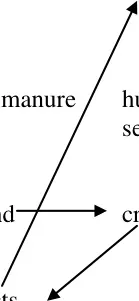
Livestock farming is closely linked with crop farming. Animals convert crop residues, grazing resources, and by-products into useful products such as milk, meat, eggs, wool, manure, and draught power.
The original lecture highlights six major benefits:
- Food such as milk, meat, and eggs.
- Fiber and by-products such as wool, skin, and hide.
- Fuel through dung use and biogas production.
- Fertilizer in the form of farmyard manure and poultry litter.
- Traction for cultivation and transport.
- Security because animals act like a living bank during emergencies.
Livestock is especially important in small and mixed farms because it gives recurring returns even when crops fail.
Economic and Social Importance
The lesson notes that livestock contributes to household nutrition, poverty reduction, and rural employment. It is particularly valuable for small and marginal farmers because income comes in smaller but more regular intervals.
Important points preserved from the source:
- a large share of livestock is owned by small and marginal farmers
- milk production is strongly supported by weaker sections of society
- India holds a major share of the world's buffalo, cattle, goat, and sheep population
- the sector contributes significantly to agricultural output and employment
This is why animal husbandry is often called the sheet anchor of agriculture.
Livestock Population and Production Base
The original lesson provides population figures for India and Tamil Nadu to show the scale of the resource base.
| Species | India | Tamil Nadu |
|---|---|---|
| Cattle | 209.08 million | 9.10 million |
| Buffalo | 92.19 million | 2.93 million |
| Goat | 120.60 million | 5.87 million |
| Sheep | 56.47 million | 5.61 million |
| Pig | 15.42 million | 0.60 million |
| Poultry | 343.0 million | 24.0 million |
The lecture also mentions production indicators such as milk, eggs, wool, and meat. The important teaching point is that a large population does not automatically mean high productivity.
Productivity per animal is more important than just the number of animals.
Why Productivity Remains Low
The original notes identify several practical constraints:
- many low-producing or non-descript animals
- shortage of feed and fodder
- poor nutritive value of available feed resources
- low fertility rates
- shrinking grazing land
- competition between humans and animals for feed resources
This means livestock development must focus on better breeding, better feeding, and better health care rather than only increasing animal numbers.
Example:
- Two well-bred and well-fed dairy animals can be more profitable than four poorly managed animals.
Link Between Livestock and Crop Farming
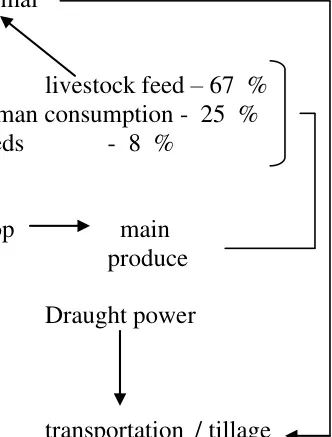
Livestock supports agriculture through continuous recycling within the farm system.
1. Better use of crop and agro-industrial by-products
The lesson refers to materials such as sugarcane bagasse, tapioca waste, vegetable wastes, and other by-products that can be converted into milk, meat, wool, and eggs.
2. Organic nutrient recycling
Dung and poultry litter return nutrients to the soil and improve fertility.
3. Animal power
Draught animals still support cultivation and transport in many farming systems.
Manure and Biogas Value
Livestock and poultry wastes are productive farm resources, not just waste products.
| Nutrient | Cattle | Sheep | Pig | Horse | Poultry |
|---|---|---|---|---|---|
| Nitrogen | 25-40 | 20-45 | 20-45 | 17-30 | 28-62 |
| Phosphorus | 4-10 | 4-11 | 6-12 | 3-7 | 9-29 |
| Potassium | 7-25 | 20-29 | 15-48 | 15-18 | 8-29 |
| Calcium | 5-8 | 8-19 | 3-20 | 7-29 | 17-69 |
| Magnesium | 5-8 | 3-6 | 2-3 | 3-5 | 3-8 |
| Sulphur | 3-4 | 2-3 | 3-5 | 1-3 | 4-7 |
The original lecture also notes that cow dung, pig faeces, and poultry droppings can be used for biogas production. This shows that livestock contributes both to farm energy and soil health.
Livestock Units and Animal Power
The notes compare species on a common unit basis:
- cow = 1.0
- bullock = 1.2
- young stock = 0.6
- buffalo = 1.2
- sheep and goat = 0.2
Such standardization helps in estimating feed requirement, grazing pressure, and total livestock load in a region.
The lesson also emphasizes that draught animals save fuel and support farm transport where full mechanization is not practical.
Summary Cheat Sheet
| Topic | Key Point |
|---|---|
| Main role | Livestock gives food, income, manure, fuel, and farm power |
| Social value | Very important for small and marginal farmers |
| Economic value | Supports agricultural output, employment, and exports |
| Crop linkage | Converts residues and by-products into useful products |
| Key challenge | High population with low productivity |
| Improvement focus | Better breeding, feeding, health care, and waste recycling |
Lesson Doubts
Ask questions, get expert answers