🐣 Care and Management of Day-Old Chicks
Brooder preparation, temperature control, and early management of day-old chicks.
This lesson covers core livestock production and management concepts for practical farm application and exam-oriented preparation.
Care&management -day old
25. Care and management of day old chicks-Brooder management.
Preparation of Brooder
Brooder means to give a heat source by artificial means for the period of growth of chicks
from 0 day (Day old) to 4 weeks. The heat source generally has a large refector (Hover) under
which the chicks will get the heat uniformly.
Aim
The day old chicks do not posses the insulating
feather coverage to protect them from cold. It may result in
the losing of body heat to the environment resulting in
chilling which will create the ground for many diseases.
Preparation of Brooder and daily routine work carried out in the farm
Objective
Chicks do not possess a well-developed thermo- regulatory mechanism. The day old
chicks don't posses the insulating feather coverage to protect them from chillness. The body
temperature of chick is 107 [0 ] F which is always more than the ambient temperature. It may result
in the losing of body heat to the environment. So a source of heat is given by natural brooding or
by Artificial brooding up to 4 weeks of age.
Materials required
Hover or wooden cross bar. Automatic brooder, fuel heaters like lantern.
-
Bulbs
-
Chick guard
-
Thermometer (0 to 110 [0] F)
-
Waterer
-
Linear feeder,
-
Lime powder
 7. Lysol
-
Sprayer
-
Coirpith, GN husk or paddy husk
-
Waste news paper
-
Flame gun
-
Automatic vaccinators .
-
Debeaker
-
Bucket
-
Broomstick
-
Rake
-
Electrolyte
-
B Complex and Vitamin A
-
Antibiotics
-
Lasota F1 Vaccine
-
IBD Live vaccine
Preparation of Brooder House
- The litter material of the previous batch should be heaped up first so that building up of
germs could be destroyed.
-
After 2 to 3 days the heaped up material can be removed from the brooder room.
-
The portion of the litter sticking over the ground must be scraped and removed.
-
The removal of spider web, cob webs and dirt are also essential.
-
The floor and sidewalls should be washed with plain water.
-
Disinfection of the room is carried out by spraying phenyl, lysol, etc at 5%
concentration.
-
Use Flame gun to destroy the insects.
-
The entire floor and side walls should be white washed with fresh limestone.
-
Feeders, waterers,, chick guards should be washed and disinfected
in phenyl or lysol. Dry it in the sun for a day.
- Hang the gunny bags around the brooder house to maintain the room temperature
to maintain temperature notbelow 80 [0] F in the first week 75 [0] F in the 2 [nd] week 70 [0] F III
week, 65 [0] F -IV week.
Liter material and paper
Decide on the no. of brooders depending on the number of chicks ordered
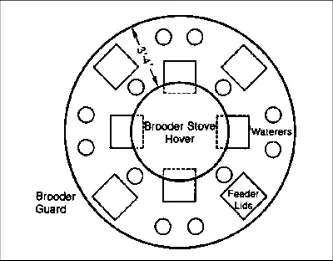
- Connect the chick guards in circular fashion with diameter of 5 feet to accommodate
150-200 chicks.
- Spread the litter material like coirpith, or paddy husk or ground nut husk on the prepared
floor to a depth 2 inches.
 3. The litter material is to be covered with newspaper.
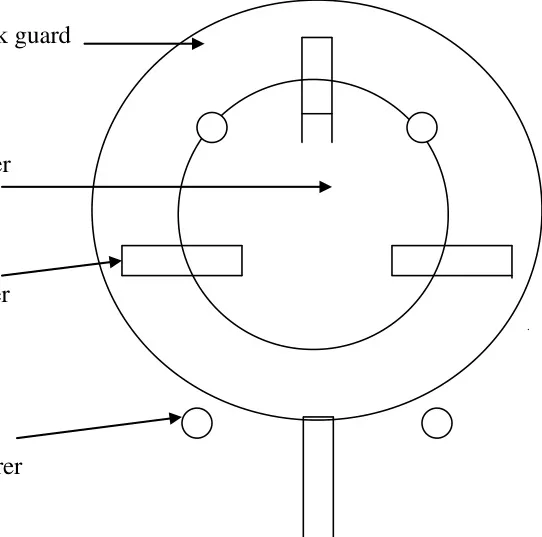
- The feeders and waterers are to be arranged in a radiating fashion from the light
source.
- 4 hours before the scheduled arrival of chicks place the waterers with water in order to
bring water to room temperature.
-
The brooding unit should be kept ready at least a day before the arrival of chicks.
-
The brooding bulb must be switched on atleast 24 hours earlier to make the area warm at
the time of housing the chick.
- Depending on weather condition put curtains on all four sides of room to maintain room
temperature.
Brooder Management
-
Spread finally grained maize over the news paper before the arrival of chicks.
-
Give cool water after boiling. Add electrolytes, B Complex and antibiotics.
-
Distribute chicks equally after counting under the brooders.
-
Before putting chicks under the brooder scale their beaks with water.
-
For first 3 days provide crushed maize twice a day. Also provide ground maize
in the feeder.
-
Change newspaper sheets immediately if they get wet.
-
Remove newspapers on 5 [th] day.
-
Remove wet litter under waterers immediately and add fresh liter.
-
On fifth day give Lasota F1
Vaccine.
-
According to the age of the birds brooder temperature should be adjusted.
-
Medication and vaccination
a) 1 [st] day give 5% glucose in water.
b) 2 [nd] to 4 [th] day - antibiotic + Vit.A + B Complex.
c) 5 [th] day - RDVF vaccination
d) 10 [th] day - IBD vaccination.
-
Daily morning and evening wash the waterer and give freshly boiled and cooled water.
-
Give 24 hrs. light up to 3 weeks to induce night feeding.
-
Debeaking is done at 2 [nd] week to prevent cannibalism and feed wastage.
-
Chick mash should contain 22% protein and 2800 kcal/kg ME
Observation
Watch the chicks under light, if chicks are spread uniformly under the light and brooder
area, then the temperature maintained is correct. If the chicks are huddled under the light, heat
provided is not enough.. If the chicks are away from the light source, the heat intensity is high.
Give enough space for watering and feeding for growing chicks according to the age of the birds.
Brooder management : Zero –8 weeks
Chick hood is the most critical age in birds life as it readily picks up problems due to chilling,
mal - nutrition, over crowding and diseases.
Productivity of a layer or a broiler depends largely on the way how they start their life.
New born chicks require warmth to keep them in comfort. Hence they are provided with
artificial heat by a device called brooder.
Brooder can be hover type, flat, type, wooden reapers fitted with bulbs or heating bulbs
or infra red bulbs
Brooding Temperature : 95 [o] C I week
90 [o] C II week
85 [o] C III week
80 [o] C IV week
Floor space : ¼ sq.ft/bird 0-3 weeks
½ sq.ft./bird 4-8 weeks
Feeder space
Water space
0-3 weeks 1”
4-8 weeks 2”
0.3 week ½”
3-8 weeks1”
Arranging for brooding
Spread litter on a prepared floor, over which place old news paper arrange the heating
device in the middle. Cover the desire area with chick guards. Keep waterers and feeders,
radiating from the heat source.
Conserve heat by blocking the side-mesh with gunny sacks.
Medications
I day glucose- 5% in water
II to 7 [th] day – antibiotic + Vit.A + B Complex
III week & VI week coccidiostats in water.
Always use boiled and cooled water for 1 [st] three weeks.
Then sanitize the water for the rearing period
Vaccination : Mareks, Ranikhet and Fowl pox.
After 3 weeks continuous or 23 hours light period has to be given to the chicks to induce night
feeding and avoid trampling. Debeaking is done at II week to prevent cannibalism and feed
wastage – Feed used in chick mash. Contains 22% crude protein and 2800 kcal/kg ME.
Grower management
8 - 20 weeks. –floor space : 1-1 ½ Sq.ft. feeder space – 3” water space : 1½-2” feed – Grower
mash
Restricted feeding
To keep the birds in normal desirable wt. range -10% to 20% of the feed required by the bird is
restricted from 10-18 week of age.
Lighting : Grower should not be provided with extra hight except day light to counteract
undesirable effect on sexual maturity.
Deworming :
Debeaking, delicing if necessary – are to be carried out before the onset of lay.
Summary Cheat Sheet
| Topic | Key Point |
|---|---|
| Main lesson | Care and management of day-old chicks |
| Brooder purpose | Provides warmth, comfort, and protection during early life |
| Preparation need | Brooder house must be ready before chicks arrive |
| Major requirements | Heat, clean litter, water, starter feed, and hygiene |
| Early management | Close observation is essential in first few days |
| Temperature care | Wrong brooding temperature quickly affects chick survival |
| House preparation | Clean, disinfected, and dry brooder area is essential |
| Behaviour clue | Chick grouping/scattering helps judge brooder comfort |
| Main goal | Reduce mortality and promote uniform growth |
| Exam trap | Brooding is not just heating; feed, water, litter, and observation are equally critical |
Lesson Doubts
Ask questions, get expert answers