💧 Field Capacity and Soil Water Potential
Understand field capacity, soil water storage, and basic water-potential terms used to explain water availability to plants.
Field capacity is one of the most important ideas in crop water relations because it tells us how much water the soil can hold for plant use after excess gravitational water has drained away. This lesson links the soil-side concept of water storage with the plant-side idea of water potential.
What Is Field Capacity?
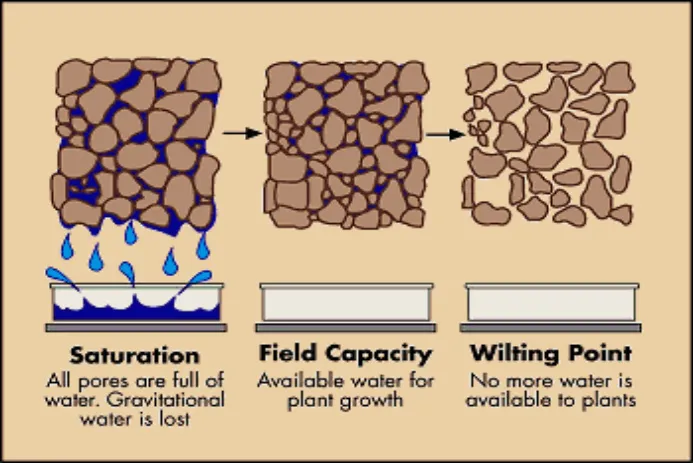
After rainfall or irrigation, some water drains downwards under gravity, while some water remains in the soil. The retained water after free drainage is called field capacity or water-holding capacity of the soil.
It is often treated as:
- the upper limit of water storage useful for plant growth
- the capillary water status of a well-drained soil
The source notes place soil water potential near field capacity roughly in the range of -0.1 to -0.3 bars.
Factors Affecting Field Capacity
Field capacity is influenced by:
- soil texture
- soil structure
- clay content
- organic matter
- effective root-zone depth
- temperature and profile characteristics
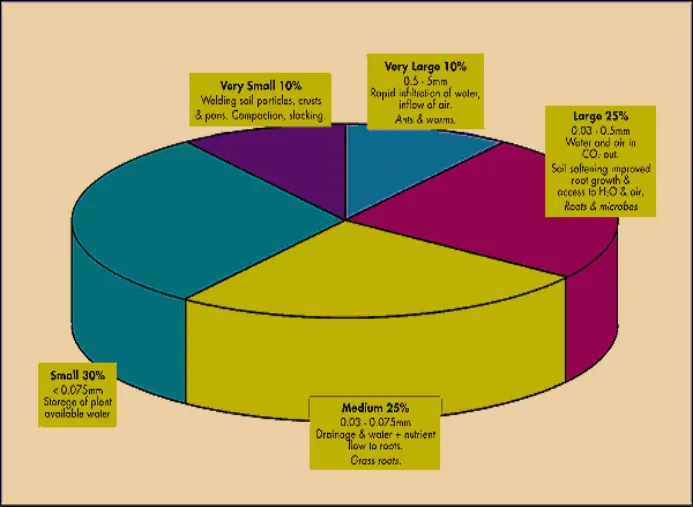
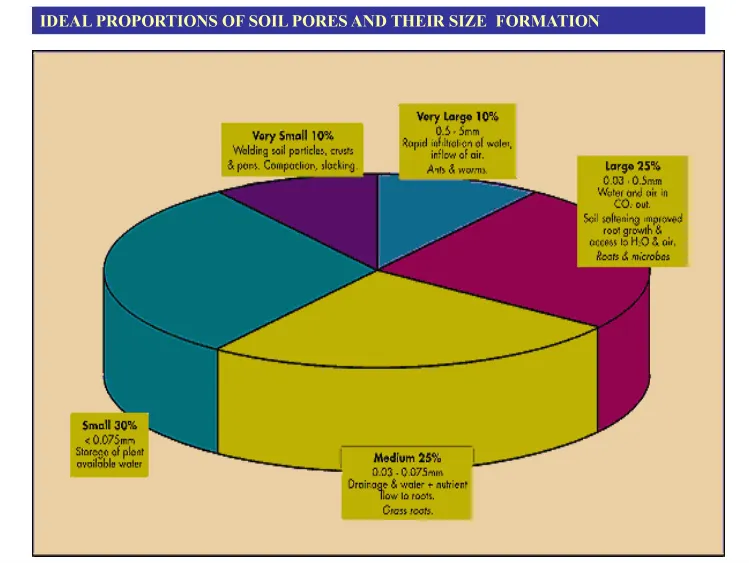
Fine-textured soils with more silt and clay usually hold more water than sandy soils because they provide greater surface area. Organic matter also increases water-holding capacity.
Water Potential
Water moves according to water potential, represented by the symbol psi (ψ).
Important points:
- pure water has water potential of zero
- addition of solutes lowers water potential
- water moves from higher water potential to lower water potential
In simplified biological use:
- ψs = solute potential
- ψp = pressure potential or turgor potential
- ψm or matric effects may be relevant in soils and walls
For many plant-cell discussions, the working relation is:
ψw = ψs + ψp
Osmotic Pressure and Turgor Pressure
Osmotic pressure reflects the effect of solutes on water movement, while turgor pressure reflects the pressure created inside a plant cell by water.
Practical understanding:
- a cell with more negative water potential attracts water
- a turgid cell has positive pressure potential
- a flaccid or plasmolysed cell has low or zero turgor
This explains why water relation is central to cell expansion, stomatal function, and overall crop growth.
Why This Matters in Crop Physiology
Field capacity is not just a soil-science term. It helps explain:
- when irrigation is actually needed
- how long soil can support crop uptake after rainfall
- why different soils behave differently under drought
- why water movement between cells and tissues follows potential gradients
Example:
- a sandy soil reaches low available water quickly after irrigation, while a clay-rich soil may retain more water for a longer period.
Summary Cheat Sheet
| Topic | Key Point |
|---|---|
| Field capacity | Water retained after gravitational drainage |
| Main controls | Texture, clay, organic matter, root-zone depth |
| Water potential | Drives water movement |
| Pure water | Water potential = 0 |
| Plant rule | Water moves toward more negative water potential |
Lesson Doubts
Ask questions, get expert answers