🌿 Translocation of Solutes
Translocation of Solutes.
This lesson discusses translocation of solutes and the mechanisms of long-distance transport in crop plants.
Translocation of organic solutes
The movement of organic food materials or the solutes in soluble form one place to
another in higher plants is called as translocation of organic solutes
Directions of translocation
Translocation of organic solutes may take place in the following directions.
Downward translocation
Mostly, the organic material is manufactured by leaves and translocated downward to
stem and roots for consumption and storage.
Upward translocation
It takes place mainly during the germination of seeds, tubers etc. When stored food
after being converted into soluble form is supplied to the upper growing part of the young
seedling till it has developed green leaves.
Upward translocation of solutes also takes place through stem to young leaves, buds
and flowers which are situated at the tip of the branch.
Lateral translocation
Radical translocation of organic solutes also takes place in plants from the cells of the
pith to cortex.
Path of the translocation of organic solutes
Path of downward translocation
Downward translocation of the organic solutes takes place through phloem. This can
be proved by the ringing experiment.
Path of upward translocation
Although translocation of organic solutes take place through phloem, but under
certain conditions it may take place through xylem.
Path of lateral translocation
Lateral translocation from pith to cortex takes place through medullary rays.
Mechanism of translocation
Various theories have been put forward to explain the mechanism of phloem
conduction. Among them Munchs’ (1930) hypothesis is mot convincing.
Munchs mass flow on pressure flow hypothesis
According to this hypothesis put forward by Much (1930) and others, the
translocation of organic solutes takes place though phloem along a gradient of turgor
pressure from the region of higher concentration of soluble solutes (supply end) to the region
of lower concentration (consumption end). The principle involved in this hypothesis can be
explained by a simple physical system as shown in Fig.
Two members X and Y permeable only to water and dipping in water are connected
by a tube T to form a closed system membrane X contains more concentrated sugar solution
than in membrane Y.
Due to higher osmotic presence of the concentrated sugar solution in the membrane
X, water enters into it so that its turgor pressure is increased. The increase in turgor pressure
results in mass flow of sugar solution to membrane Y though the T till the concentration of
sugar solution in both the membrane is equal.
In the above system it could be possible to maintain continuous supply of sugars in
membrane X and its utilization on conversion into insoluble form in membrane Y, the flow
of sugar solution from X to Y will continue indefinitely.
According to this theory, a similar analogous system for the translocation of organic
solutes exists in plants. As a result of photosynthesis, the mesophyll cells in the leaves
contain high concentration of organic food material in them in soluble form and correspond
to membrane X or supply end.
The cells of stem and roots where the food material is utilized or converted into
insoluble form correspond to membrane Y or consumption end. While the sieve tubes in
phloem which are placed and to end correspond to the tube T.
Mesophyll cells draw water from the xylem of the leaf due to higher osmotic pressure
and suction presume of their sap so that their turgor pressure is increased. The turgor
presume in the cells of stem and the roots is comparatively low and hence, the soluble
organic solutes begin to flow en mass from mesophyll through phloem down to the cells of
stem and the roots under the gradient of turgor presume. In the stem and the roots, the
organic solutes are either consumed or converted into insoluble form and the excess water is
released into xylem through cambium.
XYLEM TRANSPORT
ASCENT OF SAP
The water after being absorbed by the roots is distributed to all parts of the plants. In
order to reach the topmost part of the plant, the water has to move upward through the stem.
The upward movement of water is called as Ascent of sap.
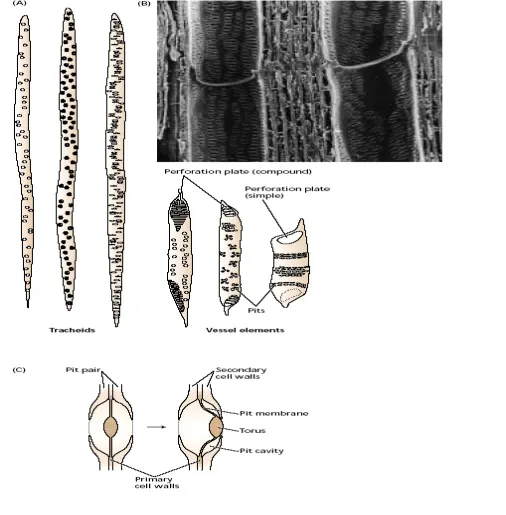
Ascent of sap can be studied under the following two headings.
-
Path of ascent of sap
-
Mechanism of ascent of sap.
Path of ascent of sap
Ascent of sap takes place through xylem. It can be shown by the experiment.
A leafy twig of Balsam plant (it has semi transpiration stem) is cut under water (to
avoid entry of air bubble through the cut end of the stem) and placed in a beaker containing
water with some Eosine (a dye) dissolved in it.
After sometimes coloured lines will be seen moving upward in the stem. If sections
of stem are cut at this time, only the xylem elements will appear to be filled with coloured
water.
Ringing experiment
A leafy twig from a tree is cut under water and placed in a beaker filled with water.
A ring of bark is removed from the stem. After sometime it is observed that the leaves above
the ringing part of the stem remain fresh and green. It is because water is being continuously
supplied to the upper part of the twig through xylem.
B. Mechanism of ascent of sap
In small trees and herbaceous plants, the ascent of sap can be explained easily, but in
tall trees like Eucalyptus and conifers reaching a height of 300-400 feet), where water has to
rise up to the height of several hundred feet, the ascent of sap, it feet, becomes a problem. To
explain the mechanism of Ascent of sap, a number of theories have been put forward.
a. vital theory
b. root pressure theory
c. physical force theory
d. transpiration pull and cohesion of water theory
A. Vital theories
According to vital theories, the ascent of sap is under the control of vital activities in
the stem.
- According to Godlewski (1884) – Ascent of sap takes place due to the pumping
activity xylem tissues which are living.
- According to Bose (1923) – upward translocation of water takes place due to
pulsatory activity of the living cells of the inner must cortical layer just outside the
endodermis.
B. Root pressure theory
Although, root pressure which is developed in the xylem of the roots can raise water
to a certain height but does not seem to be an effective force in ascent of sap due to the
following reasons. Magnitude of root pressure is very low (about 2 atmos).
Even in the absence of root pressure, ascent of sap continues. For example, when
leafy twig is cut under water and placed in a beaker full of water it remains fresh and green
for sufficient long time.
C. Physical force theories
Various physical forces may be involved in ascent of sap.
Atmospheric pressure
This does not seem to be convincing because
it cannot act on water present in xylem in roots
Incase it is working, and then also it will not be able to raise water beyond 34.
Imbibition
Sachs (1878) supported the view that ascent of sap could take place by imbibition
through the walls of xylem. But imbibitional force is insignificant in the A. of sap because it
takes place through the lumen of xylem elements and not through walls.
Capillary force
In plants the xylem vessels are placed one above the other forming a sort of
continuous channel which can be compared with long capillary tubes and it was thought that
as water rises in capillary tube due to capillary force in the same manner ascent of sap takes
place in the xylem.
D. Transpiration pull and cohesion of water theory
This theory was originally proposed by Dixon and Jolly (1894) later supported and
elaborated by Dixon (1924). This theory is very convincing and has now been widely
supported by many workers.
Although H- bond is very weak (Containing about 5 K –cal – energy) but they are
present in enormous numbers as incase of water, a very strong mutual force of attraction or
cohesive force develops between water molecules and hence they remain in the form of a
continuous water column in the xylem. The magnitude of this force is very high (up to 350
atm), therefore the continuous water column in the xylem cannot be broken easily due to the
force of gravity or other abstractions offered by the internal tissues in the upward movement
of water.
The adhesive properties of water i.e. attractions between the water molecules and the
containers walls (here the walls of xylem) further ensure the continuity of water column in
xylem.
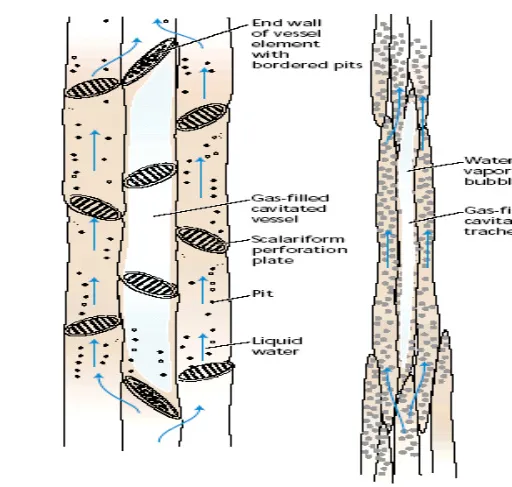
When transpiration takes place in the leaves at the upper parts of the plant, water
evaporates from the intercellular spaces of the leaves to the outer atmosphere through
stomata. More water is released into the intercellular spaces from mesophyll cells. In turn,
the mesophyll cells draw water from the xylem of the leaf. Due to all this, a tension is
created in the xylem elements of the leaves. This tension is transmitted downward to water
in xylem elements of the root through the xylem of petiole and stem and the water is pulled
upward in the form of continuous unbroken water column to reach the transpiring surfaces up
to the top of the plant
Summary Cheat Sheet
Quick Recall Points
- Core definitions in this lesson should be revised first.
- Focus on section-wise concepts and their practical relevance in crop physiology.
- Revise key mechanisms, terms, and cause-effect relationships asked in exams.
Exam Traps
- Similar terms are often confused; verify definitions in context.
- Do not mix process description with outcome without stating conditions.
- Use correct biological terminology while answering descriptive questions.
References
1 source • [1]
References
Plant Physiology course notes (PPHY261)
BookLesson Doubts
Ask questions, get expert answers