🌿 Mineral Nutrition
Mineral Nutrition.
This lesson introduces mineral nutrition, essential elements, and their physiological roles in plant growth.
The term, mineral nutrient is generally used to refer to an inorganic ion obtained from
the soil and required for plant growth. The chemical form in which elements are applied to
plants is called as nutrient . Nutrition may be defined as the supply and absorption of
chemical compounds needed for plant growth and metabolism
The nutrients indispensable for the growth and development of higher plants are
obtained from three sources viz., atmosphere, water and soil. The atmosphere provides
carbon and oxygen as carbon dioxide. Carbon is reduced during photosynthesis and oxygen
is utilized during aerobic respiration. Soil provides the mineral ions.
Essential elements
The term essential mineral element was proposed by Arnon and Stout (1939). These
are the composition of both macro and microelements, in the absence of any one of these
elements the plant cannot maintain its normal growth and develops deficiency symptoms,
affects metabolism and die prematurely. Of the many elements that have been detected in
plant tissues, only 16 are essential for all higher plants. They are C, H, O, N, P, K, Ca, Mg,
S, Zn, Cu, Fe, Mn, B, Cl and Mo. In the absence of each of the essential elements, plants
develop deficiency symptoms characteristic of the deficient element and die prematurely.
Macronutrients
The nutrient elements which are required for the growth of plants relatively in larger
quantities are called as major nutrients or macronutrients . The major elements required for
growth of plants are C, H, O, N, P, K, Ca, Mg and S. Among these nutrients, C, H and O are
taken up by the plants from the atmosphere and water. The N, P, K, Ca, Mg and S are taken
up by the plants from the soil and they are applied in the form of chemical fertilizers either
through the soil or foliage.
Micronutrients
The nutrient elements which are required comparatively in small quantities are called
as minor or micro nutrients or trace elements. The micronutrients required for the plant
growth are Zn, Cu, Fe, Mn, Mo, B and Cl.
Tracer elements or labeled elements
The nutrient elements that are required for plants are some times labeled and used to
study their movement or tracing out the involvement of such nutrients in metabolism in
different organs of plants, are called as tracer elements . They may either be stable or radio
active types and they are also called as isotopic elements.
E.g. Stable isotopes: [15] N, [12] C, [31] P
Radio active : [14] C, [32] P, [65] Zn, [56] Fe, [60] Co, etc.
Hidden hunger
When the plants are not able to meet their requirement either one or more of these
essential elements, the plants will undergo starvation for such elements. At the initial stage
of deficiency of such elements plants will not show any characteristic symptoms which could
be exhibited morphologically and due to want of those elements some activities of plants
would rather be affected and the internal deficiency is called as Hidden hunger.
General role of essential elements
In general, an element is essential to the life of a higher green plant for one or more of
the following three reasons.
- It may perform a nutritive role by being a component of one or more of the major
classes of plant constituents.
- It may be a catalytic role either as an action for of an enzyme or as an integral
component of an enzyme.
- It may function as a free ion and thereby exert a balancing role in maintaining electro
neutrality within plant cells (e.g. Potassium).
Criteria for essentiality of elements
The demonstration of the essentially several elements (macro and micronutrients),
especially, micronutrients is rather very difficult. In view of the technical difficulties
associated with demonstrating the essentiality of elements required in very small amounts,
Arnon and Stout (1939) suggested the adoption of the following three criteria of essentiality
for judging the exact status of a mineral in the nutrient of a plant.
- The element must be essential for normal growth or reproduction and the plant
processes cannot proceed without it.
-
The element cannot be replaced by another element.
-
The requirement must be direct i.e., not the result of some indirect effect such as
relieving toxicity caused by some other substance.
Another recent suggestion to the criteria of essentiality is that some elements might
better be called functional or metabolic elements rather than essential elements. This is
intended to indicate that an element that is metabolically active, functional or metabolic may
or may not be essential. For example in chlorine-bromine, chlorine is designated as a
functional element rather than an essential element as chlorine can be substituted with
bromine.
Based on the mobility in phloem, elements are also classified into three types.
-
Mobile elements : N, K, P, S and Mg
-
Immobile elements : Ca, Fe and B
-
Intermediate : Zn, Mn, Cu, Mo
Functions of elements
Protoplasmic elements : N, P, S
Balancing elements : Ca, Mg, K – counteract to toxic effects of other minerals
by causing ionic balance.
Frame work elements : C, H2O – as they are the constituents of carbohydrates that
form cell walls.
Catalytic elements : Mn, Cu, Mg, etc.
SOIL LESS GROWTH OR HYDROPONICS
The practice of growing plants in nutrient enriched water without soil is called as soil
less growth or hydroponics. However, the term hydroponics is now being applied to plants
rooted in sand, gravel or other similar matter which is soaked with a recycling flow of
nutrient – enriched water.
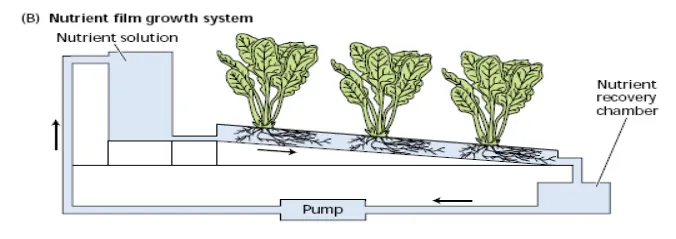
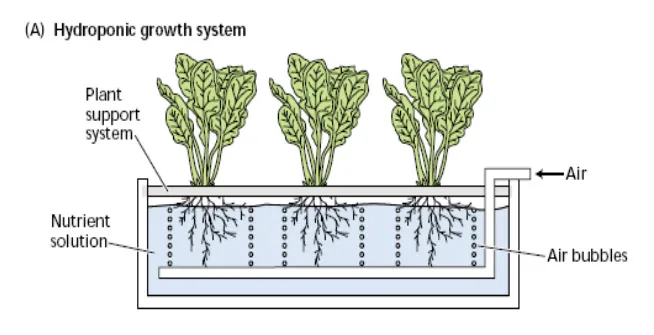
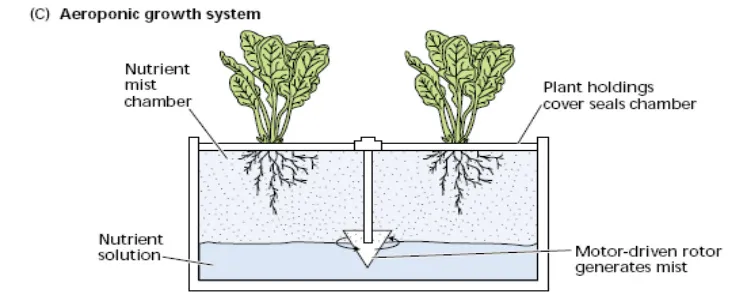
According to a recent limited nations report on hydroponics: In area of tropics, where
the water deficiency is the limiting factor in crop production, the soil less methods hold out
much promise because of the more economical use of water.
The report also indicated that in some areas, lack of fertile soil or very thin soil layers
may also move soil less methods worth serious consideration.
Besides these the other advantages of growing cucumbers, egg plants, peppers,
lettuces, spinach and other vegetables hydroponically under controlled environment are
-
The regulation of nutrients
-
Control of pets and diseases
-
Reduction of labour cost
-
Sometimes quicker yield
But there is two main drawbacks of hydroponics farming.
-
Firstly the cost of settling up the system is very high
-
Secondly it requires skills and knowledge its operation
Summary Cheat Sheet
Quick Recall Points
- Core definitions in this lesson should be revised first.
- Focus on section-wise concepts and their practical relevance in crop physiology.
- Revise key mechanisms, terms, and cause-effect relationships asked in exams.
Exam Traps
- Similar terms are often confused; verify definitions in context.
- Do not mix process description with outcome without stating conditions.
- Use correct biological terminology while answering descriptive questions.
References
1 source • [1]
References
Plant Physiology course notes (PPHY261)
BookLesson Doubts
Ask questions, get expert answers