🌿 Plant Growth
Plant Growth.
Plant growth describes the irreversible increase in plant size and biomass through coordinated cell division, elongation, and differentiation. This lesson connects growth phases, growth curves, and controlling factors that are repeatedly tested in crop physiology exams.
Growth is defined as a vital process that brings about a permanent and irreversible
change in any plant or its part in respect to its size, form, weight and volume. Growth is
restricted only to living cells and is accomplished by metabolic processes involving
synthesize of macromolecules, such as nucleic acids, proteins, lipids and polysaccharides at
the expense of metabolic energy.
Growth at cellular level is also accompanied by the organization of macromolecules
into assemblages of membranes, plastids, mitochondria, ribosome and other cell organelles.
Cells do not definitely increase in size but divide, giving rise to daughter cells. An important
process during cell division is synthesis and replication of nuclear DNA in the chromosomes,
which is then passed into the daughter cells. Therefore, the term growth is used to denote an
increase in size by cell division and cell enlargement, together with the synthesis of new
cellulose materials and the organization of cellular organelles.
Growth regions
Typical growth regions in plants are the apices of shoot and root. Such growing
regions are known as apical meristems, primary meristems or regions of primary growth.
These apical meristems are responsible for the increase in length, differentiation of various
appendages and formation of plant tissues.
Phases of growth
Growth is not a simple process. It occurs in meristematic regions where the
meristematic cell has to pass through the following 3 phases.
-
Cell formation phase
-
Cell elongation phase
-
Cell differentiation (cell maturation)
The cell formation phase is represented by meristematic zone and cell enlargement
phase by cell elongation zone.
The dividing meristematic cells are thin walled and have dense protoplasm with a
large nucleus and with or without very small vacuoles. The intercellular spaces are also
absent. The newly formed cells after the first phase of cell division have to pass through the
second phase of cell enlargement. During the second phase of cell elongation on account of
large quantities of solutes inside the growing cell, water enters the cell due to osmotic effect
resulting in the increased turgidity and expansion and dilation of the thin and elastic cell wall.
This phase also results in appearance of large vacuoles.
In the last phase or cell maturation, the secondary walls are laid down and cell
matures and gets differentiated into permanent tissue.
Growth curve
Growth curve is a graph obtained by plotting the growth rate of a plant against time
factor. The growth rate of a cell, a plant organ, a whole plant or the whole life cycle of plant
is measured in terms of length, size, area, volume or weight. It has been found that different
growth phases result in ‘S’ shaped curve or sigmoid curve. In initial stages during the phase
of cell formation, the growth rate increases slowly while it increases rapidly during the phase
of cell elongation or cell enlargement and again slows down during the phase of cell
maturation.
The period during which the course of growth takes place is known as grand period of
growth. Thus, in a standard growth curve, three well marked regions can be observed, the
initial growth stage (lag phase), the grand period of growth (exponential or log phase) and the
steady stage (maturity stage or senescence or stationary phase). The overall growth may be
affected by external or internal factors but the S- shaped curve of grand period of growth is
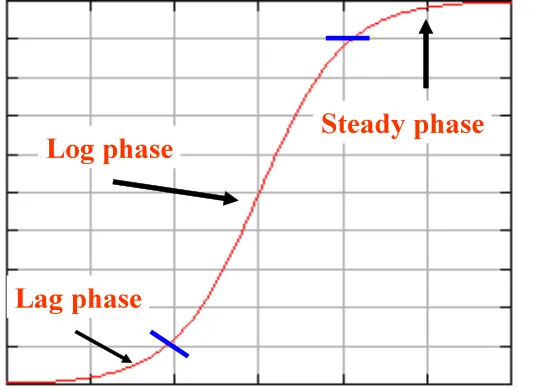
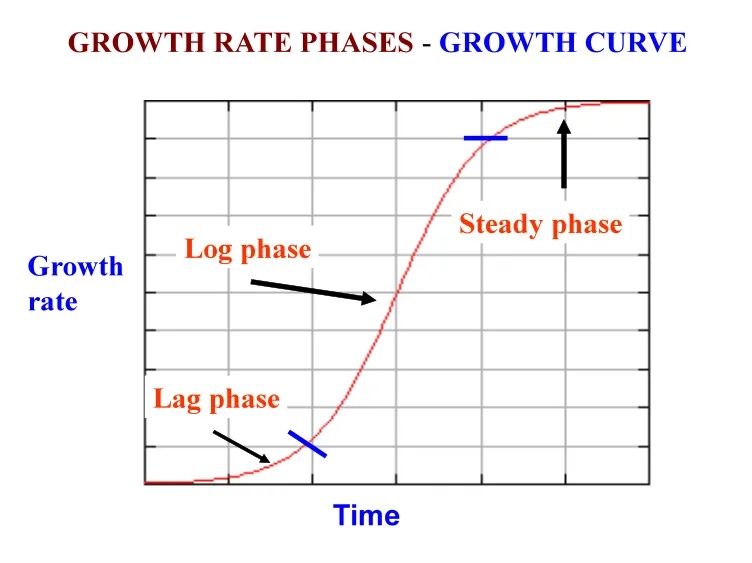 never influenced. This growth curve suits well to the entire life of an annual plant when
measured in terms of dry weight against time.
Early growth of the plant is limited by the amount of food reserves in the seed. When
the emerged seedlings develop an adequate root system and enough leaf surfaces to support
vigorous photosynthesis and anabolism, a period of rapid increase in size is possible.
High metabolic rates are not maintained indefinitely and eventually processes are set
in motion that leads to cessation of growth. The factors responsible for the decrease in
growth are competition for essential metabolites, growth substances, water, light or the
accumulation of inhibitors, toxic substances or waste materials.
Blackman (1919) suggested that the growth of the plants can be represented by
equation.
W1 = Wo e [rt ]
Where, W1 is the final size (Wt, ht etc) after time t. Wo is the initial size at the
beginning of the time period. r is the rate at which plant substance is laid down during time t
and e is the base of natural logarithm. Blackman pointed out that equation describes the way
in which money placed at compound interest increases with time; the term compound interest
law is used to describe such phenomenon. In banks, compound interest is usually applied
quarterly or annually so that the increase in amount occurs as a jump. With plant system,
compound interest is applied continuously and size increase follows a smooth curve.
From the equation, the final size of an organism (W1) depends on the initial size (Wo).
Larger seed give a larger plant.
In addition, equation shows that plant size also depends on the magnitude of r, the
relative growth rate. Blackman suggested that r might be used as a measure of the ability of
the plant to produce new plant material and called r as the efficiency index. The plants with
high efficiency index could be expected to outperform plants with low efficiency index.
Measurement of growth
The measurement of growth is possible in terms of either increase in weight or
increase in volume or area. The common and simplest method for the measurement of
growth can be a direct method by which the growth is measured by a scale at regular
intervals from beginning to end. The other methods that can be used are horizontal
microscope, auxanometers.
Factors influencing growth
Growth is affected by all factors that affect the activity of protoplasm. Both
physiological and environmental factors such as water, minerals, photosynthesis, respiration,
climate and edaphic factors significantly influence the growth. In general, factors can be
grouped into external and internal factors.
External factors
Light
It has direct effect on photosynthesis and transpiration. Light in terms of intensity,
quality and periodicity influence the growth very much.
Light intensity: A weak light promotes shortening of internodes and affects expansion of leaf.
Very weak light reduces the rate of over all growth and also photosynthesis due to poor
development of chlorophyll and higher rate of water loss from the plant.
Light quality : The different wavelengths of light have different responses to growth. In blue
violet radiation, the internodal growth is pronounced while green colour light promotes the
expansion of leaves as compared to complete spectrum of visible light. The red light favours
the growth while infra red and UV is detrimental to growth.
Light duration: The re is remarkable effect of the duration of light on the growth. The
induction and suppression of flowering depend on duration
Temperature
The plants have different temperature requirements based on the region where they
are grown. In general, best growth takes place between 28 and 33 C. and it varies from
temperate to tropical conditions. The optimum temperature requirement is essential for seed
germination, growth, metabolic activities, flowering and yield.
Oxygen
The growth of the plant is directly proportional to the amount of oxygen which is
essential for respiration during which the food materials are oxidized to release energy.
Carbon dioxide
It is one of the major factors that influence the photosynthesis. The rate of
photosynthesis increases as the availability of CO2 increases while other factors are not
limiting.
Water
Water is an essential factor for growth. It is essential for uptake of nutrients,
translocation of nutrients and food materials, regulating transpiration and for various
physiological processes like photosynthesis, respiration and enzymatic activities.
- Nutrients and food materials
The rate of growth is directly proportional to the availability of nutrients and food
materials. The shortage of food supply affects the growth as it provides the growth material
to the growing region and also it provides the potential energy to the growing region.
Internal factors
-
Growth hormones and their availability
-
Resistance to climatic, edaphic and biological stresses
-
Photosynthetic rate and respiration
-
Assimilate partitioning and nitrogen content
-
Chlorophyll and other pigments
-
Source-sink relationship and enzyme activities
Summary Cheat Sheet
Quick Recall Points
- Plant growth is a permanent and irreversible increase in size or dry matter.
- Primary growth occurs at apical meristems of shoots and roots.
- Classical growth curve is sigmoid (S-shaped) with lag, log, and stationary phases.
- Growth rate is measured using length, area, volume, or dry weight over time.
Exam Traps
- Growth is not only cell enlargement; it also includes cell division and differentiation.
- External factors do not alter the basic sigmoid nature of the grand growth period.
- Avoid confusing growth with development; development includes qualitative changes too.
References
1 source • [1]
References
Plant Physiology course notes - Plant Growth
BookLesson Doubts
Ask questions, get expert answers