🌤️ Elements of Weather & Climate
Study the five key weather elements — temperature, rainfall, humidity, wind and sunshine for CUET Agriculture. Instruments, diurnal variation explained.
Weather vs Climate
Understanding the difference between weather and climate is one of the most fundamental concepts in agrometeorology.
- Weather refers to the short-term atmospheric conditions at a specific place and time — we're talking about hours to a few days. It includes things like today's temperature, rainfall, humidity, and wind speed.
- Climate, on the other hand, describes the average weather conditions of an area calculated over a long period — typically 30 or more years. Climate tells us what to expect in a region over time.
- A simple way to remember: Weather is what you get; climate is what you expect. Weather can surprise you on any given day, but climate represents the long-term pattern.
TIP
Think of climate as the "personality" of a region's atmosphere, while weather is its "mood" on any particular day.
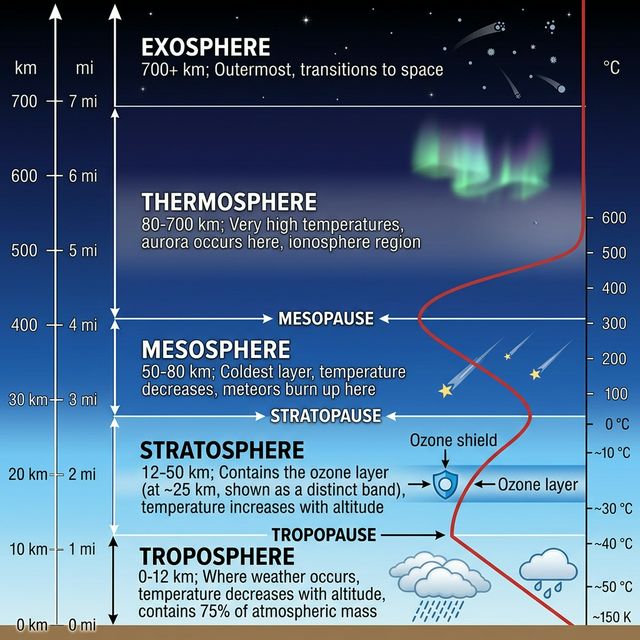
Key Weather Elements
There are five major weather elements that every agrometeorology student must understand. These elements directly influence crop growth, pest activity, and farm operations.
Pro Content Locked
Upgrade to Pro to access this lesson and all other premium content.
₹99 charged monthly · Cancel anytime
- All Agriculture & Banking Courses
- AI Lesson Questions (100/day)
- AI Doubt Solver (50/day)
- Glows & Grows Feedback (30/day)
- AI Section Quiz (20/day)
- 22-Language Translation (100/day)
- Recall Questions (20/day)
- AI Quiz (15/day)
- AI Quiz Paper Analysis (100/day)
- AI Step-by-Step Explanations (100/day)
- Spaced Repetition Recall (FSRS)
- AI Tutor
- Immersive Text Questions
- Audio Lessons — Hindi & English
- Mock Tests & Previous Year Papers
- Summary & Mind Maps
- XP, Levels, Leaderboard & Badges
- Generate New Classrooms
- Voice AI Teacher (AgriDots Live)
- AI Revision Assistant
- Knowledge Gap Analysis
- Interactive Revision (LangGraph)
🔒 Secure via Razorpay · Cancel anytime · No hidden fees
Weather vs Climate
Understanding the difference between weather and climate is one of the most fundamental concepts in agrometeorology.
- Weather refers to the short-term atmospheric conditions at a specific place and time — we're talking about hours to a few days. It includes things like today's temperature, rainfall, humidity, and wind speed.
- Climate, on the other hand, describes the average weather conditions of an area calculated over a long period — typically 30 or more years. Climate tells us what to expect in a region over time.
- A simple way to remember: Weather is what you get; climate is what you expect. Weather can surprise you on any given day, but climate represents the long-term pattern.
TIP
Think of climate as the "personality" of a region's atmosphere, while weather is its "mood" on any particular day.
Key Weather Elements
There are five major weather elements that every agrometeorology student must understand. These elements directly influence crop growth, pest activity, and farm operations.
1. Temperature
Temperature is a measure of the hotness or coldness of the atmosphere. It is one of the most critical factors affecting crop growth because every crop has a specific temperature range within which it thrives.
- Maximum temperature: The highest temperature recorded during the day, which usually occurs around 2 PM (early afternoon) when solar heating is at its peak.
- Minimum temperature: The lowest temperature recorded, which typically occurs just before sunrise, after the Earth has been radiating heat throughout the night.
- Diurnal variation: This is the difference between the maximum and minimum temperature on any given day. A large diurnal variation (warm days, cool nights) can be beneficial for crops like cotton and tomato, as it encourages sugar accumulation in fruits.
- Instruments used to measure temperature:
- Maximum thermometer — uses mercury (mercury expands with heat and stays at the highest point reached due to a constriction in the tube)
- Minimum thermometer — uses alcohol (alcohol has a lower freezing point, making it suitable for recording cold temperatures)
- Six's thermometer — a combined instrument that records both maximum and minimum temperatures simultaneously
NOTE
Temperature directly affects the rate of photosynthesis, respiration, transpiration, and enzymatic activity in plants. Both extremes — too hot or too cold — can damage crops.
2. Rainfall (Precipitation)
Rainfall is considered the most important weather element for Indian agriculture because a majority of India's farmland is rain-fed (not irrigated). The success or failure of crops in India is largely determined by the quantity and distribution of rainfall.
Types of rainfall:
| Type | Mechanism | Region in India |
|---|---|---|
| Convectional | Heated air rises, cools, and condenses to form clouds and rain | Equatorial regions, summer afternoons in interior India |
| Orographic | Moist air is forced upward by mountains, cools at higher altitude, and precipitates on the windward side | Western Ghats, NE India (Cherrapunji/Mawsynram) |
| Cyclonic/Frontal | Occurs when warm and cold air masses meet — the lighter warm air rises over the cold air, cools, and produces rain | Coastal areas during cyclones |
Orographic rainfall is especially important to understand for CUET — it explains why the Western Ghats receive heavy rainfall on the windward (western) side while the leeward (eastern) side remains relatively dry (rain shadow region).
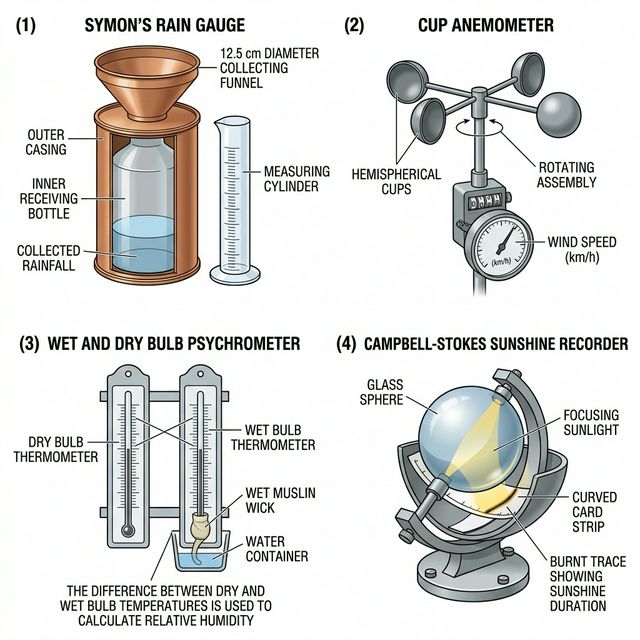
- Instruments: The standard rain gauge used in India is the Symon's rain gauge, which has a collecting funnel with a diameter of 12.5 cm. It is placed at a height of 30 cm above ground level.
- India's average annual rainfall is approximately 118 cm (~1180 mm).
How is rainfall measured using Symon's rain gauge?
The Symon's rain gauge consists of a **cylindrical copper container** with a funnel at the top (12.5 cm diameter). Rainwater passes through the funnel into a **receiving bottle** inside the container. Every day at 8:30 AM IST, the collected water is poured into a **graduated measuring cylinder** to read the rainfall in millimetres. The gauge is placed in an open area away from buildings and trees to avoid obstruction.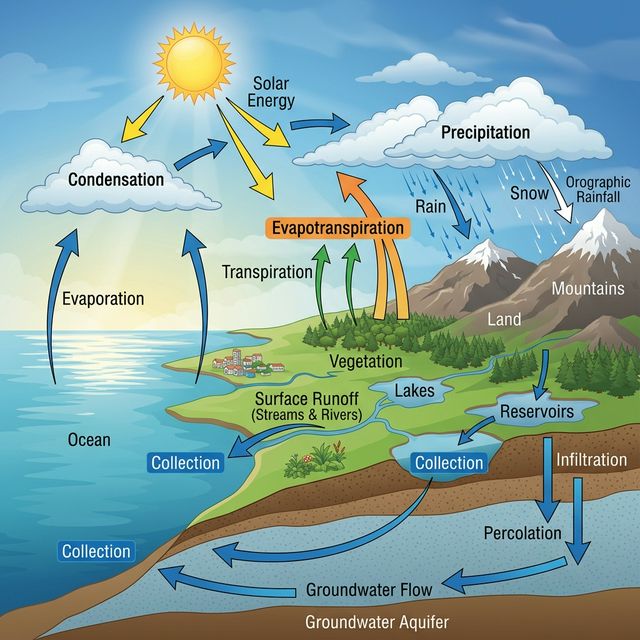
3. Humidity
Humidity refers to the amount of water vapour present in the atmosphere. It plays a crucial role in agriculture because it influences evapotranspiration rates, the spread of fungal diseases, and the overall comfort of the growing environment.
- Absolute humidity: The actual mass of water vapour per unit volume of air, expressed in g/m³. This is a straightforward measurement of how much moisture is in the air.
- Relative humidity (RH): The ratio of actual vapour pressure to saturation vapour pressure, multiplied by 100 and expressed as a percentage. In simpler terms, RH tells you how "full" the air is with moisture compared to its maximum capacity at that temperature.
- Specific humidity: The mass of water vapour per unit mass of moist air, expressed in g/kg. Unlike RH, specific humidity does not change with temperature, making it useful for meteorological calculations.
- Instruments: Hygrometer (general humidity measurement) and Psychrometer (also called the wet and dry bulb thermometer — the difference in readings between the wet bulb and dry bulb gives the relative humidity).
IMPORTANT
High relative humidity favours fungal diseases in crops. Diseases like blast in rice, late blight in potato, and downy mildew thrive when RH is above 80-90%. Farmers must monitor humidity to time fungicide applications effectively.
4. Wind
Wind is the horizontal movement of air from areas of high pressure to areas of low pressure. The greater the pressure difference (pressure gradient), the stronger the wind.
- Speed: Measured by an anemometer, which typically has rotating cups — as the wind blows, the cups spin, and the rotation speed is converted to wind speed (km/h or m/s).
- Direction: Measured by a wind vane (also called a weather vane), which points to the direction the wind is coming from. So a "westerly wind" blows from the west towards the east.
- Agricultural significance of wind: Wind affects evapotranspiration (higher wind = more water loss from plants), pollination (wind-pollinated crops like maize and wheat rely on air currents), and the spread of pests and diseases (spores, insects, and even weed seeds travel with wind).
TIP
Remember: An anemometer measures wind speed (think "a" for "air speed"), while a wind vane measures wind direction (think "vane" pointing like an arrow).
5. Solar Radiation
Solar radiation is the primary source of energy for all life on Earth. Without it, photosynthesis — the process by which plants convert light energy into food — would be impossible.
- PAR (Photosynthetically Active Radiation): This is the portion of solar radiation that plants can actually use for photosynthesis. It falls within the wavelength range of 400-700 nm, which corresponds roughly to visible light.
- Instruments:
- Pyranometer — measures total solar radiation (both direct and diffuse) reaching a surface
- Sunshine recorder (Campbell-Stokes) — a glass sphere that focuses sunlight onto a curved card, burning a trace that indicates the duration of bright sunshine in hours
- India receives about 5,000 trillion kWh of solar energy per year — an enormous resource that makes solar-powered agriculture increasingly viable.
Why is PAR important for agriculture?
Only about **45-50% of total solar radiation** falls within the PAR range (400-700 nm). Plants use this specific range because chlorophyll absorbs red and blue light most efficiently. Understanding PAR helps farmers and researchers estimate **potential photosynthesis rates**, plan **greenhouse lighting**, and optimize **crop spacing** to ensure every plant receives adequate light.Key Points to Remember
- Weather = short-term atmospheric state; Climate = 30-year average
- Symon's rain gauge collecting funnel diameter: 12.5 cm
- India's average annual rainfall: ~118 cm
- PAR wavelength: 400-700 nm
- Maximum thermometer uses mercury; minimum thermometer uses alcohol
- Anemometer → wind speed; Wind vane → wind direction
- Psychrometer (wet & dry bulb) measures relative humidity
- High RH (>80%) favours fungal crop diseases
Summary Cheat Sheet
| Concept / Topic | Key Details / Explanation |
|---|---|
| Weather vs Climate | Weather = short-term atmospheric conditions (hours to days). Climate = average weather over 30+ years. "Weather is what you get; climate is what you expect." |
| Five Major Weather Elements | Temperature, Rainfall, Humidity, Wind, Solar Radiation |
| Temperature — Max & Min | Max temp occurs around 2 PM; Min temp occurs just before sunrise. Diurnal variation = difference between max and min temp. |
| Temperature Instruments | Maximum thermometer — uses mercury. Minimum thermometer — uses alcohol. Six's thermometer — records both max and min. |
| Rainfall (Precipitation) | Most important weather element for Indian agriculture (majority farmland is rain-fed). |
| Types of Rainfall | Convectional — heated air rises, cools, condenses. Orographic — moist air forced upward by mountains (Western Ghats, NE India). Cyclonic/Frontal — warm and cold air masses meet. |
| Rain Gauge | Symon's rain gauge — funnel diameter 12.5 cm, placed 30 cm above ground, read daily at 8:30 AM IST. |
| India's Average Annual Rainfall | ~118 cm (~1180 mm) |
| Humidity Types | Absolute humidity — mass of water vapour per unit volume (g/m³). Relative humidity (RH) — ratio of actual to saturation vapour pressure (%). Specific humidity — mass of vapour per unit mass of moist air (g/kg). |
| Humidity Instruments | Hygrometer — general humidity. Psychrometer (wet & dry bulb thermometer) — difference in readings gives RH. |
| High RH & Crop Diseases | RH >80-90% favours fungal diseases (blast in rice, late blight in potato, downy mildew). |
| Wind | Horizontal movement of air from high to low pressure. |
| Wind Instruments | Anemometer — measures wind speed. Wind vane — measures wind direction (points to where wind comes from). |
| Wind & Agriculture | Affects evapotranspiration, pollination (maize, wheat), spread of pests/diseases/weed seeds. |
| Solar Radiation | Primary energy source for life; drives photosynthesis. |
| PAR (Photosynthetically Active Radiation) | Wavelength 400–700 nm (visible light); about 45-50% of total solar radiation. |
| Solar Radiation Instruments | Pyranometer — measures total solar radiation. Campbell-Stokes sunshine recorder — glass sphere burns a trace on card to record sunshine duration. |
| India's Solar Energy | Receives about 5,000 trillion kWh of solar energy per year. |
Lesson Doubts
Ask questions, get expert answers