📦 Post-Harvest Technology & Preservation
Study fruit and vegetable preservation — canning, dehydration, freezing for CUET Agriculture. Cold storage, MAP, irradiation and FPO standards.
India loses approximately 25-30% of fruits and vegetables post-harvest due to inadequate handling, storage, and processing infrastructure. This enormous loss -- estimated at lakhs of crores of rupees annually -- represents not just economic waste but also food security concerns in a country where millions face hunger. Understanding post-harvest technology is essential for minimizing losses and adding value to horticultural produce.
Quick Study Frame
Use this lesson in the same sequence as real supply chains:
- Identify where loss occurs.
- Match each stage with a control intervention.
- Select preservation/storage method based on crop physiology and market distance.
Post-Harvest Losses
Causes of Post-Harvest Losses
Post-harvest losses occur through multiple pathways, and often several factors act together to accelerate deterioration:
| Category | Causes |
|---|---|
| Physiological | Respiration (converts stored sugars to CO2, reducing quality), transpiration (water loss causing wilting/shriveling), ethylene production (accelerates ripening and senescence), senescence (natural aging) |
| Pathological | Fungal infections (Aspergillus, Rhizopus, Penicillium, Botrytis), bacterial soft rots -- pathogens enter through wounds and multiply rapidly in warm, humid conditions |
| Mechanical | Bruising, cuts, abrasion during harvesting, handling, and transport -- even minor bruises create entry points for pathogens |
| Environmental | Temperature extremes, humidity fluctuations, improper storage -- tropical heat accelerates all deterioration processes |
| Entomological | Insect infestation (fruit flies, weevils, beetles) -- insects both damage produce directly and introduce pathogens |
| Chemical | Residual pesticides, contamination, oxidative browning -- enzymatic browning occurs when cut surfaces are exposed to oxygen |
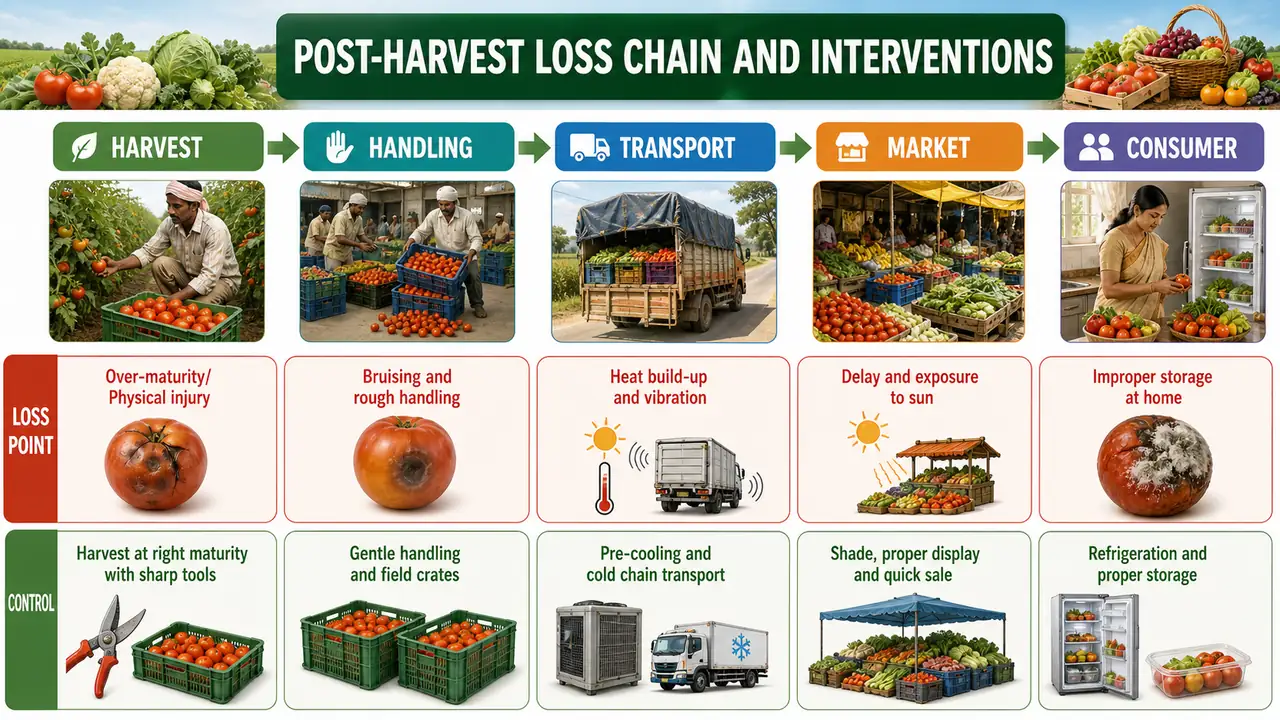
Stages of Post-Harvest Loss
Losses accumulate at every stage of the supply chain, and addressing them requires interventions at each point:
- Harvesting (field losses) -- rough handling, improper maturity
- Handling and transportation -- crushing, heat damage, vibration injury
- Market/wholesale level -- delays, exposure to sun and rain
- Retail level -- improper display, overhandling by customers
- Consumer level -- improper home storage, over-purchasing
Harvesting Maturity Indices
Harvesting at the correct maturity stage is the first and most critical step in reducing post-harvest losses. Harvest too early and the produce lacks flavour, colour, and nutrients. Harvest too late and shelf life is drastically reduced.
Types of Maturity
- Physiological maturity -- fully developed seed; crop has completed its growth cycle. This is the stage at which the plant considers the fruit "done."
- Horticultural/Commercial maturity -- stage at which crop is suitable for harvest and marketing (may be before physiological maturity). For example, green beans are harvested well before seeds mature.
NOTE
For most fruits, horticultural maturity comes before physiological maturity. A mango harvested at the mature green stage (horticultural maturity) will ripen properly after harvest, but if harvested at full physiological maturity, it will be overripe by the time it reaches the consumer.
Maturity Indices for Important Crops
| Crop | Maturity Indices |
|---|---|
| Mango | Shoulder development, specific gravity < 1.0 (floats in water), skin colour change, days from fruit set (110-120) |
| Banana | Ridges on fingers become round (75% maturity), light green colour, angularity disappears |
| Citrus | TSS:Acid ratio (Mandarin 10:1, Sweet orange 12:1), colour change from green to orange |
| Guava | Change from dark green to light green/yellowish |
| Papaya | 1/4 yellow streaks on skin, latex turns watery (from milky) |
| Apple | Starch-iodine test (starch converts to sugar as fruit matures -- iodine staining decreases), ground colour change (green to yellow), firmness, TSS, days after full bloom |
| Grapes | TSS 20-24 Brix, TSS:Acid ratio 25-35:1 |
| Tomato | Breaker stage (first pink colour) for distant markets; full red for local markets |
| Potato | Haulm yellowing, skin firmly attached (skin set) -- if skin rubs off easily, it is not ready |
| Onion | Neck fall (50-75% tops fall), bulb firmness |
| Cauliflower | Compact, white curd of 15-20 cm diameter |
| Peas | Well-filled pods, bright green, tender |
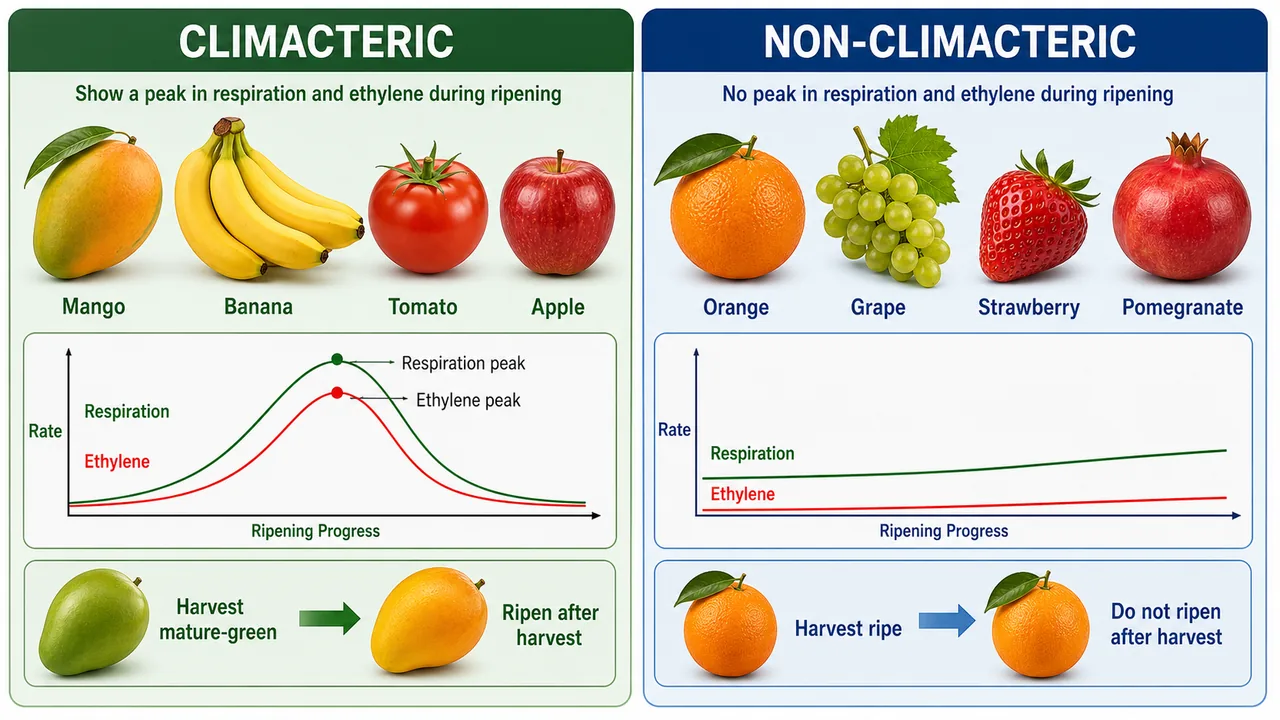
Classification of Fruits by Ripening Behaviour
This classification has major practical implications for how fruits are handled, stored, and marketed:
| Climacteric Fruits | Non-Climacteric Fruits |
|---|---|
| Mango, Banana, Papaya, Guava, Apple, Tomato, Sapota, Custard apple, Avocado, Peach, Plum, Pear | Citrus (orange, lemon), Grapes, Litchi, Pomegranate, Pineapple, Watermelon, Strawberry, Cherry, Cucumber |
- Climacteric fruits show a sharp rise in respiration rate and ethylene production during ripening; they can ripen after harvest. This means they can be harvested green and ripened during transport or storage.
- Non-climacteric fruits do not show such a rise; they must be harvested at desired maturity because they will not ripen further after picking. They may soften or change colour slightly, but sugar content and flavour will not improve.
TIP
An easy memory aid: Climacteric fruits can be picked green and ripened later (mango, banana, tomato). Non-climacteric fruits must be picked ripe (citrus, grapes, strawberry). The word "climacteric" comes from "climax" -- referring to the peak in respiration during ripening.
Post-Harvest Handling Operations
1. Pre-cooling
Pre-cooling is the rapid removal of field heat immediately after harvest. Field heat accelerates respiration, water loss, and microbial growth -- removing it quickly is the single most effective step in extending shelf life.
- Methods: room cooling, forced-air cooling, hydro-cooling, vacuum cooling, icing
- Hydro-cooling -- immersion in or spraying with cold water; suitable for carrots, cherries, sweet corn. Fast and effective but not suitable for water-sensitive produce.
- Vacuum cooling -- rapid evaporation under low pressure; best for leafy vegetables (lettuce, spinach) because their high surface area allows rapid evaporative cooling
- Forced-air cooling -- cold air forced through stacked produce; the most versatile and widely used commercial method
2. Sorting and Grading
- Sorting -- removal of damaged, diseased, and immature produce -- a quality control step that prevents one bad fruit from spoiling others
- Grading -- classification by size, shape, colour, weight, and quality -- adds value and commands better prices in the market
- Standards set by AGMARK (Agricultural Marketing), BIS, and Codex Alimentarius
- Grading adds value and fetches better market prices -- consumers are willing to pay more for uniformly graded produce
3. Washing and Cleaning
- Remove dirt, surface microorganisms, and pesticide residues
- Chlorinated water (100-150 ppm) commonly used for sanitization -- chlorine kills surface bacteria and fungi
- Ozone washing -- emerging technology for surface disinfection; ozone (O3) is a powerful oxidizer that breaks down quickly, leaving no residue
4. Waxing
- Application of edible wax coating on fruit surface -- creates a thin, invisible barrier
- Reduces transpiration (moisture loss), improves appearance (shine), and extends shelf life by slowing respiration
- Common waxes: shellac (lac-based -- from the lac insect), carnauba (from Brazilian palm wax), beeswax
- Applied to: Apple, citrus, cucumber, tomato, capsicum -- fruits with smooth skin benefit most
5. Ripening
- Ethylene gas (100 ppm) -- natural ripening hormone; used commercially in ripening chambers with controlled temperature and humidity
- Ethrel / Ethephon -- a liquid that releases ethylene when applied; used for banana, mango, tomato ripening
- Calcium carbide (CaC2) -- BANNED by FSSAI (produces traces of arsenic and phosphorus which are harmful to health). Despite the ban, its illegal use persists due to its cheapness.
- Optimal conditions for banana ripening: 15-20°C, 85-90% RH, ethylene 100 ppm for 24 hours
WARNING
Calcium carbide for fruit ripening is banned in India under FSSAI regulations. It releases acetylene gas (not ethylene) along with traces of arsenic and phosphorus -- both toxic to humans. Fruits ripened with calcium carbide may have a shorter shelf life, poor flavour, and pose health risks. The approved method uses ethylene gas in controlled ripening chambers.
6. Packaging
- Functions: protection, containment, communication (labelling), convenience
- CFB (Corrugated Fibre Board) boxes -- replacing wooden crates for fruits; lighter, more hygienic, stackable
- Punnets/clamshells -- for berries, cherry tomato, grapes; provide visibility and protection
- Modified Atmosphere Packaging (MAP) -- altering gas composition inside package
- Low O2 (2-5%) + High CO2 (3-8%) reduces respiration and ripening -- slows down metabolic processes that lead to deterioration
- Shrink wrapping -- individual fruit wrapping (cucumber, capsicum) -- reduces water loss dramatically
- Ventilated packaging -- necessary for preventing heat buildup in respiring produce
Storage Methods
1. Cold Storage
- Most common method for extending shelf life of perishables
- Principle: Low temperature slows respiration, enzymatic activity, microbial growth, and ethylene production -- every 10°C reduction in temperature roughly halves the respiration rate
| Crop | Storage Temperature | RH (%) | Shelf Life |
|---|---|---|---|
| Mango | 13°C | 85-90 | 2-3 weeks |
| Banana (green) | 13-14°C | 85-90 | 3-4 weeks |
| Citrus (orange) | 3-5°C | 85-90 | 6-8 weeks |
| Apple | 0-1°C | 90-95 | 2-4 months |
| Grapes | -1 to 0°C | 90-95 | 2-4 months |
| Potato | 2-4°C | 90-95 | 6-8 months |
| Onion | 0-2°C | 65-70 | 6-8 months |
| Tomato (mature green) | 12-14°C | 85-90 | 3-5 weeks |
| Cauliflower | 0°C | 95 | 3-4 weeks |
| Peas | 0°C | 90-95 | 1-2 weeks |
IMPORTANT
Tropical fruits (mango, banana, papaya) are susceptible to chilling injury if stored below recommended temperatures. Symptoms include pitting, skin browning, off-flavours, and failure to ripen. This is why mango is stored at 13°C, not at near-freezing temperatures. Also note that onion requires low humidity (65-70%) -- high humidity promotes sprouting and rot.
2. Controlled Atmosphere (CA) Storage
- Active control of gas composition in sealed storage room using gas generators and scrubbers
- Reduced O2 (1-5%) + Increased CO2 (1-5%) + Low temperature
- Suppresses respiration and ethylene production -- dramatically slows all metabolic processes
- Best suited for apple -- extends storage life to 6-8 months (compared to 2-4 months in regular cold storage)
- Also used for kiwi, pear, cabbage
| Gas | Normal Air | CA Storage |
|---|---|---|
| O2 | 21% | 1-5% |
| CO2 | 0.03% | 1-5% |
| N2 | 78% | 90-97% |
How CA storage works for apples
In CA storage, the sealed room's atmosphere is actively modified using nitrogen generators (to reduce O2) and CO2 scrubbers (to maintain precise CO2 levels). At low O2 (1-3%), the apple's respiration rate drops to a fraction of normal, dramatically slowing the conversion of starch to sugar, the production of ethylene, and the loss of firmness. The elevated CO2 further suppresses ethylene action. Combined with low temperature (0-1°C), CA storage can keep apples in near-harvest condition for 6-8 months -- allowing fruit harvested in October to be sold fresh the following May. The technology is expensive (airtight rooms, gas monitoring equipment) but essential for the apple industry.3. Modified Atmosphere (MA) Storage
- Passive modification of gas composition through produce respiration within sealed packaging -- the produce itself changes the atmosphere by consuming O2 and releasing CO2
- Cheaper than CA; uses perforated or selective-permeable films that allow some gas exchange
- Suitable for retail packaging -- consumer-level MAP bags and pouches
4. Evaporative Cooling (Zero Energy Cool Chamber)
- Developed by IARI, New Delhi (Dr. S.K. Roy) -- a landmark innovation for rural India
- Principle: Evaporation of water absorbs heat energy, reducing temperature
- Double brick wall structure with wet sand between walls -- water is poured over the top, seeps through the sand, and evaporates from the outer surface
- Reduces temperature by 10-15°C below ambient -- significant in Indian summers where ambient temperature can exceed 45°C
- Extends shelf life of fruits and vegetables by 5-7 days
- Zero electricity cost -- ideal for rural India where cold chain infrastructure is absent. This technology requires only bricks, sand, and water.
TIP
The Zero Energy Cool Chamber (ZECC) is one of the most exam-relevant innovations. Remember: developed at IARI by Dr. S.K. Roy, uses evaporative cooling (no electricity), double brick wall with wet sand, reduces temperature by 10-15°C, extends shelf life by 5-7 days.
5. Irradiation
- Exposure to ionizing radiation (gamma rays from Cobalt-60 or Cesium-137, or electron beam)
- Effects depend on the dose applied:
- Low dose (< 1 kGy): Inhibits sprouting (potato, onion), kills insects
- Medium dose (1-10 kGy): Delays ripening, reduces microbial load
- High dose (> 10 kGy): Sterilization (for spices, dried foods)
- Approved by WHO, FAO, IAEA -- internationally recognized as safe
- Radura symbol -- the international symbol (a green flower-like design in a circle) displayed on irradiated food packages
- Does NOT make food radioactive -- this is a common misconception. The radiation passes through the food and kills organisms, but no radioactive material is added.
6. Hypobaric Storage
- Storage at reduced atmospheric pressure (sub-atmospheric) -- typically 1/10th of normal pressure
- Removes ethylene (which diffuses out under low pressure), reduces O2 concentration, slows ripening
- Expensive; limited commercial use -- mainly for high-value research applications
Food Preservation Methods
Principles of Food Preservation
All preservation methods work through one or more of these three fundamental principles:
- Prevention of microbial activity -- removal or destruction of microorganisms (bacteria, fungi, yeasts)
- Prevention of enzymatic activity -- inactivation of food enzymes that cause browning, softening, and off-flavours
- Prevention of chemical changes -- stopping oxidation, non-enzymatic browning (Maillard reaction), and other chemical deterioration
Detailed Methods
1. Canning
- Principle: Destruction of microorganisms by heat + hermetic sealing (airtight) -- the combination ensures no new organisms can enter after sterilization
- Process: Selection -> Washing -> Peeling/Cutting -> Blanching -> Filling in cans/jars -> Exhausting (removing air) -> Sealing -> Processing (heat treatment) -> Cooling -> Labelling
- Blanching: Brief heat treatment (80-100°C for 2-5 minutes) to inactivate enzymes, remove gases (which would cause can corrosion), soften tissue (for easier filling), and fix colour
- Processing temperatures:
- Acid foods (pH < 4.5): 100°C in boiling water bath (fruits, tomato, pickles) -- the natural acidity prevents Clostridium growth
- Low acid foods (pH > 4.5): 116-121°C in pressure cooker/retort (vegetables, meat, fish) -- higher temperature needed to destroy Clostridium spores
- Clostridium botulinum -- deadly bacteria in improperly canned low-acid foods; produces botulinum toxin (one of the most potent biological toxins known); destroyed at 121°C. This is why pressure processing is mandatory for low-acid foods.
- Tin cans lined with lacquer to prevent metal-food reaction (which would cause off-flavours and discolouration)
WARNING
Clostridium botulinum is the most dangerous organism in canned foods. It thrives in anaerobic (oxygen-free), low-acid (pH > 4.5) conditions -- exactly what exists inside a sealed can of vegetables. Its spores survive boiling at 100°C and must be destroyed at 121°C under pressure. The toxin it produces (botulinum toxin) can be fatal even in tiny amounts. This is why home canning of low-acid foods (vegetables, meat) requires a pressure cooker, not just a boiling water bath.
2. Drying / Dehydration
- Principle: Removal of moisture to a level where microbial growth is inhibited -- microorganisms need water to grow, and reducing water activity below a critical threshold prevents their multiplication
- Reduces moisture content to 10-15% (fruits) or 4-6% (vegetables)
- Methods:
- Sun drying -- simplest and oldest method; for papads, mango slices, chillies (uncontrolled temperature and humidity, unhygienic)
- Solar drying -- solar cabinet/tunnel dryers (improved sun drying with better temperature control and hygiene)
- Hot air drying -- cabinet/tunnel/tray dryers; most common commercial method; offers precise temperature and airflow control
- Spray drying -- for liquids (fruit juice powder, milk powder); liquid is atomized into a hot air chamber and dries almost instantly
- Freeze drying (Lyophilization) -- sublimation under vacuum; best quality but most expensive method. Water is frozen, then removed as vapour under vacuum without passing through the liquid phase, preserving structure, colour, and nutrients almost perfectly.
- Osmotic dehydration -- immersion in sugar/salt solution before drying; partially removes water through osmosis
- Sulphuring or SO2 fumigation -- treatment before drying to prevent enzymatic browning and preserve colour (especially in light-coloured fruits like apricots and apples)
3. Freezing
- Principle: Low temperature (-18°C or below) stops microbial growth and enzyme activity -- does not kill all organisms but puts them into dormancy
- Quick freezing preferred over slow freezing -- quick freezing forms smaller ice crystals that cause less damage to cell walls, preserving texture and quality. Slow freezing forms large ice crystals that rupture cells, causing mushiness upon thawing.
- Methods:
- IQF (Individually Quick Frozen) -- each piece frozen separately (peas, corn, berries); most popular commercial method; prevents pieces from clumping together
- Blast freezing -- cold air at -30 to -40°C blown over produce
- Plate freezing -- produce pressed between refrigerated metal plates; good for flat packages
- Cryogenic freezing -- liquid nitrogen (-196°C); fastest method of all; excellent quality but expensive
- Storage: -18°C or below for long-term preservation
- Blanching is done before freezing vegetables to inactivate enzymes -- without blanching, enzymes cause off-flavours and colour changes even at freezing temperatures
4. Irradiation (Food Irradiation)
- As described in storage methods above
- Used for sprout inhibition (potato, onion), disinfestation (killing insects in grain and spices), shelf-life extension
- Cold pasteurization -- irradiation at ambient temperature is sometimes called this because it achieves similar microbial reduction as heat pasteurization but without raising the temperature
5. Chemical Preservation
- Sugar -- high concentration (65-68% TSS) as in jams, jellies; osmotic effect draws water out of microbial cells, killing them
- Salt -- high concentration (15-20%); used in pickles, fermented products; works by osmotic dehydration of microbes
- Vinegar (acetic acid) -- acidification; pH below 4.5 prevents Clostridium and most spoilage bacteria
- Sulphur dioxide (SO2) / KMS (Potassium Metabisulphite) -- antioxidant and antimicrobial; max 350 ppm in squash
- Benzoic acid / Sodium benzoate -- preservative; max 750 ppm as per FSSAI
- Sorbic acid / Potassium sorbate -- prevents mould growth in cheese, baked goods, beverages
6. Fermentation
- Controlled microbial activity to produce desirable products -- unlike spoilage (which is uncontrolled), fermentation uses specific microorganisms under controlled conditions
- Examples: Wine (grapes), Vinegar (apple/grapes), Sauerkraut (cabbage), Kimchi, Idli/Dosa batter
- Lactic acid fermentation -- cabbage -> sauerkraut; the lactic acid produced by Lactobacillus bacteria acts as a natural preservative, lowering pH to levels that prevent spoilage organisms
7. Pasteurization
- Mild heat treatment to destroy pathogenic organisms (not all microorganisms) -- extends shelf life while retaining much of the fresh flavour
- Types:
- LTLT (Low Temperature Long Time): 63°C for 30 minutes -- the traditional batch method
- HTST (High Temperature Short Time): 72°C for 15 seconds -- the standard continuous commercial method; better nutrient retention
- UHT (Ultra High Temperature): 135-150°C for 2-4 seconds -- produces shelf-stable products that do not need refrigeration (e.g., Tetra Pak milk)
- Used for: milk, fruit juices, sauces
LTLT vs HTST vs UHT -- choosing the right pasteurization
The three pasteurization methods represent a trade-off between time, temperature, and product quality: - **LTLT** (63°C/30 min): Gentle but slow. Used for small batches and artisanal products. Some flavour changes may occur due to prolonged heating. - **HTST** (72°C/15 sec): The industry standard. Fast, efficient, and preserves nutrients and flavour well. Product still requires refrigeration (shelf life 2-3 weeks). - **UHT** (135-150°C/2-4 sec): Ultra-fast heating destroys virtually all organisms including spores. When combined with aseptic packaging (e.g., Tetra Pak), the product can be stored **at room temperature for 6-9 months** without refrigeration. Some caramelization of sugars occurs, giving UHT milk a slightly different taste from fresh milk.Important Processed Products
Definitions as per FPO (Fruit Products Order, 1955) / FSSAI
These definitions and standards are frequently tested in CUET. Pay special attention to the minimum fruit content and TSS (Total Soluble Solids) requirements.
| Product | Definition | Key Standards |
|---|---|---|
| Jam | Fruit pulp + sugar cooked to thick consistency | Min 45% fruit, min 68% TSS, 0.5-0.6% acid (pectin gel) |
| Jelly | Clear fruit extract + sugar + pectin cooked to set | Min 45% fruit extract, min 65% TSS, transparent (no fruit pieces) |
| Marmalade | Jelly with suspended peel shreds (citrus only) | Min 65% TSS, peel of citrus |
| Preserve / Murabba | Whole fruit/large pieces in heavy sugar syrup | Min 68% TSS, fruit retains shape |
| Candy / Crystallized fruit | Fruit impregnated with sugar, dried with sugar coating | Min 75% TSS |
| Squash | Fruit juice + sugar + acid + water + preservative | Min 25% fruit juice, min 40% TSS, 1% acid |
| Cordial | Clear, strained squash (no pulp) | Min 25% fruit juice (clarified), min 30% TSS |
| Syrup | Fruit juice/extract + sugar (no pulp) | Min 25% fruit juice, min 65% TSS |
| RTS (Ready-to-Serve) | Diluted fruit beverage, ready for consumption | Min 10% fruit juice, min 10% TSS |
| Nectar | Fruit pulp + sugar + water (thicker than RTS) | Min 20% fruit pulp, min 15% TSS |
| Juice | Natural, unfermented, undiluted fruit juice | 100% fruit juice, no added sugar/water |
| Pickle (Achar) | Fruits/vegetables preserved in salt, oil, spices, or vinegar | Common: oil + salt + spices (Indian style) or vinegar (Western) |
| Sauce | Pulpy, pourable product from fruit/vegetables + sugar + spices + vinegar | Tomato sauce: min 12% tomato solids, min 25% TSS |
| Ketchup | Thick sauce from tomato pulp + sugar + vinegar + spices | Thicker than sauce; min 12% TSS, 1.0% acidity |
| Chutney | Thick, semi-solid product from fruits + sugar + spices + vinegar | Variable standards by fruit |
| Vinegar | Fermented dilute alcohol (4-8% acetic acid) | Min 4% acetic acid |
| Wine | Fermented fruit juice (typically grapes) | 8-14% alcohol |
| Chips/Wafers | Thin slices of fruits/vegetables, fried or dried | Banana chips, potato chips, jackfruit chips |
TIP
A quick way to remember TSS values: Jam (68%) > Jelly (65%) > Squash (40%) > Nectar (15%) > RTS (10%). The more concentrated/thick the product, the higher the TSS. Also: Jam has pulp, Jelly is clear (no pulp), Marmalade is jelly with peel shreds.
Gel Formation in Jam and Jelly
Understanding gel formation is essential because it determines the quality of jams and jellies:
- Three essential components: Pectin + Sugar + Acid
- Optimum conditions: 1% Pectin + 65-68% Sugar + pH 3.0-3.5 (0.5-1.0% acid)
- Pectin -- a polysaccharide found in cell walls of fruits; provides the gel structure by forming a three-dimensional network that traps sugar and water
- High pectin fruits: Apple, guava, citrus peel, plum -- these set easily without added pectin
- Low pectin fruits: Strawberry, cherry, pineapple -- need added pectin (commercial pectin powder) to achieve a proper gel
NOTE
All three components must be present in the correct proportions for a gel to form. Pectin provides the structural network, sugar (at 65-68%) dehydrates the pectin molecules causing them to bond together, and acid (pH 3.0-3.5) neutralizes the negative charges on pectin molecules, allowing them to cross-link. If any one component is insufficient, the gel will either be too runny or too stiff.
Important Organizations and Acts
| Organization/Act | Role |
|---|---|
| FSSAI (Food Safety and Standards Authority of India) | Regulates food safety standards in India; replaced FPO and PFA as the unified food safety regulator |
| FPO (Fruit Products Order, 1955) | Earlier standard for fruit and vegetable products (now subsumed under FSSAI) |
| BIS (Bureau of Indian Standards) | Sets quality standards for food and other products |
| AGMARK | Grading and quality certification for agricultural products |
| Codex Alimentarius | International food standards (joint WHO + FAO initiative) |
| APEDA | Agricultural and Processed Food Products Export Development Authority -- promotes export |
| NHB (National Horticulture Board) | Promotes horticulture development, cold chain infrastructure |
| MIDH (Mission for Integrated Development of Horticulture) | Central scheme for holistic horticulture development including post-harvest |
CUET Important Points to Remember
- India's post-harvest loss in fruits and vegetables: 25-30%
- Climacteric fruits can be ripened with ethylene after harvest; non-climacteric cannot
- Calcium carbide is banned for fruit ripening (FSSAI); ethylene gas is the approved method
- Controlled Atmosphere Storage: reduced O2 + increased CO2; best for apple
- Zero Energy Cool Chamber: developed at IARI; uses evaporative cooling; no electricity
- Blanching before canning/freezing: inactivates enzymes, removes gases
- Clostridium botulinum: dangerous in low-acid canned foods (pH > 4.5); destroyed at 121°C
- Freeze drying (Lyophilization): best quality but most expensive preservation method
- IQF (Individually Quick Frozen): each piece frozen separately; prevents clumping
- Jam: min 45% fruit + 68% TSS; Jelly: min 45% juice + 65% TSS (must be transparent)
- Squash: min 25% juice + 40% TSS + preservative (KMS 350 ppm or sodium benzoate 600 ppm)
- Gel formation requires: Pectin (1%) + Sugar (65-68%) + Acid (pH 3.0-3.5)
- FSSAI replaced FPO and PFA as the unified food safety regulator in India
- Radura symbol -- international logo for irradiated food
- SO2 / KMS -- used to prevent browning in dried fruits and as preservative in squashes
Summary Cheat Sheet
| Concept / Topic | Key Details / Explanation |
|---|---|
| India's post-harvest loss | 25-30% of fruits and vegetables lost post-harvest |
| Climacteric fruits | Mango, Banana, Papaya, Guava, Apple, Tomato — ripen after harvest (ethylene peak) |
| Non-climacteric fruits | Citrus, Grapes, Litchi, Pomegranate, Strawberry — must be harvested at desired maturity |
| Mango maturity | Specific gravity < 1.0 (floats in water); shoulder development; 110-120 days from fruit set |
| Apple maturity | Starch-iodine test; ground colour change; firmness |
| Onion maturity | Neck fall (50-75% tops fall) |
| Calcium carbide | BANNED by FSSAI — produces arsenic/phosphorus traces; ethylene gas is approved method |
| Pre-cooling | Rapid removal of field heat; methods: forced-air, hydro-cooling, vacuum cooling (best for leafy vegetables) |
| Waxing | Shellac, carnauba, beeswax — reduces transpiration, improves appearance, extends shelf life |
| Cold storage | Most common method; Apple 0-1°C; Mango 13°C (chilling injury if lower); Onion 65-70% RH (low humidity) |
| CA Storage | Reduced O₂ (1-5%) + Increased CO₂ (1-5%); best for apple — extends to 6-8 months |
| MAP | Modified Atmosphere Packaging; passive gas modification; Low O₂ + High CO₂ in sealed packages |
| Zero Energy Cool Chamber | Developed at IARI by Dr. S.K. Roy; evaporative cooling; double brick wall + wet sand; reduces temp by 10-15°C; no electricity |
| Irradiation | Cobalt-60 gamma rays; Radura symbol on packages; does NOT make food radioactive; "Cold pasteurization" |
| Canning — blanching | 80-100°C for 2-5 minutes; inactivates enzymes, removes gases |
| Canning — pH rule | Acid foods (pH < 4.5): 100°C boiling water bath Low acid (pH > 4.5): 121°C pressure — to destroy Clostridium botulinum |
| Freeze drying | Lyophilization — sublimation under vacuum; best quality but most expensive |
| IQF | Individually Quick Frozen — each piece frozen separately; most popular commercial method |
| Pasteurization | LTLT: 63°C / 30 min HTST: 72°C / 15 sec UHT: 135-150°C / 2-4 sec (shelf-stable, no refrigeration) |
| Jam | Min 45% fruit + min 68% TSS + pectin gel |
| Jelly | Min 45% fruit extract + min 65% TSS; must be transparent (no pulp) |
| Squash | Min 25% fruit juice + min 40% TSS + preservative (KMS 350 ppm) |
| RTS (Ready-to-Serve) | Min 10% fruit juice + min 10% TSS |
| Gel formation | Pectin (1%) + Sugar (65-68%) + Acid (pH 3.0-3.5) — all three required |
| High pectin fruits | Apple, Guava, Citrus peel, Plum — set easily without added pectin |
| Chemical preservatives | SO₂/KMS (antioxidant, max 350 ppm in squash); Sodium benzoate (max 750 ppm per FSSAI); Sorbic acid (anti-mould) |
| FSSAI | Replaced FPO and PFA as unified food safety regulator in India |
Lesson Doubts
Ask questions, get expert answers