🪳 Cockroach: External Morphology
Study Periplaneta americana external anatomy for CUET Agriculture. Head, thorax, abdomen, compound eyes, antennae, wings and leg structure.
The cockroach (Periplaneta americana) is one of the most commonly studied insects in biology. It is a model organism for understanding arthropod body organization, and questions on its anatomy appear frequently in competitive exams. This lesson covers its external features in detail.
Classification
| Rank | Taxon |
|---|---|
| Phylum | Arthropoda |
| Class | Insecta |
| Order | Dictyoptera (earlier Blattodea) |
| Genus | Periplaneta |
| Species | P. americana (American cockroach) |
NOTE
Despite being called the "American cockroach," Periplaneta americana is believed to have originated in Africa and was spread worldwide through human commerce.
General Features
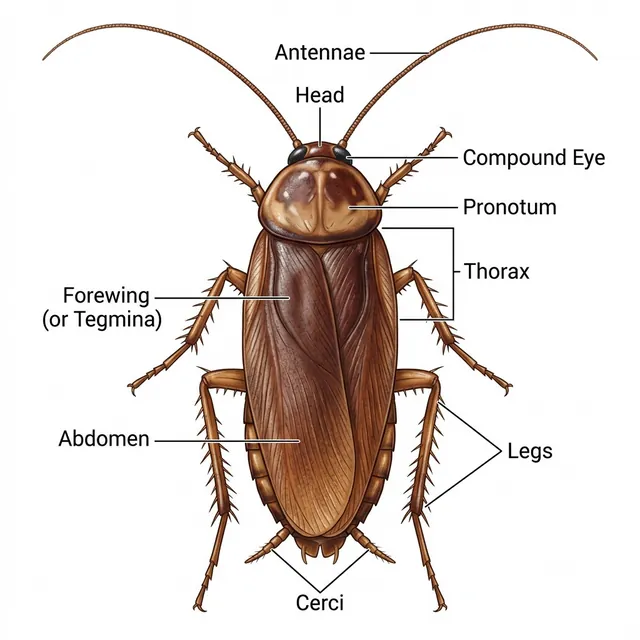
| Feature | Details |
|---|---|
| Size | 34–35 mm long |
| Colour | Brown / reddish-brown |
| Chromosome number | 2n = 34 (male has 33+X = 33 autosomes + 1 X chromosome; female has 34 = 16 pairs including XX) |
| Sex determination | XO type (male has a single X chromosome and no Y; female has XX). This is different from the XY system seen in humans. |
| Habit | Nocturnal (active at night), omnivorous (eats almost anything), cannibalistic (will eat other cockroaches if food is scarce) |
| Speed | Up to 130 cm/sec — one of the fastest running insects |
| Habitat | Warm, damp places (kitchens, drains, sewers, basements) |
Body Division and Segments
The cockroach body is divided into three distinct regions: head, thorax, and abdomen. This tripartite body plan is a defining characteristic of all insects.
Pro Content Locked
Upgrade to Pro to access this lesson and all other premium content.
₹99 charged monthly · Cancel anytime
- All Agriculture & Banking Courses
- AI Lesson Questions (100/day)
- AI Doubt Solver (50/day)
- Glows & Grows Feedback (30/day)
- AI Section Quiz (20/day)
- 22-Language Translation (100/day)
- Recall Questions (20/day)
- AI Quiz (15/day)
- AI Quiz Paper Analysis (100/day)
- AI Step-by-Step Explanations (100/day)
- Spaced Repetition Recall (FSRS)
- AI Tutor
- Immersive Text Questions
- Audio Lessons — Hindi & English
- Mock Tests & Previous Year Papers
- Summary & Mind Maps
- XP, Levels, Leaderboard & Badges
- Generate New Classrooms
- Voice AI Teacher (AgriDots Live)
- AI Revision Assistant
- Knowledge Gap Analysis
- Interactive Revision (LangGraph)
🔒 Secure via Razorpay · Cancel anytime · No hidden fees
The cockroach (Periplaneta americana) is one of the most commonly studied insects in biology. It is a model organism for understanding arthropod body organization, and questions on its anatomy appear frequently in competitive exams. This lesson covers its external features in detail.
Classification
| Rank | Taxon |
|---|---|
| Phylum | Arthropoda |
| Class | Insecta |
| Order | Dictyoptera (earlier Blattodea) |
| Genus | Periplaneta |
| Species | P. americana (American cockroach) |
NOTE
Despite being called the "American cockroach," Periplaneta americana is believed to have originated in Africa and was spread worldwide through human commerce.
General Features
| Feature | Details |
|---|---|
| Size | 34–35 mm long |
| Colour | Brown / reddish-brown |
| Chromosome number | 2n = 34 (male has 33+X = 33 autosomes + 1 X chromosome; female has 34 = 16 pairs including XX) |
| Sex determination | XO type (male has a single X chromosome and no Y; female has XX). This is different from the XY system seen in humans. |
| Habit | Nocturnal (active at night), omnivorous (eats almost anything), cannibalistic (will eat other cockroaches if food is scarce) |
| Speed | Up to 130 cm/sec — one of the fastest running insects |
| Habitat | Warm, damp places (kitchens, drains, sewers, basements) |
Body Division and Segments
The cockroach body is divided into three distinct regions: head, thorax, and abdomen. This tripartite body plan is a defining characteristic of all insects.
| Region | Segments (Embryo) | Segments (Adult) |
|---|---|---|
| Head | 6 | 6 (fused into a single head capsule) |
| Thorax | 3 | 3 (distinct segments) |
| Abdomen | 11 | 10 visible (11th segment is reduced and hidden) |
| Total (embryo) | 20 | — |
Sclerites
The exoskeleton of each body segment consists of hardened plates called sclerites, which provide structural support and protection:
| Sclerite | Position |
|---|---|
| Tergite (tergum) | Dorsal (top) |
| Sternite (sternum) | Ventral (bottom) |
| Pleuron (pleurite) | Lateral (sides — 2 per segment) |
Sclerites are joined by soft arthrodial membranes (flexible connective tissue) that allow movement between segments. This combination of rigid plates and flexible membranes gives the cockroach both protection and flexibility.
Head
- Orientation: Hypognathous (mouthparts directed downward). This is the most common head orientation in insects, allowing them to feed on surfaces they walk on.
- Shape: Triangular; formed by the fusion of 6 embryonic segments into a single structure
- Head capsule = epicranium
Head Appendages
| Structure | Details |
|---|---|
| Compound eyes | 1 pair; each contains ~2000 ommatidia (individual visual units); located dorso-laterally (on the upper sides of the head). Compound eyes provide a wide field of vision. |
| Ocelli / Fenestrae | 1 pair; simple eyes that are reduced in size; located near compound eyes. They primarily sense light intensity rather than forming images — helping the cockroach detect changes between light and dark. |
| Antennae | 1 pair; long, filiform (thread-like) shape; highly sensory organs for touch and smell; composed of many small segments. Antennae are constantly moving, sensing the environment. |
Mouthparts (Biting and Chewing Type)
The cockroach has biting and chewing type mouthparts, which is considered the most primitive type of insect mouthpart. Each part has a specific role in food processing:
| Part | Description |
|---|---|
| Labrum | The upper lip; a flap that covers the mouth anteriorly (from the front); helps hold food in place |
| Mandibles | 1 pair; hard, toothed structures; the primary tools for crushing and chewing food — they move laterally (side to side) |
| 1st Maxillae | 1 pair; help manipulate and push food toward the mandibles; bear sensory palps (maxillary palps) that taste food |
| Labium | The lower lip (formed by fusion of the 2nd maxillae); also bears sensory palps (labial palps); helps prevent food from falling out during chewing |
| Hypopharynx | A tongue-like structure inside the mouth; directs the flow of saliva onto food |
TIP
To remember the mouthparts in order (top to bottom): Labrum (upper Lip), Mandibles (Mash food), maXillae (eXtra manipulation), Labium (Lower lip), Hypopharynx (Hidden tongue).
Thorax
The thorax consists of three segments, each bearing 1 pair of legs (= 3 pairs / 6 legs total). This is why cockroaches (and all insects) are called hexapods.
| Segment | Legs | Wings |
|---|---|---|
| Prothorax | 1st pair | No wings (wingless segment) |
| Mesothorax | 2nd pair | Tegmina (forewings — thick, leathery, opaque; primarily protective, covering the delicate hind wings) |
| Metathorax | 3rd pair | Hind wings (thin, membranous, transparent; the actual wings used for flight) |
NOTE
Although cockroaches have wings, most species are poor fliers. The tegmina are not true flight wings — they serve as protective covers (like the elytra of beetles). Only the membranous hind wings are used for actual flight, and even then, cockroaches prefer to run.
Legs (Walking Type / Cursorial)
Each leg has 5 segments, connected by joints that allow the leg to move in multiple directions:
| Segment | Description |
|---|---|
| Coxa | The basal segment; attaches the leg to the thorax |
| Trochanter | A small segment connecting coxa to femur; acts as a pivot point |
| Femur | The largest, most muscular segment (equivalent to the thigh); provides power for locomotion |
| Tibia | Long and thin; bears spines on its surface that aid in gripping surfaces |
| Tarsus | Divided into 5 sub-segments (tarsomeres); ends in paired claws (for gripping rough surfaces) + arolium (a soft adhesive pad between the claws that allows the cockroach to climb smooth surfaces like glass) |
Abdomen
The abdomen houses the reproductive organs, excretory structures, and part of the digestive system. There are important differences between males and females:
| Feature | Male | Female |
|---|---|---|
| Visible segments | 9 | 7 |
| Visible sterna | 9 | 7 (the 7th sternum is boat-shaped and forms a brood pouch that holds the egg case) |
| Largest tergum | 7th | — |
| Anal cerci | Present (1 pair) — sensory appendages that detect air currents and vibrations | Present (1 pair) — sensory |
| Anal styles | Present (1 pair) — male only; these are small, unjointed appendages near the cerci | Absent |
| Stink/odoriferous glands | Present on 5th and 6th terga — secrete a foul-smelling substance for defense | Present |
| Gonapophyses | — | 3 pairs (plate-like structures surrounding the ootheca chamber; help in forming and depositing the egg case) |
IMPORTANT
Key sex difference for exams: Males have 9 visible sterna + anal styles; Females have 7 visible sterna + no anal styles. The presence of anal styles is the quickest way to identify a male cockroach.
Body Wall
The body wall of the cockroach consists of three layers (from outside to inside):
| Layer | Details |
|---|---|
| Cuticle (outermost) | Non-living; secreted by the underlying epidermis. Has two sub-layers: epicuticle (thin, waxy, waterproof — prevents water loss) and procuticle (thick, chitinous — further divided into hard exocuticle and flexible endocuticle) |
| Epidermis | Single layer of living cells; responsible for secreting the cuticle above and the basement membrane below |
| Basement membrane (innermost) | Thin, non-cellular sheet that separates the epidermis from the body cavity |
- The cuticle is primarily made of chitin (a tough polysaccharide — the same material found in crab shells) hardened by a process called sclerotization (chemical tanning with proteins)
- Because the rigid exoskeleton cannot grow, the cockroach must periodically shed it through moulting (ecdysis) to allow growth
Haemocoel (Body Cavity)
- The cockroach has an open circulatory system, meaning blood does not flow through closed vessels. Instead, the body cavity is a haemocoel — a large space filled with haemolymph (the insect equivalent of blood)
- The haemocoel contains blood sinuses (open spaces where haemolymph bathes the organs directly) and fat bodies (irregular masses of tissue that store food reserves, uric acid, and other metabolic products)
Why is the circulatory system 'open'?
In an open circulatory system, blood (haemolymph) is not always contained within blood vessels. The heart pumps haemolymph into the body cavity (haemocoel), where it directly bathes the organs, supplying nutrients and removing wastes. This is less efficient than a closed system but is adequate for insects because their **tracheal system** delivers oxygen directly to cells — the blood does not need to carry oxygen.Compound Eyes
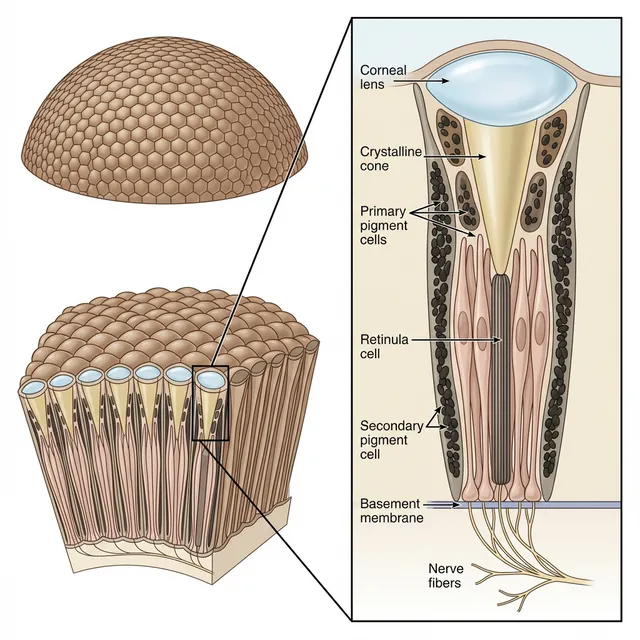
- Each compound eye contains ~2000 ommatidia — the structural and functional units of the compound eye
- Each ommatidium acts as an independent light receptor with its own lens system: corneal lens → crystalline cone → 8 retinula cells → rhabdom (the light-sensitive central rod formed by the rhabdomeres of the retinula cells)
Types of Vision
| Type | Condition | Image Quality |
|---|---|---|
| Apposition / Mosaic image | Bright light (day) | Sharp, detailed — each ommatidium forms a separate image of a small portion of the visual field; all these partial images combine to form a complete mosaic image |
| Superposition image | Dim light (night) | Blurred, less detailed — light from adjacent ommatidia overlaps, creating a brighter but less sharp image |
- The cockroach has predominantly mosaic vision and sees better in bright light, though it is paradoxically a nocturnal animal. Its other senses (antennae for touch and smell, cerci for vibration detection) are more important for navigation in the dark.
Summary Cheat Sheet
| Concept / Topic | Key Details / Explanation |
|---|---|
| Classification | Phylum: Arthropoda, Class: Insecta, Order: Dictyoptera (Blattodea) Genus: Periplaneta, Species: P. americana (American cockroach — actually originated in Africa) |
| General Features | Size: 34–35 mm; Colour: brown/reddish-brown Chromosome number: 2n = 34 Sex determination: XO type (male 33+X, female 34 = XX) Habit: nocturnal, omnivorous, cannibalistic Speed: up to 130 cm/sec (one of fastest running insects) |
| Body Division | Head (6 fused segments) + Thorax (3 segments) + Abdomen (10 visible segments, 11th reduced) Total embryonic segments: 20 |
| Sclerites | Tergite (dorsal) + Sternite (ventral) + Pleurites (lateral, 2 per segment) Joined by flexible arthrodial membranes |
| Head | Orientation: Hypognathous (mouthparts directed downward) Shape: triangular; head capsule = epicranium |
| Compound Eyes | 1 pair; each contains ~2000 ommatidia; located dorso-laterally Ocelli/Fenestrae: 1 pair, simple eyes, sense light intensity only |
| Antennae | 1 pair; filiform (thread-like); sensory for touch and smell; many small segments |
| Mouthparts (Biting & Chewing) | Labrum (upper lip) → Mandibles (hard, toothed, crush food) → 1st Maxillae (manipulate food, bear maxillary palps) → Labium (lower lip, fused 2nd maxillae, labial palps) → Hypopharynx (tongue-like, directs saliva) |
| Thorax — Segments & Wings | Prothorax: 1st pair legs, no wings Mesothorax: 2nd pair legs + tegmina (forewings — thick, leathery, protective) Metathorax: 3rd pair legs + hind wings (thin, membranous, used for flight) |
| Legs (Cursorial/Walking) | 3 pairs (6 legs = hexapod); each has 5 segments: Coxa (basal) → Trochanter (pivot) → Femur (largest, muscular) → Tibia (spines for gripping) → Tarsus (5 tarsomeres + paired claws + arolium pad for smooth surfaces) |
| Abdomen — Male vs Female | Male: 9 visible sterna, anal styles present (1 pair, male only), anal cerci (1 pair) Female: 7 visible sterna (7th is boat-shaped brood pouch), no anal styles, anal cerci (1 pair), 3 pairs gonapophyses Quick sex ID: anal styles = male |
| Stink Glands | Present on 5th and 6th abdominal terga; secrete foul-smelling substance for defense |
| Body Wall (3 Layers) | Cuticle (outermost, non-living): epicuticle (waxy, waterproof) + procuticle (chitinous: exocuticle + endocuticle) Epidermis (middle, living cells): secretes cuticle Basement membrane (innermost, non-cellular) Made of chitin, hardened by sclerotization; growth requires moulting (ecdysis) |
| Haemocoel | Open circulatory system; body cavity = haemocoel filled with haemolymph Contains blood sinuses + fat bodies (store food, uric acid) |
| Compound Eye — Ommatidium | Each of ~2000 ommatidia has: corneal lens → crystalline cone → 8 retinula cells → rhabdom (light-sensitive rod) |
| Types of Vision | Apposition/Mosaic image: bright light → sharp, detailed image Superposition image: dim light → blurred but brighter image Cockroach sees better in bright light despite being nocturnal |
Lesson Doubts
Ask questions, get expert answers