🦠 Pests and Diseases of Honey Bees
Wax moths, mites, birds, and microbial diseases -- identification, symptoms, and management of major bee enemies
In the previous lesson, we explored bee behaviour -- swarming, absconding, dance language, and morphology. Now we turn to the threats bees face: the pests, predators, and diseases that can devastate colonies and how to manage them.
A progressive beekeeper in Madhya Pradesh opens his hive one morning and finds silken tunnels running through the comb, with larvae feeding on the wax. His colony has been attacked by the Greater Wax Moth -- one of the most destructive pests of stored bee combs. Honey bee colonies face threats from insect pests, mites, birds, and microbial diseases. Effective management of these enemies is crucial for maintaining colony health and profitable beekeeping.
This lesson covers:
- Insect pests -- wax moths, ants, wasps, wax beetles, bee-eater birds
- Bee mites -- Varroa, Acarapis, and Isle of Wight disease
- Microbial diseases -- Nosema, AFB, EFB, Chalk Brood, Stone Brood, Sac Brood
- Pest management -- bee-safe insecticides and repellents
Part 1: Insect Pests
Insect pests attack bee colonies by feeding on wax, honey, pollen, or the bees themselves. Weak colonies with insufficient workers to patrol all areas are most vulnerable.
Pro Content Locked
Upgrade to Pro to access this lesson and all other premium content.
₹99 charged monthly · Cancel anytime
- All Agriculture & Banking Courses
- AI Lesson Questions (100/day)
- AI Doubt Solver (50/day)
- Glows & Grows Feedback (30/day)
- AI Section Quiz (20/day)
- 22-Language Translation (100/day)
- Recall Questions (20/day)
- AI Quiz (15/day)
- AI Quiz Paper Analysis (100/day)
- AI Step-by-Step Explanations (100/day)
- Spaced Repetition Recall (FSRS)
- AI Tutor
- Immersive Text Questions
- Audio Lessons — Hindi & English
- Mock Tests & Previous Year Papers
- Summary & Mind Maps
- XP, Levels, Leaderboard & Badges
- Generate New Classrooms
- Voice AI Teacher (AgriDots Live)
- AI Revision Assistant
- Knowledge Gap Analysis
- Interactive Revision (LangGraph)
🔒 Secure via Razorpay · Cancel anytime · No hidden fees
In the previous lesson, we explored bee behaviour -- swarming, absconding, dance language, and morphology. Now we turn to the threats bees face: the pests, predators, and diseases that can devastate colonies and how to manage them.
A progressive beekeeper in Madhya Pradesh opens his hive one morning and finds silken tunnels running through the comb, with larvae feeding on the wax. His colony has been attacked by the Greater Wax Moth -- one of the most destructive pests of stored bee combs. Honey bee colonies face threats from insect pests, mites, birds, and microbial diseases. Effective management of these enemies is crucial for maintaining colony health and profitable beekeeping.
This lesson covers:
- Insect pests -- wax moths, ants, wasps, wax beetles, bee-eater birds
- Bee mites -- Varroa, Acarapis, and Isle of Wight disease
- Microbial diseases -- Nosema, AFB, EFB, Chalk Brood, Stone Brood, Sac Brood
- Pest management -- bee-safe insecticides and repellents
Part 1: Insect Pests
Insect pests attack bee colonies by feeding on wax, honey, pollen, or the bees themselves. Weak colonies with insufficient workers to patrol all areas are most vulnerable.
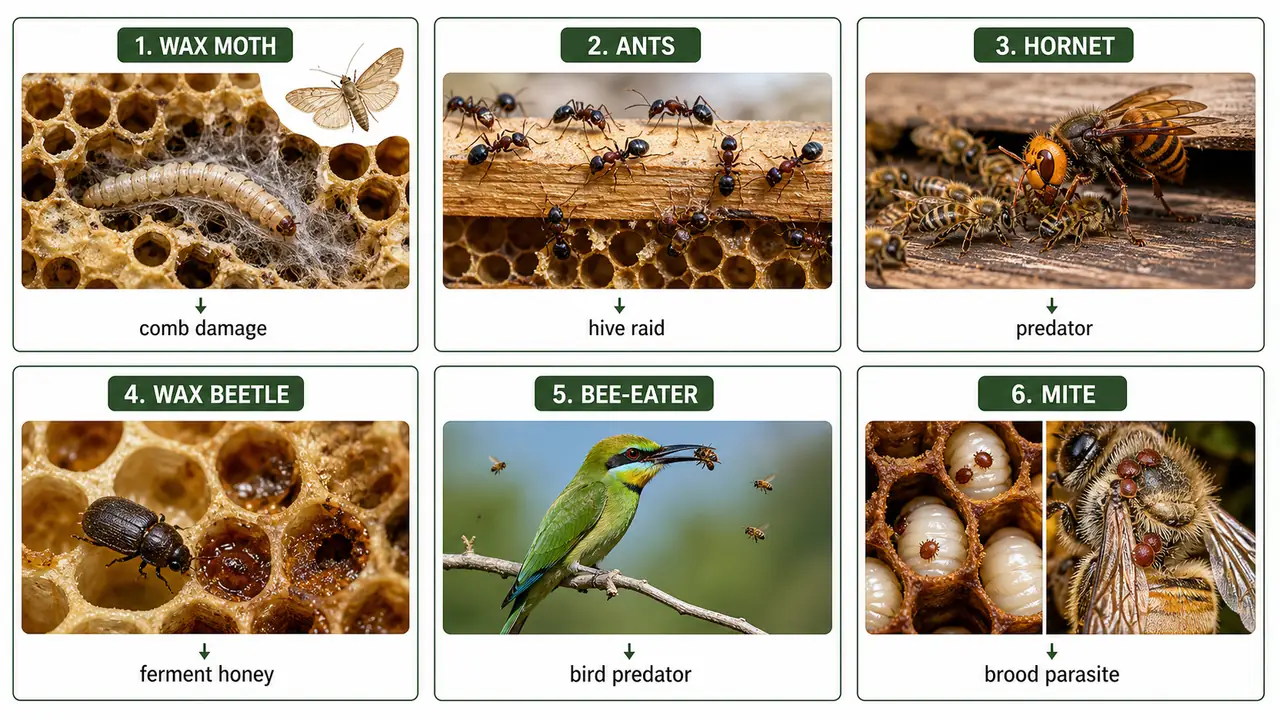
1. Greater Wax Moth -- Galleria mellonella — Most Important Natural Enemy
IMPORTANT
Galleria mellonella (Greater Wax Moth) is the most important natural enemy of honey bees. Its larvae tunnel through combs and can destroy entire stored combs. Weak colonies and unguarded stored combs are most vulnerable.
- Family: Galleridae, Order: Lepidoptera
- One of the most destructive pests of stored bee combs in tropical and sub-tropical Asia.
- Larvae tunnel through combs, spinning silk-lined tunnels (silken galleries), feeding on wax, pollen, propolis, and royal jelly.
- Weak colonies are especially vulnerable because they lack sufficient workers to patrol all areas.
- Empty and stored combs are most at risk if left unattended.
2. Lesser Wax Moth -- Achroia grisella
- Family: Galleridae, Order: Lepidoptera
- Smaller than the Greater Wax Moth but still damaging to stored combs and weak colonies.
- Feeds on comb debris and de-caps sealed cells, exposing pupae -- this condition is called bald brood.
TIP
Exam Distinction: Greater Wax Moth = silken galleries in comb. Lesser Wax Moth = bald brood (de-capped cells exposing pupae).
3. Ants
- Among the most common predators in tropical/subtropical areas.
- Attack hives en masse, taking dead/alive bees, brood, and honey.
- Control: Use ant wells (containers filled with water or oil) around hive stand legs as a physical barrier.
4. Wasps and Hornets -- Vespa spp.
- Dangerous predators across all Asian countries including India.
- A single hornet can kill 40 bees per minute; a group can destroy an entire colony in hours.
5. Wax Beetle
- Tenebroid beetle (Platybolium alvearium) and African small hive beetle (Aethina tumida).
- Larvae tunnel through comb, consuming honey and pollen, causing honey to ferment and spoil.
6. Honey Bee Eater Birds
- Airborne bees are virtually defenceless against insectivorous birds.
- Major bird pests:
- Green Bee Eater (Merops orientalis)
- Black Drongo (Dicrurus macrocercus)
- These birds can consume hundreds of bees per day, significantly reducing the foraging workforce.
7. Bee Mites
Parasitic mites are among the most serious enemies globally. They weaken bees by feeding on haemolymph and fat bodies, and also serve as vectors for viral diseases.
| Disease | Mite | Host | Site of Infection |
|---|---|---|---|
| Isle of Wight disease | Acarapis woodi | A. mellifera, A. cerana | Trachea (breathing tubes) |
| Varroasis | Varroa jacobsoni, V. destructor | A. mellifera | Brood cells and adult bees |
| -- | Euvarroa sinhai | A. florea | Brood and adult bees |
| -- | Tropilaelaps spp. | A. dorsata, A. mellifera | Brood and adult bees |
| -- | Neocypholaelaps spp. (phoretic) | Apis spp. | Adult bees, pollen-storage cells |
- Varroa destructor is the single most devastating pest of honey bees globally, responsible for massive colony losses worldwide.
Pest Management
TIP
Bee Repellents (phenols): propionic acid, benzaldehyde, acetic acid, propionic anhydride. Insecticides non-toxic to bees: Pyrethrum, Nicotine, Rotenone, Sulphur, 2,4-D. Remember: "P-N-R-S-D = Please Never Rush Spraying Dangerously."
Part 2: Microbial Diseases
Unlike insect pests that attack from outside, microbial diseases infect bees internally -- caused by protozoa, bacteria, fungi, or viruses. Identification relies on specific symptoms and diagnostic tests, and accurate classification by pathogen type is a favourite exam question.
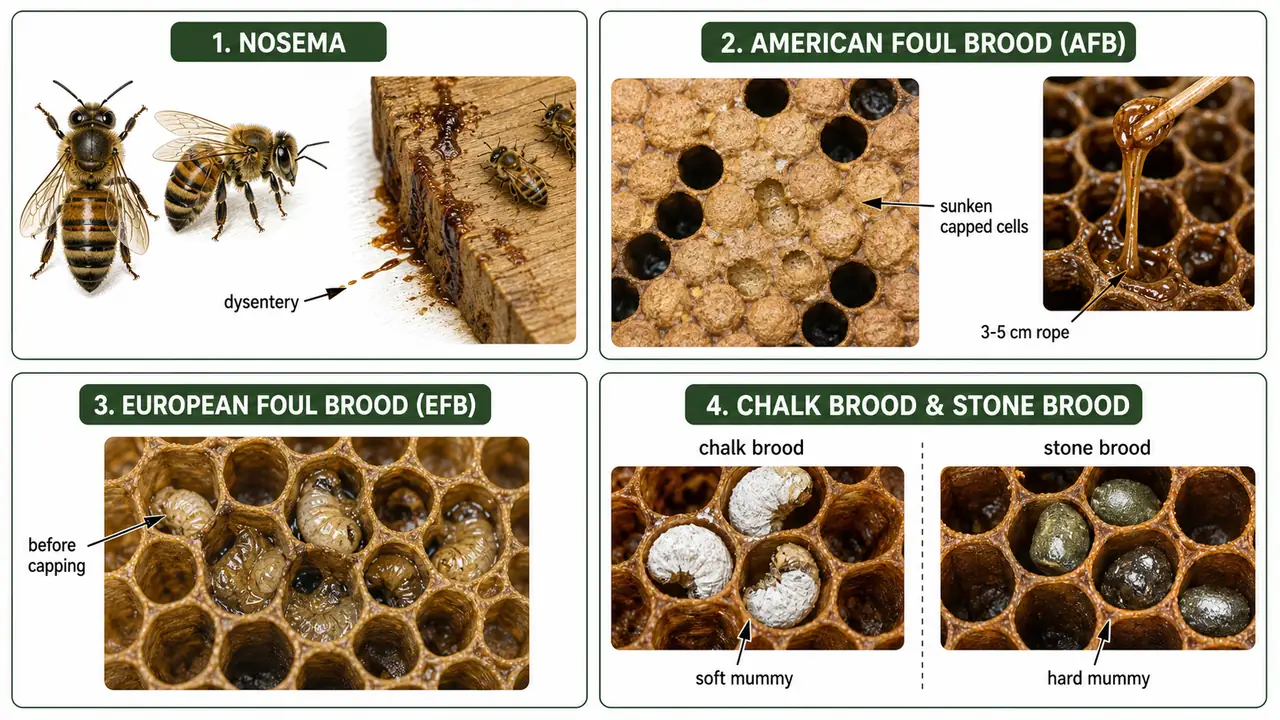
Comparison of Bee Diseases
| Disease | Pathogen Type | Causal Organism | Key Symptom | Diagnostic Feature |
|---|---|---|---|---|
| Nosema | Protozoan | Nosema apis | Dysentery, crawling at entrance | Yellow/golden fecal streaks on hive |
| American Foul Brood (AFB) | Bacterial | Paenibacillus larvae | Sunken cappings, sour odour | Ropiness test: thread 3-5 cm |
| European Foul Brood (EFB) | Bacterial | Melissococcus plutonius | Patchy brood, ammonia smell | Ropiness test: thread 1.5 cm |
| Chalk Brood | Fungal | Ascosphaera apis | White/grey mummies in cells | Soft, spongy mummies |
| Stone Brood | Fungal | Aspergillus flavus (+ A. fumigatus, A. niger) | Green/yellow mummies | Hard mummies (like stones) |
| Sac Brood | Viral | Sac Brood Virus | Larvae look like water-filled sacs | Head raised, banana shape |
Nosema
- Caused by protozoan Nosema apis (microsporidian parasite infecting midgut epithelial cells).
- Affects adult bees during cold, foggy, and rainy weather when bees are confined to the hive.
- Regarded as one of the most destructive diseases of adult bees.
- Spores contaminate food and water; remain viable for years.
- Affected bees are unable to fly, crawl at the hive entrance, and show signs of dysentery -- runny yellow/golden fecal streaks (1/4" to 2" long) on the hive.
- Hypopharyngeal glands deteriorate, meaning nurse bees can no longer produce royal jelly, crippling brood rearing.
American Foul Brood (AFB)
- Caused by bacterium Paenibacillus larvae, transmitted through spores that remain infectious for over 50 years.
- The most serious bacterial disease of honey bees worldwide.
- Symptoms: sunken, greasy-looking cappings; larvae die and turn yellow then chocolate brown.
- Ropiness test: Probe the dead larva with a matchstick -- contents rope out forming an elastic thread 3-5 cm long.
- Emits a sour odour.
European Foul Brood (EFB)
- Caused by bacterium Melissococcus plutonius, transmitted through spores.
- Typically kills larvae before capping (unlike AFB which kills after capping).
- Symptoms: uneven, patchy brood; dead larvae change from pearly white to yellow to brown.
- Ropiness test: Thread only 1.5 cm long (shorter than AFB's 3-5 cm -- a useful distinguishing feature).
- Smell: ammonia-like (sometimes sour).
TIP
AFB vs. EFB Mnemonic: AFB = After capping, rope 3-5 cm, sour smell. EFB = Early (before capping), rope 1.5 cm, ammonia smell.
Chalk Brood Disease
- Caused by fungus Ascosphaera apis.
- Rarely kills colonies but weakens them, reducing honey yields.
- Mummies are white (or grey/black when spores form), soft and spongy -- hence "chalk-like."
Stone Brood Disease
- Caused by fungi Aspergillus flavus, A. fumigatus, A. niger (common soil-dwelling organisms).
- Mummies are very hard (like stones), green/yellow in colour.
- Key distinction: Chalk brood mummies are soft/spongy; stone brood mummies are hard.
Sac Brood Disease
- Caused by Sac Brood Virus -- the most common viral disease of honey bees.
- Larvae appear sac-like (fluid trapped between old and new skin, failing to shed during final moult).
- Dead larvae are pearly white, look like a water-filled sac, with head raised toward the top of the cell in a characteristic banana shape.
- Infected larvae die shortly after capping and fail to pupate.
Summary Table
| Pest/Disease | Type | Key Identifier |
|---|---|---|
| Greater Wax Moth | Insect | Silken galleries in comb |
| Lesser Wax Moth | Insect | Bald brood (de-capped cells) |
| Varroa mite | Mite | Brood infection; global #1 pest |
| Acarapis mite | Mite | Isle of Wight disease (trachea) |
| Nosema | Protozoan | Dysentery, yellow fecal streaks |
| AFB | Bacterial | Ropiness 3-5 cm, sour odour |
| EFB | Bacterial | Ropiness 1.5 cm, ammonia smell |
| Chalk Brood | Fungal | Soft, white/grey mummies |
| Stone Brood | Fungal | Hard, green/yellow mummies |
| Sac Brood | Viral | Water-filled sac, banana shape |
| Bee-safe insecticides | -- | Pyrethrum, Nicotine, Rotenone, Sulphur, 2,4-D |
References
1 source
References
Summary Cheat Sheet
| Concept / Topic | Key Details |
|---|---|
| Greater Wax Moth | Galleria mellonella; Lepidoptera: Galleridae; silken galleries in comb |
| Lesser Wax Moth | Achroia grisella; causes bald brood (de-capped cells) |
| Ants – control | Ant wells (water/oil containers) around hive stand legs |
| Wasps & Hornets | Vespa spp.; single hornet kills 40 bees/minute |
| Wax Beetle | Platybolium alvearium, Aethina tumida; larvae cause honey to ferment |
| Green Bee Eater | Merops orientalis; major bird pest consuming hundreds of bees/day |
| Black Drongo | Dicrurus macrocercus; insectivorous bird pest |
| Isle of Wight disease | Mite Acarapis woodi; infects trachea of A. mellifera and A. cerana |
| Varroasis | Varroa destructor; most devastating pest globally; attacks brood + adults |
| Bee repellents (phenols) | Propionic acid, benzaldehyde, acetic acid, propionic anhydride |
| Insecticides non-toxic to bees | Pyrethrum, Nicotine, Rotenone, Sulphur, 2,4-D (P-N-R-S-D) |
| Nosema | Protozoan Nosema apis; dysentery; yellow fecal streaks; cold/rainy weather |
| American Foul Brood (AFB) | Paenibacillus larvae; ropiness 3-5 cm; sour odour; kills after capping |
| European Foul Brood (EFB) | Melissococcus plutonius; ropiness 1.5 cm; ammonia smell; kills before capping |
| Chalk Brood | Fungus Ascosphaera apis; soft, spongy white/grey mummies |
| Stone Brood | Aspergillus flavus/fumigatus/niger; hard green/yellow mummies |
| Sac Brood | Sac Brood Virus; larvae look like water-filled sacs; banana shape |
| AFB spore viability | Remains infectious over 50 years |
TIP
Next: Lesson 07 covers beekeeping equipment -- the bee box, smoker, honey extractor, and the critical concept of bee space.