🐳 Physiology -- Reproduction, Excretion, and Nervous System
Reproductive modes (sexual, parthenogenetic, hermaphroditic), male and female gonad anatomy, excretory types, and the nerve ring
In the previous lesson, we examined the digestive system -- the inner tube from stoma to anus. Now we explore the other organ systems suspended in the pseudocoelom: the reproductive, excretory, and nervous systems.
A single root-knot nematode female (Meloidogyne sp.) can produce 200--400 eggs without ever mating, thanks to parthenogenetic reproduction. Within one growing season, 7--8 overlapping generations can build up, turning a minor infestation into a devastating population explosion.
Why reproduction mode matters for pest control: Nematodes that reproduce by parthenogenesis (like root-knot) are harder to control because every individual is a potential founder of a new colony — no need to find a mate. Species that require sexual reproduction (like cyst nematodes) build up more slowly but survive longer through cysts. Understanding the reproductive mode helps predict how fast a population will explode after introduction.
Economic impact of reproduction rates: A single Meloidogyne female producing 300 eggs × 7 generations/season = theoretically 300⁷ = 21.8 × 10¹⁶ offspring per season. Even with 99.9% mortality, populations can increase 1000-fold per season. This is why preventive management is critical — once established, nematodes are nearly impossible to eradicate.
Pro Content Locked
Upgrade to Pro to access this lesson and all other premium content.
₹99 charged monthly · Cancel anytime
- All Agriculture & Banking Courses
- AI Lesson Questions (100/day)
- AI Doubt Solver (50/day)
- Glows & Grows Feedback (30/day)
- AI Section Quiz (20/day)
- 22-Language Translation (100/day)
- Recall Questions (20/day)
- AI Quiz (15/day)
- AI Quiz Paper Analysis (100/day)
- AI Step-by-Step Explanations (100/day)
- Spaced Repetition Recall (FSRS)
- AI Tutor
- Immersive Text Questions
- Audio Lessons — Hindi & English
- Mock Tests & Previous Year Papers
- Summary & Mind Maps
- XP, Levels, Leaderboard & Badges
- Generate New Classrooms
- Voice AI Teacher (AgriDots Live)
- AI Revision Assistant
- Knowledge Gap Analysis
- Interactive Revision (LangGraph)
🔒 Secure via Razorpay · Cancel anytime · No hidden fees
In the previous lesson, we examined the digestive system -- the inner tube from stoma to anus. Now we explore the other organ systems suspended in the pseudocoelom: the reproductive, excretory, and nervous systems.
A single root-knot nematode female (Meloidogyne sp.) can produce 200--400 eggs without ever mating, thanks to parthenogenetic reproduction. Within one growing season, 7--8 overlapping generations can build up, turning a minor infestation into a devastating population explosion.
Why reproduction mode matters for pest control: Nematodes that reproduce by parthenogenesis (like root-knot) are harder to control because every individual is a potential founder of a new colony — no need to find a mate. Species that require sexual reproduction (like cyst nematodes) build up more slowly but survive longer through cysts. Understanding the reproductive mode helps predict how fast a population will explode after introduction.
Economic impact of reproduction rates: A single Meloidogyne female producing 300 eggs × 7 generations/season = theoretically 300⁷ = 21.8 × 10¹⁶ offspring per season. Even with 99.9% mortality, populations can increase 1000-fold per season. This is why preventive management is critical — once established, nematodes are nearly impossible to eradicate.
This lesson covers:
- Reproductive system -- three modes of reproduction, female and male gonad anatomy
- Excretory system -- canalicular vs glandular types
- Nervous system -- nerve ring and peripheral sensory organs
Reproductive System
The reproductive system is one of the most well-developed organ systems in nematodes. Their rate of reproduction directly determines how quickly populations build up and cause crop damage -- making this section critical for understanding nematode management strategies.
The reproductive system is one of the most well-developed organ systems in nematodes. Their rate of reproduction directly determines how quickly populations build up and cause crop damage.
General Features
- Nematodes are generally dioecious (separate male and female individuals).
- Most plant parasitic nematodes are vermiform (worm-shaped) in both sexes.
- Sexual dimorphism (visible difference between sexes) is observed in sedentary genera: Meloidogyne, Heterodera, Globodera, Rotylenchulus, Tylenchulus, and Nacobbus -- where the female becomes permanently fixed and enormously enlarged.
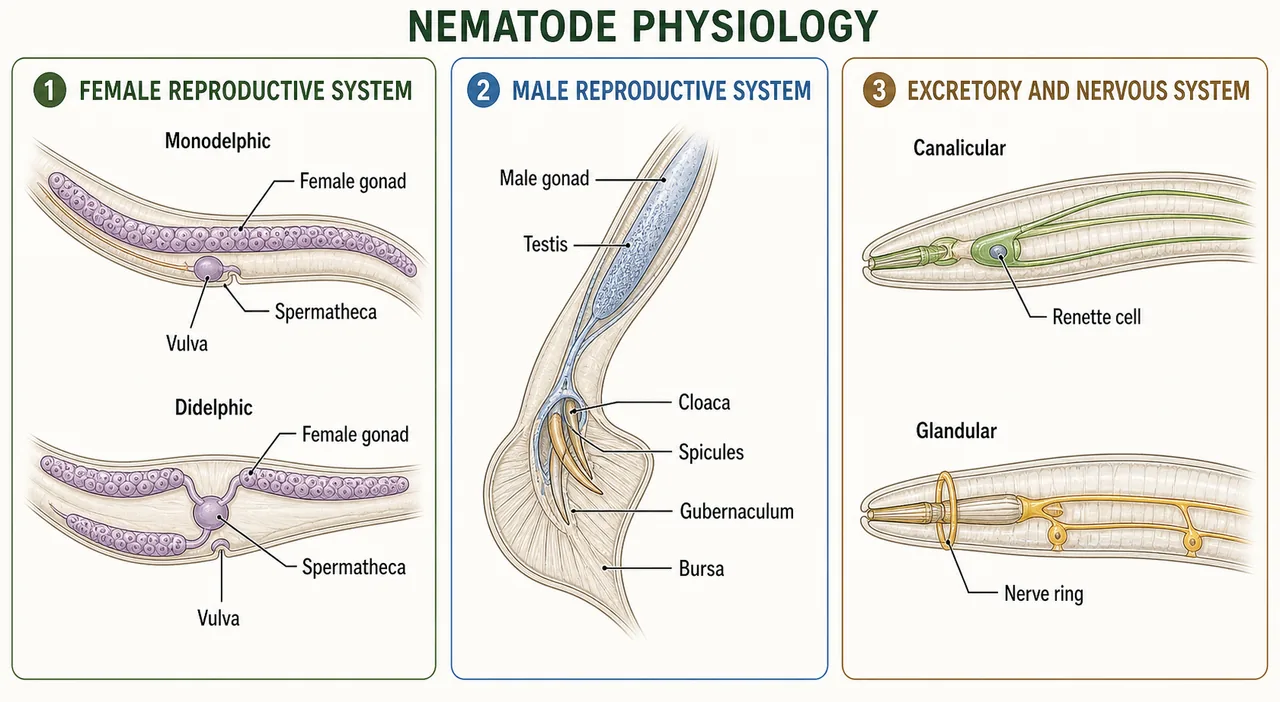
Three Modes of Reproduction
| Mode | Mechanism | Example |
|---|---|---|
| Sexual (Amphimictic) | Fusion of haploid male and female gametes; ensures genetic diversity | Most nematode species |
| Parthenogenetic | Eggs develop into embryos without fertilisation; a single female can start an entire infestation | Meloidogyne sp. (root-knot nematode) |
| Hermaphroditic | Same individual produces both male and female gametes; self-fertilisation occurs | Caenorhabditis elegans (model organism) |
NOTE
Parthenogenesis in Meloidogyne is one reason why root-knot nematodes are so successful as parasites -- a single female can establish an entire population without needing a male.
Female Reproductive System (Female Gonad)
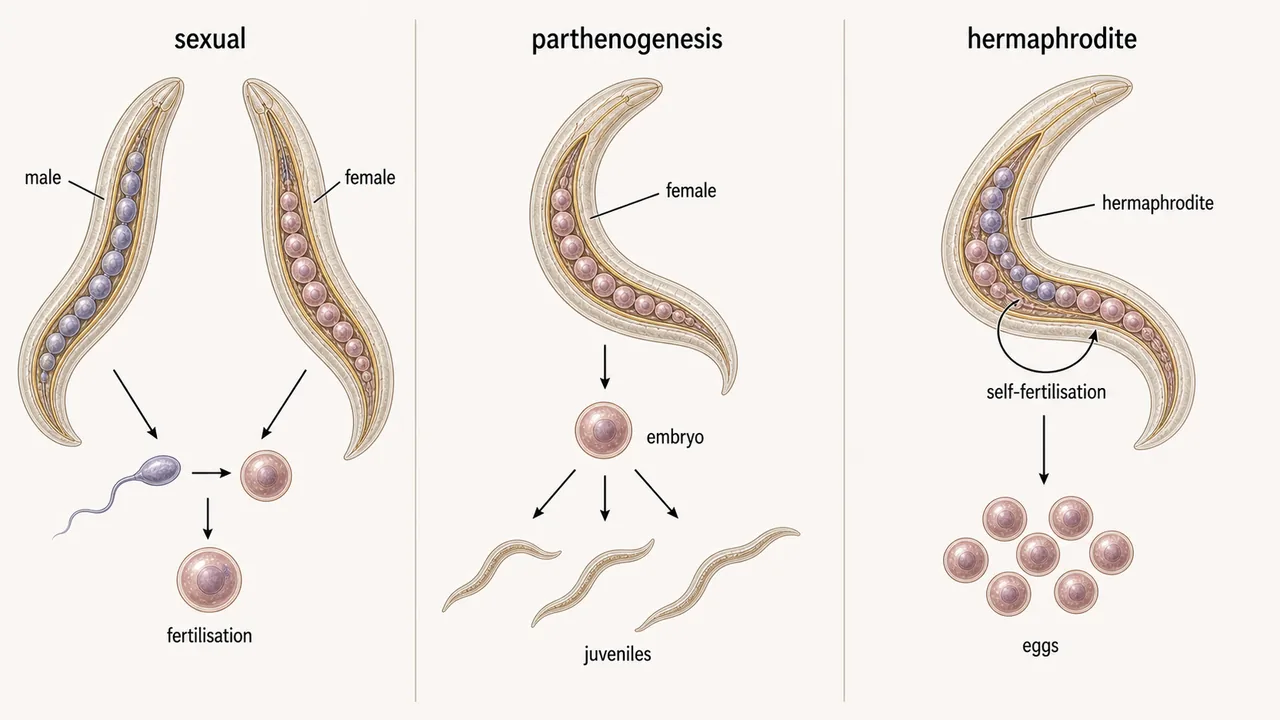
The female gonad comprises two major parts: ovary/ovaries and gonoduct.
Ovary -- Egg Production
The ovary has three functional zones through which cells progress:
| Zone | Process |
|---|---|
| Germinal zone (below cap cells) | Germ cells undergo repeated mitosis, forming oogonial cells |
| Growth zone | Oogonial cells enlarge by accumulating yolk (deutoplasm) to become oocytes; undergo Meiosis-I |
| Maturation/Ripening zone | Haploid oocytes mature and pass into the gonoduct |
Ovary Terminology
| Term | Meaning |
|---|---|
| Monodelphic | One ovary |
| Didelphic | Two ovaries |
| Prodelphic | Ovary/ovaries directed anteriorly |
| Amphidelphic | Two ovaries extending in opposite directions (most common in PPNs) |
| Opisthodelphic | Ovary/ovaries directed posteriorly |
| Outstretched | Terminal portion of ovary is straight |
Gonoduct -- Egg Transport and Fertilisation
| Part | Function |
|---|---|
| Oviduct | Two rows of cells with a tiny canal; controls passage of matured oocytes |
| Uterus | Distal part is the spermatheca -- stores sperm; fertilisation occurs here |
| Vagina | Narrow muscular passage for egg expulsion through the vulva (gonopore) |
TIP
The position of the vulva along the body is an important diagnostic character used in nematode identification keys.
Male Reproductive System (Male Gonad)
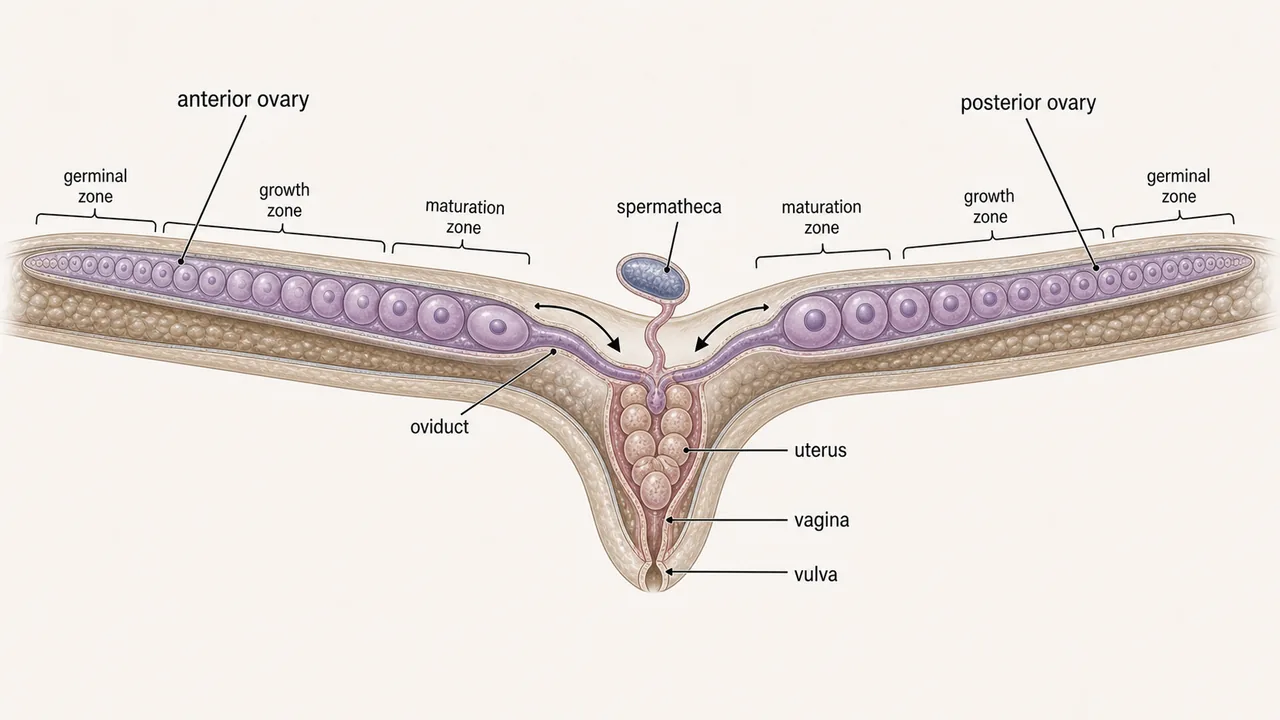
Testis Terminology
| Term | Meaning |
|---|---|
| Monorchic | One testis (most common in plant parasitic Tylenchids) |
| Diorchic | Two testes |
| Monorchic proorchic | One testis directed anteriorly |
| Diorchic proorchic | Two testes directed anteriorly |
| Diorchic opposed | Two testes extending in opposite directions |
Most plant parasitic Tylenchid/Aphelenchid nematodes have a monorchic proorchic outstretched testis.
Gonoduct
| Part | Function |
|---|---|
| Seminal vesicle | Dilated part; permanent storehouse of spermatids/spermatozoa |
| Vas deferens | Long tube connecting seminal vesicle to the rectum, forming the cloaca |
Accessory Copulatory Structures
| Structure | Description | Function |
|---|---|---|
| Spicules | Pair of hard, curved, protrusible tubular organs | Open the female vulva for sperm transfer; shape is a taxonomic character |
| Gubernaculum | Sclerotised, boat-shaped plate on dorsal side of spicules | Guides spicules in straight position during copulation |
| Caudal alae (Bursa) | Pair of lateral wing-like cuticular extensions on the male tail | Clasps the female during mating |
| Cloaca | Common opening of digestive and reproductive systems in males | Controlled by sphincter muscles |
Excretory System
Unlike higher animals, nematodes have a poorly developed excretory system with no distinct kidneys. Despite this simplicity, the system performs vital functions including waste removal, osmoregulation, and secretion of chemicals involved in host-parasite interaction.
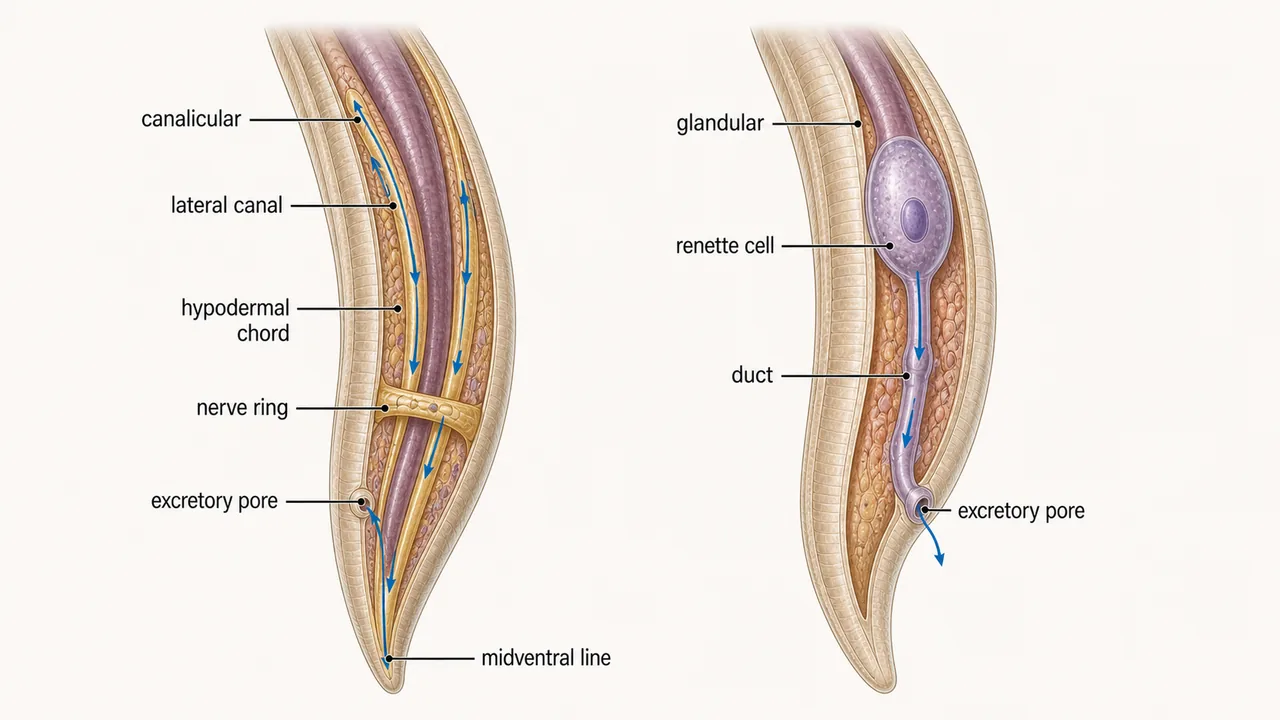
Two Types
| Type | Found In | Structure |
|---|---|---|
| Canalicular | Most Tylenchid nematodes (majority of PPNs) | One lateral excretory canal through the hypodermal chord; opens via excretory pore at midventral line near nerve ring |
| Glandular | Adenophorea class (Xiphinema, Longidorus) | Primitive single gland cell called Renette cell |
Functions of the Excretory System
| Function | Details |
|---|---|
| Waste removal | Removes toxic ammonia and fatty acids |
| Egg protection | Secretory glands produce gelatinous matrix that protects eggs (e.g., citrus nematode egg mass) |
| Osmoregulation | Regulates internal water and salt balance -- critical in fluctuating soil moisture |
| Chemical secretion | Secretes various chemicals involved in host-parasite interaction |
Nervous System
The nematode nervous system is primitive but functional, enabling host detection, soil navigation, mate finding, and environmental response.
1. Central Nervous System
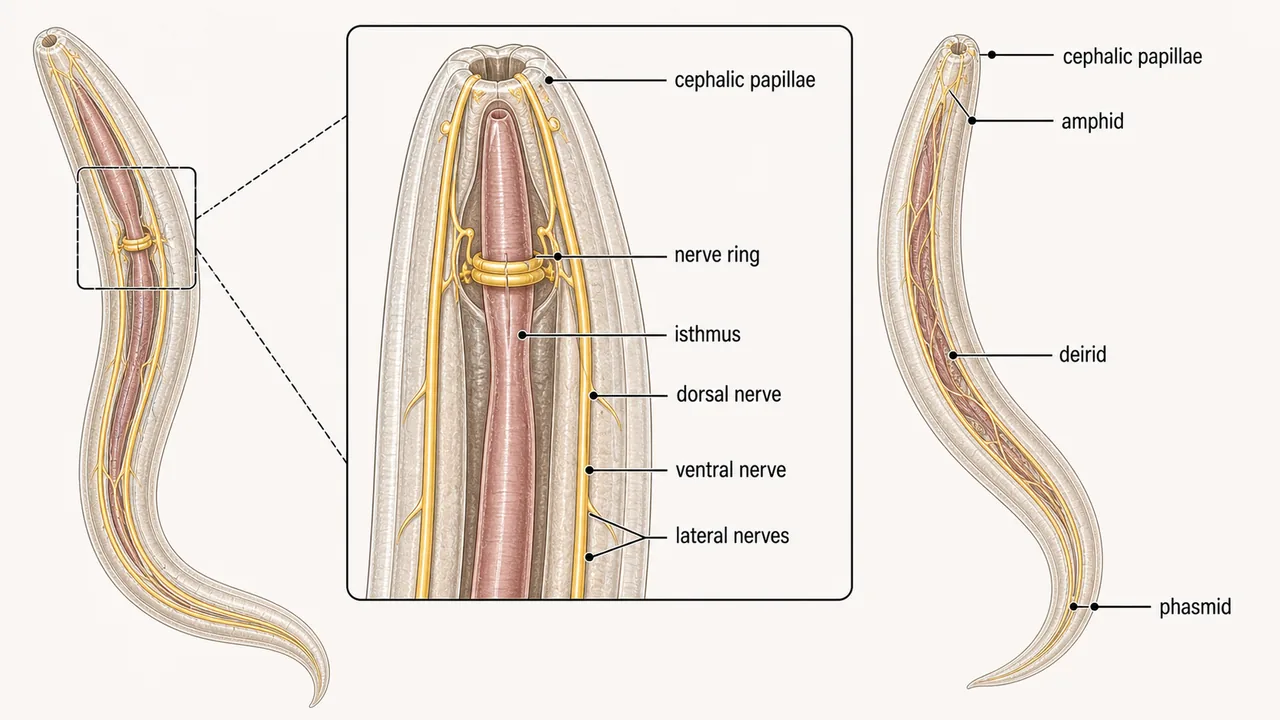
The central nervous system consists of ganglionated nerve fibres forming the Nerve Ring (or Circum-Oesophageal Commissure) -- called the "brain" of the nematode.
- The nerve ring is positioned obliquely (dorsal side up, ventral side down).
- It circles the oesophagus around the isthmus region.
2. Peripheral Nervous System
Located in the body cuticle and the cephalic/caudal regions, the peripheral nerves relay sensory information back to the nerve ring. Key sensory organs include:
| Sensory Organ | Type | Function |
|---|---|---|
| Cephalic papillae | Touch receptors | Detect physical contact at head |
| Amphids | Chemoreceptors | Detect host plant chemicals (root exudates) |
| Phasmids | Chemoreceptors | Aggregation signals (scent trail) |
| Deirids | Mechanoreceptors | Detect physical contact and pore size |
These sensory structures work together to provide environmental awareness -- locating food, avoiding unfavourable conditions, and finding mating partners.
Summary Table
| System | Key Feature | Exam-Critical Fact |
|---|---|---|
| Female reproduction | Ovary (cap cells, germinal/growth/maturation zones) + gonoduct (oviduct, uterus with spermatheca, vagina, vulva) | Amphidelphic arrangement most common in PPNs |
| Male reproduction | Testis + gonoduct (seminal vesicle, vas deferens) + accessory structures (spicules, gubernaculum, bursa, cloaca) | Monorchic proorchic most common in Tylenchids |
| Sexual reproduction | Amphimictic (gamete fusion) | Ensures genetic diversity |
| Parthenogenesis | Eggs develop without fertilisation | Meloidogyne sp. -- single female starts infestation |
| Hermaphroditic | Self-fertilisation | Caenorhabditis elegans |
| Excretory (Tylenchida) | Canalicular type | Excretory pore at midventral, near nerve ring |
| Excretory (Adenophorea) | Glandular type with Renette cell | Primitive, single-celled gland |
| Central nervous system | Nerve ring (circum-oesophageal commissure) | "Brain" of the nematode; circles the isthmus |
| Peripheral nervous system | Amphids, phasmids, deirids, cephalic papillae | Chemoreceptors + mechanoreceptors |
TIP
Exam mnemonic -- "CRG" for excretory systems: Canalicular = Tylenchida (most PPNs), Renette cell = Adenophorea (primitive), Glandular type = Adenophorea class.
References
- Walia, R. K and Bajaj, H. K (2014). Textbook of Introductory Plant Nematology. Directorate of Knowledge Management in Agriculture, ICAR, New Delhi.
- Ravichandra, N. G. (2019). Plant Nematology. I. K. International Publishing House Pvt. Ltd., New Delhi.
- Dasgupta, M. K. (1998). Phytonematology. Pilgrims Publishing
- Fotedar, D.N. & Handoo, Z.A. (1978) A revised scheme of classification to order Tylenchida Thorne, 1949 (Nematoda). Journal of Science, University of Kashmir (1975), 3, 55-82.
- Qing, X., Bert, W. Family Tylenchidae (Nematoda): an overview and perspectives. Org Divers Evol 19, 391-408 (2019).
- https://doi.org/10.1007/s13127-019-00404-4
- https://nematode.unl.edu/dolichod.htm
- http://www.nematologia.com.br/files/tematicos/6.pdf
Summary Cheat Sheet
| Concept / Topic | Key Details |
|---|---|
| Female reproduction | Ovary (cap cells, germinal/growth/maturation zones) + gonoduct (oviduct, uterus with spermatheca, vagina, vulva) — Amphidelphic arrangement most common in PPNs |
| Male reproduction | Testis + gonoduct (seminal vesicle, vas deferens) + accessory structures (spicules, gubernaculum, bursa, cloaca) — Monorchic proorchic most common in Tylenchids |
| Sexual reproduction | Amphimictic (gamete fusion) — Ensures genetic diversity |
| Parthenogenesis | Eggs develop without fertilisation — Meloidogyne sp. -- single female starts infestation |
| Hermaphroditic | Self-fertilisation — Caenorhabditis elegans |
| Excretory (Tylenchida) | Canalicular type — Excretory pore at midventral, near nerve ring |
| Excretory (Adenophorea) | Glandular type with Renette cell — Primitive, single-celled gland |
| Central nervous system | Nerve ring (circum-oesophageal commissure) — "Brain" of the nematode; circles the isthmus |
| Peripheral nervous system | Amphids, phasmids, deirids, cephalic papillae — Chemoreceptors + mechanoreceptors |
TIP
Next: Lesson 07 covers classification -- the taxonomic split between Secernentea and Adenophorea, and the feeding-habit-based classification system.