🪱 Seed-Gall Nematode (Anguina tritici)
The first-ever PPN discovered -- earcockle and tundu diseases of wheat, seed-borne biology, brine flotation, and management
In the previous lesson, we covered cyst nematodes -- Heterodera and Globodera with their hardened cyst survival mechanism. Now we examine another nematode with remarkable survival ability: the seed-gall nematode, whose juveniles can remain viable for 32 years inside dried galls.
In 1996--98, wheat farmers in Bihar and Madhya Pradesh faced such severe nematode infestation that they were forced to burn their standing crop. The culprit was the seed-gall nematode (Anguina tritici) -- historically the very first plant parasitic nematode ever discovered (Needham, 1743).
This lesson covers:
- Discovery and distribution -- Needham (1743), Indian distribution
- Biology -- seed-borne life cycle, 32-year survival
- Earcockle disease -- nematode alone on wheat
- Tundu (Yellow Ear Rot) -- nematode + bacterium complex
- Management -- brine flotation, hot water treatment, seed sanitation
Discovery and Distribution
| Fact | Details |
|---|---|
| First discovered | Needham, 1743 -- the first plant parasitic nematode ever reported |
| Original name | Vibrio tritici (Steinbuch, 1799); current name Anguina tritici (Filipjev, 1936) |
| Etymology | Anguinus (Latin) = snake-like; tritici = after host Triticum aestivum (wheat) |
| First report in India | Milne, 1919, Punjab |
| Distribution in India | Bihar, Delhi, Haryana, HP, MP, Punjab, Rajasthan, UP (major wheat states of the Indo-Gangetic plain) |
| Main host | Wheat |
Biology
| Feature | Details |
|---|---|
| Seed-borne | Galls mixed with seed are sown together |
| Juveniles per gall | 3,000--12,000 quiescent J2 larvae |
| Infective stage | J2 -- absorbs moisture in soil, becomes active |
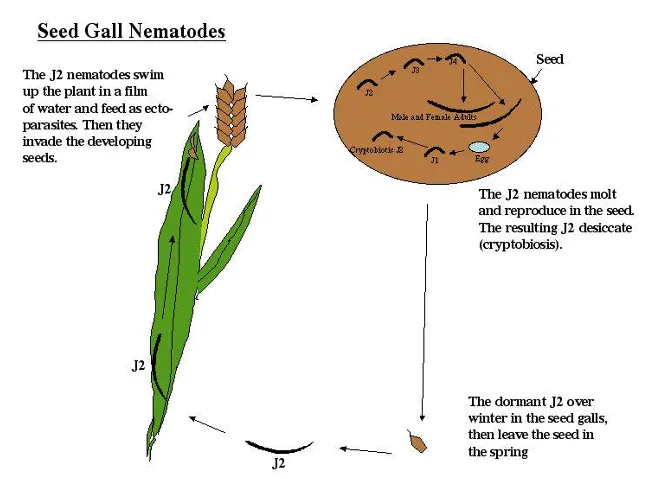
| Infection site | Enters floral primordia at the time of floral initiation |
| Feeding progression | Initially ectoparasitic, becomes endoparasitic after three moults |
| Reproduction | Female lays eggs inside the gall, replacing the developing seed |
| Survival (quiescent) | Up to 32 years in dried galls without moisture |
| Spread | Primarily through contaminated seed (seed-borne disease) |
Earcockle Disease
The nematode alone (without bacteria) causes earcockle disease of wheat.
Pro Content Locked
Upgrade to Pro to access this lesson and all other premium content.
₹99 charged monthly · Cancel anytime
- All Agriculture & Banking Courses
- AI Lesson Questions (100/day)
- AI Doubt Solver (50/day)
- Glows & Grows Feedback (30/day)
- AI Section Quiz (20/day)
- 22-Language Translation (100/day)
- Recall Questions (20/day)
- AI Quiz (15/day)
- AI Quiz Paper Analysis (100/day)
- AI Step-by-Step Explanations (100/day)
- Spaced Repetition Recall (FSRS)
- AI Tutor
- Immersive Text Questions
- Audio Lessons — Hindi & English
- Mock Tests & Previous Year Papers
- Summary & Mind Maps
- XP, Levels, Leaderboard & Badges
- Generate New Classrooms
- Voice AI Teacher (AgriDots Live)
- AI Revision Assistant
- Knowledge Gap Analysis
- Interactive Revision (LangGraph)
🔒 Secure via Razorpay · Cancel anytime · No hidden fees
In the previous lesson, we covered cyst nematodes -- Heterodera and Globodera with their hardened cyst survival mechanism. Now we examine another nematode with remarkable survival ability: the seed-gall nematode, whose juveniles can remain viable for 32 years inside dried galls.
In 1996--98, wheat farmers in Bihar and Madhya Pradesh faced such severe nematode infestation that they were forced to burn their standing crop. The culprit was the seed-gall nematode (Anguina tritici) -- historically the very first plant parasitic nematode ever discovered (Needham, 1743).
This lesson covers:
- Discovery and distribution -- Needham (1743), Indian distribution
- Biology -- seed-borne life cycle, 32-year survival
- Earcockle disease -- nematode alone on wheat
- Tundu (Yellow Ear Rot) -- nematode + bacterium complex
- Management -- brine flotation, hot water treatment, seed sanitation
Discovery and Distribution
| Fact | Details |
|---|---|
| First discovered | Needham, 1743 -- the first plant parasitic nematode ever reported |
| Original name | Vibrio tritici (Steinbuch, 1799); current name Anguina tritici (Filipjev, 1936) |
| Etymology | Anguinus (Latin) = snake-like; tritici = after host Triticum aestivum (wheat) |
| First report in India | Milne, 1919, Punjab |
| Distribution in India | Bihar, Delhi, Haryana, HP, MP, Punjab, Rajasthan, UP (major wheat states of the Indo-Gangetic plain) |
| Main host | Wheat |
Biology
| Feature | Details |
|---|---|
| Seed-borne | Galls mixed with seed are sown together |
| Juveniles per gall | 3,000--12,000 quiescent J2 larvae |
| Infective stage | J2 -- absorbs moisture in soil, becomes active |
| Infection site | Enters floral primordia at the time of floral initiation |
| Feeding progression | Initially ectoparasitic, becomes endoparasitic after three moults |
| Reproduction | Female lays eggs inside the gall, replacing the developing seed |
| Survival (quiescent) | Up to 32 years in dried galls without moisture |
| Spread | Primarily through contaminated seed (seed-borne disease) |
Earcockle Disease
The nematode alone (without bacteria) causes earcockle disease of wheat.
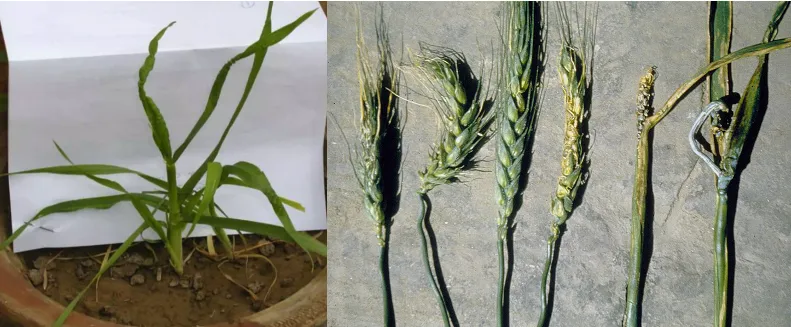
- Local names: Sehu, Gegla, Mamni
- Key symptoms:
- Plants are stunted and grow prostrate with increased tillering
- Profuse tillering with earheads emerging 30--40 days before healthy plants (important field diagnostic)
- Earheads are shorter and broader
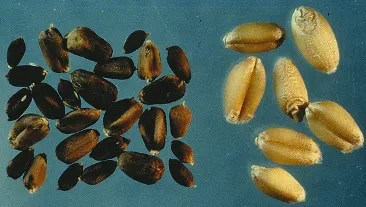
- Grains replaced by cockles/galls -- small, dark brown or black, irregular structures filled with dormant juveniles
Tundu (Yellow Ear Rot) Disease
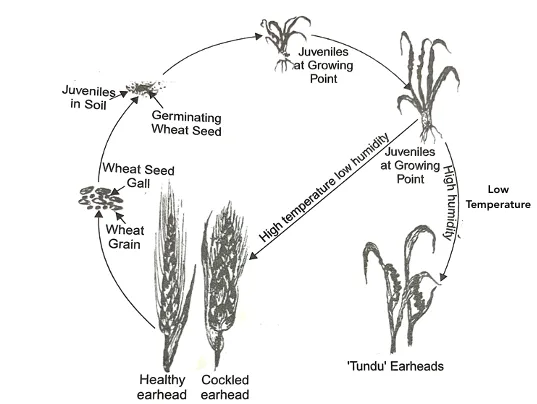
When Anguina tritici associates with bacterium Clavibacter tritici (Corynebacterium tritici), it causes the more destructive Tundu disease.
| Feature | Earcockle | Tundu (Yellow Ear Rot) |
|---|---|---|
| Caused by | Nematode alone | Nematode + Clavibacter tritici (bacterium) |
| Nematode role | Direct parasite | Vector carrying bacteria on body surface |
| Severity | Less destructive | More destructive |
| Conditions favouring | Normal | High humidity + low temperature |
| Diagnostic symptom | Grains replaced by galls | Yellow slimy bacterial ooze on leaves and stems |
| Damage extent | Individual grains replaced | Complete earhead destruction and defoliation |
Management
Since this is a seed-borne disease, controlling it at the seed level is the most effective approach.
WARNING
No resistant wheat variety exists for seed-gall nematode. Management depends entirely on seed sanitation and cultural practices.
| Method | Details |
|---|---|
| Gall-free certified seed | Most important single measure -- use only clean seed |
| Dry cleaning / Winnowing | Mechanical separation exploiting size/weight differences |
| Salt (brine) flotation | Seeds soaked in 20% brine solution; galls float (lighter), healthy seeds sink |
| Hot water treatment | 54 degrees C for 10 minutes -- kills quiescent juveniles |
| Crop rotation | Growing non-host crops reduces soil population |
| Resistant varieties | None available |
Summary Table
| Feature | Key Fact |
|---|---|
| Scientific name | Anguina tritici |
| Historical significance | First PPN ever discovered (Needham, 1743) |
| Main host | Wheat |
| Type of disease | Seed-borne |
| Juveniles per gall | 3,000--12,000 |
| Maximum survival | 32 years (quiescent, dry galls) |
| Disease (nematode alone) | Earcockle (Sehu) |
| Disease (nematode + bacterium) | Tundu / Yellow Ear Rot (with Clavibacter tritici) |
| More destructive disease | Tundu > Earcockle |
| Brine separation | 20% salt solution; galls float, seeds sink |
| Hot water treatment | 54 degrees C, 10 minutes |
| Resistant varieties | None |
| Infective stage | J2 |
| India distribution | Bihar, Delhi, Haryana, HP, MP, Punjab, Rajasthan, UP |
TIP
Exam mnemonic -- "32-12-20-54" for Anguina tritici: 32 years survival, 12,000 max juveniles/gall, 20% brine for flotation, 54 degrees C hot water treatment.
References
- Dropkin, V.H. 1980. Introduction to plant nematology. John Wiley and sons, INC. New York.
- Singh, R.S and Sitaramaiah, K. 1994. Plant pathogens. The plant parasitic nematodes. Oxford & IBH Pub. Co. Pvt. Ltd. New Delhi.
- Walia, R. K and Bajaj, H. K (2014). Textbook of Introductory Plant Nematology. Directorate of Knowledge Management in Agriculture, ICAR, New Delhi.
- Kumar, V., Khan, M.R. & Walia, R.K. Crop Loss Estimations due to Plant-Parasitic Nematodes in Major Crops in India. Natl. Acad. Sci. Lett. 43, 409-412 (2020).
- Figure 1: Source: A: Maggenti, 1981, B-E: Franklin, 1973
Summary Cheat Sheet
| Concept / Topic | Key Details |
|---|---|
| Scientific name | Anguina tritici |
| Historical significance | First PPN ever discovered (Needham, 1743) |
| Main host | Wheat |
| Type of disease | Seed-borne |
| Juveniles per gall | 3,000--12,000 |
| Maximum survival | 32 years (quiescent, dry galls) |
| Disease (nematode alone) | Earcockle (Sehu) |
| Disease (nematode + bacterium) | Tundu / Yellow Ear Rot (with Clavibacter tritici) |
| More destructive disease | Tundu > Earcockle |
| Brine separation | 20% salt solution; galls float, seeds sink |
| Hot water treatment | 54 degrees C, 10 minutes |
| Resistant varieties | None |
| Infective stage | J2 |
| India distribution | Bihar, Delhi, Haryana, HP, MP, Punjab, Rajasthan, UP |
TIP
Next: Lesson 04 covers the citrus nematode (Tylenchulus semipenetrans) -- the semi-endoparasite causing slow decline of citrus orchards.