🪱 Citrus Nematode (Tylenchulus semipenetrans)
Slow decline of citrus -- semi-endoparasitic biology, nurse cell formation, feeder root symptoms, and neem cake management
In the previous lesson, we covered the seed-gall nematode (Anguina tritici) -- an above-ground, seed-borne parasite of wheat. Now we examine a below-ground semi-endoparasite that causes one of the most economically significant nematode diseases in Indian horticulture.
A citrus grower in Maharashtra notices that his Nagpur orange trees have been yielding progressively less fruit over the past five years. The canopy is thinning, leaves are yellowing, and fruits are smaller. When the feeder roots are examined, they appear dark and unhealthy instead of the normal creamy colour. This gradual deterioration is the hallmark of slow decline of citrus.
This lesson covers:
- Etymology and discovery -- Cobb (1912), Siddiqi (1961) in India
- Biology -- semi-endoparasitic nature, nurse cell formation
- Symptoms -- slow decline, feeder root discolouration
- Management -- neem cake, carbofuran, clean nursery stock
Etymology and Discovery
| Feature | Details |
|---|---|
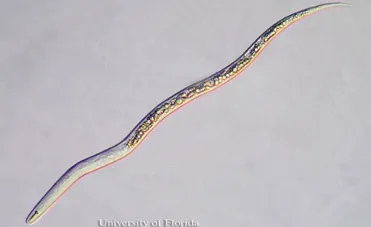
| Generic name | Tylenchulus: tylos (knob) + enchos (spear) = knob-tipped stylet |
| Specific name | semipenetrans = semi-endoparasitic nature (only head penetrates root) |
| Other common names | Stunt nematode, Stylet nematode |
| First report (World) | Cobb, 1912 -- on diseased citrus in California, USA |
| First report (India) | Siddiqi, 1961 -- from Aligarh, Uttar Pradesh |
Biology
| Feature | Details |
|---|---|
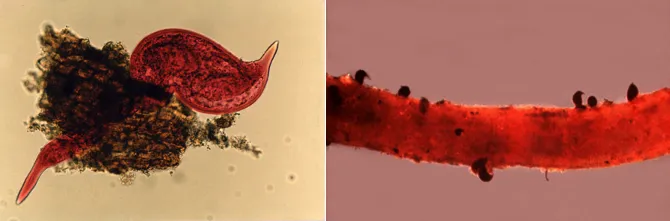
| Parasitism type | Cortical, sedentary, semi-endoparasite |
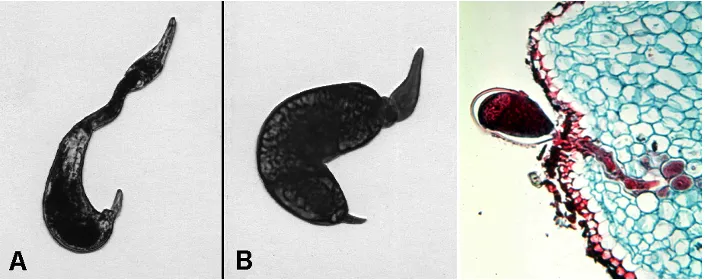
| Body position | Only anterior (head) portion inside root; posterior hangs in soil |
| Infective stage | J2 (second-stage juveniles) infect fine feeder roots |
| Feeding site | 6--10 cortical parenchyma cells modified into nurse cells |
| Nurse cell function | Nutrient-rich feeding sites supplying all resources to the developing female |
Symptoms -- Slow Decline of Citrus
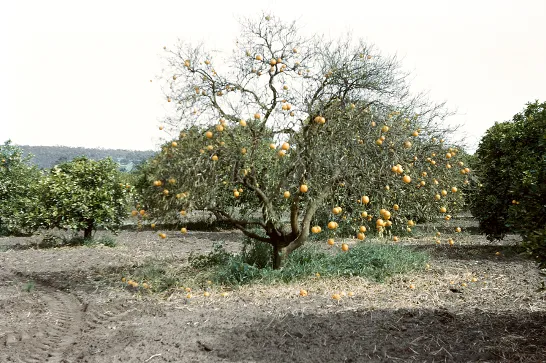
The term "slow decline" describes the nature of this disease -- the tree does not die suddenly but deteriorates gradually over several years.
Pro Content Locked
Upgrade to Pro to access this lesson and all other premium content.
₹99 charged monthly · Cancel anytime
- All Agriculture & Banking Courses
- AI Lesson Questions (100/day)
- AI Doubt Solver (50/day)
- Glows & Grows Feedback (30/day)
- AI Section Quiz (20/day)
- 22-Language Translation (100/day)
- Recall Questions (20/day)
- AI Quiz (15/day)
- AI Quiz Paper Analysis (100/day)
- AI Step-by-Step Explanations (100/day)
- Spaced Repetition Recall (FSRS)
- AI Tutor
- Immersive Text Questions
- Audio Lessons — Hindi & English
- Mock Tests & Previous Year Papers
- Summary & Mind Maps
- XP, Levels, Leaderboard & Badges
- Generate New Classrooms
- Voice AI Teacher (AgriDots Live)
- AI Revision Assistant
- Knowledge Gap Analysis
- Interactive Revision (LangGraph)
🔒 Secure via Razorpay · Cancel anytime · No hidden fees
In the previous lesson, we covered the seed-gall nematode (Anguina tritici) -- an above-ground, seed-borne parasite of wheat. Now we examine a below-ground semi-endoparasite that causes one of the most economically significant nematode diseases in Indian horticulture.
A citrus grower in Maharashtra notices that his Nagpur orange trees have been yielding progressively less fruit over the past five years. The canopy is thinning, leaves are yellowing, and fruits are smaller. When the feeder roots are examined, they appear dark and unhealthy instead of the normal creamy colour. This gradual deterioration is the hallmark of slow decline of citrus.
This lesson covers:
- Etymology and discovery -- Cobb (1912), Siddiqi (1961) in India
- Biology -- semi-endoparasitic nature, nurse cell formation
- Symptoms -- slow decline, feeder root discolouration
- Management -- neem cake, carbofuran, clean nursery stock
Etymology and Discovery
| Feature | Details |
|---|---|
| Generic name | Tylenchulus: tylos (knob) + enchos (spear) = knob-tipped stylet |
| Specific name | semipenetrans = semi-endoparasitic nature (only head penetrates root) |
| Other common names | Stunt nematode, Stylet nematode |
| First report (World) | Cobb, 1912 -- on diseased citrus in California, USA |
| First report (India) | Siddiqi, 1961 -- from Aligarh, Uttar Pradesh |
Biology
| Feature | Details |
|---|---|
| Parasitism type | Cortical, sedentary, semi-endoparasite |
| Body position | Only anterior (head) portion inside root; posterior hangs in soil |
| Infective stage | J2 (second-stage juveniles) infect fine feeder roots |
| Feeding site | 6--10 cortical parenchyma cells modified into nurse cells |
| Nurse cell function | Nutrient-rich feeding sites supplying all resources to the developing female |
Symptoms -- Slow Decline of Citrus
The term "slow decline" describes the nature of this disease -- the tree does not die suddenly but deteriorates gradually over several years.
Above-Ground Symptoms
| Symptom | Description |
|---|---|
| Leaf yellowing | Progressive chlorosis |
| Defoliation | Premature leaf drop |
| Fruit shedding | Premature dropping of fruits |
| Fruit quality decline | Reduced number and size of fruits |
| Twig dieback | Increasing dead twigs from the top |
| Weak flushes | Poor seasonal growth spurts |
| Thin canopy | Progressive canopy thinning over years |
Below-Ground Symptoms (Diagnostic)
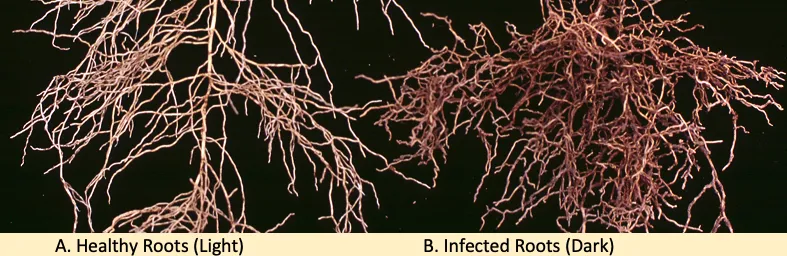
The feeder roots show the most reliable diagnostic feature:
| Root Condition | Colour |
|---|---|
| Healthy roots | Light creamish |
| Infested roots | Dark (necrotic) |
This colour contrast is the most reliable field-level indicator.
NOTE
Do not confuse: Slow decline of citrus = Tylenchulus semipenetrans (citrus nematode); Spreading decline of citrus = Radopholus citrophilus (burrowing nematode, found only in Florida/Hawaii).
Management
| Method | Details |
|---|---|
| Neem cake | Neem cake @ 1 kg/tree -- provides organic matter + releases nematicidal compounds (azadirachtin) |
| Chemical | Carbofuran @ 2 kg a.i./ha |
| Combined approach | Neem cake + carbofuran together for best results (organic + chemical) |
| Nematode-free nursery stock | Use certified, clean planting material |
| Tree nutrition | Maintain proper nutrition to enhance tolerance |
| General INM | Organic amendments, soil health management |
Summary Table
| Feature | Key Fact |
|---|---|
| Scientific name | Tylenchulus semipenetrans |
| Common name | Citrus nematode |
| Disease caused | Slow decline of citrus |
| Parasitism type | Cortical, sedentary, semi-endoparasite |
| Body position | Head inside root, posterior outside in soil |
| Infective stage | J2 |
| Feeding site | 6--10 nurse cells (cortical parenchyma) |
| First report (World) | Cobb, 1912, California |
| First report (India) | Siddiqi, 1961, Aligarh (UP) |
| Diagnostic below-ground sign | Feeder roots turn dark (healthy = creamish) |
| Key management | Neem cake @ 1 kg/tree + Carbofuran @ 2 kg a.i./ha |
TIP
Exam mnemonic -- "Semi-Slow-Six": Semi-endoparasite causes Slow decline with Six-to-ten nurse cells.
References
- Dropkin, V.H. 1980. Introduction to plant nematology. John Wiley and sons, INC. New York.
- Singh, R.S and Sitaramaiah, K. 1994. Plant pathogens. The plant parasitic nematodes. Oxford & IBH Pub. Co. Pvt. Ltd. New Delhi.
- Walia, R. K and Bajaj, H. K (2014). Textbook of Introductory Plant Nematology. Directorate of Knowledge Management in Agriculture, ICAR, New Delhi.
- Kumar, V., Khan, M.R. & Walia, R.K. Crop Loss Estimations due to Plant-Parasitic Nematodes in Major Crops in India. Natl. Acad. Sci. Lett. 43, 409-412 (2020).
- Figure 1: Source: A: Maggenti, 1981, B-E: Franklin, 1973
Summary Cheat Sheet
| Concept / Topic | Key Details |
|---|---|
| Scientific name | Tylenchulus semipenetrans |
| Common name | Citrus nematode |
| Disease caused | Slow decline of citrus |
| Parasitism type | Cortical, sedentary, semi-endoparasite |
| Body position | Head inside root, posterior outside in soil |
| Infective stage | J2 |
| Feeding site | 6--10 nurse cells (cortical parenchyma) |
| First report (World) | Cobb, 1912, California |
| First report (India) | Siddiqi, 1961, Aligarh (UP) |
| Diagnostic below-ground sign | Feeder roots turn dark (healthy = creamish) |
| Key management | Neem cake @ 1 kg/tree + Carbofuran @ 2 kg a.i./ha |
TIP
Next: Lesson 05 covers aphelenchid nematodes -- the above-ground parasites causing white tip of rice, mushroom damage, and red ring disease of coconut.