🧺 Market: Meaning, Structure & Agricultural Marketing
Understand the concept of market, its components, market structure, agricultural marketing, its importance, and the four types of utility created by marketing.
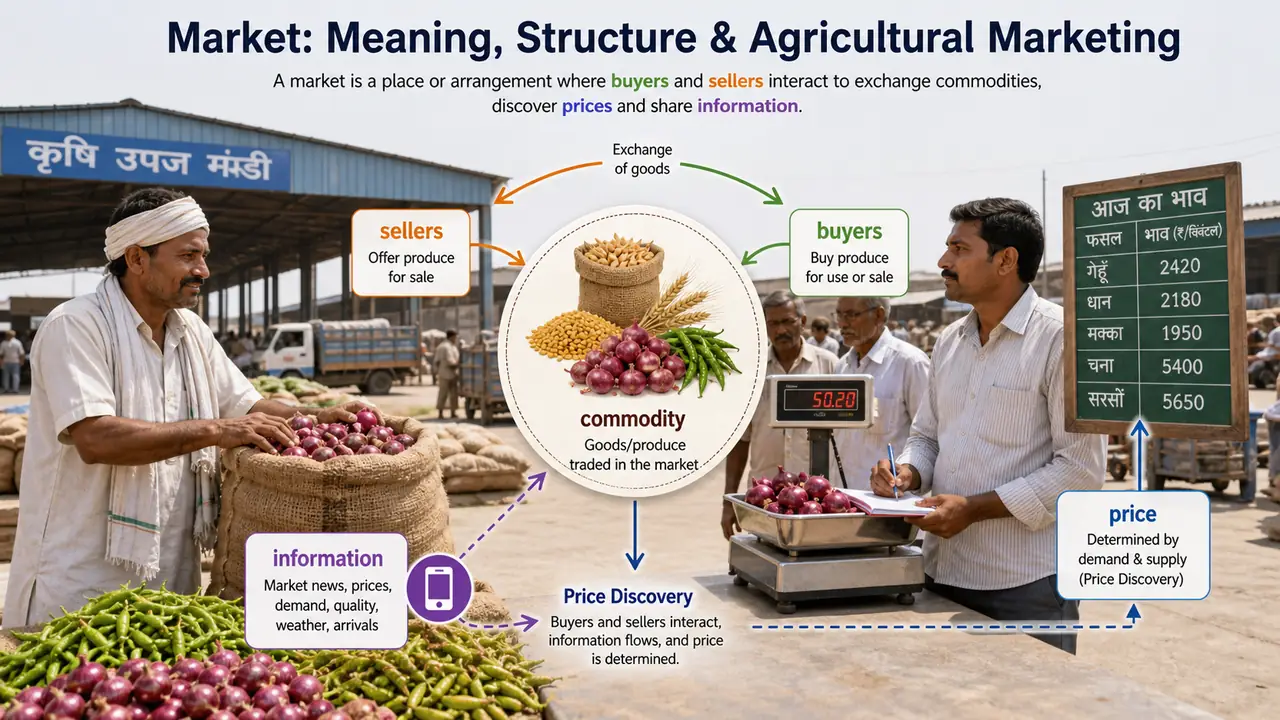
Imagine a wheat farmer in Punjab who has harvested 50 quintals of grain. He needs buyers, a place to sell, a fair price, and information about demand. The moment these elements come together -- whether in a village mandi or on an online platform like e-NAM -- a market is born.
What is a Market?
The word market comes from the Latin word "marcatus", meaning merchandise or trade. In economics, a market is not limited to a physical location -- it is any arrangement where buyers and sellers interact to exchange goods and services.
Key Definitions
| Scholar / Source | Definition | Core Idea |
|---|---|---|
| General economic | The sphere within which price-determining forces operate | Demand and supply set prices |
| Price-based | The area where demand and supply converge to establish a single price | Price uniformity |
| Classical (Cournot) | Any region where buyers and sellers are in free intercourse so that prices of the same goods tend to equality | Free communication + price uniformity |
| Institutional | A social institution that provides facilities for exchanging commodities | Market as an organized institution |
| Commodity-centred | Refers to a commodity and buyers/sellers in free intercourse, not a place | Commodity + participants define the market |
TIP
Pro Content Locked
Upgrade to Pro to access this lesson and all other premium content.
Charged once for one year · ₹1188 total
Save ₹100/month vs ₹2388/year launch price
- All Agriculture & Banking Courses
- AI Lesson Questions (100/day)
- AI Doubt Solver (50/day)
- Glows & Grows Feedback (30/day)
- AI Section Quiz (20/day)
- 22-Language Translation (100/day)
- Recall Questions (20/day)
- AI Quiz (15/day)
- AI Quiz Paper Analysis (100/day)
- AI Step-by-Step Explanations (100/day)
- Spaced Repetition Recall (FSRS)
- AI Tutor
- Immersive Text Questions
- Audio Lessons — Hindi & English
- Mock Tests & Previous Year Papers
- Summary & Mind Maps
- XP, Levels, Leaderboard & Badges
- Generate New Classrooms
- Voice AI Teacher (AgriDots Live)
- AI Revision Assistant
- Knowledge Gap Analysis
- Interactive Revision (LangGraph)
🔒 Secure one-time yearly payment via Razorpay · No hidden fees
Imagine a wheat farmer in Punjab who has harvested 50 quintals of grain. He needs buyers, a place to sell, a fair price, and information about demand. The moment these elements come together -- whether in a village mandi or on an online platform like e-NAM -- a market is born.
What is a Market?
The word market comes from the Latin word "marcatus", meaning merchandise or trade. In economics, a market is not limited to a physical location -- it is any arrangement where buyers and sellers interact to exchange goods and services.
Key Definitions
| Scholar / Source | Definition | Core Idea |
|---|---|---|
| General economic | The sphere within which price-determining forces operate | Demand and supply set prices |
| Price-based | The area where demand and supply converge to establish a single price | Price uniformity |
| Classical (Cournot) | Any region where buyers and sellers are in free intercourse so that prices of the same goods tend to equality | Free communication + price uniformity |
| Institutional | A social institution that provides facilities for exchanging commodities | Market as an organized institution |
| Commodity-centred | Refers to a commodity and buyers/sellers in free intercourse, not a place | Commodity + participants define the market |
TIP
Exam Mnemonic -- "DPIC" for remembering what defines a market: Demand-supply forces, Price determination, Interaction of buyers-sellers, Commodity exchange.
Core Building Blocks of a Market
Components of a Market
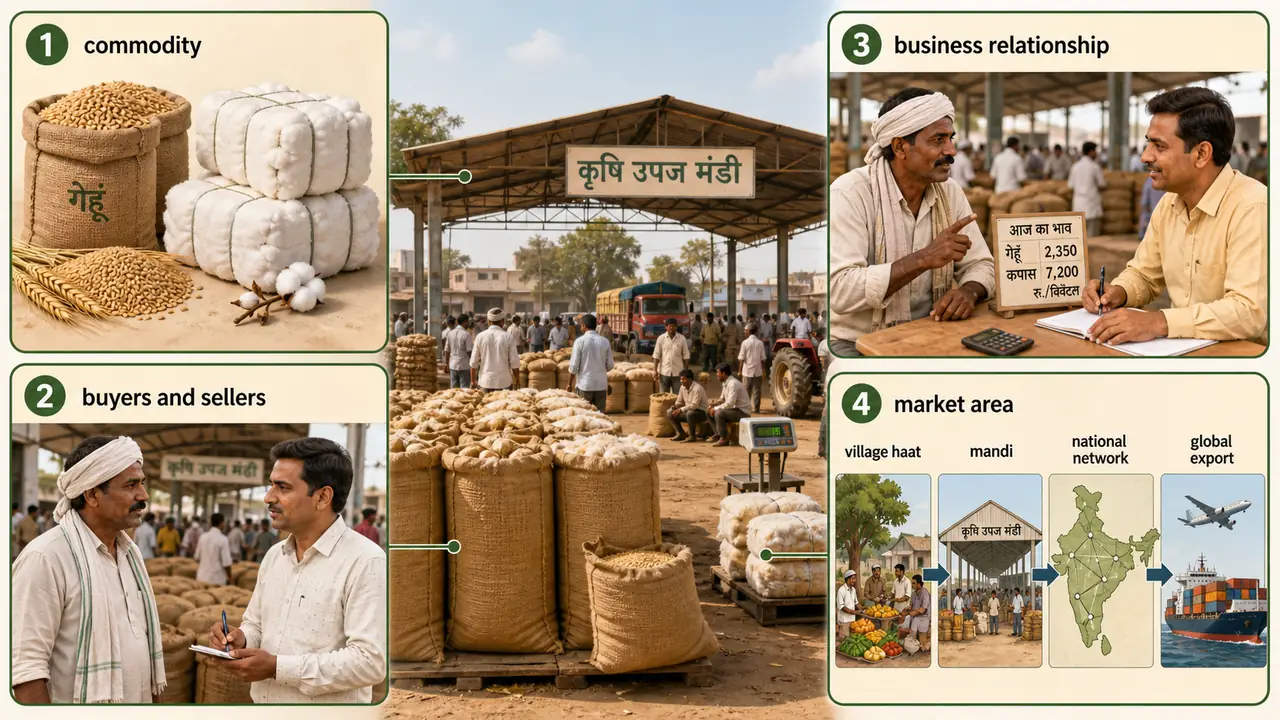
For a market to exist, four essential conditions must be met:
| Component | Explanation | Agricultural Example |
|---|---|---|
| Good or commodity | A product for transaction (physical presence not necessary -- futures contracts qualify) | Wheat, rice, cotton, or a forward contract for soybean |
| Buyers and sellers | At least one buyer and one seller | Farmer (seller) and trader/commission agent (buyer) |
| Business relationship | Communication and willingness to transact | Farmer and wholesaler negotiating price at a mandi |
| Demarcation of area | Place, region, country, or the whole world | Village haat, district mandi, national e-NAM, or global commodity exchange |
Perfect competition or uniform price is not necessary. A market can exist even with imperfect competition.
How Markets Are Organized and Evaluated
Market Structure
Meaning
The term market structure refers to the size, design, and manner of operation of a market. Think of it as the framework that governs how a market functions.
- Structure and function are interdependent -- changes in one affect the other.
- Understanding market structure helps identify imperfections and suggest reforms.
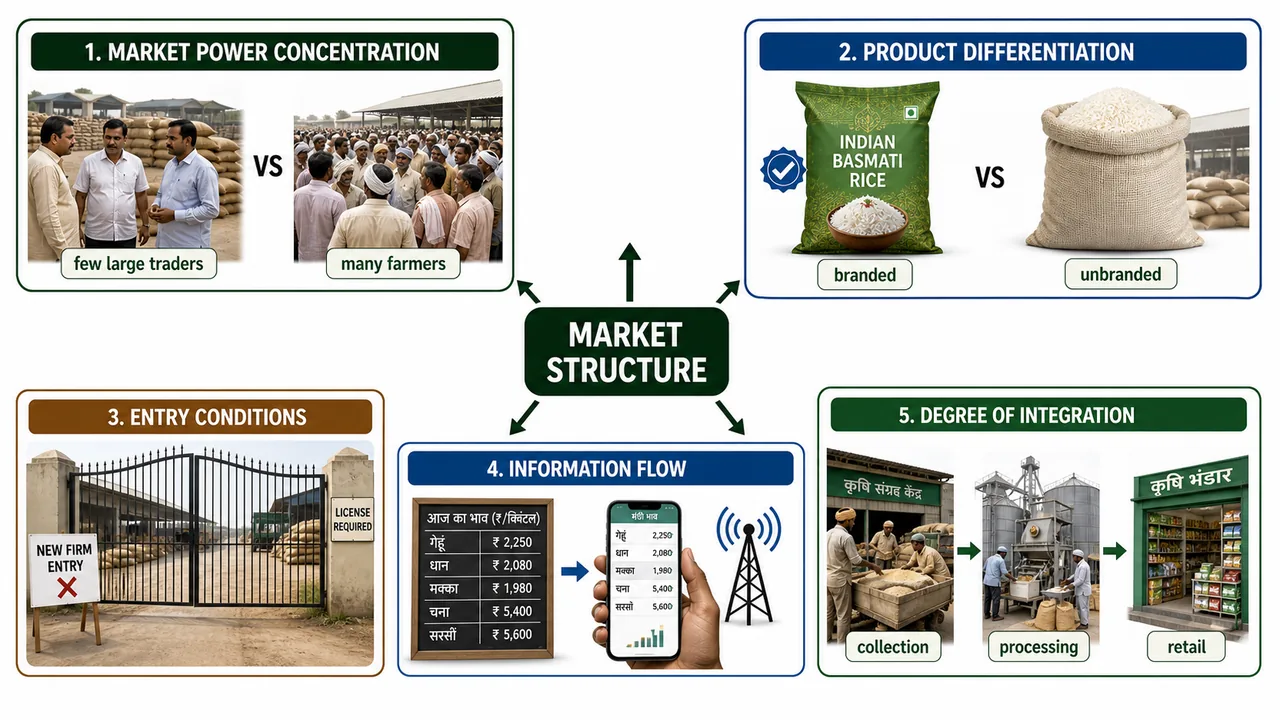
Five Components of Market Structure
| Component | What It Means | Agricultural Example |
|---|---|---|
| 1. Concentration of market power | Number and size of firms controlling buying/selling. High concentration creates oligopoly (few sellers) or oligopsony (few buyers) | A few large traders dominating the wheat mandi in a district |
| 2. Degree of product differentiation | Whether products are homogeneous or heterogeneous. Differentiation leads to brand competition and varied pricing | Branded basmati rice (e.g., India Gate vs Daawat) vs unbranded grain |
| 3. Conditions for entry of firms | Restrictions on new firms entering the market. Barriers reduce competition | High licence fees or dominance of existing commission agents in a mandi |
| 4. Flow of market information | How freely price, supply, and demand data reaches all participants | Real-time price display at e-NAM vs opaque pricing in unregulated mandis |
| 5. Degree of integration | Whether firms are integrated across marketing stages. Greater integration brings economies of scale but may reduce competition | A dairy cooperative that collects, processes, and retails milk (e.g., Amul) |
Market Conduct and Performance
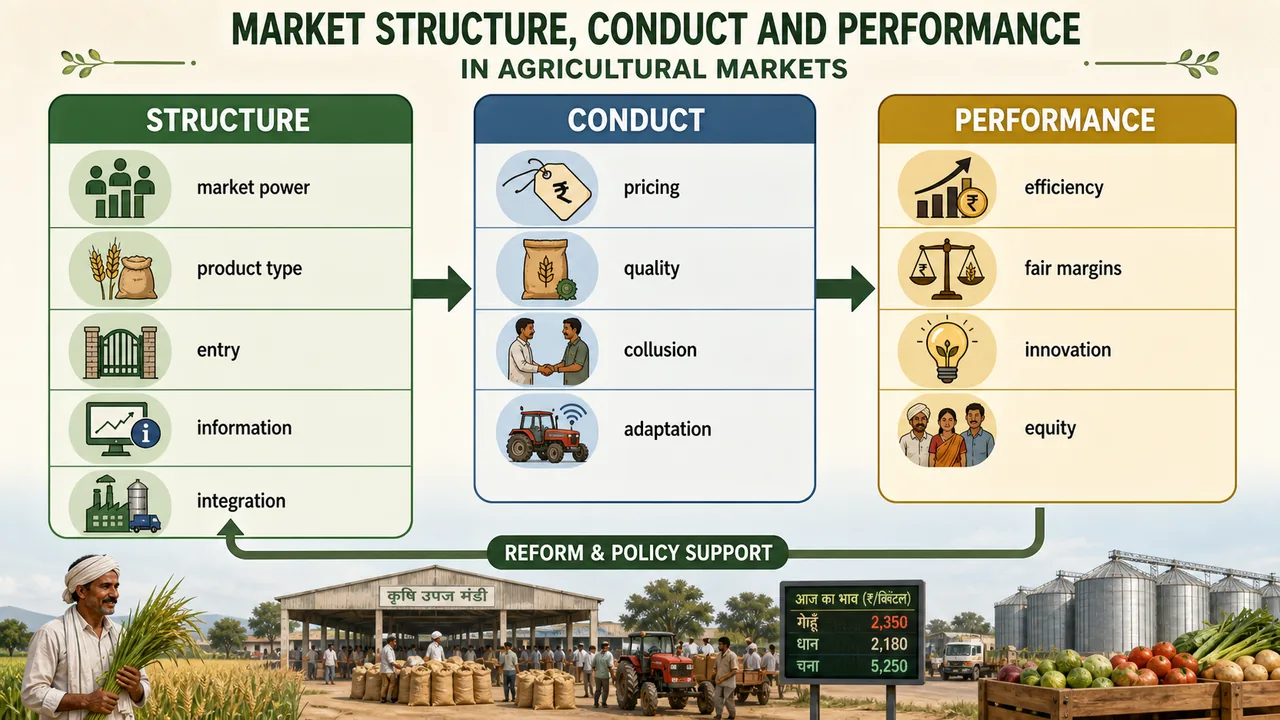
Market structure determines market conduct (behaviour) and performance (economic results).
| Concept | Meaning | What It Includes |
|---|---|---|
| Market conduct | Patterns of behaviour of firms in pricing and market adaptation | Price-setting policies, coercion of rivals, product quality decisions |
| Market performance | Economic results that flow from the industry | Efficiency of resource use, presence of monopoly profits, dynamic progressiveness, impact on income inequality |
Criteria for Measuring Market Performance
- Efficiency in resource use -- Are marketing functions performed at the lowest possible cost?
- Absence of monopoly profits -- Are margins reasonable relative to costs?
- Dynamic progressiveness -- Is the system adopting new technology, adjusting firm sizes, and innovating?
- Equity -- Does the system worsen income inequalities? For example:
- A middleman pocketing returns greater than his contribution
- Small farmers receiving lower prices because of low marketable surplus
- Inter-product price parity disturbed by regional production rigidities
Adapting to Change
A static market structure becomes obsolete. The structure must adjust to:
| Factor | Example of Change |
|---|---|
| Production pattern | A region shifts from subsistence millets to commercial soybean -- marketing infrastructure must evolve |
| Demand pattern | Growing urban middle class demands processed and packaged foods |
| Costs of marketing functions | Government subsidies on cold chain reduce storage costs |
| Technological change | Digital platforms (e-NAM), cold chain logistics, and e-commerce reshape agricultural markets |
Agricultural Marketing in Practice
Agricultural Marketing
Marketing is the series of activities involved in moving goods from the point of production to the point of consumption. It is the bridge between the farmer's field and the consumer's table.
Marketing creates four utilities: time, place, form, and possession.
Agricultural marketing covers all activities, agencies, and policies involved in:
- Input side -- procurement of seeds, fertilizers, machinery by farmers
- Output side -- movement of farm produce to consumers
It is the link between the farm and the non-farm sectors, connecting rural producers with urban consumers and industrial users.
Importance of Agricultural Marketing
Agricultural marketing has been called the most important multiplier of agricultural development. Here is why:
| Role | How It Helps | Example |
|---|---|---|
| Optimization of resources | Reduces losses from inefficient processing, storage, and transport; increases marketable surplus | Cold storage for potatoes in UP reduces spoilage from 25% to 5% |
| Increase in farm income | Reduces middlemen, restricts malpractices, ensures better prices; creates a virtuous cycle of investment and production | Direct sale through FPOs eliminates commission agent charges |
| Widening of markets | Takes products to remote corners within and outside the country | Alphonso mangoes from Ratnagiri exported to Europe and the Middle East |
| Growth of agro-based industries | Supplies raw materials reliably to processing industries | Cotton ginning, rice milling, sugar manufacturing, oilseed processing |
| Price signals | Guides farmers on what to produce more or less of | Rising soybean prices signal farmers to increase soybean acreage |
| Adoption of new technology | Assured market clearance gives confidence to invest in improved inputs | Farmers adopt hybrid seeds only when assured of market demand |
| Employment | Provides jobs in packaging, transport, storage, processing, and trade | Commission agents, brokers, hamals, packagers, weighmen, retailers |
| Addition to national income | Every marketing step adds value to the product, increasing GNP and NNP | Cleaning, grading, packaging, and transporting wheat all contribute |
| Better living | Reduces poverty, lowers consumer food prices, earns foreign exchange | Efficient marketing of pulses reduces retail prices for urban consumers |
IMPORTANT
Exam Tip: Remember the importance of agricultural marketing with the mnemonic "OIW-GRAPE-B" -- Optimization, Income, Widening markets, Growth of industries, Resource allocation (price signals), Adoption of technology, Provides employment, Earnings (national income), Better living.
Value Creation Through Marketing
Four Types of Utility Created by Marketing
Marketing is productive -- production is complete only when the product reaches the consumer in the right form, place, time, and ownership.
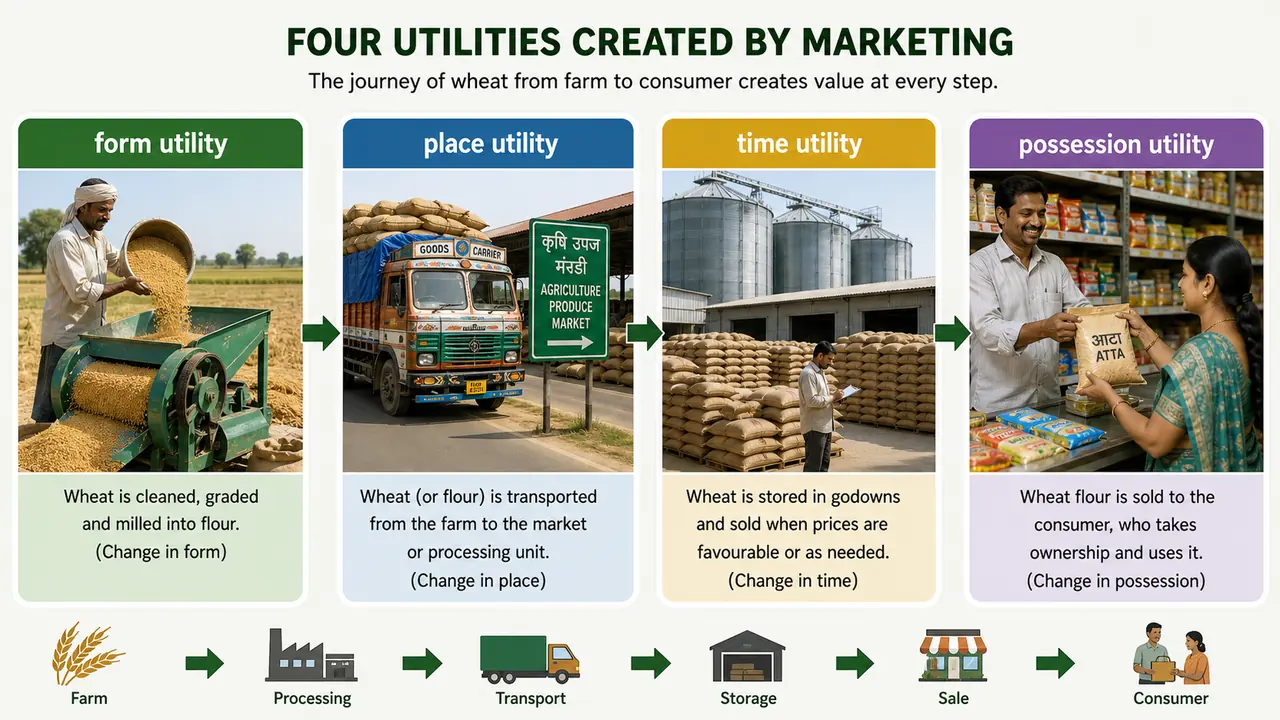
| Utility | Marketing Function | What It Does | Agricultural Example |
|---|---|---|---|
| Form Utility | Processing | Transforms raw material into finished form | Oilseeds → oil; sugarcane → sugar; wheat → flour and bread; paddy → rice |
| Place Utility | Transportation | Moves product from place of plenty to place of need | Wheat from Punjab transported to Kerala where it is scarce |
| Time Utility | Storage | Makes product available when needed (bridges seasonal production and year-round consumption) | Onions stored after rabi harvest and released during monsoon scarcity |
| Possession Utility | Buying and selling | Transfers ownership from low-utility holder to high-utility holder | Farmer sells grain to miller who values it more for processing |
IMPORTANT
Exam Favourite: These four utilities -- Form, Place, Time, Possession -- are frequently tested. Remember: "FPT-P" or think of it as "Factory, Post-office, Timer, Purchase".
Why Agricultural Markets Are Different From Industrial Markets
Understanding these differences is crucial for IBPS AFO aspirants advising farmers:
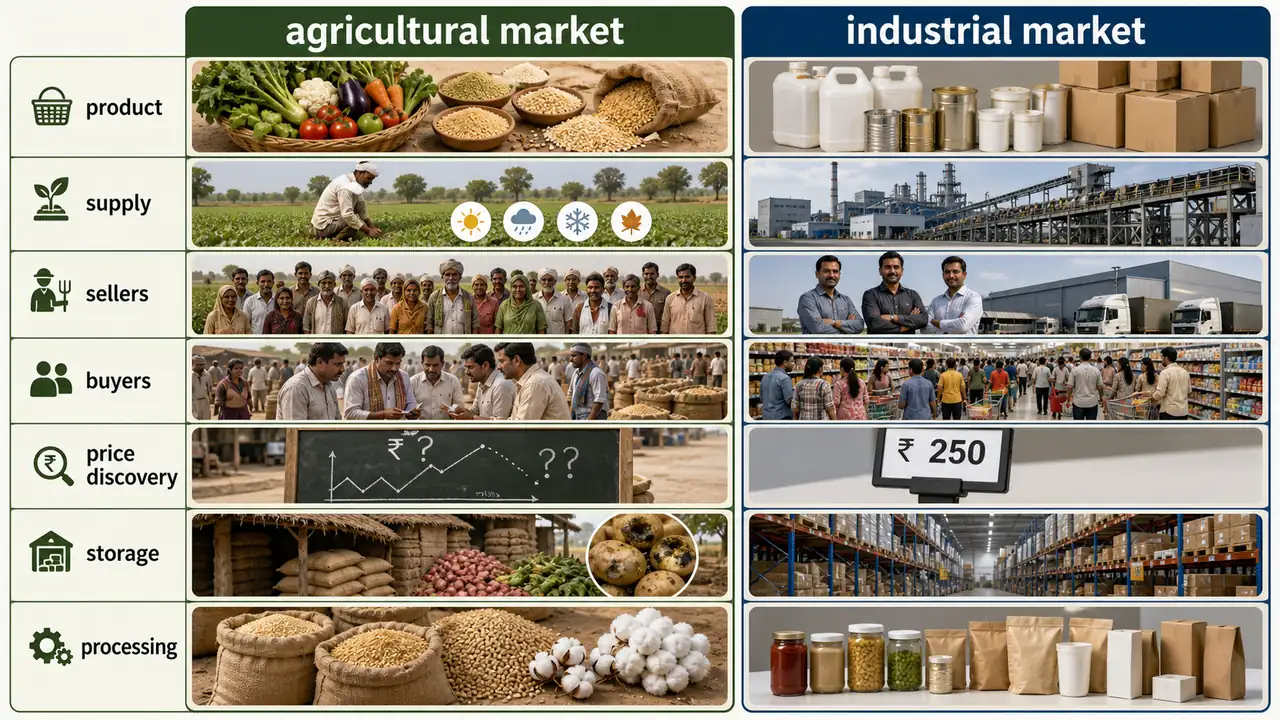
| Feature | Agricultural Market | Industrial Market |
|---|---|---|
| Product | Perishable, bulky, seasonal | Durable, compact, year-round |
| Supply | Inelastic in short run (can't produce more wheat mid-season) | Can adjust production quickly |
| Sellers | Millions of small, scattered farmers (weak bargaining) | Fewer, larger firms (stronger bargaining) |
| Buyers | Fewer intermediaries (commission agents, traders) | Many retail buyers |
| Price discovery | Often opaque; farmer is price-taker | Seller sets price |
| Storage | Losses 7-15% due to poor infrastructure | Minimal losses |
| Processing | Most sold as raw commodity (low value) | Sold as finished product (high value) |
This asymmetry explains why farmers get only 25-40% of the consumer's rupee for most crops. The rest goes to transport, storage, processing, and intermediary margins. Government interventions (APMC, e-NAM, FPOs, MSP) exist to reduce this gap.
The four utilities analogy: Marketing is like a relay race — the baton (produce) passes through four legs:
- Form utility — wheat → flour → bread (processing adds value)
- Place utility — Punjab farm → Delhi consumer (transport)
- Time utility — harvest glut → stored → sold in lean season (storage)
- Possession utility — farmer → trader → retailer → consumer (ownership transfer)
Each leg adds cost but also adds value. Efficient marketing minimizes cost at each stage.
Summary Cheat Sheet
| Concept / Topic | Key Details / Explanation |
|---|---|
| Market (definition) | From Latin "marcatus"; any arrangement where buyers and sellers interact to exchange goods/services; not limited to a physical place |
| Cournot's definition | Buyers and sellers in free intercourse; prices of same goods tend to equality |
| 4 Components of a Market | Good/commodity, buyers-sellers, business relationship, demarcation of area |
| Market Structure | Size, design, and manner of operation; structure and function are interdependent |
| 5 Components of Market Structure | Concentration of market power, product differentiation, entry conditions, information flow, degree of integration |
| Oligopoly | Few sellers, many buyers; strategic behaviour in pricing |
| Oligopsony | Many sellers, few buyers; buyers control the market |
| Market Conduct | Patterns of behaviour — pricing, coercion, quality decisions |
| Market Performance | Economic results — efficiency, monopoly profits, progressiveness, equity |
| 4 Criteria for Performance | Efficiency in resource use, absence of monopoly profits, dynamic progressiveness, equity |
| Agricultural Marketing | All activities moving produce from farm to consumer; covers input and output sides |
| 4 Utilities of Marketing | Form (processing), Place (transport), Time (storage), Possession (buying/selling) |
| Form Utility | Raw material → finished product (e.g., oilseeds → oil) |
| Place Utility | Moves product from surplus to deficit area (e.g., wheat Punjab → Kerala) |
| Time Utility | Storage bridges seasonal production and year-round consumption |
| Possession Utility | Transfers ownership from low-utility to high-utility holder |
| Importance Mnemonic | "OIW-GRAPE-B" — Optimization, Income, Widening markets, Growth, Resource allocation, Adoption, Provides employment, Earnings, Better living |
| Marketing = Productive | Production is complete only when the product reaches the consumer in right form, place, time, and ownership |
| Static vs Dynamic Structure | Market structure must adjust to changes in production, demand, costs, and technology |
| Exam Mnemonic — DPIC | Demand-supply, Price determination, Interaction, Commodity exchange |