Agricultural Economics 💹
Comprehensive course on Principles of Economics, Consumer Behaviour, Market Structure, National Income, Farm Management, Production Economics, Agricultural Finance, Credit, Marketing, APMC, Direct Marketing Channels & Modal Bankable Projects.

Course Structure
What's Inside

Principles of Economics
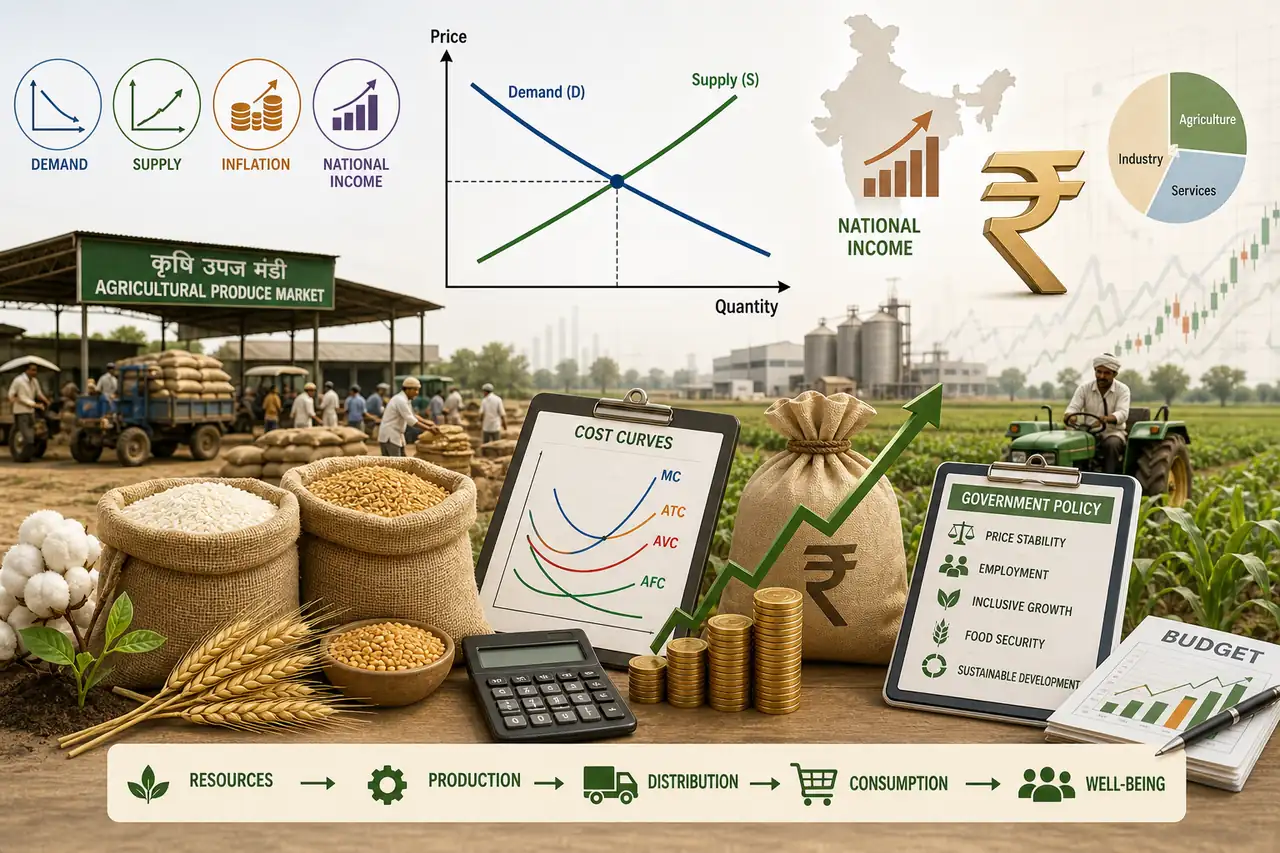
Demand and supply analysis, price elasticity, market structures (perfect, monopoly, oligopoly), consumer behaviour, national income, inflation, WTO and trade policy — fundamental for agriculture economics papers.

Farm Management & Production
Farm planning and resource allocation, production economics, cost concepts (fixed, variable, marginal), profit maximization, farm budgeting, enterprise selection — high-weightage for exams Professional Knowledge.

Agriculture Marketing
Agricultural market types, MSP and procurement, APMC markets, cold chain infrastructure, regulated markets, e-NAM, futures trading, agri export-import policy — high-weightage for exams.

Agriculture Finance
Farm credit systems, NABARD schemes, Kisan Credit Card, cooperative credit, interest rate structures, priority sector lending, and agricultural insurance — essential for agriculture exams.

NABARD Model Bankable Projects (MBP) — Complete Course
Comprehensive notes on all NABARD Model Bankable Projects (MBPs) — dairy, goat, poultry, fisheries, food processing, forestry, FPO financing, plantation & horticulture, and more. Covers TFO, IRR, DSCR, margin money, and all techno-economic parameters tested in IBPS AFO and NABARD Grade A, JRF, Pre-PG, and state PSC agriculture exams.
Agricultural Economics
This comprehensive course covers all the important concepts of Agricultural Economics essential for competitive agricultural exams. The course is divided into the following sections:
- Principles of Economics — Definitions (Adam Smith, Marshall, Robbins, Samuelson), scope, methodology, types of economy, micro & macro economics
- Consumer Behaviour & Utility — Consumption, wants, utility types (form, place, time, possession), laws of diminishing & equi-marginal utility
- Demand & Elasticity — Types of demand, 5 degrees of elasticity, determinants, measurement methods
- Market Structure — Perfect competition, monopolistic competition, oligopoly, monopoly comparison table
- Capital & National Income — Capital types, GDP, GNP, NNP formulas, personal income, disposable income, per capita income
- Cost Concepts — Fixed vs variable costs, opportunity cost, social cost, economic cost
- Inflation — Types (creeping, walking, running, galloping), factors causing inflation
- Factors of Production — Land, labour, capital, entrepreneur; rent, wages, interest, profit
- Farm Management — Basic terms, production functions, returns to scale, risk & uncertainty
- Production Economics — Factor-product, factor-factor (least cost combination, isoquants), product-product (PPC, MRPS) relationships
- Compounding & Discounting — Time comparison principle, future value & present value formulas
- Types of Farming — Specialized, diversified, mixed, dry, ranching
- Business Organisations — Sole proprietorship, partnership, joint-stock company, co-operative society
- Important Economic Terms — Marketable surplus, marketed surplus, consumer surplus, economic holding, financial ratios
- Agricultural Finance — Credit classification (5 bases), 3Rs, 5Cs, 7Ps of credit, institutional & non-institutional sources
- Agricultural Marketing — Market classification, marketing functions (Thomsen, Kohls & Uhl, Huegy & Mitchell), APMC
- Marketing Agencies & Institutions — Middlemen types, commodity boards, public & cooperative sector institutions, hedging
- Direct Marketing Channels — Apni Mandi (Punjab 1987), Hadaspar, Rythu Bazars, Uzhavar Sandies
- Market Integration — Horizontal, vertical integration, conglomeration
- Agricultural Trade — WTO, pricing policy, trade agreements
- Modal Bankable Projects — Project formulation and appraisal
Frequently Asked Questions
What does Agricultural Economics cover for agriculture exams?
This course covers microeconomics and macroeconomics basics, consumer behaviour, production economics, farm management, agricultural finance, credit, marketing channels, APMC, price concepts, and project appraisal topics that repeatedly appear in IBPS AFO, NABARD, and ICAR-aligned preparation.
Why is Agricultural Economics important for IBPS AFO and NABARD?
Agricultural Economics connects farming with money, markets, and policy. Questions often come from farm management, cost concepts, banking and credit, agricultural marketing reforms, and development programmes, so it helps both professional agriculture sections and agri-finance understanding.
What is the difference between farm management and production economics?
Farm management focuses on decision-making at the farm level, such as planning, budgeting, records, and resource use. Production economics focuses more on input-output relationships, laws of returns, and how to optimise combinations of land, labour, capital, and other inputs.
How should beginners study Agricultural Economics?
Start with demand, supply, elasticity, and market structure. Then move to cost concepts, farm planning, break-even analysis, agricultural finance, and marketing institutions. Once the basics are clear, practice objective questions on schemes, institutions, and terminology.
What is the difference between agricultural economics and agricultural finance?
Agricultural economics is the broader subject that studies production, consumption, markets, policy, and farm decision-making, while agricultural finance focuses more specifically on credit, capital, repayment, sources of funds, and financial management in agriculture.
Why are cost concepts so important in Agricultural Economics?
Cost concepts matter because they are repeatedly used in farm management, profitability, break-even thinking, and production decisions. Many exam questions become easier once students clearly separate fixed cost, variable cost, opportunity cost, and economic cost.
What should I study first in agricultural marketing?
Start with marketing functions, channels, APMC basics, marketable versus marketed surplus, and institutions involved in agricultural trade. After that, move to direct marketing, cooperative marketing, and newer market-reform ideas.
Is Agricultural Economics difficult for science-background agriculture students?
It can feel different at first because the vocabulary is less biological and more decision-oriented, but it becomes manageable once students connect the terms to farm reality, pricing, credit, production choices, and government policy.
Which Agricultural Economics topics are asked most often?
Demand and elasticity, market structure, cost concepts, farm management, credit classification, agricultural marketing, national income basics, and production relationships are among the most commonly repeated exam areas.
How should I revise Agricultural Economics quickly before an exam?
Use comparison tables and short concept maps. The subject becomes faster to revise when you compress definitions, formulas, classifications, and farm-management relationships into small high-recall notes instead of re-reading long paragraphs.