₹Agricultural Pricing Policy
MSP, procurement price, issue price, CACP, cost calculation methods (A2, A2+FL, C2), Market Intervention Scheme, ISAM, e-NAM with exam-oriented tables and mnemonics
Why Does Agriculture Need a Price Policy?
A wheat farmer in Haryana invests Rs 1,500/quintal on seeds, fertilizers, irrigation, and labour. In a bumper harvest year, market prices crash to Rs 1,200/quintal — below his cost. Without government intervention, he faces a net loss despite good production. Agricultural price policy exists precisely to prevent this — it guarantees farmers a minimum price, ensures food security for consumers, and maintains buffer stocks for the nation.
What Is Agricultural Price Policy?

- It is a method of government intervention in the market through announcement of administered prices — Minimum Support Price, Procurement Price, and Issue Price
- Prices are announced for agricultural crops by the Department of Agriculture and Co-operation, Government of India, on the recommendation AFO-2021 of the Commission for Agricultural Costs and Prices (CACP)
- Currently, only MSP is announced before each sowing season by the Cabinet Committee on Economic Affairs (CCEA) based on CACP recommendations
CACP — Commission for Agricultural Costs and Prices
| Feature | Detail |
|---|---|
| Originally Established | 1965 as Agricultural Price Commission (APC) |
| Renamed | 1985 — Commission for Agricultural Costs and Prices (CACP) |
| Recommended By | Foodgrains Prices Committee headed by Shri L.K. Jha |
| Status | Attached office of Ministry of Agriculture and Farmers Welfare |
| Current Chairman | Dr. Vijay Paul Sharma |
| Function | Recommends MSP; submits separate reports for Kharif and Rabi seasons |
IMPORTANT
CACP was established as APC in 1965 and renamed CACP in 1985. It only recommends MSP — the final decision is taken by CCEA. This distinction is frequently tested.
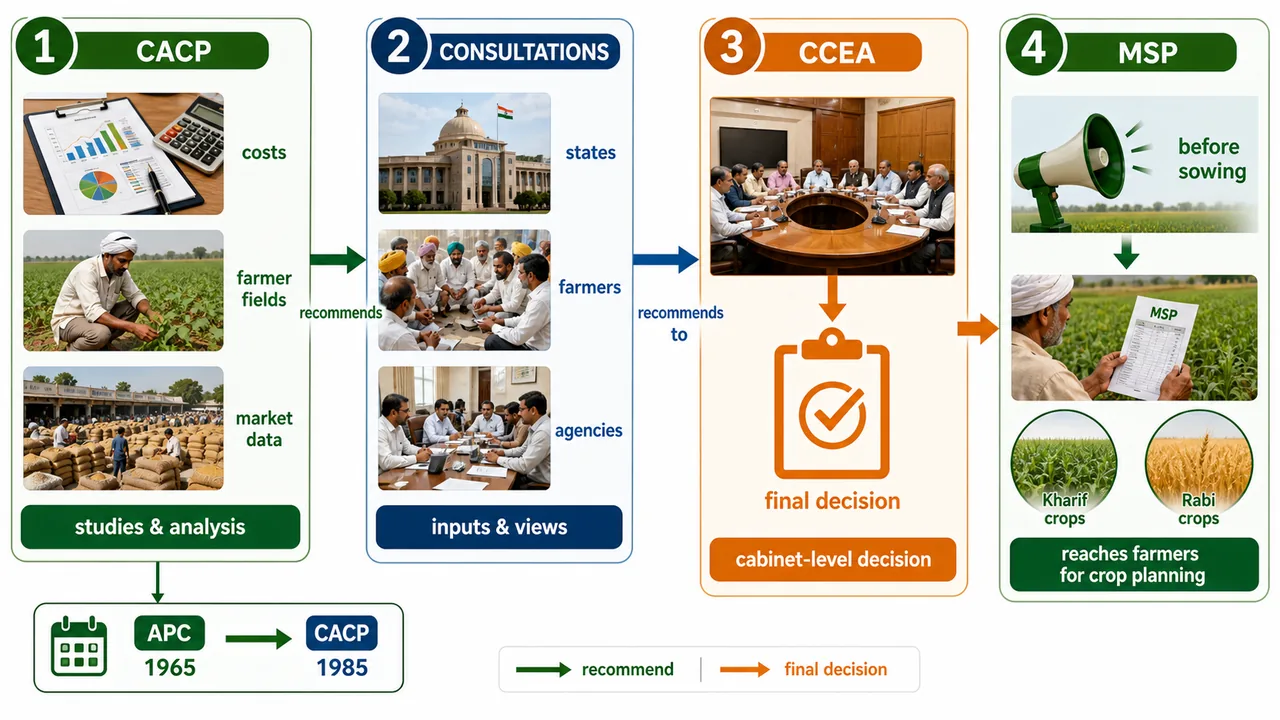
Agricultural Example: Before the Kharif 2024 sowing season, CACP visits paddy-growing states, consults FCI, NAFED, and farmer organizations, and then recommends a paddy MSP to the government. CCEA then announces the final MSP.
Three Types of Administered Prices
Prices fixed by the government serve three purposes: protect farmers from price crashes, protect consumers from price spikes, and ensure procurement for buffer stocks and PDS.
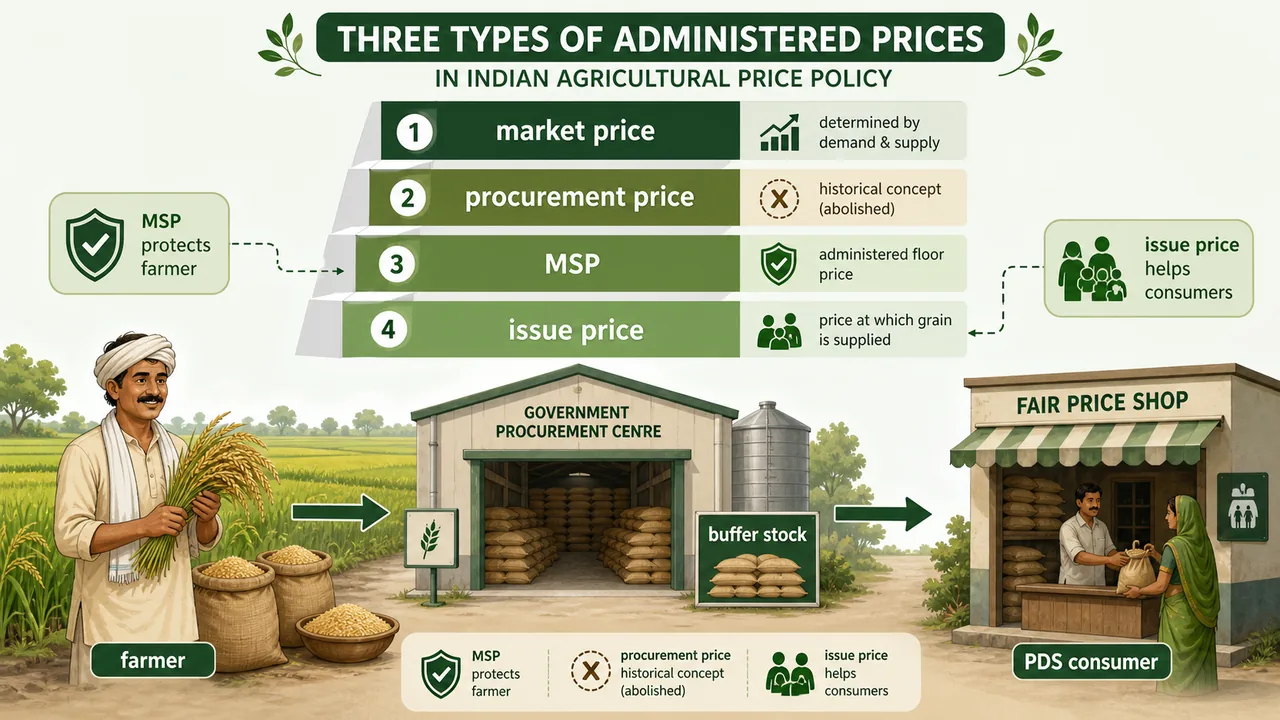
1. Minimum Support Price (MSP)
- Price fixed to protect farmers against excessive fall in prices during bumper production years
- Acts as a safety net — guarantees a minimum return regardless of market conditions
- Announced in June (Kharif) and October (Rabi) — before sowing — so farmers can plan which crops to grow
- Addresses price volatility caused by supply variation, lack of market integration, and information asymmetry
Crops Covered Under MSP
Government announces MSP for 22 mandated crops plus Fair and Remunerative Price (FRP) for sugarcane = Total 23.
| Category | Number | Crops |
|---|---|---|
| Cereals | 7 | Paddy, Wheat, Barley, Jowar, Bajra, Maize, Ragi |
| Pulses | 5 | Gram, Arhar/Tur, Moong, Urad, Lentil |
| Oilseeds | 8 | Groundnut, Rapeseed/Mustard, Toria, Soybean, Sunflower, Sesamum, Safflower, Nigerseed |
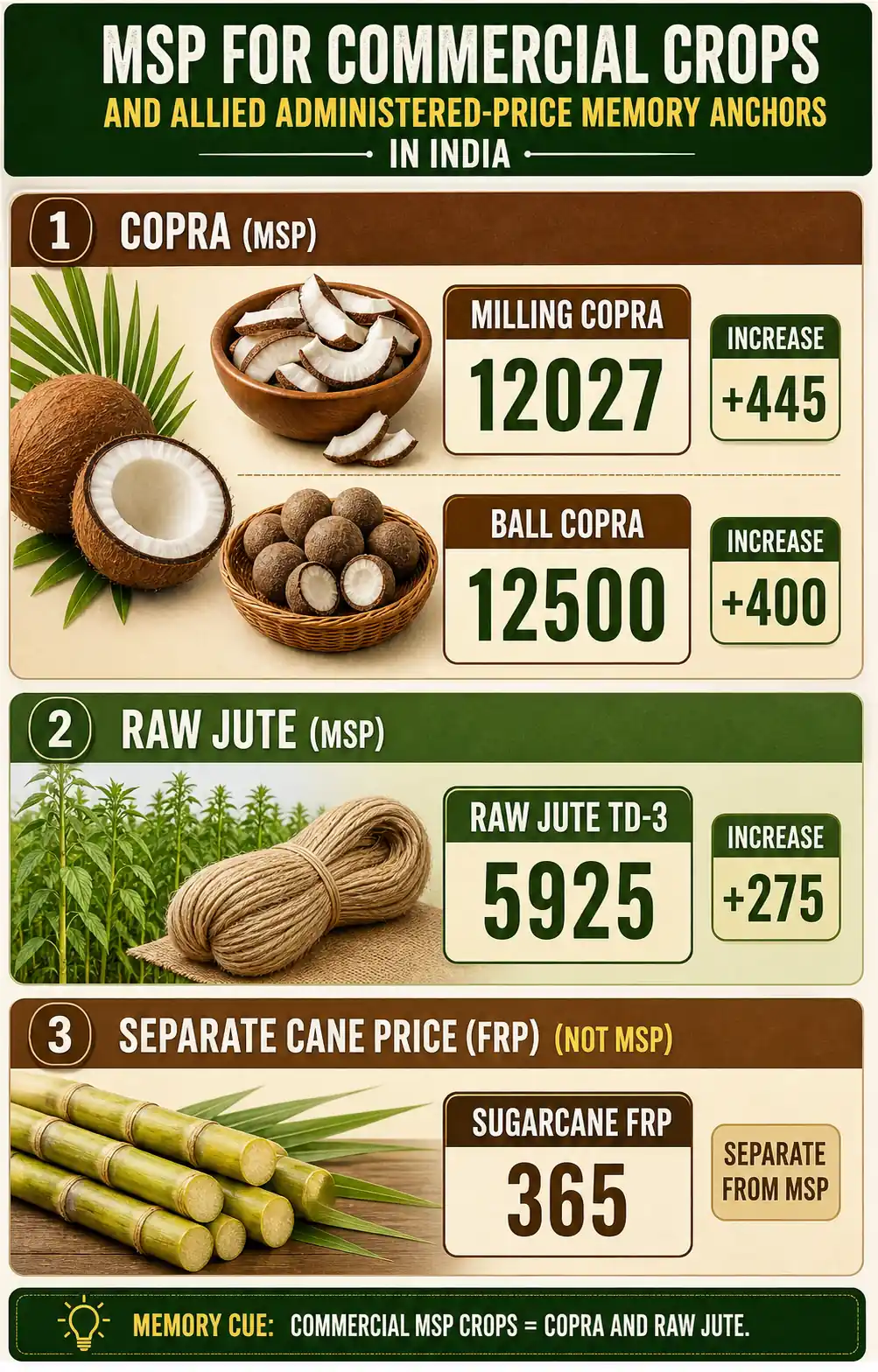
| Commercial | 2 | Raw Cotton, Raw Jute |
| Others | 1 | Copra (+ De-husked Coconut and VFC Tobacco linked to copra/mustard) |
| FRP | 1 | Sugarcane |
TIP
Memory aid for MSP crops: 7C + 5P + 8O + 2Com = 22 + 1 FRP = 23 total. Think: “7 cereals feed us, 5 pulses nourish us, 8 oilseeds fuel us, 2 commercial crops clothe us, 1 sugarcane sweetens us.”
Procurement Agency

The Food Corporation of India (FCI) is the nodal central agency. Along with state agencies, FCI purchases produce at MSP from farmers, turning the price guarantee into reality on the ground.
Factors for Fixing MSP
CACP considers these factors before recommending MSP:
| Factor | What It Means |
|---|---|
| Demand and supply | Overall market scenario for the commodity |
| Cost of production | Calculated using A2+FL method |
| Price trends | Domestic and international market prices |
| Inter-crop price parity | Ensuring fairness between different crops |
| Terms of trade | Agriculture vs non-agriculture to keep farming viable |
| 50% margin guarantee | Minimum 50% profit over cost of production |
| Consumer impact | Balancing farmer and consumer interests |
CACP also makes on-the-spot visits to states for direct assessment of farmer constraints. After CACP submits recommendations, the government circulates reports to state governments and central ministries for feedback. The CCEA then takes the final decision on MSP levels.
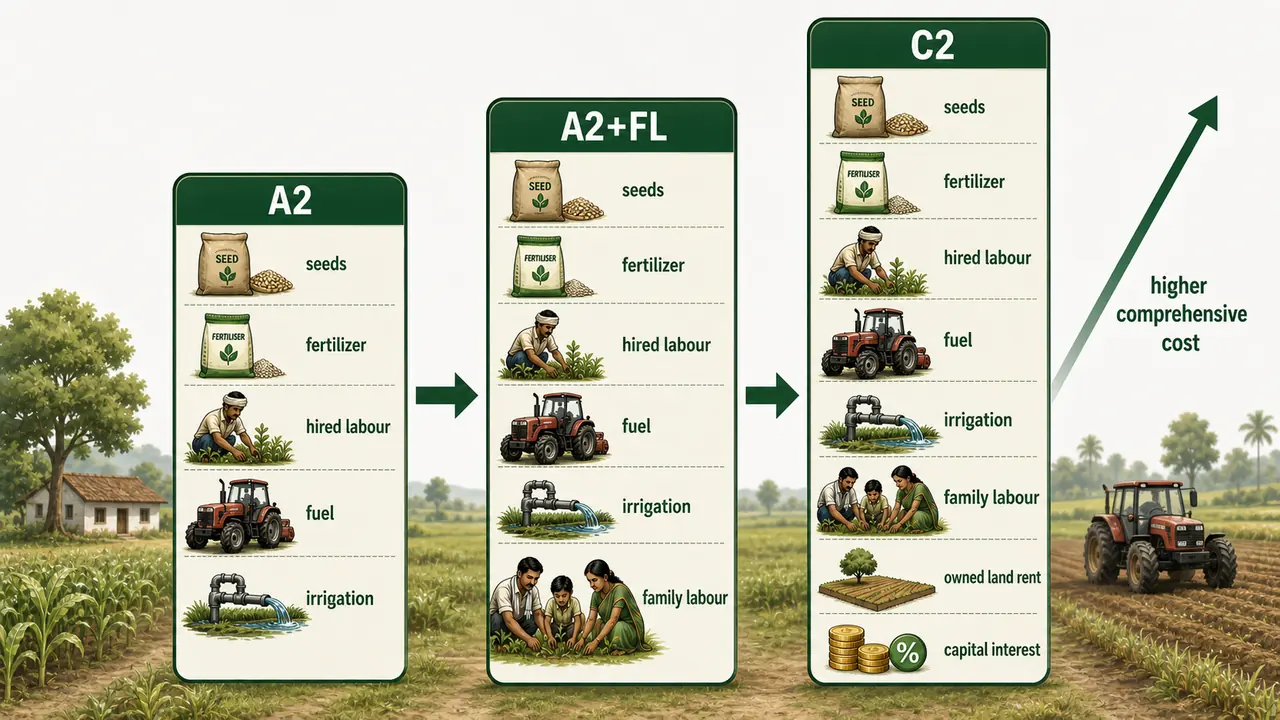
Cost Calculation Methods — A2, A2+FL, C2
| Method | What It Includes | Example for Wheat |
|---|---|---|
| A2 | Only actual paid-out costs — seeds, fertilizers, hired labour, fuel, irrigation charges | Rs 900/quintal |
| A2 + FL | A2 + imputed value of family labour | Rs 1,100/quintal |
| C2 | A2 + FL + imputed rent on owned land + interest on capital assets | Rs 1,500/quintal |
IMPORTANT
Cost Methods (ascending order): A2 < A2+FL < C2. Government uses A2+FL for MSP calculation. Swaminathan Commission recommended C2 (comprehensive cost). The C2 method ensures the highest price for farmers because it accounts for the full economic cost.
Key Policy: MSP is set at a minimum of 1.5 times the A2+FL cost — announced in Union Budget 2018-19, ensuring at least 50% profit margin for farmers.
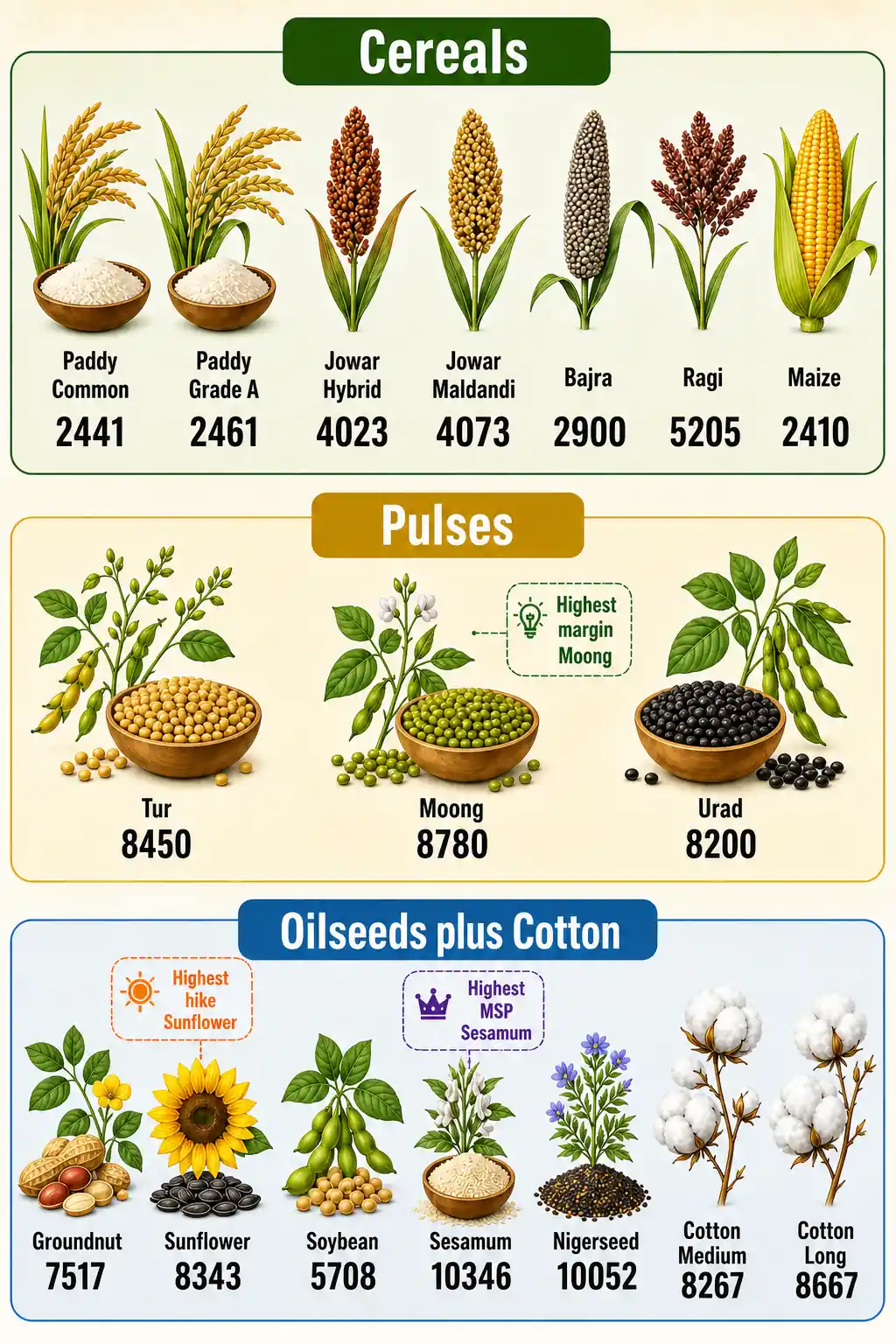
MSP Highlights — Kharif 2025-26

Source: CCEA decision, PIB press release PRID 2131983, dated 28 May 2025
| Crop | MSP 2025-26 (Rs/qtl) | Increase over 2024-25 |
|---|---|---|
| Paddy (Common) | 2,369 | +69 |
| Paddy (Grade A) | 2,389 | +69 |
| Jowar (Hybrid) | 3,699 | +328 |
| Bajra | 2,775 | +150 |
| Ragi | 4,886 | +596 |
| Maize | 2,400 | +175 |
| Tur/Arhar | 8,000 | +450 |
| Moong | 8,768 | +86 |
| Urad | 7,800 | +400 |
| Groundnut | 7,263 | +480 |
| Sunflower Seed | 7,721 | +441 |
| Soybean (Yellow) | 5,328 | +436 |
| Sesamum | 9,846 | +579 |
| Nigerseed | 9,537 | +820 |
| Cotton (Medium Staple) | 7,710 | +589 |
| Cotton (Long Staple) | 8,110 | +589 |
- Calculated at A2 + FL method
- Highest absolute increase: Nigerseed (+Rs 820/qtl), followed by Ragi (+Rs 596), Cotton (+Rs 589), Sesamum (+Rs 579)
- All crops guaranteed at least 50% return over cost of production (A2+FL)
- Crop diversification push: Coarse cereals, oilseeds, and pulses saw higher increases
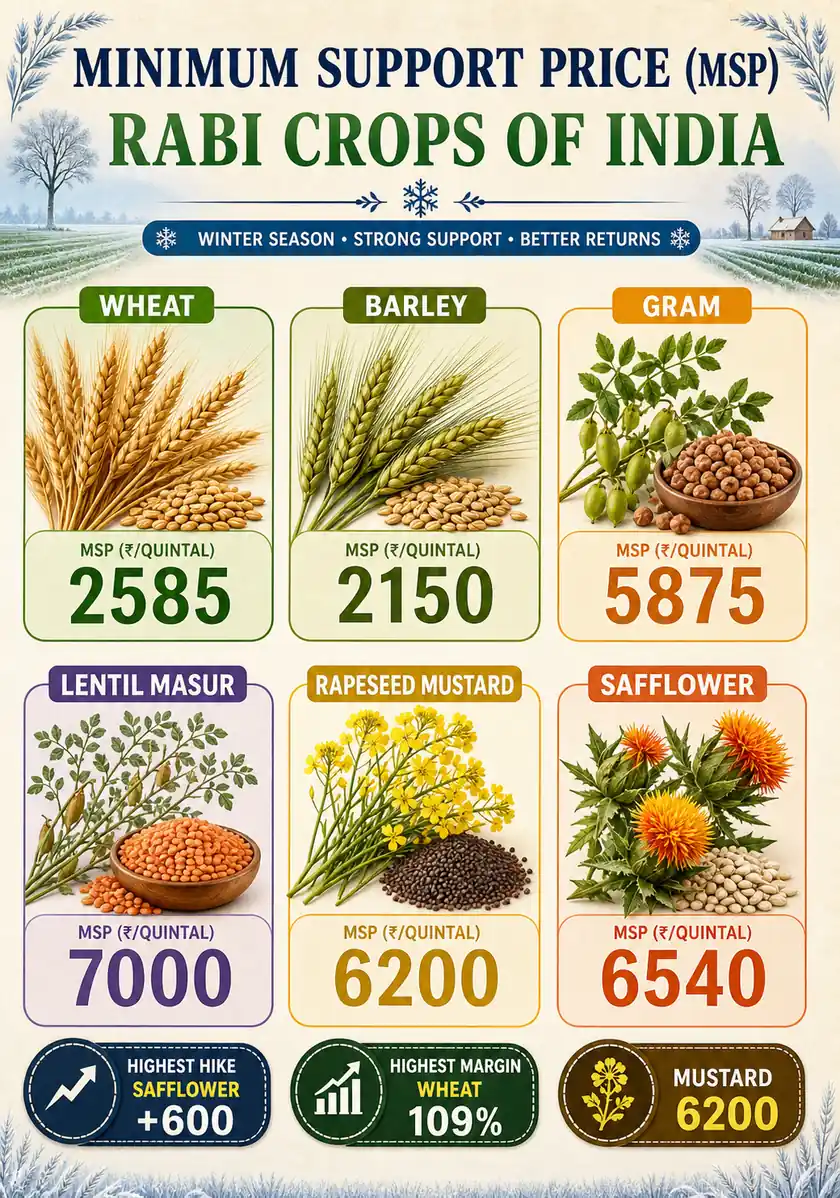
MSP Highlights — Rabi 2025-26

Source: CCEA decision, PIB press release PRID 2065309, dated 16 October 2024
| Crop | MSP 2025-26 (Rs/qtl) | Increase over 2024-25 | Margin over cost |
|---|---|---|---|
| Wheat | 2,425 | +150 | 105% |
| Barley | 1,980 | +130 | 60% |
| Gram | 5,650 | +210 | 60% |
| Lentil (Masur) | 6,700 | +275 | 89% |
| Rapeseed & Mustard | 5,950 | +300 | 98% |
| Safflower | 5,940 | +140 | 50% |
- Highest absolute increase: Rapeseed & Mustard (+Rs 300/qtl), followed by Lentil/Masur (+Rs 275)
- Highest return over cost: Wheat (105%) — farmer earns more than double the cost
- All crops maintain at least 50% margin over A2+FL cost
PM-ASHA — Umbrella Scheme for Price Support
Pradhan Mantri Annadata Aay SanraksHan Abhiyan (PM-ASHA), announced in 2018, provides multiple mechanisms for remunerative returns:
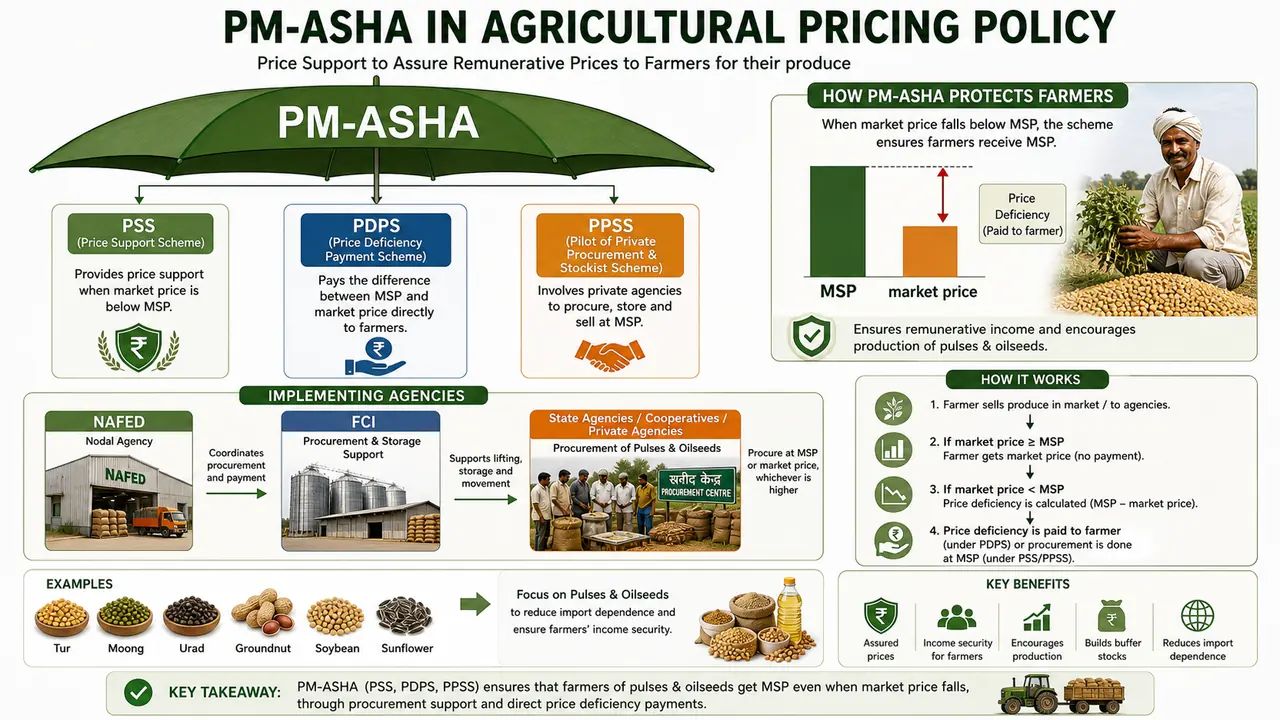
| Sub-Scheme | Full Form | Mechanism |
|---|---|---|
| PSS | Price Support Scheme | Government procures at MSP through NAFED/FCI |
| PDPS | Price Deficiency Payment Scheme | Government pays the difference between MSP and market price directly to farmer |
| PPSS | Private Procurement & Stockist Scheme | Private players procure at MSP with government guarantee (pilot basis) |
Fair and Remunerative Price (FRP) for Sugarcane
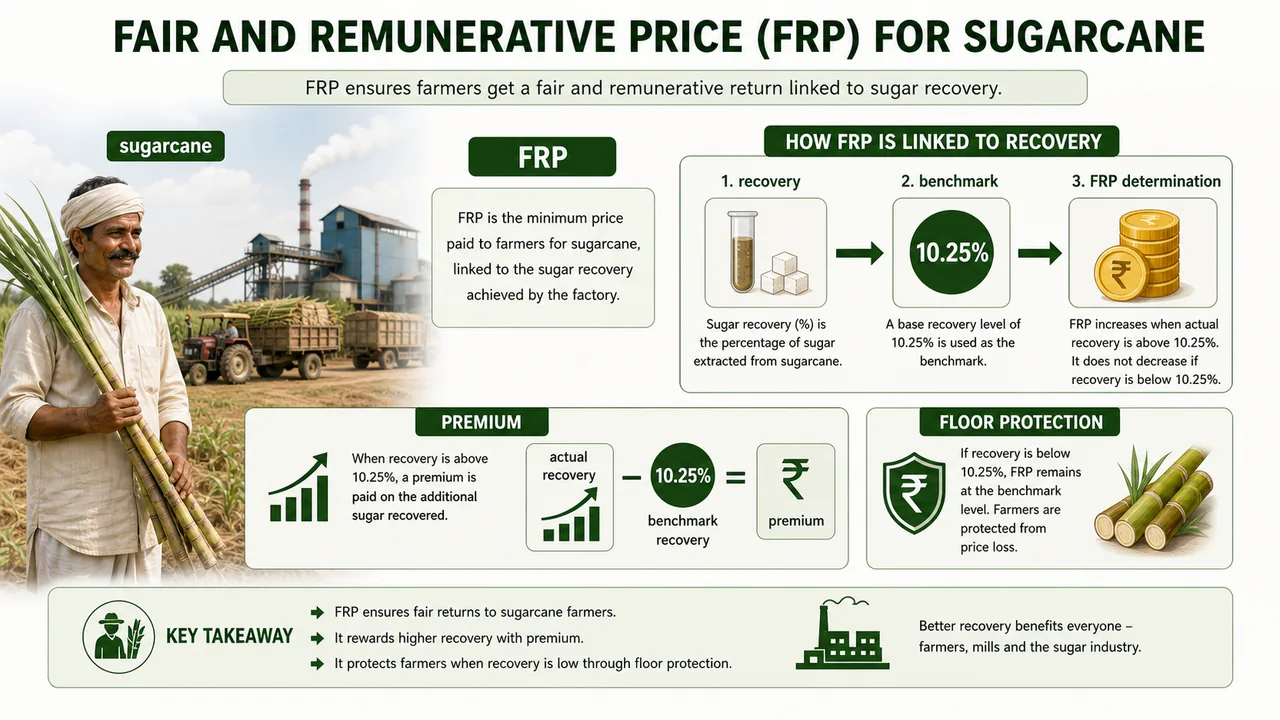
Source: CCEA decision, PIB press release PRID 2125471, dated 30 April 2025 (for sugar season October 2025 – September 2026)
| Parameter | Detail |
|---|---|
| FRP for 2025-26 | Rs 355/quintal for basic recovery rate of 10.25% |
| Premium | Rs 3.46/quintal for every 0.1% increase above 10.25% recovery |
| Reduction | Rs 3.46/quintal deduction for every 0.1% decrease in recovery |
| Floor protection | No deduction below 9.5% recovery — farmer gets Rs 329.05/quintal |
| Increase over 2024-25 | +Rs 15/quintal (4.41% increase); 2024-25 FRP was Rs 340/quintal |
| Cost coverage | FRP is 105.2% higher than A2+FL production cost (Rs 173/quintal) |
Agricultural Example: A sugar mill in UP with 10.75% recovery rate pays Rs 355 + (5 × Rs 3.46) = Rs 372.30/quintal. This recovery-linked pricing incentivizes farmers to grow high-sugar sugarcane varieties.
Problems with MSP
- The MS Swaminathan Commission recommended MSP should be 50% higher than total cost of production (C2 method) — this has been a central demand of farmer movements
- Government currently uses A2+FL method, which excludes rent on land and interest on capital
- The gap between A2+FL and C2 is the core of the ongoing debate on MSP adequacy
- MSP procurement is effective mainly for wheat and paddy; other crops lack adequate procurement infrastructure
2. Procurement Price (Abolished)
| Feature | Detail |
|---|---|
| Purpose | Price at which government procured from farmers for buffer stocks and PDS |
| Timing | Announced after harvest began (unlike MSP which is before sowing) |
| Relationship | Lower than market price, higher than MSP |
| Status | Abolished from Kharif 1991-92 — only MSP is announced now |
Why abolished? Having two prices (MSP and procurement price) created confusion. Since 1991-92, MSP serves the dual purpose of both support and procurement price.
3. Issue Price

- Price at which the government sells foodgrains to consumers at fair price shops under PDS and welfare schemes
- Always lower than procurement cost — the difference is borne by the government as food subsidy
- Under NFSA 2013, the Central Issue Price (CIP) is: Wheat Rs 3/kg, Rice Rs 2/kg, Coarse grains Rs 1/kg — unchanged since 2013
Price Hierarchy
Market Price > Procurement Price > MSP > Issue Price
| Price Type | Who Benefits | Who Sets It | Current Status |
|---|---|---|---|
| Market Price | Determined by demand and supply | Market forces | Active |
| Procurement Price | Government procurers | Government | Abolished (1991-92) |
| MSP | Farmers | CCEA (on CACP recommendation) | Active — 23 crops |
| Issue Price (CIP) | Consumers (PDS beneficiaries) | Government | Active — Rs 1/2/3 per kg |
Characteristics of Agricultural Product Prices
| Characteristic | Agricultural Example |
|---|---|
| Supply cannot be adjusted quickly to price changes | A paddy farmer cannot increase output mid-season if prices rise |
| Variable cost of production across regions | Wheat costs more to grow in rainfed Bundelkhand than irrigated Punjab |
| Wide quality variation affects prices | Grade-A basmati fetches 3x the price of broken rice |
| Prices show co-movement within a commodity group | When wheat price rises, barley and maize prices tend to follow |
| Prices vary across space | Onions are cheaper in Nashik (production zone) than in Chennai |
| Prices remain low post-harvest | Potato prices crash in January-February when harvest floods the market |
| Multiple prices exist simultaneously | Different grades, lot sizes, and buyer relationships create price variation |
| Regulated markets ensure fair prices | APMC mandis provide transparent auction-based price discovery |
Market Intervention Scheme (MIS)
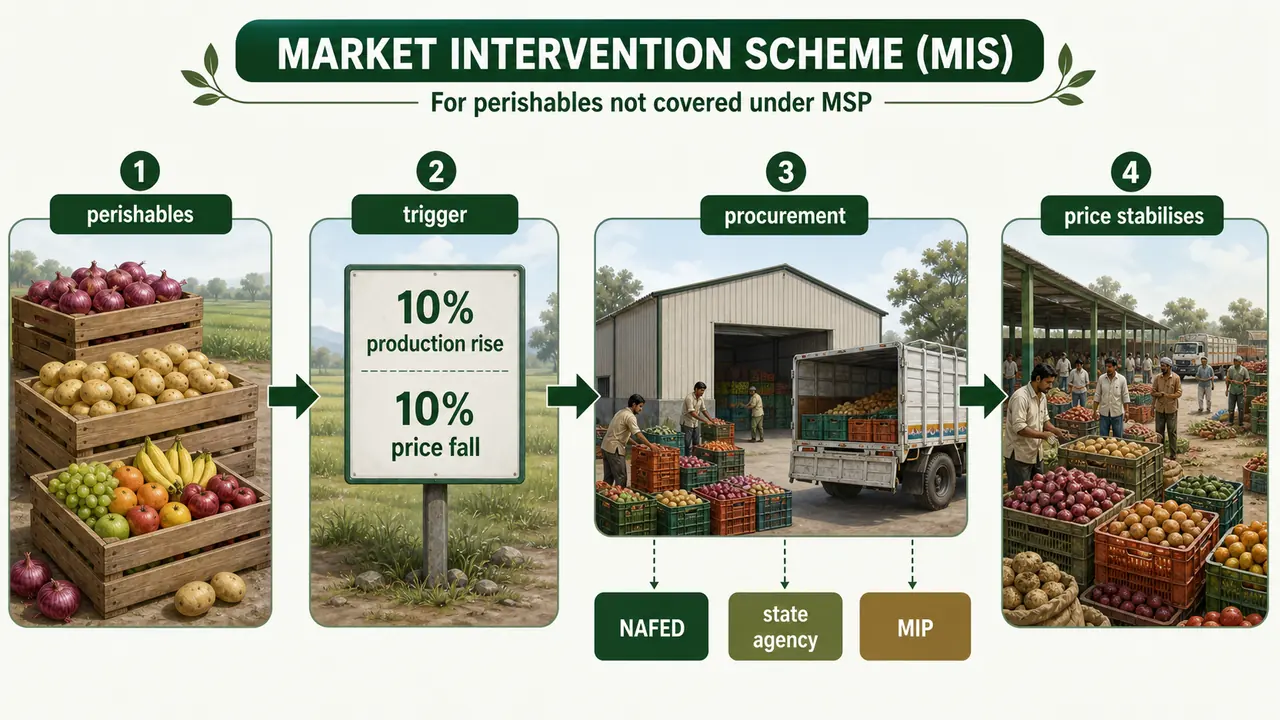
MIS fills the gap for perishable crops like onion, potato, and fruits that are not covered under MSP.
| Feature | Detail |
|---|---|
| Type | Ad hoc price support scheme |
| Coverage | Horticultural and perishable commodities not under MSP |
| Objective | Provide remunerative prices during glut in production and price crash |
| Trigger | At least 10% increase in production OR 10% decrease in ruling prices vs normal year |
| Department | Department of Agriculture & Cooperation |
| Cost Sharing | Centre:State = 50:50 (general); 75:25 (North-Eastern States) |
| Procurement Agency | NAFED (central) + state-designated agencies |
| Mechanism | Pre-determined quantity procured at fixed Market Intervention Price (MIP) until prices stabilize |
Agricultural Example: If onion production in Maharashtra jumps 15% and prices crash 20%, the state requests MIS. NAFED and state agencies procure onions at MIP, stabilizing the market.
Integrated Scheme for Agricultural Marketing (ISAM)
Started in 2014 AFO 2018 to keep pace with growing agricultural production and marketing surplus.
Objectives
- Create agricultural marketing infrastructure with backend subsidy support
- Promote scientific storage and pledge financing to increase farmer income
- Build integrated value chains (up to primary processing) for vertical integration
- Use ICT for market information dissemination to farmers
- Establish a nationwide information network for real-time price and arrival data
- Support grading standards and quality certification (Agmark)
- Catalyze private investment in agribusiness projects
- Promote training, research, and extension in agricultural marketing
Five Sub-Schemes of ISAM
| Sub-Scheme | Full Form | Key Feature |
|---|---|---|
| AMI | Agricultural Marketing Infrastructure | Backend capital subsidy — 25% (general) or 33.33% (special category) on capital cost. Subsumes GBY and AMIGS |
| MRIN | Marketing Research and Information Network | Real-time price and arrival data across mandis (AGMARKNET) |
| SAGF | Strengthening of Agmark Grading Facilities | Equipment, renovation for Agmark labs under DMI |
| ABD (VCA + PDF) | Agribusiness Development through Venture Capital Assistance and Project Development Facility | Financial support via nationalized banks, NABARD, SIDBI for agribusiness ventures |
| CCS NIAM | Centre for Commodity Studies, NIAM Jaipur | Applied research in agricultural marketing problems |
AMI Eligible Organizations: Individuals, farmers, farmer groups, partnership firms, NGOs, SHGs, companies, cooperatives, local bodies, FPOs, APMCs, marketing boards, and agro-processing corporations. Renovation assistance for rural godowns is restricted to cooperatives only.
e-NAM — Electronic National Agricultural Market
| Feature | Detail |
|---|---|
| Full Form | Electronic National Agricultural Market |
| Launched | 14th April 2016 |
| Implementing Agency | SFAC (Small Farmers Agri-Business Consortium) |
| Commodities | 150+ commodities with digital payment |
| Vision | ”One Nation One Market” for agriculture |
- A pan-India unified electronic market connecting regulated mandis across the country
- Ensures better price discovery, transparency, and competition
- Breaks geographical barriers — a farmer in Rajasthan can sell to a buyer in Kerala through online bidding
- Reduces cash transactions through digital payments
TIP
e-NAM key facts: Launched 14 April 2016 | Implementing agency: SFAC | 150+ commodities | “One Nation One Market.” If an exam asks about unified electronic market for agriculture, the answer is always e-NAM.
Exam Tips and Mnemonics
| Topic | Mnemonic/Tip |
|---|---|
| CACP | ”APC became CACP” — 1965 renamed 1985. CACP recommends, CCEA decides |
| MSP Crops | 7+5+8+2+1 = 23. “7 Cereals, 5 Pulses, 8 Oils, 2 Cloth, 1 Sweet” |
| Cost Methods | A2 < A2+FL < C2. “A2 is cheapest, C2 is costliest” |
| Price Order | Market > Procurement > MSP > Issue. “Consumers pay least (issue), market pays most” |
| Procurement Price | Abolished since Kharif 1991-92 — trick question in exams |
| MIS Trigger | 10% production up OR 10% price down — “10-10 rule” |
| MIS Sharing | 50:50 general, 75:25 NE states — “NE gets more from Centre” |
| e-NAM | SFAC implements, 14 April 2016, 150+ commodities |
Summary Table
| Concept | Key Fact |
|---|---|
| CACP | Est. 1965 (as APC), renamed 1985; recommends MSP |
| MSP | 22 crops + 1 FRP = 23; announced before sowing; min 1.5x A2+FL cost |
| Cost Methods | A2 (paid-out) < A2+FL (+ family labour) < C2 (+ rent + interest) |
| Procurement Price | Abolished from Kharif 1991-92 |
| Issue Price (CIP) | Wheat Rs 3, Rice Rs 2, Coarse grains Rs 1 per kg (NFSA 2013) |
| Price Hierarchy | Market > Procurement > MSP > Issue Price |
| MIS | Ad hoc for perishables not under MSP; 10% trigger; 50:50 sharing |
| ISAM | 5 sub-schemes (AMI, MRIN, SAGF, ABD, CCS NIAM); started 2014 |
| e-NAM | Pan-India electronic market; SFAC; 14 April 2016; 150+ commodities |
| PM-ASHA | PSS + PDPS + PPSS; umbrella scheme for price support since 2018 |
Farmer’s Decision Guide: Where to Sell?
An AFO officer should help farmers compare selling options:
| Option | When to Use | Price Farmer Gets | Risk |
|---|---|---|---|
| Sell at MSP (via FCI/NAFED/State agency) | Market price is at or below MSP; farmer has standard quality produce | MSP (guaranteed floor price) | Long wait at procurement centres; quality rejection possible |
| Sell at mandi (APMC) | Market price is above MSP; local mandi accessible | Market price (can be higher than MSP) | Price volatility; intermediary commissions (2-8%) |
| Sell on e-NAM | Farmer has smartphone, quality produce, and e-NAM registered mandi nearby | Competitive price from wider buyer pool | Requires digital literacy; logistics for distant buyers |
| Direct sale (PM-KISAN/FPO/contract farming) | Farmer is part of FPO or has contract with processor | Negotiated price (often above MSP) | Contract terms may be unfavorable; legal literacy needed |
| Store and sell later | Farmer has storage facility; expects price to rise post-harvest | Higher price (seasonal price rise of 15-30% for most crops) | Storage losses; interest cost on crop loan |
Cost calculation — what CACP considers:
| Cost Concept | What’s Included | Who Uses It |
|---|---|---|
| A2 | All paid-out costs (seed, fertilizer, hired labour, fuel, irrigation) | Minimum baseline |
| A2 + FL | A2 + imputed value of family labour | MSP is set at min 1.5× this (since 2018-19 policy) |
| C2 | A2+FL + rental value of owned land + interest on owned capital | Full economic cost; Swaminathan Committee recommended MSP at 1.5× C2 |
Key exam distinction: Current policy guarantees MSP at 1.5× A2+FL (not C2). The demand for MSP at 1.5× C2 remains a farmer movement demand. Know which cost basis is used — this is tested frequently.
Summary Cheat Sheet
| Concept / Topic | Key Details / Explanation |
|---|---|
| Agricultural Price Policy | Government intervention via administered prices — MSP, Procurement Price, Issue Price |
| CACP | Est. 1965 as APC; renamed 1985; recommends MSP; attached to Ministry of Agriculture |
| L.K. Jha | Headed the Foodgrains Prices Committee that recommended establishing APC |
| CCEA | Cabinet Committee on Economic Affairs — takes final decision on MSP |
| MSP | Minimum Support Price; safety net against price crash; announced before sowing (June for Kharif, Oct for Rabi) |
| MSP Crops | 22 mandated crops + 1 FRP (sugarcane) = 23 total; 7 cereals + 5 pulses + 8 oilseeds + 2 commercial + 1 copra |
| Cost A2 | Only actual paid-out costs (seeds, fertilizers, hired labour, fuel) |
| Cost A2 + FL | A2 + imputed value of family labour; used for MSP calculation |
| Cost C2 | A2 + FL + imputed rent on owned land + interest on capital; recommended by Swaminathan Commission |
| Cost order | A2 < A2+FL < C2 |
| MSP = 1.5 × A2+FL | Minimum 50% profit margin over cost; announced in Union Budget 2018-19 |
| FCI | Nodal procurement agency for cereals at MSP |
| Procurement Price | Was higher than MSP, lower than market price; abolished from Kharif 1991-92 |
| Issue Price (CIP) | Price at fair price shops under PDS; Wheat Rs 3/kg, Rice Rs 2/kg, Coarse grains Rs 1/kg (NFSA 2013) |
| Price Hierarchy | Market > Procurement > MSP > Issue Price |
| FRP for Sugarcane | Rs 355/quintal for 10.25% recovery (2025-26); Rs 3.46 premium per 0.1% above 10.25%; floor at 9.5% recovery (Rs 329.05/qtl) |
| MIS (Market Intervention Scheme) | For perishables not under MSP; trigger: 10% production up OR 10% price down; cost sharing 50:50 (75:25 for NE) |
| ISAM | Integrated Scheme for Agricultural Marketing (2014); 5 sub-schemes: AMI, MRIN, SAGF, ABD, CCS NIAM |
| AMI subsidy | 25% (general) or 33.33% (special category) backend capital subsidy |
| e-NAM | Electronic National Agricultural Market; launched 14 April 2016; implementing agency SFAC; 150+ commodities; “One Nation One Market” |
| PM-ASHA (2018) | Umbrella scheme: PSS (govt. procures at MSP), PDPS (pays price difference), PPSS (private procurement) |
| Agri price characteristics | Supply inelastic short-run, variable costs, quality variation, co-movement, spatial variation, post-harvest low prices |
References and Sources
Government / Official Sources
-
CCEA — MSP for Kharif Crops 2025-26 Press Information Bureau, Government of India. Cabinet Committee on Economic Affairs approves MSP for Kharif Crops for Marketing Season 2025-26. 28 May 2025. pib.gov.in — PRID 2131983
-
CCEA — MSP for Rabi Crops 2025-26 Press Information Bureau, Government of India. Cabinet Committee on Economic Affairs approves MSP for Rabi Crops for Marketing Season 2025-26. 16 October 2024. pib.gov.in — PRID 2065309
-
CCEA — Fair and Remunerative Price (FRP) for Sugarcane 2025-26 Press Information Bureau, Government of India. Cabinet approves Fair and Remunerative Price (FRP) of sugarcane for sugar season 2025-26. 30 April 2025. pib.gov.in — PRID 2125471
-
Commission for Agricultural Costs and Prices (CACP) Ministry of Agriculture and Farmers Welfare, Government of India. cacp.dacnet.nic.in
-
National Food Security Act, 2013 — Central Issue Price Ministry of Consumer Affairs, Food and Public Distribution, Government of India. dfpd.gov.in
-
e-NAM — Electronic National Agricultural Market Small Farmers Agri-Business Consortium (SFAC), Ministry of Agriculture and Farmers Welfare. enam.gov.in
-
PM-ASHA — Pradhan Mantri Annadata Aay SanraksHan Abhiyan Ministry of Agriculture and Farmers Welfare, Government of India. Scheme announced September 2018. agricoop.nic.in
NOTE
MSP data in this lesson reflects Kharif 2025-26 and Rabi 2025-26 figures as officially announced by CCEA. Structural information (cost methods, CACP history, price hierarchy, MIS, ISAM, e-NAM) is based on established policy documents and is stable across years.
Pro Content Locked
Upgrade to Pro to access this lesson and all other premium content.
₹2388 billed yearly
- All Agriculture & Banking Courses
- AI Lesson Questions (100/day)
- AI Doubt Solver (50/day)
- Glows & Grows Feedback (30/day)
- AI Section Quiz (20/day)
- 22-Language Translation (30/day)
- Recall Questions (20/day)
- AI Quiz (15/day)
- AI Quiz Paper Analysis
- AI Step-by-Step Explanations
- Spaced Repetition Recall (FSRS)
- AI Tutor
- Immersive Text Questions
- Audio Lessons — Hindi & English
- Mock Tests & Previous Year Papers
- Summary & Mind Maps
- XP, Levels, Leaderboard & Badges
- Generate New Classrooms
- Voice AI Teacher (AgriDots Live)
- AI Revision Assistant
- Knowledge Gap Analysis
- Interactive Revision (LangGraph)
🔒 Secure via Razorpay · Cancel anytime · No hidden fees
Why Does Agriculture Need a Price Policy?
A wheat farmer in Haryana invests Rs 1,500/quintal on seeds, fertilizers, irrigation, and labour. In a bumper harvest year, market prices crash to Rs 1,200/quintal — below his cost. Without government intervention, he faces a net loss despite good production. Agricultural price policy exists precisely to prevent this — it guarantees farmers a minimum price, ensures food security for consumers, and maintains buffer stocks for the nation.
What Is Agricultural Price Policy?

- It is a method of government intervention in the market through announcement of administered prices — Minimum Support Price, Procurement Price, and Issue Price
- Prices are announced for agricultural crops by the Department of Agriculture and Co-operation, Government of India, on the recommendation AFO-2021 of the Commission for Agricultural Costs and Prices (CACP)
- Currently, only MSP is announced before each sowing season by the Cabinet Committee on Economic Affairs (CCEA) based on CACP recommendations
CACP — Commission for Agricultural Costs and Prices
| Feature | Detail |
|---|---|
| Originally Established | 1965 as Agricultural Price Commission (APC) |
| Renamed | 1985 — Commission for Agricultural Costs and Prices (CACP) |
| Recommended By | Foodgrains Prices Committee headed by Shri L.K. Jha |
| Status | Attached office of Ministry of Agriculture and Farmers Welfare |
| Current Chairman | Dr. Vijay Paul Sharma |
| Function | Recommends MSP; submits separate reports for Kharif and Rabi seasons |
IMPORTANT
CACP was established as APC in 1965 and renamed CACP in 1985. It only recommends MSP — the final decision is taken by CCEA. This distinction is frequently tested.
Agricultural Example: Before the Kharif 2024 sowing season, CACP visits paddy-growing states, consults FCI, NAFED, and farmer organizations, and then recommends a paddy MSP to the government. CCEA then announces the final MSP.
Three Types of Administered Prices
Prices fixed by the government serve three purposes: protect farmers from price crashes, protect consumers from price spikes, and ensure procurement for buffer stocks and PDS.
1. Minimum Support Price (MSP)
- Price fixed to protect farmers against excessive fall in prices during bumper production years
- Acts as a safety net — guarantees a minimum return regardless of market conditions
- Announced in June (Kharif) and October (Rabi) — before sowing — so farmers can plan which crops to grow
- Addresses price volatility caused by supply variation, lack of market integration, and information asymmetry
Crops Covered Under MSP
Government announces MSP for 22 mandated crops plus Fair and Remunerative Price (FRP) for sugarcane = Total 23.
| Category | Number | Crops |
|---|---|---|
| Cereals | 7 | Paddy, Wheat, Barley, Jowar, Bajra, Maize, Ragi |
| Pulses | 5 | Gram, Arhar/Tur, Moong, Urad, Lentil |
| Oilseeds | 8 | Groundnut, Rapeseed/Mustard, Toria, Soybean, Sunflower, Sesamum, Safflower, Nigerseed |
| Commercial | 2 | Raw Cotton, Raw Jute |
| Others | 1 | Copra (+ De-husked Coconut and VFC Tobacco linked to copra/mustard) |
| FRP | 1 | Sugarcane |
TIP
Memory aid for MSP crops: 7C + 5P + 8O + 2Com = 22 + 1 FRP = 23 total. Think: “7 cereals feed us, 5 pulses nourish us, 8 oilseeds fuel us, 2 commercial crops clothe us, 1 sugarcane sweetens us.”
Procurement Agency

The Food Corporation of India (FCI) is the nodal central agency. Along with state agencies, FCI purchases produce at MSP from farmers, turning the price guarantee into reality on the ground.
Factors for Fixing MSP
CACP considers these factors before recommending MSP:
| Factor | What It Means |
|---|---|
| Demand and supply | Overall market scenario for the commodity |
| Cost of production | Calculated using A2+FL method |
| Price trends | Domestic and international market prices |
| Inter-crop price parity | Ensuring fairness between different crops |
| Terms of trade | Agriculture vs non-agriculture to keep farming viable |
| 50% margin guarantee | Minimum 50% profit over cost of production |
| Consumer impact | Balancing farmer and consumer interests |
CACP also makes on-the-spot visits to states for direct assessment of farmer constraints. After CACP submits recommendations, the government circulates reports to state governments and central ministries for feedback. The CCEA then takes the final decision on MSP levels.
Cost Calculation Methods — A2, A2+FL, C2
| Method | What It Includes | Example for Wheat |
|---|---|---|
| A2 | Only actual paid-out costs — seeds, fertilizers, hired labour, fuel, irrigation charges | Rs 900/quintal |
| A2 + FL | A2 + imputed value of family labour | Rs 1,100/quintal |
| C2 | A2 + FL + imputed rent on owned land + interest on capital assets | Rs 1,500/quintal |
IMPORTANT
Cost Methods (ascending order): A2 < A2+FL < C2. Government uses A2+FL for MSP calculation. Swaminathan Commission recommended C2 (comprehensive cost). The C2 method ensures the highest price for farmers because it accounts for the full economic cost.
Key Policy: MSP is set at a minimum of 1.5 times the A2+FL cost — announced in Union Budget 2018-19, ensuring at least 50% profit margin for farmers.
MSP Highlights — Kharif 2025-26

Source: CCEA decision, PIB press release PRID 2131983, dated 28 May 2025
| Crop | MSP 2025-26 (Rs/qtl) | Increase over 2024-25 |
|---|---|---|
| Paddy (Common) | 2,369 | +69 |
| Paddy (Grade A) | 2,389 | +69 |
| Jowar (Hybrid) | 3,699 | +328 |
| Bajra | 2,775 | +150 |
| Ragi | 4,886 | +596 |
| Maize | 2,400 | +175 |
| Tur/Arhar | 8,000 | +450 |
| Moong | 8,768 | +86 |
| Urad | 7,800 | +400 |
| Groundnut | 7,263 | +480 |
| Sunflower Seed | 7,721 | +441 |
| Soybean (Yellow) | 5,328 | +436 |
| Sesamum | 9,846 | +579 |
| Nigerseed | 9,537 | +820 |
| Cotton (Medium Staple) | 7,710 | +589 |
| Cotton (Long Staple) | 8,110 | +589 |
- Calculated at A2 + FL method
- Highest absolute increase: Nigerseed (+Rs 820/qtl), followed by Ragi (+Rs 596), Cotton (+Rs 589), Sesamum (+Rs 579)
- All crops guaranteed at least 50% return over cost of production (A2+FL)
- Crop diversification push: Coarse cereals, oilseeds, and pulses saw higher increases
MSP Highlights — Rabi 2025-26

Source: CCEA decision, PIB press release PRID 2065309, dated 16 October 2024
| Crop | MSP 2025-26 (Rs/qtl) | Increase over 2024-25 | Margin over cost |
|---|---|---|---|
| Wheat | 2,425 | +150 | 105% |
| Barley | 1,980 | +130 | 60% |
| Gram | 5,650 | +210 | 60% |
| Lentil (Masur) | 6,700 | +275 | 89% |
| Rapeseed & Mustard | 5,950 | +300 | 98% |
| Safflower | 5,940 | +140 | 50% |
- Highest absolute increase: Rapeseed & Mustard (+Rs 300/qtl), followed by Lentil/Masur (+Rs 275)
- Highest return over cost: Wheat (105%) — farmer earns more than double the cost
- All crops maintain at least 50% margin over A2+FL cost
PM-ASHA — Umbrella Scheme for Price Support
Pradhan Mantri Annadata Aay SanraksHan Abhiyan (PM-ASHA), announced in 2018, provides multiple mechanisms for remunerative returns:
| Sub-Scheme | Full Form | Mechanism |
|---|---|---|
| PSS | Price Support Scheme | Government procures at MSP through NAFED/FCI |
| PDPS | Price Deficiency Payment Scheme | Government pays the difference between MSP and market price directly to farmer |
| PPSS | Private Procurement & Stockist Scheme | Private players procure at MSP with government guarantee (pilot basis) |
Fair and Remunerative Price (FRP) for Sugarcane

Source: CCEA decision, PIB press release PRID 2125471, dated 30 April 2025 (for sugar season October 2025 – September 2026)
| Parameter | Detail |
|---|---|
| FRP for 2025-26 | Rs 355/quintal for basic recovery rate of 10.25% |
| Premium | Rs 3.46/quintal for every 0.1% increase above 10.25% recovery |
| Reduction | Rs 3.46/quintal deduction for every 0.1% decrease in recovery |
| Floor protection | No deduction below 9.5% recovery — farmer gets Rs 329.05/quintal |
| Increase over 2024-25 | +Rs 15/quintal (4.41% increase); 2024-25 FRP was Rs 340/quintal |
| Cost coverage | FRP is 105.2% higher than A2+FL production cost (Rs 173/quintal) |
Agricultural Example: A sugar mill in UP with 10.75% recovery rate pays Rs 355 + (5 × Rs 3.46) = Rs 372.30/quintal. This recovery-linked pricing incentivizes farmers to grow high-sugar sugarcane varieties.
Problems with MSP
- The MS Swaminathan Commission recommended MSP should be 50% higher than total cost of production (C2 method) — this has been a central demand of farmer movements
- Government currently uses A2+FL method, which excludes rent on land and interest on capital
- The gap between A2+FL and C2 is the core of the ongoing debate on MSP adequacy
- MSP procurement is effective mainly for wheat and paddy; other crops lack adequate procurement infrastructure
2. Procurement Price (Abolished)
| Feature | Detail |
|---|---|
| Purpose | Price at which government procured from farmers for buffer stocks and PDS |
| Timing | Announced after harvest began (unlike MSP which is before sowing) |
| Relationship | Lower than market price, higher than MSP |
| Status | Abolished from Kharif 1991-92 — only MSP is announced now |
Why abolished? Having two prices (MSP and procurement price) created confusion. Since 1991-92, MSP serves the dual purpose of both support and procurement price.
3. Issue Price

- Price at which the government sells foodgrains to consumers at fair price shops under PDS and welfare schemes
- Always lower than procurement cost — the difference is borne by the government as food subsidy
- Under NFSA 2013, the Central Issue Price (CIP) is: Wheat Rs 3/kg, Rice Rs 2/kg, Coarse grains Rs 1/kg — unchanged since 2013
Price Hierarchy
Market Price > Procurement Price > MSP > Issue Price
| Price Type | Who Benefits | Who Sets It | Current Status |
|---|---|---|---|
| Market Price | Determined by demand and supply | Market forces | Active |
| Procurement Price | Government procurers | Government | Abolished (1991-92) |
| MSP | Farmers | CCEA (on CACP recommendation) | Active — 23 crops |
| Issue Price (CIP) | Consumers (PDS beneficiaries) | Government | Active — Rs 1/2/3 per kg |
Characteristics of Agricultural Product Prices
| Characteristic | Agricultural Example |
|---|---|
| Supply cannot be adjusted quickly to price changes | A paddy farmer cannot increase output mid-season if prices rise |
| Variable cost of production across regions | Wheat costs more to grow in rainfed Bundelkhand than irrigated Punjab |
| Wide quality variation affects prices | Grade-A basmati fetches 3x the price of broken rice |
| Prices show co-movement within a commodity group | When wheat price rises, barley and maize prices tend to follow |
| Prices vary across space | Onions are cheaper in Nashik (production zone) than in Chennai |
| Prices remain low post-harvest | Potato prices crash in January-February when harvest floods the market |
| Multiple prices exist simultaneously | Different grades, lot sizes, and buyer relationships create price variation |
| Regulated markets ensure fair prices | APMC mandis provide transparent auction-based price discovery |
Market Intervention Scheme (MIS)
MIS fills the gap for perishable crops like onion, potato, and fruits that are not covered under MSP.
| Feature | Detail |
|---|---|
| Type | Ad hoc price support scheme |
| Coverage | Horticultural and perishable commodities not under MSP |
| Objective | Provide remunerative prices during glut in production and price crash |
| Trigger | At least 10% increase in production OR 10% decrease in ruling prices vs normal year |
| Department | Department of Agriculture & Cooperation |
| Cost Sharing | Centre:State = 50:50 (general); 75:25 (North-Eastern States) |
| Procurement Agency | NAFED (central) + state-designated agencies |
| Mechanism | Pre-determined quantity procured at fixed Market Intervention Price (MIP) until prices stabilize |
Agricultural Example: If onion production in Maharashtra jumps 15% and prices crash 20%, the state requests MIS. NAFED and state agencies procure onions at MIP, stabilizing the market.
Integrated Scheme for Agricultural Marketing (ISAM)
Started in 2014 AFO 2018 to keep pace with growing agricultural production and marketing surplus.
Objectives
- Create agricultural marketing infrastructure with backend subsidy support
- Promote scientific storage and pledge financing to increase farmer income
- Build integrated value chains (up to primary processing) for vertical integration
- Use ICT for market information dissemination to farmers
- Establish a nationwide information network for real-time price and arrival data
- Support grading standards and quality certification (Agmark)
- Catalyze private investment in agribusiness projects
- Promote training, research, and extension in agricultural marketing
Five Sub-Schemes of ISAM
| Sub-Scheme | Full Form | Key Feature |
|---|---|---|
| AMI | Agricultural Marketing Infrastructure | Backend capital subsidy — 25% (general) or 33.33% (special category) on capital cost. Subsumes GBY and AMIGS |
| MRIN | Marketing Research and Information Network | Real-time price and arrival data across mandis (AGMARKNET) |
| SAGF | Strengthening of Agmark Grading Facilities | Equipment, renovation for Agmark labs under DMI |
| ABD (VCA + PDF) | Agribusiness Development through Venture Capital Assistance and Project Development Facility | Financial support via nationalized banks, NABARD, SIDBI for agribusiness ventures |
| CCS NIAM | Centre for Commodity Studies, NIAM Jaipur | Applied research in agricultural marketing problems |
AMI Eligible Organizations: Individuals, farmers, farmer groups, partnership firms, NGOs, SHGs, companies, cooperatives, local bodies, FPOs, APMCs, marketing boards, and agro-processing corporations. Renovation assistance for rural godowns is restricted to cooperatives only.
e-NAM — Electronic National Agricultural Market
| Feature | Detail |
|---|---|
| Full Form | Electronic National Agricultural Market |
| Launched | 14th April 2016 |
| Implementing Agency | SFAC (Small Farmers Agri-Business Consortium) |
| Commodities | 150+ commodities with digital payment |
| Vision | ”One Nation One Market” for agriculture |
- A pan-India unified electronic market connecting regulated mandis across the country
- Ensures better price discovery, transparency, and competition
- Breaks geographical barriers — a farmer in Rajasthan can sell to a buyer in Kerala through online bidding
- Reduces cash transactions through digital payments
TIP
e-NAM key facts: Launched 14 April 2016 | Implementing agency: SFAC | 150+ commodities | “One Nation One Market.” If an exam asks about unified electronic market for agriculture, the answer is always e-NAM.
Exam Tips and Mnemonics
| Topic | Mnemonic/Tip |
|---|---|
| CACP | ”APC became CACP” — 1965 renamed 1985. CACP recommends, CCEA decides |
| MSP Crops | 7+5+8+2+1 = 23. “7 Cereals, 5 Pulses, 8 Oils, 2 Cloth, 1 Sweet” |
| Cost Methods | A2 < A2+FL < C2. “A2 is cheapest, C2 is costliest” |
| Price Order | Market > Procurement > MSP > Issue. “Consumers pay least (issue), market pays most” |
| Procurement Price | Abolished since Kharif 1991-92 — trick question in exams |
| MIS Trigger | 10% production up OR 10% price down — “10-10 rule” |
| MIS Sharing | 50:50 general, 75:25 NE states — “NE gets more from Centre” |
| e-NAM | SFAC implements, 14 April 2016, 150+ commodities |
Summary Table
| Concept | Key Fact |
|---|---|
| CACP | Est. 1965 (as APC), renamed 1985; recommends MSP |
| MSP | 22 crops + 1 FRP = 23; announced before sowing; min 1.5x A2+FL cost |
| Cost Methods | A2 (paid-out) < A2+FL (+ family labour) < C2 (+ rent + interest) |
| Procurement Price | Abolished from Kharif 1991-92 |
| Issue Price (CIP) | Wheat Rs 3, Rice Rs 2, Coarse grains Rs 1 per kg (NFSA 2013) |
| Price Hierarchy | Market > Procurement > MSP > Issue Price |
| MIS | Ad hoc for perishables not under MSP; 10% trigger; 50:50 sharing |
| ISAM | 5 sub-schemes (AMI, MRIN, SAGF, ABD, CCS NIAM); started 2014 |
| e-NAM | Pan-India electronic market; SFAC; 14 April 2016; 150+ commodities |
| PM-ASHA | PSS + PDPS + PPSS; umbrella scheme for price support since 2018 |
Farmer’s Decision Guide: Where to Sell?
An AFO officer should help farmers compare selling options:
| Option | When to Use | Price Farmer Gets | Risk |
|---|---|---|---|
| Sell at MSP (via FCI/NAFED/State agency) | Market price is at or below MSP; farmer has standard quality produce | MSP (guaranteed floor price) | Long wait at procurement centres; quality rejection possible |
| Sell at mandi (APMC) | Market price is above MSP; local mandi accessible | Market price (can be higher than MSP) | Price volatility; intermediary commissions (2-8%) |
| Sell on e-NAM | Farmer has smartphone, quality produce, and e-NAM registered mandi nearby | Competitive price from wider buyer pool | Requires digital literacy; logistics for distant buyers |
| Direct sale (PM-KISAN/FPO/contract farming) | Farmer is part of FPO or has contract with processor | Negotiated price (often above MSP) | Contract terms may be unfavorable; legal literacy needed |
| Store and sell later | Farmer has storage facility; expects price to rise post-harvest | Higher price (seasonal price rise of 15-30% for most crops) | Storage losses; interest cost on crop loan |
Cost calculation — what CACP considers:
| Cost Concept | What’s Included | Who Uses It |
|---|---|---|
| A2 | All paid-out costs (seed, fertilizer, hired labour, fuel, irrigation) | Minimum baseline |
| A2 + FL | A2 + imputed value of family labour | MSP is set at min 1.5× this (since 2018-19 policy) |
| C2 | A2+FL + rental value of owned land + interest on owned capital | Full economic cost; Swaminathan Committee recommended MSP at 1.5× C2 |
Key exam distinction: Current policy guarantees MSP at 1.5× A2+FL (not C2). The demand for MSP at 1.5× C2 remains a farmer movement demand. Know which cost basis is used — this is tested frequently.
Summary Cheat Sheet
| Concept / Topic | Key Details / Explanation |
|---|---|
| Agricultural Price Policy | Government intervention via administered prices — MSP, Procurement Price, Issue Price |
| CACP | Est. 1965 as APC; renamed 1985; recommends MSP; attached to Ministry of Agriculture |
| L.K. Jha | Headed the Foodgrains Prices Committee that recommended establishing APC |
| CCEA | Cabinet Committee on Economic Affairs — takes final decision on MSP |
| MSP | Minimum Support Price; safety net against price crash; announced before sowing (June for Kharif, Oct for Rabi) |
| MSP Crops | 22 mandated crops + 1 FRP (sugarcane) = 23 total; 7 cereals + 5 pulses + 8 oilseeds + 2 commercial + 1 copra |
| Cost A2 | Only actual paid-out costs (seeds, fertilizers, hired labour, fuel) |
| Cost A2 + FL | A2 + imputed value of family labour; used for MSP calculation |
| Cost C2 | A2 + FL + imputed rent on owned land + interest on capital; recommended by Swaminathan Commission |
| Cost order | A2 < A2+FL < C2 |
| MSP = 1.5 × A2+FL | Minimum 50% profit margin over cost; announced in Union Budget 2018-19 |
| FCI | Nodal procurement agency for cereals at MSP |
| Procurement Price | Was higher than MSP, lower than market price; abolished from Kharif 1991-92 |
| Issue Price (CIP) | Price at fair price shops under PDS; Wheat Rs 3/kg, Rice Rs 2/kg, Coarse grains Rs 1/kg (NFSA 2013) |
| Price Hierarchy | Market > Procurement > MSP > Issue Price |
| FRP for Sugarcane | Rs 355/quintal for 10.25% recovery (2025-26); Rs 3.46 premium per 0.1% above 10.25%; floor at 9.5% recovery (Rs 329.05/qtl) |
| MIS (Market Intervention Scheme) | For perishables not under MSP; trigger: 10% production up OR 10% price down; cost sharing 50:50 (75:25 for NE) |
| ISAM | Integrated Scheme for Agricultural Marketing (2014); 5 sub-schemes: AMI, MRIN, SAGF, ABD, CCS NIAM |
| AMI subsidy | 25% (general) or 33.33% (special category) backend capital subsidy |
| e-NAM | Electronic National Agricultural Market; launched 14 April 2016; implementing agency SFAC; 150+ commodities; “One Nation One Market” |
| PM-ASHA (2018) | Umbrella scheme: PSS (govt. procures at MSP), PDPS (pays price difference), PPSS (private procurement) |
| Agri price characteristics | Supply inelastic short-run, variable costs, quality variation, co-movement, spatial variation, post-harvest low prices |
References and Sources
Government / Official Sources
-
CCEA — MSP for Kharif Crops 2025-26 Press Information Bureau, Government of India. Cabinet Committee on Economic Affairs approves MSP for Kharif Crops for Marketing Season 2025-26. 28 May 2025. pib.gov.in — PRID 2131983
-
CCEA — MSP for Rabi Crops 2025-26 Press Information Bureau, Government of India. Cabinet Committee on Economic Affairs approves MSP for Rabi Crops for Marketing Season 2025-26. 16 October 2024. pib.gov.in — PRID 2065309
-
CCEA — Fair and Remunerative Price (FRP) for Sugarcane 2025-26 Press Information Bureau, Government of India. Cabinet approves Fair and Remunerative Price (FRP) of sugarcane for sugar season 2025-26. 30 April 2025. pib.gov.in — PRID 2125471
-
Commission for Agricultural Costs and Prices (CACP) Ministry of Agriculture and Farmers Welfare, Government of India. cacp.dacnet.nic.in
-
National Food Security Act, 2013 — Central Issue Price Ministry of Consumer Affairs, Food and Public Distribution, Government of India. dfpd.gov.in
-
e-NAM — Electronic National Agricultural Market Small Farmers Agri-Business Consortium (SFAC), Ministry of Agriculture and Farmers Welfare. enam.gov.in
-
PM-ASHA — Pradhan Mantri Annadata Aay SanraksHan Abhiyan Ministry of Agriculture and Farmers Welfare, Government of India. Scheme announced September 2018. agricoop.nic.in
NOTE
MSP data in this lesson reflects Kharif 2025-26 and Rabi 2025-26 figures as officially announced by CCEA. Structural information (cost methods, CACP history, price hierarchy, MIS, ISAM, e-NAM) is based on established policy documents and is stable across years.
Knowledge Check
Take a dynamically generated quiz based on the material you just read to test your understanding and get personalized feedback.
Lesson Doubts
Ask questions, get expert answers