⚖️ Three Agricultural Laws (2026) — Enactment & Repeal
Essential Commodities Amendment, Farmers' Produce Trade and Commerce, Contract Farming laws — provisions, comparison, farmer protests, and repeal
Why These Laws Matter for Exams
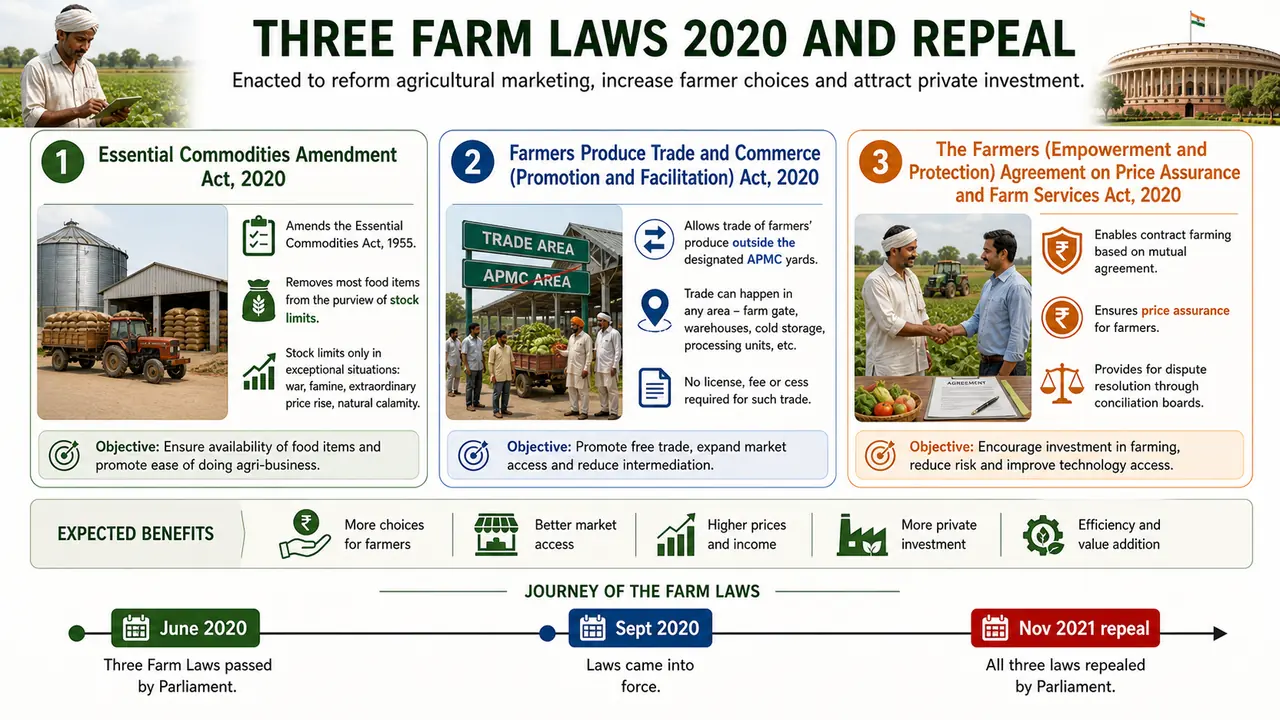
In 2020, the Government of India enacted three major agricultural reform laws targeting the APMC system, stock limits, and contract farming. These laws were among the most consequential agricultural policy decisions since the Green Revolution — and their repeal after sustained farmer protests makes them a high-frequency exam topic for exams, NABARD, FCI, and exams.
Understanding these laws requires knowledge of the APMC system (covered in the previous lesson) and agricultural trade — these laws attempted to reform both.
Timeline
| Event | Date |
|---|---|
| All three laws came into force | 5 June 2020 (as Ordinances) |
| Passed as Acts by Parliament | September 2020 |
| PM announced repeal | 19 November 2021 (Guru Nanak Jayanti) |
| Farm Laws Repeal Bill passed in both Houses | 29 November 2021 |
| Presidential assent on repeal | 30 November 2021 |
TIP
Pro Content Locked
Upgrade to Pro to access this lesson and all other premium content.
Charged once for one year · ₹1188 total
Save ₹100/month vs ₹2388/year launch price
- All Agriculture & Banking Courses
- AI Lesson Questions (100/day)
- AI Doubt Solver (50/day)
- Glows & Grows Feedback (30/day)
- AI Section Quiz (20/day)
- 22-Language Translation (100/day)
- Recall Questions (20/day)
- AI Quiz (15/day)
- AI Quiz Paper Analysis (100/day)
- AI Step-by-Step Explanations (100/day)
- Spaced Repetition Recall (FSRS)
- AI Tutor
- Immersive Text Questions
- Audio Lessons — Hindi & English
- Mock Tests & Previous Year Papers
- Summary & Mind Maps
- XP, Levels, Leaderboard & Badges
- Generate New Classrooms
- Voice AI Teacher (AgriDots Live)
- AI Revision Assistant
- Knowledge Gap Analysis
- Interactive Revision (LangGraph)
🔒 Secure one-time yearly payment via Razorpay · No hidden fees
Why These Laws Matter for Exams
In 2020, the Government of India enacted three major agricultural reform laws targeting the APMC system, stock limits, and contract farming. These laws were among the most consequential agricultural policy decisions since the Green Revolution — and their repeal after sustained farmer protests makes them a high-frequency exam topic for exams, NABARD, FCI, and exams.
Understanding these laws requires knowledge of the APMC system (covered in the previous lesson) and agricultural trade — these laws attempted to reform both.
Timeline
| Event | Date |
|---|---|
| All three laws came into force | 5 June 2020 (as Ordinances) |
| Passed as Acts by Parliament | September 2020 |
| PM announced repeal | 19 November 2021 (Guru Nanak Jayanti) |
| Farm Laws Repeal Bill passed in both Houses | 29 November 2021 |
| Presidential assent on repeal | 30 November 2021 |
TIP
Remember: enacted together (June 2020), repealed together (November 2021). Repeal announced on Guru Nanak Jayanti.
The Three Reform Tracks
Law 1: Essential Commodities (Amendment) Bill, 2020
This law amended the Essential Commodities Act, 1955 to deregulate the production, storage, and movement of certain food commodities.
Key Provisions
- Foodstuffs including cereals, pulses, potatoes, onions, edible oilseeds, and oils were removed from the list of essential commodities
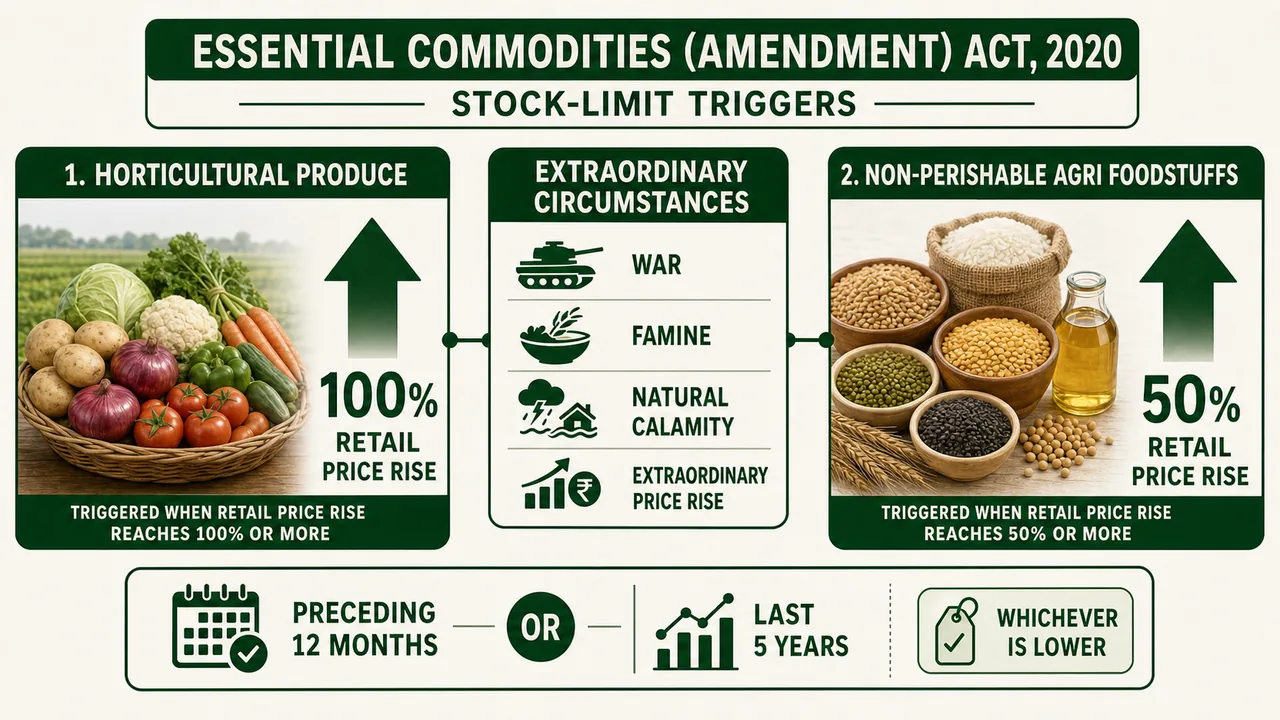
- Government regulation would apply only under "extraordinary circumstances" — war, famine, extraordinary price rise, or natural calamity
- Stock limits can be imposed only when:
| Produce Type | Price Rise Trigger for Stock Limit |
|---|---|
| Horticultural produce | 100% increase in retail price |
| Non-perishable agri foodstuffs | 50% increase in retail price |
- Price rise compared against: price of the preceding 12 months OR average retail price of last 5 years — whichever is lower
- Stock limits would not apply to value chain participants if their stock is within installed capacity of processing/storage
Purpose
Attract private investment in cold storage, warehousing, and food processing by removing the fear of arbitrary stock limits.
TIP
Exam mnemonic: "100 for Horti, 50 for Non-Perishable" — the price rise thresholds that trigger stock limits.
Law 2: Farmers' Produce Trade and Commerce (Promotion and Facilitation) Bill, 2020
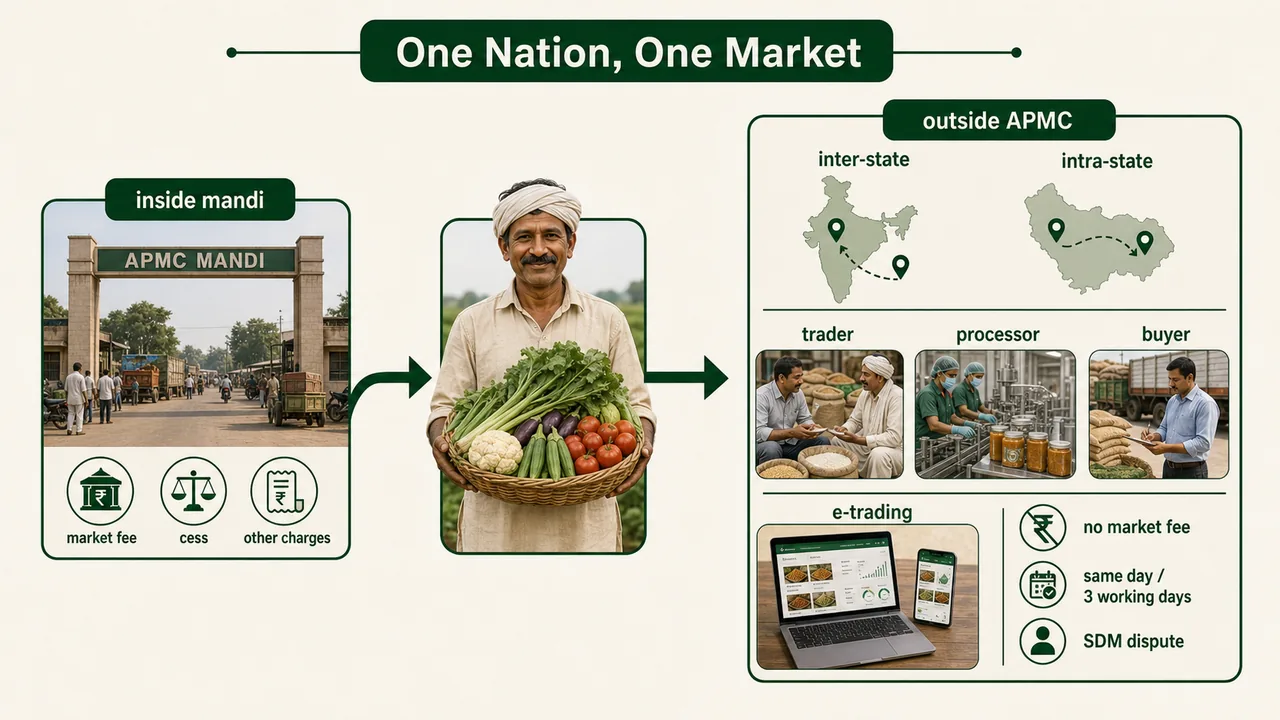
This law created a framework for trade of farmers' produce outside the physical premises of APMC mandis — the most controversial of the three laws.
Key Provisions
| Feature | Detail |
|---|---|
| Core change | Farmers and traders can trade outside APMC market yards |
| Trade scope | Both inter-state and intra-state trade freely allowed |
| Electronic trading | Electronic trading platforms allowed for direct farmer-buyer transactions |
| Levy | No market fee, cess, or levy on trade outside mandis ("trade areas") |
| Payment | Same day or within 3 working days |
| Vision | "One Nation, One Market" for agricultural commodities |
Dispute Resolution
| Stage | Authority |
|---|---|
| First level | Sub-Divisional Magistrate (SDM) |
| Conciliation | Conciliation Board (appointed by SDM) |
- No civil court shall have jurisdiction over matters under this Act
Why Farmers Opposed It
Farmers (especially from Punjab and Haryana) feared that:
- Allowing trade outside APMC mandis would weaken the mandi system and eventually the MSP guarantee
- Large corporates would dominate, leaving small farmers without bargaining power
- No legal guarantee of MSP in the law
TIP
Exam key points: Trade outside APMC mandis, no cess/levy, payment within 3 working days, disputes go to SDM (not civil courts).
Law 3: Farmers (Empowerment and Protection) Agreement on Price Assurance and Farm Services Bill, 2020
This law established a national framework for contract farming — farming agreements between farmers and agri-business firms, processors, wholesalers, exporters, or large retailers.

Key Provisions
| Feature | Detail |
|---|---|
| Framework for | Sale of future farming produce at a mutually agreed price |
| Minimum period | 1 crop season |
| Maximum period | 5 years (exception: orchards/plantations exceeding 5-year production cycles) |
| Pricing | Guaranteed price must be specified; additional premium/bonus based on market prices |
| Insurance/Credit | Can be linked to the farming agreement |
| Land protection | Farmer's land cannot be alienated — no transfer of ownership, lease, or mortgage |
Dispute Resolution
| Stage | Authority | Timeline |
|---|---|---|
| First level | Conciliation Board | 30 days |
| Second level | Sub-Divisional Magistrate (SDM) | — |
| Appeal | Appellate Authority (Collector/District Magistrate) | — |
- No civil court jurisdiction
- Recovery from farmers limited to value of produce supplied — no action against farmer's land
TIP
Contract periods: min 1 season, max 5 years. Dispute chain: Conciliation Board (30 days) → SDM → Collector. Farmer's land is fully protected — this was a built-in safeguard.
Comparison of the Three Laws
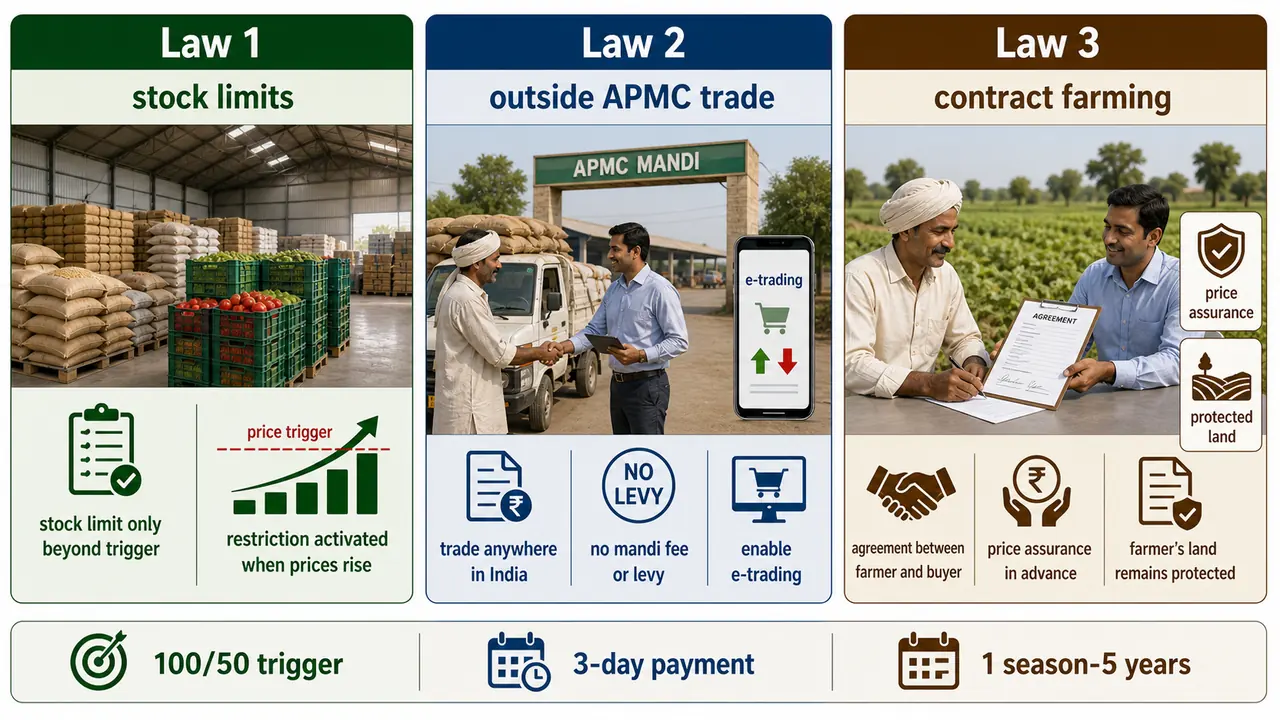
| Feature | Essential Commodities Amendment | Farmers' Trade & Commerce | Contract Farming |
|---|---|---|---|
| Main theme | Deregulate stock limits | Trade outside APMC | Farming agreements |
| Original Act | EC Act, 1955 (amended) | New legislation | New legislation |
| Key beneficiary | Traders, processors | Farmers, traders | Farmers, agri-business |
| Stock limit trigger | 100%/50% price rise | N/A | N/A |
| Payment timeline | N/A | Same day / 3 days | As per agreement |
| Dispute resolution | N/A | SDM → Conciliation | Conciliation → SDM → Collector |
| Max agreement period | N/A | N/A | 5 years |
Repeal and Continuing Issues
Repeal of the Three Laws
- After sustained farmer protests (primarily from Punjab and Haryana), the PM announced repeal on 19 November 2021 (Guru Nanak Jayanti)
- The Farm Laws Repeal Bill, 2021 was passed in both Lok Sabha and Rajya Sabha on 29 November 2021
- All three laws were repealed simultaneously
- Presidential assent: 30 November 2021
Key Demands of Protesting Farmers
| Demand | Status |
|---|---|
| Repeal of all three laws | Fulfilled |
| Legal guarantee for MSP | Pending — committee formed |
| Withdrawal of cases against protesters | Ongoing |
NOTE
The repeal does not mean the issues are resolved. The MSP legal guarantee demand remains a live issue. Exams may test both the laws' provisions AND the reasons for repeal.
Summary Cheat Sheet
| Concept / Topic | Key Details / Explanation |
|---|---|
| Three Farm Laws – enacted | As Ordinances on 5 June 2020; passed by Parliament September 2020 |
| Three Farm Laws – repealed | PM announced 19 November 2021 (Guru Nanak Jayanti); Repeal Bill passed 29 November 2021; Presidential assent 30 November 2021 |
| Law 1 – Essential Commodities (Amendment) | Amended EC Act, 1955; removed cereals, pulses, potatoes, onions, edible oilseeds from essential list |
| Law 1 – Stock limit triggers | Horticultural produce: 100% price rise; Non-perishable agri foodstuffs: 50% price rise |
| Law 1 – Comparison period | Price over preceding 12 months OR average of last 5 years — whichever is lower |
| Law 1 – Purpose | Attract private investment in cold storage, warehousing, food processing |
| Law 2 – Farmers' Trade & Commerce | Allowed trading outside APMC mandis; inter-state and intra-state trade freely |
| Law 2 – APMC levy | No market fee, cess, or levy on trade outside mandis ("trade areas") |
| Law 2 – Payment timeline | Same day or within 3 working days |
| Law 2 – Dispute resolution | SDM → Conciliation Board; no civil court jurisdiction |
| Law 2 – Vision | "One Nation, One Market" for agricultural commodities |
| Law 3 – Contract Farming | National framework for farming agreements between farmers and agri-business |
| Law 3 – Agreement period | Minimum: 1 crop season; Maximum: 5 years (longer for orchards/plantations) |
| Law 3 – Price mechanism | Guaranteed price must be specified; premium/bonus based on market price |
| Law 3 – Dispute resolution | Conciliation Board (30 days) → SDM → Appellate Authority (Collector/DM) |
| Law 3 – Farmer protection | No action against farmer's land; recovery limited to value of produce supplied |
| Insurance/credit linkage | Farming agreements under Law 3 can be linked to insurance or credit instruments |
| Farmer protests | Led by Punjab and Haryana farmers; sustained protests led to repeal |
| MSP legal guarantee | Not fulfilled — committee formed; remains a live issue |
| Comparison mnemonic | Law 1 = Stock limits, Law 2 = Trade freedom, Law 3 = Contract security |
Lesson Doubts
Ask questions, get expert answers