📋 Solar Power Fencing for Crop Protection (Himachal Pradesh) — NABARD Model Scheme
Monkey menace and wild animal damage destroy 50–89% of crop yields in Himachal Pradesh, causing ₹229–500 crore losses annually. This NABARD model covers solar power fencing as a bankable solution — system components, five area-based cost models, economic viability, and financing parameters for exams.
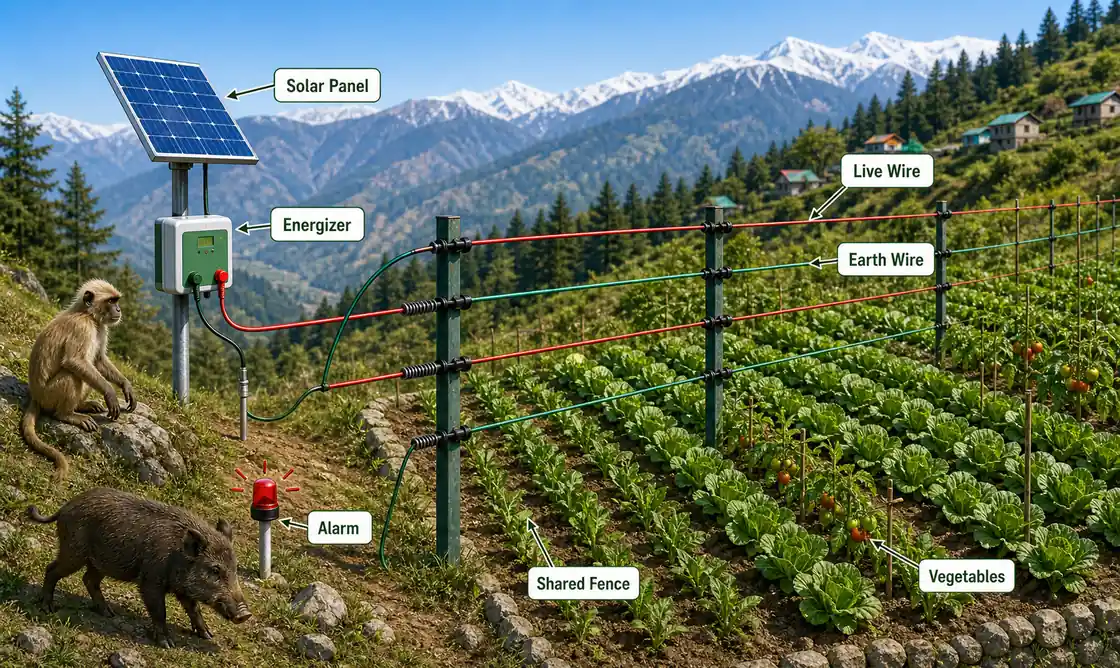
Crop damage by monkeys and wild animals is one of Himachal Pradesh's most severe agricultural challenges. Unlike most farm risks, animal menace can destroy up to 89% of normal yield in a single season — making it a bankable risk that justifies infrastructure investment.
- HP area affected by monkey/wildlife menace: 1.56 lakh hectares
- Annual crop loss estimate (Dept. of Agriculture/Horticulture, HP): ₹229 crore/year
- Independent NGO (GyanVigyan Samiti) estimate: ₹400–500 crore/year
- Monkey population (2004 census): 3,17,112; reduced to 2,26,086 by 2012 due to sterilization
NOTE
Exam context: NABARD's model bankable scheme for solar power fencing specifically addresses Himachal Pradesh's monkey menace — a unique regional problem. The economic viability depends entirely on crop type: NOT viable for foodgrains; viable for vegetables and fruit crops.
Existing Crop Protection Methods (Conventional)
| Method | Limitation |
|---|---|
| Manual guarding (day/night) | High labour cost; ineffective at night/difficult terrain |
| Crackers/noise deterrents | Temporary; animals habituate quickly |
| Crop diversification (aloe vera, ginger) | Restricts cropping choice; not always market-viable |
| Monkey sterilization | Long-term; 77,280 sterilized by Dec 2013 — problem persists |
| Traditional barbed wire fencing | Cannot stop monkeys; animals can cross |
Solar power fencing solves what conventional methods cannot — it delivers a non-lethal but effective electric shock that conditions animals to avoid the fence permanently.
Pro Content Locked
Upgrade to Pro to access this lesson and all other premium content.
₹99 charged monthly · Cancel anytime
- All Agriculture & Banking Courses
- AI Lesson Questions (100/day)
- AI Doubt Solver (50/day)
- Glows & Grows Feedback (30/day)
- AI Section Quiz (20/day)
- 22-Language Translation (100/day)
- Recall Questions (20/day)
- AI Quiz (15/day)
- AI Quiz Paper Analysis (100/day)
- AI Step-by-Step Explanations (100/day)
- Spaced Repetition Recall (FSRS)
- AI Tutor
- Immersive Text Questions
- Audio Lessons — Hindi & English
- Mock Tests & Previous Year Papers
- Summary & Mind Maps
- XP, Levels, Leaderboard & Badges
- Generate New Classrooms
- Voice AI Teacher (AgriDots Live)
- AI Revision Assistant
- Knowledge Gap Analysis
- Interactive Revision (LangGraph)
🔒 Secure via Razorpay · Cancel anytime · No hidden fees
Crop damage by monkeys and wild animals is one of Himachal Pradesh's most severe agricultural challenges. Unlike most farm risks, animal menace can destroy up to 89% of normal yield in a single season — making it a bankable risk that justifies infrastructure investment.
- HP area affected by monkey/wildlife menace: 1.56 lakh hectares
- Annual crop loss estimate (Dept. of Agriculture/Horticulture, HP): ₹229 crore/year
- Independent NGO (GyanVigyan Samiti) estimate: ₹400–500 crore/year
- Monkey population (2004 census): 3,17,112; reduced to 2,26,086 by 2012 due to sterilization
NOTE
Exam context: NABARD's model bankable scheme for solar power fencing specifically addresses Himachal Pradesh's monkey menace — a unique regional problem. The economic viability depends entirely on crop type: NOT viable for foodgrains; viable for vegetables and fruit crops.
Existing Crop Protection Methods (Conventional)
| Method | Limitation |
|---|---|
| Manual guarding (day/night) | High labour cost; ineffective at night/difficult terrain |
| Crackers/noise deterrents | Temporary; animals habituate quickly |
| Crop diversification (aloe vera, ginger) | Restricts cropping choice; not always market-viable |
| Monkey sterilization | Long-term; 77,280 sterilized by Dec 2013 — problem persists |
| Traditional barbed wire fencing | Cannot stop monkeys; animals can cross |
Solar power fencing solves what conventional methods cannot — it delivers a non-lethal but effective electric shock that conditions animals to avoid the fence permanently.
How Solar Power Fencing Works
Core principle: Pulsating electric shock (not continuous current) — 1 pulse per 1–1.2 seconds, each pulse lasting only 1/1000th of a second (1 millisecond).
- Voltage delivered: 6,000–10,000 volts (high voltage, extremely low current — safe)
- Current is pulsating — animal gets shock and moves away; muscles do not contract/trap
- After 10 consecutive shocks, system trips automatically and alarm sounds
- Wire used: Plain wire (NOT barbed) — animals cannot get trapped
Special design for monkeys: Monkeys can swing without touching ground. The fencing uses alternate live and earth wires — when a monkey touches two wires simultaneously, the circuit completes and delivers a shock even without ground contact.
System Components
| Component | Function | Life |
|---|---|---|
| Solar panel | Converts sunlight → electricity; charges battery | 25 years |
| Battery (C10 solar type) | Stores power; enables 24-hour operation | 5 years (warranty) |
| Energizer | Steps up battery voltage to 6,000–10,000V | 10–15 years |
| Earth system (rods) | Completes the circuit through soil | Permanent |
| Alarm unit | Sounds if fence is cut or animal touches | — |
| Warning boards | Posted every 10 metres on fence line | — |
Key spec: 1 joule of energizer output powers approximately 10 km of single-wire fence.
Cost Models (NABARD Table)
Five models based on protected area size:
| Model | Protected Area | Perimeter | Unit Cost | Cost/Running Metre |
|---|---|---|---|---|
| Model 1 | 1 acre | 300 m | ₹1,61,907 | ₹540 |
| Model 2 | 2.5 acres | 500 m | ₹2,10,793 | ₹422 |
| Model 3 | 5 acres | 700 m | ₹2,59,679 | ₹371 |
| Model 4 | 10 acres | 1,000 m | ₹4,07,716 | ₹408 |
| Model 5 | 20 acres | 1,400 m | Higher | Lower |
NOTE
Scale economy is important: Cost per running metre falls from ₹540 (1 acre) to ₹371 (5 acres). Models 4–5 are designed for group of farmers sharing a common fence — an important cooperative/JLG financing angle for NABARD questions.
Economic Viability Analysis
NABARD evaluated viability using IRR, BCR (Benefit-Cost Ratio), and NPV:
| Model | Area | IRR (Vegetables) | BCR (Vegetables) | NPV (Vegetables) |
|---|---|---|---|---|
| Model 1 | 1 ac | >100% | 2.61 | ₹2,48,193 |
| Model 2 | 2.5 ac | >100% | 5.69 | ₹9,41,306 |
| Model 3 | 5 ac | >100% | 9.72 | ₹21,56,370 |
| Model 4 | 10 ac | >100% | 12.63 | ₹45,17,853 |
Critical finding: Solar fencing is NOT financially viable for foodgrains (BCR < 1 for Model 1–3). It is highly viable for vegetables and fruit crops where the saved produce value far exceeds the fence cost.
NOTE
This BCR analysis is a key exam point: A BCR of 2.61 means ₹1 invested returns ₹2.61 in benefits. The scheme is justified only when high-value crops (vegetables, fruits) are grown — not staple cereals. This has policy implications for credit appraisal.
NABARD Financing Parameters
| Parameter | Value |
|---|---|
| Unit cost range | ₹1.62–4.08 lakh (1–10 acres) |
| Bank loan (85%) | ₹1.38–3.47 lakh |
| Margin money (15%) | ₹0.24–0.61 lakh |
| Moratorium | 1 year |
| Repayment period | 5–7 years |
| System life | 25 years (solar panels); 5 years (battery replacement) |
| Subsidy | Available under MNRE/State schemes |
Advantage of long system life: The 25-year panel life means one-time capital investment protects crops for a generation, making the cost-per-year very low.
Exam Summary
| Parameter | Value |
|---|---|
| Problem targeted | Monkey/wild animal crop damage in HP |
| Area affected in HP | 1.56 lakh ha |
| Annual loss (official) | ₹229 crore |
| Annual loss (NGO estimate) | ₹400–500 crore |
| Shock frequency | 1 pulse per 1–1.2 seconds |
| Voltage | 6,000–10,000 volts |
| Wire type | Plain (NOT barbed) |
| Solar panel life | 25 years |
| Battery life | 5 years |
| Cost (1 acre / 300 m) | ₹1,61,907 |
| Cost per running metre (1 ac) | ₹540 |
| Viable for | Vegetables & fruit crops (NOT foodgrains) |
| Loan component | 85% |
| Repayment | 5–7 years |
Sources & References
Primary source for this lesson is NABARD's official Model Bankable Projects portal.[1] Lesson-specific report copy used for this topic.[2]
References
2 sources • [1] [2]
References
Used for: Official NABARD portal for model bankable project documents and updates.
Used for: Reference copy used in this lesson for project parameters and worked figures.
The figures in this lesson reflect the cost norms and technical parameters as published in the NABARD document. Actual costs may vary by state, season, and year of implementation. Always refer to the latest NABARD circular for current norms.
Summary Cheat Sheet
| Concept / Topic | Key Details / Explanation |
|---|---|
| Problem targeted | Monkey/wild animal crop damage in Himachal Pradesh |
| HP area affected | 1.56 lakh ha |
| Annual loss (official) | ₹229 crore/year (Dept. of Agriculture/Horticulture, HP) |
| Annual loss (NGO estimate) | ₹400–500 crore/year (GyanVigyan Samiti) |
| Monkey population (2004) | 3,17,112; reduced to 2,26,086 by 2012 after sterilization |
| Sterilized by Dec 2013 | 77,280 monkeys — problem still persists |
| Shock principle | Pulsating (NOT continuous) — 1 pulse per 1–1.2 seconds; each pulse = 1 millisecond |
| Voltage | 6,000–10,000 volts (high voltage, extremely low current — non-lethal) |
| Wire type | Plain wire (NOT barbed) — animals cannot get trapped |
| Monkey-specific design | Alternate live and earth wires — shock completes without ground contact |
| Auto-trip | After 10 consecutive shocks — system trips + alarm sounds |
| Warning boards | Posted every 10 metres on fence line |
| Energizer capacity | 1 joule powers ~10 km of single-wire fence |
| Solar panel life | 25 years |
| Battery life | 5 years (warranty) — C10 solar type |
| Model 1 (1 acre / 300 m) | Cost ₹1,61,907; ₹540/running metre |
| Model 2 (2.5 acres / 500 m) | Cost ₹2,10,793; ₹422/running metre |
| Model 3 (5 acres / 700 m) | Cost ₹2,59,679; ₹371/running metre (lowest per-metre cost) |
| Model 4 (10 acres / 1,000 m) | Cost ₹4,07,716; ₹408/running metre (group of farmers) |
| BCR (vegetables, Model 1) | 2.61; Model 2: 5.69; Model 3: 9.72; Model 4: 12.63 |
| IRR (all vegetable models) | >100% |
| Viable for | Vegetables and fruit crops ONLY — NOT financially viable for foodgrains |
| Bank loan | 85% = ₹1.38–3.47 lakh |
| Margin money | 15% = ₹0.24–0.61 lakh |
| Moratorium | 1 year |
| Repayment | 5–7 years |
| Scale economy | Cost/metre falls from ₹540 (1 ac) to ₹371 (5 ac) — larger = cheaper per metre |
Lesson Doubts
Ask questions, get expert answers