🎹 Crop Classification -- A Complete Guide for Competitive Exams
Master the classification of crops based on botanical, agronomic, seasonal, climatic, and special-purpose criteria with exam-focused tables, mnemonics, and agricultural examples.
Walk into any Indian farmer's field during the Kharif season and you will see rice, maize, and cotton growing side by side in the same district -- yet each crop demands a different soil type, water regime, and harvesting window. How does an agronomist make sense of hundreds of cultivated species? The answer lies in crop classification -- a systematic framework that groups crops by their biology, use, season, and management needs. This chapter builds that framework step by step.
What Is a Crop?
- A crop is any plant cultivated commercially on a large scale for food, fibre, fuel, or industrial use.
- The basic principles of crop production deal with the management of soil, plants, and environment to obtain the highest sustainable returns per unit area year after year.
Why Classify Crops?
Understanding classification helps in:
- Knowing the growing season -- when to sow and harvest.
- Understanding soil and water requirements for resource planning.
- Identifying the growing habit -- erect, spreading, or climbing.
- Recognising the economic produce -- grain, fibre, oil, or fodder.
- Planning crop rotations and intercropping systems intelligently.
TIP
Pro Content Locked
Upgrade to Pro to access this lesson and all other premium content.
Charged once for one year · ₹1188 total
Save ₹100/month vs ₹2388/year launch price
- All Agriculture & Banking Courses
- AI Lesson Questions (100/day)
- AI Doubt Solver (50/day)
- Glows & Grows Feedback (30/day)
- AI Section Quiz (20/day)
- 22-Language Translation (100/day)
- Recall Questions (20/day)
- AI Quiz (15/day)
- AI Quiz Paper Analysis (100/day)
- AI Step-by-Step Explanations (100/day)
- Spaced Repetition Recall (FSRS)
- AI Tutor
- Immersive Text Questions
- Audio Lessons — Hindi & English
- Mock Tests & Previous Year Papers
- Summary & Mind Maps
- XP, Levels, Leaderboard & Badges
- Generate New Classrooms
- Voice AI Teacher (AgriDots Live)
- AI Revision Assistant
- Knowledge Gap Analysis
- Interactive Revision (LangGraph)
🔒 Secure one-time yearly payment via Razorpay · No hidden fees
Walk into any Indian farmer's field during the Kharif season and you will see rice, maize, and cotton growing side by side in the same district -- yet each crop demands a different soil type, water regime, and harvesting window. How does an agronomist make sense of hundreds of cultivated species? The answer lies in crop classification -- a systematic framework that groups crops by their biology, use, season, and management needs. This chapter builds that framework step by step.
What Is a Crop?
- A crop is any plant cultivated commercially on a large scale for food, fibre, fuel, or industrial use.
- The basic principles of crop production deal with the management of soil, plants, and environment to obtain the highest sustainable returns per unit area year after year.
Why Classify Crops?
Understanding classification helps in:
- Knowing the growing season -- when to sow and harvest.
- Understanding soil and water requirements for resource planning.
- Identifying the growing habit -- erect, spreading, or climbing.
- Recognising the economic produce -- grain, fibre, oil, or fodder.
- Planning crop rotations and intercropping systems intelligently.
TIP
Exam shortcut: Questions on crop classification typically test seasonal grouping (Kharif/Rabi/Zaid), C3/C4 pathways, and special-purpose categories (trap crop, smother crop, nurse crop). Focus on examples for each.
Bases of Crop Classification
| Basis | Key Criterion | Quick Examples |
|---|---|---|
| Botanical | Plant parts and flower structure | Monocots (cereals), Dicots (pulses) |
| Agronomic use | Economic product | Grain, pulse, oilseed, fibre, forage |
| Life cycle (Ontogeny) | Duration | Annual, biennial, perennial |
| Season | Sowing--harvest window | Kharif, Rabi, Zaid |
| Climate | Temperature zone | Tropical, sub-tropical, temperate, polar |
| Root depth | Rooting zone | Shallow, intermediate, deep |
| CO2 fixation | Photosynthetic pathway | C3, C4, CAM |
| Pollination mode | Pollen transfer | Self, often-cross, cross |
| Special purpose | Management role | Trap, nurse, smother, cover, etc. |
1. Botanical Classification
Botanical classification is based on similarity of plant parts and flower structure. It reveals how closely crops are related -- and closely related crops often share similar pest susceptibilities and nutrient needs.
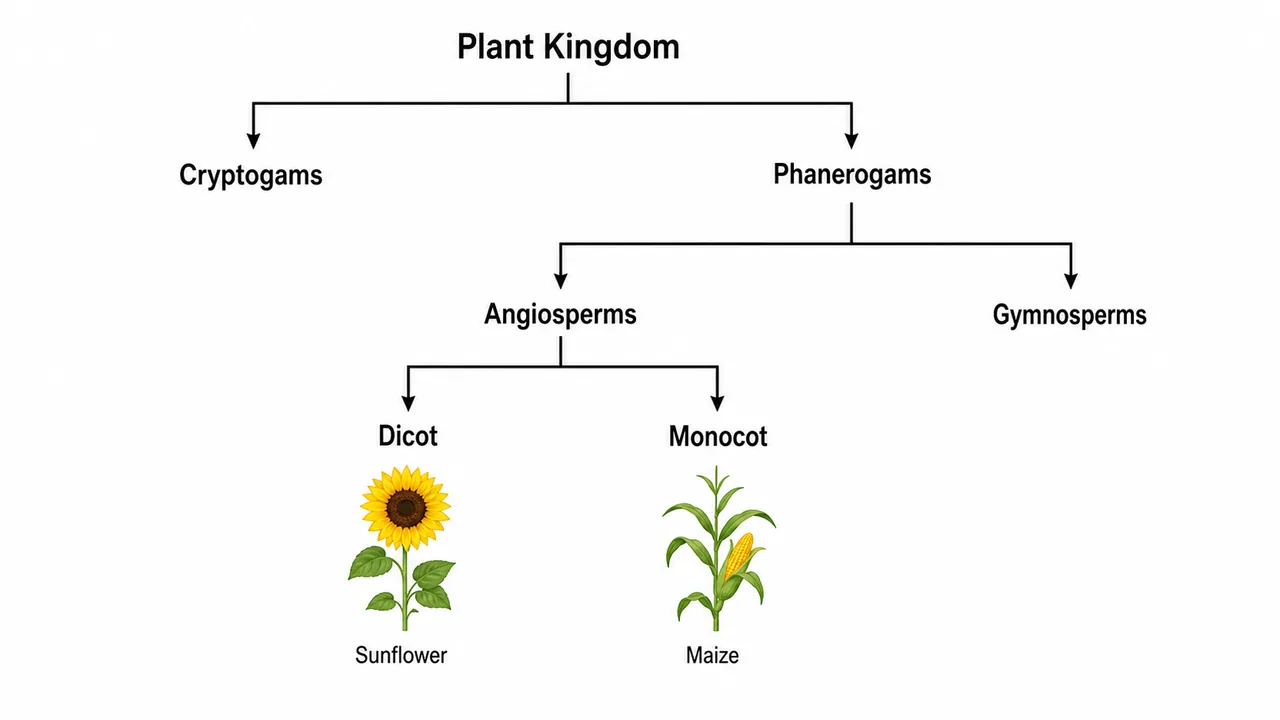
- Field crops belong to the spermatophyte (seed plant) division, subdivision Angiosperm (covered seeds).
- Angiosperms divide into two classes: monocotyledons and dicotyledons.
- All grasses -- cereals and sugarcane -- are monocots. Legumes and most other field crops are dicots.
- Each class is further divided into orders, families, genera, species, and varieties.
Cotyledon -- The First Leaf
- A cotyledon is part of the embryo within the seed. It often becomes the first leaf of the seedling upon germination.
- Cotyledons supply the stored food reserves that fuel the plant's initial growth, which is why seed quality and size matter for crop establishment.

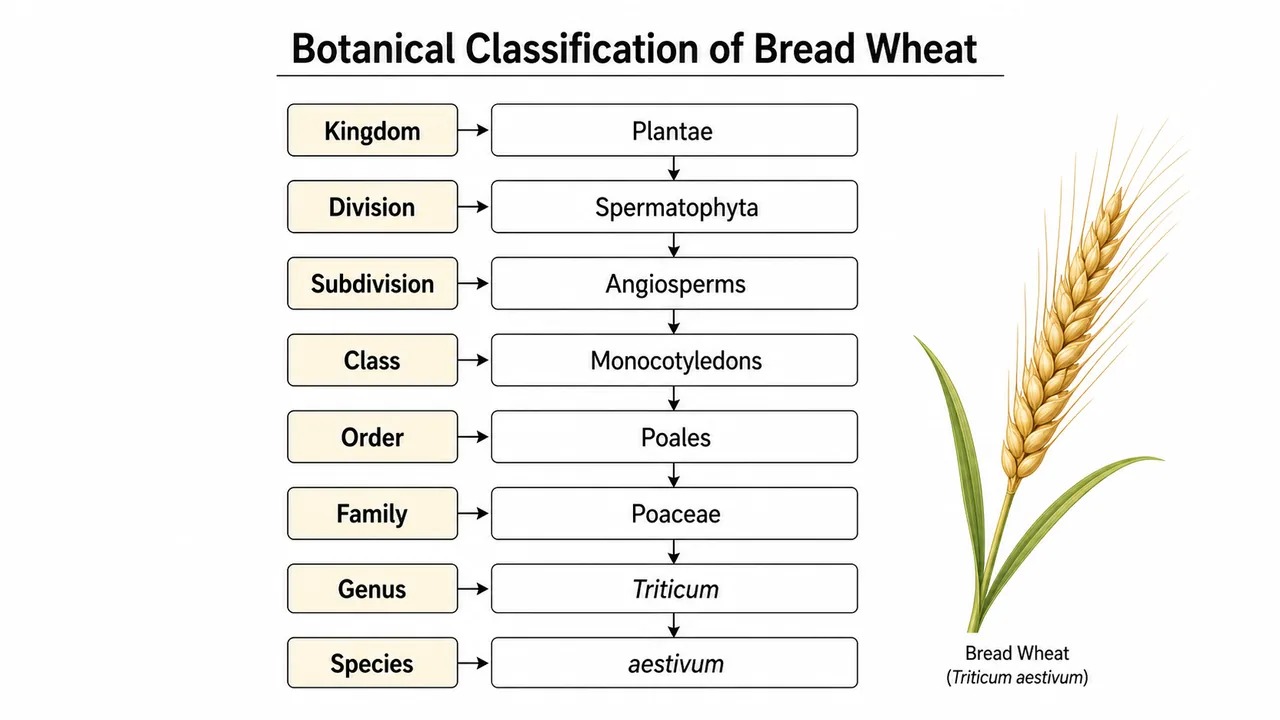
Example: Botanical classification of Bread Wheat (Triticum aestivum) -- Division Spermatophyta, Subdivision Angiospermae, Class Monocotyledonae, Order Poales, Family Poaceae, Genus Triticum, Species aestivum.
Key Monocot Families
| Family | Key Crops |
|---|---|
| Poaceae (Gramineae) | Rice, Wheat, Maize, Barley, Sorghum, Pearl millet, Sugarcane, Oats |
| Liliaceae | Onion, Garlic, Asparagus |
| Musaceae | Banana |
| Arecaceae (Palmae) | Coconut, Oil palm, Arecanut |
Key Dicot Families
| Family | Key Crops |
|---|---|
| Fabaceae (Leguminosae) | Gram, Pigeon pea, Soybean, Groundnut, Lentil, Pea |
| Brassicaceae (Cruciferae) | Mustard, Rapeseed, Cabbage, Cauliflower |
| Malvaceae | Cotton, Jute, Mesta |
| Solanaceae | Potato, Tobacco, Tomato, Chilli |
| Asteraceae (Compositae) | Sunflower, Safflower |
| Pedaliaceae | Sesame |
| Linaceae | Linseed |
2. Agronomic (Economic Use) Classification
Grain Crops
Grasses grown for their edible seeds -- the staple food for most of the world. Examples: wheat, rice, maize, barley, oat, sorghum, millets.
Pulse / Legume Crops
- The word "legume" comes from the Latin 'legere' meaning 'to gather'.
- Pulses fix atmospheric nitrogen through root-nodule bacteria, maintaining soil fertility.
- They are rich in protein and meet the bulk of protein needs of India's predominantly vegetarian population.
- Examples: Black gram, Green gram, Chickpea, Lentil.
Oilseed Crops
Seeds rich in fatty acids, used to extract vegetable oil for cooking, industry, and medicine. Examples: Groundnut, Mustard, Sunflower, Sesame, Linseed.
Fibre Crops
Grown to extract fibre for cloth, ropes, and bags. Examples: Cotton, Jute, Flax.
Root and Tuber Crops
Grown for underground economic parts -- rhizome, bulb, or tuber. Examples: Potato, Onion, Garlic, Radish, Carrot.
Forage Crops
Grown to be grazed by livestock or conserved as hay or silage -- critical for the dairy and livestock industry.
Spices and Condiment Crops
Provide flavour and sometimes colour to food. Examples: Ginger, Garlic, Chilli, Cumin, Turmeric, Cardamom.
Green Manure Crops
Grown and incorporated into soil to increase fertility by adding organic matter and nitrogen. Example: Sunhemp.
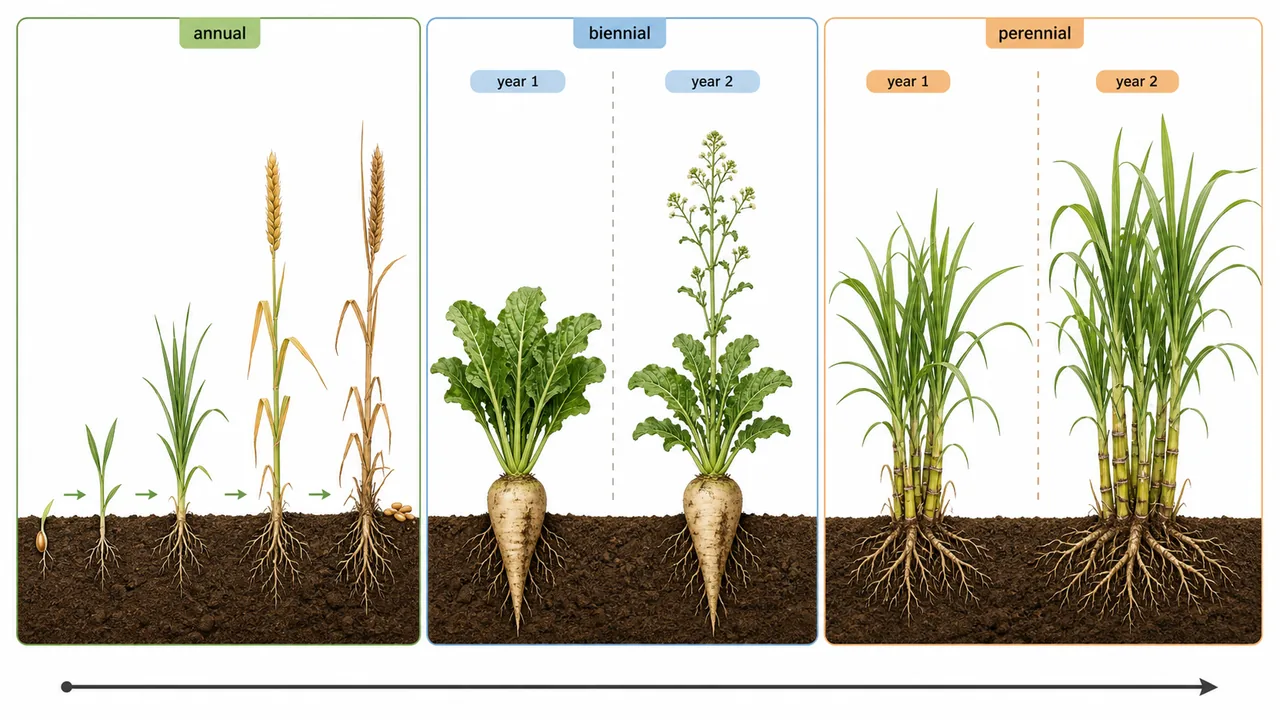
3. Classification by Life Cycle (Ontogeny)
| Category | Duration | Examples |
|---|---|---|
| Annuals | Complete life cycle in one growing season | Wheat, Rice, Maize, Sorghum, Lentil, Soybean |
| Biennials | Require two years -- vegetative in year 1, flowering and seed in year 2 | Onion, Sugar beet, Sweet clover |
| Perennials | Persist for more than two years; may or may not seed annually | Sugarcane, Coconut, Napier grass, Alfalfa, Mango |
NOTE
Vernalisation link: If first-year sugar beet plants are exposed to low temperature, they can flower in the same year and behave as annuals. This cold-induced flowering is called vernalisation.
4. Seasonal Classification
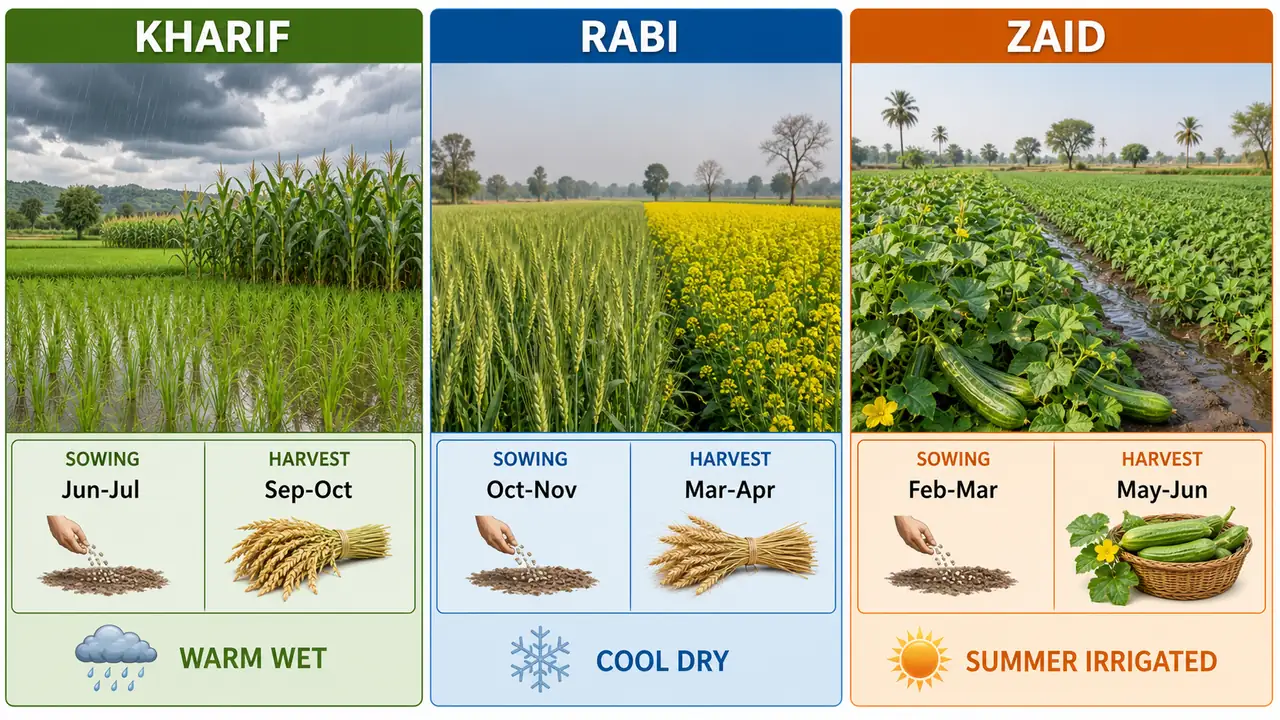
Kharif / Monsoon Crops
- Sowing: June--July (onset of south-west monsoon)
- Harvest: September--October
- Climate need: Warm, wet weather; shorter day length for flowering.
- The term Kharif means autumn in Arabic.
- Examples: Rice, Maize, Soybean, Castor, Groundnut.
- Note: Castor is Kharif in most states but grown as a Rabi crop in Andhra Pradesh and Odisha -- a good example of how regional conditions alter seasonal classification.
Rabi / Winter Crops
- Sowing: October--November
- Harvest: March--April
- Climate need: Cold, dry weather; longer day length for flowering.
- The term Rabi means spring in Arabic.
- Examples: Wheat, Barley, Oats, Mustard, Potato, Bengal gram, Berseem.
Zaid / Summer Crops
- Sowing: February--March
- Harvest: May--June
- Grown in the short window between Rabi harvest and Kharif sowing to maximise land use.
- Examples: Black gram (Urad), Green gram (Moong), Sesame, Cowpea, Cucurbits.
TIP
Mnemonic for seasons: KRA-Z -- Kharif (Jun-Jul), Rabi (Oct-Nov), Zaid (Feb-Mar). Arabic meanings: Kharif = autumn, Rabi = spring.
5. Climatic Classification
| Climate Zone | Examples | Characteristic |
|---|---|---|
| Tropical | Sugarcane, Coconut | Hot, humid near equator |
| Sub-tropical | Rice, Cotton | Distinct wet and dry seasons |
| Temperate | Wheat, Oat, Barley Exams | Cooler temperatures |
| Polar | Pines, pasture grasses | Extremely cold, short growing season |
6. Root Depth Classification
| Category | Root Depth | Examples |
|---|---|---|
| Shallow | Up to 1 metre | Wheat, Barley, Rye |
| Intermediate | 1--1.5 metres | Sugar beet |
| Deep | More than 1.5 metres | Alfalfa (more drought tolerant) |
7. Root System Classification
| System | Description | Examples |
|---|---|---|
| Tap root | Main root goes deep; strong anchorage | Gram, Cotton (Dicots) |
| Adventitious / Fibrous | Shallow, spreading roots; bind soil efficiently | Wheat, Rice (Monocots) |
8. CO2 Fixation Pathway
| Pathway | Mechanism | Examples |
|---|---|---|
| C3 | Calvin cycle only | Rice, Wheat |
| C4 | Hatch-Slack pathway -- more efficient in hot, dry conditions | Maize, Sugarcane, Sorghum |
| CAM | Fix CO2 at night to conserve water | Pineapple |
TIP
Exam mnemonic for C4 crops: "SMSC" -- Sorghum, Maize, Sugarcane, Cotton (partial). All are warm-season, high-light crops.
9. Pollination Mode
| Mode | Description | Examples |
|---|---|---|
| Self-pollinated | Own pollen fertilises; genetically uniform | Wheat, Rice |
| Often-cross pollinated | Both self and cross occur | Sorghum, Pigeonpea |
| Cross-pollinated | Pollen from another plant; greater genetic diversity | Maize |
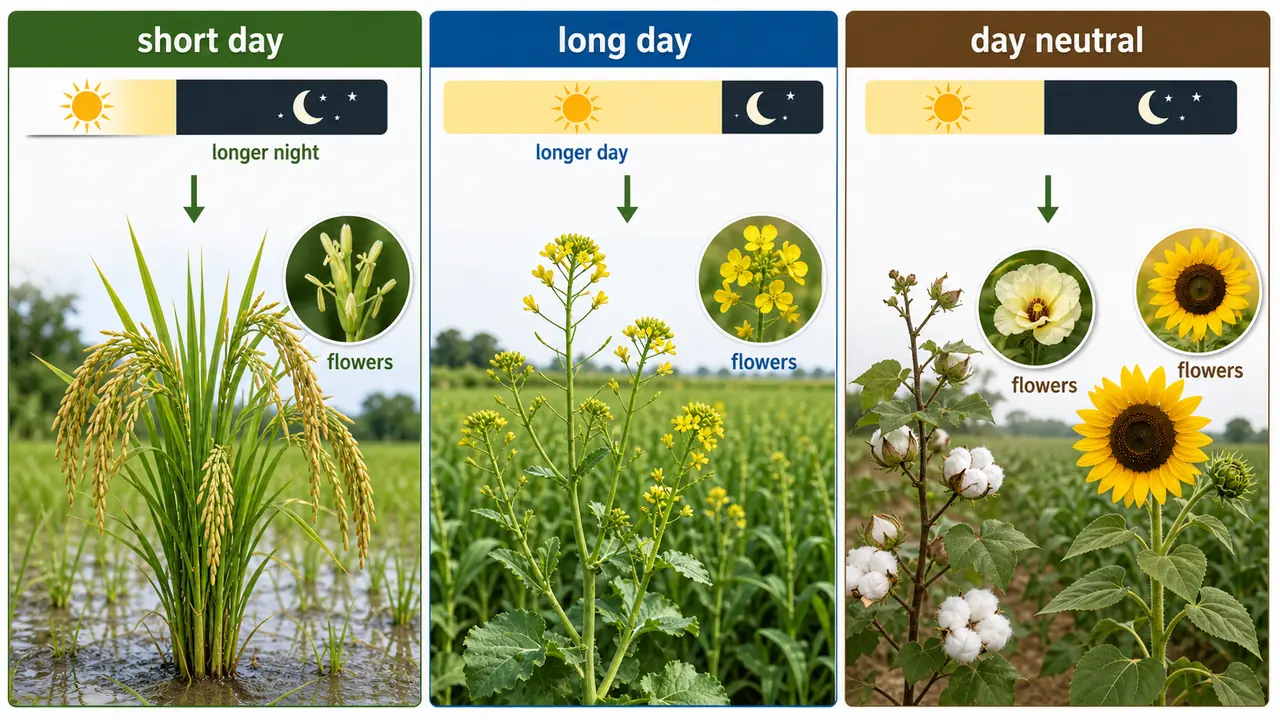
10. Photoperiod Response
Photoperiodism is the response of plants to the relative length of day and night. Discovered by Gardner and Allard (1920).
| Category | Day Length Requirement | Typical Season | Crops |
|---|---|---|---|
| Short-Day Plants (SDP) | < 12 hours of light | Mostly Kharif | Rice, Sorghum, Bajra, Soybean, Sesame, Green gram, Black gram, Tobacco, Cowpea, Pigeonpea, Jute |
| Long-Day Plants (LDP) | > 12 hours of light | Mostly Rabi | Wheat, Barley, Castor, Mustard, Sugar beet, Chickpea, Clusterbean |
| Day-Neutral Plants (DNP) | Flower regardless of photoperiod | Multiple seasons | Cotton, Sunflower, Safflower, Maize, Mungbean |
TIP
Exam shortcut: SDP = mostly Kharif (Rice, Sorghum, Bajra, Soybean, Sesame). LDP = mostly Rabi (Wheat, Barley, Mustard). DNP = multi-season (Cotton, Sunflower, Maize). Photoperiodism discovered by Gardner & Allard (1920).
11. Alternate Names of Plant Families
Many exam questions test whether you know both the modern and old family names.
| Modern Name | Old / Alternate Name | Key Crops |
|---|---|---|
| Poaceae | Gramineae | All cereals, millets, sugarcane |
| Fabaceae / Papilionaceae | Leguminosae | All pulses, soybean, groundnut |
| Brassicaceae | Cruciferae | Mustard, rapeseed |
| Asteraceae | Compositae | Sunflower, safflower |
| Solanaceae | Nightshades | Potato, tobacco, tomato |
| Lamiaceae | Labiatae | Mint |
| Theaceae | Camelliaceae | Tea |
12. Germination Types and Growth Habits
| Term | Definition | Examples |
|---|---|---|
| Epigeal germination | Cotyledons emerge above soil and act as first photosynthetic leaves | Bean, Cotton, Onion |
| Hypogeal germination | Cotyledons remain below soil; only plumule emerges | Wheat, Rice, Maize, Pea |
| Determinate plants | Complete vegetative growth before initiating reproduction | Wheat, Barley, Soybean (some varieties) |
| Indeterminate plants | Vegetative and reproductive growth continue simultaneously | Okra, Tomato, Cotton, Pigeon pea |
TIP
Exam fact: Soybean has both determinate and indeterminate varieties. Epigeal = cotyledons above (Bean, Cotton); Hypogeal = cotyledons below (Wheat, Rice).
13. Harvest Maturity Symptoms
Knowing the correct harvest time is critical for maximizing yield and minimizing post-harvest losses.
Visual Symptoms
| Crop | Maturity Symptoms |
|---|---|
| Wheat | Yellowing of spikelets; grains hard and firm (hard dough stage) |
| Finger Millet | Ears turn brown; grains harden |
| Groundnut | Dark patches inside shell; kernels turn red to pink |
| Sugarcane | Lower leaves turn yellow and dry; sucrose > 10%; Brix > 18% |
| Tobacco | Yellow specks on leaves; leaves become thick and brittle |
Quantitative Criteria
| Crop | Harvest Criteria |
|---|---|
| Rice | Green grains < 4-9%; moisture < 20% |
| Sorghum | 40 days after flowering; moisture < 28% |
| Maize | Moisture < 22-25%; husk turns pale brown |
| Wheat | Moisture ~15%; hard dough stage |
| Sugarcane | Brix 18-20%; sucrose ~15% |
| Pigeonpea | 35-40 days after flowering; 80-85% pods turn brown |
| Cotton | Bolls fully opened; fibre fluffy and white |
TIP
Exam tip: Rice harvest at < 20% moisture with < 9% green grains. Sugarcane at Brix 18-20%. Sorghum at 40 days after flowering.
14. Botanical Names, Family & Origin — Master Table
Cereals
| Crop | Botanical Name | Family | Origin |
|---|---|---|---|
| Rice | Oryza sativa | Poaceae | South East Asia |
| Wheat (Bread) | Triticum aestivum | Poaceae | South West Asia |
| Barley | Hordeum vulgare | Poaceae | South East Asia |
| Pearl millet (Bajra) | Pennisetum typhoides / P. glaucum | Poaceae | — |
| Sorghum | Sorghum bicolor | Poaceae | Africa |
| Maize | Zea mays | Poaceae | Mexico |
| Triticale | Secale cereal | Poaceae | — |
| Buck wheat | Fagopyrum esculentum | Polygonaceae | — |
IMPORTANT
Buck wheat belongs to family Polygonaceae, NOT Poaceae — frequently asked.
Millets
| Crop | Botanical Name |
|---|---|
| Cheena / Proso millet | Panicum miliacearum |
| Little millet | Panicum sumatrense |
| Foxtail / Italian / German millet / Kakun | Setaria italica |
| Kodo / Coarsest millet | Paspalum scrobiculatum |
| Madua / Ragi / Finger millet | Eleusine coracana |
Pulses
| Crop | Botanical Name | Origin |
|---|---|---|
| Chickpea (Gram / Bengal gram) | Cicer arietinum | South West Asia |
| Field pea / Grain pea | Pisum sativum var. arvense | — |
| Pigeon pea (Arhar / Red gram / Tur) | Cajanus cajan | India |
| Soybean | Glycine max | China |
| Black gram (Urdbean) | Vigna mungo / Phaseolus mungo | — |
| Green gram (Moong / Moong bean) | Vigna radiata / Phaseolus aureus | — |
| Mothbean | Vigna / Phaseolus aconitifolia | — |
| French bean (Rajma) | Phaseolus vulgaris | — |
| Indian cowpea (Lobia) | Vigna unguiculata / V. sinensis | — |
| Lentil (Masoor) | Lens esculentum / L. culinaris | India |
| Lathyrus (Chickling pea) | Lathyrus sativus | — |
| Horse gram (Kulthi) | Macrotyloma uniflorum | — |
Oilseeds
| Crop | Botanical Name | Type |
|---|---|---|
| Groundnut (Peanut / Monkeynut) | Arachis hypogaea | Edible oilseed |
| Sunflower | Helianthus annuus | Edible oilseed |
| Safflower | Carthamus tinctorius | Edible oilseed |
| Rapeseed and mustard | Brassica spp. | Edible oilseed |
| Sesamum / Til | Sesamum indicum | Edible oilseed |
| Niger | Guizotia abyssinica | Edible oilseed |
| Linseed / Flax | Linum usitatissimum | Non-edible oilseed |
| Castor | Ricinus communis | Non-edible oilseed |
Fibre Crops
| Crop | Botanical Name | Family | Origin |
|---|---|---|---|
| Cotton | Gossypium spp. | Malvaceae | India |
| Jute (Tita pat) | Corchorus capsularis | Malvaceae | India |
| Sunhemp | Crotalaria juncea | Fabaceae | India |
Forage Crops
| Crop | Botanical Name |
|---|---|
| Berseem (Egyptian clover) | Trifolium alexandrinum |
| Lucerne (Alfalfa) | Medicago sativa |
| Oat | Avena sativa |
| Napier grass | Pennisetum purpureum |
| Clusterbean / Guar | Cyamopsis tetragonoloba |
Sugar, Tuber, Stimulant, Medicinal and Aromatic Crops
| Group | Crop | Botanical Name |
|---|---|---|
| Sugar crop | Sugarcane / Cane | Saccharum officinarum |
| Sugar crop | Sugar beet | Beta vulgaris |
| Tuber crop | Potato | Solanum tuberosum |
| Tuber crop | Tapioca | Manihot utilissima |
| Stimulant crop | Tobacco | Nicotiana spp. |
| Stimulant crop | Opium | Papaver somniferum |
| Medicinal crop | Safed musli | Chlorophytum borivilianum |
| Medicinal crop | Ashwagandha / Winter cherry | Withania somnifera |
| Medicinal crop | Rauvolfia / Sarpagandha | Rauvolfia serpentina |
| Medicinal crop | Isabgol | Plantago ovata |
| Aromatic crop | Lemon grass | Cymbopogon flexuosus |
| Aromatic crop | Citronella | Cymbopogon winterianus |
| Aromatic crop | Mentha / Mint | Mentha arvensis |
| Aromatic crop | Khus / Vetivar | Vetiveria zizanioides |
| Aromatic crop | Tulsi / Basil | Ocimum sanctum |
IMPORTANT
Most asked botanical names: Rice = Oryza sativa. Wheat = Triticum aestivum. Maize = Zea mays. Groundnut = Arachis hypogaea. Soybean = Glycine max. Cotton = Gossypium spp. Sugarcane = Saccharum officinarum.
15. Restorative vs Exhaustive Crops
| Type | Effect on Soil | Examples |
|---|---|---|
| Restorative | Fix nitrogen, restore fertility | Legumes (pulses) |
| Exhaustive | Deplete soil nutrients heavily | Cereals (Rice, Wheat) |
This distinction is the foundation of crop rotation -- an exhaustive cereal is followed by a restorative legume to maintain soil health.
16. Special-Purpose Crop Classification
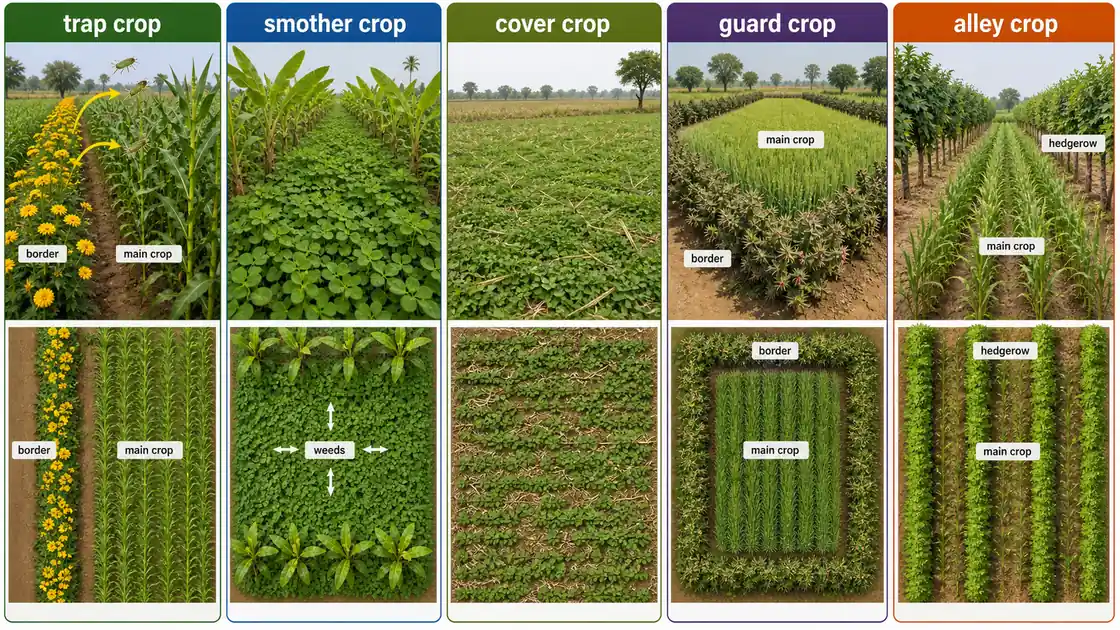
Beyond botanical and seasonal groupings, agronomists classify crops by their management role in a farming system. These special-purpose categories describe what a crop does in the field -- whether it traps pests, smothers weeds, nurses a companion, or restores soil fertility. This is one of the most exam-relevant sections because MCQs frequently test definitions and examples.
Arable Crops

Crops cultivated on ploughed land. They are annual and include cereals, root crops, tobacco, sugarcane, maize, and potatoes.
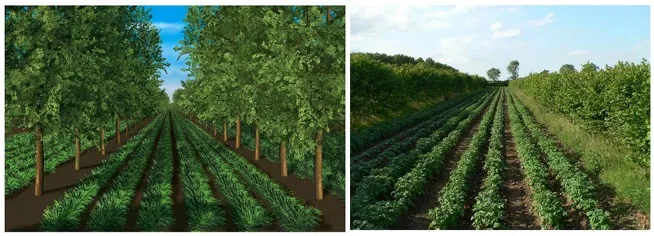
Alley Crops (Hedge-Row Intercrops)
- An agroforestry practice where perennial, preferably leguminous trees or shrubs are grown simultaneously with arable crops in the alley between tree rows. IBPS 2018
- Hedgerows are pruned to about one metre to prevent shading.
- Slight shade tolerance and non-trailing habit are prerequisites for alley crops.
- Examples: Sweet potato, Black gram, Turmeric, Ginger grown between rows of Eucalyptus, Subabul, or Cassia.
Augment Crops
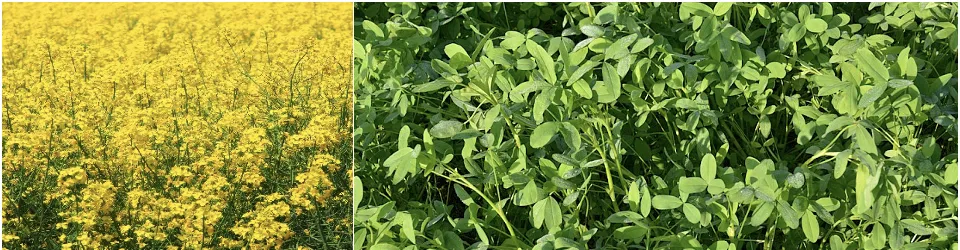
- Grown to supplement the yield of main crops by boosting total output.
- Examples: Japanese mustard with Berseem; Chinese cabbage with mustard -- they help in getting higher yield in the first cutting.
Avenue Crops
- Grown along farm roads and fences, making productive use of otherwise idle land.
- Examples: Pigeon pea UPPSC 2021, Glyricidia, Sisal.
Border / Barrier / Guard Crops
- Grown around field edges to protect the main crop from animals or wind.
- Example: Safflower (thorny oilseed) planted around a gram field.
Brake Crops
- Break the continuity of agro-ecological conditions in multiple cropping systems to reduce soil-borne pests, diseases, and weeds.
- Also used to designate guard crops that retard wind speed.
- Example: Legume in a rice-wheat system.
Cash / Commercial Crops
- Grown primarily for direct sale to earn cash rather than for the farmer's own consumption.
- Examples: Sugarcane, Cotton, Jute, Tobacco.
Catch / Contingent / Emergency Crops
- Very short-duration, quick-growing crops cultivated to catch the forthcoming season when the main crop fails -- a safety net for farmers.
- Examples: Linseed, Toria, Urad, Moong, Cowpea.
Nurse Crops
- A crop introduced to foster or nourish another crop by providing shade, frost protection, or physical support.
- Examples: Sorghum in Cowpea, Sunhemp in Sugarcane, Rai in Pea.
- The widest use is in establishing leguminous plants like alfalfa and clover.
Complementary Crops
- Both main and intercrop benefit each other -- the ideal intercropping relationship.
- Example: Sorghum + Cowpea (Lobia) -- Cowpea supplies nitrogen to sorghum; sorghum provides physical support to cowpea.
Competitive Crops
- Crops that compete with each other for light, water, and nutrients -- unsuitable for intercropping.
- Example: Two cereals grown together.
Supplementary Crops
- Neither complementary nor competitive -- a neutral relationship when grown together.
- Example: Maize + Cucurbits.
Cleaning Crops
- Crops whose intensive tillage and weeding practices effectively clean the field of weeds.
- Examples: Potato, Maize.
Cole Crops
- Derived from "colewart" (ancestor of wild cabbage). Cold-weather crops of the Cruciferae family capable of withstanding considerable frost.
- Examples: Cabbage, Cauliflower, Brussels sprouts.
Aromatic Crops
- Contain odoriferous and volatile substances (essential oils, gum exudates, balsam, oleoresin) in wood, bark, foliage, flower, or fruit. High value in perfumery, pharmaceutical, and food industries.
Medicinal Crops
- Contain alkaloids, glycosides, steroids, or other compounds of medicinal value. India has a rich tradition of using these in Ayurveda and traditional medicine.
Energy Crops
- Low-cost, low-maintenance crops used to make biofuels or exploited directly for energy content.
- Examples: Sugarcane, Potato, Maize, Tapioca.
- Any fuel derived from biomass is called a biofuel (e.g., bio-ethanol, bio-diesel).
Fouling Crops
- Crops whose cultural practices allow intensive weed infestation because management does not suppress weeds effectively.
- Example: Direct-seeded upland rice.
Contour Crops
- Grown on or along contour lines to protect sloping land from soil erosion by reducing runoff and soil loss.
- Example: Marvel grass.
Cover Crops
- Close-growing crops grown primarily to protect and improve the soil from erosion through ground-covering foliage and root mats. They also suppress weeds and improve soil health.
- Examples: Cowpea, Groundnut, Urad, Sweet potato, Methi.
Mulch Crops
- Grown to conserve soil moisture through ground-covering foliage that reduces evaporation.
- Example: Cowpea.
Paira / Utera Crops
- Seeds of succeeding crops (lentil, gram, pea, lathyrus, berseem, linseed) are broadcast 10--15 days before harvesting rice.
- This saves time, money on land preparation, and uses residual moisture and fertility -- an excellent example of resource-efficient agriculture.
- Common in both upland and lowland rice areas. Paira cropping in succession constitutes relay cropping.
Paired Row Crops
- Crops grown in paired rows with the third row skipped to conserve soil moisture in dryland areas.
Skip Cropping
- A line is left unsown in the regular row series, aiding moisture conservation in rainfed agriculture.
Restorative Crops
- Help maintain soil fertility by fixing atmospheric nitrogen through Rhizobium bacteria.
- Examples: Pulses and legumes.
Riparian Crops
- Grown along irrigation and drainage channels or water bodies to protect soil from erosion and provide fodder.
- Examples: Water bindweed (Kalmi sak), Para grass.
Silage Crops
- Crops harvested at early maturity, finely chopped, packed tightly to exclude air, and stored in silos, pits, or trenches for fermentation as animal feed during lean periods.
- Examples: Maize, Cowpea, Sorghum.
- The process of making silage is called ensiling -- it involves anaerobic fermentation that preserves the nutritive value of green fodder.
Ley Crops
- Any crop or combination grown for grazing or harvesting for livestock feeding.
- Growing leguminous pasture with grain crops is called ley farming. Exams
- Example: Berseem + Mustard.
Soiling Crops
- Grown to be harvested while still green and fed fresh to livestock in stalls -- no processing or preservation.
- Examples: Berseem, Napier, Maize, Oat, Peas, Sorghum.
Smother Crops
- Specialised cover crops with the ability to suppress weeds through dense, quick-growing foliage that blocks sunlight from reaching the ground.
- Examples: Cowpea, Urad, Buckwheat, Mustard.
Stimulant Crops
- Contain substances that stimulate the human nervous system, used for recreational or cultural purposes.
- Examples: Tobacco, Opium.
Trap / Decoy Crops
- Planted around the main cash crop to attract pests away from it -- a key strategy in Integrated Pest Management (IPM).
- Examples: Cotton red bug trapped by Ladyfinger around Cotton; Orobanche (weed) trapped by Solanaceous plants; Striga trapped by Sorghum.
Truck Crops
- Vegetable crops grown on a large scale for fresh shipment to distant markets. The name "truck" comes from the old meaning of trading or bartering.
- Important truck crops: Potato, Tomato, Lettuce, Melon, Beet, Broccoli, Onion, Cabbage, Strawberry.
Ware Crops
- Crops grown for temporary storage in warehouses for future use or sale when market prices are favourable.
- Example: Potato UPPSC 2021
17. Famous Names of Crops
Remembering the "king", "queen", and nickname of each crop is one of the easiest ways to score marks in exams.
Kings and Queens
| Title | Crop |
|---|---|
| King of Cereals | Wheat |
| Queen of Cereals | Maize |
| King of Coarse Cereal | Sorghum |
| King of Pulses | Gram (Chickpea) |
| Queen of Pulses | Pea |
| King of Fruits | Mango |
| Queen of Fruits | Mangosteen |
| King of Temperate Fruits | Apple |
| King of Spices | Black Pepper |
| Queen of Spices | Cardamom |
| King of Vegetables | Potato |
| King of Oilseeds | Groundnut |
| Queen of Oilseeds | Sesame |
| King of Fodder Crops | Berseem |
| Queen of Fodder Crops | Lucerne |
| King of Fibres | Cotton |
| King of Forest | Teak |
| King of Weeds | Congress grass (Parthenium) |
| Queen of Beverage Crop | Tea |
| Queen of Flowers | Rose |
Nicknames and Special Names
| Famous Name | Crop |
|---|---|
| Poor Man's Meat / Boneless Meat / Wonder Crop / Cinderella Crop / Golden Bean | Soybean |
| Miracle Crop | Maize |
| Famine Reserves | Millets |
| Drought Avoidance Crop | Pearl Millet |
| Drought Tolerance Crop | Sorghum |
| Vegetable Meat | Cowpea |
| Poor Man's Fruit | Jackfruit, Ber |
| Poor Man's Cereal | Ragi (Finger Millet) |
| Poor Man's Friend | Potato |
| Dollar Crop | Cashew Nut |
| Bio Energy Plant | Jatropha |
| Man Made Cereal | Triticale |
| White Gold | Cotton |
| Black Gold | Opium |
| Green Gold | Bamboo |
| Golden Fibre | Jute |
Summary Table -- Special-Purpose Crops (Quick Revision)
| Category | Key Feature | Top Example |
|---|---|---|
| Alley crop | Grown between hedgerows in agroforestry | Sweet potato with Subabul |
| Augment crop | Supplements yield of main crop | Japanese mustard + Berseem |
| Avenue crop | Along farm roads/fences | Pigeon pea, Glyricidia |
| Border / Guard crop | Protects field from animals/wind | Safflower around gram |
| Brake crop | Breaks pest/weed cycle in rotations | Legume in rice-wheat |
| Cash crop | Grown for sale | Sugarcane, Cotton |
| Catch / Emergency crop | Short-duration substitute when main crop fails | Toria, Moong |
| Nurse crop | Shelters/supports a companion crop | Sorghum in Cowpea |
| Complementary crop | Both crops benefit mutually | Sorghum + Cowpea |
| Competitive crop | Compete with each other | Two cereals together |
| Cleaning crop | Intensive tillage cleans weeds | Potato, Maize |
| Cover crop | Protects soil from erosion | Cowpea, Groundnut |
| Smother crop | Suppresses weeds with dense canopy | Cowpea, Buckwheat |
| Trap crop | Attracts pests away from main crop | Ladyfinger around Cotton |
| Silage crop | Fermented green fodder for livestock | Maize, Sorghum |
| Soiling crop | Fed fresh green to livestock | Berseem, Napier |
| Ley crop | Pasture + grain integration | Berseem + Mustard |
| Paira / Utera crop | Sown in standing rice before harvest | Lentil, Gram in rice |
| Ware crop | Stored in warehouse for later sale | Potato |
| Truck crop | Large-scale vegetable for distant markets | Potato, Tomato |
Summary Cheat Sheet
| Concept / Topic | Key Details |
|---|---|
| Annual crops | Life cycle in one season — Rice, Wheat, Maize, Mustard |
| Biennial crops | Two seasons — Sugar beet, Onion |
| Perennial crops | 3+ years — Coconut, Sugarcane, Napier grass |
| Kharif season | June-Oct; warm-wet; short-day — Rice, Maize, Groundnut, Cotton |
| Rabi season | Oct-Feb; cold-dry; long-day — Wheat, Mustard, Chickpea, Barley |
| Zaid season | Feb-May; warm-dry — Green gram, Black gram, Sesame |
| Kharif meaning | Autumn (Arabic); Rabi = Spring (Arabic) |
| Photoperiodism | Discovered by Gardner & Allard (1920) |
| SDP (Short-Day Plants) | Rice, Sorghum, Bajra, Soybean, Sesame (mostly Kharif) |
| LDP (Long-Day Plants) | Wheat, Barley, Mustard, Chickpea (mostly Rabi) |
| DNP (Day-Neutral) | Cotton, Sunflower, Maize — flower regardless of day length |
| C3 crops | Calvin cycle — Rice, Wheat |
| C4 crops | Hatch-Slack — Maize, Sugarcane, Sorghum |
| CAM crop | Nighttime CO₂ fixation — Pineapple |
| Epigeal germination | Cotyledons above soil — Bean, Cotton, Onion |
| Hypogeal germination | Cotyledons below soil — Wheat, Rice, Maize, Pea |
| Determinate plants | Vegetative then reproductive — Wheat, Barley |
| Indeterminate plants | Both simultaneously — Okra, Tomato, Cotton |
| Exhaustive crops | Deplete soil — Cereals (Rice, Wheat) |
| Restorative crops | Enrich soil — Legumes (fix nitrogen) |
| Poaceae old name | Gramineae |
| Fabaceae old name | Leguminosae |
| Buckwheat family | Polygonaceae (NOT Poaceae) — frequently asked |
| Rice harvest moisture | < 20% with < 9% green grains |
| Sugarcane harvest Brix | 18-20%; sucrose ~15% |
| Smother crop | Weed suppression — Cowpea, Buckwheat, Mustard |
| Trap crop | Pest trapping — Ladyfinger around Cotton |
| Catch crop | Substitute after failure — Toria, Moong |
| Paira/Utera crop | Sown in standing rice — Lentil, Gram |
| Sunnhemp dual use | Both fibre and green manure crop |
| King of Cereals | Wheat; Queen = Maize |
| King of Oilseeds | Groundnut; Queen = Sesame |
| King of Pulses | Gram (Chickpea); Queen = Pea |
| King of Fodder | Berseem; Queen = Lucerne |
| King of Spices | Black Pepper; Queen = Cardamom |
| Soybean nicknames | Poor Man's Meat, Golden Bean, Cinderella Crop, Wonder Crop |
| White Gold | Cotton; Black Gold = Opium; Green Gold = Bamboo |
| Golden Fibre | Jute; Man Made Cereal = Triticale |
TIP
Next: The following lessons cover individual cereal crops in depth -- starting with Rice, the most important food crop of India, followed by Wheat, Barley, and Maize.