🍚 Rice -- India's Lifeline Crop (Complete Production Guide)
Master rice cultivation from origin to harvest -- varieties, SRI method, nutrient and water management, hybrid rice, golden rice, and exam-important variety tables with mnemonics.
In the waterlogged paddies of West Bengal and the terraced fields of Manipur, rice shapes the livelihood of millions. It occupies nearly a quarter of India's cropped area and supplies 43% of total food grain production. Whether you are preparing for exams, NABARD, or IBPS SO, rice is the single most examined crop.
In the previous lesson, we established the classification framework for all crops -- seasonal, botanical, and special-purpose groupings. Now we apply that framework to rice, the most important individual crop in India.
This chapter covers:
- Basics and global standing -- botany, protein, area, production, and productivity rankings
- Climate and cultivation -- seasons, nursery methods, transplanting, SRI
- Nutrient and water management -- NPK doses, nitrogen management, water use efficiency
- Varieties -- historical development from TN-1 to Swarna Sub 1, basmati, and hybrid rice
- Golden rice and biofortification -- Vitamin A enrichment
- Pests and diseases -- Khaira, BLB, Tungro, and more
All sections are high-yield for IBPS AFO, NABARD Grade A, and FCI exams.
Pro Content Locked
Upgrade to Pro to access this lesson and all other premium content.
Charged once for one year · ₹1188 total
Save ₹100/month vs ₹2388/year launch price
- All Agriculture & Banking Courses
- AI Lesson Questions (100/day)
- AI Doubt Solver (50/day)
- Glows & Grows Feedback (30/day)
- AI Section Quiz (20/day)
- 22-Language Translation (100/day)
- Recall Questions (20/day)
- AI Quiz (15/day)
- AI Quiz Paper Analysis (100/day)
- AI Step-by-Step Explanations (100/day)
- Spaced Repetition Recall (FSRS)
- AI Tutor
- Immersive Text Questions
- Audio Lessons — Hindi & English
- Mock Tests & Previous Year Papers
- Summary & Mind Maps
- XP, Levels, Leaderboard & Badges
- Generate New Classrooms
- Voice AI Teacher (AgriDots Live)
- AI Revision Assistant
- Knowledge Gap Analysis
- Interactive Revision (LangGraph)
🔒 Secure one-time yearly payment via Razorpay · No hidden fees
In the waterlogged paddies of West Bengal and the terraced fields of Manipur, rice shapes the livelihood of millions. It occupies nearly a quarter of India's cropped area and supplies 43% of total food grain production. Whether you are preparing for exams, NABARD, or IBPS SO, rice is the single most examined crop.
In the previous lesson, we established the classification framework for all crops -- seasonal, botanical, and special-purpose groupings. Now we apply that framework to rice, the most important individual crop in India.
This chapter covers:
- Basics and global standing -- botany, protein, area, production, and productivity rankings
- Climate and cultivation -- seasons, nursery methods, transplanting, SRI
- Nutrient and water management -- NPK doses, nitrogen management, water use efficiency
- Varieties -- historical development from TN-1 to Swarna Sub 1, basmati, and hybrid rice
- Golden rice and biofortification -- Vitamin A enrichment
- Pests and diseases -- Khaira, BLB, Tungro, and more
All sections are high-yield for IBPS AFO, NABARD Grade A, and FCI exams.
Basics

- Botanical name: Oryza sativa Exams
- Family: Poaceae (Gramineae)
- Origin: South-East Asia
- Chromosome: 2n = 24 (diploid)
- Rice is the most important crop of India, occupying 23.3 per cent of the gross cropped area.
- It contributes 43 per cent of total food grain production and 46 per cent of total cereal production.
- Only 10% of rice is grown outside Asia -- it is predominantly an Asian crop.
- Rice contains about 70 per cent carbohydrate, 6-7 per cent protein (Oryzein), and 2.5% fat.
- Rice protein is rich in lysine (4%), an essential amino acid typically deficient in most other cereals, making rice protein nutritionally superior.
- Oryza has 24 species, of which only Oryza sativa (grown in India) and Oryza glaberrima (grown in Africa) are cultivated; the remaining 22 are wild types.
- O. sativa is believed to have evolved from O. nivara.
Rice Growing Regions in India
| Region | States |
|---|---|
| North-Eastern | Assam and North-Eastern states |
| Eastern | Bihar, Chhattisgarh, Madhya Pradesh, Odisha, Eastern Uttar Pradesh, West Bengal |
| Northern | Haryana, Punjab, Western Uttar Pradesh, Uttarakhand, Himachal Pradesh, Jammu & Kashmir |
| Western | Rajasthan, Gujarat, Maharashtra |
| Southern | Andhra Pradesh, Karnataka, Kerala, Tamil Nadu |
India's diverse agro-climatic zones allow rice to be cultivated across almost every region.
Global and National Standing
World
| Parameter | Ranking |
|---|---|
| Area | India (43.19 M ha) > China > Indonesia |
| Production | China (28%) > India (21.65%) > Indonesia |
| Highest Productivity | Japan (58 q/ha) |
| Export | India > Thailand > Vietnam |
| Top rice importers (2015-16) | China (3.25 MT) > Saudi Arabia > Iraq |
- India exported 15.5 million metric tonnes of rice in 2020-21 (highest in the world).
- India's major basmati export destination: Iran > Saudi Arabia > UAE.
- India's major non-basmati export destination: Nepal > Benin > Senegal.
- Import of seeds is restricted; import for human consumption is permitted through State Trading Enterprises.
India
- Rice is the largest staple food crop of India.
- Production: West Bengal > UP > Andhra Pradesh. Total: 122.27 MT (2020-21).
- Area: Uttar Pradesh (highest).
- Highest Productivity: Punjab (55-60 q/ha). National average: 20 q/ha.
- Punjab achieves high productivity through assured irrigation, high-yielding varieties, and intensive management.
Climate Requirements
Rice demands warm, humid conditions with abundant water throughout the growing season. Understanding these requirements explains why rice dominates eastern and southern India but plays a secondary role in the arid north-west.
| Temperature level | Requirement |
|---|---|
| Minimum | 10-12 C |
| Optimum / Cardinal | 30-32 C |
| Maximum | 36-38 C |
| Parameter | Requirement |
|---|---|
| Weather | Hot and humid |
| Blooming temperature | 26.5 to 29.5 C |
| Rainfall | 1000-1500 mm throughout growth |
| Irrigated wetland water requirement | 1500 mm |
| Best soil | Clay loam, slightly acidic (pH 4-6) |
| Spacing | 20 cm (row) x 10 cm (plant) |
| Pollination | Self-pollinated |
| Photoperiod | Short-day plant |
- Rice is grown in three seasons in Eastern and Peninsular India because of temperature uniformity.
- Acidic soils favour availability of iron and other micronutrients.
Seasons of Rice Cultivation
| Varietal group | Main features |
|---|---|
| Indica rice | Tropical rice, grown in India, awnless or with short awn, late in maturity, long stem |
| Japonica rice | Temperate or sub-tropical rice, grown in Japan, early maturing, photosynthetically very active, short stem, highly responsive to nitrogen fertiliser, no lodging |
| Javanica rice (Balu rice) | Wild form of rice, grown in Indonesia |
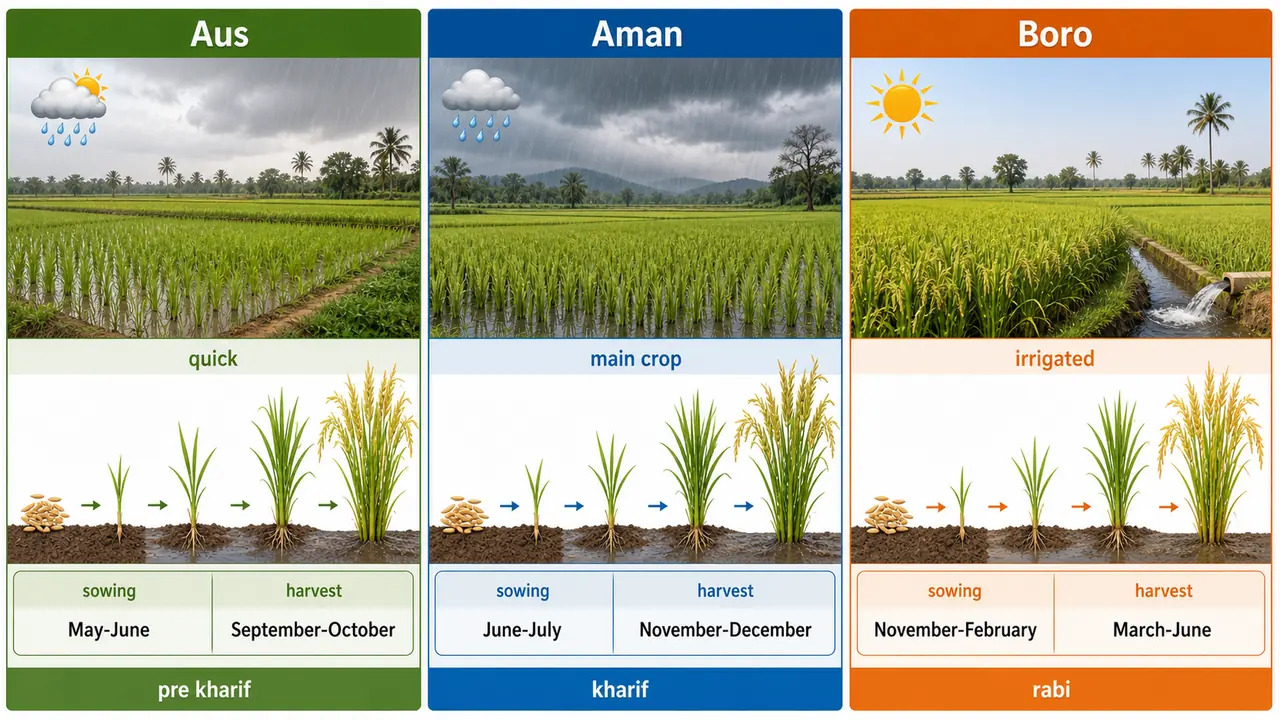
Rice is grown in three seasons in Eastern and Peninsular India because temperature remains suitable year-round:
| Season | Local Name | Sowing | Harvesting |
|---|---|---|---|
| Autumn (Aus) | Pre-Kharif | May-June | September-October |
| Winter (Aman/Sali) | Kharif | June-July | November-December |
| Summer (Boro) | Rabi | November-February | March-June |
| Season block | Meaning and local note | Typical crop window |
|---|---|---|
| Aus / Pre kharif / Autumn | Word aus is derived from Sanskrit ashu, meaning quick or early | Pre-monsoon rice grown during April-May, harvested in August-September, so it is called autumn rice |
| Aman / Kharif / Winter | Aman is linked with safety and stability of the crop (Aman-chain) | Sown in June-July and harvested in October; also called winter rice because harvest comes in winter |
| Boro / Spring / Summer | Boro refers to rice grown on submerged lower-elevation land | Grown during Jan-Feb to April-May; also called summer rice because it is harvested in summer |
Oryza sativa has three subspecies/varietal groups: Indica (tropical, long-grain, grown in lowland India), Japonica (temperate, short-grain, grown in Japan and Korea), and Javanica (intermediate, grown in Indonesia). Most Indian rice belongs to the Indica group.
Morphology

Rice has distinctive floral and structural features that set it apart from other cereals and are frequently tested in exams.
| Feature | Detail |
|---|---|
| Inflorescence | Panicle with 6 stamens (other cereals typically have 3) |
| Hull | Lemma + Palea together |
| Stem | Called culm |
| Fruit | Caryopsis (seed coat fused with fruit wall -- all grasses) |

Varieties -- Historical Development
Understanding the lineage of Indian rice varieties is a favourite exam topic. Here is the logical sequence:
- TN-1 (Taichung Native-1): Developed in Taiwan after World War II -- one of the earliest semi-dwarf, fertiliser-responsive varieties.
- TN-1 = Dee-geo-woo-gen (dwarf, N-responsive) x Tsai Yung Chung (tall, drought resistant)
- Introduced to India in 1964-65 by G. V. Chalam (2 kg from IRRI). Before TN-1, rice productivity was about 2 q/ha; after, it reached 8 q/ha -- marking the start of the Green Revolution in Indian rice.

- IR-8: Evolved by breeder Henry Beachell at IRRI, Manila. Called "Miracle Rice" globally for unprecedented yields.
- IR-8 = Dee-geo-woo-gen (China) x Peta (Indonesia)
- Introduced to India in 1966 and out-yielded TN-1.

- Jaya: First rice variety developed under India's own programme by Dr. Shastry.
- Jaya = TN-1 (Taiwan) x T-141 (Indian). Out-yielded both TN-1 and IR-8 -- called Miracle Rice of India.

- Padma: Reverse cross of Jaya's parents -- Padma = T-141 x TN-1.
- Jagannath: Mutant variety of T-141.
- Sahbhagi Dhan: Drought-tolerant variety for rainfed areas.

- Swarna-Sub 1: Submergence-tolerant -- survives 14 days under water. Invaluable for flood-prone eastern India.
TIP
Mnemonic for rice variety lineage: "TIJ" -- TN-1 (1964, Taiwan), IR-8 (1966, IRRI), Jaya (India's first, Dr. Shastry). Each out-yielded the previous one.
Basmati Rice
- Basmati 370, Basmati 385, 1121 (Extra-long grain variety).
- Pusa Basmati-1 (Muchal): World's first high-yielding dwarf variety under quality rice, developed by IARI through convergent breeding.

- Fragrant varieties derived from basmati stock but not true basmati: PB-2 (Sugandha-2), PB-3, RS-10.
- A basmati grain contains 0.09 ppm of aromatic chemical -- 12 times more than non-basmati rice.
- The characteristic fragrance is caused by 2-acetyl-1-pyrroline (pandan-like aroma).
Non-Basmati Rice
Gobindbhog: Cultivated mostly in West Bengal; awarded G.I. tag for its white, aromatic, sticky rice with a sweet buttery flavour. Named after offerings to Govindaji, the family deity of the Setts of Kolkata.

Rice Varieties for Special Conditions
| Special condition | Important varieties |
|---|---|
| Saline-alkaline soil | CSR-10, CSR-13, CSR-27 |
| Salt tolerant | Lunishree, TRY-1 |
| Post-flood situation | Heera, Kalinga-3 |
| Gall midge resistance | Phalguna, Surekha, Suraksha |
| BPH resistance | Aruna, Chandana |
| BLB resistance | Ajaya, PR-10 |
| Blast resistance | Tulsi, IR-64 |
| Stem borer resistance | IR-20, Ratna, Sweta, ADT-44 |
| Drought tolerant | Govind, Sabari |
| Deep water rice | Pankaj, Jagannath |
This condition-wise table preserves the same exam-relevant grouping as the older scanned figure, but in editable Markdown.
Types of Rice Cultivation
| Method | Condition |
|---|---|
| Transplanted puddled lowland | Most common in India -- better weed control, uniform stand |
| Wet-seeded puddled lowland | Saves transplanting labour cost |
| Dry-seeded rainfed un-puddled lowland | Used where water availability is limited |
Methods of Rice Cultivation
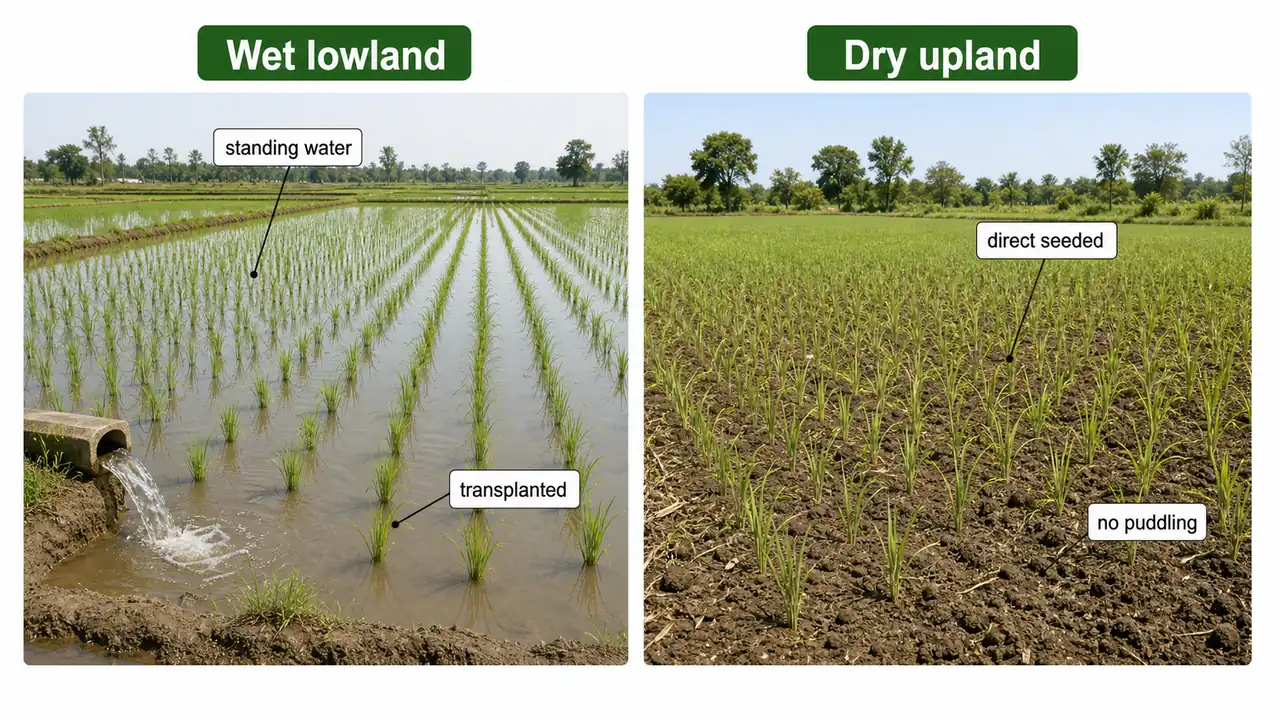
1. Dry or Semi-dry Upland Cultivation
- Broadcasting the seed, or sowing behind the plough / drilling.
2. Wet or Lowland Cultivation
- The major part of India's rice is grown under lowland conditions.
- Optimum depth of puddling: 5 cm (creates an impervious layer reducing water percolation loss).
- Transplanting in puddled fields, or broadcasting sprouted seeds in puddled fields.
Types of Nursery in Rice
| Nursery Type | Area for 1 ha | Ratio |
|---|---|---|
| Dry Bed | 1000 m2 | 1:10 |
| Wet Bed | 1250-1500 m2 | 1:8 |
| SRI Method | 100 m2 | 1:100 |
| Dapog Method | 40 m2 | 1:250 (most nursery-efficient) |
Dapog Method

- Originated in the Philippines.
- Seedlings ready for transplanting on the 12th day -- the fastest nursery method available.
- Seed rate: sprouted seeds @ 1.5-2 kg/m2 (2.5 times higher than other methods) on wooden planks, trays, or concrete floor covered with polythene.
- Seedlings from 1 m2 are sufficient for 200-250 m2 of field.
- Crop flowers days earlier when transplanted by this method.
Transplanting
- Ideal age: Seedling with 4 leaves (not 5). Age: 20-30 days in Kharif (spacing 20 x 15 cm), 30-35 days in Rabi (spacing 15 x 15 cm).
- Thumb rule: Age of transplanting = 1/4th of total crop duration.

Spacing
| Establishment method | Recommended spacing |
|---|---|
| Transplanting | 20 x 10 cm |
| Hybrid | 20 x 15 cm |
| SRI Method | 25 x 25 cm |
- Paira and Utera cropping systems are most practised in Odisha, Bihar, and Chhattisgarh.
- The most prominent cropping pattern of rice in India is Rice-Wheat, feeding the majority of the population.
Nutrient Management
Rice nutrient management is dominated by nitrogen because waterlogged conditions create a unique soil chemistry -- ammoniacal nitrogen is stable while nitrate nitrogen is rapidly lost through denitrification. Understanding this distinction is the key to efficient fertilisation.
| Parameter | Detail |
|---|---|
| Preferred N form | Ammoniacal (NH4) -- dominant in waterlogged conditions |
| Best top-dressing fertiliser | Ammonium sulphate (provides N + S) |
| Best basal dose | DAP followed by SSP |
| Recommended NPK dose | 100 : 60 : 40 kg/ha |
| Highest N loss mechanism | Denitrification (bacteria convert NO3 to N2 gas) |
| Input | Recommended dose |
|---|---|
| FYM | 250-300 q/ha |
| N | 100 kg/ha |
| P2O5 | 60 kg/ha |
| K2O | 50 kg/ha |
-
Ammonium polyphosphate is superior to both DAP and SSP, especially in acid clay loams.
-
N loss can be reduced by placing ammoniacal fertiliser in the reduced zone and nitrate fertiliser in the oxidised zone. In lowland rice, fertiliser is applied in the reduced zone only.
-
Zinc deficiency is a major problem in intensively cultivated and saline-sodic soils. Apply ZnSO4 @ 40 kg/ha every three crop seasons (100 kg/ha initially in saline-sodic soils).
-
Gypsum @ 6 t/ha for sodic soils (pH 9.5-9.7) rapidly reduces exchangeable sodium from 70% to 50% in the first season. A combination of gypsum (3 t/ha) + green manure (6 t/ha) is equally effective.
-
Iron toxicity in acid Ultisols, Oxisols, and acid-sulphate soils -- varietal tolerance is the only solution. Phalguna shows some tolerance.
-
Rice paddies emit CH4 (methane), a potent greenhouse gas.
NOTE
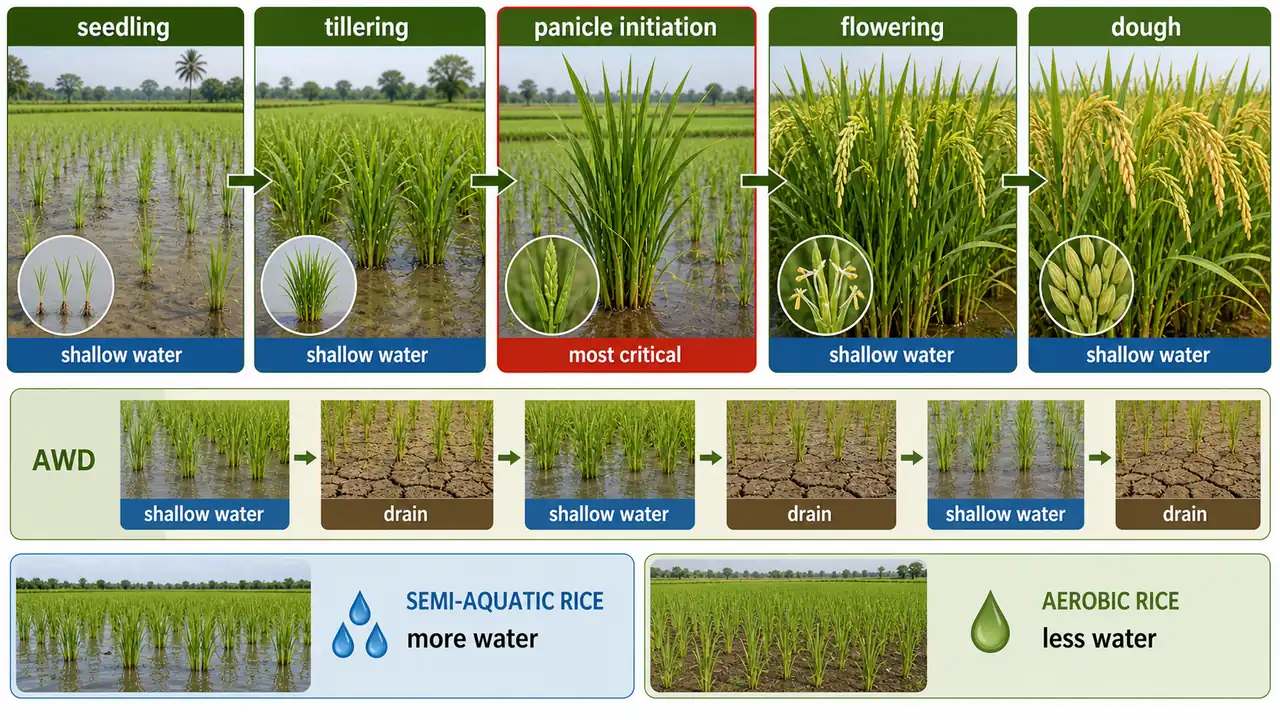
Rice paddies are one of the largest agricultural sources of methane (CH4) emissions. Alternate Wetting and Drying (AWD) can reduce methane by 30-50% while saving water.
Nitrogen Management in Rice

- Azolla: A free-floating fern hosting the nitrogen-fixing cyanobacterium Anabaena azollae, applied for N fixation and organic matter enrichment.
- Azospirillum: Nitrogen-fixing bacterium found on the root surface of rice -- a low-cost biological alternative for partial N supplementation.
Water Management
Rice is the most water-intensive cereal -- it requires continuous submergence during much of its growth. This makes water management the single largest determinant of rice production costs and environmental impact.
| Parameter | Value |
|---|---|
| Water requirement | 1400-1500 mm |
| Number of irrigations | 5 |
| Submergence depth (reproductive + grain stage) | 5 cm |
| Water to produce 1 kg (semi-aquatic) | 5000 litres |
| Water to produce 1 kg (aerobic) | 2500 litres |
| IW/CPE ratio | 1.20 |
- Rice has the lowest water use efficiency (WUE) and is the highest water-consuming crop.
- 5 critical growth stages for irrigation: Seedling, Tillering, Panicle Initiation (most critical), Flowering, Dough/Maturity.
- The critical stages for both fertiliser and irrigation are Tillering and Panicle Initiation (PI).
Seed Rate
- Germination: Hypogeal -- cotyledons remain below the soil surface.
- Test weight (1000 grains): 25 g
| Establishment method | Seed rate |
|---|---|
| Broadcasting | 100 kg/ha |
| Dibbling and drilling | 60 kg/ha |
| Hybrid rice | 15 kg/ha |
| SRI system | 5-6 kg/ha |
| Dapog method | 1.5-2 kg/m2 |
Weed Control
- Most dominant weed: Echinochloa spp. (Wild Rice) -- closely resembles rice in early stages, making identification difficult.

| Herbicide | Dose | Timing |
|---|---|---|
| Propanil (Stam F-34) | 3 kg a.i. in 400-600 L water/ha | 6-8 DAT (weeds at 1-3 leaf) |
| Butachlor (Machete) | 2 kg a.i./ha | Pre-emergence |
| Fluchloralin (Basalin) | 1 kg a.i./ha | Soil incorporated at puddling or 1-3 DAT |
| Nitrofen (TOK-E-25) | 2 kg a.i./ha | Pre-emergence |
Harvesting and Post-Harvest
| Parameter | Value |
|---|---|
| Harvest stage | Panicles turn golden yellow; grain at 20% moisture |
| Safe storage moisture | 10-12% |
| Harvest Index | 0.45 (45%) |
| Hulling % | 66% |
| Milling recovery / Shelling % | 60% |
- Rice cleaned = 2/3 of paddy weight.
- Rice husk contains 15-18% silica -- used in silicate and glass manufacture.


Parboiled Rice
- Retains more B-complex vitamins (especially Thiamine / B1) that are otherwise lost during milling and polishing.
- Parboiling involves partial boiling of paddy with husk to increase nutritional value, change texture, and reduce milling breakage. Three steps: Soaking, Steaming, Drying.

- Dehusked rice = Brown rice (retains the bran layer, more nutritious than polished white rice).

Oil Content in Rice Bran

| Type | Oil Content |
|---|---|
| Raw rice bran | 12-18% |
| Parboiled bran | 20-28% (parboiling increases extractability) |
| De-oiled bran | 1-3% |
Red Rice

- Iron-rich red rice is grown in the Brahmaputra valley of Assam without chemical fertilisers, known as 'Bao-dhaan'. Valued for high iron content and antioxidant properties.
- First consignment of red rice was exported to the USA on 4 March 2021.

Pests and Diseases
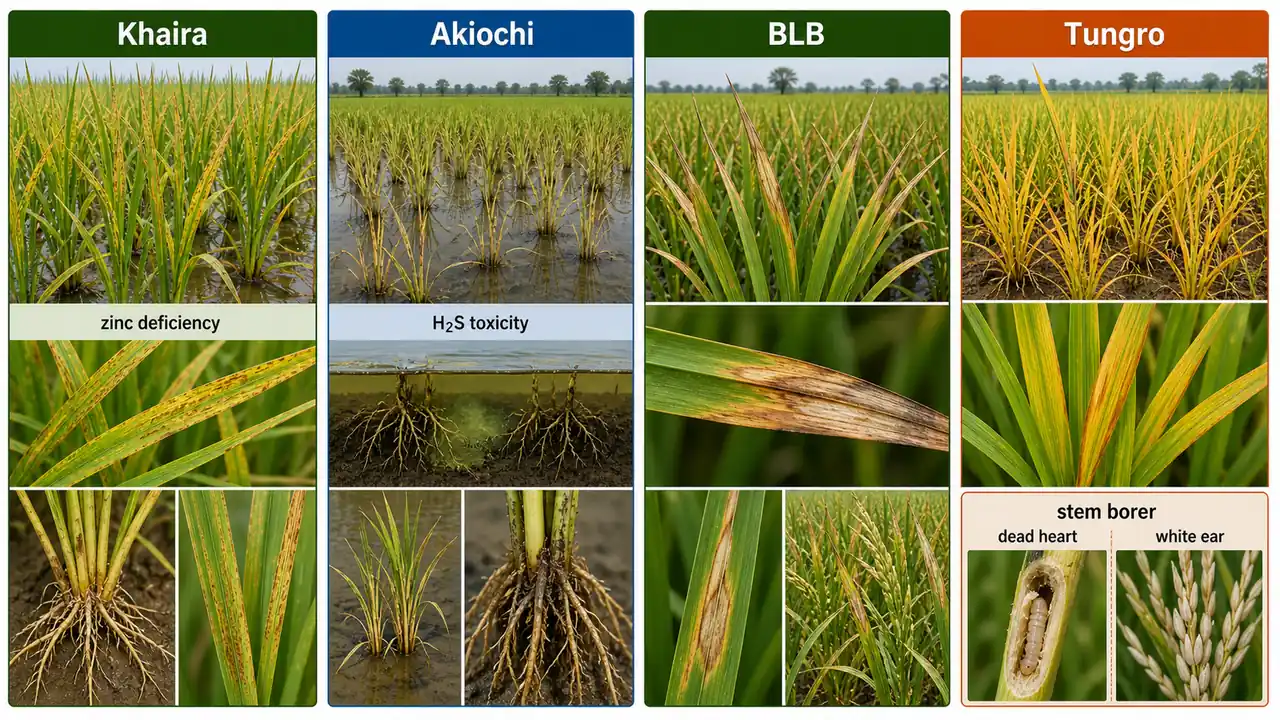
Rice faces a wide range of nutritional disorders, fungal, bacterial, and viral diseases, plus insect pests. Exam questions frequently test the cause behind named diseases -- especially Khaira (zinc deficiency) and the two "killer diseases" (BLB and Tungro).
| Disease / Disorder | Cause |
|---|---|
| Akiochi disease | H2S toxicity (poorly drained, waterlogged soils) |
| Khaira disease | Zinc deficiency (most widespread nutritional disorder) |
| Montek disease | Rice root nematode |
| Ufra disease | Nematode (Ditylenchus angustus) |
| White eye | Iron (Fe) deficiency |
| Dead heart and white ear | Yellow stem borer (larva bores into stem) |
| Killer diseases | Bacterial Leaf Blight (BLB) and Tungro Virus |
TIP
Exam favourite: Khaira = Zinc deficiency. Symptoms: rusty brown spots on leaves of 15-30 day old seedlings. This is the single most common nutritional disorder question in banking exams.
Fluffy Paddy Soil

Under continuous flooding in a rice-rice-rice sequence, soil particles remain in constant flux and lose mechanical strength, leading to fluffiness -- a serious soil health issue in intensive rice monoculture.
Beushening / Biasi in Rice

- A traditional method prominent in Chhattisgarh, Bihar, and Odisha.
- Rice seeds are broadcast in ploughed fields after monsoon onset; the standing crop is ploughed 4-6 times later when 4-5 cm of water is standing.
- Uprooted seedlings are transplanted after biasi -- called Chalai gap filling.
- Objectives: Control weeds, create semi-puddled conditions, arrest percolation loss, and adjust plant population.
Hybrid Rice

- First developed in the late 1970s by Chinese scientist Yuan Longping (the Father of Hybrid Rice) using Cytoplasmic Male Sterility (CMS).
- In India (1994), the first five hybrid rice varieties were released: APRH 1, APRH 2 (Andhra), KRH 1 (Karnataka), MGR-1 (Tamil Nadu).
- Two years later: CNRH 1, KRH 3, DRRH-1 were released.
- PHB-71 is the only hybrid rice released by a private organisation.
- Seed rate for hybrid rice: 15 kg/ha (20 x 15 cm spacing) -- lower because hybrid vigour ensures better tillering.

Golden Rice


- Produced by combining genetic material from Daffodils, Erwinia uredovora, Agrobacterium tumefaciens, and Japonica rice by Professor Ingo Potrykus and Dr. Peter Beyer (Germany, 1999).
- Purpose: Combat Vitamin A deficiency, a major cause of childhood blindness and death from infectious diseases like measles. A biofortified crop of immense public health significance.
- Rice is naturally low in beta-carotene; golden rice contains it, giving the grain its golden colour.
System of Rice Intensification (SRI)

SRI is based on transplanting young seedlings (8-12 days old), planting single seedlings at wider spacing, and maintaining alternate wetting and drying instead of continuous flooding. It saves five resources simultaneously:
| Resource | Saving |
|---|---|
| Water | 20-25% (1571 L per kg seed production) |
| Labour | 14% |
| Seed | 70-80% (only 5-6 kg/ha needed) |
| Production cost | Reduced significantly |
| Productivity | Increased 20-45% |
- Leaf Colour Chart (LCC): A simple tool for nitrogen management that saves 15 kg N/ha by applying nitrogen only when the plant needs it.
- Rotary/Cono weeder is used for weeding in lowland rice.

- The first systematic work on SRI in India began at TNAU, Tamil Nadu in 1993.
| S.No. | Particulars | SRI Method |
|---|---|---|
| 1. | Seed rate/ha. | 5-6 kg |
| 2. | Nursery area/ha. | 1 per cent (100 m²) |
| 3. | Nursery raising | Raised bed-dry nursery |
| 4. | Age of the nursery at transplantation | 10-12 days |
| 5. | Stage of the crop at the time of transplantation | Only 2 leaves |
| 6. | Spacing | 25 × 25 cm, 16 hills/sq.m |
| 7. | No. of plants/hill | Single |
| 8. | Condition of the main field at the time of transplantation | Perfectly levelled with sticky muddy condition |
| 9. | Transfer of nursery | Seedlings are lifted from underneath soil gently & transferred as and when required |
| 10. | Method of transplanting | Shallow-to be planted along with seed & attached soil at required spacing |
| 11. | Channels | Required all along the field to drain out excess water |
| 12. | Inter-cultivation | No weedicide application. Repeated inter cultivation through rotary weeder and line weeder |
| 13. | Water management | Intermittent wetting & drying for aeration. A thin film of water is maintained from primordial initiation stages to physiological - maturity |
| 14. | Water use | More |
| 15. | Root development | Profuse & deep |
| 16. | Pest and disease incidence | Less |
| 17. | Availability of organic matter | More |
Important Rice Varieties Asked in AFO/NABARD
| Variety | Special Characteristics |
|---|---|
| TN1 (Taichung Native 1) | 1st dwarf variety developed in the world (1964-65) |
| IR 8 (Dee gee woo gen x Peta) | 1st High Yielding dwarf variety released by IRRI in 1966, also known as miracle rice |
| Jaya (TN1 x TN141) | 1st Indian high yielding variety, also known as miracle rice of India |
| Jagannath (from TN 141), Sattari | Mutant varieties |
| Bala, Kanchan, Kiran, Bhawani, Sahbhagi Dhan | Drought tolerant |
| TKM 6, Ajay | BLB resistant (TKM 6 tolerant to stem borer) |
| Govind, IR 20 | BLW resistant |
| Jalmagan (3-4 m standing water), Madhukar, Chakkaiya 59 | Suitable for waterlogging areas |
| IR 8, Damodar, Lunishree, CSR 5, CSR 10, CSR 23, SR 26 B | Salinity tolerant |
| MGR 1 (earlier CoRH 1) | 1st Hybrid variety in India (developed by TNAU) |
| Pusa Basmati 1 | 1st high yielding basmati variety (developed by IARI) |
| PRH 10 (Pusa Rice Hybrid) | 1st super fine grain aromatic hybrid of basmati |
| PHB-71 | Only hybrid rice released by private org. |
| Sugandha-4 (Pusa-1121), CSR-3C, Taraori Basmati, Basmati-386, Pusa Basmati-1 | Important Basmati varieties |
| Norin-8,18, Pankaj, IR-20, Pusa 2-21 | Varieties released from IARI |
| Phalguna | Tolerant to Fe toxicity |
| Swarna Sub 1 | Submerge tolerant (14 days) |
| Kalinga 3 | Post-flooded variety |
| Pankaj, Jagannath | For deep water |
| VL Dhan 206 | Hilly regions variety |
| Narendra dhan 18 | Rainfed variety |
TIP
Most asked rice varieties: IR 8 = miracle rice (IRRI, 1966), Jaya = miracle rice of India, TN1 = 1st dwarf, MGR 1 = 1st Indian hybrid (TNAU), Pusa Basmati 1 = 1st HYV basmati (IARI), Swarna Sub 1 = submergence tolerant.
Summary Table -- Rice at a Glance
| Parameter | Value |
|---|---|
| Botanical name | Oryza sativa |
| Family | Poaceae |
| Origin | South-East Asia |
| Chromosome | 2n = 24 |
| Protein | 6-7% (Oryzein), rich in lysine (4%) |
| Pollination | Self-pollinated, short-day plant |
| NPK dose | 100:60:40 kg/ha |
| Water requirement | 1400-1500 mm |
| Critical stages | Tillering and Panicle Initiation |
| Harvest Index | 0.45 (45%) |
| Milling recovery | 60% |
| Test weight | 25 g |
| 1st dwarf variety | TN-1 (1964-65) |
| 1st Indian hybrid | MGR-1 (TNAU) |
| Submergence tolerant | Swarna Sub 1 (14 days) |
| Father of Hybrid Rice | Yuan Longping (China) |
Rice Cultivation: Quick Decision Guide for Field Officers
Which establishment method to recommend?
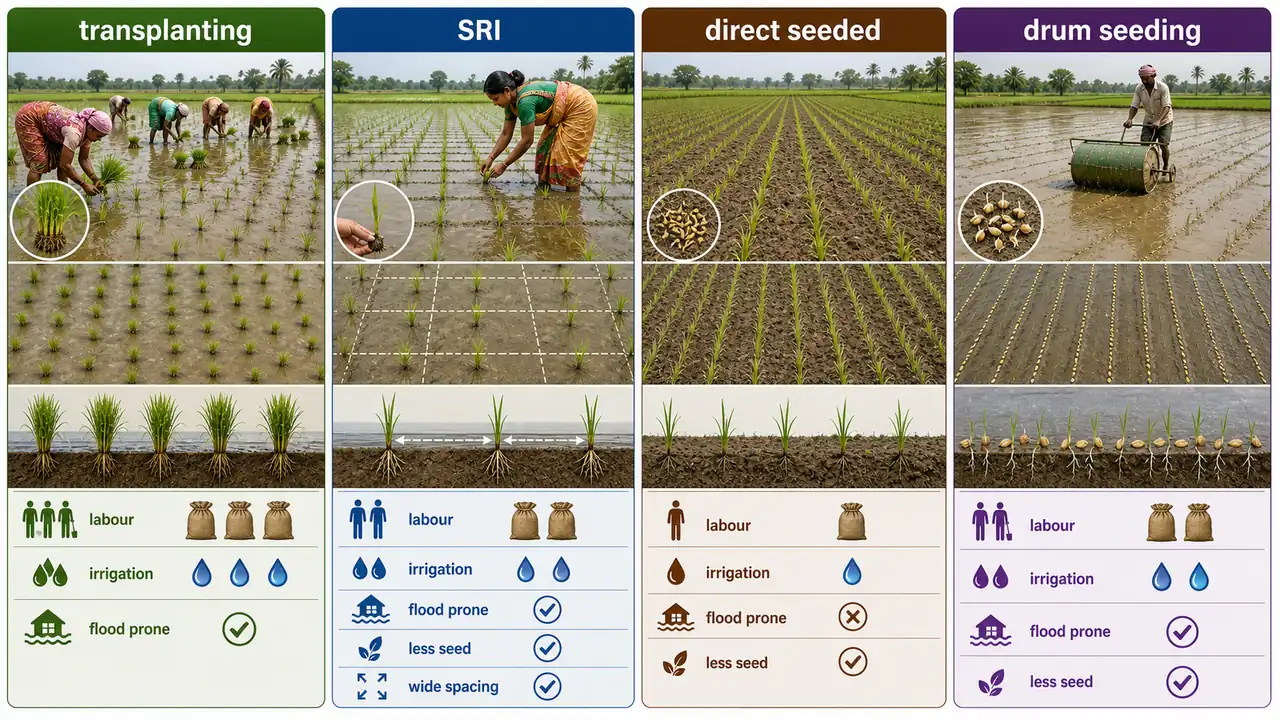
| Situation | Method | Why | Seed Rate |
|---|---|---|---|
| Adequate labour + irrigation (traditional) | Transplanting (21-25 day seedlings) | Most common; good weed control; higher yield | 50-60 kg/ha (nursery) |
| Labour shortage + assured irrigation | SRI (System of Rice Intensification) | Uses 8-12 day seedlings, wider spacing; can increase yield 20-30% with less seed and water | 5-7.5 kg/ha |
| Labour shortage + upland/rainfed | Direct seeded rice (DSR) | No nursery, no transplanting; saves water; suits aerobic conditions | 80-100 kg/ha |
| Flood-prone areas (eastern India) | Drum seeding / wet DSR | Pre-germinated seeds; quick establishment | 60-80 kg/ha |
Critical growth stages — when NOT to miss irrigation:
| Stage | DAT (approx.) | Why Critical | What Happens If Missed |
|---|---|---|---|
| Tillering | 20-40 DAT | Maximum tiller production determines panicle number | Fewer panicles → lower yield |
| Panicle initiation | 55-65 DAT | Spikelet number being determined | Fewer grains per panicle |
| Flowering | 80-90 DAT | Pollen viability requires adequate moisture | Chaffy grains, severe yield loss |
SRI vs Conventional — evidence-based comparison (ICAR-NRRI data): SRI typically uses 25-50% less water and 80-90% less seed than conventional transplanting. Yield advantage varies from 10-30% depending on management quality. The method requires skilled labour for young seedling handling.
Summary Cheat Sheet
| Concept / Topic | Key Details |
|---|---|
| Botanical name | Oryza sativa; Family Poaceae; Origin South-East Asia |
| Chromosome | 2n = 24; 24 species, only 2 cultivated |
| India's cropped area share | 23.3%; contributes 43% of food grain |
| Protein | 6-7% (Oryzein); rich in lysine (4%) |
| Pollination | Self-pollinated; Short-day plant |
| NPK dose | 100:60:40 kg/ha |
| Water requirement | 1400-1500 mm; 5000 L per kg (semi-aquatic) |
| Critical stages | Tillering and Panicle Initiation (most critical) |
| Harvest moisture | 20%; safe storage 10-12% |
| Harvest Index | 0.45 (45%); Milling recovery 60% |
| TN-1 (1964-65) | 1st dwarf variety in the world |
| IR-8 (1966) | Miracle Rice — Peta × Dee-geo-woo-gen (IRRI) |
| Jaya | 1st Indian HYV — TN-1 × T-141 (Dr. Shastry) |
| MGR-1 | 1st hybrid variety in India (TNAU) |
| Pusa Basmati-1 | 1st HYV basmati (IARI, convergent breeding) |
| Swarna Sub 1 | Submergence tolerant (14 days) |
| Father of Hybrid Rice | Yuan Longping (China, CMS system) |
| Golden Rice | Vitamin A fortified; by Ingo Potrykus |
| Khaira disease | Zinc deficiency — most common nutritional disorder |
| SRI seed rate | Only 5-6 kg/ha; seedlings 8-12 days old |
| Dapog method | From Philippines; seedlings ready 12 days |
| Methane emission | Rice paddies are major CH₄ source |
TIP
Next: The following lesson covers Wheat -- the King of Cereals and India's second most important food crop. Compare wheat's Rabi, long-day, low-water requirements with rice's Kharif, short-day, high-water profile.