🔅 Sorghum -- The Camel Crop (Complete Cultivation Guide)
Master sorghum production for exams -- Pellagra and the 4-Ds mnemonic, HCN toxicity, sweet sorghum, varieties, and exam-focused tables for exams, NABARD, and IBPS SO.
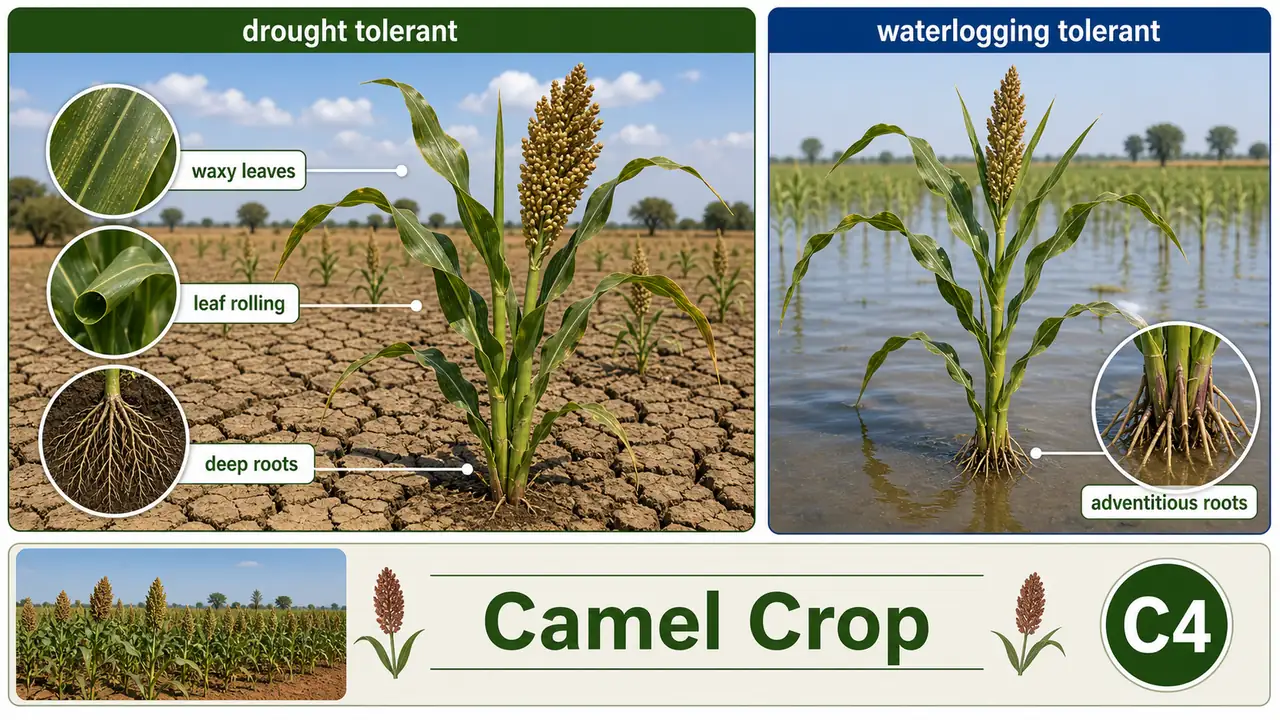
In India's Deccan plateau, where black cotton soils bake under the semi-arid sun, sorghum stands tall through months of scanty rainfall. Farmers call it the "Camel Crop" because, like the camel in a desert, sorghum survives prolonged drought through its deep roots, waxy leaves, and leaf-rolling ability. As the King of Coarse Cereals, it commands the largest area among all millets and offers grain, fodder, and even biofuel.
In the previous lessons, we covered the major cereals -- Rice, Wheat, Barley, and Maize. Now we move to the millets, which dominate dryland agriculture and are collectively the 4th most widely cultivated food crop group globally.
This chapter covers:
- Millets overview -- India's position, C4 advantage
- Sorghum basics -- botany, Pellagra, and amino acid profile
- Climate, soil, and cultivation -- drought and waterlogging tolerance
- HCN toxicity -- the critical safety concern for livestock
- Hybrids and varieties -- CSH series, sweet sorghum, biofortified types
- Pests and diseases -- stem borer, shoot fly, grain mould
All sections are high-yield for IBPS AFO, NABARD Grade A, and FCI exams.
Pro Content Locked
Upgrade to Pro to access this lesson and all other premium content.
Charged once for one year · ₹1188 total
Save ₹100/month vs ₹2388/year launch price
- All Agriculture & Banking Courses
- AI Lesson Questions (100/day)
- AI Doubt Solver (50/day)
- Glows & Grows Feedback (30/day)
- AI Section Quiz (20/day)
- 22-Language Translation (100/day)
- Recall Questions (20/day)
- AI Quiz (15/day)
- AI Quiz Paper Analysis (100/day)
- AI Step-by-Step Explanations (100/day)
- Spaced Repetition Recall (FSRS)
- AI Tutor
- Immersive Text Questions
- Audio Lessons — Hindi & English
- Mock Tests & Previous Year Papers
- Summary & Mind Maps
- XP, Levels, Leaderboard & Badges
- Generate New Classrooms
- Voice AI Teacher (AgriDots Live)
- AI Revision Assistant
- Knowledge Gap Analysis
- Interactive Revision (LangGraph)
🔒 Secure one-time yearly payment via Razorpay · No hidden fees
In India's Deccan plateau, where black cotton soils bake under the semi-arid sun, sorghum stands tall through months of scanty rainfall. Farmers call it the "Camel Crop" because, like the camel in a desert, sorghum survives prolonged drought through its deep roots, waxy leaves, and leaf-rolling ability. As the King of Coarse Cereals, it commands the largest area among all millets and offers grain, fodder, and even biofuel.
In the previous lessons, we covered the major cereals -- Rice, Wheat, Barley, and Maize. Now we move to the millets, which dominate dryland agriculture and are collectively the 4th most widely cultivated food crop group globally.
This chapter covers:
- Millets overview -- India's position, C4 advantage
- Sorghum basics -- botany, Pellagra, and amino acid profile
- Climate, soil, and cultivation -- drought and waterlogging tolerance
- HCN toxicity -- the critical safety concern for livestock
- Hybrids and varieties -- CSH series, sweet sorghum, biofortified types
- Pests and diseases -- stem borer, shoot fly, grain mould
All sections are high-yield for IBPS AFO, NABARD Grade A, and FCI exams.
Millets -- The Big Picture
- India, Nigeria, and China are the largest millet producers globally. Millets are the 4th most widely cultivated food crop after rice, wheat, and maize.
- Coarser millets include Jowar (sorghum), Bajra (pearl millet), and Ragi (finger millet). Exams
- All millets belong to the C4 group -- they use the Hatch-Slack pathway for more efficient carbon fixation in hot, dry conditions, losing less water per unit of carbon gained.
Sorghum / Jowar -- Basics

| Parameter | Detail |
|---|---|
| Botanical name | Sorghum bicolor |
| Family | Poaceae |
| Origin | East Central Africa |
| Chromosome | 2n = 20 |
| Title | King of Coarse Cereals (highest area and production among millets) |
| Nickname | Camel Crop (extreme drought tolerance) |
| Amino acid profile | Poor in lysine, rich in leucine |
Pellagra -- The Sorghum-Linked Disease

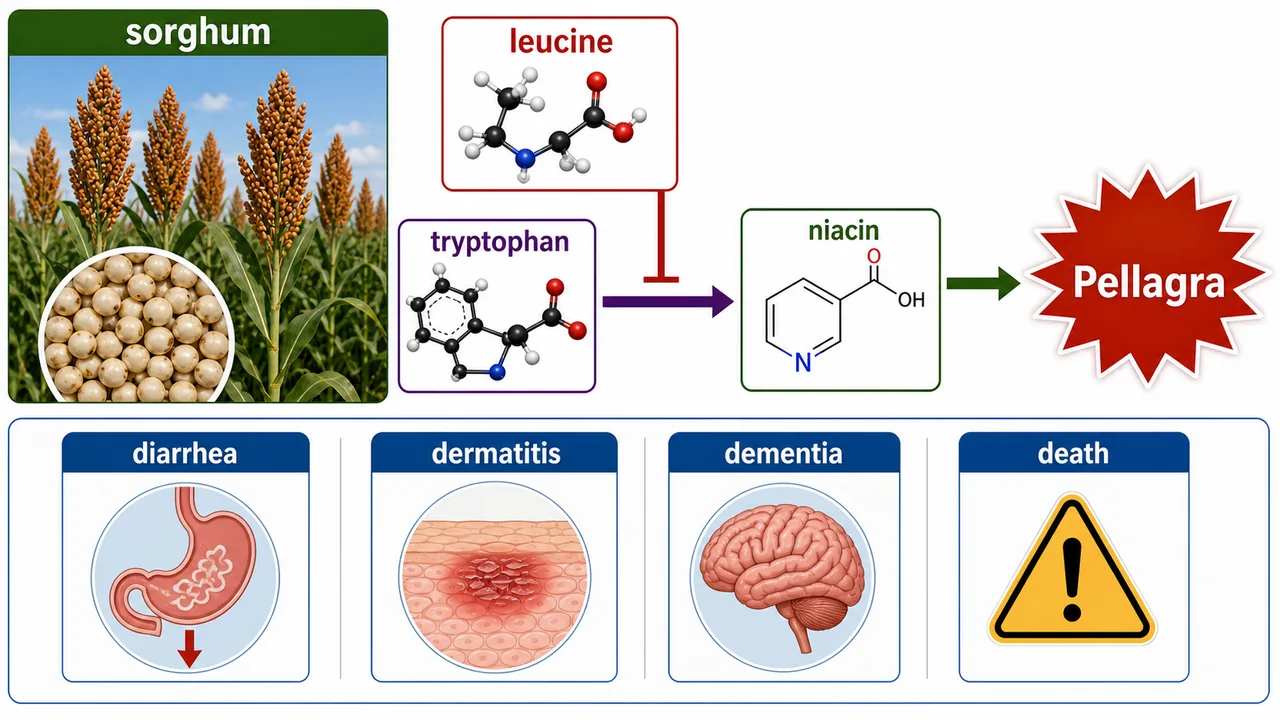
- Excess leucine in sorghum inhibits the enzyme kynurenine hydroxylase, blocking conversion of tryptophan into niacin (Vitamin B3).
- When sorghum is the staple diet without supplementation, Pellagra disease results from Niacin (B3) deficiency.
- Symptoms = 4 Ds: Diarrhea, Dermatitis, Dementia, Death.
TIP
Exam Mnemonic -- Pellagra = 4 Ds: Diarrhea, Dermatitis, Dementia, Death. Caused by Niacin (B3) deficiency due to excess leucine in sorghum-heavy diets. This is one of the most frequently asked facts about sorghum.
Climate
| Parameter | Requirement |
|---|---|
| Photoperiod | Short-day plant |
| Temperature | Warm season crop; optimum 27-32 C |
| Rainfall | 400-600 mm |
| Drought tolerance | Yes -- deep root system, C4 metabolism |
| Waterlogging tolerance | Yes -- develops adventitious roots |
- Sorghum's dual tolerance to both drought and waterlogging is unusual among crops, making it exceptionally versatile for dryland farming.
Soil
- Best on clay loam or loam texture (good balance of moisture retention and drainage).
- Tolerates pH 6.0-8.5 (considerable salinity and alkalinity tolerance).
- The black cotton soils (Vertisols) of central India are excellent -- high clay content provides moisture-holding capacity during dry spells.
Seed Rate and Sowing
| Parameter | Value |
|---|---|
| Grain | 12-15 kg/ha |
| Fodder | 30-35 kg/ha (denser stand for maximum biomass) |
| Seed depth | 3-4 cm |
| Test weight | 25-30 g |
| Germination | Hypogeal |
| Spacing | 45 x 12 cm |
| Plant population | 1,50,000 plants/ha |
| Sowing time | Late June to first week of July (monsoon onset) |
| Input | Recommended dose |
|---|---|
| FYM | 10-15 tonnes/ha |
| N | 100 kg/ha |
| P2O5 | 50 kg/ha |
| K2O | 40 kg/ha |
Morphology and Botany

| Feature | Detail |
|---|---|
| Inflorescence | Panicle (commonly called Head) -- compact for grain types, loose for fodder |
| Tillering | Usually no tillering; single main stem |
| Support roots | Prop roots from lower nodes prevent lodging |
| Photosynthetic pathway | C4 |
| Pollination | Often cross-pollinated (5-30% natural crossing) |
| Root system | Finer and more fibrous than maize |

Hybrids and Key Varieties
| Category | Details |
|---|---|
| Hybrid series | CSH 1 to 6, CSH 9, 10, 13, 16, 17, 18 |
| 1st hybrid | CSH-1 in 1964 -- first commercially released sorghum hybrid in India |
| Key male sterile line | Combine Kafir 60 (CK-60) -- CMS line used as female parent in hybrid seed production |
Cultural Practices
- Thinning at 12-15 cm within the row ensures adequate space, light, and nutrients per plant.
HCN Toxicity -- Critical Safety Warning
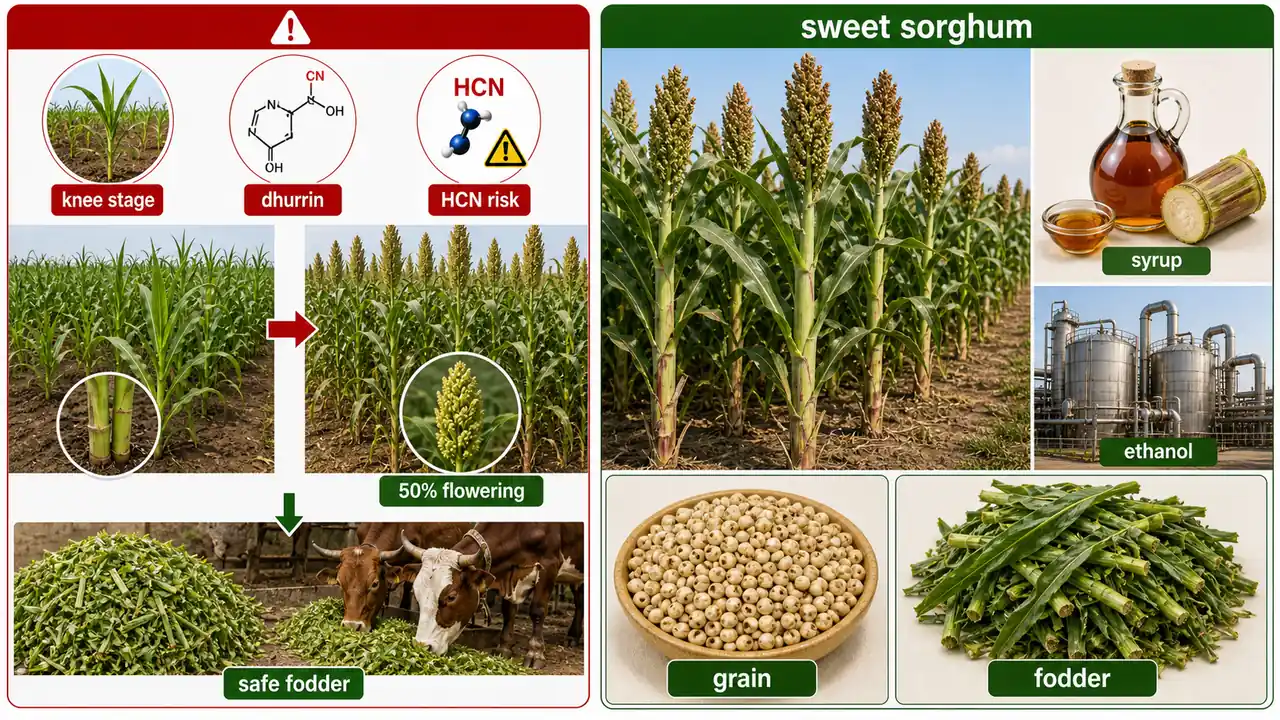
- Sorghum leaves at the knee stage contain high levels of HCN (from Dhurrin alkaloid), which is poisonous to livestock.
- HCN is synthesised by roots and concentrated in upper leaves during the first 40-50 days.
- Fodder should only be used after 50% flowering when dhurrin concentration falls to safe levels.
- Drought stress increases HCN because growth slows but dhurrin production continues.
- A dose of 0.5 g HCN per animal can be lethal.
WARNING
Never feed sorghum fodder to livestock before 50% flowering stage. Young plants (under 45-50 days) contain lethal HCN levels. Drought-stressed sorghum is even more dangerous.
Varieties of Sorghum
| Category | Varieties |
|---|---|
| Best Rabi variety | M 35-1 (most popular in Maharashtra and Karnataka) |
| Drought + salinity tolerant (rainfed) | CSH 1, 6, 9, 11, 3 |
| Sweet sorghum (ethanol, syrup, jaggery) | RSSV 46, 53, 59, 84, 96, NSS 216 |
| Dual purpose (grain + fodder) | CSH 13, CSV 15 |
| Low HCN (safer for livestock) | IS 208, IS 28450, IS 288692 |
| Multi-cut fodder | MFSH 7, 885 F, CO (FS) 29 |
| Prabhani Shakti | India's first biofortified sorghum (high iron and zinc), launched 2018 by ICRISAT / VNMKV, Maharashtra |
NOTE
Sweet sorghum has high sugar content in stalks (like sugarcane) and can produce ethanol, syrup, and jaggery in addition to grain and fodder -- a triple-purpose crop gaining importance for biofuel.
Diseases
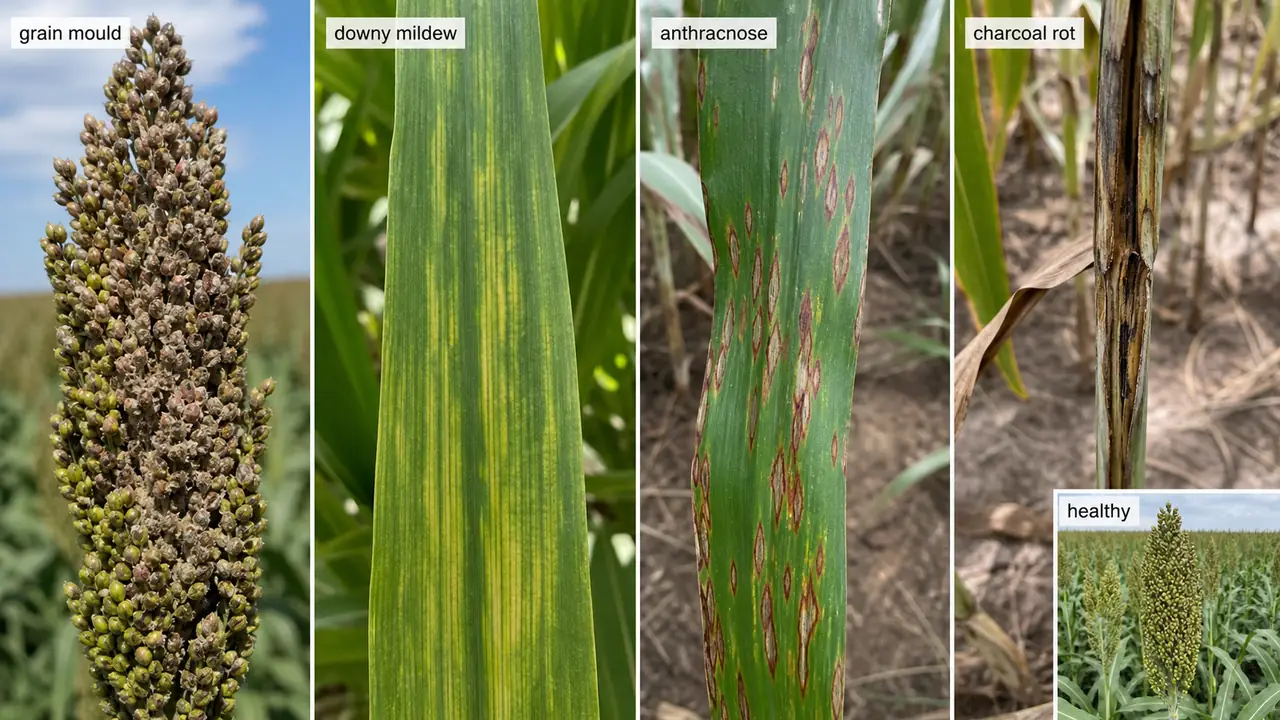
Major diseases include Grain mould (Fusarium, Aspergillus -- especially problematic in Kharif when rain occurs at grain maturity), Downy mildew (Peronosclerospora sorghi), Anthracnose (Colletotrichum graminicola), and Charcoal rot (Macrophomina phaseolina). Management: resistant varieties, crop rotation, timely fungicide application.
Insect Pests
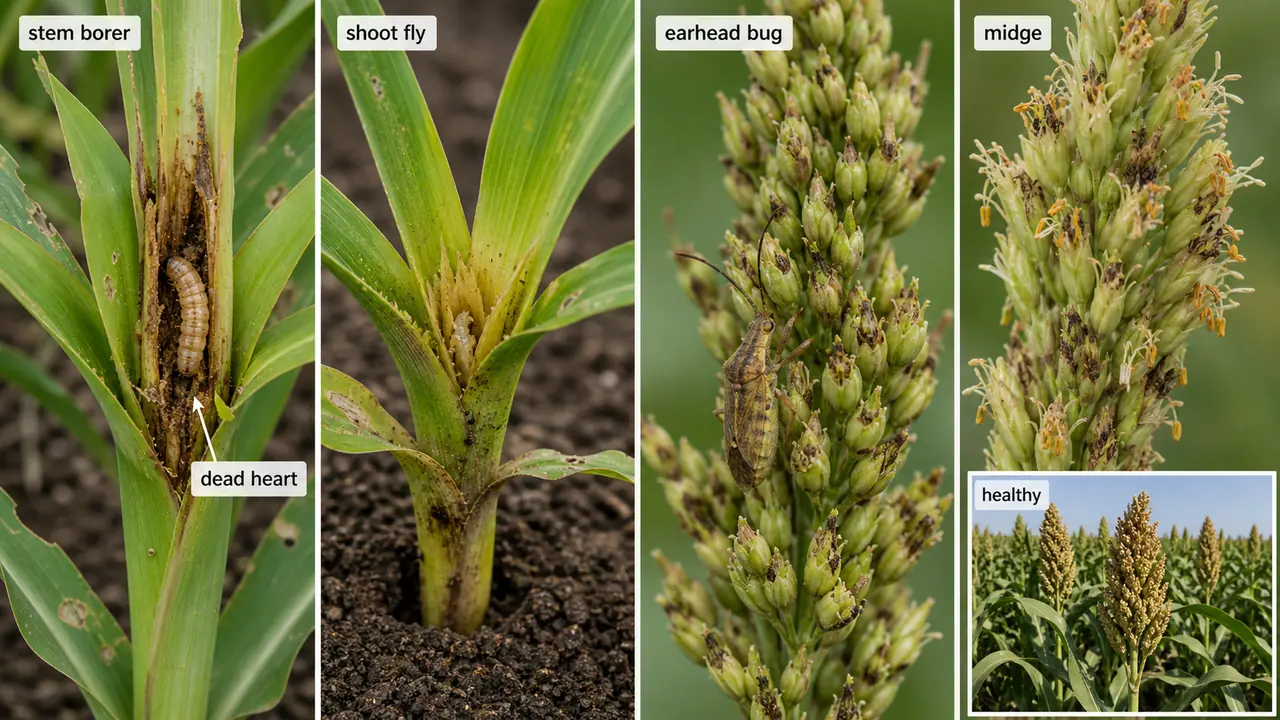
| Pest | Damage |
|---|---|
| Stem borer (Chilo partellus) | Most destructive -- larvae bore into stem causing "dead hearts" |
| Shoot fly (Atherigona soccata) | Attacks seedlings |
| Earhead bug (Calocoris angustatus) | Sucks sap from developing grains |
| Midge (Stenodiplosis sorghicola) | Damages florets |
Harvesting and Yield
- Harvest when grains are hard with less than 25% moisture (physiological maturity).
- Grain (irrigated): 25-30 q/ha.
- Fodder: 300-400 q/ha.
Important Sorghum Varieties Asked in AFO/NABARD
| Variety | Special Characteristics |
|---|---|
| CSH-1,5,6,9,10,11,13,14,16,18,23,25 | Kharif hybrids |
| CSH 7R (1st rabi hybrid), CSH 14R, CSH 15R, CSH 19R, DSH 4, Mahalakshmi 296 | Rabi hybrids |
| CSV-10,11,13,15,17,20,23 | Kharif varieties |
| M 35-1, 8R, 14R, 18, 22, 216 R | Rabi varieties |
| CSH-1 | 1st commercial sorghum hybrid released in 1964 |
| CSH-6, CSH-9 | Suitable for mixed cropping |
| CSH-29 | Suitable for saline soils |
| CSH-1, 3 | Suitable for rainfed conditions |
| Combine Kafir-60 | Male sterile variety |
| CSH-9 | Drought and salinity tolerant |
| Pusa Chari | Multicut variety |
Summary Table -- Sorghum at a Glance
| Parameter | Value |
|---|---|
| Botanical name | Sorghum bicolor |
| Family | Poaceae |
| Origin | East Central Africa |
| Chromosome | 2n = 20 |
| Title | King of Coarse Cereals, Camel Crop |
| Photosynthetic pathway | C4 |
| Photoperiod | Short-day |
| Pollination | Often cross-pollinated |
| Water requirement | 400-600 mm |
| Soil pH tolerance | 6.0-8.5 |
| Seed rate (grain) | 12-15 kg/ha |
| 1st hybrid | CSH-1 (1964) |
| Male sterile line | Combine Kafir-60 |
| HCN toxicity | Safe to feed only after 50% flowering |
| Pellagra link | Excess leucine causes Niacin (B3) deficiency -- 4 Ds |
| Biofortified variety | Prabhani Shakti (ICRISAT, 2018) |
| Best Rabi variety | M 35-1 |
Sorghum: Why It's the "Camel Among Crops" — Practical Guide
Sorghum thrives where other cereals fail: It tolerates drought (400-600 mm rainfall), heat, and alkaline soils (pH up to 8.5). This makes it the ideal cereal for dryland/rainfed farming in Deccan India.
| Sorghum Type | Season | Duration | Main Use | Key Region |
|---|---|---|---|---|
| Kharif (grain) | Jun-Oct | 90-110 days | Grain for food + fodder from stalks | Maharashtra, Karnataka |
| Rabi (Maldandi) | Oct-Feb | 120-140 days | Highest quality grain (preferred for bhakri/jowar roti) | Maharashtra (most important rabi sorghum area globally) |
| Fodder (multicut) | Year-round | Multiple cuttings | Green fodder for livestock | All dairy regions |
| Sweet sorghum | Kharif | 90-100 days | Ethanol from stalk juice + grain | ICRISAT-promoted biofuel crop |
Critical safety issue — HCN toxicity:
Sorghum produces dhurrin (a cyanogenic glucoside) in young leaves that converts to hydrogen cyanide (HCN) — toxic to livestock. This is exam-critical:
- Safe to graze/cut for fodder only after 50% flowering stage
- Young regrowth after cutting or drought-break is most dangerous
- HCN content decreases with plant maturity and proper sun-drying
Pellagra connection: Sorghum grain has excess leucine which inhibits conversion of tryptophan to niacin (Vitamin B3). Populations dependent on sorghum as staple can develop pellagra — the disease of "4 Ds": Dermatitis, Diarrhoea, Dementia, Death. This is why balanced diets and biofortified varieties (like Parbhani Shakti with higher iron + zinc) matter.
Summary Cheat Sheet
| Concept / Topic | Key Details |
|---|---|
| Botanical name | Sorghum bicolor; Family Poaceae; Origin East Central Africa |
| Chromosome | 2n = 20 |
| Title | King of Coarse Cereals / Camel Crop (extreme drought tolerance) |
| Photosynthetic pathway | C4 (Hatch-Slack) — efficient in hot, dry conditions |
| Photoperiod | Short-day plant |
| Pollination | Often cross-pollinated |
| Pellagra disease | Niacin (B3) deficiency — excess leucine blocks tryptophan conversion |
| Pellagra 4 Ds | Diarrhea, Dermatitis, Dementia, Death |
| HCN toxicity (Dhurrin) | Dangerous at 30-35 days; safe only after 50% flowering |
| Water requirement | 400-600 mm |
| Seed rate (grain) | 12-15 kg/ha |
| 1st hybrid | CSH-1 (1964) |
| Male sterile line | Combine Kafir-60 |
| Biofortified variety | Prabhani Shakti (ICRISAT, 2018) |
| Best Rabi variety | M 35-1 |
| Drought + salinity tolerant | CSH-9 |
| Nicking | Partially cutting peduncle so earhead bends down |
| Amino acid profile | Poor in lysine, rich in leucine |
| Sweet sorghum | Used for bioethanol production |
| India millets | 4th most cultivated food crop globally |
TIP
Next: The following lesson covers Pearl Millet (Bajra) -- the most drought-tolerant cereal on Earth, requiring only 250-350 mm of rainfall. Compare pearl millet's protogyny (female first) with sorghum's often cross-pollination and maize's protandry (male first).