🍲 Chickpea (Gram) -- King of Pulses (Complete Cultivation Guide)
Master chickpea production for exams -- Desi vs Kabuli types, nipping with TIBA, wilt management, malic acid in leaves, Rhizobium nodulation, and exam-important variety tables.
In the Rabi fields of Madhya Pradesh and Rajasthan, chickpea stands as the undisputed King of Pulses -- it alone accounts for more than one-third of India's total pulse area and 40% of pulse production. India dominates global chickpea production with 65% of the world's area and 70% of output. For the millions of vegetarians who depend on pulses for protein, gram is the single most important source.
This lesson covers:
- Basics and origin -- botanical classification, Desi vs Kabuli types, and India's global dominance
- Leaf chemistry -- malic and oxalic acid in chickpea leaves (frequently tested)
- Climate and sowing -- Rabi season requirements, wilt management through late planting
- Nipping / topping -- manual and chemical methods using TIBA (high-frequency exam topic)
- Varieties -- wilt-resistant, blight-resistant, and short-duration cultivars
- Diseases, yield, and cheat sheet
All sections are high-yield for exams, NABARD, and FCI exams.
World Pulses Day
Before diving into chickpea-specific agronomy, note this global recognition of pulse crops that frequently appears in general knowledge sections of agricultural exams.
Pro Content Locked
Upgrade to Pro to access this lesson and all other premium content.
Charged once for one year · ₹1188 total
Save ₹100/month vs ₹2388/year launch price
- All Agriculture & Banking Courses
- AI Lesson Questions (100/day)
- AI Doubt Solver (50/day)
- Glows & Grows Feedback (30/day)
- AI Section Quiz (20/day)
- 22-Language Translation (100/day)
- Recall Questions (20/day)
- AI Quiz (15/day)
- AI Quiz Paper Analysis (100/day)
- AI Step-by-Step Explanations (100/day)
- Spaced Repetition Recall (FSRS)
- AI Tutor
- Immersive Text Questions
- Audio Lessons — Hindi & English
- Mock Tests & Previous Year Papers
- Summary & Mind Maps
- XP, Levels, Leaderboard & Badges
- Generate New Classrooms
- Voice AI Teacher (AgriDots Live)
- AI Revision Assistant
- Knowledge Gap Analysis
- Interactive Revision (LangGraph)
🔒 Secure one-time yearly payment via Razorpay · No hidden fees
In the Rabi fields of Madhya Pradesh and Rajasthan, chickpea stands as the undisputed King of Pulses -- it alone accounts for more than one-third of India's total pulse area and 40% of pulse production. India dominates global chickpea production with 65% of the world's area and 70% of output. For the millions of vegetarians who depend on pulses for protein, gram is the single most important source.
This lesson covers:
- Basics and origin -- botanical classification, Desi vs Kabuli types, and India's global dominance
- Leaf chemistry -- malic and oxalic acid in chickpea leaves (frequently tested)
- Climate and sowing -- Rabi season requirements, wilt management through late planting
- Nipping / topping -- manual and chemical methods using TIBA (high-frequency exam topic)
- Varieties -- wilt-resistant, blight-resistant, and short-duration cultivars
- Diseases, yield, and cheat sheet
All sections are high-yield for exams, NABARD, and FCI exams.
World Pulses Day
Before diving into chickpea-specific agronomy, note this global recognition of pulse crops that frequently appears in general knowledge sections of agricultural exams.
World Pulses Day is a United Nations global event proclaimed on February 10 of each year (since 2019) to recognise the importance of pulses -- chickpeas, dry beans, lentils, and peas -- in global food and nutrition security. The UN designated this day because pulses contribute to all four dimensions of food security: availability (high yield per unit area), access (affordable protein), utilisation (nutritionally dense), and stability (long shelf life without refrigeration).
Chickpea / Gram -- Basics

This section covers the fundamental botanical and economic parameters of chickpea -- the facts that form the backbone of most MCQ questions on this crop.
| Parameter | Detail |
|---|---|
| Botanical name | Cicer spp. |
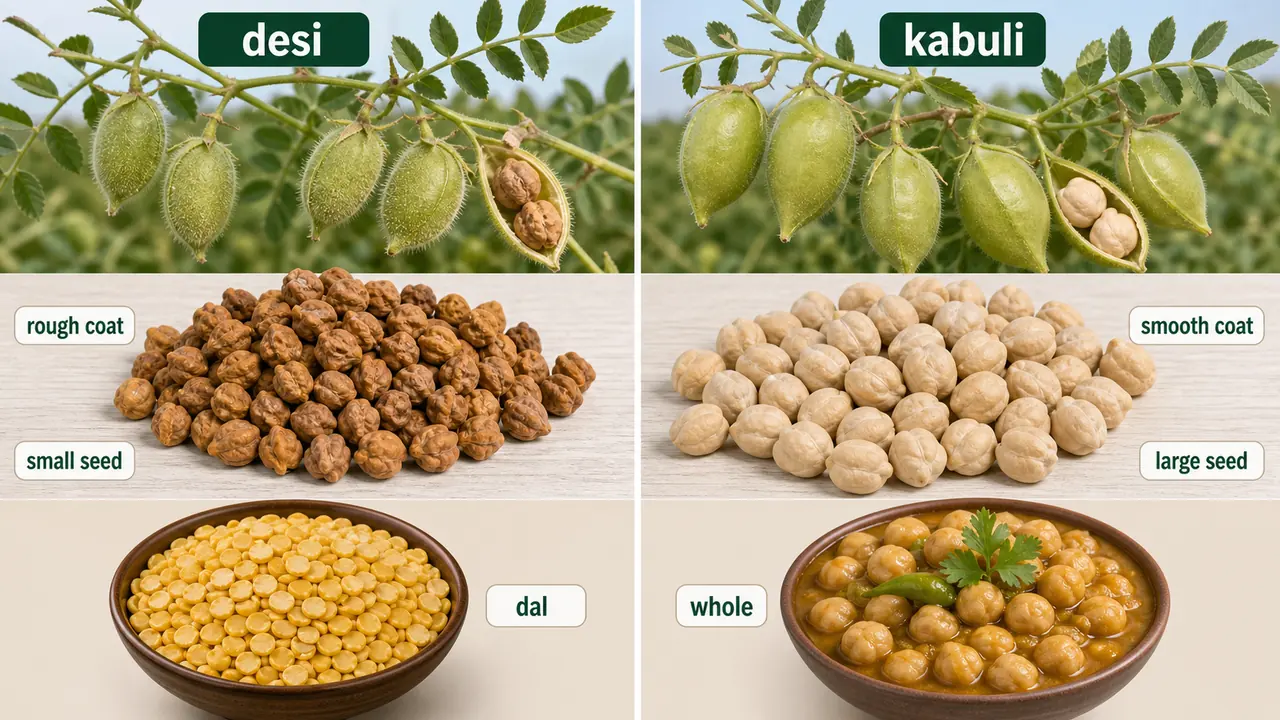
| Desi type | Cicer arietinum -- brown/dark, small seeds, rough coat. Most widely grown in India (80-85% of production). |
| Kabuli type | Cicer kabulium -- white/light, larger seeds, smoother coat. Higher market price, mainly exported. |
| Family | Papilionaceae (Leguminaceae) |
| Chromosome | 2n = 14/16 |
| Origin | South-West Asia (Afghanistan) |
| Also known as | Gram, Bengal gram |
| Title | King of Pulses (Queen = Pea) |
| Protein content | 22-23% |

- India is the largest producer, sharing 65% area and 70% of total global production. This dominance stems from the extensive Rabi dryland belts of central India where chickpea thrives on residual soil moisture.
- Chickpea constitutes the highest area among all pulses in India, followed by pigeonpea. Together these two crops account for over half of India's total pulse area.
- As a legume, chickpea fixes atmospheric nitrogen through Rhizobium bacteria in its root nodules, contributing approximately 20-50 kg N/ha and enriching soil for subsequent crops.
Leaf Chemistry -- Malic and Oxalic Acid

Chickpea has a unique leaf chemistry that distinguishes it from other pulses and is a favourite topic in MCQs. The acids secreted by the leaves also explain the crop's partial resistance to certain leaf-feeding insects.
- The sour taste of leaves and pods is due to Malic Acid (90-96%) and Oxalic Acid (4-10%), secreted by glandular hairs (trichomes) on the leaf surface. These acids create an acidic microenvironment that deters some herbivorous insects.
- Chickpea leaves are traditionally recommended for intestinal disorders because the acids have a mild laxative and digestive effect.
- Gram fruit is called a Pod -- each pod typically contains 1-2 seeds.
- Germination: Hypogeal -- cotyledons remain below soil, protecting seed reserves from bird damage and desiccation. This is the same germination type found in most major pulses (pigeonpea, lentil, pea).

Desi vs Kabuli -- Comparison
Understanding the Desi-Kabuli distinction is essential because exam questions frequently test specific differences in seed characteristics, geographical distribution, and end-use. The two types are sometimes classified as separate species.
| Feature | Desi | Kabuli |
|---|---|---|
| Seed size | Small | Large |
| Seed colour | Dark/brown | Light/white |
| Seed coat | Rough | Smooth |
| Global share | 80-85% of production | 15-20% |
| Main regions | Indian subcontinent, Ethiopia, Mexico | Southern Europe, N. Africa, Afghanistan |
| Fibre content | Higher | Lower |
| Glycemic index | Very low (suitable for diabetics) | Relatively higher |
| Primary use | Chana dal (split pulse) | Whole -- salads, soups, chole |
Climate
Chickpea is a cool-season pulse adapted to the Rabi environment. Its climatic requirements explain why Madhya Pradesh and Rajasthan dominate production -- these states offer the right combination of mild winters, low humidity, and residual soil moisture after the Kharif season.
| Parameter | Requirement |
|---|---|
| Season | Rabi (winter season crop) |
| Pollination | Self-pollinated |
| Photosynthetic pathway | C3 |
| Photoperiod | Long-day plant |
| Optimum temperature | 20-25 C |
| Water requirement | 350-450 mm (dryland/rainfed crop) |
| Frost sensitivity | Severe cold and frost at flowering damages seed development |
| Best soil | Light alluvial -- good drainage and aeration |
| Seedbed | Loose, well-aerated, and rough for root penetration and nodule formation |
- Can be grown as a sole crop or mixed with barley, lathyrus, linseed, mustard, peas, sorghum, or wheat.
- Also grown as a catch crop in sugarcane fields and as a second crop after rice (utilises residual moisture).
- Mixed cropping checks blight disease by breaking the monoculture cycle.
Seed and Sowing
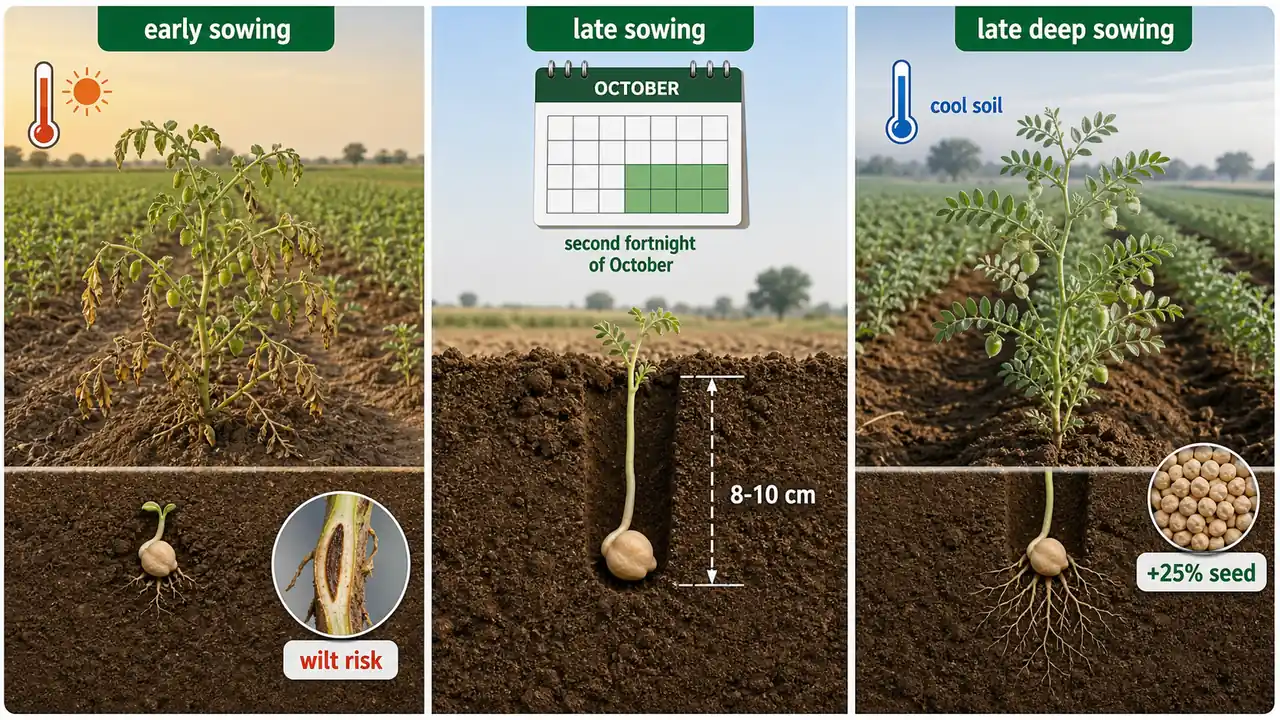
Correct sowing time and depth are critical in chickpea because they directly influence wilt incidence -- one of the most devastating diseases of this crop. Late planting and deeper sowing form the first line of defence against Fusarium wilt.
| Parameter | Value |
|---|---|
| Seed rate (early sown) | 75-80 kg/ha |
| Seed rate (late sown) | 80-100 kg/ha (+25% to compensate for reduced germination) |
| Sowing time | 2nd fortnight of October (15-20 October is optimum) |
| Spacing | 30 x 10 cm |
| Plant population | 3,33,333 plants/ha |
| Sowing depth | 8-10 cm (deeper sowing reduces wilt incidence) |
Wilt Management Through Late Planting
Late planting protects seedlings from wilt disease (Fusarium oxysporum f. sp. ciceri) because cooler soil temperatures are less favourable for the wilt fungus. In late planting, the seed rate is increased by 25%.
NOTE
Wilt management strategy: Late planting + deeper sowing (8-10 cm) + 25% higher seed rate. This three-pronged approach reduces wilt incidence while maintaining adequate plant population.
Fertiliser Management
As a legume with Rhizobium symbiosis, chickpea requires minimal nitrogen but responds strongly to phosphorus. The fertiliser strategy reflects this biology -- a small starter N dose plus heavy P application to support nodulation and energy transfer.
| Nutrient | Normal (kg/ha) | Rainfed (kg/ha) |
|---|---|---|
| N | 20 | 15 |
| P | 60 | 20 |
| K | 30 | 15 |
- Low nitrogen dose because chickpea fixes its own nitrogen through Rhizobium. A starter dose supports early growth before nodules become active.
- Phosphorus should be applied below or beside the seed -- it is critical for root development, nodule formation, and energy transfer.
- Critical stages for irrigation: Pre-flowering/late vegetative phase and Pod development.
Important Varieties
| Category / trait | Important varieties |
|---|---|
| Recently released from IARI | PDM-11, BG-2024 |
| Popular varieties released from ICAR | Pusa-209, DG-203 |
| Desi variety | JG-11, CO-3, RS-10, GCP-11 |
| Kabuli variety | Pusa-1003, K-551 |
| Early maturing and medium sized grain | Chaff chaff, JG-62 |
| Medium duration and high yielding | L-550, C-104, NP-58, RS-11, G-130 |
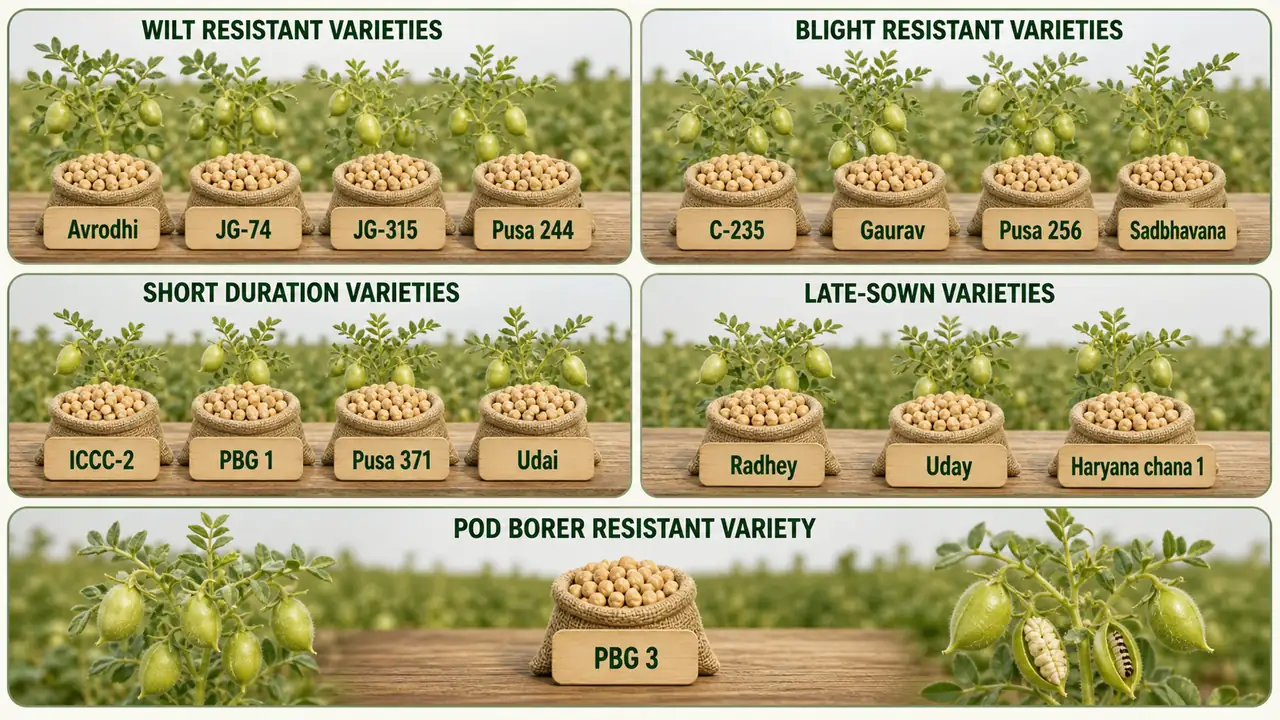
| Suitable variety for late sown | Radhey, Uday, Haryana chana 1 |
| Culinary purpose | C-104 |
| Both early and late planting | Mahamaya 2 |
| Rainfed condition | Vishal, Anubhav |
| Drought resistant (Most suitable) | NP-58 |
| Resistant to drought and wilt | G-24 |
| Resistant to blight | C-235, Gaurav, Pusa 256, Sadbhavana |
| Resistant to wilt | Awarodhi, JG-74, JG-315, BG-256 |
| Resistant to pod borer | PBG 3 |
Variety selection in chickpea is driven primarily by disease resistance (wilt and Ascochyta blight) and maturity duration. Exams frequently ask about specific wilt-resistant and blight-resistant varieties.
| Variety | Special Characteristics |
|---|---|
| Avrodhi, Pusa 244, Vishal, Vijay, JG 74, JG 315, Pusa 391, ICCC 32 | Wilt resistant |
| Pusa-256/BG 256 | Best for rainfed condition |
| C-235 | Widely adopted for dryland, tolerant to Ascochyta blight |
| Gaurav, GHG 146, GNG 469, PUSA 261 | Resistant to Ascochyta blight |
| RS-11 | Mutant variety, drought resistant |
| ICCC-2, PBG 1, PUSA 371, Udai | Short duration variety |
| Aparna | Green colour grains |
| PBG 3 | Pod borer resistant |
| RSG 44, RSG 896 | Double podded |
Root System and Nitrogen Fixation

The root architecture of chickpea is central to both its drought tolerance and its value as a soil-improving crop. Understanding the nitrogen fixation contribution helps explain why chickpea needs only a starter dose of nitrogen fertiliser.
- Central strong tap root with numerous lateral branches spreading in the upper soil layer -- this architecture enables efficient absorption from a wide soil volume and access to deeper moisture reserves.
- Numerous nodules on roots contain Rhizobium bacteria (Mesorhizobium ciceri) that fix atmospheric nitrogen, contributing approximately 20-50 kg N/ha and reducing the need for synthetic fertilisers. Nodules become active about 20-25 days after germination, which is why a starter N dose is applied at sowing.
Nipping / Topping -- A High-Frequency Exam Topic

Nipping is a unique agronomic practice almost exclusive to chickpea among field crops. It exploits the principle of apical dominance -- by removing the terminal bud, auxin redistribution triggers lateral bud growth, converting a tall, lanky plant into a bushy, high-yielding one.
| Aspect | Detail |
|---|---|
| What | Plucking the apical buds to stop apical growth |
| When | 45-60 DAS |
| Why | Redistributes auxins, stimulates lateral buds into productive branches |
| Effect | Reduces plant height, increases primary/secondary branches and pods per plant |
| Traditional method | Done by a flock of sheep grazing on terminal buds |
| Chemical method | TIBA @ 75 PPM (Tri-Iodo-Benzoic Acid) -- acts as an anti-auxin |
TIP
Nipping is a high-frequency exam topic. Remember: Done at 45-60 DAS, can be done by sheep grazing, or chemically with TIBA @ 75 PPM. Purpose: stop apical growth, increase branching and pod count.
Diseases and Pests
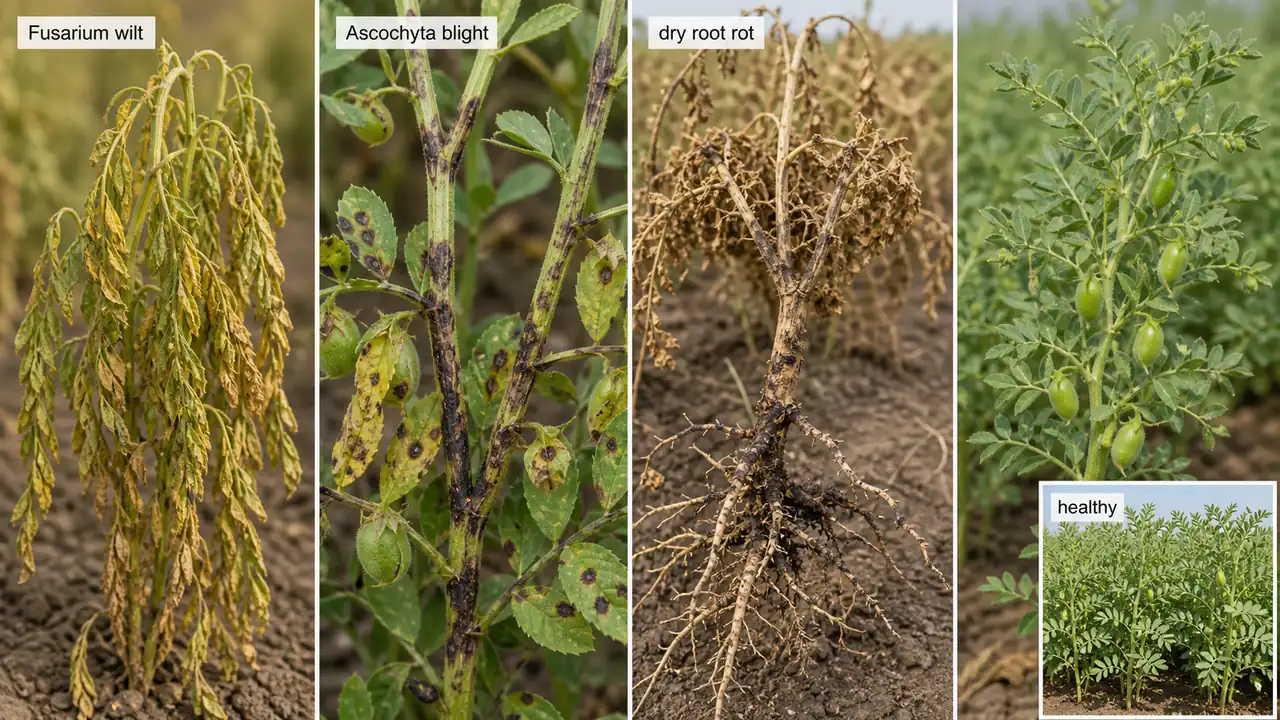
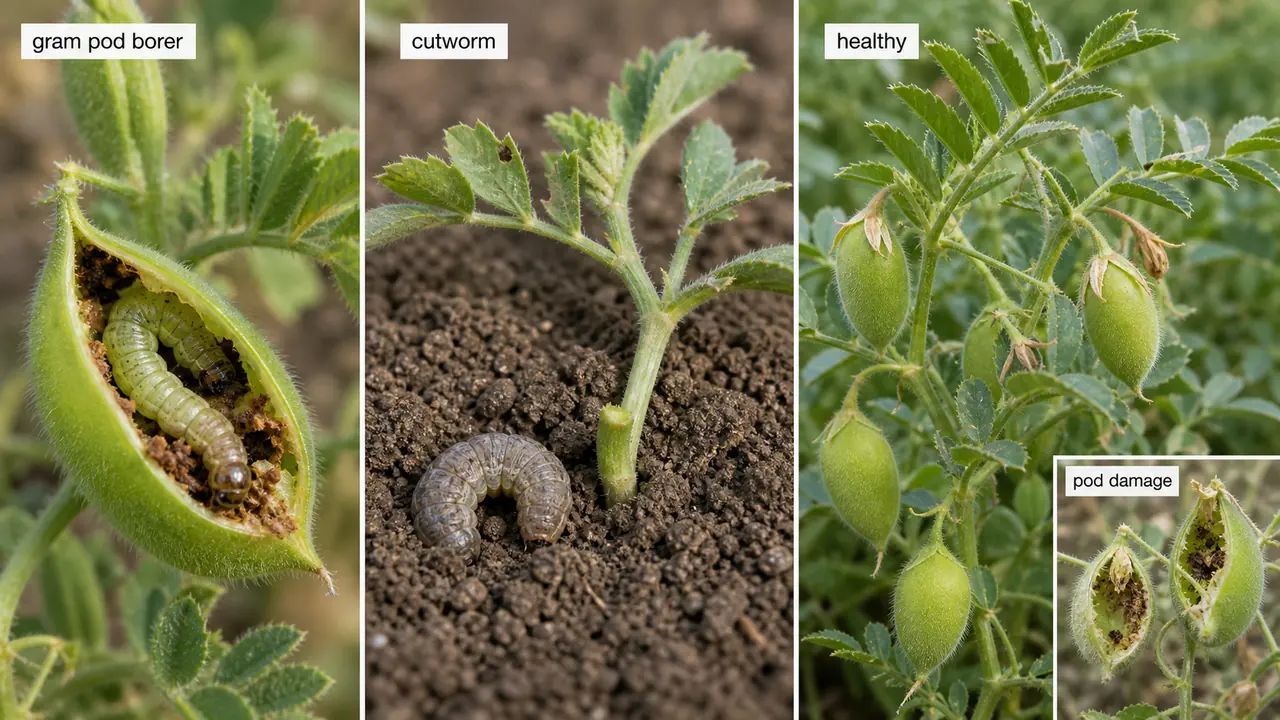
Chickpea faces several biotic stresses that exams test through variety-disease matching questions. The two most important diseases are Fusarium wilt and Ascochyta blight, while the major insect pest is the gram pod borer.
| Disease / Pest | Causal Agent | Key Facts |
|---|---|---|
| Fusarium Wilt | Fusarium oxysporum f. sp. ciceri | Most devastating disease; managed by late planting, deep sowing, and resistant varieties (Avrodhi, Pusa 244) |
| Ascochyta Blight | Ascochyta rabiei | Favoured by cool, humid weather; resistant varieties include C-235 and Gaurav |
| Dry Root Rot | Rhizoctonia bataticola | Increases under drought stress at pod-filling stage |
| Gram Pod Borer | Helicoverpa armigera | Most destructive insect pest; larvae bore into pods and feed on developing seeds, causing 20-30% yield loss |
| Cutworm | Agrotis ipsilon | Cuts seedlings at ground level, damaging early plant stand |
IMPORTANT
Wilt vs Blight varieties -- do not confuse: Avrodhi and Pusa 244 are wilt-resistant. C-235 and Gaurav are Ascochyta blight-resistant. Exams frequently swap these to create trap options.
Yield
Chickpea yields vary dramatically between rainfed and irrigated conditions because even 1-2 well-timed irrigations at the pre-flowering and pod development stages can double or triple grain output.
| Condition | Yield |
|---|---|
| Rainfed | 5-6 q/ha |
| Irrigated | 12-15 q/ha (2-3x with 1-2 well-timed irrigations) |
| Shelling % | 49% (about half the pod weight is grain) |
Summary Table -- Chickpea at a Glance
| Parameter | Value |
|---|---|
| Botanical name | Cicer arietinum (Desi), Cicer kabulium (Kabuli) |
| Family | Papilionaceae |
| Origin | South-West Asia (Afghanistan) |
| Chromosome | 2n = 14/16 |
| Title | King of Pulses |
| Protein | 22-23% |
| Pollination | Self-pollinated, long-day, C3 |
| Season | Rabi |
| Water requirement | 350-450 mm |
| Sowing depth | 8-10 cm (deep to avoid wilt) |
| Germination | Hypogeal |
| Nipping time | 45-60 DAS |
| Chemical for nipping | TIBA @ 75 PPM |
| Leaf acids | Malic acid 90-96%, Oxalic acid 4-10% |
| India's global share | 65% area, 70% production |
| World Pulses Day | February 10 |
| Shelling % | 49% |
| Best wilt-resistant variety | Avrodhi, Pusa 244 |
| Best dryland variety | C-235 |
Chickpea: Practical Cultivation Guide
Key decisions for maximizing chickpea yield:
| Decision | Recommendation | Why |
|---|---|---|
| Desi vs Kabuli? | Desi for rainfed (hardier, drought-tolerant); Kabuli for irrigated (higher market price but sensitive) | Kabuli fetches 30-50% higher price but needs 1-2 irrigations |
| Sowing depth | 8-10 cm deep (deeper than most crops) | Deep sowing avoids wilt (Fusarium); shallow sowing = high wilt incidence |
| Nipping? | Nip terminal buds at 45-60 DAS (or spray TIBA @ 75 ppm) | Promotes branching → more pods; critical in irrigated tall varieties |
| Irrigation? | Pre-sowing + one at pod-filling; avoid flowering-stage irrigation | Excess moisture at flowering causes flower drop; chickpea is drought-tolerant |
| Wilt management | Grow resistant varieties (Avrodhi, Pusa 244); deep sowing; seed treatment with Trichoderma | Wilt (Fusarium oxysporum f.sp. ciceri) is the #1 disease — can destroy entire crop |
Why chickpea matters for India: India produces 65% of global chickpea (area) and 70% (production). It is the most important pulse crop for protein security. As a legume, it fixes atmospheric nitrogen (~80-100 kg N/ha), improving soil fertility for the next crop in rotation.
Exam-critical concept: Chickpea secretes malic acid (90-96%) and oxalic acid (4-10%) from leaf glands. This acid secretion is linked to Helicoverpa pod borer attraction — higher acidity attracts more borers. This is why H. armigera is the most devastating pest of chickpea.
Exam One-Liners: Uses and Moisture Conservation
| Fact | Detail |
|---|---|
| Most important pulse globally | Dry bean (Phaseolus vulgaris), followed by field pea and chickpea. |
| Highest area and production in India | Chickpea, followed by pigeonpea and greengram. |
| Pulses as protein source | Pulses are the richest protein source among food grains. |
| Pulse N-fixation contribution | Pulses meet about 80-90% of their nitrogen requirement through biological N-fixation. |
| Starter N dose | Most pulses need only 15-25 kg N/ha, except French bean. |
| N added to soil | Pulse crops add about 15-35 kg N/ha to the soil for the following crop. |
| Traditional use | Chickpea is cited in exam notes for blood purification. |
| Germinated seed | Helps against scurvy because germination increases vitamin C. |
| KCl/MOP role | KCl is used to conserve moisture in chickpea; potassium improves stomatal regulation and drought tolerance. |
Summary Cheat Sheet
| Concept / Topic | Key Details |
|---|---|
| Botanical name | Cicer arietinum (Desi); Cicer kabulium (Kabuli) |
| Family | Papilionaceae (Leguminaceae) |
| Origin | South-West Asia (Afghanistan) |
| Chromosome | 2n = 14/16 |
| Title | King of Pulses (Queen = Pea) |
| Protein content | 22-23% |
| Pulse group facts | Dry bean is the most important pulse globally; pulses meet 80-90% N need by fixation and add 15-35 kg N/ha to soil |
| India's global share | 65% area, 70% production |
| Pollination | Self-pollinated; Long-day plant; C3 pathway |
| Season | Rabi (winter); water requirement 350-450 mm |
| Germination | Hypogeal — cotyledons remain below soil |
| Leaf acids | Malic acid 90-96%, Oxalic acid 4-10% (sour taste) |
| Nipping time | 45-60 DAS |
| Chemical nipping | TIBA @ 75 PPM (anti-auxin) |
| Traditional nipping | Flock of sheep grazing terminal buds |
| Sowing depth | 8-10 cm (deeper sowing reduces wilt) |
| Wilt management | Late planting + deep sowing + 25% higher seed rate |
| Wilt-resistant varieties | Avrodhi, Pusa 244 |
| Ascochyta blight resistant | C-235, Gaurav |
| Shelling % | 49% |
| N-fixation | 20-50 kg N/ha via Rhizobium |
| Exam uses | Blood purification; germinated seeds help against scurvy |
| KCl/MOP role | Used for moisture conservation through potassium-mediated stomatal regulation |
| World Pulses Day | February 10 |
TIP
Next: Lesson 2 covers Pigeonpea (Arhar/Tur) -- India's second most important pulse, the "mini fertiliser crop" with the lowest harvest index among pulses and the world's first pulse hybrid (ICPH-8).