🥜 Groundnut -- King of Oilseeds (Complete Production Guide)
Master groundnut cultivation from geocarpy to aflatoxin management -- varieties, bunch vs spreading types, irrigation, nutrient management, and exam-favourite facts for exams, NABARD, and IBPS exams.
Walk through the fields of Junagadh district in Gujarat during the Kharif season and you will see rows of low, bushy plants with bright yellow flowers. Beneath the soil surface, something remarkable is happening -- fertilised flowers are pushing their ovaries underground on stalk-like pegs to develop pods in the dark. This extraordinary process, called geocarpy, makes groundnut one of the most fascinating crops in agriculture. It also happens to be the single most important oilseed crop in India by area and production.
This lesson covers:
- Oil percentage ranking -- where groundnut stands among global and Indian oilseeds
- Botany and life cycle -- geocarpy, gynophore (peg), and the unique 7:4:1 ratio
- Agronomy -- climate, soil, sowing, irrigation, and nutrient management
- Varieties -- bunch vs spreading types, detailed classification
- Deficiency disorders and aflatoxin -- popping, hollow heart, and food safety
- Diseases and pests -- major threats and management
All sections are high-yield for exams, NABARD, and FCI exams.
Oil Percentage of Oilseed Crops

Oilseed crops vary widely in their oil content and global importance. Understanding production rankings and nutrient requirements sets the stage for crop-specific study.
| Parameter | Ranking |
|---|---|
| World (Production) | Soybean > Cotton Seed Oil > Rapeseed Oil > Groundnut > Sunflower |
| India (Production) | Soybean > Groundnut > Rape Seed and Mustard |
- Soybean dominates global oilseed production due to its dual utility -- it provides both oil and high-protein meal for animal feed.
- Generally, Sulphur and Phosphorus are required in higher amounts in oilseed crops than other crops. IBPS 2018 Sulphur is a key component of amino acids (methionine, cysteine) and is involved in oil synthesis, while phosphorus drives energy metabolism and seed development -- both directly influencing oil content and yield.
Basics

Groundnut belongs to the legume family and stands apart from other oilseeds due to its underground pod development and dual value as both an oilseed and a protein source.
| Feature | Detail |
|---|---|
| Botanical Name | Arachis hypogea |
| Family | Papilionaceae |
| Origin | Brazil (South America) |
| Chromosome No. | 2n = 40 |
| Oil Content | 45% in kernel |
| Protein | 26% in kernel |
| Nickname | King of Oilseed (Queen = Sesame) |
| Other Names | Peanut, Monkeynut, Earthnut, Mungfalli, Poor Man's Almonds |
- Arachis hypogea comes from two Greek words: Arachis = Legume, Hypogea = Below the ground. Together, the name literally translates to "legume that fruits below the ground", perfectly describing the crop's unique characteristic of geocarpic (underground fruit) development.
Two Botanical Types
- Arachis hypogea fastigiata (Bunch/Erect/Spanish type) -- Compact, erect growth habit with pods clustered close to the base, making harvest easier.
- Arachis hypogea procumbens (Spreading/Virginia runner type) -- Trailing branches that spread along the ground, generally producing larger pods and higher yields but requiring more space.
Global and National Standing
India leads the world in groundnut acreage but trails China in total production, a gap explained by differences in productivity and technology adoption.
| Parameter | Ranking |
|---|---|
| Area | India > China > Nigeria |
| Production | China (36%) > India (17%) > Nigeria |
| Productivity | USA (highest) |
| India -- Leading States | Gujarat > Tamil Nadu > Andhra Pradesh |
- Although India has the largest area under groundnut, China leads in production due to significantly higher productivity per hectare.
- The USA achieves the highest groundnut productivity through advanced mechanisation, improved varieties, and precision farming.
- Groundnut accounts for more than 30 per cent acreage and 40 per cent of total oilseed production of India.
Climate
Groundnut is a warm-season crop adapted to tropical climates. Its flexibility across all three Indian growing seasons makes it one of the most versatile oilseeds.
| Parameter | Requirement |
|---|---|
| Climate type | Tropical |
| Rainfall | 500-1000 mm |
| Temperature | 25-35°C |
| Seasons grown | All 3 (Kharif, Rabi, Summer) |
| Pollination | Self-pollinated |
| Photosynthetic pathway | C3 |
| Photoperiod | Short-day plant |
- Groundnut is a wide-spectrum adaptable crop grown in all 3 seasons, making it one of the most versatile oilseed crops.
- Flowering and seed setting are affected by cloudy weather, which reduces light intensity and photosynthesis.
- It resists drought and tolerates flooding for one week once established, due to its deep tap root system.
- Generally, groundnut grown during Rabi season gives higher yield compared to Kharif season due to fewer incidences of insects, pests, and diseases.
Soil
Light-textured soils are essential for groundnut because the peg must physically penetrate the soil to form pods underground.
- Groundnut thrives best in well-drained sandy and sandy loam soils, as light soil helps the gynophore (peg) to penetrate easily and pods to develop without breaking.
- Clay soil is strictly avoided because excess moisture causes pod rot, aflatoxin contamination, and makes harvesting difficult.
- Soil pH: 6.0-6.5
The Unique Groundnut Life Cycle -- Geocarpy
The most distinctive feature of groundnut is its underground pod development. Understanding this process -- from flowering to peg insertion to pod maturation -- is essential for both agronomy and exam preparation.

- Groundnut is a modified fruit. Unlike most legumes where pods develop above ground, groundnut pods develop underground -- a phenomenon called geocarpy.

- Fruit of groundnut is Nut and fruit type is Lomentum -- a type of legume fruit constricted between the seeds, giving the pod its characteristic segmented appearance.
The Peg (Gynophore)
- Gynophore of groundnut is known as Peg (intercalary meristem from fertilised flower).
- Geotropism: After fertilisation, the base of the ovary elongates into a stalk-like structure (gynophore) that bends downward and forces the ovary into the soil. After entering the soil, the ovary takes up a horizontal position and pods begin to enlarge. This process takes about 60-70 days from flowering to pod development.

Flowering and Reproduction
| Parameter | Detail |
|---|---|
| Flowering begins | 24 to 40 days after sowing |
| Pegs become viable | 5-7 days after flowering |
| Peg soil insertion | 2-10 days after peg formation |
| Inflorescence | Raceme |
| Flower : Pegs : Pods ratio | 7 : 4 : 1 |
| Germination type | Hypogeal |
- The low conversion ratio (7:4:1) is why groundnut plants produce a large number of flowers to ensure adequate pod set.
- Testa is the thin skin that covers the seed, containing tannins that give the characteristic red, pink, or brown colour to kernels.

Sowing and Seed Rate
Sowing time varies by season, and the seed rate differs between bunch and spreading types due to their contrasting growth habits and space requirements.
Sowing Time
| Season | Time |
|---|---|
| Kharif | 3rd week of June to 1st week of July |
| Rabi | November |
| Summer | Last week of Dec to end of January |
Seed Rate and Spacing
| Type | Seed Rate |
|---|---|
| Bunch type | 100-120 kg/ha (higher rate for compact growth) |
| Spreading type | 80-100 kg/ha |
- At the time of sowing, 0.1 per cent Ethrel + 3 gm Thiram is used for seed treatment to break seed dormancy. Ethrel releases ethylene (triggers germination), Thiram protects against soil-borne diseases.
Irrigation
Groundnut water needs vary dramatically by season -- Kharif relies on monsoon rainfall, while summer crops demand intensive irrigation. Moisture management during pegging and pod formation directly affects yield.
| Season | Irrigations Required |
|---|---|
| Kharif | No need (monsoon rainfall sufficient) |
| Rabi | 5-6 |
| Summer | 10-12 |
Critical Stages of Crop Growth
- Establishment (10-20 DAS)
- Vegetative phase (25-35 DAS)
- Flowering and peg initiation stage (35-50 DAS)
- Pod formation stage (50-75 DAS)
- Pod/Seed development stage (75-90 DAS)
Critical Stages for Irrigation
- Flowering stage -- water stress reduces the number of flowers and pegs.
- Pegging stage -- adequate soil moisture is essential for the peg to penetrate the soil.
- Pod formation stage -- moisture deficit leads to shrivelled pods and reduced yield.
- Check basin irrigation is the most suitable method for groundnut, ensuring uniform water distribution without waterlogging.
- IW/CPE ratio: 0.6 (moderate irrigation schedule).
Nutrient Management
Groundnut nutrient management centres on phosphorus for root and seed development and calcium for pod filling -- the latter being uniquely absorbed directly by the pod from surrounding soil.
- Application of 25 : 60 : 60 kg NPK/ha with 25 to 50 kg ZnSO4 and FeSO4 both give higher yield.
- Zinc and iron are important micronutrients that play key roles in enzyme activation and chlorophyll synthesis.
- Calcium (Ca) is essential for pod development -- calcium is directly absorbed by the developing pod from the surrounding soil. Deficiency leads to empty pods (pops) and dark, discoloured kernels.
IMPORTANT
Calcium must be available in the pod zone, not just the root zone. Unlike most nutrients, groundnut pods absorb calcium directly from the surrounding soil. Apply gypsum (CaSO4) at flowering/pegging stage in the pod-forming area.
- NAA @ 40 ppm enhances floral initiation and pod formation.
- During pod development stage, the field should be well drained, otherwise poor aeration causes aflatoxin formation.

Weed and Inter-culture Management

Weed control in groundnut requires careful timing because disturbing the soil during pegging can break tender gynophores and reduce pod set.
- Star weeder is used to control weeds in groundnut fields -- a manually operated implement with star-shaped rolling blades that uproot weeds between rows without damaging plants.
- Intercultural operations should be avoided during pegging stage as disturbing the soil can damage or break tender pegs.
- Earthing-up is done at 35 to 45 days after sowing to facilitate proper peg penetration and pod development.
Bunch Type vs Spreading Type

The two botanical types of groundnut differ in growth habit, pod distribution, yield potential, and harvesting ease. Exams frequently test these distinctions.
| Feature | Bunch Type | Spreading Type |
|---|---|---|
| Growth habit | Erect, compact | Trailing, spreading |
| Pod location | Clustered near base | Distributed along branches |
| Seed rate | 100-120 kg/ha | 80-100 kg/ha |
| Yield | 15-20 q/ha | 20-30 q/ha |
| Harvesting | Easier | More difficult |
| Duration | Shorter | Longer |

Cropping Systems
Groundnut is an excellent component in intercropping systems because it fixes atmospheric nitrogen and has a compact growth habit that complements taller crops. The most common groundnut-based intercropping systems are:
| System | Ratio |
|---|---|
| Groundnut + Pigeonpea | 4:1 |
| Groundnut + Castor | -- |
| Groundnut + Sunflower | -- |
| Groundnut + Urdbean | 4:1 |
| Groundnut + Til | 3:1 |
These systems maximise land use efficiency, provide risk diversification, and the legume component enriches soil with fixed nitrogen.
Yield and Post-Harvest
Post-harvest handling is critical in groundnut because improper drying leads to aflatoxin contamination, while the shelling percentage determines the commercial value of the crop.
| Parameter | Detail |
|---|---|
| Bunch Type yield | 15-20 q/ha |
| Spreading Type yield | 20-30 q/ha |
| N-fixing bacterium | Rhizobium japonicum |
| Safe storage moisture | 5 per cent |
| Shelling percentage | 70 per cent |
| Groundnut cake N content | 7-8% |
Nutrient Deficiency Disorders
Two deficiency disorders in groundnut are among the most frequently asked questions in agricultural exams. Both directly affect seed quality and are easy to confuse if not memorised clearly.
TIP
Exam favourites -- Groundnut deficiency disorders: These are asked very frequently. Remember the pair: Calcium = empty pods (Popping), Boron = hollow heart.
| Disorder | Cause |
|---|---|
| Popping (empty pods) | Calcium (Ca) deficiency |
| Hollow heart (in kernels) | Boron (B) deficiency |
- Broad Bed and Furrow (BBF) method developed by ICRISAT is recommended for groundnut cultivation -- improves drainage and reduces waterlogging.
- Maleic Hydrazide (MH) is used to break dormancy in freshly harvested groundnut seeds.
Aflatoxin -- A Critical Food Safety Concern

Aflatoxin contamination is the single most important food safety issue in groundnut. It arises from fungal infection during storage and directly affects export quality and human health.
-
Bitterness of kernel is due to Aflatoxin (toxic substance) caused by:
- Pod moisture content > 8 per cent
- Fungus Aspergillus niger and Aspergillus flavus exams 2021
-
Aspergillus flavus produces Aflatoxin B1, the most potent naturally occurring carcinogen.
-
Aflatoxin safe limit: 5-30 ppb (parts per billion)
WARNING
Aflatoxin is a potent carcinogen. Always dry groundnut pods to below 5% moisture before storage. Pod moisture above 8% combined with poor aeration creates ideal conditions for Aspergillus fungal growth and aflatoxin production.
Disease
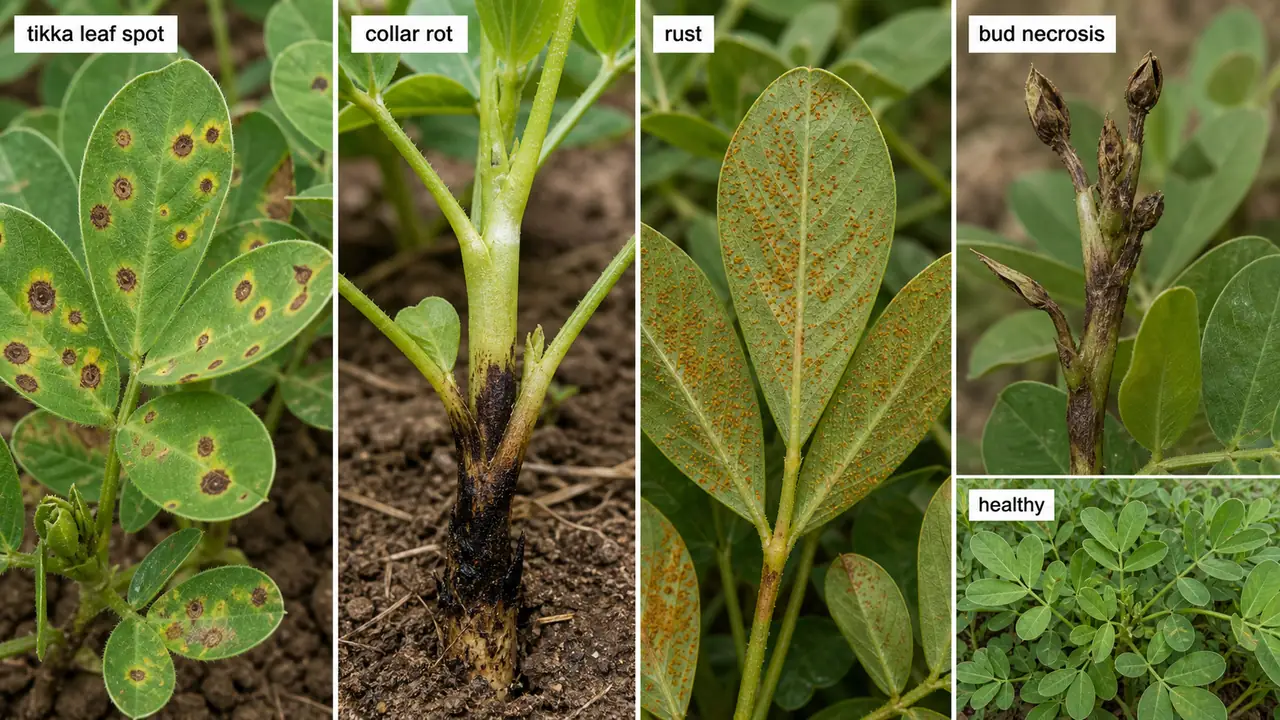
Groundnut is susceptible to several fungal and viral diseases that reduce both yield and seed quality.
- Tikka disease (Early and Late leaf spot) -- caused by Cercospora arachidicola (early) and Cercosporidium personatum (late). The most widespread foliar disease, causing circular brown spots on leaves and premature defoliation. Reduces photosynthesis and pod filling.
- Collar rot -- caused by Aspergillus niger. Attacks seedlings at the collar region, causing blackening and death within 2-3 weeks of sowing. Seed treatment with Thiram helps prevent it.
- Stem rot -- caused by Sclerotium rolfsii. White fungal mat at the base of the stem; favoured by high soil moisture and temperature.
- Rust -- caused by Puccinia arachidis. Orange-brown pustules on the lower leaf surface; severe in humid conditions.
- Bud necrosis -- caused by Groundnut Bud Necrosis Virus (GBNV), transmitted by thrips (Thrips palmi). Necrosis of terminal buds and axillary shoots.
Insect-Pest
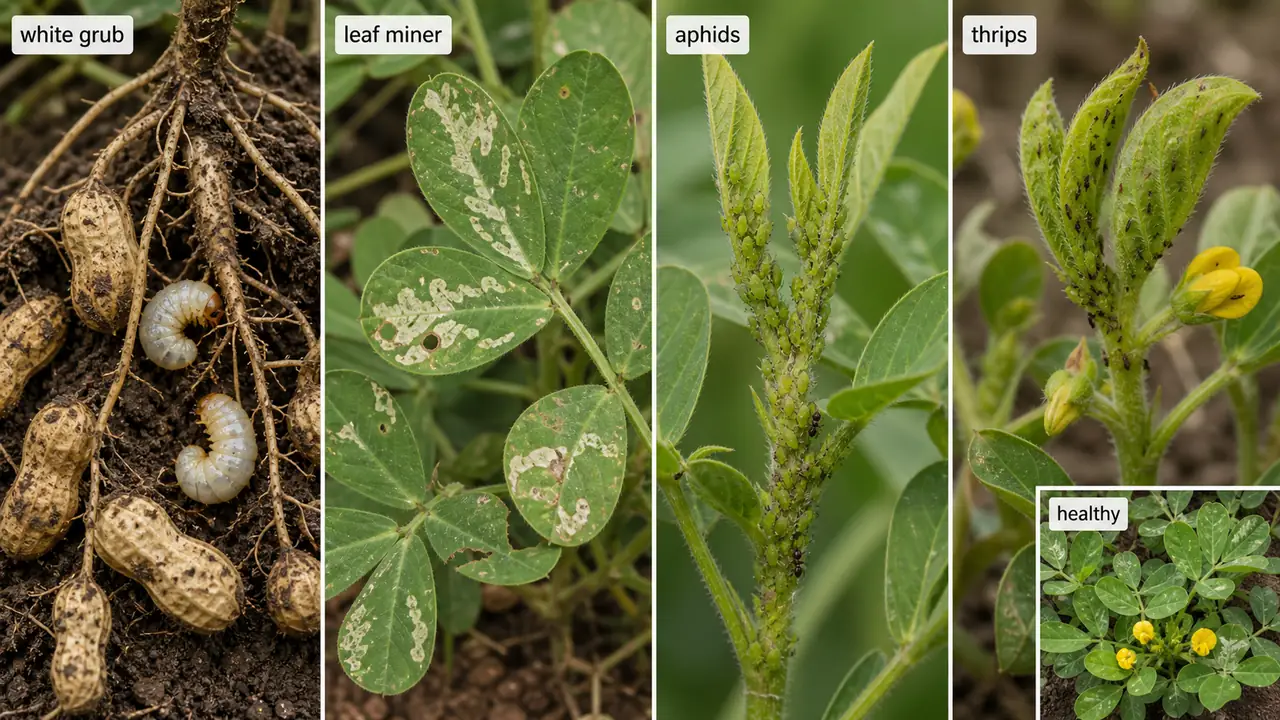
Major insect pests of groundnut cause damage from seedling stage through pod development.
- White grub (Holotrichia spp.) -- the most destructive soil pest; larvae feed on roots and developing pods underground, causing severe yield loss in sandy soils.
- Leaf miner (Aproaerema modicella) -- larvae mine between the upper and lower leaf epidermis, creating brown blotch-like mines that reduce photosynthetic area.
- Aphids (Aphis craccivora) -- suck cell sap from tender shoots; also act as vectors for Groundnut Rosette Virus.
- Thrips (Thrips palmi) -- feed on young leaves and flowers; vector of Bud Necrosis Virus (GBNV).
- Red hairy caterpillar (Amsacta spp.) -- defoliator that appears in large numbers during early Kharif season.
Detailed Variety Classification
Variety identification is a frequent topic in exams. The key distinction is between bunch (erect/Spanish) and spreading (Virginia/runner) types.
| Type | Varieties |
|---|---|
| Bunch type | Jyoti, Kaushal (G201), Chitra, AK 12-24, JL24, Kisan, Girnar, Improved Small Japan, RG 141, ICGS 76, GAUG 1, TMV 2, 7, 9, RS 138, Mallika |
| Spreading type | RS 1, M 13, Chandra, Somnath, GAUG 10, TMV 1, 3, M 145, Utkarsh, GG 11, GG 16 |
| Semi-spreading | AK-10, CG-20 |
Quick Revision Summary
| Parameter | Detail |
|---|---|
| Botanical Name | Arachis hypogea |
| Family | Papilionaceae |
| Origin | Brazil |
| Oil / Protein | 45% / 26% |
| Nickname | King of Oilseeds |
| Unique feature | Geocarpy (underground fruiting) |
| Peg = Gynophore | Pushes ovary into soil |
| Flower:Peg:Pod | 7:4:1 |
| Ca deficiency | Popping (empty pods) |
| B deficiency | Hollow heart |
| Aflatoxin fungi | A. flavus, A. niger |
| Safe storage moisture | 5% |
| Shelling % | 70% (pod → kernel) |
| Oil recovery | 40% of kernel; 28% of pod |
| Leading state | Gujarat |
| BBF method by | ICRISAT |
| Key disease | Tikka (leaf spot) -- Cercospora spp. |
| Key pest | White grub, Leaf miner |
TIP
Next: The next lesson covers Soybean -- the "Wonder Crop" with 40% protein and 20% oil, the reverse of most oilseeds.
Groundnut: Practical Decision Guide
Understanding geocarpy — why it matters for cultivation:
Groundnut is geocarpic — after above-ground flowering, the fertilized ovary develops into a peg that grows downward and penetrates the soil, where the pod develops underground. This unique biology creates specific agronomic requirements:
| Because Of Geocarpy... | You Must... | If You Don't... |
|---|---|---|
| Pegs must penetrate soil | Keep soil loose and well-tilled at pegging stage | Hard soil = pegs can't enter = no pods |
| Pods develop underground | Apply gypsum (calcium source) at pegging (500 kg/ha) | Poor pod filling; high unfilled pods |
| Pods in contact with soil fungi | Maintain safe moisture at harvest (must dry to 5%) | Aflatoxin contamination (A. flavus) — makes crop unmarketable |
| Harvesting pulls pods from soil | Harvest at 75% pod maturity (shells show dark inner markings) | Over-mature pods break off and stay in soil → yield loss |
Bunch vs Spreading types — which to grow?
| Type | Growth Habit | Duration | Where Grown | Oil % |
|---|---|---|---|---|
| Bunch (var. vulgaris) | Erect, compact | 100-110 days | Irrigated, Rabi season | 45-48% |
| Semi-spreading (var. fastigiata) | Intermediate | 110-120 days | Both irrigated and rainfed | 44-46% |
| Spreading (var. hypogaea) | Prostrate, spreading | 130-150 days | Rainfed, Kharif season | 42-45% |
Key fact for exams: Gujarat is #1 in groundnut (produces ~40% of India's crop). ICRISAT developed the BBF (Broad Bed Furrow) method specifically for groundnut to improve drainage and reduce aflatoxin risk in heavy soils.
Exam One-Liners: Nutrition, Cake and Test Weight
| Fact | Detail |
|---|---|
| Cover crop role | Groundnut is an effective cover crop; its spreading canopy protects soil from erosion. |
| Caloric value | 5.8 calories/g, higher than sugar (4 cal/g) and wheat (3.5 cal/g). |
| Groundnut cake nitrogen | 7.2-7.3% N, the highest among edible oil cakes. |
| Test weight | 250-350 g, much higher than small-seeded oilseeds. |
Summary Cheat Sheet
| Concept / Topic | Key Details / Explanation |
|---|---|
| Botanical name | Arachis hypogea; Family Papilionaceae; Chromosome 2n = 40 |
| Origin | Brazil (South America) |
| Title | King of Oilseeds (Queen = Sesame) |
| Other names | Peanut, Monkeynut, Earthnut, Poor Man's Almonds |
| Oil / Protein | 45% oil / 26% protein in kernel |
| Caloric value | 5.8 calories/g |
| Cake nitrogen | 7.2-7.3% N, highest among edible oil cakes |
| Test weight | 250-350 g |
| Global standing | Area: India > China > Nigeria; Production: China (36%) > India (17%); Productivity: USA |
| India leading state | Gujarat > Tamil Nadu > Andhra Pradesh |
| Oilseed world rank | World production: Soybean > Cottonseed > Rapeseed > Groundnut > Sunflower |
| Climate | Tropical; rainfall 500-1000 mm; temp 25-35°C; grown in all 3 seasons |
| Pollination | Self-pollinated; Short-day; C3 |
| Geocarpy | Pods develop underground — uniquely underground fruiting |
| Gynophore (Peg) | Fertilised ovary pushes into soil via stalk-like peg; takes 60-70 days to pod |
| Inflorescence | Raceme; Fruit = Nut (Lomentum type) |
| Flower : Peg : Pod ratio | 7 : 4 : 1 |
| Germination | Hypogeal |
| Soil | Well-drained sandy / sandy loam; pH 6.0-6.5; clay avoided (pod rot) |
| Seed rate (bunch type) | 100-120 kg/ha |
| Seed rate (spreading type) | 80-100 kg/ha |
| Earthing-up | Done at 35-45 DAS to facilitate peg penetration |
| Ca deficiency | Popping — empty pods |
| B deficiency | Hollow heart — in kernels |
| Aflatoxin | Caused by Aspergillus flavus & A. niger; safe limit 5-30 ppb; pod moisture must be < 5% |
| Shelling % | 70% |
| Safe storage moisture | 5% |
| Yield (bunch) | 15-20 q/ha; spreading: 20-30 q/ha |
| BBF method | Broad Bed and Furrow — developed by ICRISAT |
| Key disease | Tikka (leaf spot) — Cercospora arachidicola |
| Key pest | White grub (Holotrichia spp.) |
| N-fixing bacterium | Rhizobium japonicum |
| Bunch varieties | Jyoti, Kaushal, JL24, TMV 2 |
| Spreading varieties | RS 1, Chandra, Somnath |