👕 Cotton -- White Gold and King of Fibre Crops (Complete Guide)
Master cotton cultivation from Gossypium species to Bt technology -- ginning, fibre quality, Bollgard, delinting, varieties, and exam-critical facts for exams, NABARD, and IBPS exams.
Travel to the black-soil heartland of Gujarat -- where cotton fields stretch to the horizon -- and you witness a crop that has shaped global trade for centuries. Cotton is the backbone of the textile industry, meeting 45% of the world's fibre needs. India, the original home of cotton domestication (with evidence from the Indus Valley Civilisation over 5,000 years ago), now leads the world in production. The introduction of Bt cotton in 2002 transformed Indian cotton farming, taking coverage to 90% of the cotton area. For exams, questions about Gossypium species, ginning percentage, H-4 hybrid, Bollgard, and delinting are perennial favourites.
This lesson covers:
- Basics and species -- four Gossypium species and their fibre characteristics
- Climate, soil, and planting -- black soil advantage, sowing windows, and UNR spacing
- Fibre science -- ginning, delinting, lint index, and the 170 kg bale
- Bt cotton -- India's only GM crop, Bollgard genes, and GEAC approval
- Varieties, diseases, and yield -- landmark hybrids H-4 and Varalaxmi
All sections are high-yield for exams, NABARD, and FCI exams.
Pro Content Locked
Upgrade to Pro to access this lesson and all other premium content.
Pay once for one year · Effective ₹99/mo
- All Agriculture & Banking Courses
- AI Lesson Questions (100/day)
- AI Doubt Solver (50/day)
- Glows & Grows Feedback (30/day)
- AI Section Quiz (20/day)
- 22-Language Translation (100/day)
- Recall Questions (20/day)
- AI Quiz (15/day)
- AI Quiz Paper Analysis (100/day)
- AI Step-by-Step Explanations (100/day)
- Spaced Repetition Recall (FSRS)
- AI Tutor
- Immersive Text Questions
- Audio Lessons — Hindi & English
- Mock Tests & Previous Year Papers
- Summary & Mind Maps
- XP, Levels, Leaderboard & Badges
- Generate New Classrooms
- Voice AI Teacher (AgriDots Live)
- AI Revision Assistant
- Knowledge Gap Analysis
- Interactive Revision (LangGraph)
🔒 Secure one-time yearly payment via Razorpay · No hidden fees
Travel to the black-soil heartland of Gujarat -- where cotton fields stretch to the horizon -- and you witness a crop that has shaped global trade for centuries. Cotton is the backbone of the textile industry, meeting 45% of the world's fibre needs. India, the original home of cotton domestication (with evidence from the Indus Valley Civilisation over 5,000 years ago), now leads the world in production. The introduction of Bt cotton in 2002 transformed Indian cotton farming, taking coverage to 90% of the cotton area. For exams, questions about Gossypium species, ginning percentage, H-4 hybrid, Bollgard, and delinting are perennial favourites.
This lesson covers:
- Basics and species -- four Gossypium species and their fibre characteristics
- Climate, soil, and planting -- black soil advantage, sowing windows, and UNR spacing
- Fibre science -- ginning, delinting, lint index, and the 170 kg bale
- Bt cotton -- India's only GM crop, Bollgard genes, and GEAC approval
- Varieties, diseases, and yield -- landmark hybrids H-4 and Varalaxmi
All sections are high-yield for exams, NABARD, and FCI exams.
Basics

Cotton is classified under the family Malvaceae and is a day-neutral plant, meaning it flowers irrespective of day length. India is both the birthplace of cotton cultivation and the current global leader in production.
| Feature | Detail |
|---|---|
| Botanical Name | Gossypium spp. |
| Family | Malvaceae |
| Origin | India |
| Nickname | White Gold of America / King of Fibre Crops |
| Share of world fibre | 45% |
| Photoperiod | Day Neutral plant |
| World Cotton Day | 7th October |

Global and National Standing
India overtook China to become the world's largest cotton producer, largely driven by the adoption of Bt cotton hybrids. Within India, the western and southern Deccan states dominate production due to their extensive black soil belts.
| Parameter | Ranking |
|---|---|
| World (Production) | India > China > USA |
| India (Production) | Gujarat > Maharashtra > Telangana |
- Gujarat alone contributes approximately one-third of India's total cotton production due to widespread adoption of Bt cotton hybrids and favourable black soil conditions.
Cotton Species
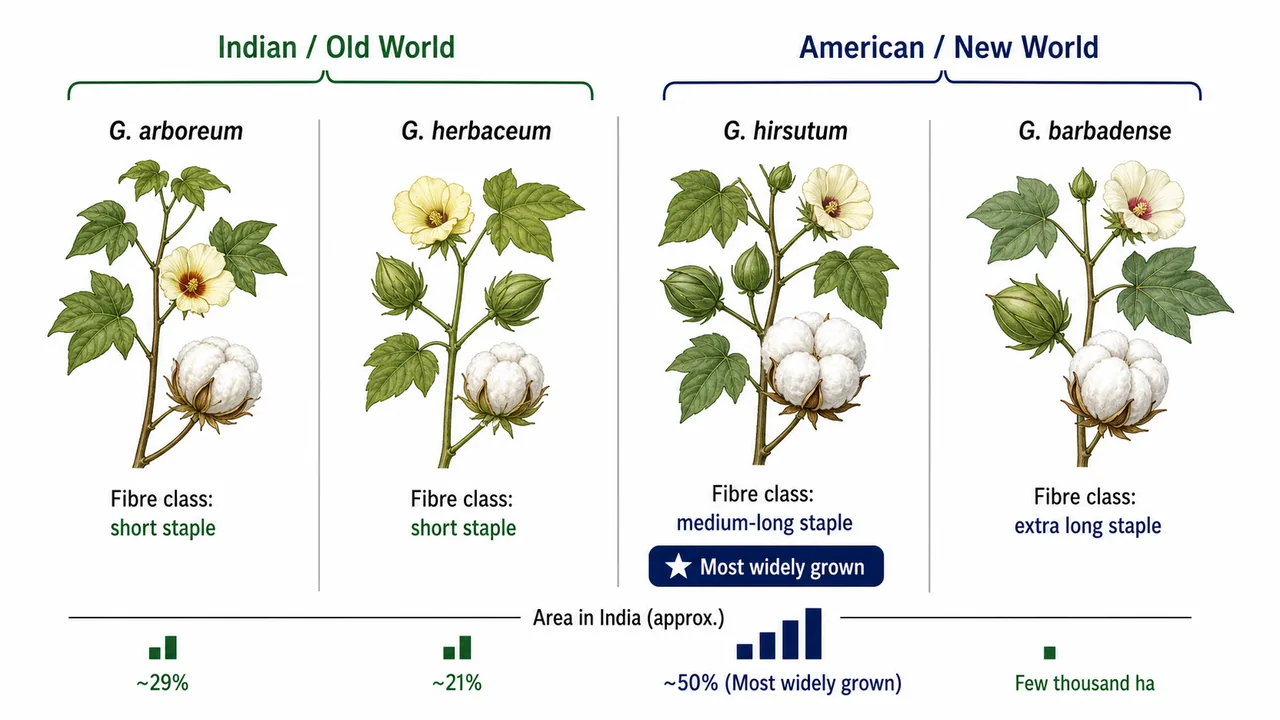
Four species of Gossypium are commercially cultivated worldwide. The two Indian (Desi) species produce shorter fibres but have higher ginning percentage, while the two New World species produce longer, finer fibres preferred by the textile industry.
| Species | Type | Key Feature |
|---|---|---|
| G. arboreum | Indian (Desi) | Short staple, higher ginning % |
| G. herbaceum | Indian (Desi) | Short staple, higher ginning % |
| G. hirsutum | American (Upland) | Medium-long staple, most widely grown |
| G. barbadense | Sea Island / Egyptian | Longest and finest fibres (>32 mm), Extra Long Staple (ELS) |
- G. barbadense (Sea Island Cotton) produces the finest fibres, prized for luxury textiles.
Indian vs American Cotton

The key distinction between Indian (Desi) and American (Upland) cotton lies in fibre length and ginning percentage. Indian species (G. arboreum, G. herbaceum) produce short-staple fibre (<22 mm) with higher ginning percentage (36-42%), while American upland cotton (G. hirsutum) produces medium-long staple fibre (25-30 mm) with lower ginning percentage (28-32%). Indian textile mills increasingly demand longer staple for finer fabrics, which is why G. hirsutum now covers over 90% of India's cotton area.
Varieties of Cotton
| Category | Important varieties / hybrids |
|---|---|
| Desi / Indian / Old World | G-777, Digvijay |
| Inter-specific | Varalaxmi, DCH-32 (hybrid), HB-224, DHB-105 |
| Intra-specific | H-4, 6, Savita, Surya (hybrid), JKHY-1 |
| Egyptian cotton | Sujata, Savin (non-hybrid) |
| American cotton | MCU-4, MCU-5, MCU-8, MCU-9 |
| Varieties with MSP fixed by government | H4, H-777, F-414 |
India has a rich history of cotton breeding, producing both the world's first commercial cotton hybrid and the first interspecific hybrid. Varieties are chosen based on fibre length, ginning percentage, and disease resistance.
Landmark Hybrids
- Two years after the release of H4 (the world's first commercial cotton hybrid), the first interspecific hybrid between G. hirsutum and G. barbadense was released as Varalaxmi from the Cotton Research Station, Bangalore.
| Hybrid | Parents | Significance |
|---|---|---|
| H-4 | G-67 x American Nectarless | 1st commercial cotton hybrid; developed by Dr. C.T. Patel |
| Varalaxmi | Laxmi x SB-289E | 1st interspecific hybrid (hirsutum x barbadense) |
Climate
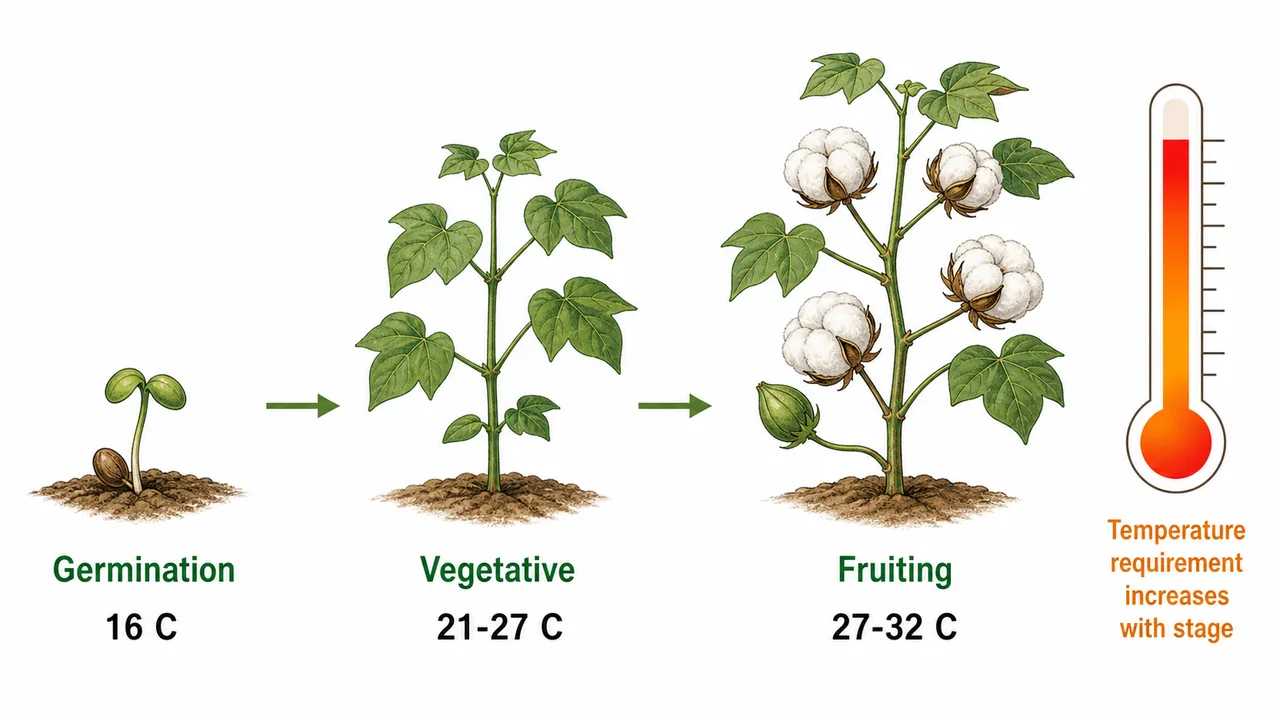
Cotton is a warm-season crop that thrives in hot, sunny conditions with moderate rainfall. Each growth phase has distinct temperature requirements, and water stress or excess rain at the wrong stage can devastate yields.
| Parameter | Requirement |
|---|---|
| Climate | Warm season crop |
| Rainfall | 500-700 mm |
| Germination temp | 16°C |
| Vegetative growth temp | 21-27°C |
| Fruiting phase temp | 27-32°C |
| Photoperiod | Day Neutral |
- Critical stages for irrigation: Flowering and Boll formation -- water stress during these stages causes flower and boll shedding, directly reducing lint yield.

- Abundant sunshine during boll maturation and harvesting is essential because UV light promotes fibre drying and prevents fungal contamination of open bolls.
- Heavy rain during fruiting causes shedding of flowers and young bolls because excess moisture disrupts pollination and triggers abscission.
Soil
Cotton grows best in deep, moisture-retentive soils. The association between cotton and black soil is so strong that Vertisols are commonly called "black cotton soil" in India.
- Black cotton soil (Regur/Vertisol) is best -- excellent moisture-retention capacity due to high clay content and the swelling mineral montmorillonite, which holds water in its crystal lattice and releases it slowly during dry spells.

- Not suitable: sandy, saline, and waterlogged soils -- sandy soils cannot retain enough moisture for the long crop duration, while waterlogging causes root rot.
- Tap root system (depth > 1.6 m) makes it relatively drought-tolerant by accessing deeper soil moisture reserves.
Plant Architecture

Understanding cotton branching is essential because the two branch types serve entirely different functions -- one produces bolls (yield) and the other supports canopy structure.
| Branch Type | Function |
|---|---|
| Sympodial | Reproductive branches (bear flowers and bolls) |
| Monopodial | Vegetative branches (non-fruiting, give rise to sympodial branches) |
- Squaring (flower bud appearance) occurs 35-70 DAS. Peak flowering: 70-100 DAS.
Seed Rate and Sowing
| Type | Seed rate | Spacing | Population |
|---|---|---|---|
| Bt Cotton | 1-1.5 kg/ha | 100 x 100 cm | 10,000 plants/ha |
| Hybrid | 2-3 kg/ha | 100 x 60 cm | 67,000 plants/ha |
| American Cotton | 15-20 kg/ha | 60 x 30 cm | 55,600 plants/ha |
| Desi Cotton | 10-12 kg/ha | 60 x 15 cm | 1,11,111 plants/ha |
Seed rate and spacing vary significantly between conventional and ultra-narrow row (UNR) systems. The sowing window depends on the onset of monsoon in each region.
| Parameter | Detail |
|---|---|
| Ultra Narrow Row (UNR) spacing | 19 x 19 cm (2,77,000 plants/ha) -- developed by USA |
| Germination | Epigeal |
| Seed depth | 3 cm (Dibbling) |
| Choulfi method | Square planting in Maharashtra and Malwa (Madhya Pradesh) |


Sowing Time
| Region | Time |
|---|---|
| North India | 1st fortnight of May |
| Central India | Last week of June to 1st week of July |
| Tamil Nadu | Sept - Oct |
Nutrient Management and Topping
| Input | Recommended dose |
|---|---|
| FYM | 15-20 tonnes/ha |
| N | 40-60 kg/ha |
| P2O5 | 30 kg/ha |
| K2O | 30 kg/ha |
Cotton requires balanced nutrition for both vegetative growth and boll development. Topping is a key cultural practice that redirects plant energy toward boll filling.
- Topping: Removal of terminal growing point at a height of 1.2 m (80-90 DAS) to encourage sympodial branching and redirect photosynthates from vertical growth to boll filling.
Fibre and Seed -- Key Concepts
This section covers the critical terminology around cotton fibre that appears in virtually every exams. Cotton fibres develop from the outermost cells of the seed-coat. Each fibre is a single elongated cell from the epidermis of the seed -- making cotton a unique seed fibre (unlike jute or flax which are bast fibres).
| Term | Meaning |
|---|---|
| Cotton seed | Only seeds (no fibre) |
| Seed cotton | Seeds with lint attached |
| Ginning | Separation of fibre from seed cotton |
| Delinting | Removal of short fuzz (linters) from seed using H2SO4 |

Ginning Percentage
| Species | Ginning % |
|---|---|
| G. hirsutum (American) | 28-32% |
| G. arboreum & G. herbaceum (Indian) | 36-42% |
- Ginning % = (Wt. of lint / Wt. of Seed Cotton) x 100
- Lint Index = (Weight of 100 cotton seeds / 100) x Ginning %
- Indian species have higher ginning percentage but produce shorter, coarser fibres.
Delinting and Measurement

- Arealometer measures length of cotton fibre and judges maturity by measuring air permeability.
- 170 kg cotton = 1 bale (standard Indian trade unit, as defined by the Cotton Corporation of India).

Cotton Seed Products
| Product | Detail |
|---|---|
| Oil content (Desi) | 14.6-25.6% |
| Oil content (American) | 14-18% |
| Cake NPK | 6.5% N, 3% P2O5, 2% K2O |
Bt Cotton -- India's Only GM Crop

Bt cotton is the single most transformative technology in Indian cotton farming. It introduced a gene from the soil bacterium Bacillus thuringiensis that produces a crystal protein toxic to bollworm larvae, dramatically reducing pesticide use.
| Feature | Detail |
|---|---|
| Approved by | GEAC (Genetic Engineering Appraisal Committee) |
| Approval date | March 2002 |
| Developed by | Monsanto (registered as Bollgard) |
| Resistant against | Helicoverpa (Spotted bollworm) |
| Gene | Bt gene from Bacillus thuringiensis produces Cry1Ac protein |
| Bt-Cotton in India pioneer | Dr. C.D. Mayee |
| Bt cotton area | 90 per cent of total 12.44 million ha (2017-18) |
IMPORTANT
Bt cotton is the ONLY GM crop approved for commercial cultivation in India (approved by GEAC in March 2002). It covers ~90% of India's cotton area. No other GM food or fibre crop has been approved.
| Bt Version | Gene(s) |
|---|---|
| Bollgard 1 | Cry 1 Ac |
| Bollgard 2 | Cry 1 Ac + Cry 2 Ab |
Disease and Pest
Cotton is susceptible to several diseases and insect pests that can cause significant yield losses. Bt cotton has dramatically reduced bollworm damage, but sucking pests have emerged as a growing concern.
Major Diseases
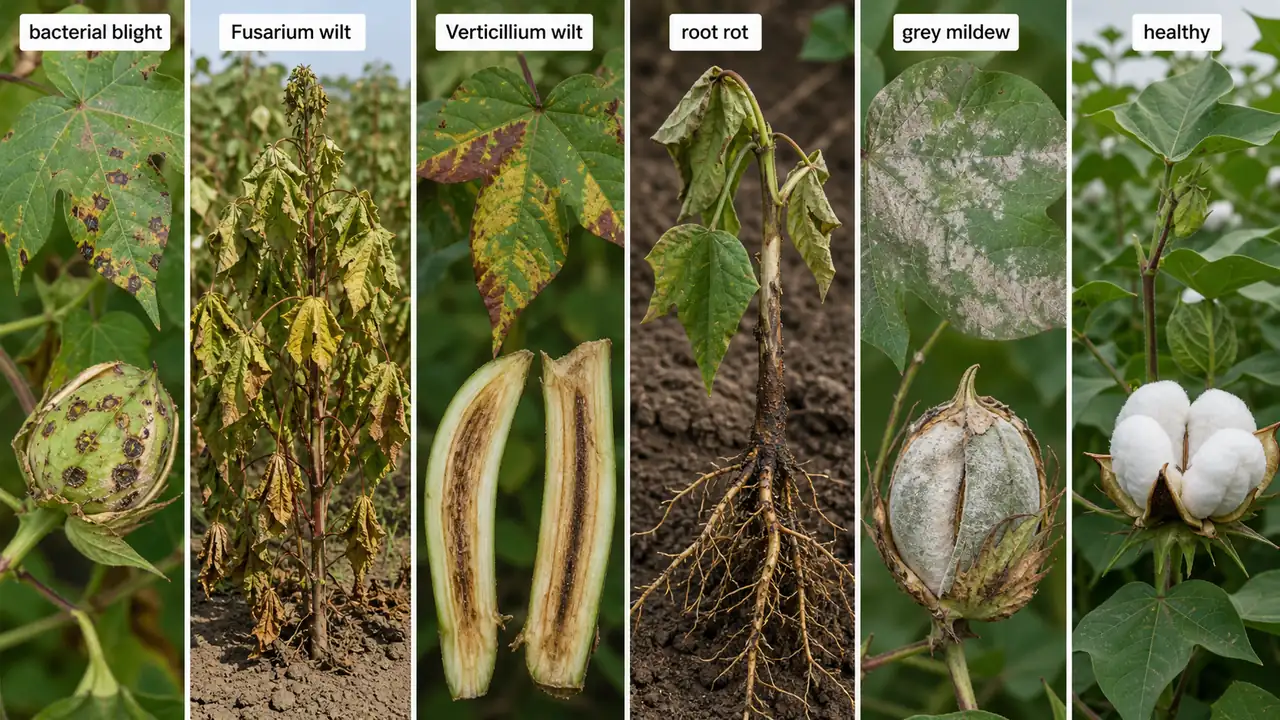
| Disease | Pathogen | Key Feature |
|---|---|---|
| Bacterial blight | Xanthomonas citri pv. malvacearum | Angular leaf spots, boll rot -- most widespread cotton disease |
| Fusarium wilt | Fusarium oxysporum f.sp. vasinfectum | Vascular wilting, yellowing of leaves |
| Verticillium wilt | Verticillium dahliae | Leaf mottling, vascular browning |
| Root rot | Rhizoctonia solani | Seedling mortality, damping off |
| Grey mildew | Ramularia areola | White powdery patches on leaves |
Insect Pests
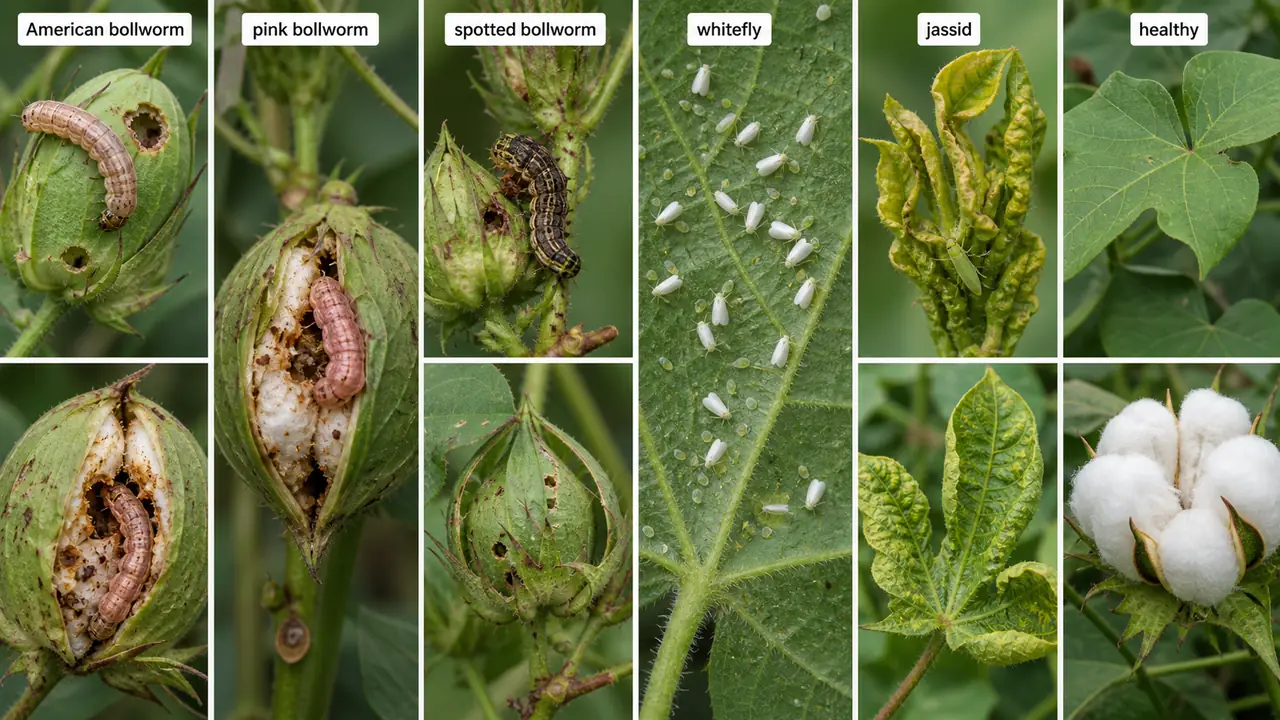
| Pest | Damage |
|---|---|
| American bollworm (Helicoverpa armigera) | Most destructive -- feeds on squares, flowers, and bolls (Bt cotton targets this pest) |
| Pink bollworm (Pectinophora gossypiella) | Larvae bore into bolls, damage lint and seeds |
| Spotted bollworm (Earias vittella) | Shoot and boll boring |
| Whitefly (Bemisia tabaci) | Sap sucking, transmits Cotton Leaf Curl Virus (CLCuV) |
| Jassid (Amrasca biguttula) | Sap sucking, leaf curling |
| Aphid (Aphis gossypii) | Sap sucking, honeydew secretion, sooty mould |
| Mealybug | Sap sucking, white waxy coating on stems |
IMPORTANT
Bt cotton and bollworm: Bt cotton (Cry1Ac + Cry2Ab proteins) is effective against American bollworm (Helicoverpa) and spotted bollworm (Earias). However, it does NOT control sucking pests (whitefly, jassid, aphid) -- these require separate IPM strategies.
Yield
| Type | Yield |
|---|---|
| Common | 15-20 q/ha |
| Hybrid | 25-30 q/ha |
The yield difference is due to heterosis (hybrid vigour) -- hybrid plants exhibit superior boll number, boll weight, and fibre quality.
Explore More
Important Cotton Varieties Asked in AFO/NABARD
| Type | Varieties |
|---|---|
| G. arboreum | Lohit, Virnar, G-27, RG-1, Sanjay, Jyoti, Shyamali |
| G. herbaceum | Digvijay, Sujay |
| G. hirsutum | Ganganagar Ageti, Bikaneri Nerma, F-320, F-414, Laxmi |
| G. barbadense | Suvin, Sujata, Surabi |
| H-4 (G-67 x American Nectorless) | 1st commercial cotton hybrid |
| Varalaxmi (G. hirsutum x G. barbadense) | 1st interspecific hybrid |
| H-4, MCU-5 | Extra long staple variety |
| Savita, Surya | Intra-specific hybrid of hirsutum |
| Sujata | 1st high spinning Egyptian cotton |
| Bollgard 1 | 1st Bt cotton variety (Cry 1 Ac gene), released by Monsanto |
| Bollgard 2 | 2nd Bt cotton variety (Cry 1 Ac + Cry 2 Ab) |
| MECH-12, 162, 184 | Bt cotton for Gujarat, Maharashtra, and southern states |
| RCH-134, RCH-138 | Bt cotton for North India |
| Fateh, Dhanalakshmi, H-6, Savita, Surya, Raj HH 16, Mauvikas, DCH 32, Om Shankar | Other hybrids |
Cotton: Species Selection and Practical Decision Guide
Which cotton species for which region?
| Species | Fibre Type | Staple Length | Where Grown | Share |
|---|---|---|---|---|
| G. hirsutum (American upland) | Medium-long staple | 24-28 mm | Punjab, Haryana, Rajasthan, Gujarat, Maharashtra, AP | ~90% of India's area |
| G. arboreum (Desi/Asian) | Short staple | 18-22 mm | Rainfed areas of MP, Maharashtra | ~5% (declining) |
| G. herbaceum (Desi) | Short staple | 18-21 mm | Gujarat, Rajasthan (rainfed) | ~4% |
| G. barbadense (Egyptian/Sea Island) | Extra-long staple | >32 mm | Limited — Tamil Nadu, Karnataka | ~1% (premium) |
Bt vs Non-Bt decision:
| Factor | Bt Cotton | Non-Bt (Refuge) |
|---|---|---|
| Bollworm protection | Cry1Ac + Cry2Ab proteins kill bollworm larvae | No protection — requires more insecticide |
| Mandatory refuge | 20% of area must be planted with non-Bt as refuge (to delay resistance) | Serves as refuge |
| Sucking pest protection | None — Bt does not protect against jassid, aphid, whitefly | Same |
| Seed cost | Higher (₹800-1,200/packet) | Lower |
Key principle: Bt cotton controls only bollworms (Lepidoptera). All sucking pests, leaf spots, and wilt diseases need separate management. Farmers who believe "Bt means no spray needed" suffer heavy losses from sucking pests.
Exam One-Liners: Cotton Trade, Seasons and GM Concerns
| Fact | Detail |
|---|---|
| Raw seed cotton | Known as kapas. |
| Main irrigation source | Canal irrigation. |
| Largest terminal market | Mumbai. |
| Commercial cotton hybrid pioneer | India pioneered commercial cotton hybrids. |
| Exported cotton types | Bengal cotton and staple cotton. |
| Cotton Corporation of India | Established in 1970; registered office at Navi Mumbai. |
Cotton Marketing Seasons
| Region | Marketing season |
|---|---|
| North India | October to February |
| Central India | Up to April-May |
| South India | January to May |
GM Crop Demerits
For Bt cotton and other GM crop questions, remember four common concerns: danger to biodiversity, development of resistance in target pests, high cost of production, and possible human health concerns.
Summary Cheat Sheet
| Concept / Topic | Key Details |
|---|---|
| Botanical Name | Gossypium spp.; Family Malvaceae |
| Origin | India (Indus Valley, 5,000+ years ago) |
| Nickname | White Gold of America / King of Fibre Crops |
| World fibre share | 45% of global fibre needs |
| Best soil | Black cotton soil (Regur/Vertisol) -- montmorillonite clay |
| Photoperiod | Day Neutral |
| Pollination | Often cross-pollinated |
| Rainfall | 500-700 mm |
| Species | G. arboreum & G. herbaceum (Indian/Desi); G. hirsutum (American); G. barbadense (Egyptian/Sea Island) |
| 1st commercial hybrid | H-4 by Dr. C.T. Patel |
| 1st interspecific hybrid | Varalaxmi (hirsutum x barbadense) |
| Bt cotton (2002) | Only GM crop in India; approved by GEAC; Bollgard by Monsanto |
| Bollgard 1 | Cry 1 Ac gene |
| Bollgard 2 | Cry 1 Ac + Cry 2 Ab genes |
| Bt pioneer in India | Dr. C.D. Mayee |
| Raw seed cotton | Kapas |
| Largest terminal market | Mumbai |
| Cotton marketing season | North: Oct-Feb; Central: up to Apr-May; South: Jan-May |
| Cotton Corporation of India | Established in 1970; registered office Navi Mumbai |
| GM crop demerits | Biodiversity risk, pest resistance, high production cost, health concerns |
| Ginning % (hirsutum) | 28-32% |
| Ginning % (Indian) | 36-42% |
| 1 bale | 170 kg |
| Delinting agent | H2SO4 |
| Fibre measurement | Arealometer |
| World Cotton Day | 7th October |
| Leading state | Gujarat > Maharashtra > Telangana |
| World ranking | India > China > USA |
| Major disease | Bacterial blight (Xanthomonas) |
| Major pest | American bollworm (Helicoverpa armigera) -- target of Bt cotton |
| UNR spacing | 19 x 19 cm (developed by USA) |
| Sujata | 1st high spinning Egyptian cotton |
| Yield (hybrid) | 25-30 q/ha |