🍰 Sugarcane -- The Heavy-Feeding Perennial That Sweetens the World (Complete Guide)
Master sugarcane cultivation from sett treatment to ratoon management -- species classification, planting methods, growth phases, sugar recovery, Bt cotton comparison, by-products, and exam-critical facts for exams, NABARD, and IBPS exams.
Drive through western Uttar Pradesh in February and you will see bullock carts stacked high with freshly cut cane stalks lining every road, all heading toward the nearest sugar mill. India is the world's second-largest sugar producer, and sugarcane is the backbone of a massive agro-industrial chain that stretches from field to factory. A single planting can yield crops for 2-3 years through ratooning, yet this perennial grass demands more water and nutrients than almost any other field crop. For exams, questions about hot water treatment (52 degrees C), growth phases, sugar recovery (11%), the CO variety series from Coimbatore, and the ratoon system appear with remarkable regularity.
This lesson covers:
- Basics and classification -- Saccharum species, why it is called a "heavy feeder"
- Climate, soil, and planting -- sett treatment, planting methods, ratoon system
- Growth phases -- Germination, Formative, Grand Growth, Maturity
- Nutrient and water management -- nitrogen-sugar trade-off, irrigation scheduling
- Harvesting and by-products -- Brix maturity, bagasse, molasses, gasohol
- Sugarcane vs sugar beet -- a perennial exam comparison
All topics are high-yield for exams, NABARD, and FCI exams.
Pro Content Locked
Upgrade to Pro to access this lesson and all other premium content.
Pay once for one year · Effective ₹99/mo
- All Agriculture & Banking Courses
- AI Lesson Questions (100/day)
- AI Doubt Solver (50/day)
- Glows & Grows Feedback (30/day)
- AI Section Quiz (20/day)
- 22-Language Translation (100/day)
- Recall Questions (20/day)
- AI Quiz (15/day)
- AI Quiz Paper Analysis (100/day)
- AI Step-by-Step Explanations (100/day)
- Spaced Repetition Recall (FSRS)
- AI Tutor
- Immersive Text Questions
- Audio Lessons — Hindi & English
- Mock Tests & Previous Year Papers
- Summary & Mind Maps
- XP, Levels, Leaderboard & Badges
- Generate New Classrooms
- Voice AI Teacher (AgriDots Live)
- AI Revision Assistant
- Knowledge Gap Analysis
- Interactive Revision (LangGraph)
🔒 Secure one-time yearly payment via Razorpay · No hidden fees
Drive through western Uttar Pradesh in February and you will see bullock carts stacked high with freshly cut cane stalks lining every road, all heading toward the nearest sugar mill. India is the world's second-largest sugar producer, and sugarcane is the backbone of a massive agro-industrial chain that stretches from field to factory. A single planting can yield crops for 2-3 years through ratooning, yet this perennial grass demands more water and nutrients than almost any other field crop. For exams, questions about hot water treatment (52 degrees C), growth phases, sugar recovery (11%), the CO variety series from Coimbatore, and the ratoon system appear with remarkable regularity.
This lesson covers:
- Basics and classification -- Saccharum species, why it is called a "heavy feeder"
- Climate, soil, and planting -- sett treatment, planting methods, ratoon system
- Growth phases -- Germination, Formative, Grand Growth, Maturity
- Nutrient and water management -- nitrogen-sugar trade-off, irrigation scheduling
- Harvesting and by-products -- Brix maturity, bagasse, molasses, gasohol
- Sugarcane vs sugar beet -- a perennial exam comparison
All topics are high-yield for exams, NABARD, and FCI exams.
Basics

Sugarcane belongs to the grass family Poaceae and is technically a perennial tropical grass that can be harvested multiple times from the same rootstock. It is one of the most important crops globally, providing 62% of the world's sugar.
| Feature | Detail |
|---|---|
| Botanical Name | Saccharum spp. |
| Family | Gramineae (Poaceae) |
| Origin | Indo-Burma |
| Chromosome No. | 80 |
| Photoperiod | Intermediate day length |
| Life cycle | Perennial tropical grass |
| Nickname | Most important cash crop |
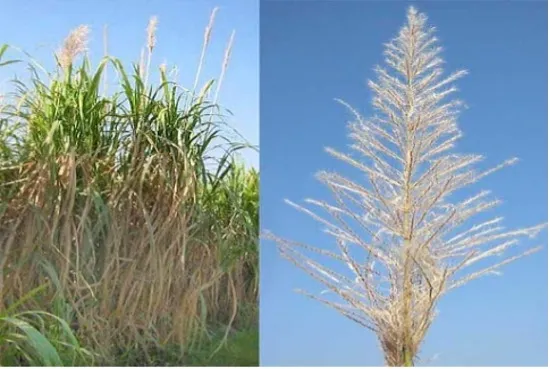
| Inflorescence | Arrow (open panicle) |
- World's 62% sugar is obtained from sugarcane. The remaining 38% comes primarily from sugar beet, which is the major sugar source in temperate regions (Europe, Russia).
- Sugarcane is technically a perennial grass that can be harvested multiple times from the same root stock (ratoon crop).
- Arrowing refers to the emergence of the flower panicle at the top of the cane stalk. Flowering is generally undesirable in commercial sugarcane because it diverts energy from sucrose storage to seed production, reducing sugar yield.
Why Sugarcane Is Called a "Heavy Feeder"
Sugarcane earns several special descriptors that exams frequently test:
| Descriptor | Reason |
|---|---|
| Most important cash crop | Backbone of sugar industry -- raw material for sugar, gur, khandsari, ethanol |
| Heavy feeder crop | Requires very large quantities of nutrients due to massive biomass (often >100 tonnes/ha) |
| Highest water consuming crop | Highest total water requirement among field crops due to long duration (10-18 months) and large leaf area |
| Sun loving plant (C4) | C4 photosynthetic pathway is most efficient under high light intensity |
Global and National Standing
| Parameter | Ranking |
|---|---|
| World (Production) | Brazil (41%) > India (19%) > China > Guatemala |
| Productivity | Guatemala > Brazil > China > India |
| India (Leading States) | Uttar Pradesh > Maharashtra > Karnataka |
- Cuba is known as the Sugar Bowl of the World, though Brazil has since overtaken it in production.
- Uttar Pradesh accounts for about 45 per cent of total production and 58 per cent of the total area of sugarcane in India, thanks to the extensive Indo-Gangetic alluvial plains with fertile soils and canal irrigation.
- Highest number of sugar mills are in Maharashtra (181) > Uttar Pradesh (120) > Karnataka (66). Maharashtra's dominance reflects its cooperative sugar industry model.
TIP
Exam mnemonic -- "UP grows it, MH mills it": Uttar Pradesh leads in area and production of sugarcane, but Maharashtra has the most sugar mills and leads in sugar production.
Key Institutes
| Institute | Location | Focus |
|---|---|---|
| Sugarcane Breeding Institute (SBI) | Coimbatore, Tamil Nadu | Varietal development -- famous CO series |
| Indian Institute of Sugarcane Research (IISR) | Lucknow, Uttar Pradesh | Production technology and agronomy |
| Indian Sugar Institute (ISI) | Kanpur, Uttar Pradesh | Sugar processing technology |
- AICRP on sugarcane was started in 1970-71.
- Average yield of India in 2018-19: 73.82 tonnes/ha over 51.59 lakh ha.
Species Classification
| Cane group | Species / chromosome | Key characteristics |
|---|---|---|
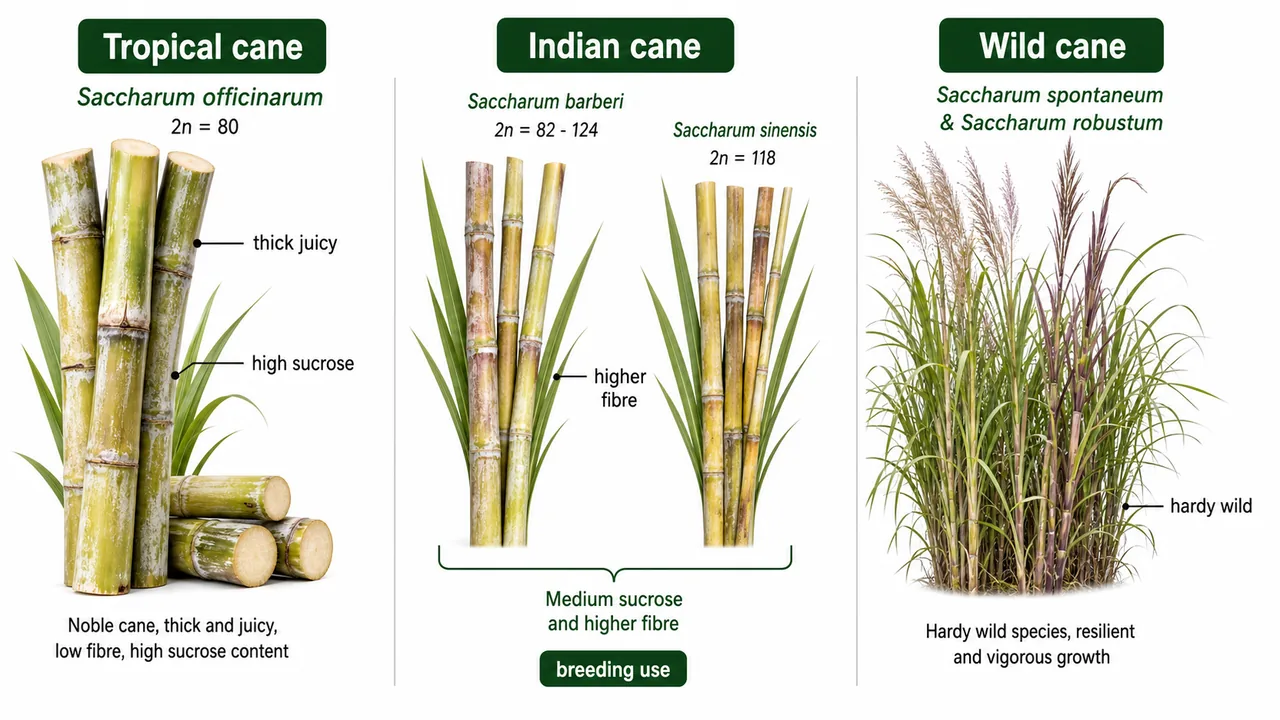
| Tropical cane | Saccharum officinarum, 2n = 80 | Noble, thick and juicy cane, good for chewing purpose, indigenous to New Guinea, higher sugar content, low fibre, long duration, higher sucrose content |
| Indian cane | Saccharum barberi, 2n = 82-124 | Native of North India, used for breeding purpose, medium sucrose and high fibre content |
| Indian cane / Chinese cane | Saccharum sinensis, 2n = 118 | Also called Chinese cane, medium sucrose and high fibre content |
| Wild cane | Saccharum spontaneum, Saccharum robustum | Wild species used in breeding for hardiness and stress tolerance |
The cultivated sugarcane belongs to the genus Saccharum, which includes six species. The most commercially important are S. officinarum (noble cane, high sugar) and S. barberi (Indian thin cane). Modern varieties are complex hybrids combining the high sugar of officinarum with the hardiness of S. spontaneum (wild cane).
Climate
| Parameter | Requirement |
|---|---|
| Rainfall | 2500-3000 mm (or equivalent irrigation) |
| Optimum temperature | 28-32 degrees C |
| Climate type | Tropical |
| Light requirement | High solar radiation (C4 plant) |
- Short day length decreases the number of tillers per plant. Tillers develop more vigorously under long day conditions, which is why the spring-summer tillering phase is critical.
- Sugarcane is a sun loving plant -- under long day length conditions, the plant produces more dry matter.
Soil
| Parameter | Requirement |
|---|---|
| Best soil | Well-drained loamy soil |
| Range | Sandy loam to clay loam |
| pH | 6.5-7.5 |
| Unsuitable | Saline, alkaline, acidic soils |
- Zero Tillage is mostly practiced in Sugarcane. In ratoon sugarcane, the crop regrows from the stubble without any land preparation.
Root System

Sugarcane has two distinct root types that function at different stages of crop growth. Understanding this is important for managing irrigation and nutrition during early establishment.
| Root Type | Function |
|---|---|
| Sett roots | Temporary -- emerge from root band of planted sett, sustain seedling until shoot roots develop |
| Shoot roots | Permanent -- produced from lower nodes of shoots, main functional root system for water and nutrient uptake |
Planting
Planting Season
| Planting season | Month | Planted in region | Crop duration |
|---|---|---|---|
| Spring planting | Feb - March | North India | 12 months |
| Autumn planting | Sept - Oct. | North India | 12 months |
| Adsali planting | July - Aug. | South India | 18 months |
The planting season varies by region -- North India plants in spring (February-March) while South India follows the Adsali system with planting in July-August for an 18-month crop.
Planting Material and Spacing
| Parameter | Detail |
|---|---|
| Planting material | Upper 1/3 to half of cane (younger, more vigorous buds with higher glucose and N) |
| Buds per sett | 3 buds preferred (10-12 months age cane) |
| Spacing (N. India) | 60-90 cm |
| Spacing (S. India / Adsali) | 90-120 cm (longer crop duration, more vigorous growth) |
Sett Rate
| Type | Setts per ha |
|---|---|
| 3-budded | 35,000-40,000 |
| 2-budded | 80,000 |
| 1-budded | 1,20,000 |
- Single-bud setts are used in the Sugarcane Settling Transplanting Technology (SST) and bud chip method for improved germination.
Ratoon Crop
- 30-40% of India's sugarcane area is under the ratoon system.
- A ratoon crop grows from stubble left after harvesting, eliminating replanting costs.
- Generally gives 10-20% lower yield than the plant crop. Typically 1-2 ratoons are taken before replanting.
Planting Methods
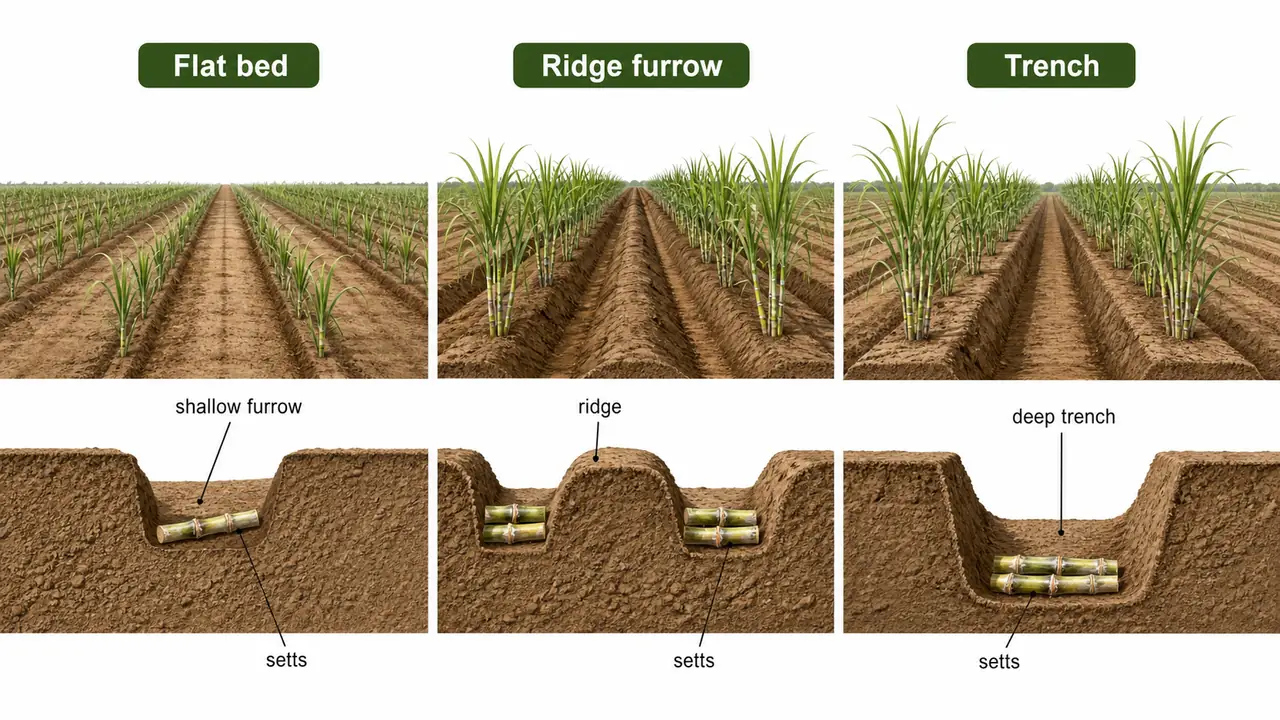
Common planting methods include flat bed, furrow, and trench planting. Furrow planting is most common in North India, while trench planting is preferred in South India for Adsali crops that require deeper root anchorage for the longer growth period.
Sett Treatments
To get better germination and reduce seed-borne diseases, several treatment methods are used:
| Treatment | Method | Purpose |
|---|---|---|
| Cold water | Whole cane dipped for 12-48 hours | Hydration of buds, improved germination |
| Hot water | 52 degrees C for 30-40 minutes | Controls RSD, grassy shoot disease, smut |
| Chemical | Agallol / Areton @ 200 gm/50 L water | Fungicidal protection against soil-borne infections |
| KMnO4 / MgSO4 | 0.1-0.5% solution for 12-24 hours | Disinfection |
| Mud and dung | Coating for 12-48 hours | Protective layer + beneficial microorganisms |
| Lime + MgSO4 | Cold saturated lime + 450 gm MgSO4 for 8-12 hours | 10% more germination + 12% more sugar yield |
TIP
Exam favourite: Hot water treatment at 52 degrees C for 30-40 minutes is frequently asked. This precise temperature kills pathogens without damaging the buds.
Four Growth Phases of Sugarcane
| Phase | Period (DAP) | What Happens | Management Focus |
|---|---|---|---|
| 1. Germination | 0-60 | Buds sprout into primary shoots | Adequate moisture, soil temp >20 degrees C |
| 2. Formative (Tillering) | 60-130 | Side shoots develop from base; determines final cane population | Most critical for irrigation |
| 3. Grand Growth | 130-250 | Maximum stalk elongation and biomass accumulation | Highest water and nutrient demand |
| 4. Maturity | 250-365 | Stalk elongation slows, sucrose accumulates | Restrict N and water for sugar buildup |
- The Formative stage (Tillering) is the most critical stage for irrigation, followed by the Grand phase. Water stress during tillering directly reduces cane population per unit area.
TIP
Mnemonic -- "G-F-G-M" (Germination, Formative, Grand, Maturity): Four phases of sugarcane. Remember that Formative = Tillering = most critical for irrigation.
Nutrient Management

As a "heavy feeder", sugarcane removes enormous quantities of nutrients from the soil. Nitrogen management is particularly critical because it involves a direct trade-off between cane tonnage and sugar content.
IMPORTANT
Nitrogen-Sugar Trade-off: Excess nitrogen boosts cane tonnage but reduces sugar recovery. Balanced nitrogen application is key to maximising both yield and sugar content.
- Higher doses of nitrogen enhance vegetative growth but reduce sucrose content. Proper nitrogen management requires balancing cane tonnage with sugar recovery.
- Application of nitrogen-fixing biofertilisers (Azospirillum and Gluconacetobacter) and phosphate-solubilising bacteria (Phosphobacteria) can reduce chemical fertiliser requirement by 25%.
- Gluconacetobacter diazotrophicus is an endophytic bacterium that fixes nitrogen inside the sugarcane stalk itself.
Water Management
| Parameter | Detail |
|---|---|
| Total water requirement | 2500-3000 mm |
| Irrigations needed | 10-12 |
| Water per tonne of cane | 60-70 tonnes water |
| 1st irrigation | 20 DAP |
| Winter interval | 25-30 days |
| Summer interval | 10-15 days |
| Irrigation trigger | At 50 per cent available soil moisture depletion |
- The enormous water requirement (4-5 times that of pearl millet or sorghum) makes efficient water management and drip irrigation critical.

Inter-culture Operations
Detrashing

Only 8-10 leaves (top green leaves) are photosynthetically active out of 35-40 total leaves. Detrashing removes dried lower leaves to improve air circulation, light penetration, and reduce pest harbourage.
Propping

Tying cane stalks together to prevent lodging (falling over). Lodging reduces sugar recovery because lodged canes produce side shoots that consume stored sugar.
Other Operations
| Operation | Timing / Detail |
|---|---|
| Blind/light hoeing | 1 week after planting -- breaks soil crust, improves aeration and germination |
| Earthing up | 4 months after planting -- prevents lodging, facilitates irrigation |
| Wrapping | Bending one or more lower leaves and wrapping them around the cane stem; common in South India, especially Karnataka |
| Flower control | Spraying Ethrel at 500 ppm -- suppresses arrowing to prevent pith formation and sugar diversion |

Sugar Accumulation and Potassium
- Conversion of glucose into sucrose intensifies during extreme cold (November-February). Cool nights slow respiration rate, reducing consumption of stored sugars. The enzyme sucrose synthase actively converts glucose into sucrose during this period, which is why sugarcane is harvested during the crushing season (October-March).
- Potassium (K) is responsible for translocation of sugar in sugarcane. It activates enzymes involved in sugar synthesis and plays a crucial role in phloem loading for transporting sucrose from leaves to stalks.
Weed Management
| Parameter | Detail |
|---|---|
| Critical weed competition period | Up to 4 months after planting |
| Key herbicides | Simazine, Atrazine, Alachlor (pre-emergence) |
- The wide inter-row spaces are exposed to sunlight for several months before canopy closure, allowing aggressive weed growth.
Varieties
| Category | Varieties |
|---|---|
| 1st sugarcane hybrid | Co 205 |
| Wonder cane | Co 419 and COC-617 |
| Early maturing | Co 419, Co 449 |
| Mutant varieties | Co 8152 (mutant of Co 527), Co 8153 (mutant of Co 775) |

| Red rot resistant | Co 1148, Co 62101, Co 62399 | | Sub-tropical India | Co 312 | | Tropical India | Co 419 | | Drought tolerant | Co 740, Co 997, Co 6304 | | Suitable for ratooning | Co 419, Co 740, Co 1148 | | National level commercial | CO Pant-85004, 86032, 87263 |
- Red rot (Colletotrichum falcatum) is the most dreaded disease of sugarcane. Developing resistant varieties is the most effective strategy because chemical control of this internal disease is extremely difficult.
Crop Rotation
| Region | Rotation Partners |
|---|---|
| North India | Sugarcane with Cotton, Gram, Brassica spp., Sorghum, Maize, Peas |
| South India | Sugarcane -- Cotton -- Gram |
Crop rotation breaks pest and disease cycles, restores soil fertility (especially with legumes), and maintains soil structure.
Disease
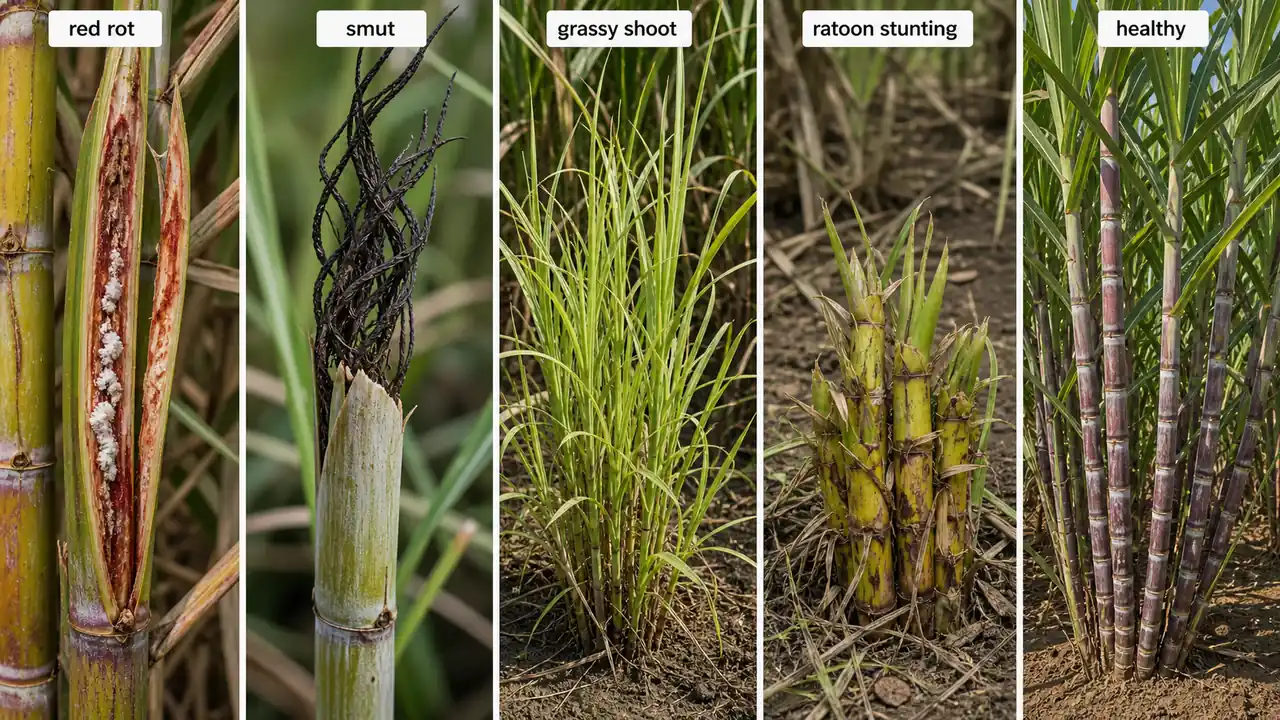
Sugarcane is susceptible to several serious diseases, with red rot being the most economically devastating. Hot water treatment of setts at 52 degrees C is the primary preventive measure against most seed-borne diseases.
| Disease | Pathogen | Key Feature |
|---|---|---|
| Red rot | Colletotrichum falcatum | Most destructive -- reddening and rotting of internal stalk |
| Smut | Ustilago scitaminea | Long whip-like structure from growing point |
| Wilt | Fusarium sacchari | Wilting and drying |
| Grassy Shoot Disease | Phytoplasma | Thin, grass-like tillers |
Management involves resistant varieties, disease-free setts, hot water treatment, and roguing of infected clumps.
Insect-Pest
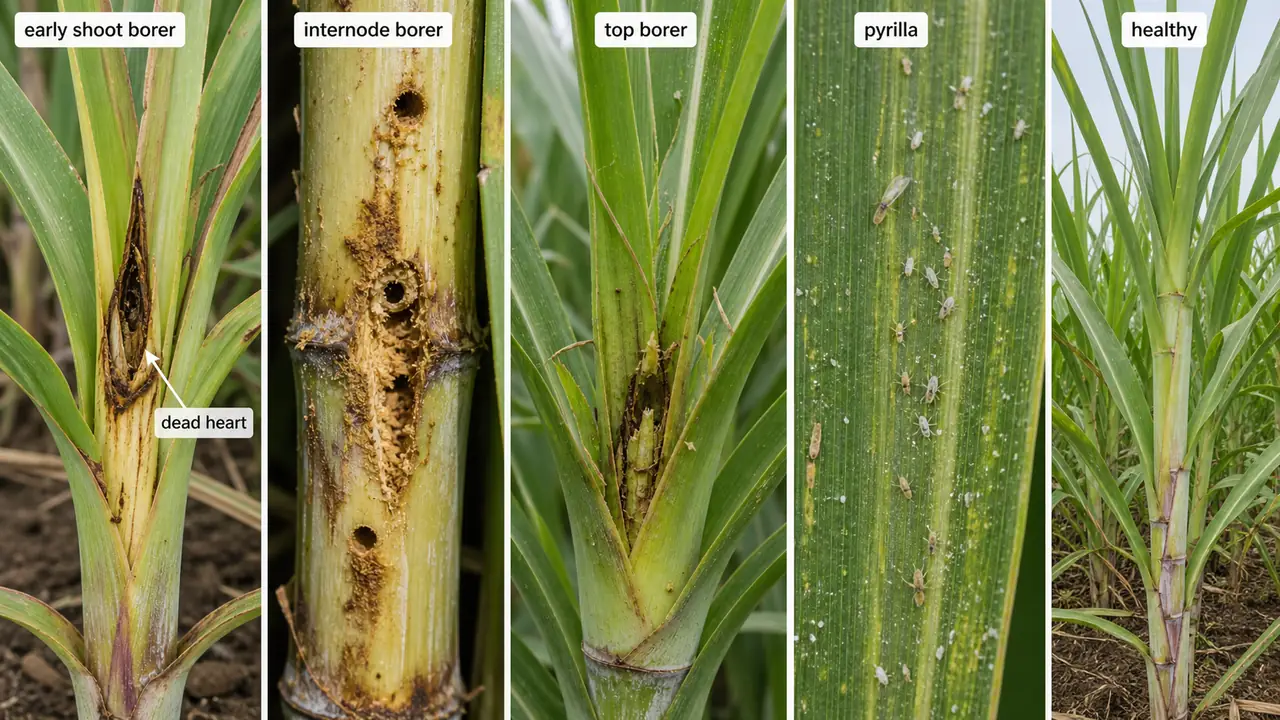
Sugarcane pests are primarily borers that attack different parts of the plant at different growth stages. Recognising the characteristic damage symptoms helps identify the specific borer involved.
| Pest | Damage |
|---|---|
| Early shoot borer | "Dead hearts" in young plants |
| Top borer | "Bunchy top" appearance |
| Internode borer | "Red tunnels" inside stalk |
| Pyrilla (leafhopper) | Sap sucking, honeydew, sooty mould |
| White grub | Root damage, poor growth and lodging |
Harvesting and Maturity
| Maturity Sign | Detail |
|---|---|
| Arrowing | Growth stops, plant flowers |
| Metallic sound | Tapping mature cane produces a ringing sound (vs dull thud for immature) |
| Brix reading | Brix = percentage of total soluble solids in sugarcane juice, measured by Brix hydrometer or refractometer. Harvest at 18-20% |
| Top:Bottom brix ratio | Close to 1:1 for optimal maturity |
| Glucose | < 0.5% by Fehling solution (confirms sucrose conversion complete) |

Yield and Sugar Recovery
| Parameter | Detail |
|---|---|
| N. India yield (10-12 months) | 60-100 tonnes/ha |
| S. India yield (18 months) | 80-130 tonnes/ha |
| Juice yield | 65-75% |
| Average sugar recovery | 11% from juice |
| Sugar beet recovery | 15-18% (higher than sugarcane) |
- Crop Logging is a method of plant analysis for assessing nutrient requirements, given by H.F. Clements, first used in sugarcane at Hawaii.
By-products of Sugarcane

Sugarcane is remarkable for its zero-waste potential -- every part of the plant and every stage of processing generates a valuable by-product. This is why the sugar industry is called an agro-industrial complex.
| By-product | Use |
|---|---|
| Bagasse | Fibrous remnants of crushed sugarcane stalks after juice extraction. Used as fuel in sugar mills, raw material for paper, particleboard, and cogeneration of electricity |
| Molasses | Ethanol, yeast production |
| Press mud | Organic fertiliser |
| Vinasse | Biogas, fertigation |
- Gasohol is prepared from 80% petrol + 20% alcohol from sugarcane. India's Ethanol Blending Programme aims to achieve 20% blending by 2025-26.
Sugarcane vs Sugar Beet -- A Comparison
| Feature | Sugarcane | Sugar Beet |
|---|---|---|
| Family | Gramineae | Chenopodiaceae |
| Climate | Tropical | Temperate |
| Duration | 10-18 months | 5-6 months |
| Sugar recovery | 11% | 15-18% |
| World sugar share | 62% | 38% |
| Water requirement | Very high (2500-3000 mm) | Moderate |
| Propagation | Vegetative (setts) | Seed |
TIP
Exam tip: Sugar beet has higher sugar recovery (15-18%) than sugarcane (11%), but sugarcane dominates because of higher tonnage per hectare and suitability to tropical climates where most developing nations lie.
Sugarcane: Planting Method Decision Guide
Which planting method for which situation?
| Method | Sett Type | Sett Rate | Best When | Advantage |
|---|---|---|---|---|
| Flat planting | 3-budded setts | 6-8 t/ha | Good drainage, light soils | Simple, traditional |
| Furrow planting | 3-budded setts | 6-8 t/ha | Medium-heavy soils | Earthing up easier |
| Trench planting (deep furrow) | 2-3 budded | 5-6 t/ha | Water-scarce areas, ratoon management | Saves water; better lodging resistance |
| Ring-pit method | Single-bud | 3-4 t/ha | Saline/alkaline soils, research plots | Highest yield potential but labour-intensive |
| Sett transplanting (STP) | Settled seedlings | 15,000-20,000 seedlings/ha | Seed material shortage | Saves 70-75% seed material |
Ratoon management — critical for farm economics:
| Parameter | Plant Crop | 1st Ratoon | 2nd Ratoon |
|---|---|---|---|
| Duration | 12-18 months | 10-12 months | 10-12 months |
| Yield (typical) | 80-100 t/ha | 60-80 t/ha | 40-60 t/ha |
| Cost of cultivation | Highest (land prep + planting) | 30-40% lower | Similar to 1st ratoon |
| Profitability | Moderate | Highest (low cost, decent yield) | Declining — consider replanting |
Rule of thumb: Most farmers take 1-2 ratoon crops. Beyond 2nd ratoon, yields decline significantly and pest/disease pressure increases. A good exams recommendation: replant after 2nd ratoon with a disease-free variety.
Summary Cheat Sheet
| Parameter | Detail |
|---|---|
| Botanical Name | Saccharum spp. |
| Family | Gramineae (Poaceae) |
| Origin | Indo-Burma |
| Photoperiod | Intermediate day length |
| Inflorescence | Arrow (open panicle) |
| World sugar share | 62% |
| Sugar Bowl of World | Cuba |
| India rank | 2nd (production), after Brazil |
| Leading state | Uttar Pradesh (45% production, 58% area) |
| Most sugar mills | Maharashtra (181) |
| Breeding institute | SBI, Coimbatore |
| 1st hybrid | Co 205 |
| Wonder cane | Co 419 |
| Hot water treatment | 52 degrees C, 30-40 min |
| Growth phases | Germination-Formative-Grand-Maturity |
| Critical irrigation stage | Formative (Tillering) |
| Water requirement | 2500-3000 mm |
| Irrigations | 10-12 |
| Sugar recovery | 11% (crystal sugar = 10.2%) |
| Gur (jaggery) recovery | 11.2-11.5% |
| Molasses recovery | 4-4.5% |
| Brix at maturity | 18-20% |
| Ratoon area | 30-40% of India's sugarcane |
| Key disease | Red rot (C. falcatum) |
| Crop logging | H.F. Clements, Hawaii |
| Gasohol | 80% petrol + 20% ethanol |
| Brix | % total soluble solids in juice — harvest at 18-20% |
| Bagasse | Fibrous remnants after juice extraction — fuel, paper, electricity |