🥔 Potato -- The "King of Vegetables" and Its Underground Stem Biology (Complete Guide)
Master potato cultivation from tuberisation to cold storage -- Solanum tuberosum botany, solanine toxicity, TPS technology, Kufri varieties, seed plot technique, and exam-critical facts for exams, NABARD, and IBPS exams.
In the fertile Indo-Gangetic plains of Uttar Pradesh, as winter settles in and night temperatures drop to 15-17 degrees C, millions of hectares turn into a vast potato-growing belt. The cool nights are not just pleasant weather -- they are a biological trigger. Potato tubers form only when soil temperatures fall below 20 degrees C, and tuberisation stops entirely above 30 degrees C. This temperature sensitivity makes potato a uniquely seasonal crop in the tropics, yet it remains the world's most important non-cereal food crop and earns the title "King of Vegetables" for its unmatched versatility and caloric yield per hectare. For exams, questions about tuberisation temperature, solanine toxicity, the seed plot technique by Dr. Pushkarnath, and the Kufri variety series are perennial favourites.
This lesson covers:
- Basics and botany -- underground stem biology, solanine toxicity
- Climate and soil -- tuberisation temperature thresholds, short-day trigger
- Planting and seed technology -- TPS revolution, dormancy breaking
- Varieties -- Kufri series from CPRI Shimla
- Harvesting and storage -- dehaulming, cold storage at 4-5 degrees C
- Seed Plot Technique -- Dr. Pushkarnath's aphid management strategy
All topics are high-yield for exams, NABARD, and FCI exams.
Pro Content Locked
Upgrade to Pro to access this lesson and all other premium content.
Pay once for one year · Effective ₹99/mo
- All Agriculture & Banking Courses
- AI Lesson Questions (100/day)
- AI Doubt Solver (50/day)
- Glows & Grows Feedback (30/day)
- AI Section Quiz (20/day)
- 22-Language Translation (100/day)
- Recall Questions (20/day)
- AI Quiz (15/day)
- AI Quiz Paper Analysis (100/day)
- AI Step-by-Step Explanations (100/day)
- Spaced Repetition Recall (FSRS)
- AI Tutor
- Immersive Text Questions
- Audio Lessons — Hindi & English
- Mock Tests & Previous Year Papers
- Summary & Mind Maps
- XP, Levels, Leaderboard & Badges
- Generate New Classrooms
- Voice AI Teacher (AgriDots Live)
- AI Revision Assistant
- Knowledge Gap Analysis
- Interactive Revision (LangGraph)
🔒 Secure one-time yearly payment via Razorpay · No hidden fees
In the fertile Indo-Gangetic plains of Uttar Pradesh, as winter settles in and night temperatures drop to 15-17 degrees C, millions of hectares turn into a vast potato-growing belt. The cool nights are not just pleasant weather -- they are a biological trigger. Potato tubers form only when soil temperatures fall below 20 degrees C, and tuberisation stops entirely above 30 degrees C. This temperature sensitivity makes potato a uniquely seasonal crop in the tropics, yet it remains the world's most important non-cereal food crop and earns the title "King of Vegetables" for its unmatched versatility and caloric yield per hectare. For exams, questions about tuberisation temperature, solanine toxicity, the seed plot technique by Dr. Pushkarnath, and the Kufri variety series are perennial favourites.
This lesson covers:
- Basics and botany -- underground stem biology, solanine toxicity
- Climate and soil -- tuberisation temperature thresholds, short-day trigger
- Planting and seed technology -- TPS revolution, dormancy breaking
- Varieties -- Kufri series from CPRI Shimla
- Harvesting and storage -- dehaulming, cold storage at 4-5 degrees C
- Seed Plot Technique -- Dr. Pushkarnath's aphid management strategy
All topics are high-yield for exams, NABARD, and FCI exams.
Basics

Potato belongs to the Solanaceae family (same as tomato, brinjal, and tobacco). Its tuber is a modified underground stem -- not a root -- which is the single most important botanical distinction tested in exams.
| Feature | Detail |
|---|---|
| Botanical Name | Solanum tuberosum |
| Family | Solanaceae |
| Origin | South America (Peru) |
| Nickname | King of Vegetables / Poor Man's Friend |
| Protein | 1.6% (high-quality patatin protein) |
| Solanine | 5 mg/100 gm (toxic glycoalkaloid) |
| Tuber | Modified underground stem (not a root) |
| Dormancy | 8-10 weeks (65-70 days) |


- The potato tuber is not a root but a modified underground stem (stolon). The "eyes" on the tuber are actually axillary buds (nodes), which is why tubers can sprout and produce new plants.
- Potato is called "Poor Man's Friend" because it provides carbohydrates, vitamin C, potassium, and B vitamins at a very low cost per unit of nutrition.
Solanine -- The Green Potato Danger

Solanine is a toxic glycoalkaloid naturally produced in potato tubers, especially when exposed to light or physical damage. The characteristic green colour on potato skin indicates elevated solanine levels.
| Parameter | Detail |
|---|---|
| Normal level | 5 mg/100 gm |
| Unsafe level | >20 mg/100 gm |
| Cause of greening | Light exposure |
| Symptoms | Nausea, vomiting, neurological problems |
WARNING
Green-skinned potatoes are toxic. The green colour indicates high solanine levels caused by light exposure. Normal level is 5 mg/100g; above 20 mg/100g is dangerous. Always store potatoes in dark conditions.
Global and National Standing
India is the second-largest producer of potatoes in the world after China, and the Indo-Gangetic belt accounts for the bulk of national output.
| Parameter | Detail |
|---|---|
| Area | 1.8 million ha (2008-09) |
| Production | 34.39 million MT |
| Productivity | 18.8 MT/ha |
| Leading states | Uttar Pradesh > West Bengal > Bihar |
- Uttar Pradesh alone contributes over 30% of India's total potato production due to its fertile Indo-Gangetic alluvial soils and favourable winter climate.
Climate
Temperature is the single most critical factor in potato cultivation. Unlike most crops where temperature affects growth rate, in potato it controls whether tubers form at all -- making it a binary trigger.
| Parameter | Requirement |
|---|---|
| Climate type | Temperate and cool with moist conditions |
| Germination temperature | 25 degrees C |
| Vegetative growth | 17 degrees C |
| Tuberisation | 17-20 degrees C |
| Tuberisation stops | Above 30 degrees C |
| Photoperiod (growth) | Long day for vegetative growth |
| Photoperiod (tuberisation) | Short day triggers tuber initiation |
TIP
Temperature thresholds for potato (exam must-know): Tuberisation requires 17-20 degrees C. Above 30 degrees C, tuberisation stops completely. Storage: 4-5 degrees C at 90-95% RH.

- Cloudy weather, rainy days, and high humidity are unfavourable because they promote late blight (Phytophthora infestans), the most devastating potato disease.
- Short days trigger the hormonal signal (gibberellin decline + tuberisation stimulus) needed for tuber initiation.
Soil
Potato requires light-textured, well-drained soils that allow easy tuber expansion and clean harvesting. Soil pH directly affects disease incidence.
| Parameter | Requirement |
|---|---|
| Best soil | Alluvial / Sandy loam / Silty soil |
| pH | 5 to 6.5 |
| Unsuitable | Heavy clay, waterlogged |
- Slightly acidic soils reduce the incidence of common scab (Streptomyces scabies), which thrives in neutral to alkaline soils.
- Light-textured soils allow easy tuber expansion, facilitate harvesting, and produce clean, smooth-skinned tubers.
Planting
Planting Time
| Region | Time |
|---|---|
| Plains | Last week of October to 2nd week of November |
| Hills | February to March |
Seed Tuber Selection
| Criterion | Standard |
|---|---|
| Condition | Pure, viable, readily sprouted |
| Skin colour | Brown (healthy, not green) |
| Size | 2.5-3 cm diameter, 25-30 gm weight |
| Buds per cut piece | At least 3 buds |
Breaking Tuber Dormancy
Treatment with 1% thiourea + 1 ppm GA3 for 1 hour breaks tuber dormancy. Thiourea stimulates metabolic activity, while GA3 (Gibberellic acid) activates enzymes that mobilise starch reserves.


Seed Rate
| Seed size (diameter) | Spacing | Seed rate |
|---|---|---|
| 2.5-3.0 cm | 45 cm x 45 cm | 10 qt/ha |
| 2.5-4.0 cm | 60 cm x 25 cm | 20 qt/ha |
| 4.0-5.0 cm | 50 cm x 20 cm | 25 qt/ha |
Potato has one of the highest seed rates among field crops (measured in quintals, not kilograms), which makes seed cost a major factor in cultivation economics. The TPS technology addresses this limitation.
| Cultivar Type | Seed Rate |
|---|---|
| Round shaped | 15-18 q/ha |
| Oval shaped | 20-25 q/ha |
True Potato Seed (TPS) Technology
40-45 gm of True Potato Seed is enough for planting 1 ha -- compared to 15-25 quintals of tubers in conventional planting. TPS refers to the actual botanical seeds from the berry (fruit), drastically reducing seed cost and eliminating many seed-borne diseases.

TIP
Exam tip -- TPS Revolution: True Potato Seed needs only 40-45 gm/ha versus 15-25 q/ha of tubers. This 99.99% reduction in planting material weight is a game-changer for potato farming economics.
Methods of Planting

| Method | Detail |
|---|---|
| Ridge and Furrow | Most popular -- good drainage, loose soil for tuber expansion, easy harvesting |
| Flatbed | Used in areas with assured irrigation |
Earthing-Up
Earthing-up is done when plant height reaches 15-20 cm. It prevents greening (solanine formation), provides space for tuber development, controls weeds, and improves drainage.
| Region | Timing |
|---|---|
| Plains | 30-45 DAS |
| Hills | 40-45 DAS |
- 2nd Earthing is done 2 weeks after 1st Earthing.
Nutrient Management
| Nutrient | Dose (kg/ha) |
|---|---|
| N | 180-200 |
| P | 100-150 |
| K | 100-150 |
Potato is a heavy feeder crop requiring substantially higher nutrient doses than most crops:
- High nitrogen supports vigorous vegetative growth and a large leaf canopy for photosynthesis.
- Phosphorus promotes root development and tuber initiation.
- Potassium is essential for starch synthesis, tuber quality, and disease resistance.
Irrigation
- Most critical stage for irrigation is the 25 per cent tuber formation stage. At this stage, tubers are actively bulking and have the highest water demand.
Cropping Systems and Intercropping
| System | Detail |
|---|---|
| Most popular rotation | Potato -- Sunflower -- Rice/Maize |
| Main intercrop | Sugarcane (potato fills the inter-row space during early months) |
Varieties
All Kufri varieties are developed by the Central Potato Research Institute (CPRI), Shimla. "Kufri" is named after a hill station near Shimla.
Early Duration (90-120 days)
Kufri Alankar, Kufri Chandramukhi, Kufri Bahar, Kufri Jyoti

Medium Duration (120-150 days)
Kufri Badshah, Kufri Chamatkar, Kufri Lalima, Kufri Sheetman, Kufri Swarna


Late Maturing (150-180 days)
Kufri Sinduri, Kufri Dewa, Kufri Jeevan
Special Purpose
- Kufri Frysona -- high dry matter (>22%), developed specifically for making French fries. Low dry matter tubers absorb more oil during frying and produce soggy fries.

Harvesting

| Parameter | Detail |
|---|---|
| Maturity sign | Haulms start yellowing and falling (natural senescence) |
| Dehaulming | Remove top portion 10-12 days before harvest using CuSO4 |
| Yield | 30-35 tonnes/ha |
| Harvest deadline | Complete by end of January (before temperature exceeds 30 degrees C) |

- Dehaulming hardens tuber skin (making it resistant to mechanical damage) and prevents late blight spread from foliage to tubers.
Post-Harvest Processing
| Step | Detail |
|---|---|
| Drying and curing | Heap under shade at 15-20 degrees C for 10-15 days -- allows cuts to heal by forming suberised layer |
| Sorting | Remove diseased, damaged, rough tubers |
| Grading | Uniform quality for market |
Grading Standards
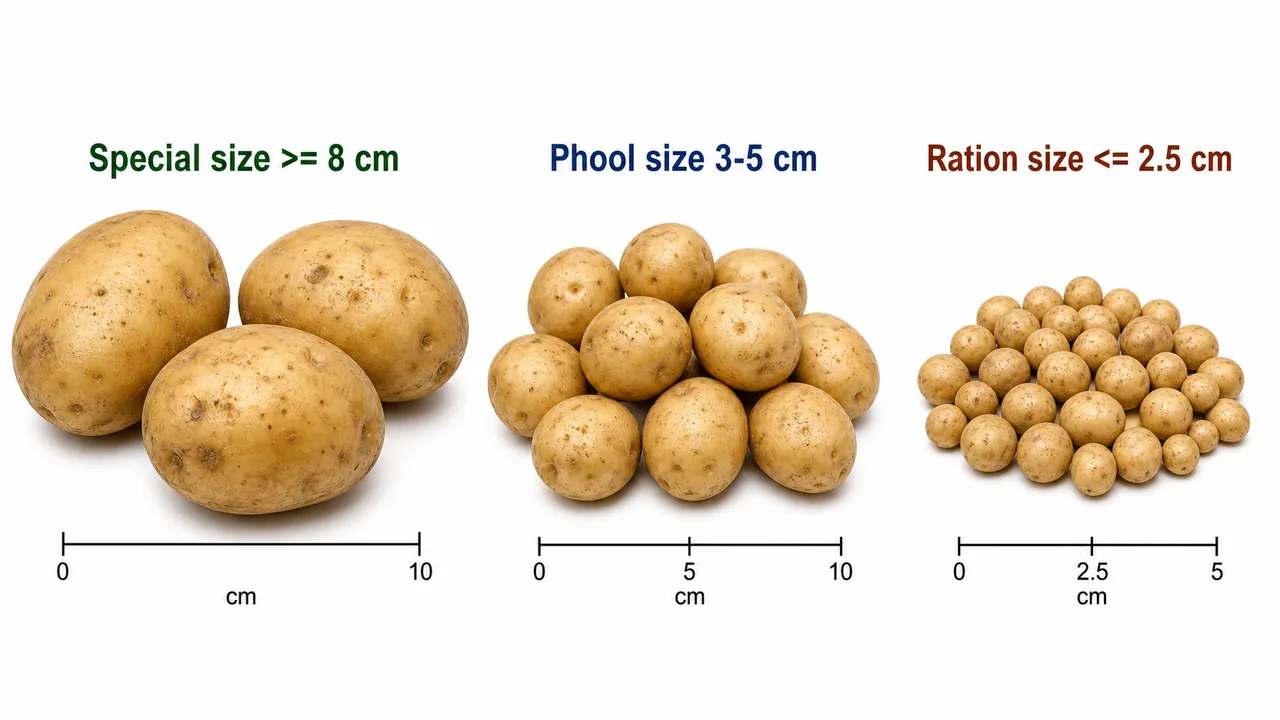
| Grade | Diameter |
|---|---|
| Special size | 8 cm or more |
| Phool size | 3-5 cm |
| Ration size | 2.5 cm or less |
Seed Plot Technique (SPT)
Seed Plot Technique was discovered by Dr. Pushkarnath.
The technique involves raising the crop during a period when aphid population is very low, using insecticides against aphids, periodically roguing mosaic (virus)-affected plants, and dehaulming before aphid population reaches critical levels.
Aphids (especially Myzus persicae) are the primary vectors of potato viruses like PVX, PVY, and PLRV. By timing the crop to avoid peak aphid populations and removing foliage before buildup, viral infection risk in seed tubers is minimised.
TIP
Exam tip -- SPT connection: Seed Plot Technique by Dr. Pushkarnath controls virus spread in seed potatoes by managing aphid vectors. If you see "aphid + potato seed" in an exam question, think SPT.
Storage Conditions
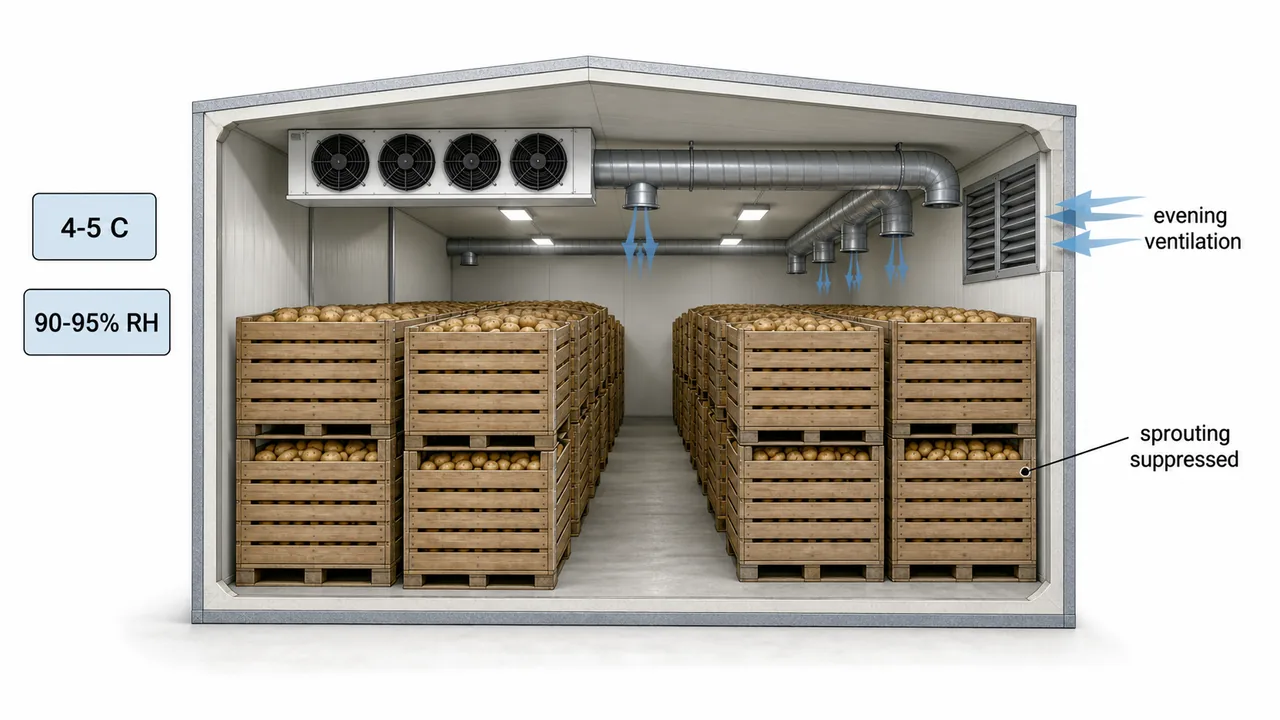
Proper cold storage is essential because potatoes are perishable and will sprout, shrivel, or rot without controlled conditions. India has one of the world's largest cold storage networks, predominantly in Uttar Pradesh.
| Parameter | Requirement |
|---|---|
| Temperature | 4-5 degrees C |
| Relative Humidity | 90-95% |
| Room management | Closed during daytime, opened in evening for cool air circulation |
- Low temperature (4-5 degrees C) suppresses sprouting by maintaining dormancy.
- High humidity (90-95%) prevents weight loss due to evaporation.
Potassium Fertilizer: KCl Paradox
KCl fertilizer is not recommended in potato and other solanaceous crops because chloride reduces tuber dry matter and starch quality. It can produce spongy tubers and blackening after boiling. However, about 97% of K-fertilizer consumption in potato is still KCl/MOP because it is cheaper and more widely available than potassium sulphate.
TIP
Exam trap: Recommendation = avoid KCl in potato; field reality = most K used in potato is still KCl.
Potato vs Sweet Potato -- A Common Exam Comparison
| Feature | Potato | Sweet Potato |
|---|---|---|
| Family | Solanaceae | Convolvulaceae |
| Edible part | Modified stem (tuber) | Modified root |
| Origin | Peru (South America) | Tropical America |
| Propagation | Tuber pieces (vegetative) | Vine cuttings |
| Climate | Cool/temperate | Warm/tropical |
| Storage organ | Stem tuber | Root tuber |
| Solanine | Present | Absent |
TIP
Exam tip: Potato tuber = modified stem (has eyes/buds). Sweet potato = modified root (no eyes). This is the most fundamental botanical difference and is tested repeatedly.
Summary Cheat Sheet
| Parameter | Detail |
|---|---|
| Botanical Name | Solanum tuberosum |
| Family | Solanaceae |
| Origin | Peru (South America) |
| Nickname | King of Vegetables |
| Tuber | Modified underground stem |
| Dormancy | 8-10 weeks |
| Solanine (normal) | 5 mg/100 gm |
| Tuberisation temp | 17-20 degrees C |
| Tuberisation stops | Above 30 degrees C |
| Photoperiod | Long day (growth), Short day (tuberisation) |
| pH | 5-6.5 |
| NPK | 180-200 : 100-150 : 100-150 kg/ha |
| KCl/MOP | Not recommended because chloride harms starch and dry matter; still ~97% of K use in potato |
| Critical irrigation | 25% tuber formation stage |
| Dehaulming | CuSO4, 10-12 days before harvest |
| Yield | 30-35 tonnes/ha |
| Storage | 4-5 degrees C, 90-95% RH |
| SPT | Dr. Pushkarnath (aphid management for virus-free seed) |
| TPS | 40-45 gm/ha (vs 15-25 q/ha tubers) |
| Leading state | Uttar Pradesh |
| French fry variety | Kufri Frysona (>22% dry matter) |
| All Kufri varieties | CPRI, Shimla |