🚬 Tobacco -- From Portuguese Introduction to India's Second-Largest Crop (Curing, Nicotine & Operations)
Complete guide to tobacco (Nicotiana tabacum) -- Portuguese introduction, Solanaceae family, FCV vs Non-Virginia types, topping-desuckering-priming-curing sequence, nicotine synthesis in roots, burning quality and potassium, and all exam-important operations.
In the early 1600s, Portuguese traders arriving at the port of Goa carried an unfamiliar plant from the Americas -- tobacco. Within decades, this crop spread from the Deccan Plateau to the Gangetic plains, and today India is the second-largest producer of tobacco in the world after China. In Andhra Pradesh's Guntur district, farmers construct specialised flue-curing barns where harvested leaves are dried into golden sheets destined for cigarette manufacturing, while in Gujarat and Bihar, darker air-cured leaves feed the bidi and chewing tobacco industries. This chapter covers every testable aspect of tobacco cultivation, from its unique alkaloid chemistry to the critical post-harvest operations that determine leaf quality.
This lesson covers:
- Botanical profile -- Solanaceae family, Portuguese introduction, chromosome number
- FCV vs Non-Virginia -- the fundamental classification by curing method and end use
- Nicotine chemistry -- synthesis in roots, accumulation in leaves
- Critical operations -- Topping, Desuckering, Priming, Curing (TDPC sequence)
- Burning quality -- the potassium-chloride relationship
All topics are high-yield for exams, NABARD, and UPPSC exams.
Pro Content Locked
Upgrade to Pro to access this lesson and all other premium content.
Pay once for one year · Effective ₹99/mo
- All Agriculture & Banking Courses
- AI Lesson Questions (100/day)
- AI Doubt Solver (50/day)
- Glows & Grows Feedback (30/day)
- AI Section Quiz (20/day)
- 22-Language Translation (100/day)
- Recall Questions (20/day)
- AI Quiz (15/day)
- AI Quiz Paper Analysis (100/day)
- AI Step-by-Step Explanations (100/day)
- Spaced Repetition Recall (FSRS)
- AI Tutor
- Immersive Text Questions
- Audio Lessons — Hindi & English
- Mock Tests & Previous Year Papers
- Summary & Mind Maps
- XP, Levels, Leaderboard & Badges
- Generate New Classrooms
- Voice AI Teacher (AgriDots Live)
- AI Revision Assistant
- Knowledge Gap Analysis
- Interactive Revision (LangGraph)
🔒 Secure one-time yearly payment via Razorpay · No hidden fees
In the early 1600s, Portuguese traders arriving at the port of Goa carried an unfamiliar plant from the Americas -- tobacco. Within decades, this crop spread from the Deccan Plateau to the Gangetic plains, and today India is the second-largest producer of tobacco in the world after China. In Andhra Pradesh's Guntur district, farmers construct specialised flue-curing barns where harvested leaves are dried into golden sheets destined for cigarette manufacturing, while in Gujarat and Bihar, darker air-cured leaves feed the bidi and chewing tobacco industries. This chapter covers every testable aspect of tobacco cultivation, from its unique alkaloid chemistry to the critical post-harvest operations that determine leaf quality.
This lesson covers:
- Botanical profile -- Solanaceae family, Portuguese introduction, chromosome number
- FCV vs Non-Virginia -- the fundamental classification by curing method and end use
- Nicotine chemistry -- synthesis in roots, accumulation in leaves
- Critical operations -- Topping, Desuckering, Priming, Curing (TDPC sequence)
- Burning quality -- the potassium-chloride relationship
All topics are high-yield for exams, NABARD, and UPPSC exams.
Botanical Profile

Tobacco belongs to the Solanaceae family (same as potato, tomato, and brinjal), which explains several shared characteristics including alkaloid production and sensitivity to waterlogging.
| Parameter | Details |
|---|---|
| Botanical name | Nicotiana tabacum |
| Family | Solanaceae |
| Chromosome number | 2n = 48 |
| Origin | Central America |
| Introduction to India | By Portuguese traders in the early 17th century (around 1605), initially cultivated in Goa |
| Area | China > India |
| Production | China (40%) > India (12%) |
| Productivity | Pakistan (highest) |
Types of Indian Tobacco -- FCV vs Non-Virginia
| Particular | Nicotiana tabacum | Nicotiana rustica |
|---|---|---|
| Purpose of growing | Smoking and chewing | Hookah, chewing and snuff |
| Nicotine content (per cent) | 0.5 to 5.5 | 3.5 to 8.0 |
| Soil | Light and high land | Heavy and low laying area |
| Plant height | 150-250 cm | 90-120 cm |
| Transplanting age | 7 to 9 weeks (4-5 leaf stage) | 5 to 6 weeks |
| Harvesting method | Priming | Stalk cutting |
Indian tobacco is broadly classified into two categories based on curing method and end use. This distinction determines everything -- from nitrogen management to leaf colour to market price.
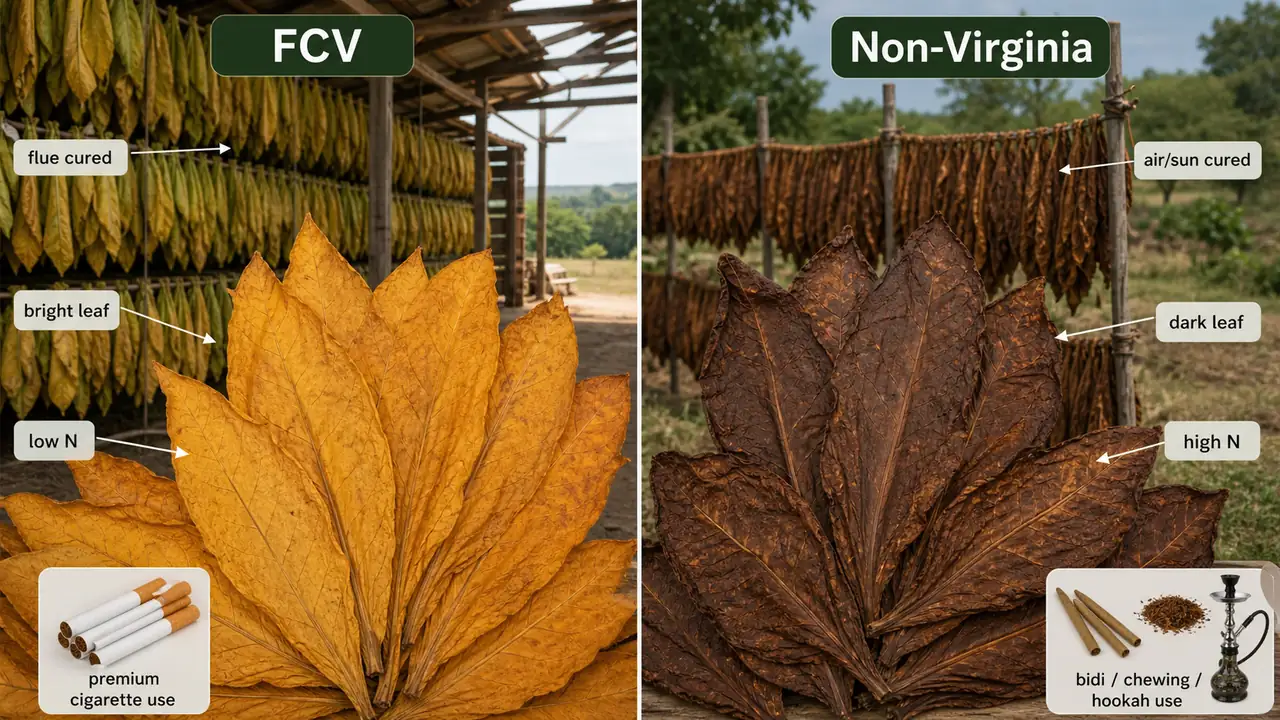
1. Flue Cured Virginia (FCV)
- Also called cigarette tobacco
- Covers 30% area but only 20% of total production
- Considered the highest quality tobacco, primarily used for manufacturing cigarettes
- Cured in specially constructed flue-curing barns where heat is applied through metal flues (pipes) without direct exposure to smoke
- Produces a characteristic bright yellow to orange leaf colour
- Commands the highest market price despite lower area share
2. Non-Virginia
- Covers 70% area and 80% of total production
- Includes types used for bidi, chewing, hookah, snuff, and cigar manufacturing
- These types are air-cured or sun-cured
- Grown extensively across Gujarat, Bihar, West Bengal, Karnataka, and Andhra Pradesh
| S.N. | Types of Tobacco | Prominent States |
|---|---|---|
| 1. | Cigarette tobacco | AP, Karnataka |
| 2. | Bidi tobacco | Gujarat, Karnataka, Maharashtra, AP |
| 3. | Chewing tobacco | UP, TN, WB, Orissa, Bihar |
| 4. | Natu tobacco | AP |
| 5. | Cigar and cheroot tobacco | WB |
| 6. | Snuff tobacco | TN, AP, Kerala |
FCV vs Non-Virginia -- Comparison
| Character | FCV (Virginia) | Non-Virginia |
|---|---|---|
| Area share | 30% | 70% |
| Production share | 20% | 80% |
| Curing method | Flue curing (barns) | Air/Sun curing |
| Leaf colour | Bright yellow to orange | Dark brown |
| End use | Cigarettes | Bidi, chewing, hookah, snuff, cigar |
| Nitrogen requirement | Low N | High N |
| Nicotine content | Moderate | Higher |
| Market price | Highest | Lower |
TIP
FCV vs Non-Virginia (exam favourite): FCV covers only 30% area but produces only 20% of production -- it yields less because quality, not quantity, is the goal. FCV needs low nitrogen for thin, golden leaves; Non-Virginia needs high nitrogen for thick, dark leaves. Remember: FCV = Fine quality, Flue-cured.
Climate Requirements
Tobacco is a tropical crop that performs best in warm, well-drained environments. Its sensitivity to waterlogging and need for adequate moisture during leaf expansion are the two key climate considerations.
- Tobacco is a tropical crop
- Sensitive to waterlogging -- tobacco roots are shallow and require well-aerated soil. Even brief waterlogging damages the root system, reduces nutrient uptake, and predisposes the plant to root rot diseases
- Average temperature of 26°C
- Seeds require about 21°C temperature for germination
- Adequate moisture during the rapid leaf expansion phase is critical because the leaf is the economic product -- larger, healthy leaves mean higher yield and better quality
Soil Requirements
Soil type directly affects tobacco leaf quality, particularly burning characteristics. The chloride content of the soil is a critical factor.
- Adapted to moderately acidic soils with pH ranging from 5.5 to 6.5. Slightly acidic conditions ensure optimal availability of micronutrients and reduce the risk of alkalinity-related chloride uptake problems
- Sodic soils are unfit for tobacco because the plants absorb excessive chloride ions, resulting in poor burning quality of leaves. When tobacco leaves have high chloride content, they burn unevenly, produce harsh smoke, and have a bitter taste. The leaf tip should glow steadily when lit -- excess chloride prevents this
Nicotine -- The Key Alkaloid
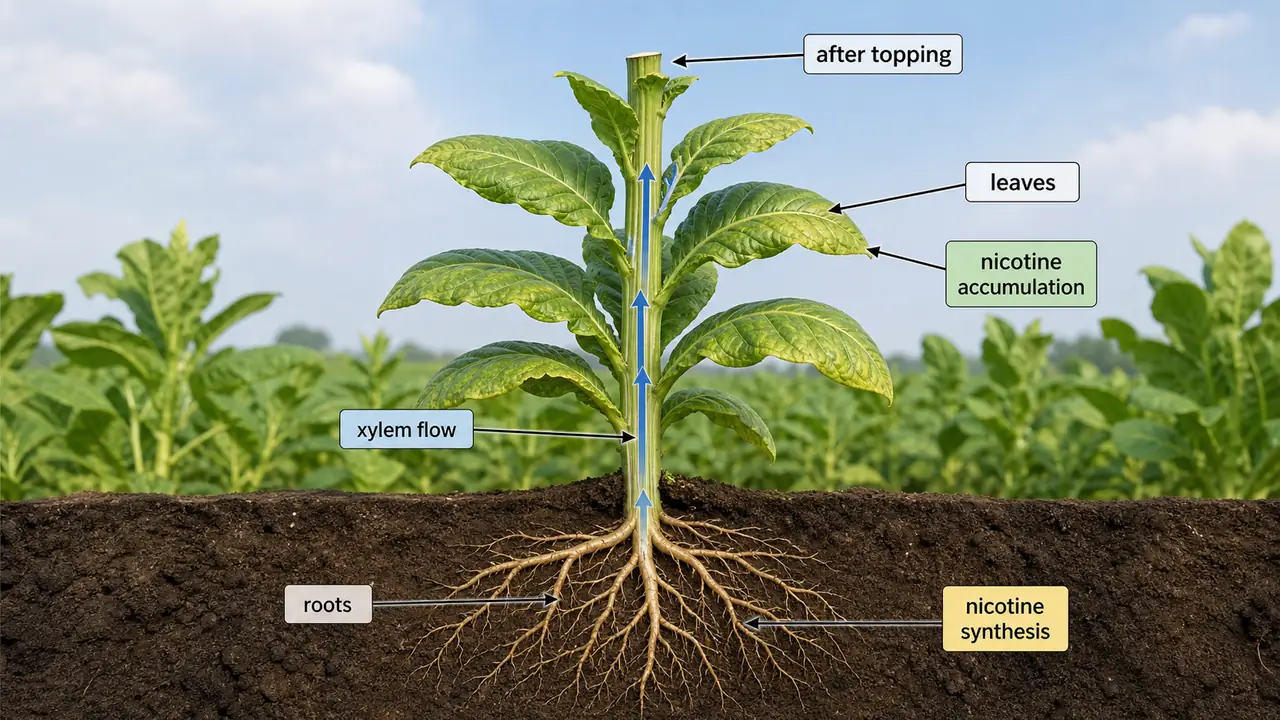
Among 12 alkaloids present in tobacco, nicotine is the most important, contributing about 97%. Nicotine is a pyridine alkaloid and the primary addictive compound in tobacco.
NOTE
Nicotine synthesis site vs accumulation site (frequently asked): Nicotine is produced in the roots but accumulates in the leaves. It is synthesized by root cells through a specific biochemical pathway and then translocated through the xylem to the leaves, where it accumulates in the vacuoles of leaf cells. After topping, nicotine levels in leaves increase because the roots continue to produce nicotine but there is no longer a growing tip to dilute it. The remaining 3% includes minor alkaloids like nornicotine, anabasine, and anatabine.
Sowing and Seed Details
| Parameter | Details |
|---|---|
| Seed rate | 2.5 to 3.0 kg/ha |
| Seed type | Positively photoblastic (require light for germination) and proteolytic |
| Sowing method | Seeds sown on the surface of the nursery bed (not buried deep, due to photoblastic nature) |
| Optimum sowing time | Second fortnight of August |
Positively photoblastic seeds require light exposure to trigger germination. The term proteolytic refers to the presence of protein-digesting enzymes that help break down seed coat proteins during germination.
Nitrogen Requirement by Tobacco Type
The nitrogen requirement varies dramatically depending on the intended use of the leaf:
| Low N Requirement | High N Requirement |
|---|---|
| Flue-cured | Chewing |
| Cigarette | Bidi |
| Cigar | Hookah |
- High N types (chewing, bidi, hookah) benefit from heavy nitrogen because it promotes large, thick leaves with higher nicotine content
- Low N types (FCV, cigarette, cigar) suffer from excess nitrogen -- it produces dark, thick leaves with high nicotine and poor burning quality. Light, thin, golden-coloured leaves with moderate nicotine are preferred
Important Varieties and Hybrids
| Type | Details |
|---|---|
| Mutant varieties | Jayashri, Bhavya |
| First hybrid | GTH-1 (Gujarat Tobacco Hybrid-1) -- demonstrates heterosis (hybrid vigour) |
Critical Operations in Tobacco Cultivation
Sequence of Operations
The sequence of different operations in tobacco crop is:
Topping --> Desuckering --> Priming --> Curing UPPSC 2021
This sequence is critical for exams. Each operation follows logically from the previous one and is aimed at maximizing leaf quality and yield.
TIP
Exam mnemonic -- TDPC: Topping, Desuckering, Priming, Curing. Remember the purpose: redirect energy from flowers to leaves (T), remove competing suckers (D), harvest mature lower leaves first (P), then process them (C).
Topping

- Removal of flower heads either alone or with a few upper/top leaves from the plant to improve leaf size and quality
- By removing the terminal flower bud (inflorescence), the plant's growth energy is redirected from reproductive growth to vegetative growth, resulting in larger, thicker, and more uniform leaves with higher nicotine content
- Topping also breaks apical dominance, which triggers the growth of lateral buds (suckers) that must be addressed by the next operation -- desuckering
- Most critical stage for irrigation is topping -- water stress during topping severely affects the redistribution of growth resources from the removed terminal bud to the remaining leaves
Desuckering
- After topping, auxiliary buds grow rapidly. Removal of such lateral branches or suckers/auxiliary buds is called desuckering
- The main aim of topping and desuckering is to divert energy and nutrients from the flower head to leaves exams
- Chemical desuckering (more efficient than manual removal) uses:
- NAA in triethanolamine (2%)
- MH -- Maleic Hydrazide (2%)
- IBA (2%)
Desuckering must be done promptly after topping because suckers grow rapidly and compete with leaves for nutrients, water, and photosynthates. MH (Maleic Hydrazide) suppresses sucker regrowth for a longer period than manual removal.
Priming

- Removal of mature lower leaves -- harvesting tobacco leaves in stages, starting from the bottom and working upward as leaves mature
- The lower leaves (called "lugs") mature first because they are oldest
- Entire harvest needs 5-6 primings at intervals of 7-10 days, removing 2-4 leaves per priming
- Popular in Cigarette, Wrapper, and Chewing type tobacco
Rabbing (Nursery Bed Sterilisation)

- Burning the seed bed before sowing with slow-burning farm waste materials like paddy husk, tobacco stubbles, waste grass, and palmyrah leaves
- A traditional nursery bed sterilisation technique where controlled heat serves to kill weed seeds, soil-borne pathogens, and insect larvae in the top soil layer
- Prevents damping off disease caused by Pythium aphanidermatum and P. debaryanum
- Also provides potash-rich ash as a nutrient source for young seedlings
Stalk Cutting Method
- Cutting the entire plant close to the ground, then hanging the stalk upon a stick or lath
- Popular in Hookah, Bidi, Cheroot, Cigar, and Chewing tobacco
- Unlike priming (individual leaves), this method harvests the entire plant at once
- The whole plant is hung upside down in curing barns or open sheds to dry
Priming vs Stalk Cutting -- Comparison
| Character | Priming | Stalk Cutting |
|---|---|---|
| Harvest unit | Individual leaves | Entire plant |
| Number of harvests | 5-6 primings | Single harvest |
| Used for | Cigarette, Wrapper, Chewing | Hookah, Bidi, Cheroot, Cigar, Chewing |
| Leaf quality | Higher (selective maturity) | Lower (mixed maturity) |
| Labour requirement | Higher | Lower |
Curing
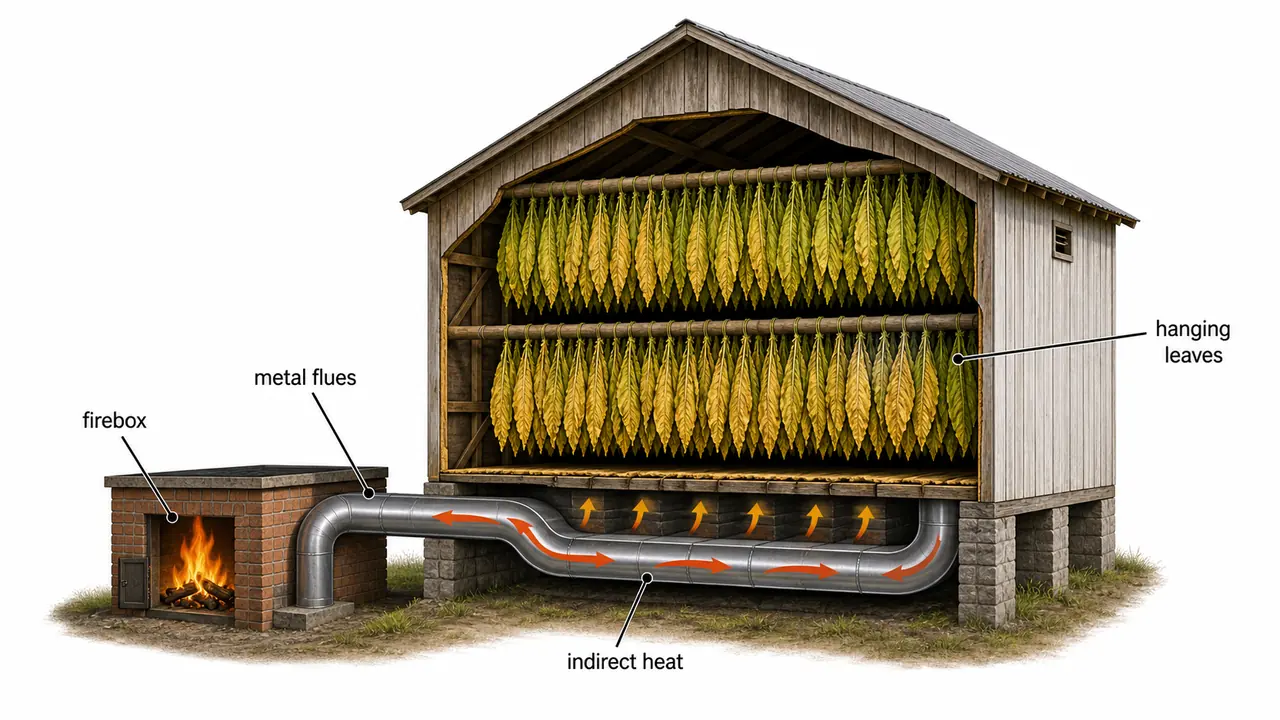
- A drying process whereby most of the moisture is removed to impart required colour, texture, and aroma to the final product
- Fresh leaf contains 85-90% moisture; cured leaf has about 12-15% moisture
- During curing, complex biochemical reactions develop the characteristic colour, aroma, flavour, and smoking quality
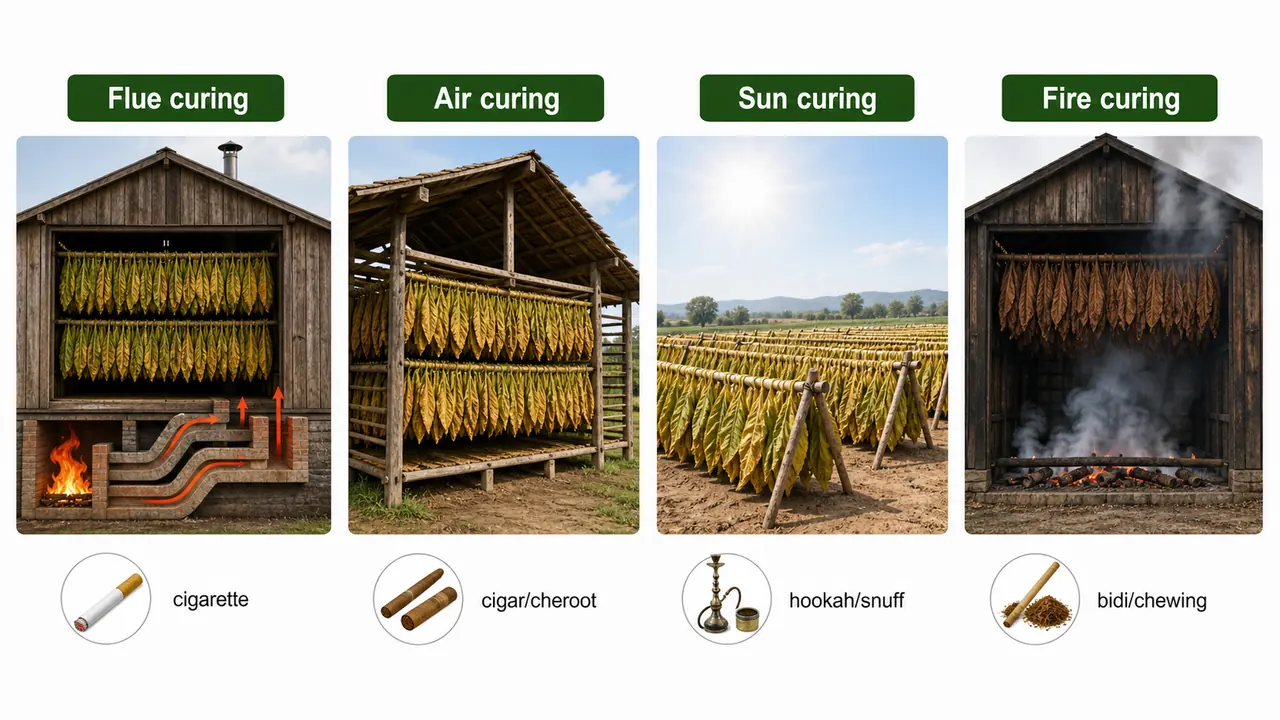
| Curing Method | Process | Leaf Colour | Used For |
|---|---|---|---|
| Flue curing | Heat through metal flues (no smoke contact) | Bright yellow to orange | FCV / Cigarette tobacco |
| Air curing | Dried in well-ventilated barns using natural air | Light to medium brown | Cigar, Chewing, Hookah |
| Sun curing | Dried under direct sunlight | Variable | Some oriental types |
| Fire curing | Leaves exposed to wood smoke | Dark, smoky | Snuff, Chewing |
Burning Quality and Potassium
- The tobacco burning quality is positively related to K (potassium) content of the leaf
- Potassium promotes complete combustion of the leaf (good burnability), resulting in a white or light grey ash
- High chloride content produces poor burning quality with a dark, hard ash
- Therefore, potassium sulphate (K2SO4) is the preferred potassium fertilizer for tobacco rather than muriate of potash (KCl), which would add unwanted chloride
TIP
Burning quality mnemonic -- "K Burns, Cl Kills": K (potassium) promotes good burning quality (white ash). Cl (chloride) kills burning quality (dark ash). Always use K2SO4 (SOP), never KCl (MOP) for tobacco. This same principle applies to potato (KCl not recommended for solanaceous crops).
Flopping in Tobacco

- Soils that stay wet for an extended period cause tobacco to flop or drown -- leaves droop toward the ground
- A physiological stress response where turgor pressure drops due to root damage from waterlogging
- The roots, deprived of oxygen in saturated soil, cannot absorb water efficiently, creating a paradoxical situation where the plant wilts despite being surrounded by water
- If waterlogging is brief, the plant may recover; prolonged flooding causes permanent root damage and severe yield loss
Summary Table -- Tobacco Key Exam Facts
| Fact | Details |
|---|---|
| Family | Solanaceae |
| Origin | Central America |
| Introduced to India by | Portuguese (around 1605) |
| Chromosome | 2n = 48 |
| World rank | 2nd largest producer (after China) |
| Key alkaloid | Nicotine (97% of 12 alkaloids) |
| Nicotine produced in | Roots |
| Nicotine accumulates in | Leaves |
| FCV area share | 30% area, 20% production |
| Non-Virginia share | 70% area, 80% production |
| Seed rate | 2.5-3.0 kg/ha |
| Seed type | Positively photoblastic |
| pH | 5.5-6.5 |
| Operations sequence | Topping > Desuckering > Priming > Curing (TDPC) |
| Burning quality | Positively related to K, negatively to Cl |
| Preferred K fertilizer | K2SO4 (NOT KCl) |
| First hybrid | GTH-1 |
| Sodic soils | Unfit (excess Cl, poor burning) |
IMPORTANT
Tobacco key exam facts: Portuguese introduced tobacco to India. Nicotine is synthesized in roots but accumulates in leaves. Operations sequence: TDPC (Topping > Desuckering > Priming > Curing). FCV = 30% area but only 20% production. Burning quality depends on potassium (positive) and chloride (negative). Use K2SO4, NOT KCl. Seed is positively photoblastic (needs light for germination).
Summary Cheat Sheet
| Concept / Topic | Key Details |
|---|---|
| Botanical name | Nicotiana tabacum; Family Solanaceae |
| Chromosome | 2n = 48 |
| Origin | Central America; introduced to India by Portuguese (~1605) |
| India's rank | 2nd largest producer (after China) |
| Key alkaloid | Nicotine (97% of 12 alkaloids) |
| Nicotine synthesis | In roots; accumulates in leaves |
| FCV (Flue Cured Virginia) | 30% area, 20% production — cigarette tobacco |
| Non-Virginia | 70% area, 80% production — bidi, chewing |
| Seed rate | 2.5-3.0 kg/ha |
| Seed type | Positively photoblastic (needs light for germination) |
| Pollination | Self-pollinated, with about 4-10% natural crossing |
| Operations sequence | TDPC — Topping > Desuckering > Priming > Curing |
| Flooping | Breaking terminal bud to increase leaf size |
| Rabbing | Burning debris in nursery for sterilization |
| Burning quality | Positive with K; negative with Cl |
| Preferred K fertilizer | K₂SO₄ (NOT KCl) |
| First hybrid | GTH-1 |
| Lightest test weight | 0.25-0.30 g (lightest among crops) |
| Sodic soils | Unfit (excess Cl, poor burning) |
| pH | 5.5-6.5 |
| Exhaustive crop | Feeds heavily on soil nutrients |