👜 Jute -- India's Golden Fibre and Its Retting Science (Complete Guide)
Master jute cultivation from Corchorus species to retting, stripping, and ribboning -- White vs Tossa jute, fibre extraction, harvesting, and exam-critical facts for exams, NABARD, and IBPS exams.
In the river basins of the Ganges-Brahmaputra delta, where warm humidity and fertile alluvial soils converge, jute plants grow up to 8-12 feet in just 120-150 days. After harvest, entire families wade waist-deep into ponds to strip fibres from water-soaked stalks -- a process called retting that has been practiced for centuries. This "Golden Fibre" of India provides the raw material for sacking, hessian, carpet backing, and now, eco-friendly shopping bags. For exams, jute retting (34 degrees C, 8-30 days), the 180 kg bale, and the distinction between Capsularis (White) and Olitorius (Tossa) jute are frequently tested topics.
This lesson covers:
- Basics -- botanical profile, bast fibre origin, and parenchymatous fibre
- Species comparison -- White Jute (C. capsularis) vs Tossa Jute (C. olitorius)
- Climate and soil -- warm humid conditions and alluvial soils
- Fibre extraction -- the complete retting, stripping, and ribboning process
- Varieties and yield -- JRC and JRO series from CRIJAF
All topics are high-yield for exams, NABARD, and FCI exams.
Pro Content Locked
Upgrade to Pro to access this lesson and all other premium content.
Pay once for one year · Effective ₹99/mo
- All Agriculture & Banking Courses
- AI Lesson Questions (100/day)
- AI Doubt Solver (50/day)
- Glows & Grows Feedback (30/day)
- AI Section Quiz (20/day)
- 22-Language Translation (100/day)
- Recall Questions (20/day)
- AI Quiz (15/day)
- AI Quiz Paper Analysis (100/day)
- AI Step-by-Step Explanations (100/day)
- Spaced Repetition Recall (FSRS)
- AI Tutor
- Immersive Text Questions
- Audio Lessons — Hindi & English
- Mock Tests & Previous Year Papers
- Summary & Mind Maps
- XP, Levels, Leaderboard & Badges
- Generate New Classrooms
- Voice AI Teacher (AgriDots Live)
- AI Revision Assistant
- Knowledge Gap Analysis
- Interactive Revision (LangGraph)
🔒 Secure one-time yearly payment via Razorpay · No hidden fees
In the river basins of the Ganges-Brahmaputra delta, where warm humidity and fertile alluvial soils converge, jute plants grow up to 8-12 feet in just 120-150 days. After harvest, entire families wade waist-deep into ponds to strip fibres from water-soaked stalks -- a process called retting that has been practiced for centuries. This "Golden Fibre" of India provides the raw material for sacking, hessian, carpet backing, and now, eco-friendly shopping bags. For exams, jute retting (34 degrees C, 8-30 days), the 180 kg bale, and the distinction between Capsularis (White) and Olitorius (Tossa) jute are frequently tested topics.
This lesson covers:
- Basics -- botanical profile, bast fibre origin, and parenchymatous fibre
- Species comparison -- White Jute (C. capsularis) vs Tossa Jute (C. olitorius)
- Climate and soil -- warm humid conditions and alluvial soils
- Fibre extraction -- the complete retting, stripping, and ribboning process
- Varieties and yield -- JRC and JRO series from CRIJAF
All topics are high-yield for exams, NABARD, and FCI exams.
Basics
Jute is a bast fibre crop -- the fibre comes from the inner bark of the stem, not from seeds (like cotton) or fruits (like coir). Understanding this distinction is critical for exam questions on fibre classification.
| Feature | Detail |
|---|---|
| Botanical Name | Corchorus spp. |
| Family | Tiliaceae |
| Origin | India |
| Chromosome No. | 2n = 14 |
| Fibre type | Parenchymatous fibre (from bast/inner bark of stem) |
| Hybrid seeds | Not available |
- Jute fibre comes from the parenchyma cells of the bast (inner bark) -- unlike cotton (seed fibre) or coir (fruit fibre).
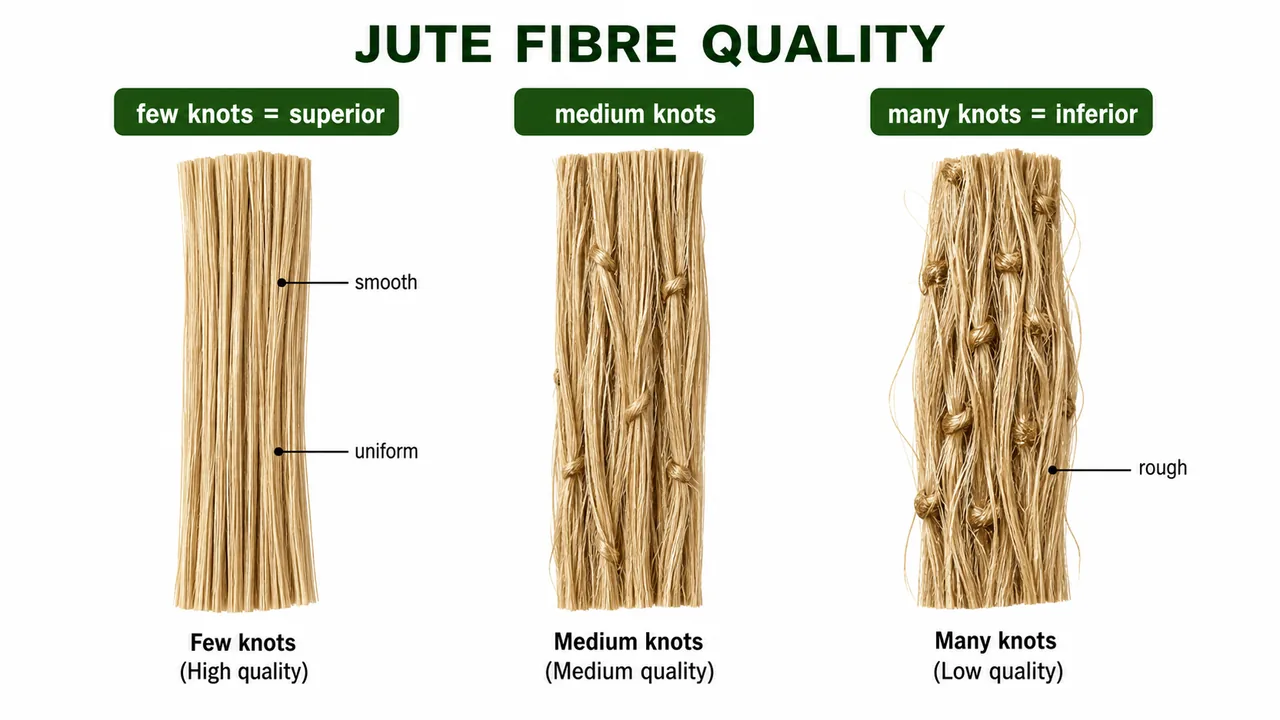
- Less number of knots per unit length indicates superior quality jute -- fewer knots mean greater smoothness, uniformity, and tensile strength of the fibre.
Jute Species -- Capsularis vs Olitorius
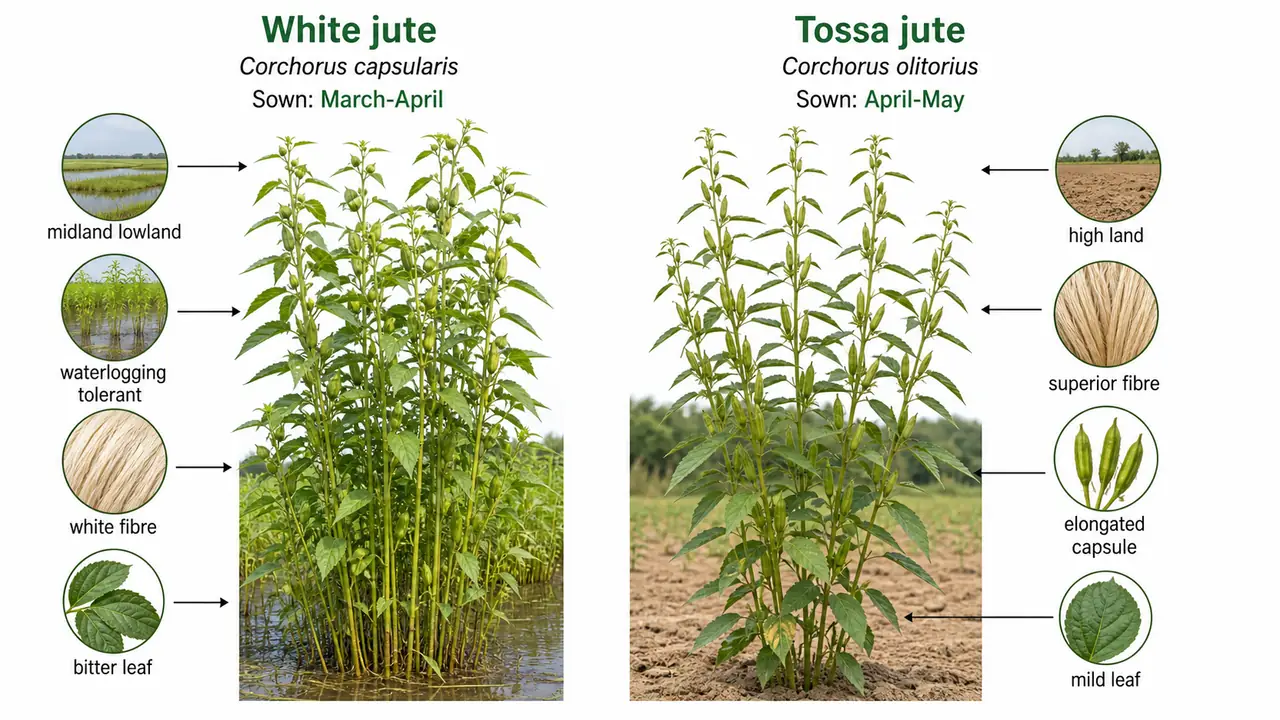
Two species of Corchorus are commercially cultivated. Their sowing time, seed rate, and fibre quality differ -- a favourite comparison topic in exams.
| Feature | C. capsularis (White Jute) | C. olitorius (Tossa Jute) |
|---|---|---|
| Common name | White Jute | Tossa Jute |
| Sowing time | March-April | April-May |
| Seed rate | 6-8 kg/ha | 4-5 kg/ha |
| Fibre quality | Good | Superior (finer, stronger) |
| Fruit shape | Round capsule | Elongated capsule |
- Generally, April sowing gives the best results in both types, coinciding with pre-monsoon showers and rising temperatures.
- Tossa jute requires a lower seed rate because its seeds are smaller and it produces more vigorous seedlings.
Climate
Jute requires a warm and humid climate -- the combination of heat, moisture, and long days promotes rapid vegetative growth and tall stems with more fibre.
| Parameter | Requirement |
|---|---|
| Climate | Warm and humid |
| Temperature range | 24-37°C |
| Optimum temperature | 34°C |
- High humidity promotes rapid vegetative growth and longer stems, directly translating to more fibre yield.
Soil
Jute thrives in the rich alluvial deposits of river deltas, which explains why West Bengal and Bangladesh dominate global production.
- Best: loamy alluvial soil (Gangetic delta and Brahmaputra valley -- naturally rich in organic matter and moisture).
- Not suitable: laterite and gravelly soils (poor water-holding capacity and low fertility).
- pH: 6-7.5
Yield
Jute produces massive green biomass, but only a small fraction is recoverable fibre -- the rest is woody stick (used as fuel and fencing material).
| Parameter | Detail |
|---|---|
| Green plant weight | 45-50 tonnes/ha |
| Fibre yield | 2.0-2.5 tonnes (20-25 q)/ha |
| Fibre fraction | Small fraction of total biomass (rest is woody stick/pith) |
Varieties
- JRC-321 (Sonali), JRC-212 (Sabuj Sona), JRC 7447 (Shyamli), D154, Hybrid C (Padma), KC1 (Joydev) etc.
- JRC = Jute Research Centre varieties, developed by ICAR-CRIJAF.
Harvesting
Harvesting jute at the correct stage is critical -- too early produces weak fibre with poor tensile strength, while too late yields coarse, brittle fibre that fetches lower market prices.
| Parameter | Detail |
|---|---|
| Ideal harvest stage | Small pod stage / initiation of pod formation (135-140 DAS) |
| Harvest window | 120-150 days |
| Plant height at harvest | 8-12 feet |
| 1 bale | 180 kg jute fibre |

- Harvesting at the right stage ensures best fibre quality -- too early gives weak fibre, too late gives coarse and brittle fibre.
- Plants are cut close to the ground with sickles.
- After harvest, plants are left in the field for 3 days for leaves to shed (defoliation) -- this prevents decaying leaves from staining the fibre during retting.
Fibre Extraction -- The Complete Process
Jute fibre extraction is a multi-step biological process. Unlike mechanical extraction used for cotton, jute relies on microbial decomposition (retting) to separate fibre from the woody core -- making it one of the most distinctive post-harvest processes in agriculture.
Step 1: Steeping/Soaking
After 2-4 days of harvesting, plants are shaken for complete leaf shedding and tied in bundles of about 20-22 cm diameter. The bundles are then ready for retting.

Step 2: Retting

| Parameter | Detail |
|---|---|
| Process | Bundles immersed in water; anaerobic bacteria break down pectin and binding materials |
| Water depth | 60-100 cm |
| Duration | 8-30 days |
| Optimum temperature | 34°C |
| Completion sign | Bark separates easily from the woody stick |
TIP
Jute retting essentials (exam favourite): Retting = microbial separation of fibre from stalk. Temperature = 34°C. Duration = 8-30 days. Water depth = 60-100 cm. 1 bale = 180 kg. Mnemonic: "34 degrees, 8-30 days, 60-100 cm, 180 kg" -- memorize these four numbers.
Step 3: Stripping (Fibre Extraction)

After retting is complete, workers stand waist-deep in water and strip the fibre by hand, pulling it away from the woody core.
Alternative: Ribboning
- Common in China and Taiwan, but not popular in India.
- The raw bark is peeled from the green plant immediately after harvest, and ribbons are retted separately.
- Produces cleaner, higher-quality fibre but is more labour-intensive.
- Reduces retting time significantly because only bark (not entire stem) is retted.
Important Jute Varieties
All major jute varieties in India are developed by ICAR-CRIJAF (Central Research Institute for Jute and Allied Fibres), Barrackpore, West Bengal. Varieties are prefixed with JRO (Tossa) or JRC (White).
| Species | Varieties |
|---|---|
| C. olitorius (Tossa jute) | JRO 524 (Navin), JRO 632 (Baisakhi Tossa), JRO 878 (Chaitali Tossa), JRO 7835 (Basudev), JRO 66 (Golden Jubilee Tossa) |
| C. capsularis (White jute) | JRC 212 (Sabujsona), JRC 321 (Sonali), JRC 7447, JRC 80 (Mitali), JRC 532 (Sashi), JRC 698, Bidhan Pat 1, KC 1 |
Summary Cheat Sheet
| Parameter | Detail |
|---|---|
| Botanical Name | Corchorus spp. |
| Family | Tiliaceae |
| Origin | India |
| Fibre type | Parenchymatous (bast fibre) |
| Species | C. capsularis (White), C. olitorius (Tossa) |
| Best sowing | April |
| Harvest | 120-150 DAS (pod initiation stage) |
| Retting temp | 34°C |
| Retting duration | 8-30 days |
| Water depth | 60-100 cm |
| 1 bale | 180 kg |
| Fibre yield | 20-25 q/ha |
| Best soil | Loamy alluvial |
| Inflorescence | Cymose |
| Ribboning | Bark peeled fresh, retted separately -- cleaner fibre (popular in China) |