🌰 Soybean -- The "Wonder Crop" with 40% Protein (Complete Guide)
Master soybean cultivation from Glycine max botany to Rhizobium inoculation -- climate, soil, nutrient management, Lipoxidase enzyme, varieties, and exam-critical facts for exams, NABARD, and IBPS exams.
In the previous lesson, we explored groundnut -- the "King of Oilseeds" with its unique geocarpic fruiting. Now we move to the crop that dominates global oilseed production by sheer volume.
Drive through the black-soil heartland of Madhya Pradesh during July-August, and vast stretches of green soybean fields dominate the landscape. This unassuming legume transformed India's oilseed economy within a few decades of its introduction from the USA in 1960. With 40% protein and 20% oil -- the reverse of most oilseeds -- soybean is the world's leading source of plant-based protein and earns nicknames like "Boneless Meat" and "Wonder Crop."
This lesson covers:
- Botany and composition -- the unique 40:20 protein-oil ratio and Lipoxidase enzyme
- Climate and soil -- why Madhya Pradesh is the soybean heartland
- Agronomy -- sowing, irrigation, and nutrient management
- Nitrogen fixation -- Rhizobium japonicum and inoculation
- Diseases and pests -- Yellow Mosaic Virus, stem fly, and more
- Varieties -- Indian and introduced cultivars
All sections are high-yield for exams, NABARD, and FCI exams.
Pro Content Locked
Upgrade to Pro to access this lesson and all other premium content.
Pay once valid for one year · Effective ₹99/month
- All Agriculture & Banking Courses
- AI Lesson Questions (100/day)
- AI Doubt Solver (50/day)
- Glows & Grows Feedback (30/day)
- AI Section Quiz (20/day)
- 22-Language Translation (100/day)
- Recall Questions (20/day)
- AI Quiz (15/day)
- AI Quiz Paper Analysis (100/day)
- AI Step-by-Step Explanations (100/day)
- Spaced Repetition Recall (FSRS)
- AI Tutor
- Immersive Text Questions
- Audio Lessons — Hindi & English
- Mock Tests & Previous Year Papers
- Summary & Mind Maps
- XP, Levels, Leaderboard & Badges
- Generate New Classrooms
- Voice AI Teacher (AgriDots Live)
- AI Revision Assistant
- Knowledge Gap Analysis
- Interactive Revision (LangGraph)
🔒 Secure one-time yearly payment via Razorpay · No hidden fees
In the previous lesson, we explored groundnut -- the "King of Oilseeds" with its unique geocarpic fruiting. Now we move to the crop that dominates global oilseed production by sheer volume.
Drive through the black-soil heartland of Madhya Pradesh during July-August, and vast stretches of green soybean fields dominate the landscape. This unassuming legume transformed India's oilseed economy within a few decades of its introduction from the USA in 1960. With 40% protein and 20% oil -- the reverse of most oilseeds -- soybean is the world's leading source of plant-based protein and earns nicknames like "Boneless Meat" and "Wonder Crop."
This lesson covers:
- Botany and composition -- the unique 40:20 protein-oil ratio and Lipoxidase enzyme
- Climate and soil -- why Madhya Pradesh is the soybean heartland
- Agronomy -- sowing, irrigation, and nutrient management
- Nitrogen fixation -- Rhizobium japonicum and inoculation
- Diseases and pests -- Yellow Mosaic Virus, stem fly, and more
- Varieties -- Indian and introduced cultivars
All sections are high-yield for exams, NABARD, and FCI exams.
Basics

Soybean is unique among oilseeds for its protein-dominant composition and its ability to fix atmospheric nitrogen, making it both a food security crop and a soil improver.
| Feature | Detail |
|---|---|
| Botanical Name | Glycine max |
| Family | Leguminosae (Papilionaceae) |
| Origin | Eastern Asia / China |
| Introduced to India | From USA in 1960 |
| Inflorescence | Raceme |
| Fruit | Pod |
| Nicknames | Boneless Meat / Yellow Jewel of America / Wonder Crop / Miracle Crop |

- "Boneless Meat" -- high-quality protein comparable to animal protein from a plant source.
- "Yellow Jewel of America" -- one of the most valuable agricultural commodities in the USA.
- "Wonder Crop" -- multiple uses (food, feed, oil, industrial products) plus nitrogen fixation ability.
Climate
Soybean requires warm, moist conditions and is primarily a Kharif crop in India. Its short-day photoperiod response and epigeal germination are frequently tested in exams.
| Parameter | Requirement |
|---|---|
| Climate | Warm and moist |
| Temperature | 26-32°C (optimum) |
| Water requirement | 600-750 mm |
| Photoperiod | Short-day plant |
| Photosynthetic pathway | C3 |
| Germination type | Epigeal |
- As a short-day plant, soybean initiates flowering when day length falls below a critical photoperiod, making it primarily a Kharif (monsoon) season crop in India.
- In epigeal germination, the cotyledons are pushed above the soil surface where they turn green and begin photosynthesis. This is why sowing depth is critical -- too deep sowing may prevent emergence.

Soil
Soybean performs best on neutral to slightly acidic soils that support its symbiotic nitrogen-fixing bacteria.
- Well-drained and fertile loam soils with pH 6.0-7.5 are most suitable.
- Neutral to slightly acidic soils support the activity of Rhizobium japonicum, the nitrogen-fixing bacteria.
- Sodic and saline soils inhibit germination due to osmotic stress that prevents the seed from absorbing water.
Sowing and Seed Rate
Sowing depth and timing are especially important in soybean because of its epigeal germination -- the cotyledons must push above the soil surface to begin photosynthesis.
| Parameter | Detail |
|---|---|
| Sowing time | 3rd week of June to 1st fortnight of July |
| Seed rate (normal) | 70-80 kg/ha |
| Seed rate (late planting) | 100-120 kg/ha |
| Spacing | 30 cm x 10 cm |
| Plant population | 3-4 lakh plants/ha |
| Depth of sowing | 3-4 cm |
- Higher seed rate for late planting compensates for reduced branching and smaller plant size.
- Correct depth ensures cotyledons can emerge (epigeal germination) while placing the seed in moist soil.
Irrigation
Soybean is predominantly rainfed in India during Kharif, but moisture stress at flowering and pod filling stages causes significant yield losses.
| Season | Requirement |
|---|---|
| Kharif | No need (monsoon sufficient) |
| Summer | 5-6 irrigations |
Critical Stages for Irrigation
- Sprouting stage -- ensures proper germination and seedling establishment.
- Flowering stage -- water stress causes flower drop and reduced pod set.
- Pod filling stage -- seeds accumulate protein and oil; water deficit directly reduces seed weight and quality.
- Grain development stage -- adequate moisture needed for maximum dry matter accumulation.
Nutritional Composition
Soybean's nutritional profile is the reverse of most oilseeds -- protein dominates over oil. This unique composition drives its industrial processing and global trade value.
| Component | Content |
|---|---|
| Protein | 40 per cent |
| Oil | 20 per cent |
| Key fatty acids | Linoleic acid (omega-6) and Oleic acid (omega-9) |
NOTE
Why soybean has 40% protein and 20% oil: This is the reverse ratio compared to most oilseeds (which have more oil than protein). This unique protein-dominant composition is why it is called "boneless meat" and is the world's leading source of plant-based protein.
- The "beany" off-flavour in soybean is caused by the enzyme lipoxygenase acting on polyunsaturated fatty acids to produce volatile sulphur compounds and aldehydes.
- Due to the enzyme Lipoxidase (Lipoxygenase), soybean is not used as dal -- it produces off-flavour. Instead, soybean is primarily processed into oil, soy milk, tofu, and soy flour.
TIP
Exam mnemonic -- "LIPO stops the DAL": Lipoxidase enzyme prevents soybean from being eaten as dal. Also remember the reverse ratio: 4-2 (40% protein, 20% oil) -- the opposite of most oilseeds.

Nutrient Management
As a nitrogen-fixing legume, soybean needs relatively low nitrogen input but benefits from higher phosphorus to promote root development and nodulation.
| Nutrient | Dose (kg/ha) |
|---|---|
| N | 40 |
| P | 60 |
| K | 40 |
| Zn | 5 |
- The relatively low nitrogen dose (40 kg/ha) reflects soybean's ability to fix its own nitrogen through Rhizobium symbiosis.
- Higher phosphorus (60 kg/ha) promotes root development and nodulation.
Nitrogen Fixation
Soybean's symbiotic relationship with Rhizobium japonicum is a core exam topic. The bacterium forms root nodules that convert atmospheric nitrogen into plant-usable forms, reducing the need for synthetic fertiliser.
| Parameter | Detail |
|---|---|
| N fixed | 40 kg N/ha |
| Nodule-forming bacterium | Rhizobium japonicum (gram-negative) |
| Nodule formation starts | 2-3 weeks after sowing |
| N-fixation starts | 2 weeks after nodule formation, up to 6-8 weeks |
- Rhizobium japonicum (now reclassified as Bradyrhizobium japonicum) specifically infects soybean roots. Seed inoculation before sowing is recommended, especially when soybean is grown in a field for the first time.
- The initial starter nitrogen (applied at sowing) sustains the seedling until nodules become active.

Varieties, Intercropping, and Weed Control
- Varieties: JS-2, 335, Indira Soya-9, PK-472, 1024, Gaurav, Ankur, Brag, Clark, NRC-2. The JS (Jawahar Soybean) series from JNKVV, Jabalpur dominates Indian soybean cultivation. JS-335 has been the most widely cultivated variety.
- Intercropping: with Cotton, Arhar, Maize etc. Soybean is an excellent intercrop partner -- a short-duration legume that fixes nitrogen.
- Weed control: Nitrofen @ 1.5 kg ai/ha (PRE) or Fluchloralin @ 1.0 kg ai/ha (PPI). Weed control in the first 30-45 days is crucial because soybean is a slow initial grower.
Yield and Harvesting
Timely harvesting at the correct moisture content is critical to minimise shattering losses in soybean.
| Parameter | Detail |
|---|---|
| Harvesting moisture | 20 per cent seed moisture |
| Indicator | Leaves start dropping, pods dried |
| Yield | 20-25 q/ha |
| Fodder harvest | Pod formation stage (maximum green biomass) |
- Harvesting at 20% moisture minimises shattering losses (pods splitting and dropping seeds in the field).
Disease
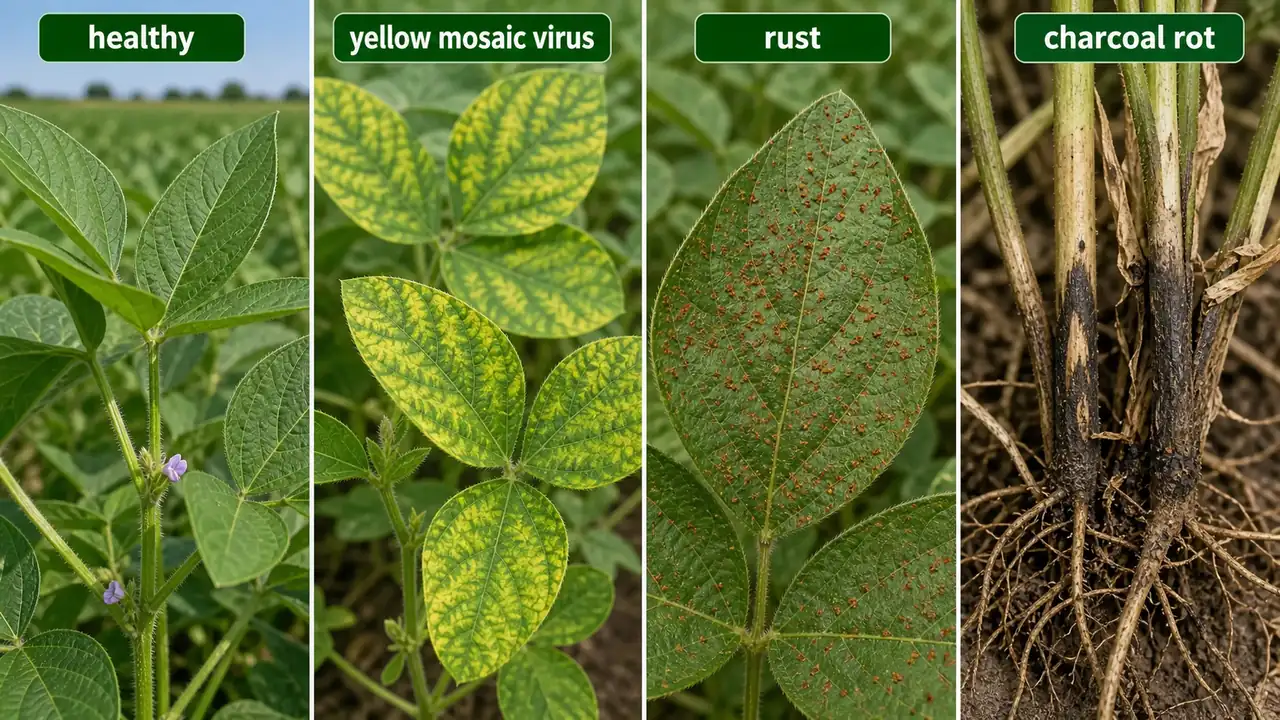
Soybean is affected by viral, fungal, and bacterial diseases. Yellow Mosaic Virus transmitted by whitefly is the most economically important disease in Indian conditions.
Major diseases include Yellow Mosaic Virus (YMV) (transmitted by whitefly), Charcoal rot (Macrophomina phaseolina), Bacterial pustule, Rust (Phakopsora pachyrhizi), and Rhizoctonia root rot. Management relies on resistant varieties, seed treatment, and IPM.
Insect-Pest
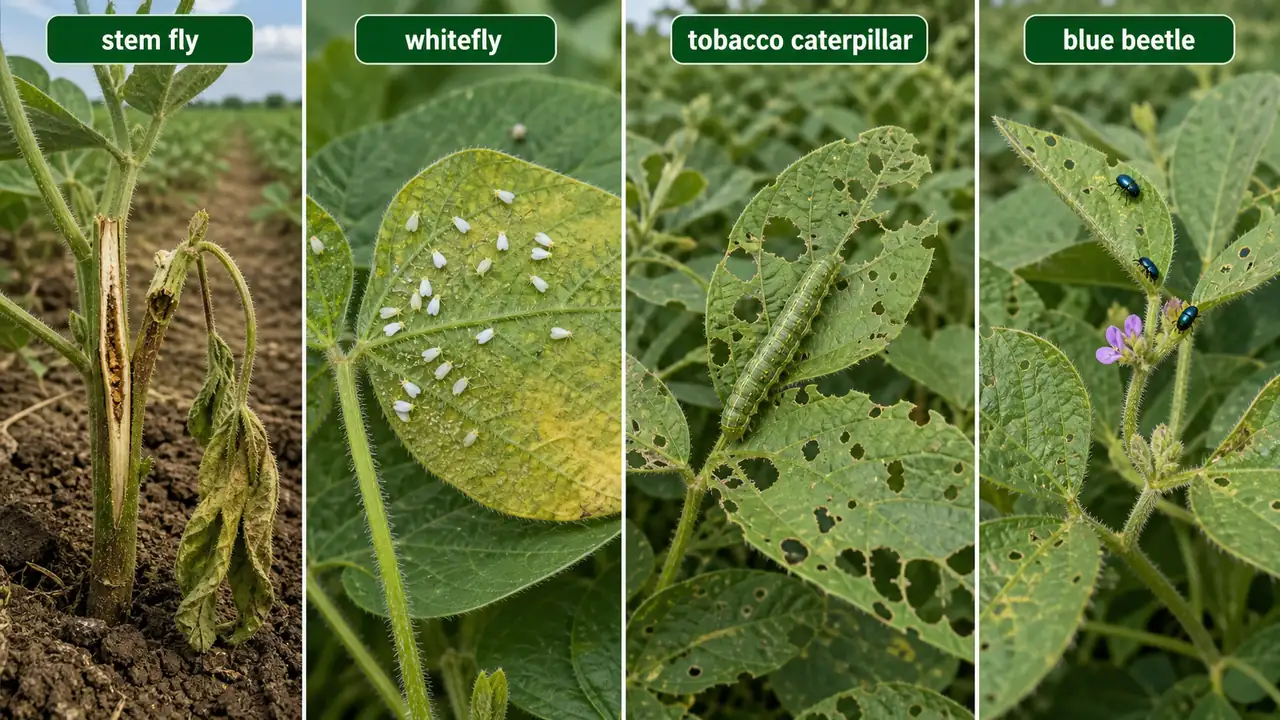
Soybean pests include both direct feeders and disease vectors. Managing the whitefly population is especially important because it transmits Yellow Mosaic Virus.
The stem fly (Melanagromyza sojae) tunnels inside stems causing wilting. Tobacco caterpillar (Spodoptera litura) is a voracious defoliator. Whitefly (Bemisia tabaci) is both a direct pest and the vector of Yellow Mosaic Virus. Blue beetle (Cneorane spp.) feeds on leaves and flowers.
Important Soybean Varieties
| Type | Varieties |
|---|---|
| Introduced from USA | Bragg, Lee, Kent, Blackheart, Clark-63 |
| Indian varieties | Shilajeet, Alankar, Ankur, Punjab-1, Monato |

Quick Revision Summary
| Parameter | Detail |
|---|---|
| Botanical Name | Glycine max |
| Family | Leguminosae |
| Origin | China; introduced to India from USA (1960) |
| Protein / Oil | 40% / 20% (reverse of most oilseeds) |
| Off-flavour enzyme | Lipoxidase (Lipoxygenase) |
| N-fixation | 40 kg N/ha via Rhizobium japonicum |
| Germination | Epigeal |
| Photoperiod | Short-day plant |
| Key disease | Yellow Mosaic Virus (whitefly vector) |
| Key pest | Stem fly, Tobacco caterpillar |
| Yield | 20-25 q/ha |
| Harvest moisture | 20% |
| Leading state | Madhya Pradesh |
TIP
Next: The next lesson covers Rapeseed and Mustard -- India's premier Rabi oilseed, the Triangle of U, and Canola varieties.
Soybean: Why It's the "Wonder Crop" — Practical Guide
Soybean is unique among crops — it is simultaneously a pulse AND an oilseed:
| Compare | Soybean | Groundnut | Chickpea |
|---|---|---|---|
| Protein | 40% (highest among oilseeds) | 25% | 20% |
| Oil | 20% | 45% | 5% |
| N-fixation | 40 kg N/ha (Rhizobium japonicum) | 40-60 kg N/ha | 80-100 kg N/ha |
| Photoperiod | Short-day (sensitive) | Day-neutral | Day-neutral |
| Season | Kharif | Kharif/Rabi | Rabi |
Critical cultivation decisions:
| Decision | Recommendation | Why |
|---|---|---|
| Inoculation | Seed treat with Rhizobium japonicum if sowing in new field | Soybean-specific Rhizobium strain; native soil bacteria won't nodulate soybean |
| Sowing time | First fortnight of July (Central India) | Short-day plant — early sowing causes excessive vegetative growth; late sowing reduces yield |
| Harvesting | At leaf yellowing + shedding; moisture ~20% | Delayed harvest causes pod shattering — severe yield loss (up to 20-30%) |
| Weed control | Critical first 30-45 days; use pre-emergence herbicide | Slow initial growth means weeds can dominate early |
Why Madhya Pradesh dominates: MP produces >50% of India's soybean. The black cotton soils (Vertisols) of Malwa plateau provide ideal moisture retention for this Kharif legume-oilseed.
Exam One-Liners: Amino Acid and Anti-Nutritional Factors
| Fact | Detail |
|---|---|
| Key amino acid | Soybean is rich in lysine, the amino acid commonly deficient in cereals. |
| Major fatty acid | Linoleic acid is the dominant fatty acid, about 54% of soybean oil. |
| Anti-nutritional factors | Trypsin inhibitor and hemagglutinins; heat processing reduces their activity. |
Summary Cheat Sheet
| Concept / Topic | Key Details / Explanation |
|---|---|
| Botanical name | Glycine max; Family Leguminosae (Papilionaceae) |
| Origin | Eastern Asia / China; introduced to India from USA in 1960 |
| Nicknames | Boneless Meat / Yellow Jewel of America / Wonder Crop / Miracle Crop |
| Protein / Oil | 40% protein / 20% oil — reverse of most oilseeds |
| Key amino acid | Lysine, important because cereals are lysine-poor |
| Key fatty acids | Linoleic acid (omega-6; about 54%) and Oleic acid (omega-9) |
| Anti-nutritional factors | Trypsin inhibitor and hemagglutinins |
| Off-flavour enzyme | Lipoxidase (Lipoxygenase) — prevents use as dal; produces beany flavour |
| Pollination | Self-pollinated; Short-day plant; C3 pathway |
| Germination | Epigeal — cotyledons pushed above soil surface |
| Climate | Warm and moist; temp 26-32°C; water requirement 600-750 mm |
| India leading state | Madhya Pradesh |
| World rank | Soybean = #1 global oilseed (by production) |
| Soil | Well-drained loam; pH 6.0-7.5; neutral-slightly acidic for Rhizobium activity |
| Sowing time | 3rd week of June to 1st fortnight of July |
| Seed rate (normal) | 70-80 kg/ha; late planting: 100-120 kg/ha |
| Sowing depth | 3-4 cm (critical for epigeal emergence) |
| Spacing | 30 x 10 cm |
| NPK | 40 : 60 : 40 kg/ha (high P for nodulation) |
| N fixation | 40 kg N/ha via Rhizobium japonicum (Bradyrhizobium japonicum) |
| Nodule formation | Starts 2-3 weeks after sowing; N-fixation from 2 weeks after nodule formation |
| Critical irrigation stages | Sprouting, Flowering (flower drop risk), Pod filling (protein/oil accumulation) |
| Harvesting moisture | 20% seed moisture; leaves dropping, pods dried |
| Yield | 20-25 q/ha |
| Key disease | Yellow Mosaic Virus (YMV) — transmitted by whitefly |
| Key pest | Stem fly (Melanagromyza sojae); Tobacco caterpillar (Spodoptera litura) |
| Key Indian varieties | JS-335 (most widely grown); Shilajeet, Alankar, Punjab-1 |
| Introduced varieties | Bragg, Lee, Kent, Clark-63 (from USA) |