🍲 Pigeonpea (Arhar/Tur) -- The Mini Fertiliser Crop
Master pigeonpea cultivation for exams -- Arhar vs Tur comparison, ICPH-8 first hybrid, UPAS-120, lowest harvest index, crop rotations, and exam-important variety tables for IBPS AFO and NABARD.
In the previous lesson, we covered chickpea -- the King of Pulses and India's most important Rabi pulse. Now we move to its Kharif counterpart: pigeonpea (arhar/tur), India's second most important pulse by area and production.
Walk through the fields of Maharashtra during the Kharif season and you will see pigeonpea -- tall, woody, and persistent -- growing alongside cotton, soybean, and sorghum. This "mini fertiliser crop" fixes atmospheric nitrogen in its root nodules, leaving behind 20-40 kg N/ha for the next crop. As India's second most important pulse after chickpea, arhar is a protein lifeline for millions.
This lesson covers:
- Basics and origin -- botanical classification, regional naming (Arhar vs Tur), and leading states
- Climate and pollination -- short-day behaviour, drought tolerance, and cross-pollination
- Sowing and fertiliser -- seed rates by duration type, crop rotations
- Key varieties -- ICPH-8 (world's first pulse hybrid), UPAS-120 (earliest variety)
- Diseases and pests -- Fusarium wilt and pod borer
- Yield and harvest index -- the lowest harvest index among pulses
All sections are high-yield for exams, NABARD, and FCI exams.
Pro Content Locked
Upgrade to Pro to access this lesson and all other premium content.
₹99 charged monthly · Cancel anytime
- All Agriculture & Banking Courses
- AI Lesson Questions (100/day)
- AI Doubt Solver (50/day)
- Glows & Grows Feedback (30/day)
- AI Section Quiz (20/day)
- 22-Language Translation (100/day)
- Recall Questions (20/day)
- AI Quiz (15/day)
- AI Quiz Paper Analysis (100/day)
- AI Step-by-Step Explanations (100/day)
- Spaced Repetition Recall (FSRS)
- AI Tutor
- Immersive Text Questions
- Audio Lessons — Hindi & English
- Mock Tests & Previous Year Papers
- Summary & Mind Maps
- XP, Levels, Leaderboard & Badges
- Generate New Classrooms
- Voice AI Teacher (AgriDots Live)
- AI Revision Assistant
- Knowledge Gap Analysis
- Interactive Revision (LangGraph)
🔒 Secure via Razorpay · Cancel anytime · No hidden fees
In the previous lesson, we covered chickpea -- the King of Pulses and India's most important Rabi pulse. Now we move to its Kharif counterpart: pigeonpea (arhar/tur), India's second most important pulse by area and production.
Walk through the fields of Maharashtra during the Kharif season and you will see pigeonpea -- tall, woody, and persistent -- growing alongside cotton, soybean, and sorghum. This "mini fertiliser crop" fixes atmospheric nitrogen in its root nodules, leaving behind 20-40 kg N/ha for the next crop. As India's second most important pulse after chickpea, arhar is a protein lifeline for millions.
This lesson covers:
- Basics and origin -- botanical classification, regional naming (Arhar vs Tur), and leading states
- Climate and pollination -- short-day behaviour, drought tolerance, and cross-pollination
- Sowing and fertiliser -- seed rates by duration type, crop rotations
- Key varieties -- ICPH-8 (world's first pulse hybrid), UPAS-120 (earliest variety)
- Diseases and pests -- Fusarium wilt and pod borer
- Yield and harvest index -- the lowest harvest index among pulses
All sections are high-yield for exams, NABARD, and FCI exams.
Basics

This section covers the foundational classification and economic parameters of pigeonpea -- the facts that anchor most exam questions on this crop.
| Parameter | Detail |
|---|---|
| Botanical name | Cajanus cajan |
| Species variants | C. cajan flavus (early maturing, yellow flowers) and C. cajan bicolor (late maturing, two-coloured flowers) |
| Family | Leguminaceae / Papilionaceae |
| Chromosome | 2n = 22 |
| Origin | Africa |
| Regional names | Arhar (North India), Tur (Maharashtra/South India), Red gram (English trade name) |
| Protein content | 22% |
- The genus name Cajanus derives from the Malay word katschang or katjang meaning pod or bean, reflecting the crop's ancient Southeast Asian trade connections.
- Arhar works as a mini fertiliser crop -- root nodules containing nitrogen-fixing bacteria convert atmospheric N2 into plant-usable forms, enriching the soil for subsequent crops.
- Second most important pulse in India after chickpea (area and production).
- Leading states: Maharashtra (highest, 30-35% of national production) > Madhya Pradesh > Uttar Pradesh > Bihar. Maharashtra leads because of favourable Vertisol (black cotton) soils and traditional dal consumption patterns.
Climate
Pigeonpea is a warm-season crop that thrives in tropical and subtropical environments. Unlike chickpea (a Rabi/long-day crop), pigeonpea is a short-day plant that flowers as days shorten after the monsoon -- this fundamental difference dictates its Kharif-season positioning.
| Parameter | Requirement |
|---|---|
| Climate | Warm tropical and subtropical |
| Vegetative phase | Fairly moist and warm |
| Flowering and ripening | Bright sunny weather (promotes pollinator activity) |
| Frost tolerance | Highly susceptible at flowering (brief frost destroys flowers and pods) |
| Temperature (Kharif) | 26-30 C |
| Temperature (post-rainy) | 17-22 C |
| Growing season | 120-180 days |
| Photoperiod | Short-day plant (flowers when days shorten after monsoon) |
| Photosynthetic pathway | C3 |
| Drought tolerance | High -- deep tap root accesses subsoil moisture |
Pollination and Seed
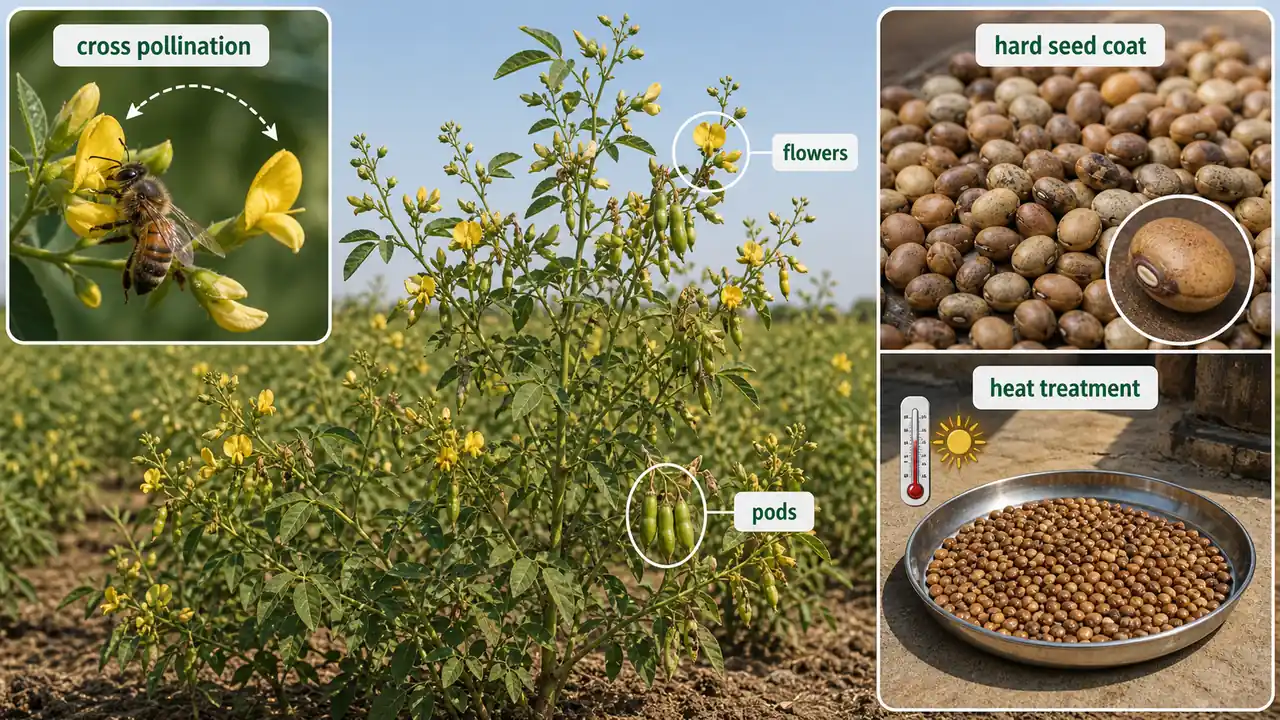
Pigeonpea's pollination biology is unusual among pulses -- it has a significant degree of natural cross-pollination (unlike the strictly self-pollinated chickpea or lentil). This cross-pollination is what made hybrid development (ICPH-8) feasible.
| Parameter | Detail |
|---|---|
| Pollination | Often-cross pollinated (average 20% cross-pollination) |
| Pod setting | Only 10% of flowers set pods -- this is natural and caused by resource competition within the plant, not a deficiency. The low pod-set ratio partly explains the low harvest index. |
| Germination | Hypogeal |
| Seed coat | Hard -- thermal energy (sun-drying/hot water) needed to break dormancy |

- Drought tolerance: Pigeonpea is the most drought-tolerant crop among major pulses -- due to its deep tap root system, leaf shedding under moisture stress (reduces transpiration), and strong recovery capacity when rains resume.
Weed Management
Pigeonpea is slow to establish canopy cover in the first 40-50 days, making early weed control critical for preventing yield losses.
- Alachlor and Pendimethalin as pre-emergence herbicides control annual grasses and broadleaf weeds before they compete with the young crop.
- Basalin (fluchloralin) as post-emergence addresses weeds that escape the pre-emergence application.
- One hand weeding at 30-40 DAS supplements chemical control and improves crop vigour.
Soil
Pigeonpea's deep tap root demands soils that allow unimpeded penetration, which is why soil texture and drainage are the primary selection criteria.
- Best on light-textured, fertile, well-drained loamy soils -- allows deep tap root penetration that contributes to the crop's drought tolerance.
- pH range: 5-8 (wide tolerance), making pigeonpea adaptable to diverse soil types across India.
- Saline-alkaline (>8 pH) and waterlogged soils are unsuitable -- high salt causes osmotic stress that inhibits root growth, while waterlogging destroys Rhizobium nodules and stops nitrogen fixation.
Sowing
Sowing time in pigeonpea varies by region and cropping system. Early sowing (April) enables a double-cropping system where pigeonpea is harvested in time for a subsequent Rabi crop like wheat or chickpea.
Sowing Time
| Region/Type | Time |
|---|---|
| Medium-early (double cropping) | 1st fortnight of April |
| Late pigeonpea | 1st week of July |
| Pre-Rabi | September-October |
| Punjab and Haryana | 1st week of June |
| UP and Rajasthan | 2nd fortnight of June |
Early sowing (April) allows harvesting in time for a subsequent Rabi crop (double cropping).
Seed Rate
| Type | Seed Rate |
|---|---|
| Early pigeonpea | 15-18 kg/ha (smaller, less branching -- needs denser population) |
| Late pigeonpea | 10-15 kg/ha (vigorous, wider spread) |
| Bund planting | 2 kg/ha |

- Spacing: 60 x 30 cm
- Plant population (Kharif): 55,000 plants/ha
- Critical irrigation stages: Pre-flowering and Pod development
Comparison Between Arhar and Tur
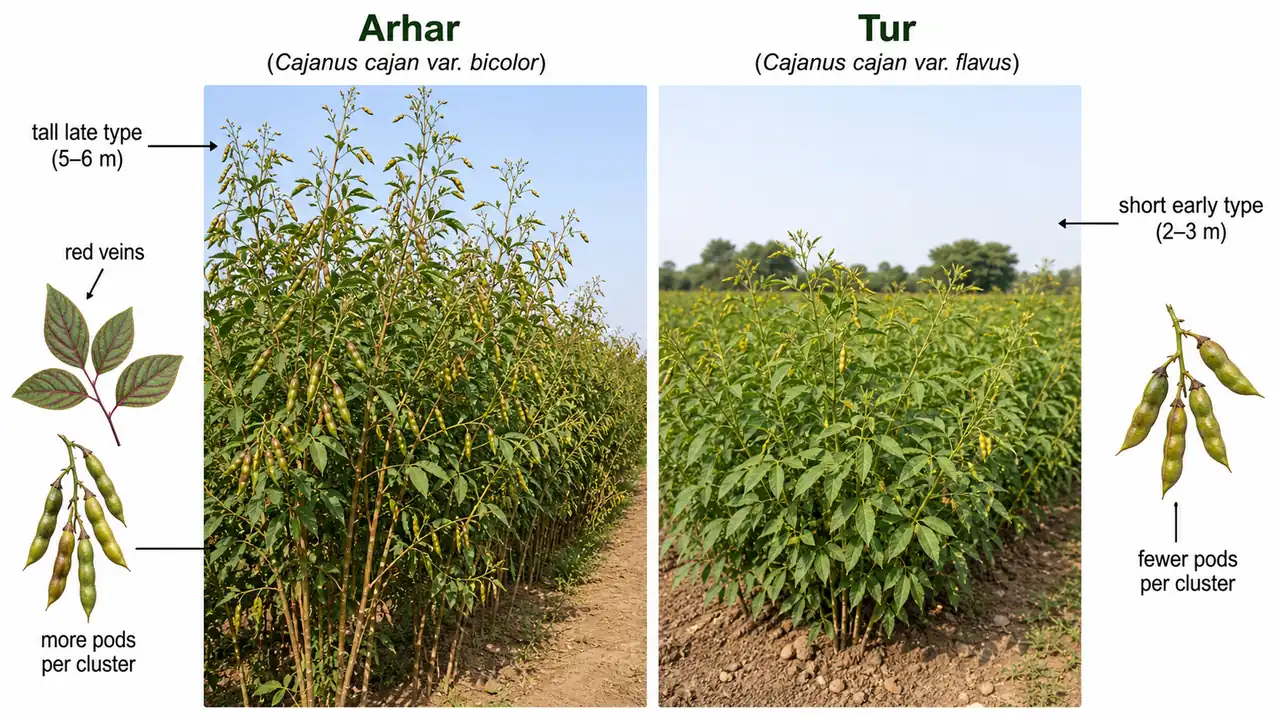
The Arhar-Tur naming distinction is a frequently asked exam question. Both names refer to the same species (Cajanus cajan), but regional usage and maturity-type associations differ.
| Feature | Arhar (North India) | Tur (South/West India) |
|---|---|---|
| Region | Uttar Pradesh, Bihar, Jharkhand | Maharashtra, Karnataka, Andhra Pradesh |
| Typical duration | Medium to late (150-180 days) | Early to medium (120-150 days) |
| Cropping system | Sole crop or intercrop with cereals | Intercrop with soybean, sorghum, cotton |
| Trade name | Arhar dal | Toor dal |
Crop Rotations with Pigeonpea
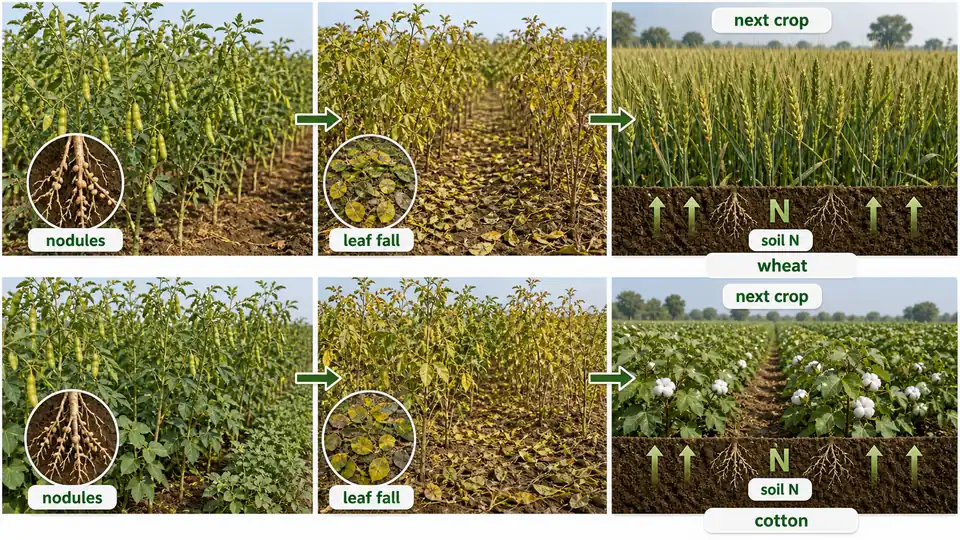
Pigeonpea is one of the most versatile pulses for crop rotation because it fixes 20-40 kg N/ha, breaks pest and disease cycles of cereals, and adds significant organic matter through heavy leaf fall and deep root biomass. The following rotations are commonly practised across different agro-climatic zones.
| Rotation |
|---|
| Paddy -- Paddy -- Pigeonpea |
| Groundnut + Pigeonpea -- Sorghum/Bajra/Maize |
| Groundnut -- Rabi Pigeonpea |
| Urad bean -- Rabi Pigeonpea |
| Soybean -- Rabi Pigeonpea |
| Pigeonpea + Urad bean -- Wheat |
| Mung bean -- Pigeonpea |
| Pigeonpea -- Cotton |
Fertiliser Management
Like other legumes, pigeonpea fixes its own nitrogen through Rhizobium symbiosis and needs only a starter N dose. However, phosphorus is critical for nodule formation and energy transfer -- without adequate P, nitrogen fixation efficiency drops sharply.
| Nutrient | Dose | Rationale |
|---|---|---|
| N | 20-25 kg/ha | Starter dose only -- legume fixes own N via Rhizobium |
| P | 50-65 kg/ha | Critical for root development, nodulation, and N-fixation efficiency |
| K | 20-35 kg/ha | General plant health |
| Zn | 2-4 ppm (foliar ZnSO4 @ 0.5%) | Corrects deficiency, improves pod set and seed weight |
| Ca | 0.25% lime | Soil amendment |
Varieties
| Duration group | Important varieties |
|---|---|
| Extra-short-duration varieties | UPAS-120, ICPL 87, ICPL 151 (Jagriti), Pant A3, Prabhat, Pragati, CO2, AL 15 |
| Short duration varieties | Pusa Ageti, T21, HY2, Pusa 84, CO1 |
| Medium duration varieties | HY 1, HY 3A, HY 5, Mukta (R60) |
| Late duration varieties | C11, Bahar, Laxmi (Kanke-3), Gwalior |
| Characteristic / suitability | Varieties |
|---|---|
| Early maturing (120 DAS) | UPAS 120, Manak, Paras, Prabhat |
| Determinate type | Durga, Sarita, Pusa 84 |
| Suitable for Rabi planting | Sharad, Bahar, Pusa 9 |
| Drought and temperature tolerant | Manak |
| Sterility mosaic and wilt resistant | Azad, Amar, Narendra Arhar 1 |
| Wilt resistant | Azad, Amar, Maruthi, Pusa 9, Mukta |
| Sterility mosaic resistant | Bahar |
| Pod borer resistant | Asha, ICP332, ICP1903, ICPL84660 |
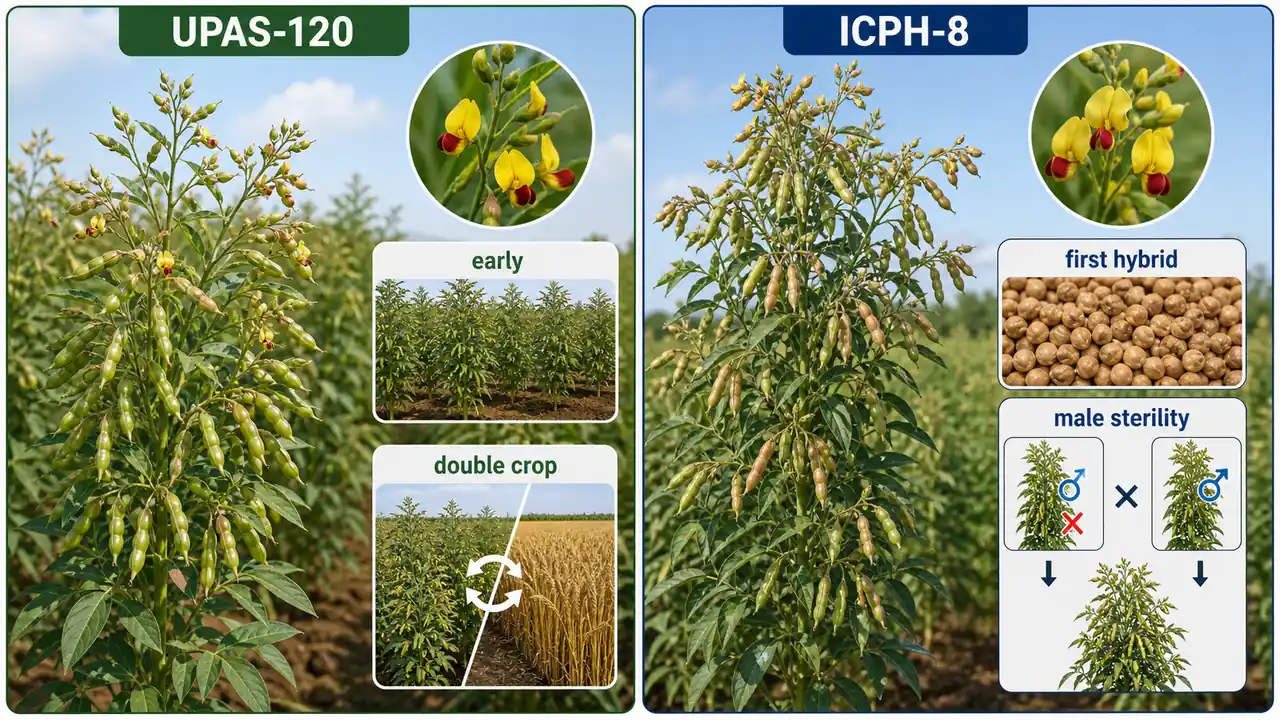
Pigeonpea variety development has two landmark achievements that are repeatedly tested in exams: UPAS-120 (the earliest maturing variety enabling double cropping) and ICPH-8 (the world's first hybrid of any pulse crop).
Key Milestone Varieties
| Variety | Significance |
|---|---|
| UPAS-120 | Earliest variety (120 days) -- suited for short-duration cropping systems |
| ICPH-8 | World's first hybrid of pigeonpea (and of any pulse), developed by ICRISAT, Hyderabad in 1991 using Genetic Male Sterility (GMS). Matures in 130-132 days, 20 q/ha productivity. |
TIP
Pigeonpea firsts (exam must-know): Earliest variety = UPAS-120 (120 days). World's first pulse hybrid = ICPH-8 (ICRISAT, 1991, GMS system). Lowest harvest index among pulses = 19%.
Diseases
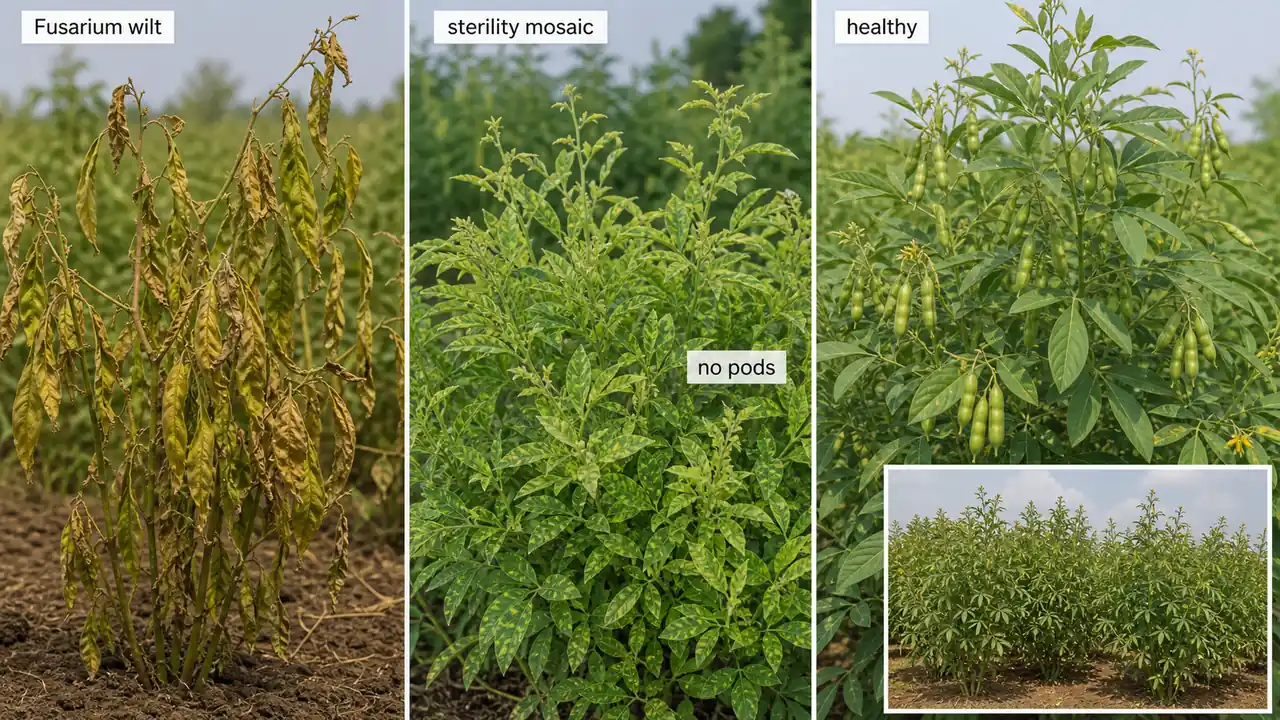
Pigeonpea faces two major diseases that exams test repeatedly. Unlike chickpea where Ascochyta blight is significant, pigeonpea's primary constraints are Fusarium wilt and Sterility Mosaic Disease (SMD).
| Disease | Cause | Impact |
|---|---|---|
| Fusarium Wilt | Fusarium udum | Most devastating -- yellowing and wilting of entire plant |
| Sterility Mosaic Disease (SMD) | Transmitted by eriophyid mite (Aceria cajani) | Major constraint to production -- infected plants produce no pods (hence "sterility") |
WARNING
Fusarium wilt in pigeonpea vs chickpea: Both crops suffer from Fusarium wilt, but the causal species differ. Pigeonpea wilt is caused by Fusarium udum, while chickpea wilt is caused by Fusarium oxysporum f. sp. ciceri. Do not interchange these in exams.
Management: resistant varieties (Birsa Arhar 1, Pusa 991, Pusa 2001), crop rotation with cereals, and seed treatment with fungicides.
Insect Pests
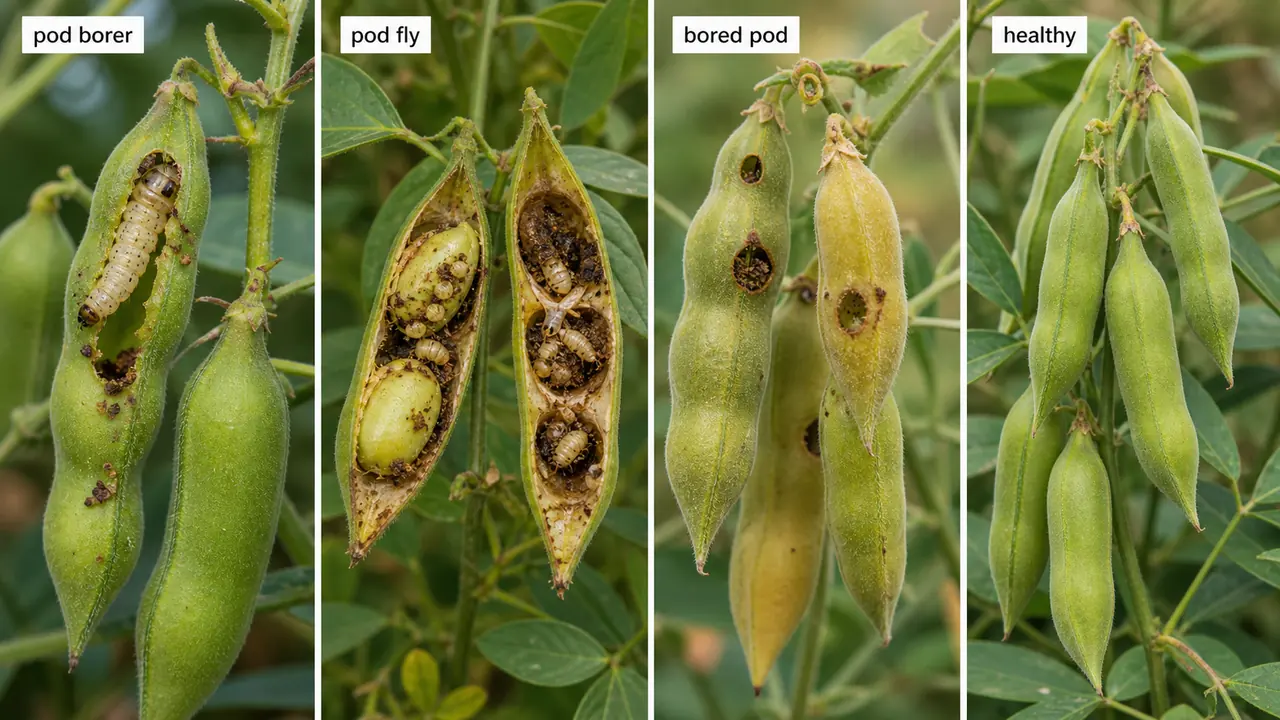
Pod borer (Helicoverpa armigera) is the single most destructive insect pest of pigeonpea -- the same species that devastates chickpea and cotton. Pod fly is the second major pest and is unique to pigeonpea among major pulses.
| Pest | Damage |
|---|---|
| Pod borer (Helicoverpa armigera) | Most destructive -- 30-80% yield loss |
| Pod fly (Melanagromyza obtusa) | Lays eggs inside pods; larvae feed on seeds from within |
Yield and Harvest
Pigeonpea produces not just grain but also significant quantities of woody sticks used for firewood and fencing -- a secondary income source for farmers. The harvest index is the lowest among all pulses because pigeonpea is botanically a perennial shrub that allocates a large proportion of photosynthate to woody stems and deep roots.
| Parameter | Value |
|---|---|
| Grain yield | 20-25 q/ha |
| Sticks (firewood/fencing) | 50-60 q/ha |
| Storage moisture | 10-11% |
| Seed to pod ratio | 50-60% |
| Harvest Index | 19% (lowest among pulses) -- because pigeonpea is a perennial shrub investing heavily in woody stems and roots |
Important Pigeonpea Varieties
These varieties are frequently asked in exams, NABARD, and IBPS SO papers. Focus on maturity duration categories and disease resistance.
| Variety | Special Characteristics |
|---|---|
| UPAS-120, Pusa Ageti | Short duration (120-125 days), suitable for pigeonpea-wheat intercropping |
| Prabhat | Extra early variety (110-120 days), suitable for pigeonpea-wheat intercropping |
| ICPH-8 | 1st hybrid of arhar/pulses in the world |
| BDN 1, 2, C-11, Mukta (wilt resistant), Sharda, Basant, Paras | Medium duration (150-180 days) |
| Pusa-9 | Long duration (180-300 days) |
| Birsa Arhar 1, Pusa 991, Pusa 2001, Azad, ICPL 8863, Vaishali, Anmol, BDN 1, BDN 2 | Wilt resistant |
| AL 15, Durga | Determinate varieties |
| PPH-4, ICPL-15 | Short duration varieties |
WARNING
T1 (1948) is a mungbean variety, not pigeonpea. Some reference tables list it under pigeonpea by mistake. T1 was the first released variety of greengram (mungbean).
Summary Table -- Pigeonpea at a Glance
| Parameter | Value |
|---|---|
| Botanical name | Cajanus cajan |
| Family | Leguminaceae |
| Origin | Africa |
| Chromosome | 2n = 22 |
| Protein | 22% |
| Pollination | Often-cross pollinated (20% crossing) |
| Photoperiod | Short-day, C3 |
| Season | Kharif (North India); Kharif + Rabi (South India) |
| Growing duration | 120-180 days |
| Drought tolerance | Most drought-tolerant among major pulses |
| N fixation | Mini fertiliser crop (leaves 20-40 kg N/ha) |
| Harvest Index | 19% (lowest among pulses) |
| Earliest variety | UPAS-120 (120 days) |
| World's 1st pulse hybrid | ICPH-8 (ICRISAT, 1991, GMS) |
| Leading state | Maharashtra (30-35% production) |
| Most devastating disease | Fusarium Wilt |
| Most destructive pest | Pod borer (Helicoverpa armigera) |
Summary Cheat Sheet
| Concept / Topic | Key Details |
|---|---|
| Botanical name | Cajanus cajan; Family Leguminaceae |
| Origin | Africa; Chromosome 2n = 22 |
| Regional names | Arhar (North), Tur (Maharashtra/South), Red gram |
| Protein | 22%; 2nd most important pulse after chickpea |
| Pollination | Often-cross pollinated (~20% crossing) |
| Photoperiod | Short-day plant; C3 pathway |
| Mini fertiliser crop | Fixes 20-40 kg N/ha via Rhizobium |
| Harvest Index | 19% — lowest among pulses |
| UPAS-120 | Earliest variety (120 days) |
| ICPH-8 | World's first pulse hybrid (ICRISAT, 1991, GMS system) |
| Leading state | Maharashtra (30-35% of national production) |
| Fusarium Wilt | Most devastating disease (Fusarium udum) |
| Pod borer | Helicoverpa armigera — 30-80% yield loss |
| Sterility Mosaic Disease | Transmitted by eriophyid mite |
| Seed rate (early) | 15-18 kg/ha |
| Grain yield | 20-25 q/ha |
| Pod setting | Only 10% of flowers set pods |
| Germination | Hypogeal; hard seed coat needs thermal treatment |
| Drought tolerance | Most drought-tolerant among major pulses |
TIP
Next: Lesson 3 covers Lentil and Field Pea -- two essential Rabi pulses. Lentil gave its name to the optical lens, and field pea gave Mendel the foundation for genetics.
| Prabhat | Extra early variety (110-120 days) |