🔅 Pearl Millet (Bajra) -- The Most Drought-Tolerant Cereal
Complete guide to pearl millet cultivation covering protogyny, climate, HB-1 hybrid, jerking, minor millets, and exam-important variety tables for exams, NABARD, and IBPS SO.
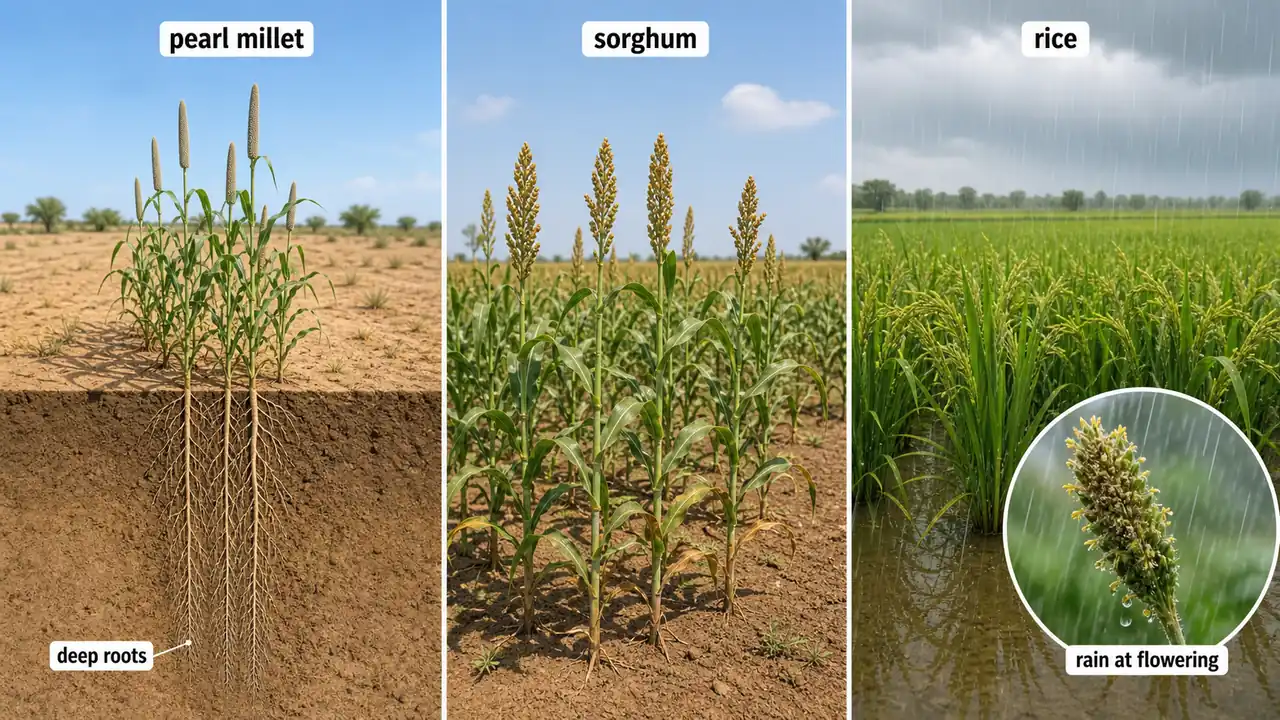
In the sandy dunes of western Rajasthan, where annual rainfall barely crosses 250 mm and temperatures soar above 45 C, pearl millet grows where no other cereal can survive. Known as the "Poor Man's Food," bajra feeds millions in the driest corners of Africa and Asia. It is the most drought-tolerant cereal on the planet, requiring only 250-350 mm of rainfall.
In the previous lesson, we covered Sorghum -- the King of Coarse Cereals requiring 400-600 mm rainfall. Pearl millet survives in even drier conditions (250-350 mm) and is distinguished by its protogyny (female matures first), contrasting with sorghum's often cross-pollinated nature and maize's protandry.
This chapter covers:
- Basics and protogyny -- botany, cross-pollination mechanism
- Climate -- extreme drought tolerance, rainfall sensitivity at flowering
- Seed rate and soil -- phytate storage, acid soil sensitivity
- HB-1 hybrid -- India's first pearl millet hybrid (1965)
- Jerking -- the unique cultural practice for uniform flowering
- Diseases -- Downy mildew (Green Ear Disease), Ergot, Smut
- Minor millets overview -- quick reference for all seven minor millets
For competitive exams, pearl millet brings unique topics -- protogyny, the HB-1 hybrid milestone, jerking, and phytate storage of phosphorus.
Pro Content Locked
Upgrade to Pro to access this lesson and all other premium content.
₹99 charged monthly · Cancel anytime
- All Agriculture & Banking Courses
- AI Lesson Questions (100/day)
- AI Doubt Solver (50/day)
- Glows & Grows Feedback (30/day)
- AI Section Quiz (20/day)
- 22-Language Translation (100/day)
- Recall Questions (20/day)
- AI Quiz (15/day)
- AI Quiz Paper Analysis (100/day)
- AI Step-by-Step Explanations (100/day)
- Spaced Repetition Recall (FSRS)
- AI Tutor
- Immersive Text Questions
- Audio Lessons — Hindi & English
- Mock Tests & Previous Year Papers
- Summary & Mind Maps
- XP, Levels, Leaderboard & Badges
- Generate New Classrooms
- Voice AI Teacher (AgriDots Live)
- AI Revision Assistant
- Knowledge Gap Analysis
- Interactive Revision (LangGraph)
🔒 Secure via Razorpay · Cancel anytime · No hidden fees
In the sandy dunes of western Rajasthan, where annual rainfall barely crosses 250 mm and temperatures soar above 45 C, pearl millet grows where no other cereal can survive. Known as the "Poor Man's Food," bajra feeds millions in the driest corners of Africa and Asia. It is the most drought-tolerant cereal on the planet, requiring only 250-350 mm of rainfall.
In the previous lesson, we covered Sorghum -- the King of Coarse Cereals requiring 400-600 mm rainfall. Pearl millet survives in even drier conditions (250-350 mm) and is distinguished by its protogyny (female matures first), contrasting with sorghum's often cross-pollinated nature and maize's protandry.
This chapter covers:
- Basics and protogyny -- botany, cross-pollination mechanism
- Climate -- extreme drought tolerance, rainfall sensitivity at flowering
- Seed rate and soil -- phytate storage, acid soil sensitivity
- HB-1 hybrid -- India's first pearl millet hybrid (1965)
- Jerking -- the unique cultural practice for uniform flowering
- Diseases -- Downy mildew (Green Ear Disease), Ergot, Smut
- Minor millets overview -- quick reference for all seven minor millets
For competitive exams, pearl millet brings unique topics -- protogyny, the HB-1 hybrid milestone, jerking, and phytate storage of phosphorus.
Pearl Millet / Bajra -- Basics
| Parameter | Detail |
|---|---|
| Botanical name | Pennisetum glaucum Exams |
| Family | Poaceae |
| Chromosome | 2n = 14 |
| Origin | Africa |
| Title | Poor Man's Food -- affordable, nutritious staple for arid regions |
| Pollination | Cross-pollinated due to protogynous condition |
| Photoperiod | Short-day plant |
Protogyny -- Why Pearl Millet Is Cross-Pollinated
In protogyny, the stigma (female part) matures and becomes receptive before the anthers (male part) release pollen on the same spike. This temporal separation promotes cross-pollination rather than self-pollination -- the exact opposite of maize's protandry.

TIP
Exam mnemonic: "Proto-GYNY = Female First" in pearl millet (cross-pollinated). Compare with maize: "Proto-ANDRY = Male First" (also cross-pollinated). Both mechanisms promote outcrossing.
Climate
| Parameter | Requirement |
|---|---|
| Weather | Warm -- thrives in hot, dry conditions |
| Optimum temperature | 27-30 C |
| Rainfall | 250-350 mm (lowest among all cereals) |
| Drought tolerance | Most drought-tolerant cereal (deep roots, dormancy under dry spells, regrowth when moisture returns) |
| Rainfall at flowering | Harmful -- washes off pollen, causes poor seed setting |
NOTE
Key exam distinction: Pearl millet = most drought-tolerant cereal (250-350 mm). Sorghum = "Camel Crop" (400-600 mm). Both are C4 short-day plants, but bajra thrives in even drier conditions.
Seed Rate and Sowing
| Parameter | Value |
|---|---|
| Seed rate (grain) | 4-5 kg/ha |
| Seed rate (fodder) | 10-12 kg/ha (denser stand for biomass) |
| Sowing | Rainfed, June-July (monsoon onset) |
| Spacing | 45 x 12-15 cm |
| Plant population | ~1,66,000 plants/ha |
| Sowing depth | 2-3 cm (shallow -- surface moisture dries quickly in drylands) |
| Germination | Hypogeal (cotyledons remain below soil) |
| Nutrient / component | Value |
|---|---|
| Carbohydrate | 67% |
| Moisture | 12.4% |
| Protein | 11.6% |
| Fat | 5% |
| Minerals | 2.7% |
Soil
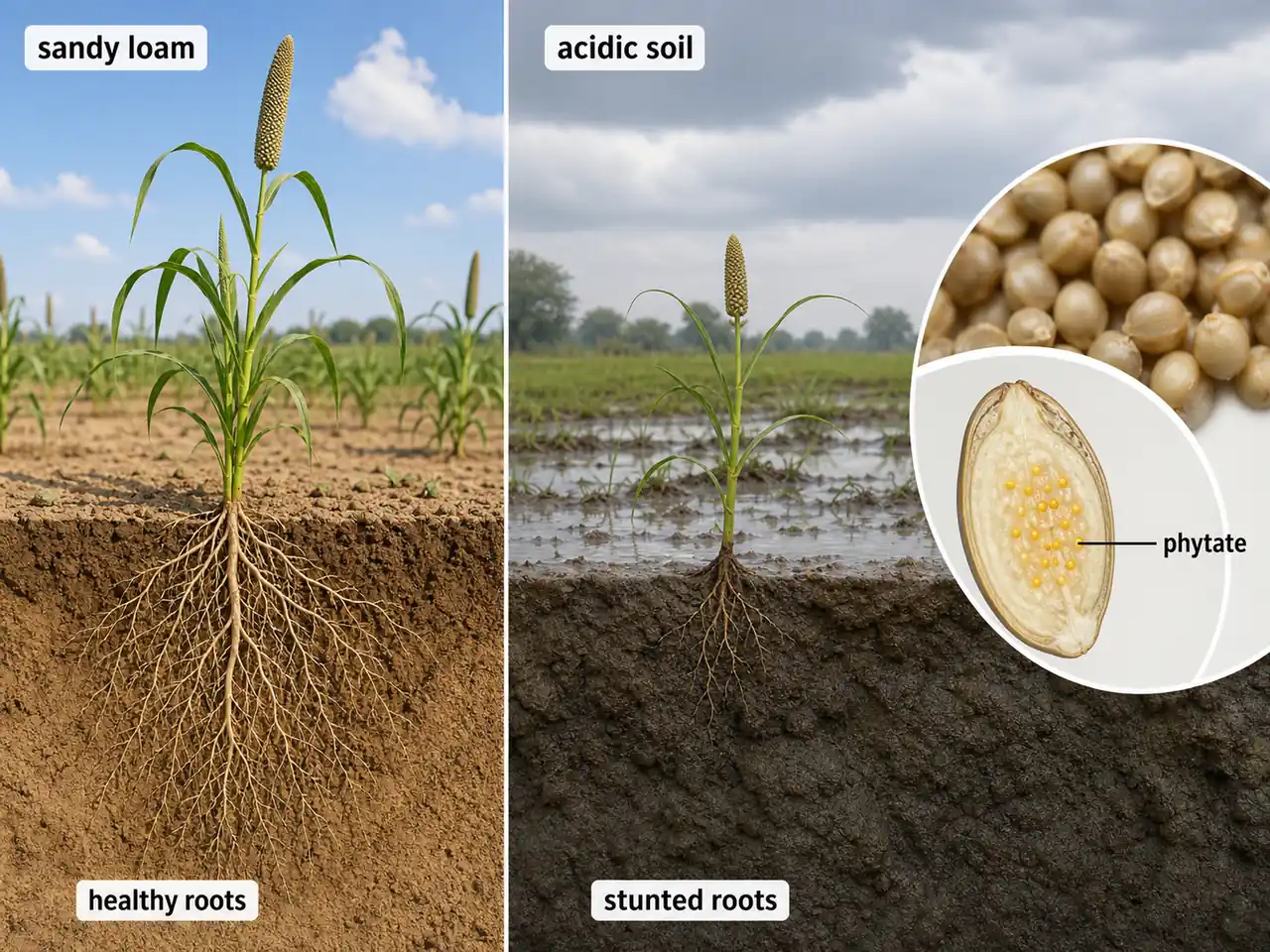
- Best on well-drained sandy loams (good root penetration, no excess moisture).
- Sensitive to waterlogging (damages roots, promotes disease).
- Sensitive to acidic soils (low pH causes aluminium toxicity, stunting roots).
- 80% of phosphorus in grain is stored as phytate -- an anti-nutritional factor for humans and monogastric animals because they lack the enzyme phytase to digest it.
Manure and Fertilisers
| Input | Recommendation |
|---|---|
| FYM | 10-15 tonnes/ha |
| N | 100 kg/ha |
| P2O5 | 50 kg/ha |
| K2O | 40 kg/ha |
Hybrids and Key Facts
| Milestone | Detail |
|---|---|
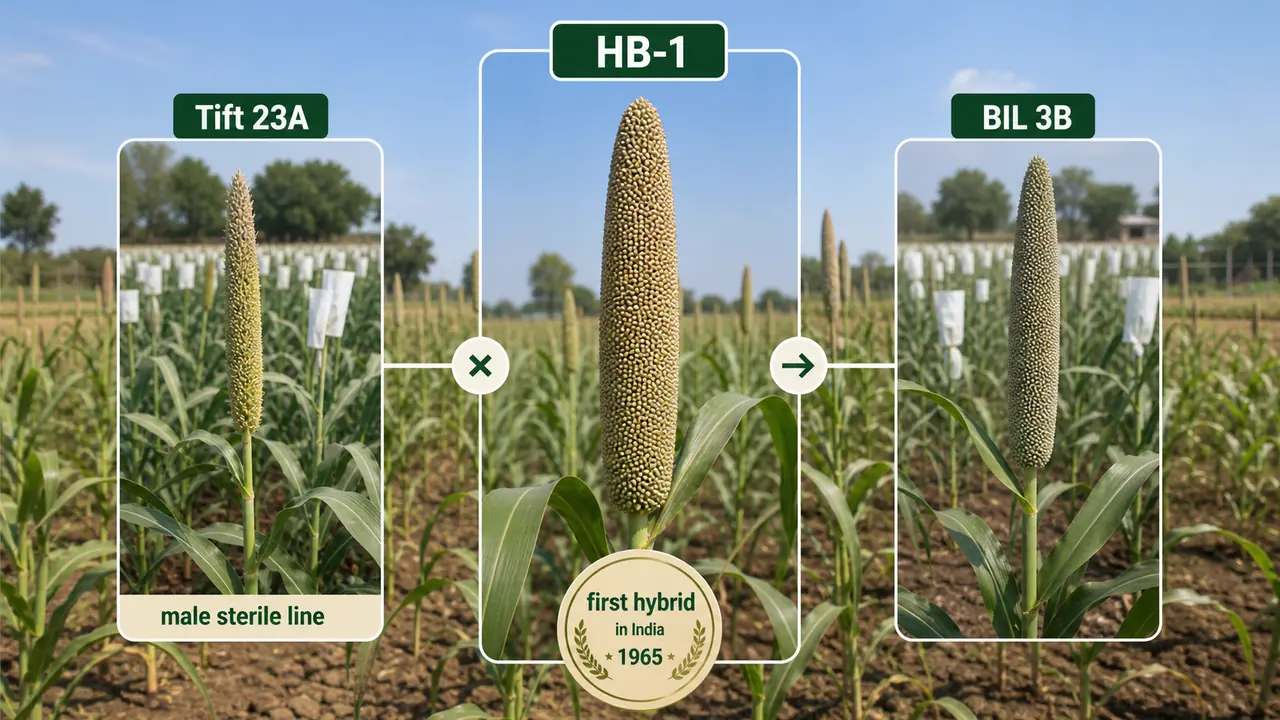
| 1st Hybrid | HB-1 (Tift 23A x BIL 3B) in 1965 -- first hybrid pearl millet in India using CMS line Tift 23A from USA |
| HB-4 | 1st hybrid using local male parent (80-85 days duration) |
| Productivity ranking | Highest in Uttar Pradesh > Gujarat > Haryana |
| Weed control | Atrazine/Propazine @ 0.5 kg/ha as pre-emergence |
Jerking -- A Unique Cultural Practice
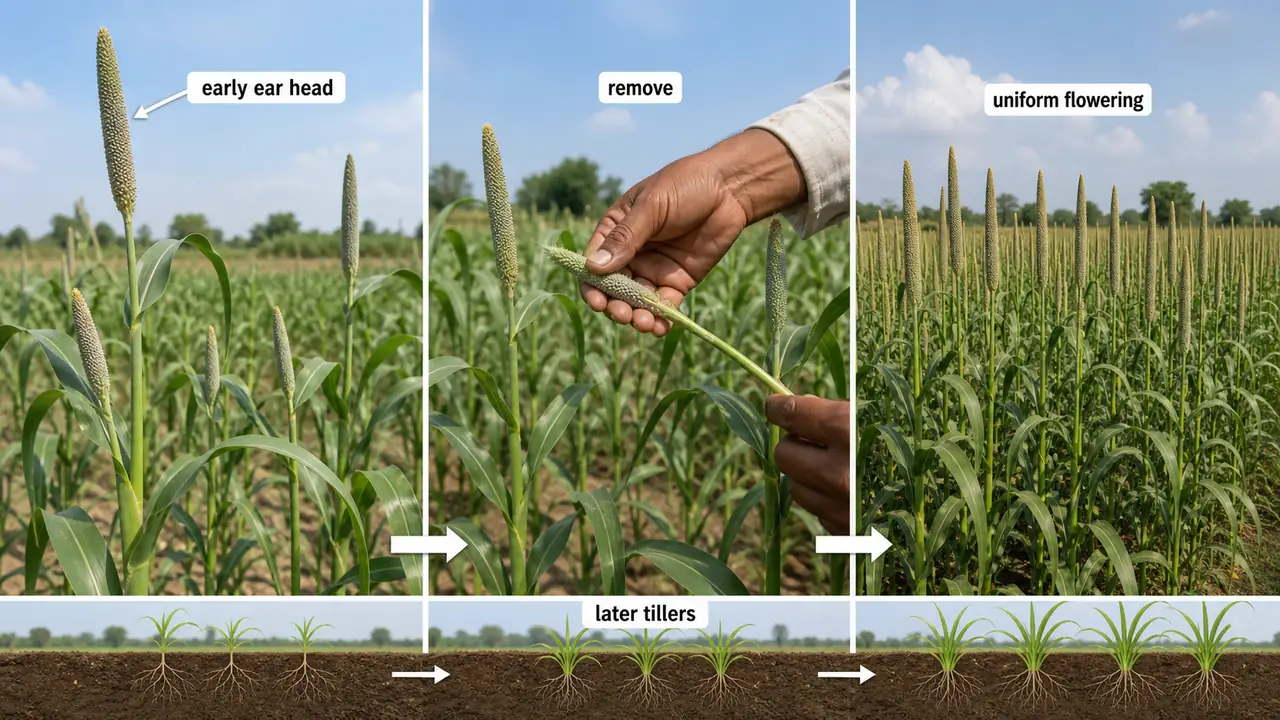
Jerking is done 20-25 days after transplanting (or 30-40 days after direct sowing). The early-formed ear heads of the first tillers are pulled out, which ensures uniform flowering of all tillers. This leads to uniform maturity, making harvesting easier and reducing grain losses from uneven ripening.
Diseases
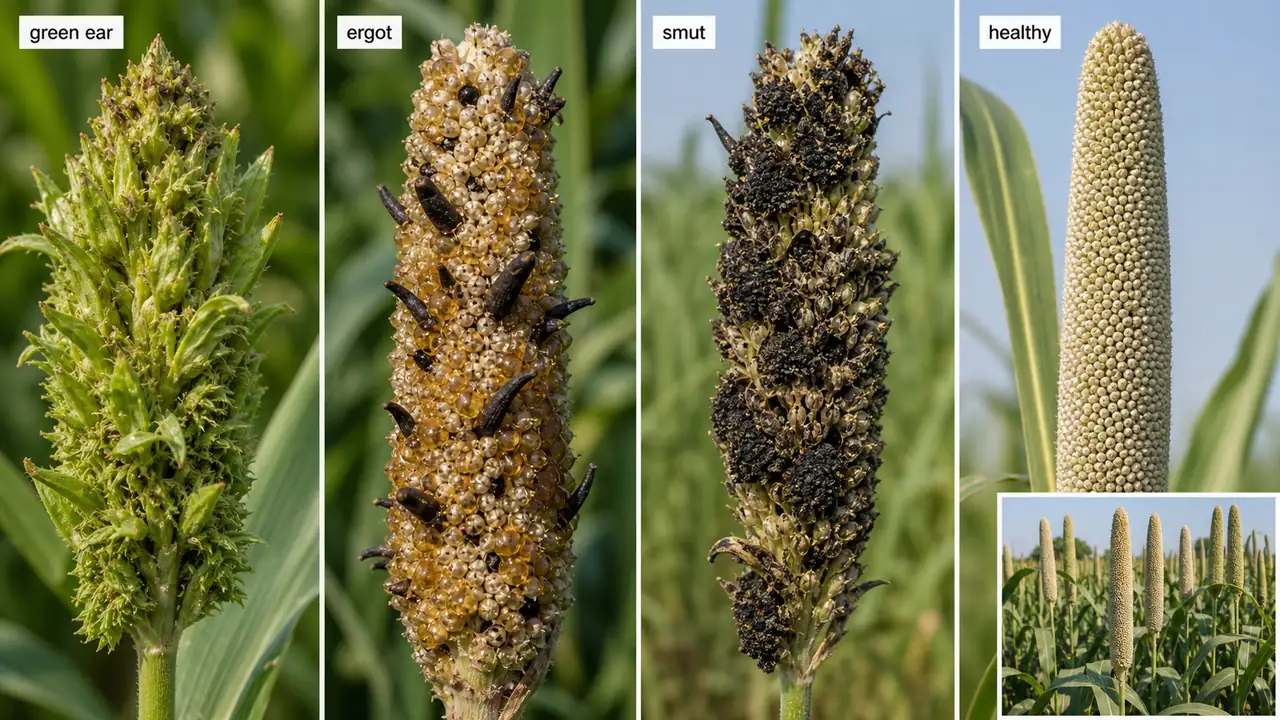
| Disease | Cause | Key Feature |
|---|---|---|
| Downy mildew (Green Ear Disease) | Sclerospora graminicola | Most devastating -- floral parts transform into leafy structures |
| Ergot | Claviceps fusiformis | Affects ear heads |
| Smut | Moesziomyces penicillariae | Grain replaced by black spore mass |
Yield
| Condition | Yield |
|---|---|
| Rainfed | 12-16 q/ha |
| Irrigated | 25-35 q/ha (nearly double with supplemental irrigation) |
| Fodder | 300-400 q/ha |
| Harvest moisture | ~20% |
Important Pearl Millet Varieties Asked in AFO/NABARD
| Variety | Special Characteristics |
|---|---|
| HB 1 (Tift 23A x Bil 3B using CMS system) | First hybrid variety released from Ludhiana in 1965 |
| Tift 23-A | First male sterile line |
| HHB-67, BJ-104, Pusa Moti, RH-30 | Other popular varieties |
| ES 1 | First open-pollinated variety |
| PHB-10 | Hybrid released from PAU, Ludhiana |
Other Millets (Minor Millets)
Minor millets are mostly grown in dryland areas and are increasingly valued as nutri-cereals for their high mineral and fibre content.
Cheena / Proso Millet
- Panicum miliacearum
- Very short growing season (60-90 days), extremely low water requirement.

Little Millet
- Panicum sumatrense
- Rich in iron and fibre; adapted to poor soils and low rainfall.

Foxtail / Italian / German Millet / Kakun
- Setaria italica
- 2nd most widely grown millet globally; rich in dietary fibre, iron, and calcium.

Kodo Millet
- Paspalum scrobiculatum
- Coarsest millet (largest grain size); high fibre, low glycemic index -- beneficial for diabetic patients.

Madua / Ragi / Finger Millet
- Eleusine coracana
- Most important minor millet in India; richest cereal source of calcium (344 mg/100g). Staple in Karnataka and Tamil Nadu.

Sawan / Barnyard Millet
- Echinochloa frumentacea
- Fastest growing millet (45-60 days); rich in fibre and iron; used as fasting food in India.

Japanese Millet
- Echinochloa esculenta
- Primarily a fodder crop suited to wet, marshy conditions; rapid growth and high green biomass.

Summary Table -- Pearl Millet at a Glance
| Parameter | Value |
|---|---|
| Botanical name | Pennisetum glaucum |
| Family | Poaceae |
| Origin | Africa |
| Chromosome | 2n = 14 |
| Title | Poor Man's Food |
| Pollination | Cross-pollinated (protogyny) |
| Photoperiod | Short-day |
| Photosynthetic pathway | C4 |
| Water requirement | 250-350 mm (lowest among cereals) |
| Drought tolerance | Most drought-tolerant cereal |
| Seed rate | 4-5 kg/ha |
| 1st hybrid | HB-1 (1965) |
| Male sterile line | Tift 23-A |
| Unique practice | Jerking (uniform flowering) |
| Phosphorus storage in grain | 80% as phytate |
| Downy mildew | Green Ear Disease (Sclerospora graminicola) |
| Inflorescence | Ear (cylindrical spike) |
| Most important minor millet | Finger millet (Ragi) -- 344 mg Ca/100g |
Summary Cheat Sheet
| Concept / Topic | Key Details |
|---|---|
| Botanical name | Pennisetum glaucum; Family Poaceae; Origin Africa |
| Chromosome | 2n = 14 |
| Title | Poor Man's Food -- affordable staple for arid regions |
| Pollination | Cross-pollinated due to protogyny (female matures first) |
| Photoperiod | Short-day plant; C4 pathway |
| Inflorescence | Ear (cylindrical spike) |
| Water requirement | 250-350 mm -- lowest among all cereals |
| Drought tolerance | Most drought-tolerant cereal on Earth |
| Seed rate | 4-5 kg/ha (grain); 10-12 kg/ha (fodder) |
| 1st hybrid | HB-1 (Tift 23A x BIL 3B) in 1965 |
| Male sterile line | Tift 23-A (from USA) |
| Jerking | Pull early ear heads at 20-25 DAT for uniform flowering |
| Phytate | 80% of grain phosphorus stored as phytate (anti-nutritional) |
| Downy mildew | Green Ear Disease -- Sclerospora graminicola |
| Ergot | Claviceps fusiformis -- affects ear heads |
| Smut | Moesziomyces penicillariae -- grain replaced by black spores |
| Rainfall at flowering | Harmful -- washes off pollen, poor seed setting |
| Ragi (Finger millet) | Eleusine coracana; richest cereal source of calcium (344 mg/100g) |
| Barnyard millet | Echinochloa frumentacea; fastest growing millet (45-60 days) |
| Kodo millet | Paspalum scrobiculatum; coarsest millet; low glycemic index |
TIP
Next: The following lesson covers Minor Millets in detail -- finger millet (ragi), foxtail, kodo, barnyard, proso, little, and Japanese millets with their nutritional profiles and varieties.