🍲 Mungbean, Urdbean, and Moth Bean -- Short-Duration Pulse Crops
Complete guide to greengram, blackgram, and moth bean covering protein content, day-neutral behaviour, YVMV resistance, mutant varieties, and exam-important comparison tables for exams, NABARD, and IBPS SO.
In the previous lessons, we covered the major Rabi pulses -- chickpea, pigeonpea, lentil, and field pea. Now we turn to three closely related Kharif/Zaid pulses from the genus Vigna that are often compared in exam questions.
Between the harvest of wheat in April and the sowing of rice in June, Indian farmers squeeze in a quick crop of mungbean or urdbean to earn extra income and add nitrogen to the soil. These short-duration pulses are the backbone of India's Zaid and Kharif pulse production. Mungbean holds the record for the highest protein content among all pulses (24%), while moth bean survives on little more than morning dew in the deserts of Rajasthan.
This lesson covers:
- Mungbean (greengram) -- highest protein pulse, day-neutral, YVMV resistance
- Urdbean (blackgram) -- indigenous to India, comparison with mungbean
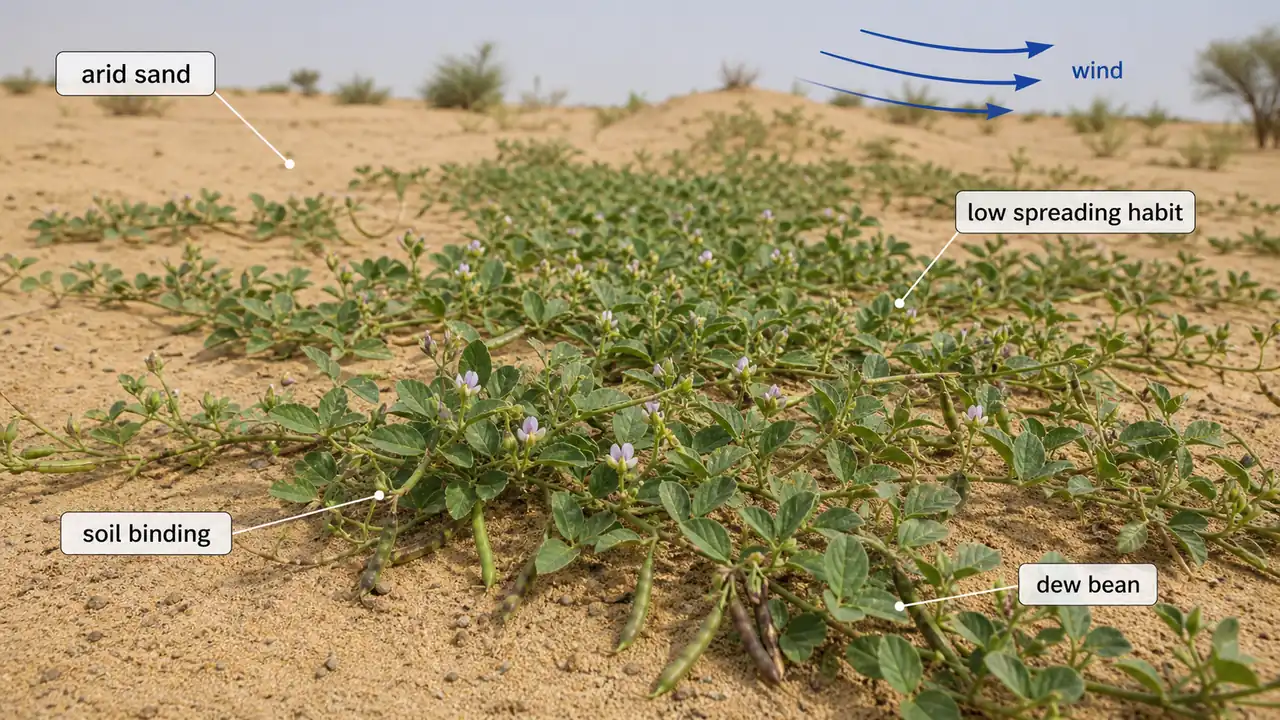
- Moth bean (dew bean) -- most drought-tolerant Kharif pulse, soil-binding role
- Vigna trio comparison -- side-by-side table for exam revision
- Key varieties and mutants -- T1, T9, Dhulia, Pant Mung 3
All sections are high-yield for exams, NABARD, and FCI exams.
Pro Content Locked
Upgrade to Pro to access this lesson and all other premium content.
Charged once for one year · ₹1188 total
Save ₹100/month vs ₹2388/year launch price
- All Agriculture & Banking Courses
- AI Lesson Questions (100/day)
- AI Doubt Solver (50/day)
- Glows & Grows Feedback (30/day)
- AI Section Quiz (20/day)
- 22-Language Translation (100/day)
- Recall Questions (20/day)
- AI Quiz (15/day)
- AI Quiz Paper Analysis (100/day)
- AI Step-by-Step Explanations (100/day)
- Spaced Repetition Recall (FSRS)
- AI Tutor
- Immersive Text Questions
- Audio Lessons — Hindi & English
- Mock Tests & Previous Year Papers
- Summary & Mind Maps
- XP, Levels, Leaderboard & Badges
- Generate New Classrooms
- Voice AI Teacher (AgriDots Live)
- AI Revision Assistant
- Knowledge Gap Analysis
- Interactive Revision (LangGraph)
🔒 Secure one-time yearly payment via Razorpay · No hidden fees
In the previous lessons, we covered the major Rabi pulses -- chickpea, pigeonpea, lentil, and field pea. Now we turn to three closely related Kharif/Zaid pulses from the genus Vigna that are often compared in exam questions.
Between the harvest of wheat in April and the sowing of rice in June, Indian farmers squeeze in a quick crop of mungbean or urdbean to earn extra income and add nitrogen to the soil. These short-duration pulses are the backbone of India's Zaid and Kharif pulse production. Mungbean holds the record for the highest protein content among all pulses (24%), while moth bean survives on little more than morning dew in the deserts of Rajasthan.
This lesson covers:
- Mungbean (greengram) -- highest protein pulse, day-neutral, YVMV resistance
- Urdbean (blackgram) -- indigenous to India, comparison with mungbean
- Moth bean (dew bean) -- most drought-tolerant Kharif pulse, soil-binding role
- Vigna trio comparison -- side-by-side table for exam revision
- Key varieties and mutants -- T1, T9, Dhulia, Pant Mung 3
All sections are high-yield for exams, NABARD, and FCI exams.
Mungbean / Greengram -- Basics

Mungbean is the most versatile among Indian pulses -- its day-neutral photoperiod response allows cultivation in Kharif, Rabi, and Zaid seasons, and its short duration (60-75 days) makes it ideal for fitting between two main-season crops.
| Parameter | Detail |
|---|---|
| Botanical name | Vigna radiata (synonym: Phaseolus aureus) |
| Family | Papilionaceae |
| Protein | 24 g / 100 g (highest among all pulses) |
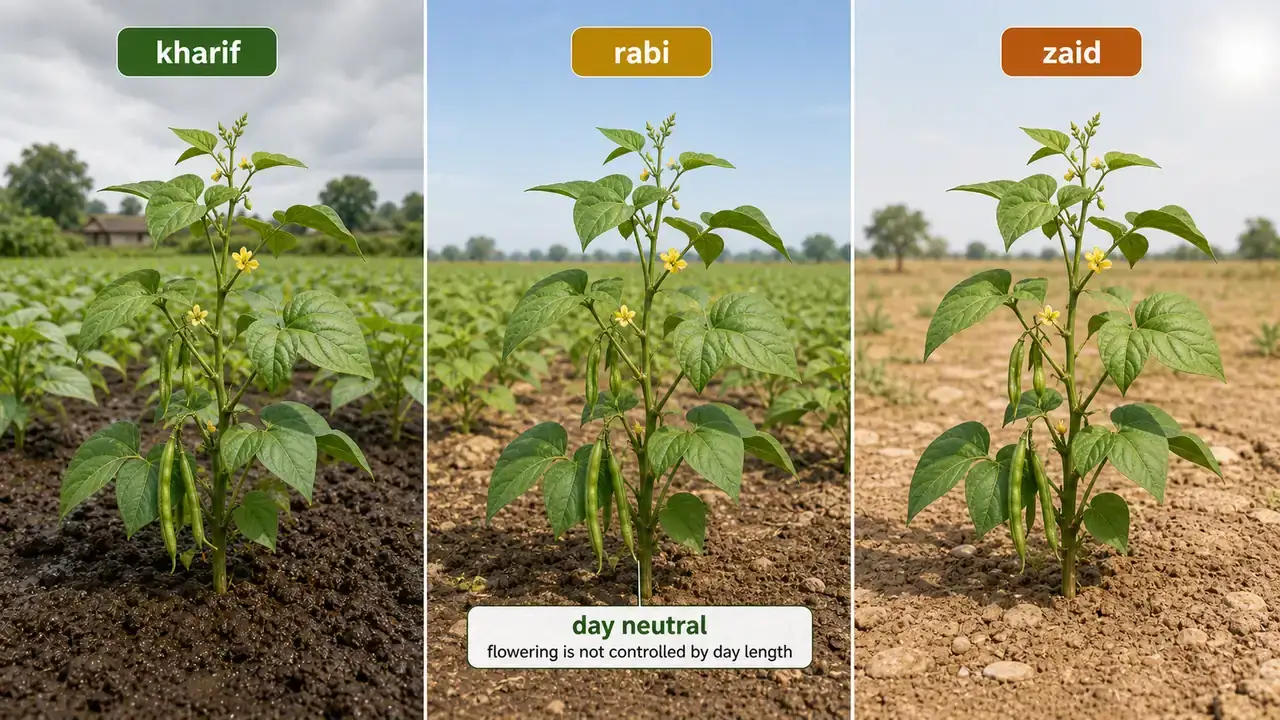
| Photoperiod | Day neutral (flowers regardless of day length -- can be grown in multiple seasons) |
| Drought tolerance | Good -- deep tap root accesses subsoil moisture |
| Hardiness | Considered the hardiest pulse (tolerates drought, heat, and poor soils) |
- The name radiata refers to the radiating lines on the pod surface.
- As a legume, mungbean fixes atmospheric nitrogen through Rhizobium bacteria, improving soil fertility for subsequent crops.
NOTE
Day-neutral crops (exam quick list): Mungbean, Maize, Sunflower, and Cotton are all day neutral -- they flower regardless of photoperiod. This is why they can be grown across multiple seasons.
Climate (Mungbean)
Mungbean thrives in hot conditions and can tolerate moderate drought -- characteristics that make it the hardiest pulse. Its day-neutral photoperiod allows multi-season cultivation that no other major pulse can match.
| Parameter | Requirement |
|---|---|
| Weather | Hot climate (Kharif, Zaid, or Spring) |
| Temperature | 25-32 C |
| Rainfall | 600-800 mm |
| Drought tolerance | Good |
Seed Rate and Sowing
Mungbean's low seed rate reflects its small seed size and vigorous branching habit. The relatively wide row spacing allows adequate air circulation, reducing humidity-related diseases like YVMV.
| Parameter | Value |
|---|---|
| Seed rate | 12-15 kg/ha |
| Spacing | 40 x 10 cm |
Important Mungbean Varieties
Mungbean variety development has focused on two key goals: YVMV resistance (the most devastating viral disease) and short duration for fitting into rice-wheat and wheat-rice cropping systems.
| Category | Varieties |
|---|---|
| General | PDM-1, 3, 11, Pusa Baisakhi, JM-721, Malviya Jyoti, Pusa 9531, Pragya, K-851, Pusa-16 |
| Summer/Spring season | Pusa Baisakhi, PS16 |
| Mutant varieties | Pant Mung 2, MUM 2, CO 4 (developed through induced mutation breeding -- gamma radiation or chemical mutagens) |
| Early maturing | Pusa Baisakhi, PS16, K851 |
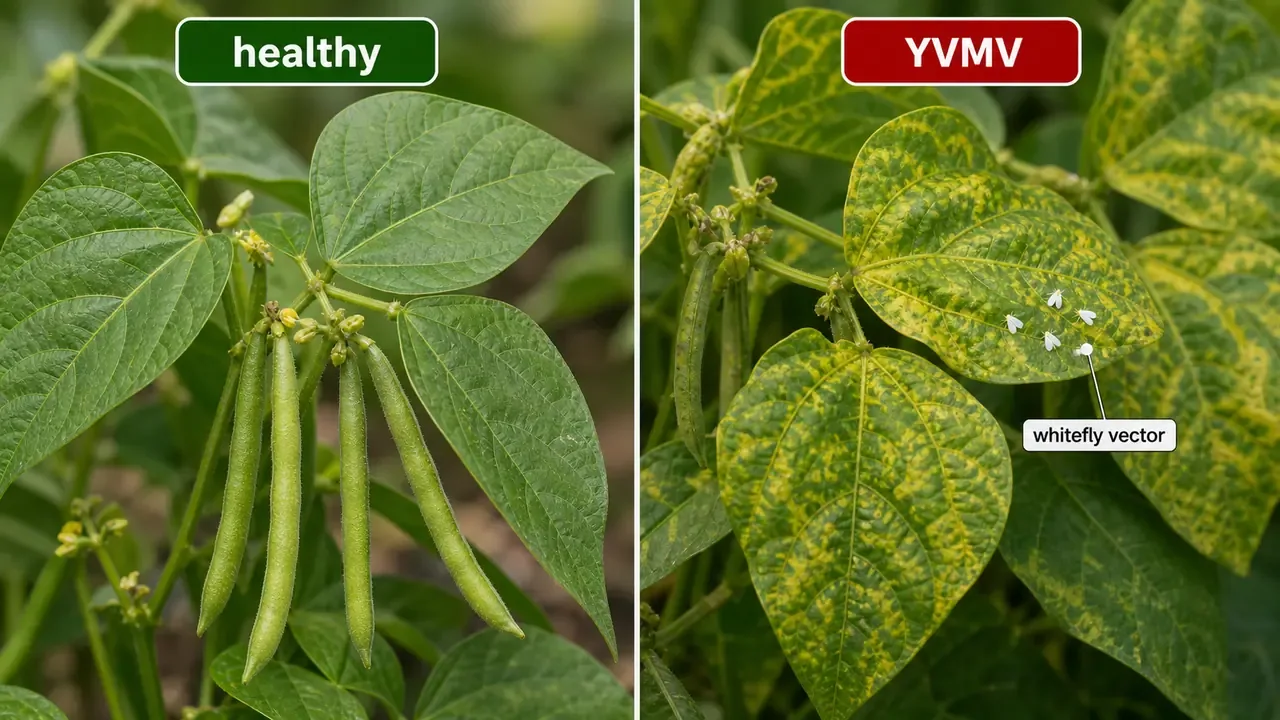
| YVMV resistant | Pant Mung 3, Sumrat, Basanti (Yellow Vein Mosaic Virus -- transmitted by whitefly) |
| Notable | Mohini |
| 1st variety released | T1 (1948) |
| 1st mutant variety | Dhulia (1980) |
- Yield: 12-15 q/ha
TIP
YVMV (Yellow Vein Mosaic Virus) is a major viral disease of mungbean transmitted by whitefly. It causes yellowing of leaf veins and significant yield loss. Resistant varieties: Pant Mung 3, Sumrat, Basanti.
Urdbean / Blackgram -- Basics

Urdbean is the only major pulse that is indigenous to India -- all others were domesticated elsewhere and introduced. This origin fact is frequently tested. Urdbean is the key ingredient in idli, dosa, and vada batters, making it culturally indispensable in South Indian cuisine.
| Parameter | Detail |
|---|---|
| Botanical name | Vigna mungo (synonym: Phaseolus mungo) |
| Family | Papilionaceae |
| Origin | India (indigenous -- cultivated for thousands of years) |
| Season | Primarily Kharif; also Rabi and Summer |
| Altitude range | Sea level to 2000 m (wide adaptability) |
Mungbean vs Urdbean -- Comparison
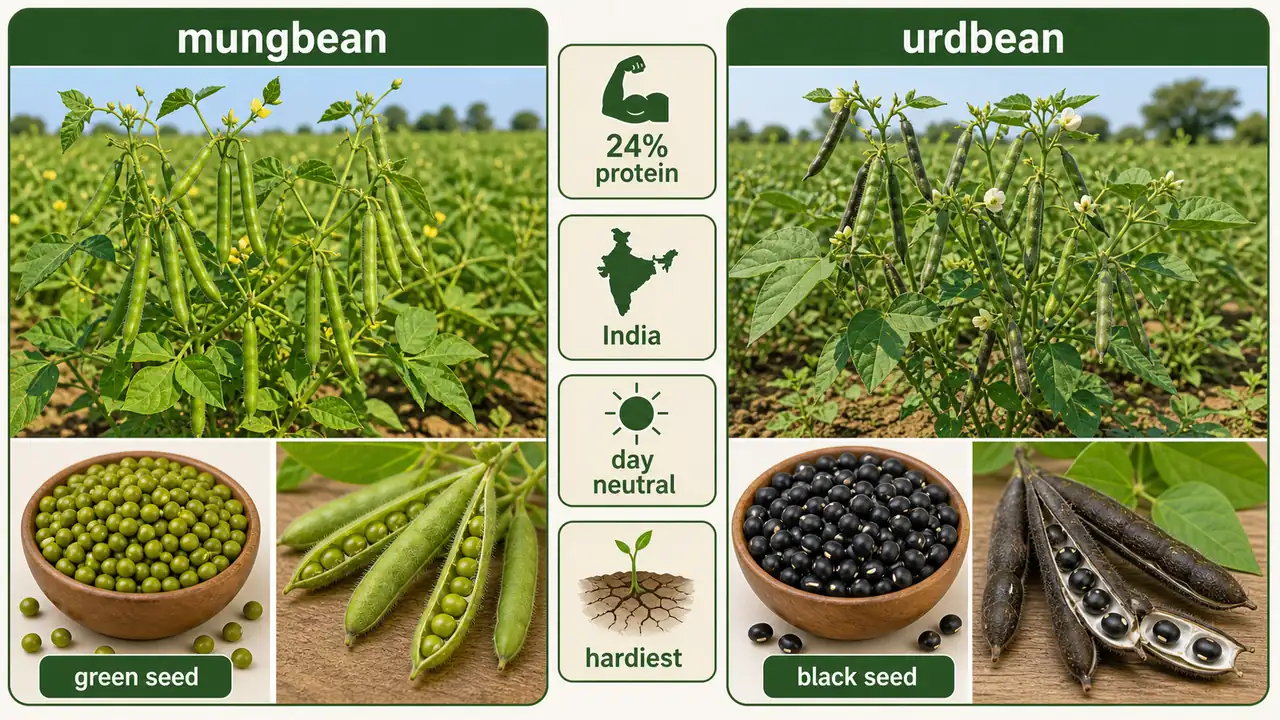
| Feature | Mungbean (Greengram) | Urdbean (Blackgram) |
|---|---|---|
| Botanical name | Vigna radiata | Vigna mungo |
| Seed colour | Green | Black |
| Protein | 24% (highest among pulses) | ~22% |
| Origin | South-East Asia | India (indigenous) |
| Photoperiod | Day neutral | Not strictly day neutral |
| Climate | Hot | Hot and humid |
| Drought tolerance | Good (hardiest pulse) | Moderate |
| Water requirement | 600-800 mm | 400-600 mm |
| Seed rate | 12-15 kg/ha | 20-25 kg/ha |
| Spacing | 40 x 10 cm | 40 x 10 cm |
| Yield | 12-15 q/ha | 10-12 q/ha |
Urdbean Varieties
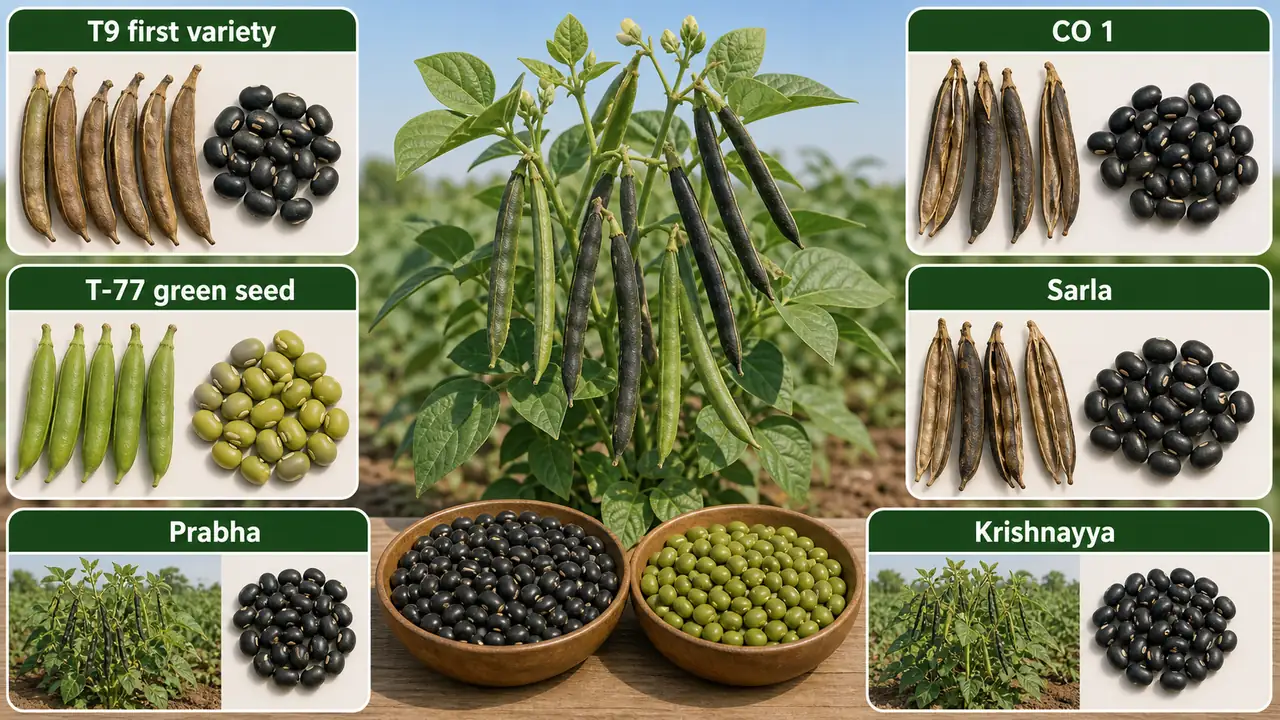
Urdbean variety development has focused on disease resistance and seasonal adaptation. Note the unusual green-seeded variety T-77, which is a common exam trap.
| Category | Varieties |
|---|---|
| General | Pant U-30, JU-2, Type-9, Barkha, Gwalior-2 |
| Mutant varieties | CO 1, Sarla |
| Spring season | Prabha, Krishnayya, AKU 4 |
| Green-seeded | T-77 (unusual green seed coat instead of typical black) |
| 1st variety released | T9 (1948) |
- Yield: 10-12 q/ha
Moth Bean (Dew Bean) -- Basics

Moth bean occupies a unique ecological niche that no other pulse can fill -- it thrives in the extreme arid conditions of western Rajasthan where annual rainfall is as low as 200-300 mm. Its ability to survive on dew moisture alone earned it the name "Dew Bean."
| Parameter | Detail |
|---|---|
| Botanical name | Vigna aconitifolia |
| Common name | Moth bean, Dew Bean (survives on very little moisture, even just dew) |
| Nature | Drought-resistant legume |
| Main regions | Rajasthan, Gujarat, western Madhya Pradesh |
| Special roles | Source of protein and income for dryland farmers; serves as a soil-binding crop preventing wind erosion in desert areas |
- The species name aconitifolia refers to the deeply lobed leaves resembling those of the Aconitum plant.
- Particularly well-suited to sandy soils and hot, dry conditions of western India.
All Three at a Glance -- The Vigna Trio
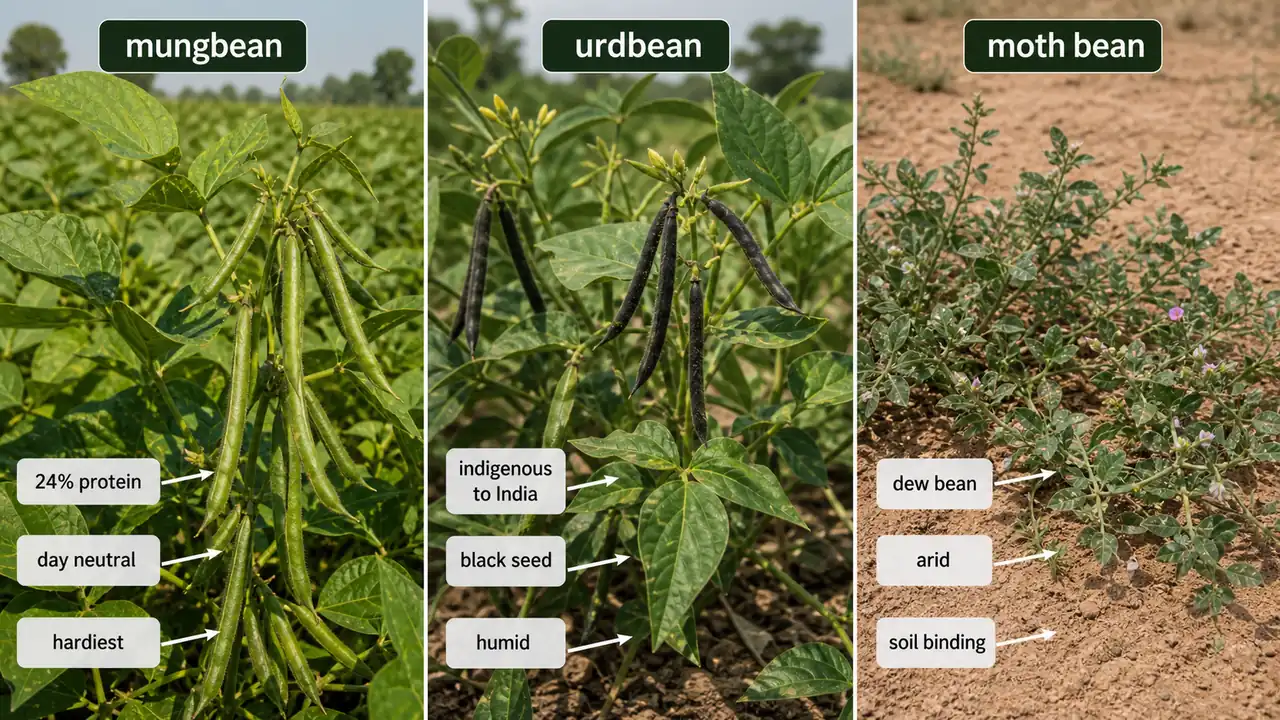
All three crops belong to the genus Vigna and family Papilionaceae -- this shared taxonomic lineage is an important exam fact. The following comparison table covers the key distinguishing features that exams test repeatedly.
| Parameter | Mungbean | Urdbean | Moth Bean |
|---|---|---|---|
| Botanical name | Vigna radiata | Vigna mungo | Vigna aconitifolia |
| Common name | Greengram | Blackgram | Dew Bean |
| Seed colour | Green | Black | Brown/mottled |
| Origin | South-East Asia | India | India |
| Protein | 24% (highest) | ~22% | ~23% |
| Climate | Hot | Hot and humid | Hot and dry (arid) |
| Drought tolerance | Good | Moderate | Excellent (survives on dew) |
| Photoperiod | Day neutral | Season-sensitive | Day neutral |
| Seed rate | 12-15 kg/ha | 20-25 kg/ha | 8-10 kg/ha |
| Yield | 12-15 q/ha | 10-12 q/ha | 3-5 q/ha |
| 1st variety released | T1 (1948) | T9 (1948) | -- |
| Key disease | YVMV (whitefly) | YVMV, leaf crinkle | -- |
| Special feature | Hardiest pulse | Indigenous to India | Soil-binding in deserts |
Important Greengram Varieties
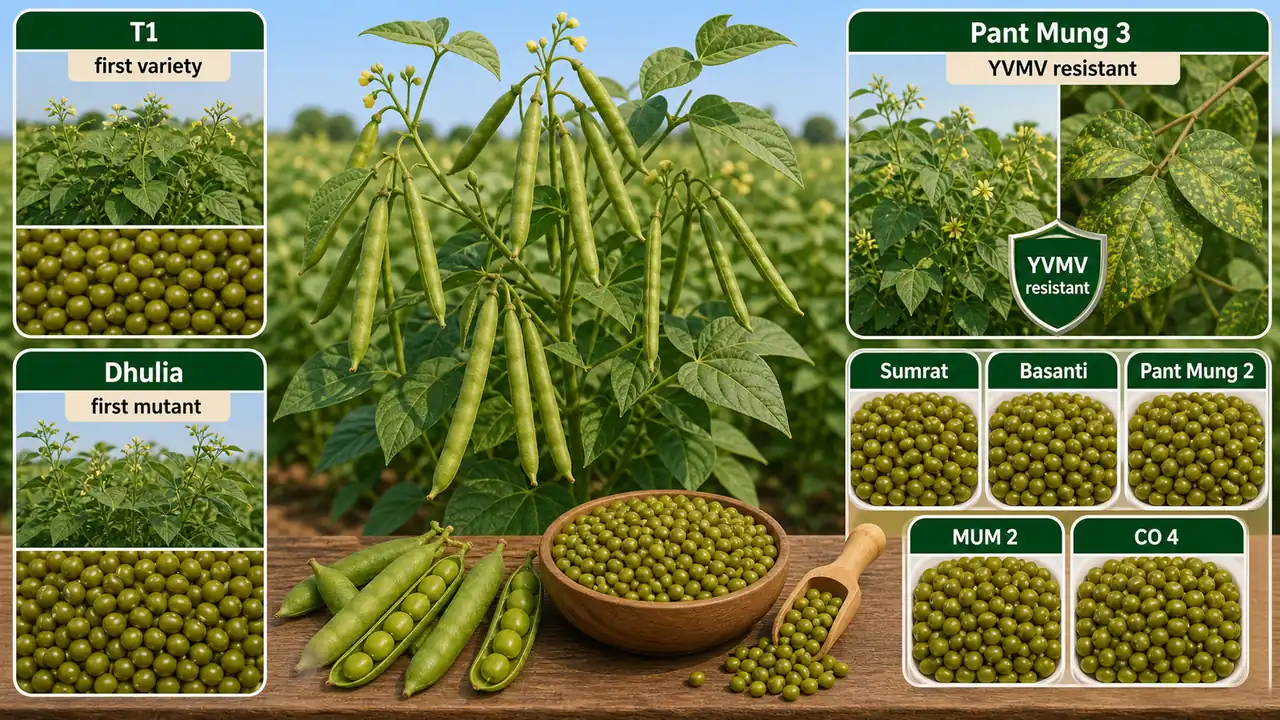
These varieties are frequently asked in exams, NABARD, and IBPS SO papers. Focus on the "firsts" and YVMV-resistance categories.
| Variety | Special Characteristics |
|---|---|
| T1 | 1st mungbean variety released (1948) |
| Dhulia | 1st mutant variety of mungbean (1980) |
| Pusa Baisakhi | Early maturing (65-75 days), best for summer/spring sowing |
| Pant Mung 3 | YVMV resistant -- most important disease-resistant variety |
| Sumrat, Basanti | YVMV resistant |
| Pant Mung 2, MUM 2, CO 4 | Mutant varieties (developed through induced mutation) |
| K-851 | Early maturing, widely adapted |
Summary Table -- Key Exam Facts
This table consolidates the most frequently tested one-liner facts from all three Vigna crops -- ideal for last-minute revision before exams.
| Exam Point | Answer |
|---|---|
| Highest protein among pulses | Mungbean (24%) |
| Day-neutral pulses | Mungbean |
| Hardiest pulse | Mungbean |
| Indigenous pulse (origin India) | Urdbean |
| Desert/dew pulse | Moth bean (Vigna aconitifolia) |
| 1st mungbean variety | T1 (1948) |
| 1st urdbean variety | T9 (1948) |
| 1st mutant mungbean | Dhulia (1980) |
| YVMV resistant mungbean | Pant Mung 3, Sumrat, Basanti |
| Genus for all three | Vigna |
| All three family | Papilionaceae |
Summary Cheat Sheet
| Concept / Topic | Key Details |
|---|---|
| Mungbean botanical name | Vigna radiata; highest protein among pulses (24%) |
| Mungbean photoperiod | Day neutral — can grow in multiple seasons |
| Mungbean | Considered the hardiest pulse |
| Mungbean seed rate | 12-15 kg/ha; spacing 40 × 10 cm |
| 1st mungbean variety | T1 (1948) |
| 1st mutant mungbean | Dhulia (1980) |
| YVMV resistant | Pant Mung 3, Sumrat, Basanti (transmitted by whitefly) |
| Urdbean botanical name | Vigna mungo; origin India (indigenous) |
| Urdbean protein | ~22%; seed rate 20-25 kg/ha |
| 1st urdbean variety | T9 (1948) |
| Moth bean botanical name | Vigna aconitifolia — Dew Bean |
| Moth bean drought | Most drought-tolerant kharif pulse; survives on dew |
| Moth bean regions | Rajasthan, Gujarat, western MP |
| Moth bean role | Soil-binding crop preventing wind erosion in deserts |
| Genus for all three | Vigna; Family Papilionaceae |
| Mungbean mutant varieties | Pant Mung 2, MUM 2, CO 4 |
| Urdbean mutant varieties | CO 1, Sarla |
| Urdbean green-seeded | T-77 |
| Mungbean yield | 12-15 q/ha |
| Moth bean yield | 3-5 q/ha (low but arid-adapted) |
TIP
Next: Lesson 5 covers Cowpea (Lobia) -- the "Vegetable Meat" of tropical agriculture, completing the pulse nickname set (King, Queen, Vegetable Meat, Poor Man's Meat).