🌻 Sunflower -- The Day-Neutral, Sun-Tracking Oilseed (Complete Guide)
Master sunflower cultivation from heliotropism to chaffiness management -- capitulum inflorescence, ray vs disc florets, allelopathy, varieties, and exam-critical facts for exams, NABARD, and IBPS exams.
From the Rabi mustard fields of Rajasthan, we now move to a crop that can be grown in all three seasons -- sunflower, the day-neutral oilseed from the Compositae family.
In the northern districts of Karnataka, sunflower fields create a striking visual -- thousands of bright yellow heads all facing the same direction, tracking the sun across the sky. This phenomenon, called heliotropism, is driven by differential auxin distribution in the stem. But sunflower is far more than a pretty face. It is one of the most versatile oilseed crops, with high-quality edible oil containing zero saturated fatty acids.
This lesson covers:
- Botany and heliotropism -- auxin-driven sun-tracking and capitulum inflorescence
- Oil quality -- zero saturated fat and high PUFA content
- Chaffiness -- the biggest yield-limiting problem and its management
- Agronomy -- climate, sowing, irrigation, and weed control
- Allelopathy -- why crop rotation planning is critical after sunflower
- Varieties -- hybrids and introduced cultivars
All sections are high-yield for exams, NABARD, and FCI exams.
Pro Content Locked
Upgrade to Pro to access this lesson and all other premium content.
Pay once valid for one year · Effective ₹99/month
- All Agriculture & Banking Courses
- AI Lesson Questions (100/day)
- AI Doubt Solver (50/day)
- Glows & Grows Feedback (30/day)
- AI Section Quiz (20/day)
- 22-Language Translation (100/day)
- Recall Questions (20/day)
- AI Quiz (15/day)
- AI Quiz Paper Analysis (100/day)
- AI Step-by-Step Explanations (100/day)
- Spaced Repetition Recall (FSRS)
- AI Tutor
- Immersive Text Questions
- Audio Lessons — Hindi & English
- Mock Tests & Previous Year Papers
- Summary & Mind Maps
- XP, Levels, Leaderboard & Badges
- Generate New Classrooms
- Voice AI Teacher (AgriDots Live)
- AI Revision Assistant
- Knowledge Gap Analysis
- Interactive Revision (LangGraph)
🔒 Secure one-time yearly payment via Razorpay · No hidden fees
From the Rabi mustard fields of Rajasthan, we now move to a crop that can be grown in all three seasons -- sunflower, the day-neutral oilseed from the Compositae family.
In the northern districts of Karnataka, sunflower fields create a striking visual -- thousands of bright yellow heads all facing the same direction, tracking the sun across the sky. This phenomenon, called heliotropism, is driven by differential auxin distribution in the stem. But sunflower is far more than a pretty face. It is one of the most versatile oilseed crops, with high-quality edible oil containing zero saturated fatty acids.
This lesson covers:
- Botany and heliotropism -- auxin-driven sun-tracking and capitulum inflorescence
- Oil quality -- zero saturated fat and high PUFA content
- Chaffiness -- the biggest yield-limiting problem and its management
- Agronomy -- climate, sowing, irrigation, and weed control
- Allelopathy -- why crop rotation planning is critical after sunflower
- Varieties -- hybrids and introduced cultivars
All sections are high-yield for exams, NABARD, and FCI exams.
Basics
Sunflower belongs to the Compositae family and is distinguished by its day-neutral photoperiod response, heliotropic behaviour, and one of the highest seed multiplication ratios among oilseeds.
| Feature | Detail |
|---|---|
| Botanical Name | Helianthus annus |
| Family | Compositae (Asteraceae) |
| Name meaning | Helios = Sun, Annus = Flower |
| Leading Indian state | Karnataka |
| Photoperiod | Day Neutral Crop |
| Seed multiplication ratio | > 1:80 |
- Heliotropism: Young flower heads track the sun's movement across the sky (east to west) during the day and reset to face east at night. This behaviour maximises light interception for photosynthesis.
- Auxin concentrates in the shaded side of the stem, causing differential cell elongation that drives the sun-tracking behaviour.
- Being day neutral, sunflower flowers based on accumulation of thermal units rather than photoperiod, which is why it can be grown across all three seasons.
Climate
Sunflower adapts to subtropical conditions and can be grown across all three Indian seasons. Cool temperatures during early growth and warm conditions at seed maturation are ideal.
| Parameter | Requirement |
|---|---|
| Climate type | Subtropical |
| Rainfall | 300-1500 mm |
| Temperature (growth) | 20-25°C |
| Vegetative phase | Requires cold temperature |
| Seasons | All 3 (Kharif, Rabi, Summer) |
- Cool temperatures during early growth promote strong root development before the reproductive phase.
- Higher temperature (> 38°C) during the reproductive stage reduces oil content by disrupting oil biosynthesis enzymes.
Oil Quality
Sunflower oil is prized for its heart-healthy fatty acid profile. It contains no saturated fat and is rich in linoleic acid, making it one of the healthiest edible oils.
| Parameter | Detail |
|---|---|
| Oil content | 45-50 per cent |
| Unsaturated fatty acid | 78 per cent |
| Saturated fat | None (safe for heart patients) |
| Key fatty acid | Linoleic acid (omega-6 PUFA) |
| Highest PUFA | Safflower (but sunflower is close) |
- Sunflower oil is valued for its light colour, mild flavour, and high smoke point.
The Capitulum Inflorescence
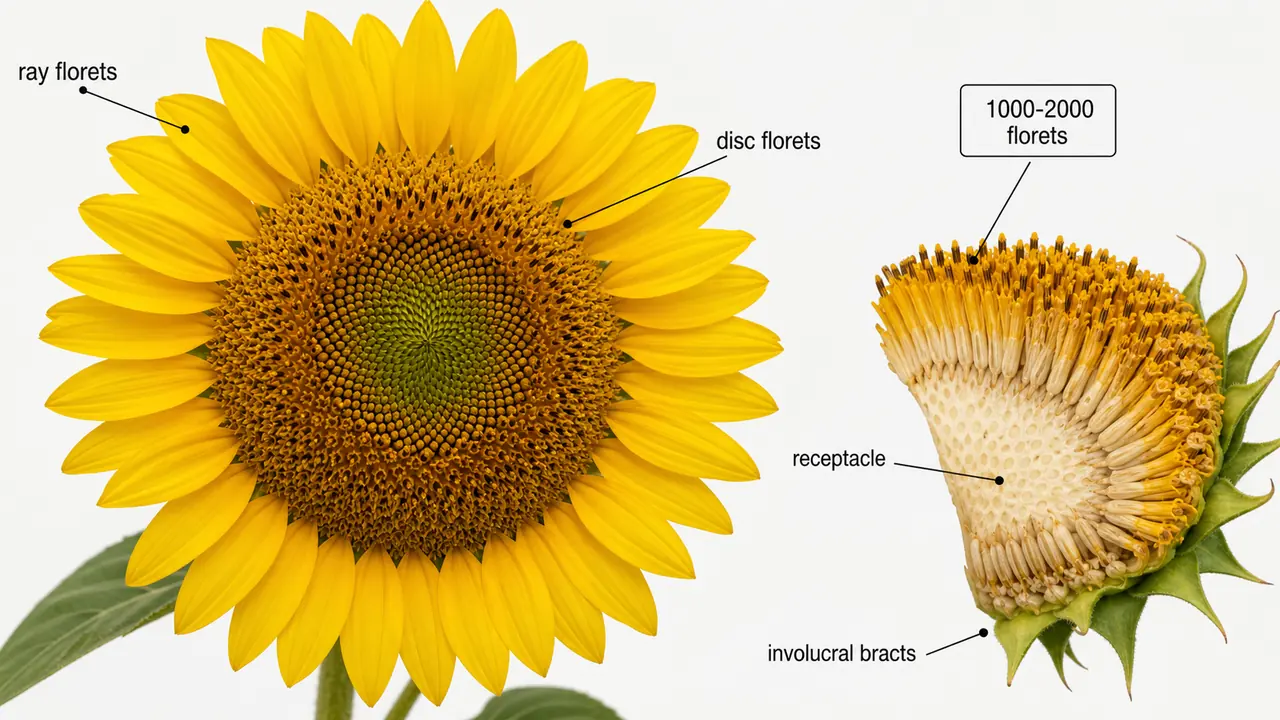
The sunflower head is not a single flower but a composite structure containing hundreds of individual florets. Understanding the capitulum structure and the distinction between ray and disc florets is essential for exams.
The head/inflorescence of sunflower is called Capitulum. Many small individual flowers (florets) are packed together on a flat or slightly domed receptacle, appearing as a single large flower. Each sunflower head can contain 1000-2000 individual florets.
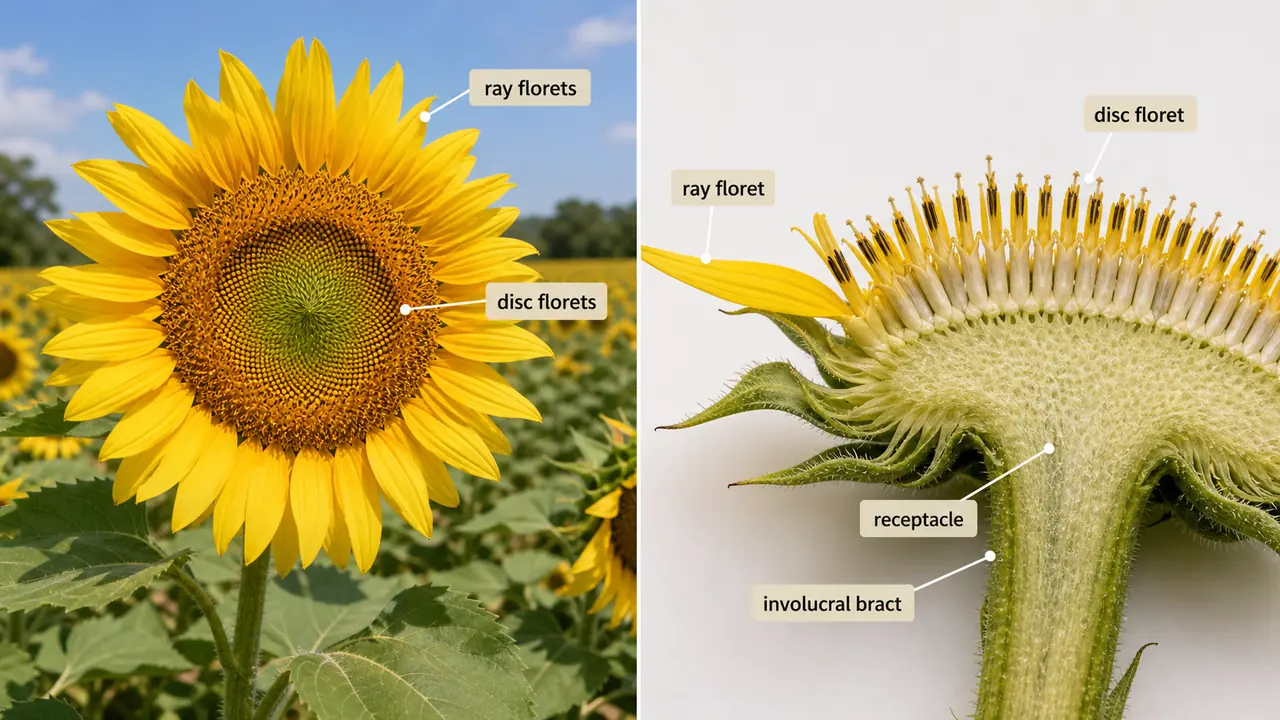
Ray Florets vs Disc Florets
| Feature | Ray Florets | Disc Florets |
|---|---|---|
| Location | Outer edge | Centre |
| Function | Attract pollinators (beauty) | Produce seeds |
| Fertility | Sterile | Fertile (male + female) |
| Colour | Bright yellow | Small, tubular |
Chaffiness -- The Biggest Problem

Chaffiness is the single most yield-limiting factor in sunflower cultivation. It is caused by poor pollination and can be managed through beehive placement and boron application.
Chaffiness means non-filling of seed -- achenes (seed shells) develop but remain empty without a kernel inside. This occurs due to:
- Poor pollination and self-incompatibility
- High temperatures during flowering
- Boron deficiency
Chaffiness can reduce yield by 20-40%.
IMPORTANT
Chaffiness is the most critical problem in sunflower. It causes 20-40% yield loss. Solution: Place 2-3 beehives/ha during flowering to ensure adequate cross-pollination. Also check for boron deficiency.
Sowing, Seed Rate, and Spacing
Sunflower sowing timing and spacing vary by season, with wider spacing in summer to compensate for higher evapotranspiration and heat stress.
Sowing Time
| Season | Time |
|---|---|
| Kharif | July to 1st week of August |
| Rabi | November 1st to 2nd week |
| Summer | February 2nd week |
Seed Rate and Spacing
| Parameter | Detail |
|---|---|
| Seed rate | 8-10 kg/ha |
| Kharif spacing | 45 x 30 cm |
| Rabi spacing | 50 x 20 cm |
| Summer spacing | 60 x 30 cm |
Wider spacing in Summer accounts for intense heat and higher evapotranspiration, requiring each plant to access a larger soil volume.

Irrigation
Sunflower irrigation requirements scale with season intensity. Water stress during bud initiation and flowering directly increases chaffiness.
| Season | Irrigations Required |
|---|---|
| Kharif | No need (monsoon sufficient) |
| Rabi | 3-4 |
| Summer | 5-6 |
Critical Stages for Irrigation
| Stage | DAS | Impact of Stress |
|---|---|---|
| Seedling | 10-12 | Poor stand establishment |
| Bud initiation/Button/Knee high | 30-35 | Reduced flower head size |
| Flowering | 50-55 | Poor pollination, chaffiness |
| Seed development | 70-90 | Reduced seed weight and oil% |

Varieties, Intercropping, and Weed Control
- Varieties: Modern, MSFH-8,17, Jwalamukhi, KBSH-1, JS-1, Sunrise Selection, EC 68413. KBSH-1 was developed by UAS Bangalore and is one of the most popular hybrids in Karnataka.
- Intercropping: with Groundnut, Arhar, Urd etc. As a tall, erect plant, sunflower pairs well with shorter crops.
- Weed management: Pendimethalin @ 1.5 kg ai/ha followed by hoeing at 30 DAS.
Allelopathy -- A Unique Concern
Sunflower plants release allelopathic chemicals into the soil that inhibit the germination of succeeding crops. The roots and residues release compounds like heliannone and phenolic acids. Farmers must plan crop rotations carefully and ensure thorough residue decomposition before planting the next crop.
TIP
Exam tip: Sunflower is one of the few crops where allelopathy is a significant management consideration. If asked "which crop inhibits succeeding crop growth through allelopathic chemicals?" -- the answer is sunflower.
Harvesting and Yield

Prompt harvesting is important in sunflower to prevent bird damage and shattering losses from mature heads.
| Parameter | Detail |
|---|---|
| Duration | 90-120 days |
| Maturity signs | 10% of heads become brown, disc florets drop |
| Yield | 20-30 q/ha (up to 35 q/ha with hybrids) |
Harvest promptly to prevent bird damage (sparrows and parrots) and shattering losses.
Insect-Pest
Sunflower has a shorter pest list than sesame or mustard in this course, but one pest is repeatedly recalled in exam-oriented crop notes because it directly damages the harvestable head.
| Pest | Key Feature |
|---|---|
| Head borer (Helicoverpa armigera) | Larvae attack the developing sunflower head and feed on florets and young seeds, reducing head filling and marketable yield |
TIP
If a question links sunflower with direct feeding on the developing head/capitulum, the expected answer is usually Helicoverpa armigera.
Important Sunflower Varieties
Sunflower was introduced to India in 1969. BSH-1 was the first hybrid developed. Knowing the introduction history and key hybrid names is important for exams.
| Variety | Special Characteristics |
|---|---|
| VNIIMK 8931 (EC 68413), Peredovick (EC 68414), Armavirskij 3497 (EC 68415), Armaverts (EC 68474) | Introduced in India in 1969 |
| EC 68415 | Recommended for Karnataka |
| Cernianka 66 | Early maturing, short stature, suited for multiple & mixed cropping |
| BSH-1 (CMS 234A x RHA 274) | 1st sunflower hybrid |
| SS 56, LS11, CO 1, CO2, CO 3, CO 4, CO 5, Jwalamukhi | Varieties |
| APSH 11, PKVSH 27, LDMRSH 1, LDMRSH 3, BSH-1, KSFH 1, MSFH 8, MSFH 17, TNAU SUF-7 | Hybrids |

Seed Dormancy One-Liner
Freshly harvested sunflower seed has a dormancy period of 40-50 days. For rapid reuse as seed, dormancy can be broken by soaking in ethrel 25 ppm solution for about 6 hours.
Quick Revision Summary
| Parameter | Detail |
|---|---|
| Botanical Name | Helianthus annus |
| Family | Compositae |
| Inflorescence | Capitulum |
| Photoperiod | Day Neutral |
| Oil content | 45-50% |
| Unsaturated FA | 78% |
| Saturated fat | None |
| Major problem | Chaffiness (20-40% yield loss) |
| Solution for chaffiness | 2-3 beehives/ha |
| Allelopathy | Inhibits succeeding crops |
| Seed dormancy | 40-50 days; broken by ethrel 25 ppm |
| 1st hybrid | BSH-1 |
| Leading state | Karnataka |
| Seed multiplication | >1:80 |
| Yield | 20-30 q/ha |
TIP
Next: The next lesson covers Safflower -- the thorny "Fencing Crop" with the highest PUFA content among oilseeds, thriving in rain-shadow regions on black cotton soils.
Summary Cheat Sheet
| Concept / Topic | Key Details / Explanation |
|---|---|
| Botanical name | Helianthus annus; Family Compositae (Asteraceae) |
| Name meaning | Helios = Sun, Annus = Flower |
| Photoperiod | Day Neutral — flowers by thermal units, not day length |
| Heliotropism | Young heads track sun east-to-west; driven by auxin on shaded side |
| Seasons grown | All 3 (Kharif, Rabi, Summer) |
| Inflorescence | Capitulum — composite head of 1000-2000 florets |
| Ray florets | Outer, bright yellow, sterile (attract pollinators) |
| Disc florets | Centre, tubular, fertile (produce seeds) |
| Fruit type | Achene (cypsela) |
| Pollination | Cross-pollinated |
| Oil content | 45-50% |
| Unsaturated fatty acid | 78% (key fatty acid: linoleic acid, omega-6 PUFA) |
| Saturated fat | None — safe for heart patients |
| Chaffiness | Empty achenes due to poor pollination; causes 20-40% yield loss |
| Chaffiness solution | Place 2-3 beehives/ha during flowering |
| Allelopathy | Releases heliannone + phenolic acids — inhibits succeeding crops |
| Seed dormancy | 40-50 days after harvest; broken by ethrel 25 ppm soaking |
| Climate | Subtropical; temp 20-25°C; rainfall 300-1500 mm |
| Seed rate | 8-10 kg/ha |
| Seed multiplication ratio | > 1:80 |
| Critical irrigation stages | Seedling, Bud initiation (30-35 DAS), Flowering (50-55 DAS), Seed development |
| NPK | High N requirement; hybrid: standard doses |
| Yield | 20-30 q/ha (up to 35 q/ha with hybrids) |
| Duration | 90-120 days |
| Leading state | Karnataka |
| 1st hybrid | BSH-1 (CMS 234A x RHA 274) |
| Introduction to India | 1969 |
| Weed control | Pendimethalin @ 1.5 kg ai/ha + hoeing at 30 DAS |