🌵 Forage Crops -- Feeding India's Livestock (Berseem, Lucerne, Oats, Napier & More)
Complete guide to major forage and fodder crops -- Berseem (King), Lucerne (Queen), Oats, Napier grass, fodder sorghum, and fodder maize with varieties, seed rates, HCN toxicity, and exam mnemonics.
India supports over 500 million livestock -- the largest herd in the world -- yet faces a chronic shortage of about 36% green fodder and 11% dry fodder. On a small dairy farm in Punjab, a farmer sows berseem in October and starts cutting lush green fodder by December, feeding his cows right through the lean winter months. This chapter covers the major forage crops that keep Indian dairying alive, from the "King" and "Queen" of fodder to the grasses and cereals that fill the feed trough year-round.
This lesson covers:
- Ideal fodder crop characteristics -- nutrition, palatability, multi-cut potential
- Berseem -- King of Fodder Crops (Egyptian Clover)
- Lucerne / Alfalfa -- Queen of Fodder Crops (perennial legume)
- Oats -- cereal fodder harvested at dough stage
- Napier grass -- perennial hybrid grass for year-round supply
- Fodder sorghum -- HCN toxicity danger in young plants
- Fodder maize -- single-cut crop, mixed with legumes for balanced ration
All topics are high-yield for exams, NABARD, and state agriculture exams.
Pro Content Locked
Upgrade to Pro to access this lesson and all other premium content.
Pay once valid for one year · Effective ₹99/month
- All Agriculture & Banking Courses
- AI Lesson Questions (100/day)
- AI Doubt Solver (50/day)
- Glows & Grows Feedback (30/day)
- AI Section Quiz (20/day)
- 22-Language Translation (100/day)
- Recall Questions (20/day)
- AI Quiz (15/day)
- AI Quiz Paper Analysis (100/day)
- AI Step-by-Step Explanations (100/day)
- Spaced Repetition Recall (FSRS)
- AI Tutor
- Immersive Text Questions
- Audio Lessons — Hindi & English
- Mock Tests & Previous Year Papers
- Summary & Mind Maps
- XP, Levels, Leaderboard & Badges
- Generate New Classrooms
- Voice AI Teacher (AgriDots Live)
- AI Revision Assistant
- Knowledge Gap Analysis
- Interactive Revision (LangGraph)
🔒 Secure one-time yearly payment via Razorpay · No hidden fees
India supports over 500 million livestock -- the largest herd in the world -- yet faces a chronic shortage of about 36% green fodder and 11% dry fodder. On a small dairy farm in Punjab, a farmer sows berseem in October and starts cutting lush green fodder by December, feeding his cows right through the lean winter months. This chapter covers the major forage crops that keep Indian dairying alive, from the "King" and "Queen" of fodder to the grasses and cereals that fill the feed trough year-round.
This lesson covers:
- Ideal fodder crop characteristics -- nutrition, palatability, multi-cut potential
- Berseem -- King of Fodder Crops (Egyptian Clover)
- Lucerne / Alfalfa -- Queen of Fodder Crops (perennial legume)
- Oats -- cereal fodder harvested at dough stage
- Napier grass -- perennial hybrid grass for year-round supply
- Fodder sorghum -- HCN toxicity danger in young plants
- Fodder maize -- single-cut crop, mixed with legumes for balanced ration
All topics are high-yield for exams, NABARD, and state agriculture exams.
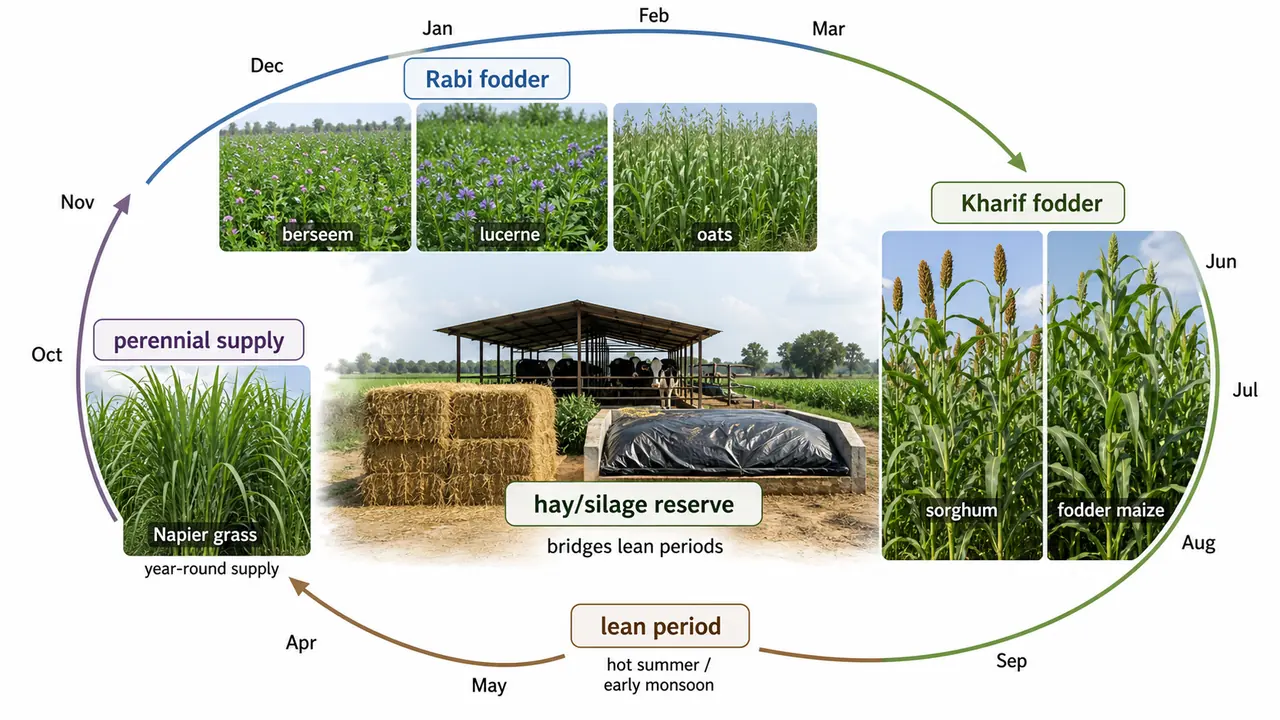
What Makes an Ideal Fodder Crop?
A good fodder crop must possess several qualities that make it suitable for livestock feeding and economical cultivation:
- Nutritious, palatable, and digestible. An ideal fodder should have a good balance of protein, energy, minerals, and vitamins so that animals can absorb and use the nutrients efficiently.
- Not injurious at the feeding stage. Some plants contain anti-nutritional factors (like HCN in young sorghum) that can be harmful -- the fodder must be safe when fed.
- Quick growing and early maturing. This ensures a rapid supply of green fodder, especially during lean periods when feed is scarce.
- High yield of green fodder with the maximum number of cuttings and biomass. Multi-cut crops provide a continuous supply of feed throughout the growing season.
- Low input requirement. Should grow well with little tillage and care, making it economically viable for resource-poor farmers.
- Preservable as hay or silage. Hay is dried fodder, while silage is fermented green fodder -- both conserve excess fodder for use during dry seasons.
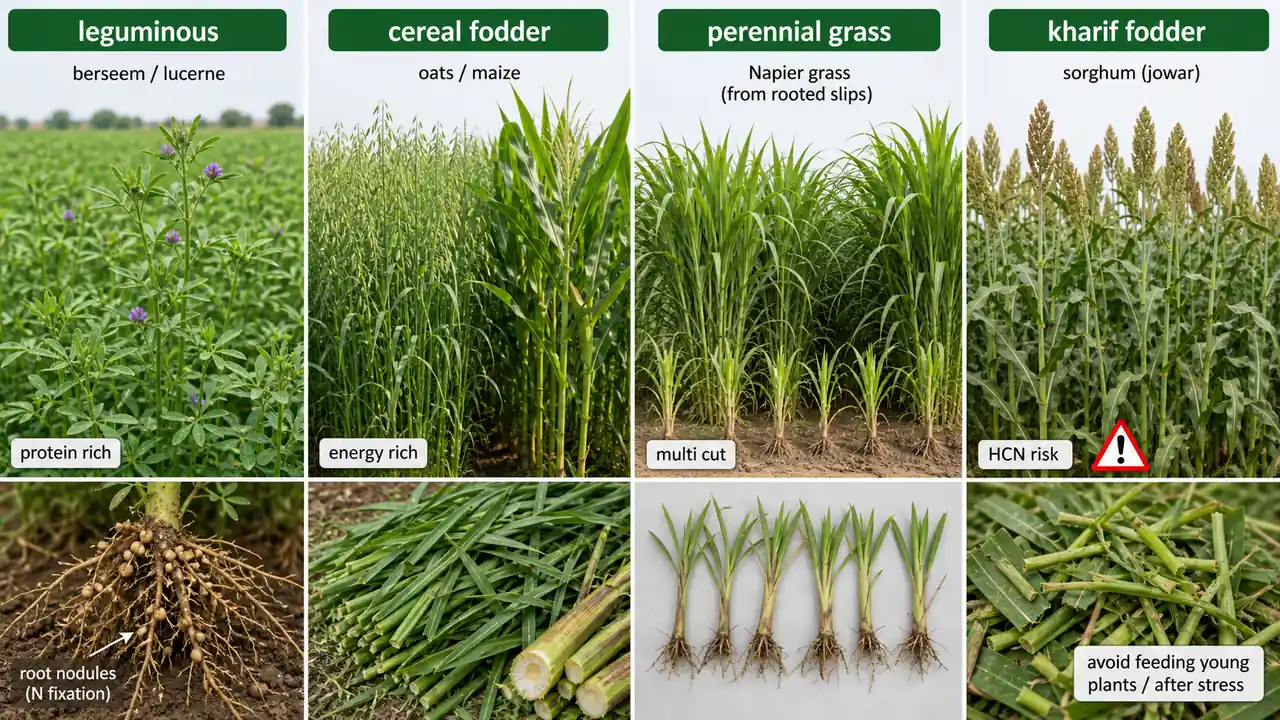
| Forage group | Main crops in this lesson | What students should remember |
|---|---|---|
| Leguminous fodder | Berseem, Lucerne | Protein-rich fodder; fixes nitrogen through root nodules |
| Cereal fodder | Oats, Fodder maize | Energy-rich green fodder; usually needs higher nitrogen than legumes |
| Perennial grass fodder | Napier grass | Tall biomass crop; gives repeated cuttings from rooted slips |
| Kharif fodder grass | Fodder sorghum / Chari | High biomass, but young plants may be unsafe due to HCN risk |
| Preserved fodder | Hay, Silage | Conserves surplus fodder for lean periods |
Berseem -- King of Fodder Crops
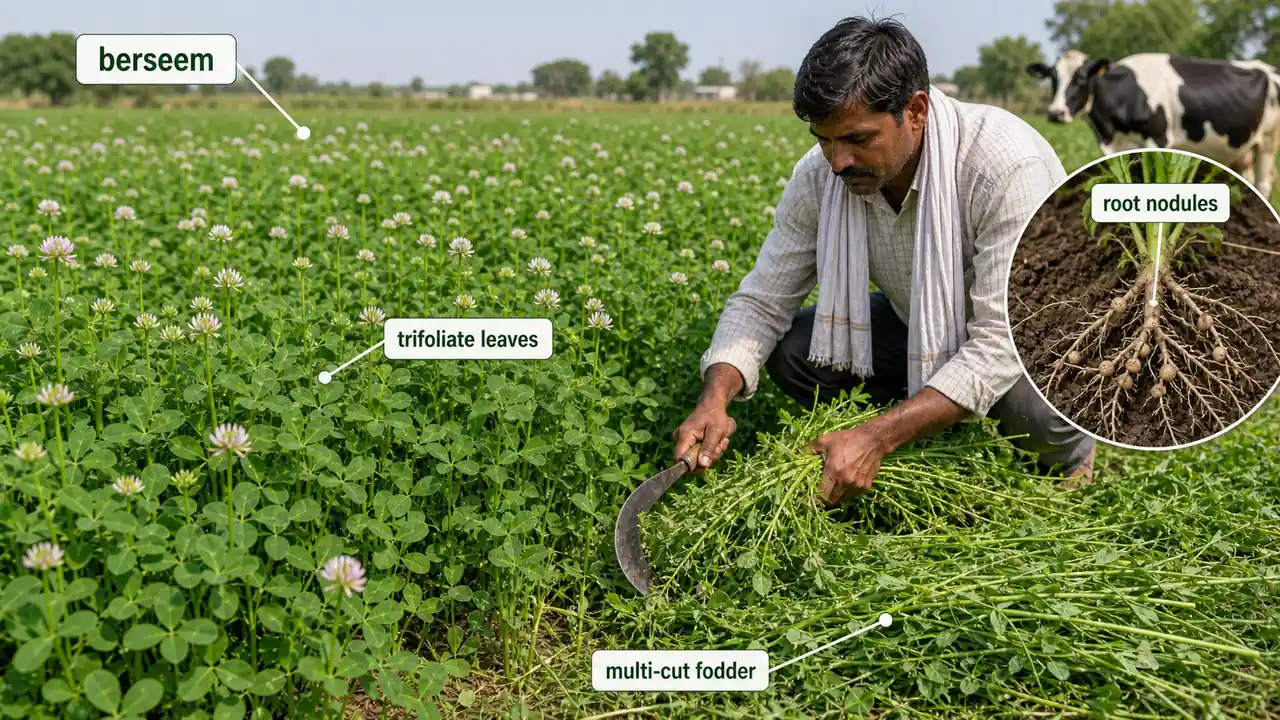
Berseem is the single most important winter fodder crop in India. Its combination of high yield, excellent palatability, and nitrogen-fixing ability makes it the backbone of Rabi-season livestock feeding.
Botanical Profile
| Parameter | Details |
|---|---|
| Botanical name | Trifolium alexandrinum (Trifolium = "three-leaved") |
| Family | Leguminoceae |
| Origin | Egypt |
| Common name | King of Fodder Crops / Egyptian Clover |
| Temperature | 18--22 °C (optimum) |
Berseem earns the title King of Fodder Crops because of its high yield, excellent nutritive value (rich in protein and minerals), palatability, and ability to provide multiple cuttings throughout the Rabi season.
Sowing and Seed Treatment
- Sowing time: October to November
- Sowing method: Broadcasting
- Seed rate: 25-30 kg/ha (Diploid varieties), 35 kg/ha (Tetraploid varieties). Tetraploid varieties have larger cells and seeds but fewer seeds per unit weight, hence the higher seed rate to maintain adequate plant population.
- Ratio of mixing diploid and Tetraploid varieties: 1:1 and 2:1. Mixing both types takes advantage of the quick establishment of diploid types and the higher biomass of tetraploid types.
- Seed treatment: By Rhizobium trifolii culture. Inoculation with the species-specific Rhizobium ensures effective root nodule formation and biological nitrogen fixation, reducing the need for nitrogen fertilisers.

Varieties
- (a) Diploid (2n = 16): Vardan, Chindwara, BL-1, 11, 22, 52, C-10 (Maskavi), IGFRI 99-1. Diploid varieties are generally more seed-productive.
- (b) Tetraploid (4n = 32): Pusa giant, T-528, 560, 678. Tetraploid varieties have double the chromosome set, resulting in larger leaves, thicker stems, and higher fodder biomass per cutting.
Weeds, Nutrition, and Yield
- Key weed: Kasni (Chicorium intybus -- objectionable weed), separated from berseem crop seed through 17 per cent salt solution. This technique uses the principle of specific gravity -- Kasni seeds are lighter and float in the salt solution, while berseem seeds sink, allowing easy separation.

- NPK: 20 : 60 : 30 kg/ha. The high phosphorus dose promotes strong root development and nodule activity, essential for a leguminous fodder crop.
- Cutting: First cutting at 50-55 days after sowing; subsequent cuttings at 25-35 day intervals. This schedule allows the plant to regrow adequately between harvests.
- Forage yield: 80--100 tonnes/ha. This exceptionally high yield is a key reason berseem is called the King of Fodder Crops.
- Glucosides found: Saponine. Saponins are plant glycosides that produce a soapy lather in water. In moderate quantities they are harmless, but excessive intake can cause bloat in ruminant animals.
TIP
Fodder crop titles (exam favourite): Berseem = King of Fodder Crops (Egyptian Clover). Lucerne/Alfalfa = Queen of Fodder Crops. Remember: King has higher Kutting yield (80-100 t/ha) and Queen has higher Quality protein (15-22%).
Lucerne / Alfalfa -- Queen of Fodder Crops
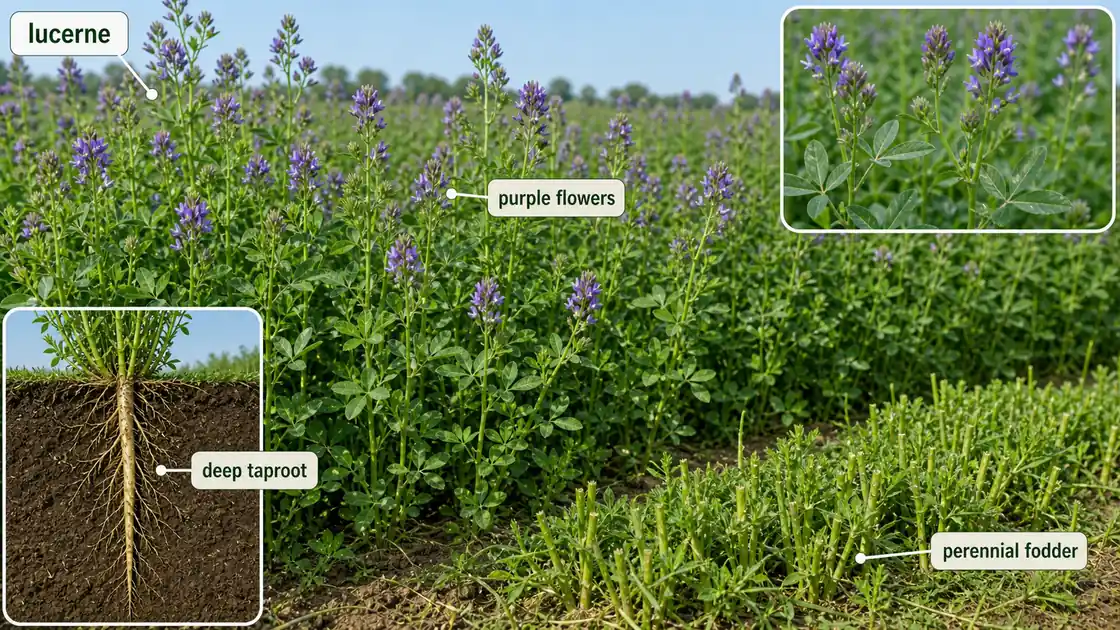
Lucerne is the premier quality fodder crop -- its protein content (15-22%) is the highest among all forage crops. As a perennial, it provides fodder for 3-4 years from a single sowing, making it economically attractive despite slower establishment.
Botanical Profile
| Parameter | Details |
|---|---|
| Botanical name | Medicago sativa |
| Family | Leguminosae |
| Origin | South West Asia |
| Common name | Queen of Fodder Crops |
| Temperature | 20--22 °C (optimum) |
Lucerne earns the title Queen of Fodder Crops due to its high protein content (15-22%), excellent digestibility, and the fact that it can provide fodder for 3-4 years from a single sowing because it is a perennial crop.
Sowing and Seed Treatment
- Sowing time: October
- Sowing method: Broadcasting
- Seed rate: 20--25 kg/ha
- Seed treatment: By Rhizobium meliloti culture. This specific Rhizobium species forms effective nodules on lucerne roots for nitrogen fixation.
Varieties, Weeds, and Yield
- Varieties: Moopa, Rambler, Anand-2, 3, Sirsa 1, 8, 9, Type-8, 9, NDRI-1, 2, IGFRI-5, 54, 244
- Key weed: Cuscuta reflexa (Dodder/Amarbel -- parasitic weed). Cuscuta is a stem parasite that wraps around the host plant and extracts water and nutrients through haustoria (specialised absorbing organs). It can devastate a lucerne field if not controlled early.
- NPK: 20-25 : 60-75 : 0-0 kg/ha. No potassium is usually recommended because lucerne's deep roots can access potassium from lower soil layers.
- Cutting: First cutting at 50-55 days after sowing; subsequent cuttings at 20-30 day intervals. The shorter interval compared to berseem reflects lucerne's faster regrowth capacity.
- Forage yield: 80--110 tonnes/ha
- Glucosides found: Saponins
- Physiological disorder: Lucerne yellowing (due to boron deficiency). Boron is essential for cell wall formation and sugar transport in plants. Its deficiency causes interveinal yellowing of leaves and stunted growth.
Berseem vs Lucerne -- Comparison
| Character | Berseem (King) | Lucerne (Queen) |
|---|---|---|
| Botanical name | Trifolium alexandrinum | Medicago sativa |
| Origin | Egypt | South West Asia |
| Life cycle | Annual | Perennial (3-4 years) |
| Protein content | Moderate | High (15-22%) |
| Forage yield | 80-100 t/ha | 80-110 t/ha |
| Cutting interval | 25-35 days | 20-30 days |
| Rhizobium | R. trifolii | R. meliloti |
| Key weed | Kasni (Chicorium intybus) | Dodder (Cuscuta reflexa) |
| Physiological disorder | -- | Yellowing (boron deficiency) |
Oats
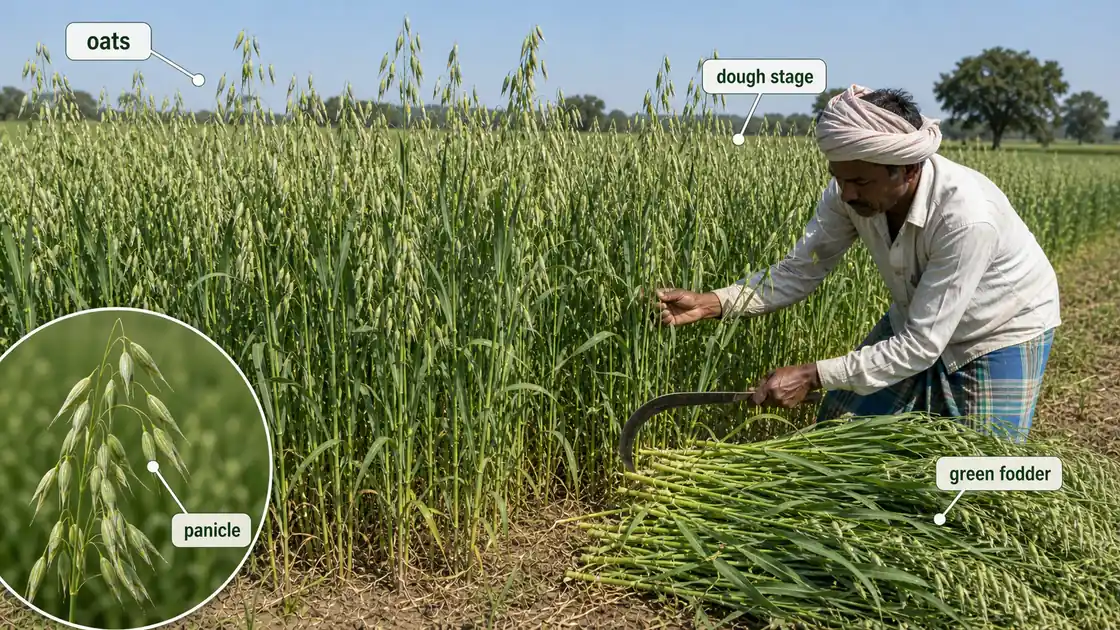
Oats is the most important cereal fodder crop for the Rabi season. Unlike berseem and lucerne (legumes with high protein), oats provides energy-rich fodder with moderate protein, making it an excellent complement when mixed with leguminous forages.
| Parameter | Details |
|---|---|
| Botanical name | Avena sativa |
| Family | Poaceae (cereal grass -- energy-rich fodder, not protein-rich) |
| Origin | Asia Minor |
| Sowing time | Mid-October to Mid-November |
| Sowing method | Broadcasting |
| Seed rate | 100-120 kg/ha (bold seeded), 80-90 kg/ha (small seeded) |
| Spacing | 20-25 cm (plant to plant) |
| Irrigations | 3-4 |
| NPK | 80 : 30 : 20 kg/ha (high N because oats is a non-legume) |
| Best harvest stage | Dough stage (best balance of digestibility and dry matter) |
| Cuttings | 2-3 cuttings; first at 70-75 days after planting |
| Fodder yield | 40-45 tonnes/ha |
- Varieties: Kent, Algerian, UPO 50, Craig, Afterlee, Fulgham, Fleming gold, HFO-114, Brunker-10, UPD-90. HFO 114 is a dual-purpose variety -- one cutting of green fodder followed by grain harvest.
- Key weed: Kasni (Chicorium intybus)
Napier Grass (Elephant Grass)
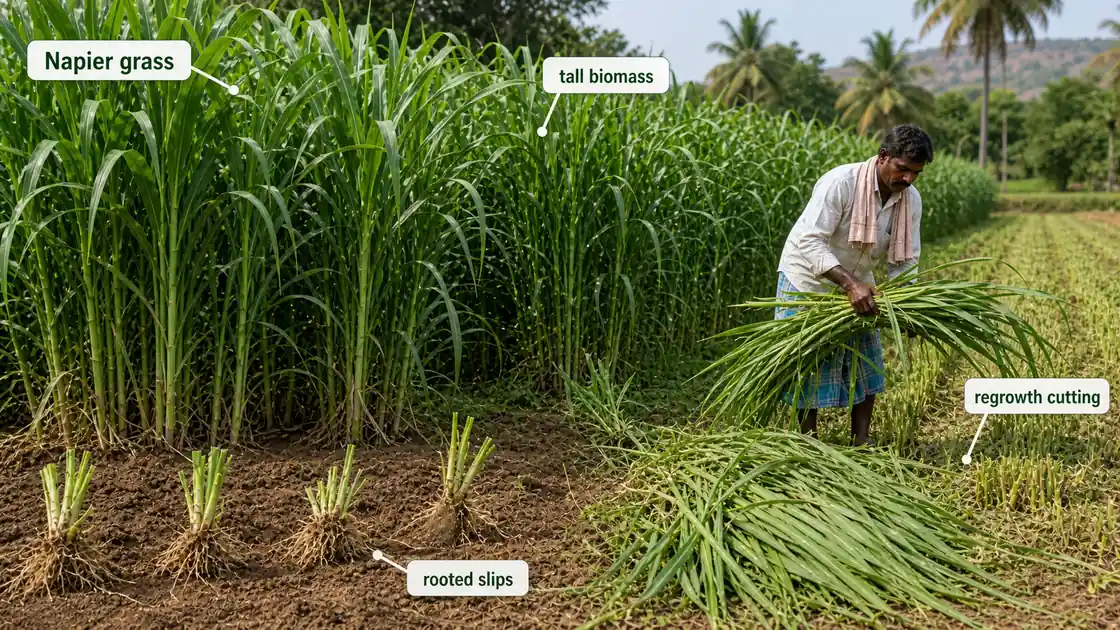
Napier grass is a perennial tropical grass that produces enormous biomass and can sustain 3-5 years of cutting from a single planting. It is propagated vegetatively (rooted slips) because seeds have poor viability.
| Parameter | Details |
|---|---|
| Botanical name | Pennisetum purpureum [PP] |
| Family | Poaceae |
| Origin | Rhodesia (South Africa) |
| Best soil | Loam soil |
| Sowing time | October |
| Sowing method | Broadcasting |
| Seed rate | 33,000-40,000 rooted slips (vegetative propagation -- poor seed viability) |
| Spacing | 60 x 60 cm |
| NPK | 40 : 30 : 20 kg/ha |
| Cutting | First at 70 days; subsequent at 40-45 day intervals |
| Life span | Perennial -- 3-5 years from a single planting |
- Varieties: Pusa giant (Hybrid: P. purpureum x P. typhoideum), NB-5, 21, EB-4, Coimbatore, Yeshwant. Pusa giant is an interspecific hybrid between Napier grass and pearl millet (bajra), combining the high biomass of Napier with the better palatability of pearl millet.
- Pusa giant is a variety of Papaya, Berseem and Napier grass. exams. Note that "Pusa giant" is a common varietal name used across different crops -- it refers to different plants in each case.
Fodder Sorghum / Chari
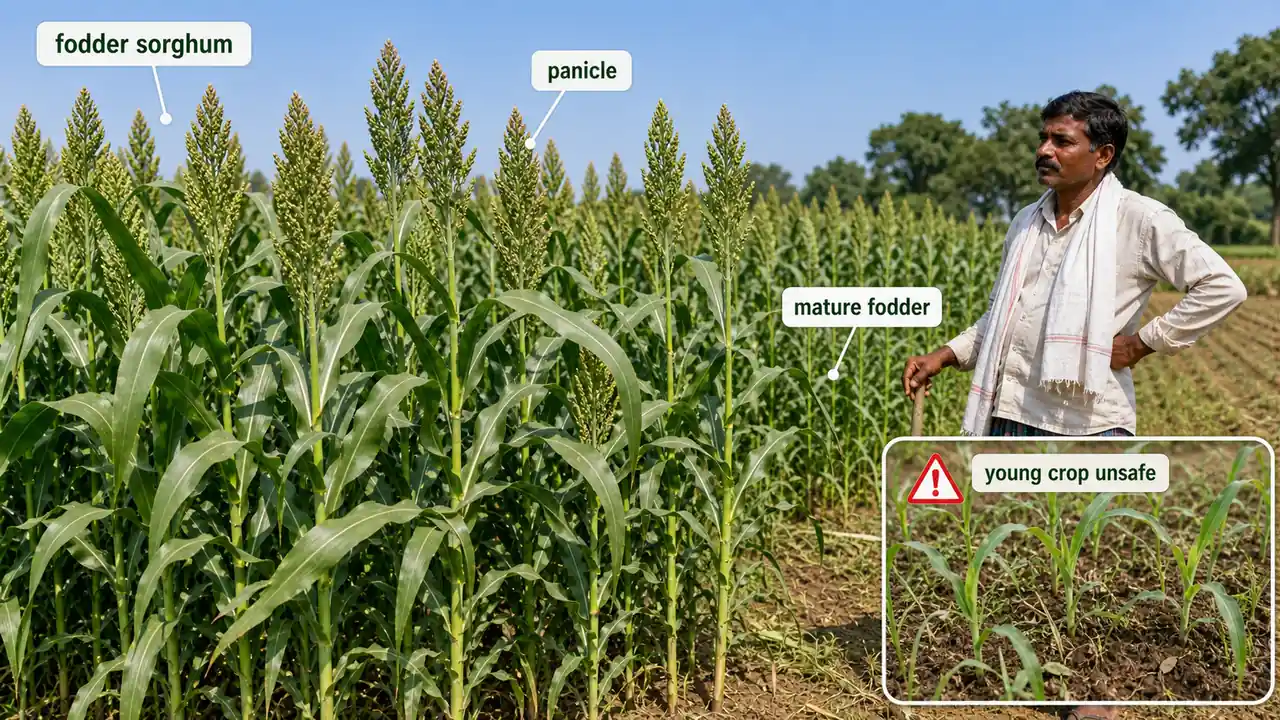
Fodder sorghum (also called Chari) is the most widely grown Kharif fodder crop in India. It produces high biomass but carries the critical danger of HCN (hydrogen cyanide) toxicity in young plants -- a fact tested repeatedly in exams.
| Parameter | Details |
|---|---|
| Botanical name | Sorghum species |
| Family | Poaceae |
| Origin | Africa |
| Temperature | 18-22 °C (optimum) |
| Sowing time | North India: March-July; South India: February-November |
| Seed rate | 40-50 kg/ha |
| Spacing | 25-30 cm (plant to plant) |
| NPK | 60 : 30 : 30 kg/ha |
| Fodder yield | 50-70 tonnes/ha |
- Varieties: JS-20, 29, 263, J3, Pusa chari, MP chari, Haryana chari, Dudhiya, Gwalior-82, 304, Vidisha 60-1, Ujjani 6, 8, CO-11, 18, 19
HCN Toxicity in Sorghum
- Sorghum contains Dhurrin/HCN (higher concentration found at 30-35 days age and mostly in summer sorghum). Dhurrin is a cyanogenic glucoside that releases hydrogen cyanide (HCN) when plant tissue is damaged. Young sorghum plants (under 45 days) can contain lethal concentrations of HCN, which can cause cyanide poisoning in livestock. HCN content decreases as the plant matures.
WARNING
Never feed young sorghum/chari fodder (under 45 days) to livestock. HCN concentration is highest at 30-35 days. Summer sorghum is especially dangerous. Always wait until at least 50% flowering for safe feeding.
Fodder Maize
| Parameter | Details |
|---|---|
| Botanical name | Zea mays |
| Family | Poaceae |
| Origin | America |
| Temperature | 18-22 °C (optimum) |
| Sowing time | North India: April-August; South India: February-November |
| Seed rate | 40-60 kg/ha (60-75 kg/ha for hybrids) |
| Spacing | 25-30 cm (plant to plant) |
| Irrigations | 4-5 (1-2 for kharif -- monsoon meets most water needs) |
| NPK | 60 : 40 : 30 kg/ha |
| Best harvest stage | Between 50 to 60 days (optimum balance of succulence, digestibility, and dry matter) |
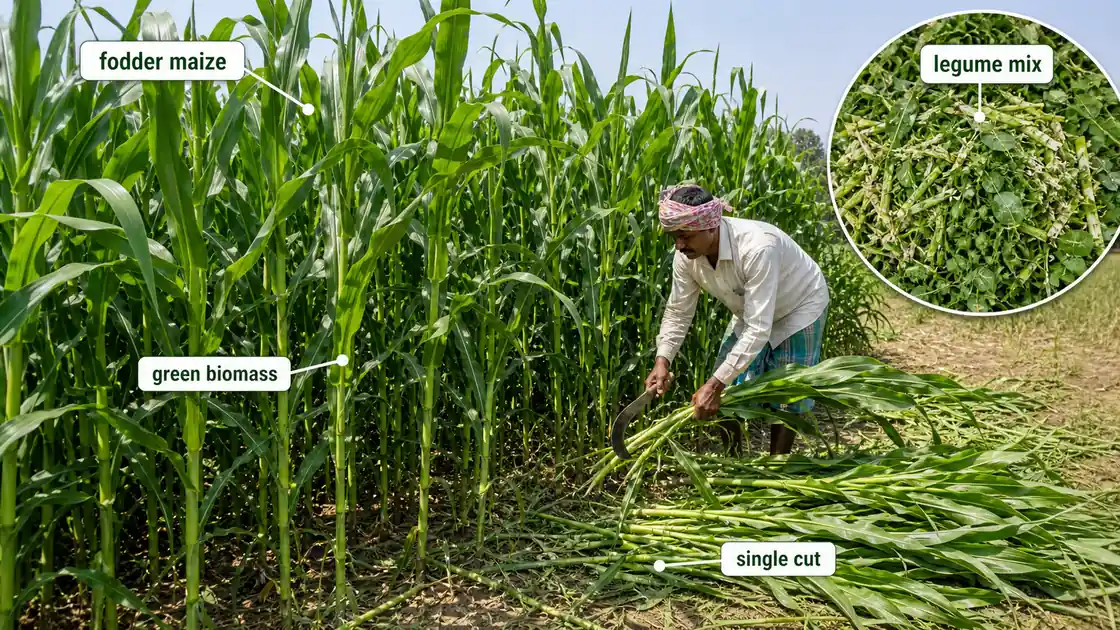
| Cuttings | One (single harvest, then the field is freed for the next crop) |
| Fodder yield | 35-45 tonnes/ha |
- Mixed cropping with: Cowpea, greengram, blackgram, horse gram. Mixing legumes with maize provides protein-rich fodder that complements maize's energy-rich biomass, resulting in a Balanced Ration — feed that furnishes all necessary nutrients (energy, protein, minerals, vitamins) in proper proportions for animal maintenance, growth, and production.
- Varieties: Ganga 5, African tall, J-1006, Vijay, Manjari, Deccan. African tall is especially popular for its tall stature and high biomass production.
Summary Table -- All Forage Crops at a Glance
| Crop | Family | Seed Rate (kg/ha) | NPK (kg/ha) | Fodder Yield (t/ha) | Special Feature |
|---|---|---|---|---|---|
| Berseem | Leguminoceae | 25-30 (diploid) | 20:60:30 | 80-100 | King of Fodder Crops |
| Lucerne | Leguminosae | 20-25 | 20-25:60-75:0 | 80-110 | Queen of Fodder Crops (perennial) |
| Oats | Poaceae | 80-120 | 80:30:20 | 40-45 | Harvest at dough stage |
| Napier | Poaceae | 33-40K slips | 40:30:20 | Perennial | Vegetative propagation |
| Fodder Sorghum | Poaceae | 40-50 | 60:30:30 | 50-70 | HCN danger in young plants |
| Fodder Maize | Poaceae | 40-60 | 60:40:30 | 35-45 | Single cutting; mix with legumes |
TIP
Exam mnemonic -- "BLO-NaSoMa" for forage crops: Berseem, Lucerne, Oats (Rabi legumes + cereal), Napier, Sorghum, Maize (perennial grass + Kharif grasses). The first three are Rabi-season crops sown in October-November; the last three are warm-season or perennial crops.
Summary Cheat Sheet
| Concept / Topic | Key Details |
|---|---|
| Berseem | King of Fodder Crops; Trifolium alexandrinum; origin Egypt |
| Berseem seed rate | 25-30 kg/ha (diploid); 35 kg/ha (tetraploid) |
| Berseem Rhizobium | R. trifolii; forage yield 80-100 t/ha |
| Berseem weed | Kasni (Chicorium intybus) — separated by 17% salt solution |
| Lucerne / Alfalfa | Queen of Fodder Crops; Medicago sativa; perennial (3-4 years) |
| Lucerne protein | 15-22% — highest among forage crops |
| Lucerne Rhizobium | R. meliloti; forage yield 80-110 t/ha |
| Lucerne weed | Cuscuta reflexa (Dodder/Amarbel — stem parasite) |
| Lucerne yellowing | Due to boron deficiency |
| Oats | Avena sativa; Poaceae; seed rate 80-120 kg/ha |
| Oats harvest stage | Dough stage; yield 40-45 t/ha |
| Napier grass | Pennisetum purpureum; perennial 3-5 years; vegetative propagation |
| Pusa giant (Napier) | Hybrid of P. purpureum × P. typhoideum |
| Fodder sorghum HCN | Dhurrin — lethal at 30-35 days age; never feed < 45 days |
| Fodder sorghum yield | 50-70 t/ha |
| Fodder maize | Harvest at 50-60 days; yield 35-45 t/ha; single cutting |
| Fodder maize mixed with | Cowpea, greengram, blackgram, horse gram (legumes for protein) |
| Saponins | Glucosides in berseem and lucerne; can cause bloat |
| India fodder deficit | 36% green fodder; 11% dry fodder shortage |
| Silage | Green forage preserved by anaerobic acid fermentation; ~65% moisture; 3 lbs silage = 1 lb hay (dry matter equivalent) |
| Balanced Ration | Feed with all nutrients (energy, protein, minerals, vitamins) in proper proportions |