🌱 Clusterbean (Guar) -- India's Gum Giant and Industrial Crop
Complete guide to clusterbean/guar (Cyamopsis tetragonoloba) -- 35% guar gum (galactomannan), oil drilling (fracking), India's 80% world share, Rajasthan as top producer, drought-tolerant kharif crop.
In the arid expanses of western Rajasthan, where annual rainfall barely touches 300 mm, a modest-looking legume generates billions of dollars in foreign exchange for India. Clusterbean (Guar) is far more than a pulse -- it is a globally critical industrial crop. The gum extracted from its seeds is used in hydraulic fracturing (fracking) by the oil and gas industry, making this drought-tolerant desert crop an unlikely player in the global energy sector. India produces 80% of the world's guar gum, with Rajasthan contributing over 70% of national output. This chapter covers the agronomy, industrial importance, and exam-essential facts about this remarkable crop.
Botanical Profile
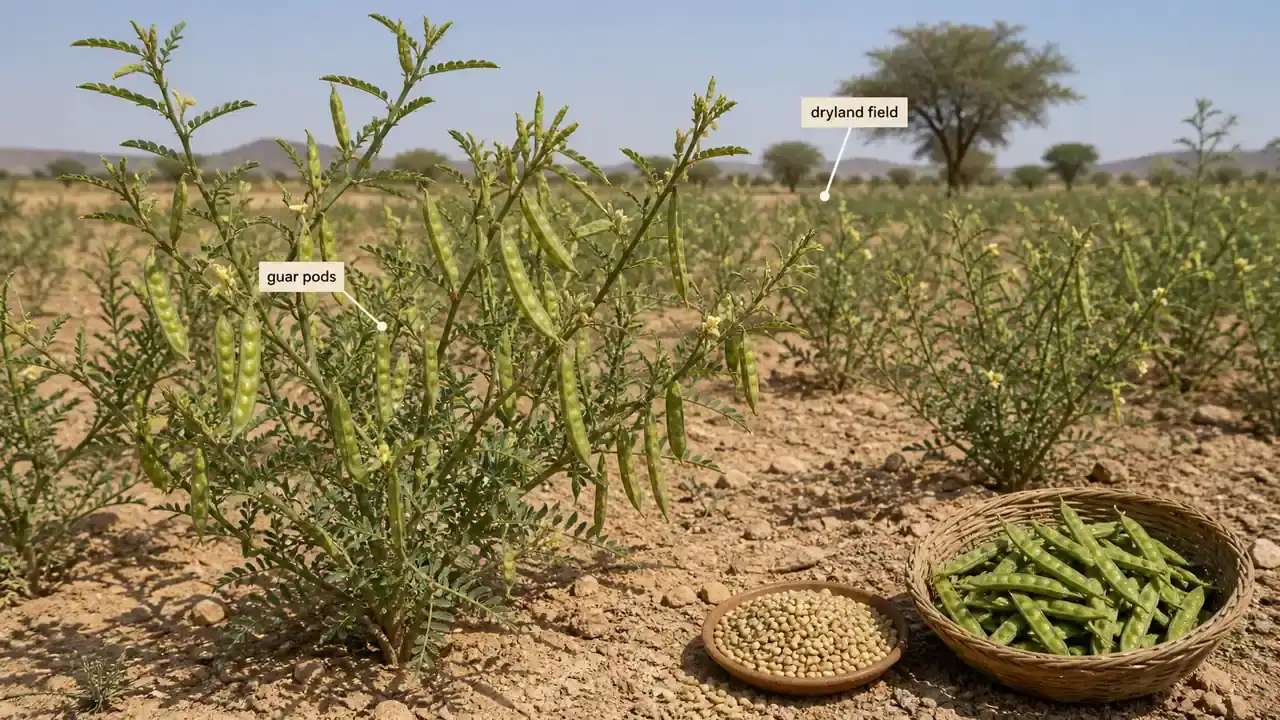
Clusterbean belongs to the Fabaceae family but is classified primarily as an industrial crop rather than a pulse -- because its main commercial product is guar gum (a galactomannan polysaccharide) extracted from the seed endosperm, not the protein-rich cotyledons.
Pro Content Locked
Upgrade to Pro to access this lesson and all other premium content.
Pay once valid for one year · Effective ₹99/month
- All Agriculture & Banking Courses
- AI Lesson Questions (100/day)
- AI Doubt Solver (50/day)
- Glows & Grows Feedback (30/day)
- AI Section Quiz (20/day)
- 22-Language Translation (100/day)
- Recall Questions (20/day)
- AI Quiz (15/day)
- AI Quiz Paper Analysis (100/day)
- AI Step-by-Step Explanations (100/day)
- Spaced Repetition Recall (FSRS)
- AI Tutor
- Immersive Text Questions
- Audio Lessons — Hindi & English
- Mock Tests & Previous Year Papers
- Summary & Mind Maps
- XP, Levels, Leaderboard & Badges
- Generate New Classrooms
- Voice AI Teacher (AgriDots Live)
- AI Revision Assistant
- Knowledge Gap Analysis
- Interactive Revision (LangGraph)
🔒 Secure one-time yearly payment via Razorpay · No hidden fees
In the arid expanses of western Rajasthan, where annual rainfall barely touches 300 mm, a modest-looking legume generates billions of dollars in foreign exchange for India. Clusterbean (Guar) is far more than a pulse -- it is a globally critical industrial crop. The gum extracted from its seeds is used in hydraulic fracturing (fracking) by the oil and gas industry, making this drought-tolerant desert crop an unlikely player in the global energy sector. India produces 80% of the world's guar gum, with Rajasthan contributing over 70% of national output. This chapter covers the agronomy, industrial importance, and exam-essential facts about this remarkable crop.
Botanical Profile
Clusterbean belongs to the Fabaceae family but is classified primarily as an industrial crop rather than a pulse -- because its main commercial product is guar gum (a galactomannan polysaccharide) extracted from the seed endosperm, not the protein-rich cotyledons.
| Parameter | Details |
|---|---|
| Botanical name | Cyamopsis tetragonoloba |
| Family | Fabaceae (Leguminosae) |
| Chromosome number | 2n = 14 |
| Origin | Africa / India |
| Common name | Guar |
| Pollination | Self-pollinated |
| Crop type | Primarily an industrial crop, not just a pulse |
| Key product | Seeds contain about 35% gum (galactomannan) |
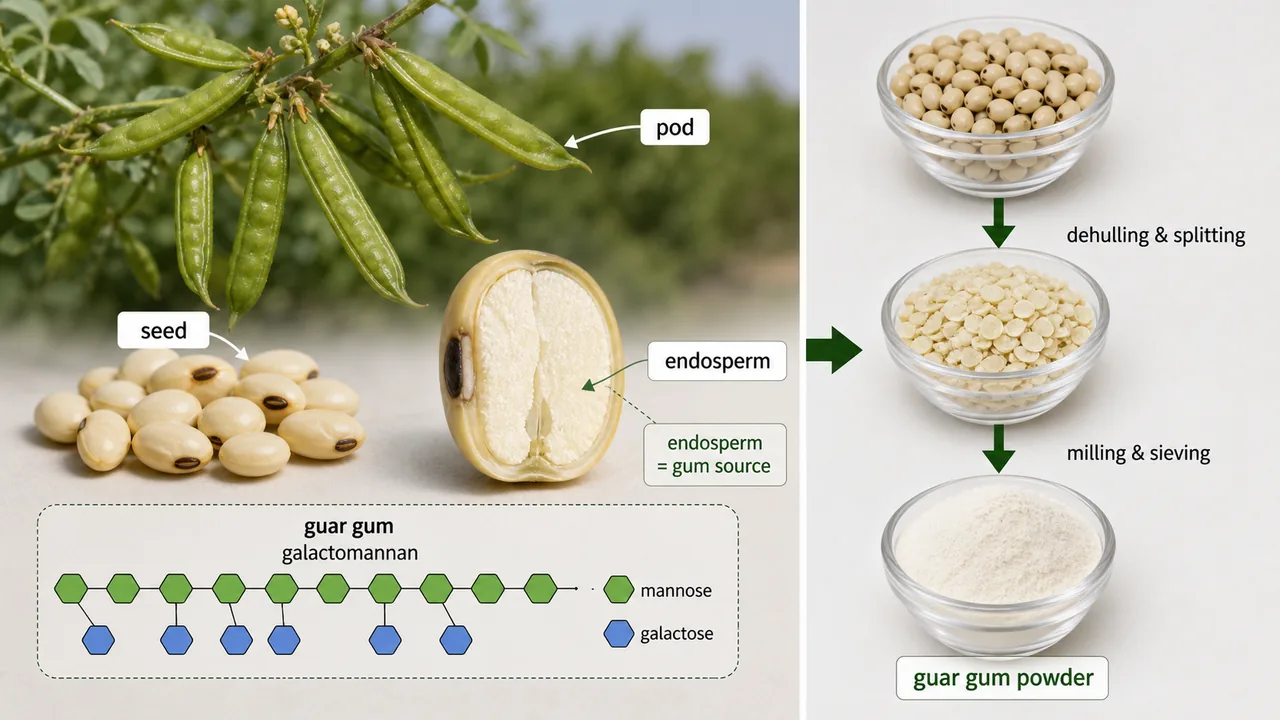
Guar Gum -- Industrial Importance
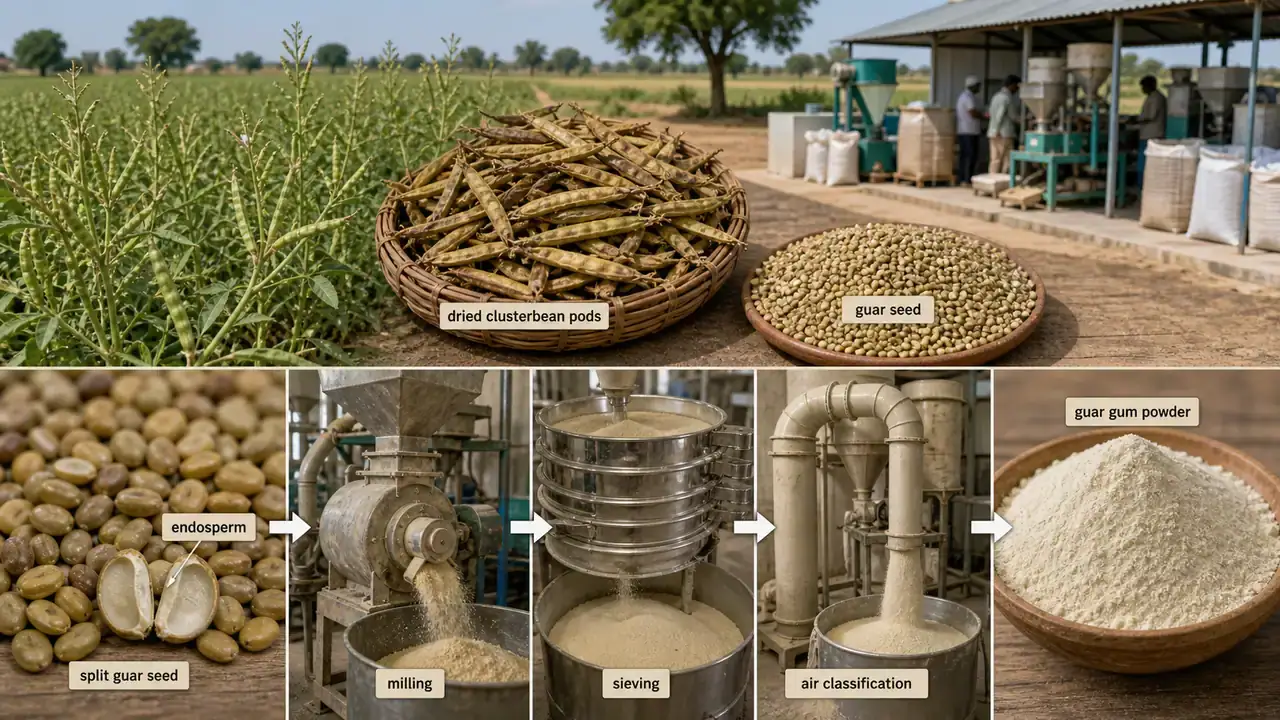
Guar gum (a galactomannan polysaccharide) is extracted from the endosperm of guar seeds. It acts as a thickener, stabilizer, and emulsifier across multiple industries:
| Industry | Application |
|---|---|
| Oil & Gas | Hydraulic fracturing (fracking) -- the largest demand driver |
| Food | Ice cream, bakery products, sauces (thickener) |
| Textile | Sizing and finishing |
| Paper | Binding agent |
| Pharmaceutical | Tablet binder, laxative |
| Cosmetics | Lotions and creams |
- India produces 80% of world's guar gum
- Global demand surged in the 2010s due to the US shale oil boom and fracking industry
TIP
Why guar is NOT just a pulse: Guar gum from the seed endosperm (not the pod) is the primary commercial product. The gum's thickening and stabilising properties drive a multi-billion-dollar global industry. Think: Guar = Gum = Global industrial crop.
Climate and Soil Requirements
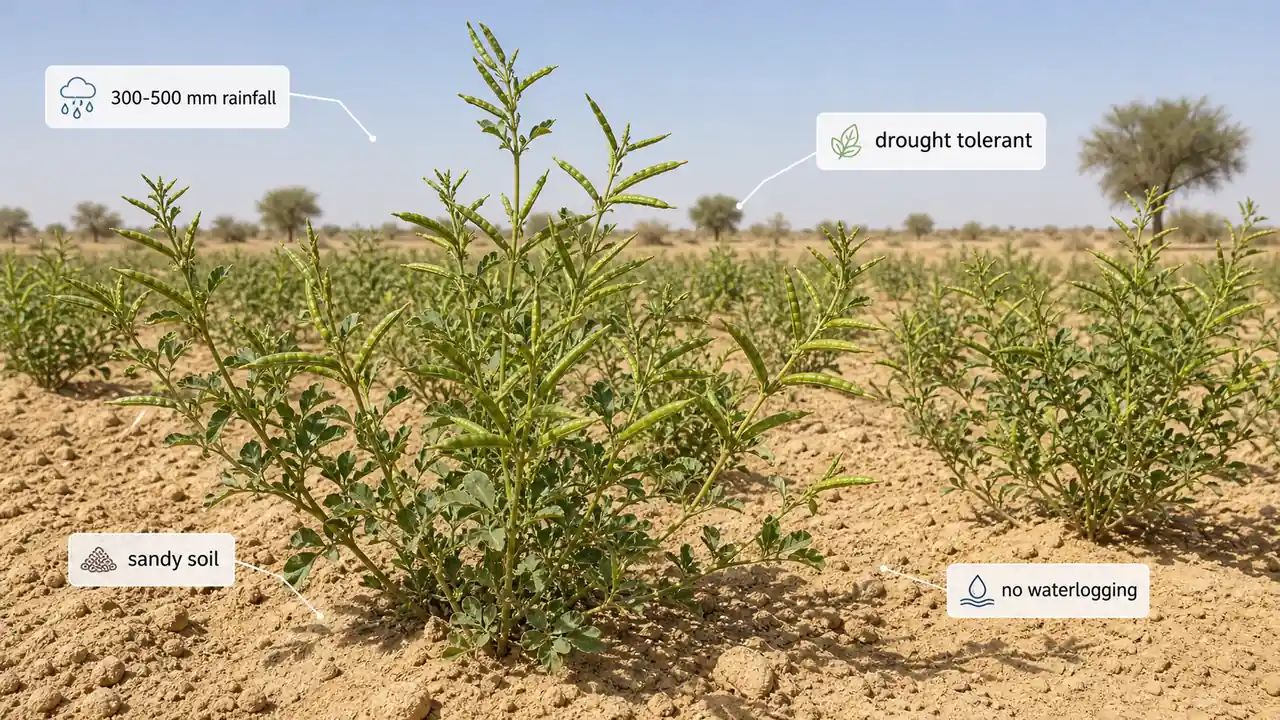
Guar is one of the most drought-adapted legumes, producing a viable crop with just 300 mm of rainfall. It thrives in the hot, arid conditions of western Rajasthan where most other crops struggle, but it cannot tolerate waterlogging at all.
| Parameter | Details |
|---|---|
| Season | Drought-tolerant kharif crop |
| Temperature | 25-35°C (optimum) |
| Rainfall | 300-500 mm -- grows well under rainfed conditions |
| Photoperiod | Long-day plant |
| Soil | Sandy to sandy loam, well-drained; tolerant of alkaline soils |
| Sensitivity | Does NOT tolerate waterlogging |
Guar's ability to produce a viable crop with just 300 mm rainfall makes it one of the most drought-adapted legumes in Indian agriculture.
Cultivation Practices
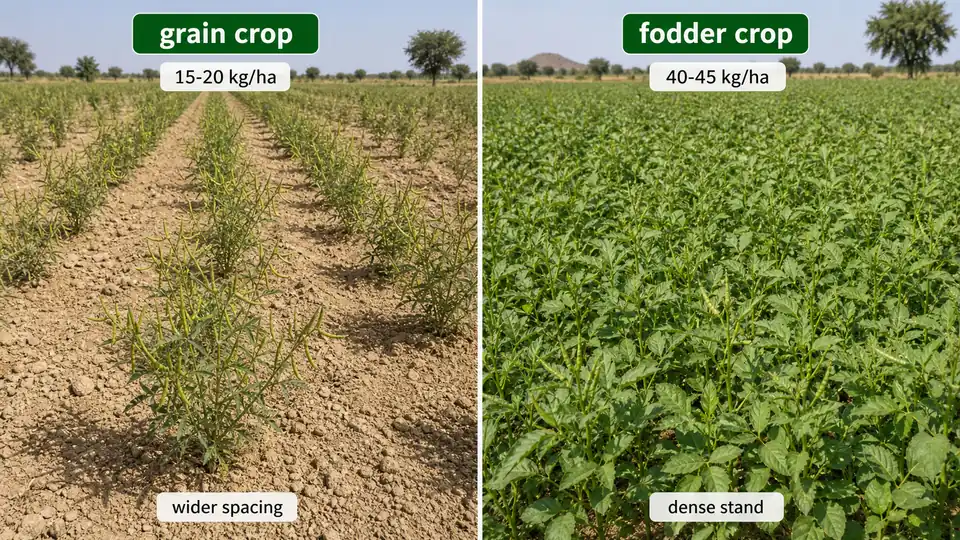
Guar is sown at the onset of the monsoon (July) in the kharif season. The seed rate differs significantly based on whether the crop is grown for grain (gum extraction) or fodder, reflecting the very different plant density requirements for each purpose.
| Parameter | Details |
|---|---|
| Seed rate (grain) | 15-20 kg/ha |
| Seed rate (fodder) | 40-45 kg/ha |
| Spacing | 45 x 20 cm |
| Sowing time | July (Kharif -- monsoon onset) |
| Fertilizers (NPK) | 20:40:0 kg/ha |
| Seed treatment | Rhizobium culture inoculation |
Yield
Guar produces respectable grain yields for an arid-zone crop, and its fodder yield is particularly impressive -- making it a dual-purpose crop for livestock-dependent Rajasthani farmers.
| Purpose | Yield |
|---|---|
| Grain yield | 10-15 q/ha |
| Fodder yield | 250-300 q/ha |
Growing Regions
Guar production is heavily concentrated in the arid and semi-arid zones of north-western India, with Rajasthan dominating overwhelmingly.
- Rajasthan is the largest producer (>70% of India's production)
- Other states: Haryana, Gujarat, Punjab, Madhya Pradesh
The concentration in Rajasthan aligns with guar's preference for arid conditions, sandy soils, and high temperatures during the kharif season.
Important Varieties
Guar breeding focuses on gum content, drought tolerance, and disease resistance. The variety RGC-936 is particularly notable for its high drought tolerance.
| Variety | Special Feature |
|---|---|
| PS-16 | Tolerant to yellow mosaic virus, highly synchronous in maturity |
| RGC-936 | Highly drought tolerant |
| Other varieties | PS-7, RGC-1002, RGC-1066, RGC-1017, HG-563, HG-365, HG-2-20 |
Guar vs Other Industrial Legumes -- Comparison
Though both guar and soybean belong to Fabaceae, their commercial classifications are entirely different -- guar is an industrial gum crop while soybean is an oilseed-protein crop. This comparison highlights the contrasts exams test.
| Character | Clusterbean (Guar) | Soybean |
|---|---|---|
| Primary product | Gum (galactomannan) | Oil + Protein meal |
| Classification | Industrial crop | Oilseed + Food |
| Gum content | 35% | None |
| Oil content | Low | 18-20% |
| Drought tolerance | Very high (300 mm) | Moderate (600-1000 mm) |
| Leading state | Rajasthan | Madhya Pradesh |
| Pollination | Self | Self |
Summary Cheat Sheet

| Fact | Details |
|---|---|
| Family | Fabaceae |
| Origin | Africa / India |
| Chromosome | 2n = 14 |
| Key product | 35% gum (galactomannan) in seeds |
| Gum source | Seed endosperm |
| Crop type | Industrial crop (NOT just a pulse) |
| India's world share | 80% of world's guar gum |
| Top state | Rajasthan (>70%) |
| Rainfall need | 300-500 mm |
| Photoperiod | Long-day plant |
| Pollination | Self-pollinated |
| Grain yield | 10-15 q/ha |
| Key variety | RGC-936 (drought tolerant) |
TIP
Guar exam essentials: 35% gum (galactomannan) in seeds -- NOT a pulse, classified as industrial crop. India produces 80% of world's guar gum. Rajasthan = largest producer. Used in oil drilling (fracking), food, textiles. Remember: Guar gum comes from seed endosperm, not the pod.
Lesson Doubts
Ask questions, get expert answers