🌾 Foundations of Agronomy
Learn the basics of agriculture, agronomy, farming systems, crop-production factors, and land-use terms.
Agronomy is the science of managing fields to produce crops efficiently and sustainably. Before we can understand agronomy's principles, we need to understand what agriculture itself is, how it evolved from primitive hunting to a modern science, and what factors determine whether a crop succeeds or fails.
This lesson covers:
- What agriculture is -- definition, etymology, and the seven branches
- How agriculture evolved -- from 10,000 B.C. to scientific farming
- What agronomy is -- definition, scope, three branches, and eight principles
- Factors affecting crop production -- external (climatic, edaphic, biotic, physiographic, socio-economic) and internal (genetic)
- Types of farming -- commercial vs subsistence, intensive vs extensive, ownership systems
- Agricultural land terminology -- net area sown, gross cropped area, cropping intensity
All sections are high-yield points for all the agriculture exams.
What is Agriculture?
Etymology
-
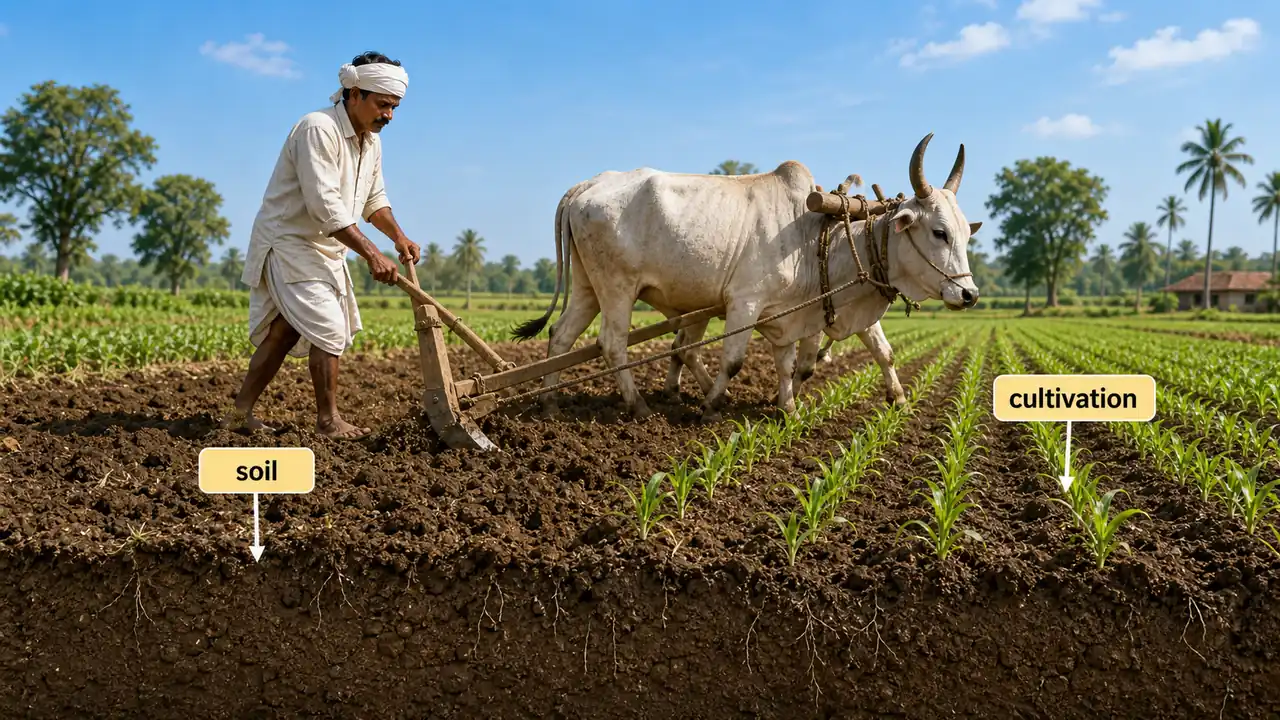
The word "Agriculture" comes from the Latin term agricultūra — "agri" meaning "soil" and "cultūra" meaning "cultivation". At its core, agriculture is about working the soil to grow crops and sustain life.
Pro Content Locked
Upgrade to Pro to access this lesson and all other premium content.
₹99 charged monthly · Cancel anytime
- All Agriculture & Banking Courses
- AI Lesson Questions (100/day)
- AI Doubt Solver (50/day)
- Glows & Grows Feedback (30/day)
- AI Section Quiz (20/day)
- 22-Language Translation (100/day)
- Recall Questions (20/day)
- AI Quiz (15/day)
- AI Quiz Paper Analysis (100/day)
- AI Step-by-Step Explanations (100/day)
- Spaced Repetition Recall (FSRS)
- AI Tutor
- Immersive Text Questions
- Audio Lessons — Hindi & English
- Mock Tests & Previous Year Papers
- Summary & Mind Maps
- XP, Levels, Leaderboard & Badges
- Generate New Classrooms
- Voice AI Teacher (AgriDots Live)
- AI Revision Assistant
- Knowledge Gap Analysis
- Interactive Revision (LangGraph)
🔒 Secure via Razorpay · Cancel anytime · No hidden fees
Agronomy is the science of managing fields to produce crops efficiently and sustainably. Before we can understand agronomy's principles, we need to understand what agriculture itself is, how it evolved from primitive hunting to a modern science, and what factors determine whether a crop succeeds or fails.
This lesson covers:
- What agriculture is -- definition, etymology, and the seven branches
- How agriculture evolved -- from 10,000 B.C. to scientific farming
- What agronomy is -- definition, scope, three branches, and eight principles
- Factors affecting crop production -- external (climatic, edaphic, biotic, physiographic, socio-economic) and internal (genetic)
- Types of farming -- commercial vs subsistence, intensive vs extensive, ownership systems
- Agricultural land terminology -- net area sown, gross cropped area, cropping intensity
All sections are high-yield points for all the agriculture exams.
What is Agriculture?
Etymology
-
The word "Agriculture" comes from the Latin term agricultūra — "agri" meaning "soil" and "cultūra" meaning "cultivation". At its core, agriculture is about working the soil to grow crops and sustain life.
-
Agriculture means the cultivation of the soil.
-
In its broadest sense, agriculture extends far beyond soil cultivation. It includes crop production, horticulture, livestock management, fisheries, forestry, sericulture (silk production), apiculture (beekeeping), and more.
IMPORTANT
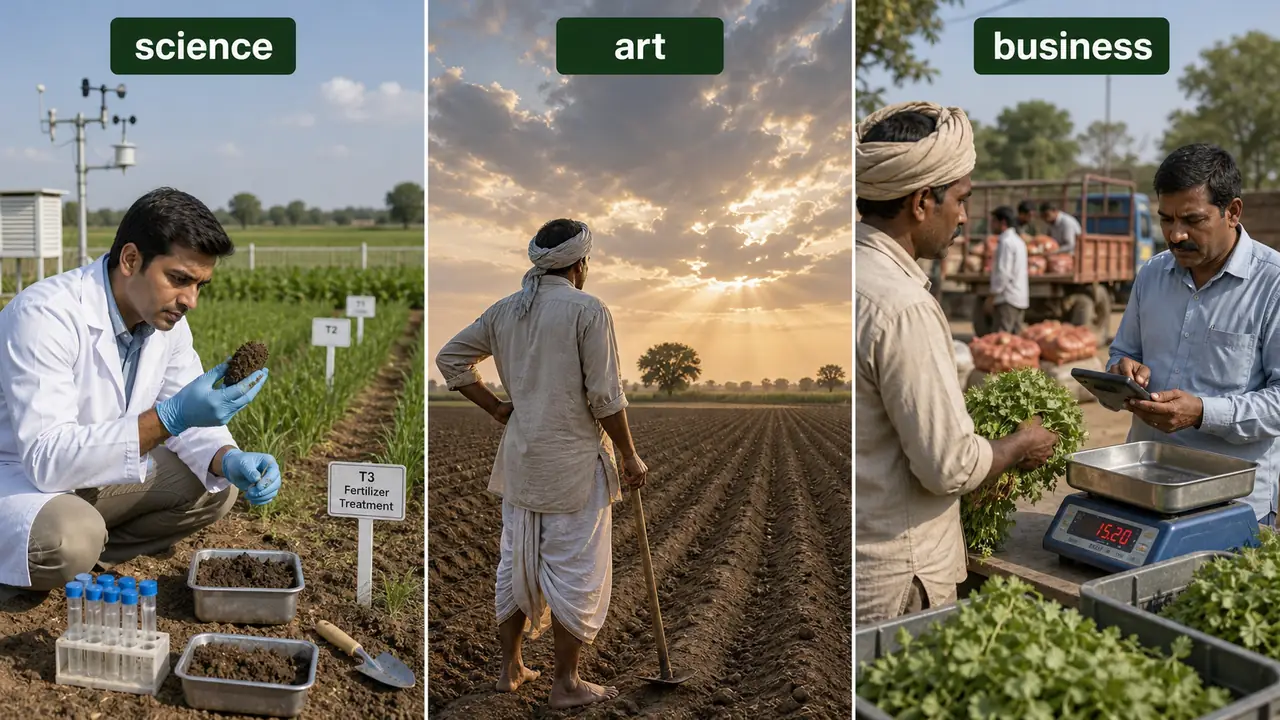
Agriculture can be termed as a Science, an Art, and a Business altogether.
Why Agriculture is Science, Art, and Business
| Aspect | Explanation | Agricultural Example |
|---|---|---|
| Science | Uses systematic observation, experimentation, and data — from soil chemistry to plant physiology | Breeding rust-resistant wheat varieties using knowledge of genetics and plant pathology |
| Art | Requires skill and experience to make sound decisions under uncertainty | A farm manager choosing the right sowing date for rice based on monsoon onset predictions |
| Business | Involves costs of production, market demand, pricing, and profit or loss | A cotton farmer deciding whether to sell raw cotton or get it ginned for higher returns |
Seven Branches of Agriculture
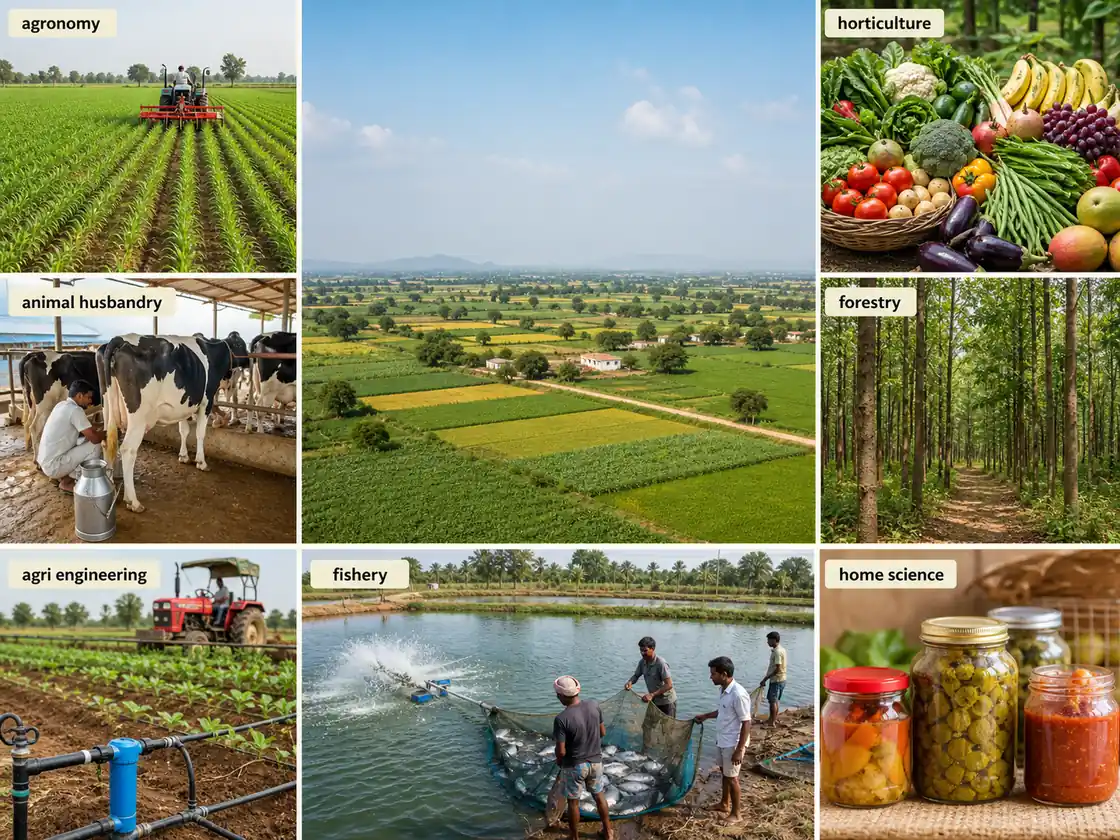
Agriculture is not a single discipline — it spans seven major branches, each specialising in a different aspect of food, fibre, and resource production. Understanding these branches helps you see where agronomy fits within the larger agricultural sciences.
Agriculture is divided into seven major branches:
| S.No. | Branch | Scope | Agricultural Example |
|---|---|---|---|
| 1 | Agronomy | Crop production, meteorology, plant pathology, entomology, breeding, extension, economics | Growing wheat in Rabi season using recommended package of practices |
| 2 | Horticulture | Fruits (Pomology), Vegetables (Olericulture), Flowers (Floriculture) | Mango orchards of Maharashtra, rose cultivation in Pune |
| 3 | Forestry | Management, conservation, and utilization of forest resources (Silviculture) | Teak plantations in Madhya Pradesh |
| 4 | Animal Husbandry | Breeding, feeding, and management of cattle, sheep, goats, poultry | Dairy farming cooperatives like Amul in Gujarat |
| 5 | Fishery Science | Management of aquatic organisms; Pisciculture (fish cultivation) | Inland fish farming in Andhra Pradesh |
| 6 | Agricultural Engineering | Farm machinery, irrigation systems, soil and water conservation structures | Design of drip irrigation systems for water-scarce regions |
| 7 | Home Science | Nutrition, food preservation, textile science, household management | Training rural women in food processing and preservation |
TIP
Remember the seven branches with the mnemonic: "A H F A F A H" — Agronomy, Horticulture, Forestry, Animal Husbandry, Fishery Science, Agricultural Engineering, Home Science.
In exam preparation, students often memorise these seven names but miss the bigger point: agronomy is the branch that connects field-level decision making to crop output. That is why topics like sowing time, tillage, irrigation, nutrient management, and cropping systems repeatedly return throughout the rest of the course.
Specialized Sub-branches
| Sub-branch | Study of | Easy Association |
|---|---|---|
| Silviculture | Forest development | Silver → Forest trees |
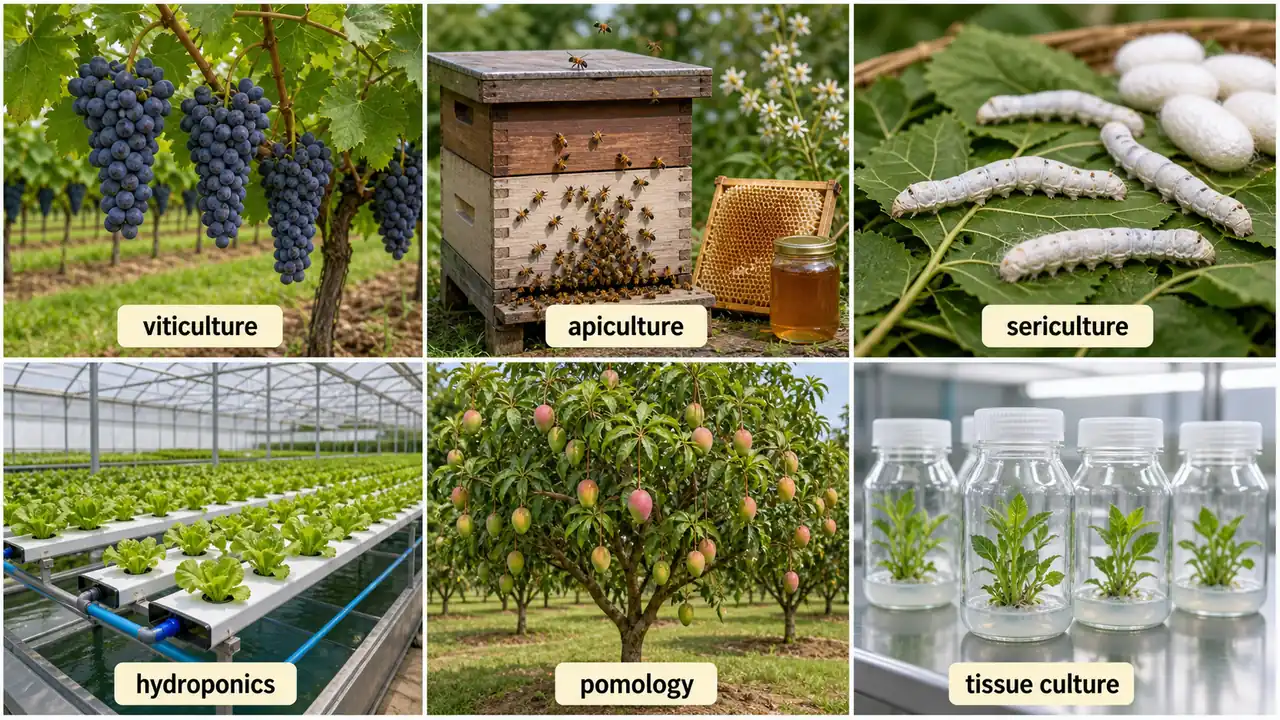
| Viticulture | Production of grapes | Viti → Vine → Grapes |
| Moriculture | Production of mulberry | Mori → Mulberry |
| Sericulture | Rearing of silk worm | Seri → Silk |
| Pomology | Study of fruits | Pomo → Fruit (French: pomme) |
| Olericulture | Study of vegetables | Oleri → Vegetable |
| Floriculture | Study of flowers | Flori → Flower |
| Horticulture | Study of fruits and vegetables | Hortus → Garden |
| Apiculture | Study of honey bee | Api → Bee (Latin: apis) |
| Vermiculture | Study of agricultural earthworm | Vermi → Worm |
| Agrostology | Study of grasses — classification, management, utilization | Agro → Grass management for fodder |
| Hydroponics | Growing plants in water with essential nutrients (soilless) | Hydro → Water-based cultivation in greenhouses |
| Tissue Culture | Production of a new plant from plant cells | Lab-based plant propagation |
Brief History of Agriculture
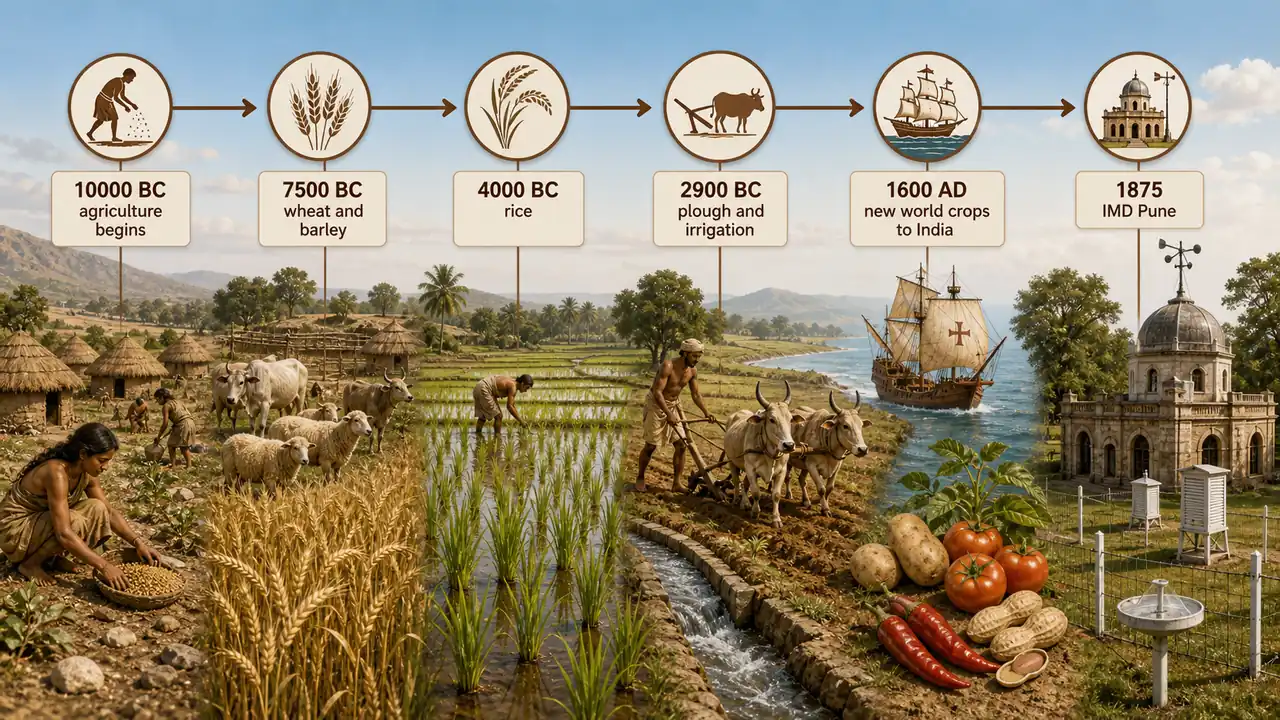
Agriculture did not begin as a science — it evolved over millennia from accidental seed dispersal near human settlements to deliberate cultivation and animal domestication. These historical milestones are frequently tested as direct one-liners.
| Time Period | Event |
|---|---|
| 10000 B.C. | Agriculture started; Domestication of Dog for hunting in Iran and Israel |
| 8700 B.C. | Domestication of Sheep |
| 7700 B.C. | Domestication of Goat |
| 7500 B.C. | Cultivation of Wheat and Barley began — the dawn of settled farming |
| 6000 B.C. | Domestication of Cattle and Pigs |
| 4400 B.C. | Cultivation of Maize |
| 4000 B.C. | Cultivation of Rice |
| 3500 B.C. | Cultivation of Potato |
| 2900 B.C. | Plough was invented; Irrigated farming started |
| 1600 AD | Introduction to India: Potato, Tomato, Chillies, Groundnut, Tobacco, Rubber, Cashewnut, Papaya Exams |
| 1875 | Indian Meteorological Department (IMD) established at Pune |
IMPORTANT
Key exam facts: Agriculture began around 10,000 B.C. Wheat and barley cultivation started at 7500 B.C. The plough was invented at 2900 B.C. The Portuguese (1600 AD) introduced many New World crops to India.
Evolution of Man and Agriculture
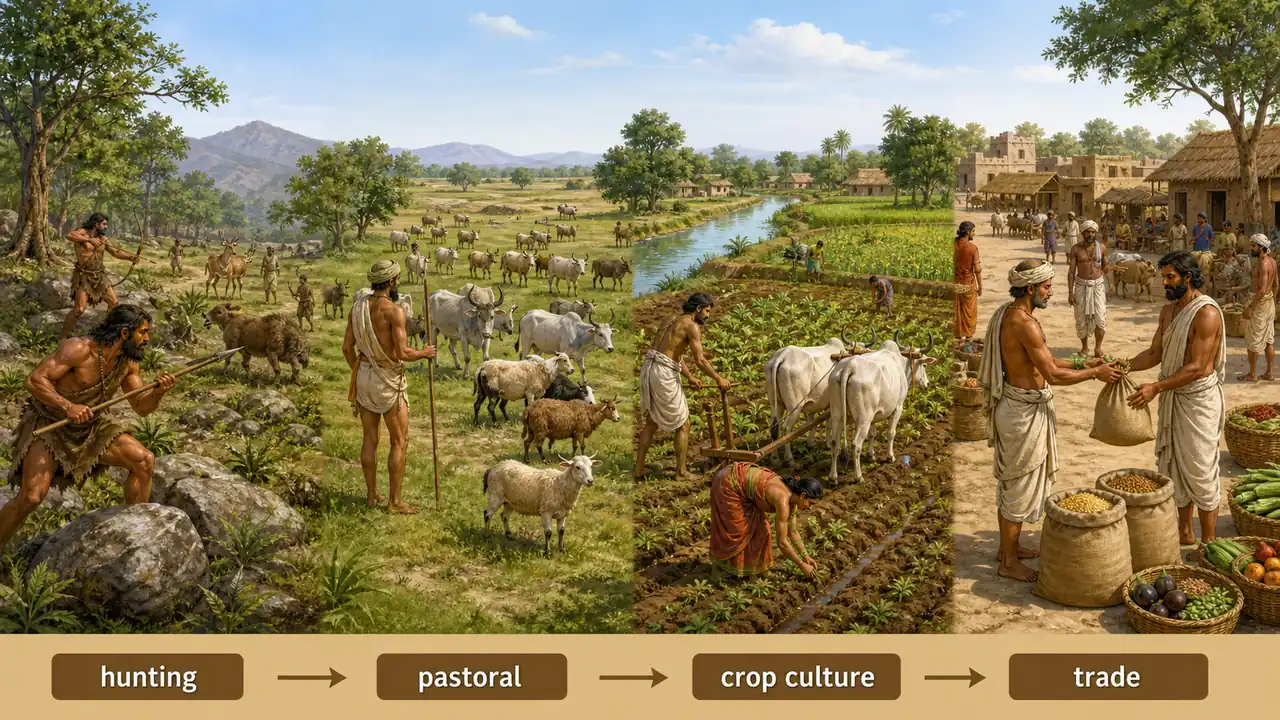
Human civilisation evolved through four distinct stages, each bringing agriculture closer to the settled, productive systems we know today. This progression — from hunting to trade — explains why agriculture is the oldest and most fundamental human occupation.
| Stage | Activity | Agricultural Significance |
|---|---|---|
| Hunting | Primary source of food in ancient times | Longest occupation in human history |
| Pastoral | Domestication of animals — dogs, horses, cattle | Living on the periphery of forests to feed animals |
| Crop Culture | Settled cultivation near river beds | Enough water for animals and crops; permanent settlements began |
| Trade | Exchange of surplus production | Led to roads, markets, and further domestication |
Development of Scientific Agriculture
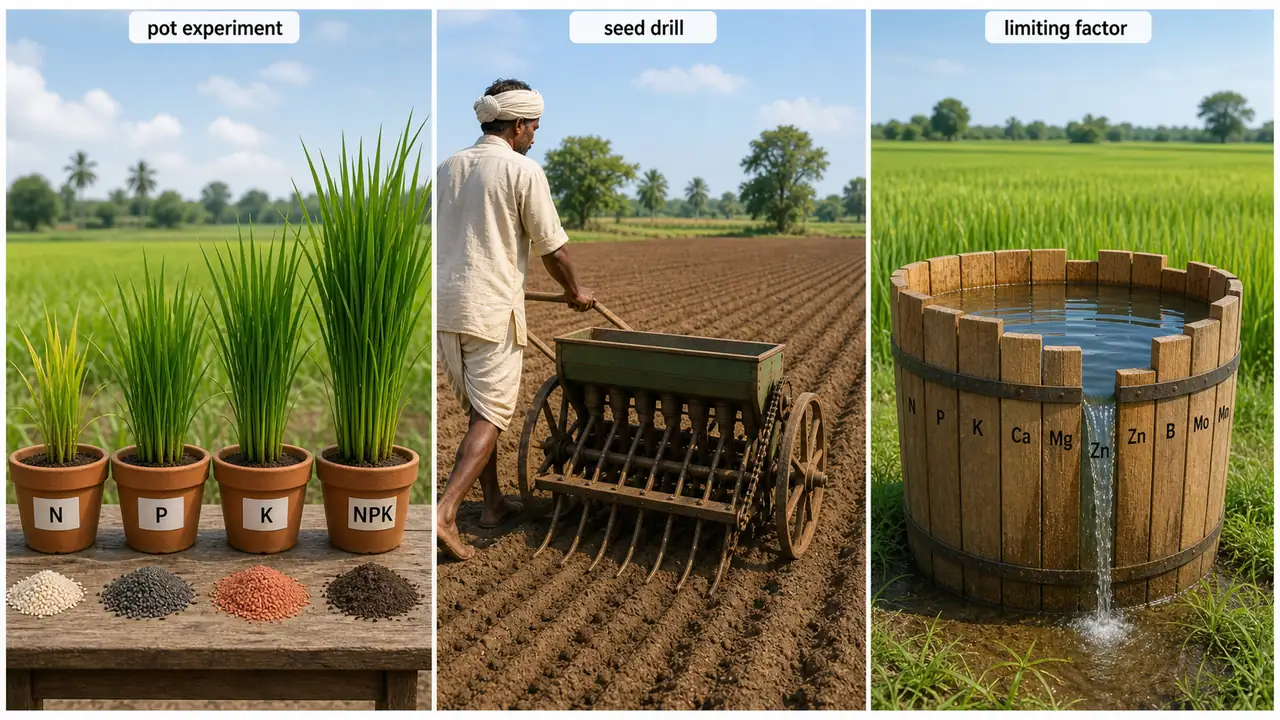
The transition from traditional to scientific agriculture happened over several centuries, driven by key experiments and discoveries. Each scientist below contributed a foundational concept that modern agronomy still relies on — and exams frequently test these associations.
| Scientist | Contribution | Agricultural Impact |
|---|---|---|
| Francis Bacon (1561–1624) | Started experimentation technique; found water as plant nutrient | Laid the foundation for scientific inquiry in farming |
| Jan Baptiste Van Helmont (1572–1644) | Conducted the famous Pot experiment | First quantitative experiment in plant nutrition |
| Jethro Tull | Fine soil particle as plant nutrient | Invented the seed drill; Father of Tillage |
| Justus von Liebig | Developed "Law of Minimum"; Father of Agricultural Chemistry | Showed that the scarcest nutrient limits crop growth |
| Gregor Mendel (1866) | Discovered the laws of heredity | Foundation of plant breeding |
| Blackman (1905) | Theory of "optima and limiting factors" | Explains why yield plateaus |
| Mitscherlich (1909) | Law of diminishing returns | Each successive fertilizer dose gives smaller yield increase |
TIP
Liebig's Law of Minimum is the most frequently examined concept — crop growth is limited by the scarcest nutrient.
What is Agronomy?
- The word comes from two Greek roots: Agros (field) + Nomos (manage). It literally means "the art of managing fields".
- Agronomy is the science of manipulating the crop-environment complex to improve agricultural productivity while understanding the underlying processes.
- A concise definition: "The branch of agricultural science that deals with the principles and practices of crop production for obtaining maximum economic returns per unit area without deteriorating soil fertility."
- Agronomy is regarded as the mother branch of agriculture because it integrates knowledge from biology, chemistry, physics, soil science, and ecology into practical field applications.
- Pietro de'Crescenzi, an Italian scholar, is recognised as the Father of Agronomy.
In simple teaching language, agronomy answers the practical field question: what should a farmer do, when, where, and why, to get a better crop with lower risk and sustainable soil health?
Three Branches of Agronomy
| Branch | Focus | Agricultural Example |
|---|---|---|
| Crop Science | Biology, genetics, and management of field crops | Selecting a drought-tolerant pearl millet hybrid for Rajasthan |
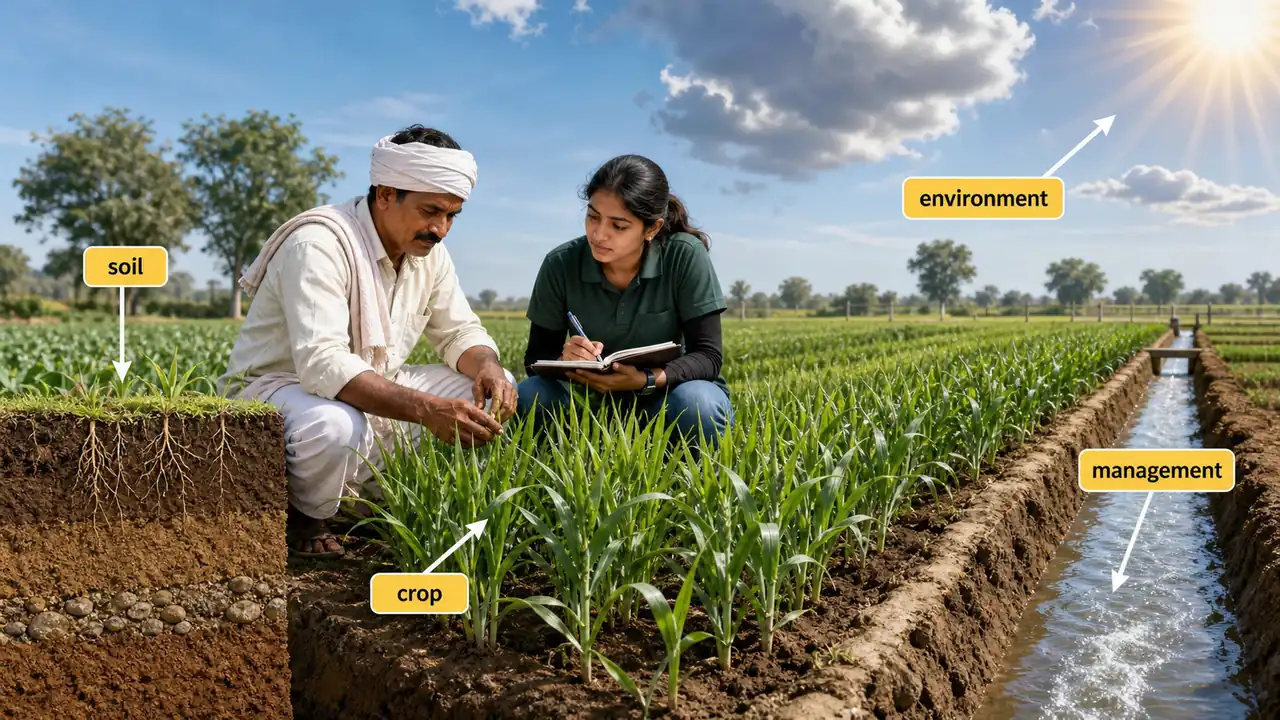
| Soil Science | Physical, chemical, and biological properties of soil | Testing soil pH before deciding lime application in acidic laterite soils of Kerala |
| Environmental Science | How weather, climate, and ecosystems affect agriculture | Studying monsoon onset dates to time rice sowing in eastern India |
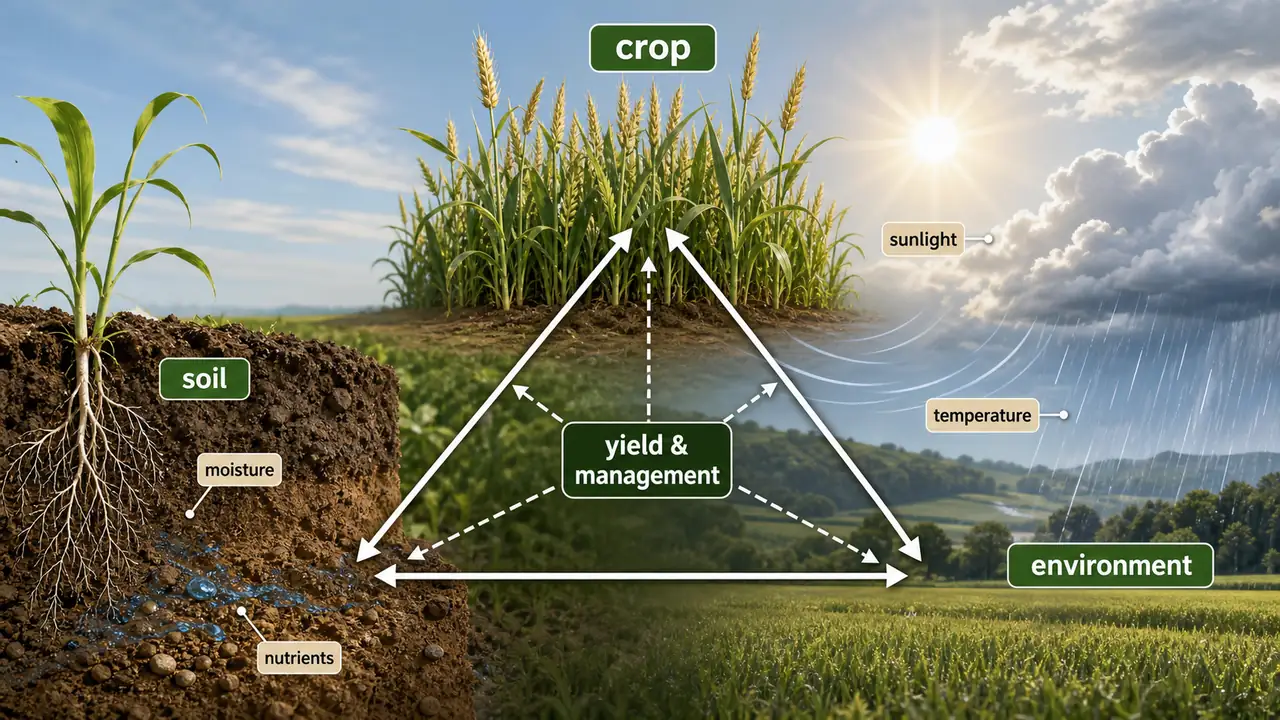
The central theme of agronomy is the soil-crop-environment relationship. Understanding how these three components interact is the key to successful farming.
Scope of Agronomy
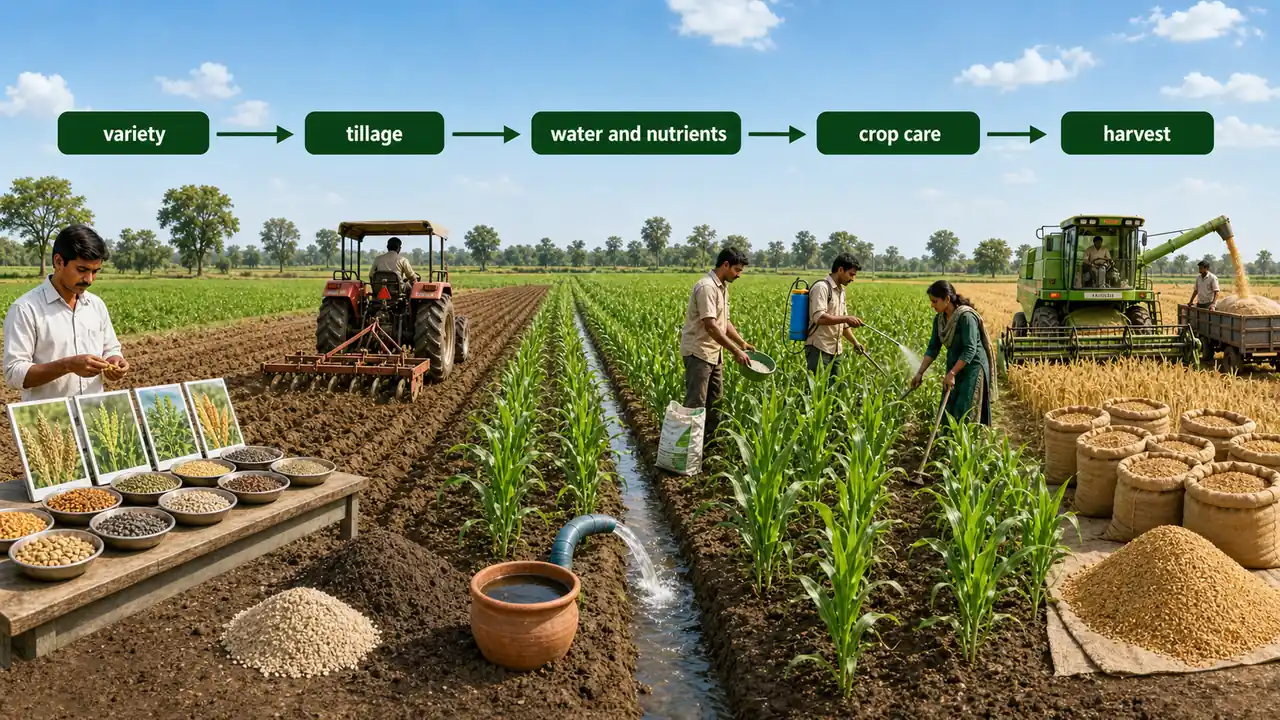
The scope of agronomy covers the entire crop production chain — from selecting the right variety to minimising post-harvest losses. Each area below represents a domain where agronomic knowledge directly improves farm economics.
TIP
Exam tip: The scope of agronomy covers the entire crop production chain -- from variety selection to post-harvest management. Questions often ask you to list 4-5 points.
| Area | How It Helps | Field Example |
|---|---|---|
| Yield maximisation | Introduction of HYVs and improved cultivars | IR-64 rice replacing local tall varieties |
| Reduced cost of production | Proper crop management lowers input costs | Balanced fertilization based on soil test values |
| Better water use efficiency | Scientific irrigation scheduling | Drip irrigation in pomegranate orchards of Maharashtra |
| Tillage and intercultural operations | Improved plant establishment and grain filling | Summer ploughing to break hard pans in vertisols |
| Soil fertility management | Higher yields with judicious fertilizer use | Site-specific nutrient management (SSNM) in rice |
| Reduced post-harvest loss | Proper harvesting techniques and timing | Timely harvesting of wheat to avoid shattering losses |
| Intensive cropping and IFS | More food per unit area per year | Rice-wheat-mung bean triple cropping in Indo-Gangetic plains |
Basic Principles of Agronomy
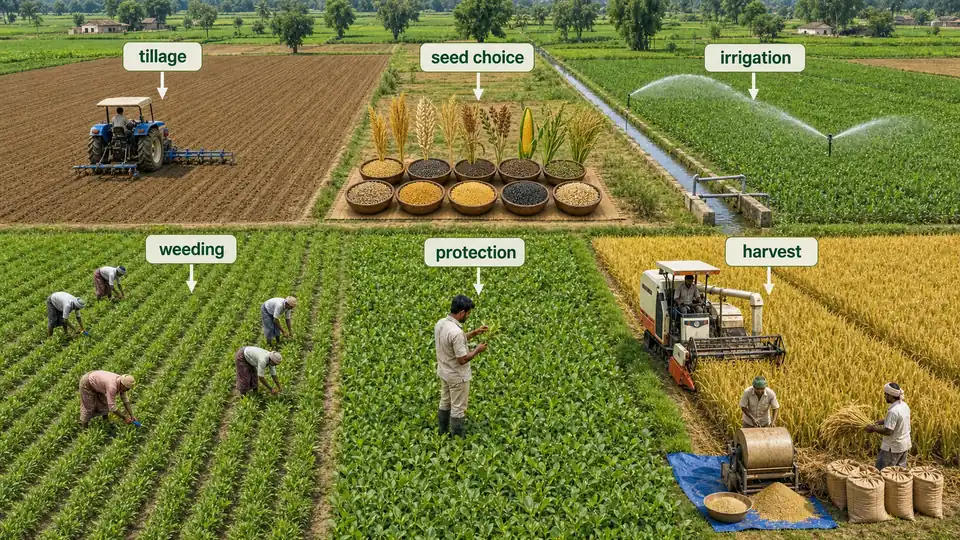
Agronomic principles are the ways and means for better management of soil, plant, and environment for economically maximum returns per unit area over the years. They guide every decision a farmer makes.
TIP
Mnemonic -- "PCTWPHA": Planning, Crop variety, Tillage, Water management, Plant protection, Harvesting, After-care (post-harvest).
- Planning and resource utilisation -- maximise use of land, sunshine, rainwater, temperature, labour, seeds, capital, and equipment.
- Choice of crop varieties -- select varieties suited to the local agro-climate, soil fertility, season, and cropping system. Often the single most important decision.
- Field preparation (Tillage) -- proper land levelling, bunding for irrigation/drainage, erosion control, and land improvement.
- Multiple and intercropping -- diversify crops to reduce risk under adverse conditions and make better use of resources.
- Water management -- improve water use efficiency, since water is often the most limiting factor.
- Plant protection / IPM -- protect crops from pests and diseases to realise full yield potential.
- Intercultural operations -- timely weeding, hoeing, and other in-season practices.
- Harvesting and post-harvest technology -- proper methods to prevent losses and preserve quality.
Agronomy Today: Why This Lesson Still Matters
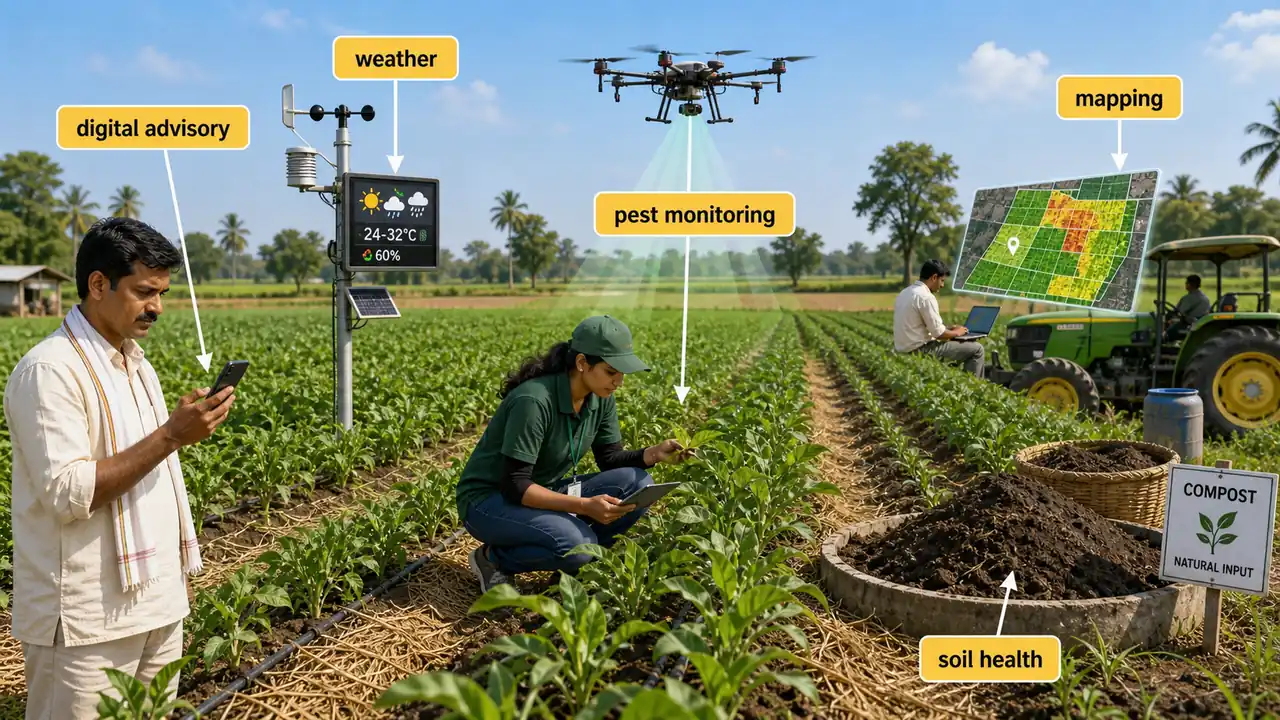
The classical principles above are still the foundation, but modern agronomy in India is increasingly shaped by digital tools, climate-risk management, and low-cost sustainability-focused systems.
- Digital Agriculture Mission approved in September 2024 aims to build a digital public infrastructure for agriculture, including AgriStack and decision-support systems. [3]
- By February 2026, official PIB reporting said the digital agriculture ecosystem had created over 7.63 crore Farmer IDs and surveyed 23.5 crore crop plots. [4]
- AI-based pest surveillance, local monsoon forecasting, and crop insurance tools are now part of real advisory systems, showing that agronomy today is data-assisted, not only experience-based. [4]
- National Mission on Natural Farming (NMNF) was approved on 25 November 2024, showing that input-cost reduction, soil health, and climate resilience are now central policy themes too. [5]
For exams, this means agronomy should be understood not only as a classical subject, but also as the base for precision agriculture, climate-smart agriculture, natural farming, and digital advisories.
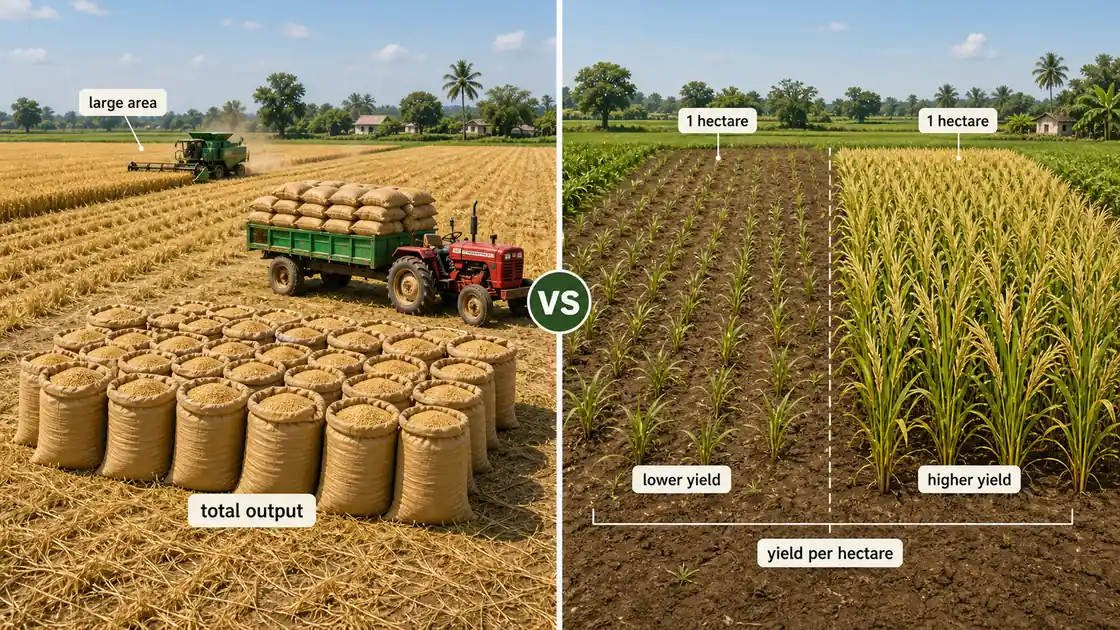
Crop Production vs Crop Productivity
| Aspect | Crop Production | Crop Productivity |
|---|---|---|
| Definition | Total quantity of output (grain, straw, etc.) | Output per unit area |
| Units | Tonnes, quintals | Quintal/ha, Kg/ha, or Tonnes/ha |
| Use | Shows total farm output | Allows fair comparison across fields, farms, or regions |
| Example | India produced 357.73 MT of foodgrains in 2024-25 (final estimates) [1] | Average wheat productivity may be compared in t/ha across states or farms |
NOTE
Common confusion: A state can have high production simply because it has a large cropped area, while another state can have high productivity because it produces more per hectare. Production tells us "how much total"; productivity tells us "how efficiently per unit area."
Factors Affecting Crop Production
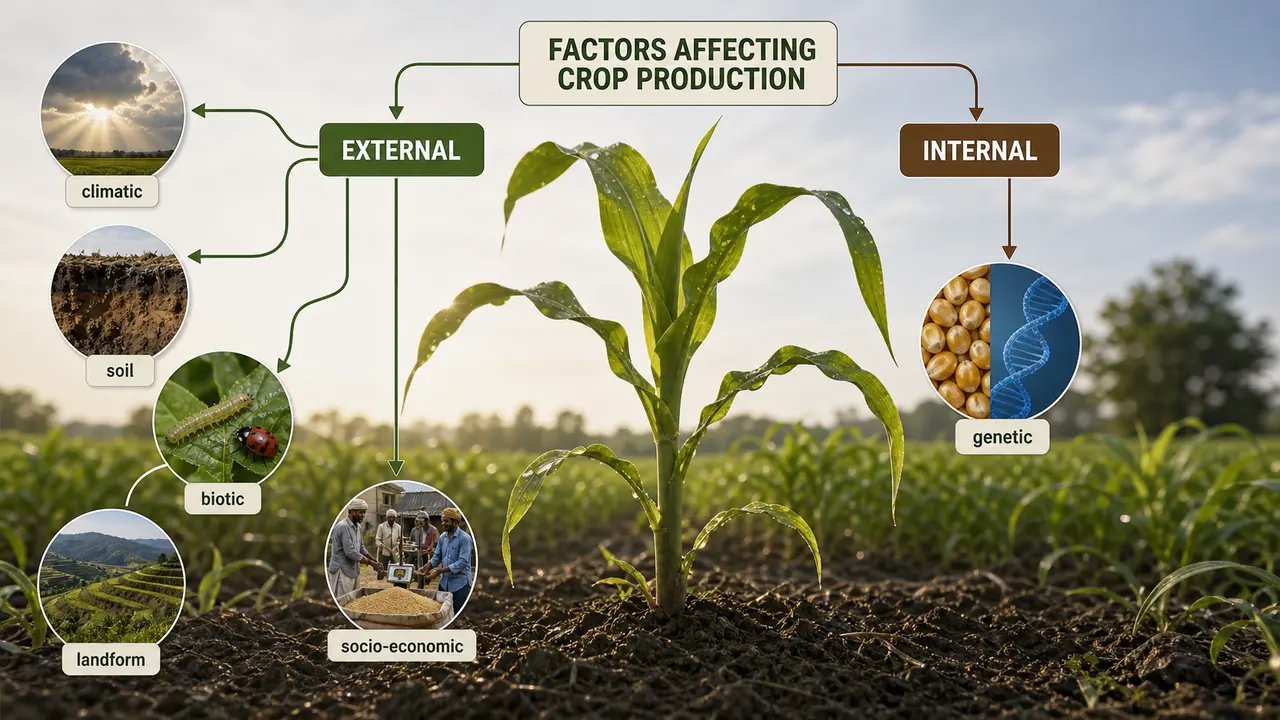
Crop yield is never determined by a single factor — it results from the interaction of multiple external and internal forces. Understanding these factors is essential because every agronomic decision (variety selection, sowing date, irrigation schedule, fertilizer dose) is an attempt to optimise one or more of them.
IMPORTANT
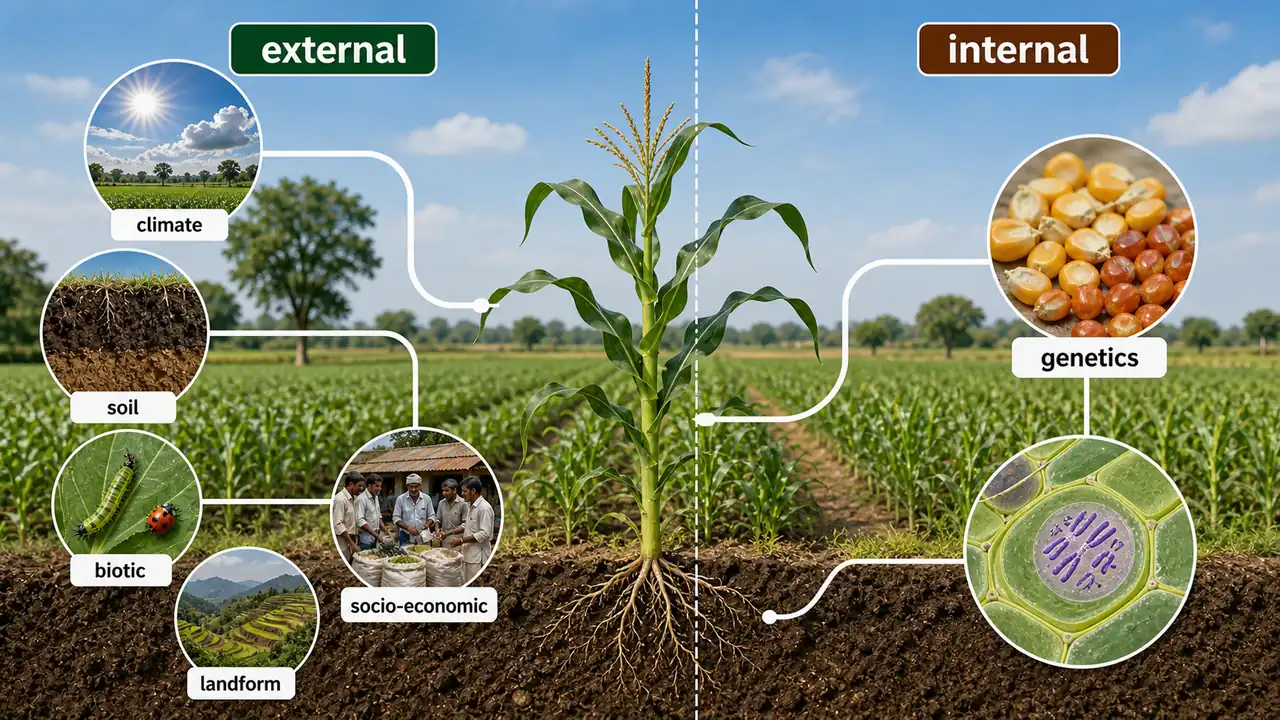
Factors affecting crop production are frequently tested. Remember two broad categories: External (Climatic, Edaphic, Biotic, Physiographic, Socio-economic) and Internal (Genetic).
Overview Table
| Category | Sub-category | Key Elements |
|---|---|---|
| External | Climatic | Temperature, RH, Precipitation, Solar Radiation, Wind, Atmospheric Gases |
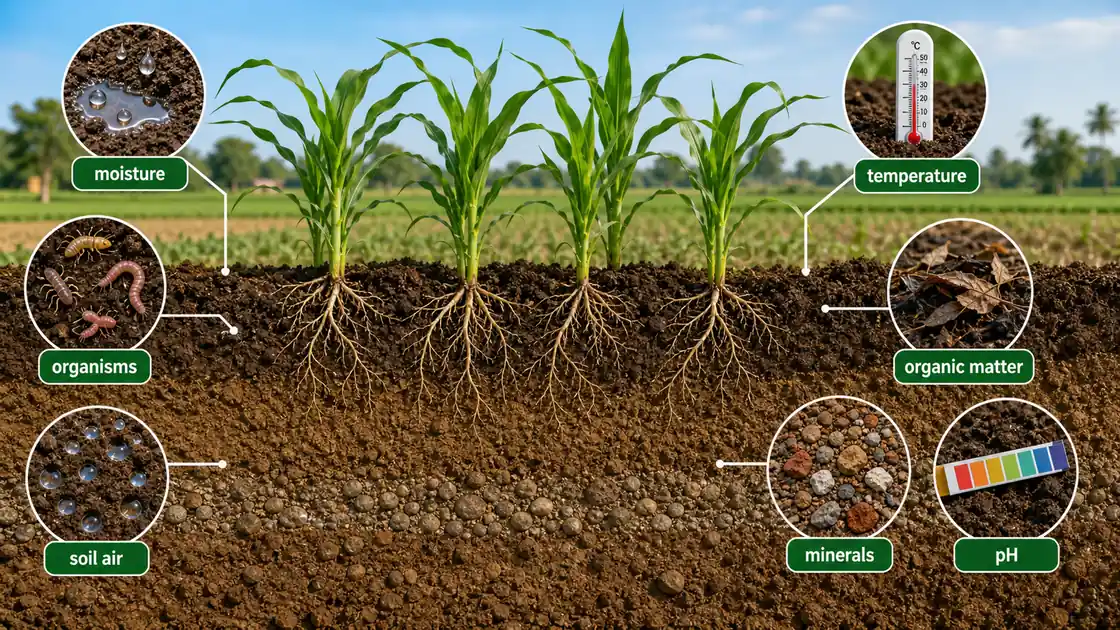
| Edaphic (Soil) | Moisture, Temperature, Organisms, OM, Minerals, pH, Soil Air | |
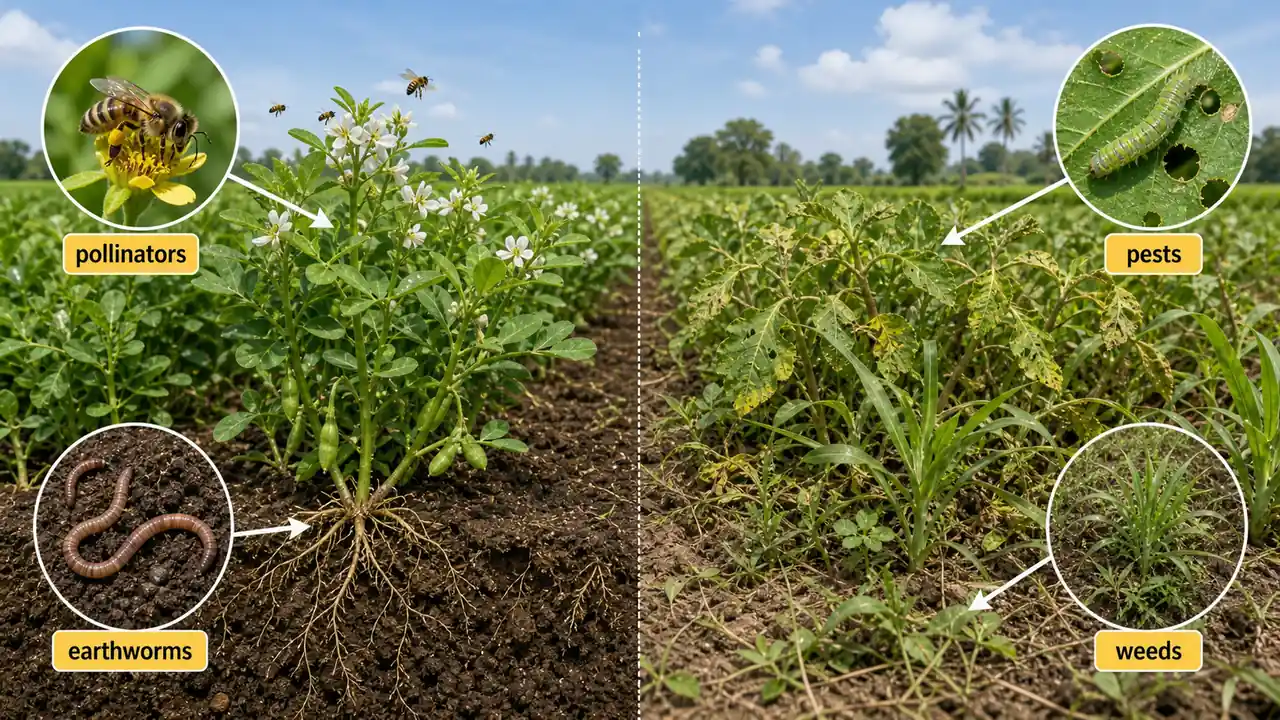
| Biotic | Flora (weeds, companion plants), Fauna (pollinators, pests) | |
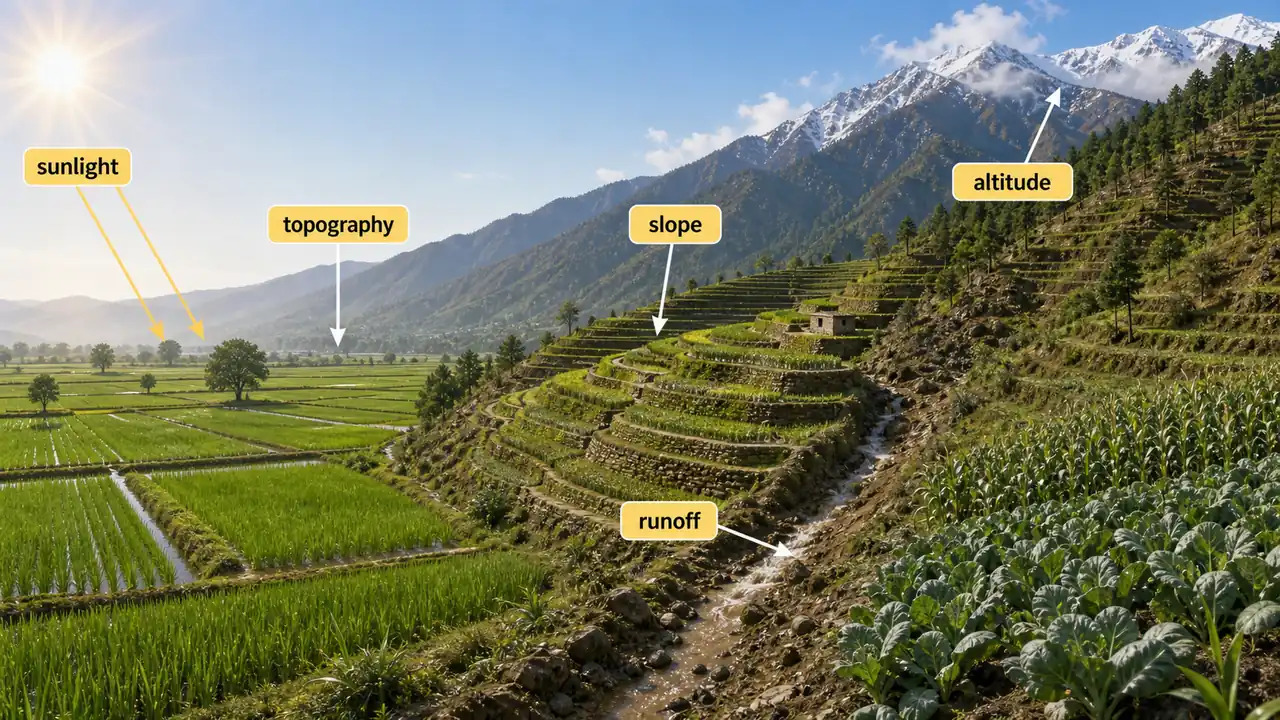
| Physiographic | Altitude, Slope, Aspect | |
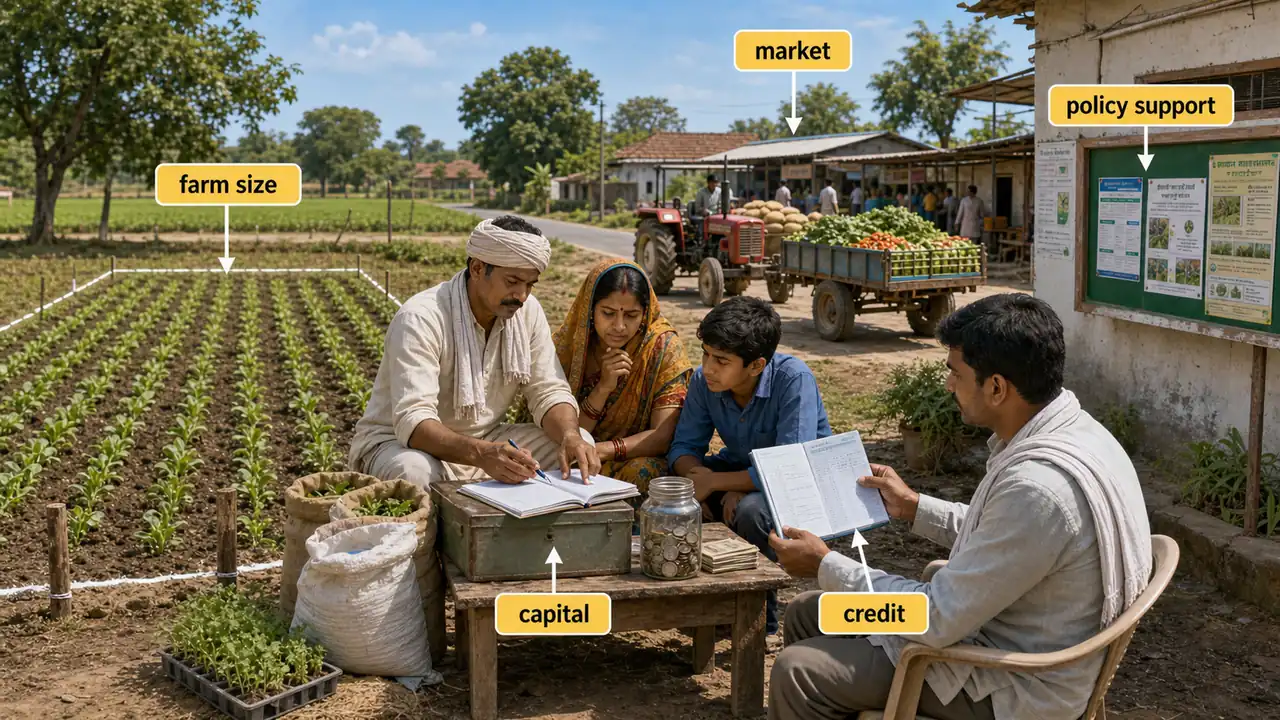
| Socio-economic | Farm size, Capital, Market access, Government policy | |
| Internal | Genetic | Genes, Chromosomes, Genomes, Gene expression |
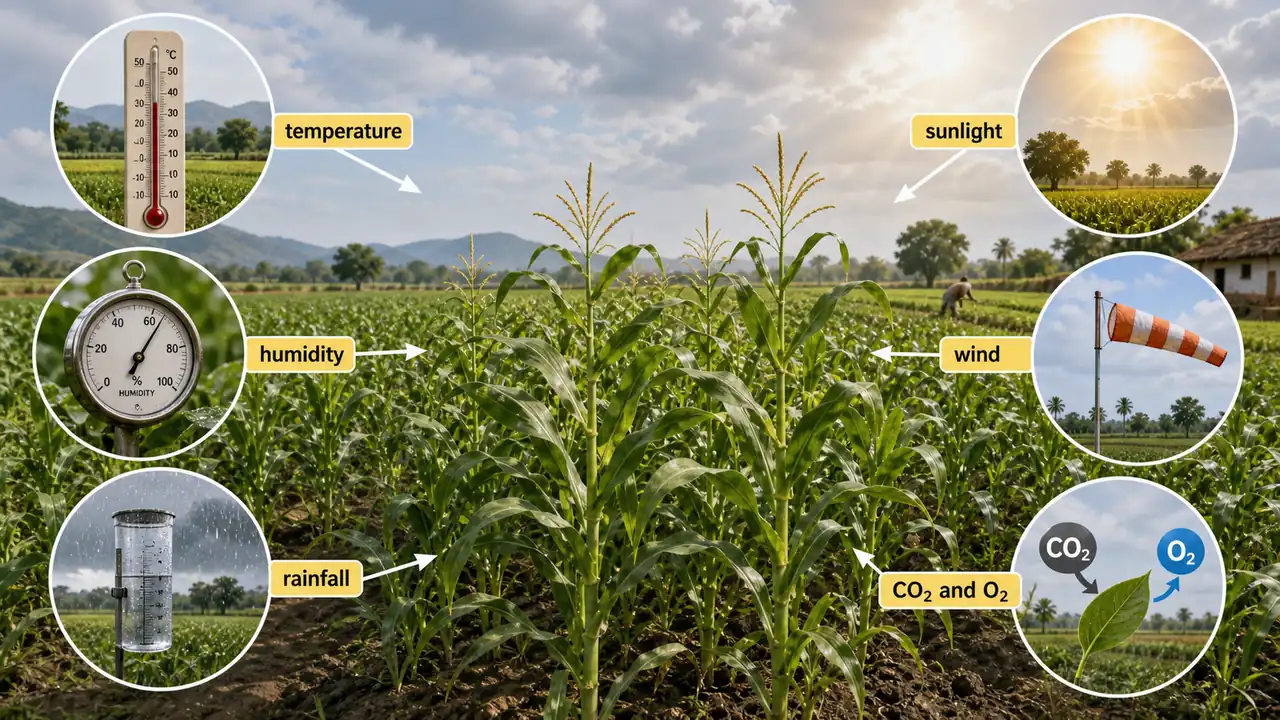
Climatic Factors
These weather-related elements directly influence crop growth:
| Factor | Role in Agriculture | Example |
|---|---|---|
| Temperature | Controls metabolic rate and phenological stages | Wheat requires vernalisation (cold exposure) for flowering |
| Relative Humidity | Affects transpiration and disease incidence | High RH promotes blast disease in rice |
| Precipitation | Primary water source for rainfed crops | SW monsoon delivers 75% of India's rainfall |
| Solar Radiation | Drives photosynthesis | Short-day crops like rice need <12 h daylight for flowering |
| Wind Velocity | Affects transpiration, pollination, lodging | Strong winds cause lodging in tall sugarcane varieties |
| Atmospheric Gases | CO2 for photosynthesis, O2 for respiration | Rising CO2 levels can boost C3 crop photosynthesis |
Edaphic (Soil) Factors
| Factor | Significance | Ideal Range / Note |
|---|---|---|
| Soil Moisture | Water available for plant uptake | Field capacity to permanent wilting point |
| Soil Temperature | Affects germination and root growth | Warm soils speed up germination of kharif crops |
| Soil Organisms | Nutrient cycling and OM decomposition | Rhizobium fixes N in legume roots |
| Soil Organic Matter | Improves structure, WHC, nutrient supply | Higher OM = better soil health |
| Soil Minerals | Supply N, P, K and micronutrients | Alluvial soils rich in potash |
| Soil pH | Determines nutrient availability | 6.0-7.5 preferred by most crops |
| Soil Air | O2 for root respiration | Waterlogged soils lack O2 -- only rice tolerates this |
Biotic Factors
| Type | Effect | Example |
|---|---|---|
| Flora | Competitive (weeds) or complementary (legume N-fixation) | Weeds compete for nutrients; pigeon pea fixes N for companion maize |
| Fauna | Beneficial (pollinators, earthworms) or harmful (pests) | Honey bees boost mustard yield by cross-pollination; bollworms damage cotton |
Physiographic Factors
Physiographic factors include altitude, slope, and aspect. They influence drainage, soil depth, and sunlight exposure.
| Physiographic Factor | Characteristics |
|---|---|
| Topography | The surface shape of land (level, undulating, or steep) affects drainage, erosion, root-zone depth, and ease of cultivation. |
| Altitude | Increase in altitude usually lowers temperature and often changes rainfall pattern, wind regime, and crop suitability. |
| Steepness of Slope | Steeper slopes increase runoff and loss of nutrient-rich topsoil unless bunding or terracing is used. |
| Exposure to Light and Wind | Aspect changes sunlight received, while dry winds can increase evapotranspiration and reduce crop performance. |
For example, terrace farming on hill slopes of Uttarakhand modifies physiographic constraints to enable rice and wheat cultivation.
Socio-Economic Factors
The economic capacity of a farmer determines input levels, technology adoption, and ultimately production. Access to markets, education, credit, and government schemes (like PM-KISAN) all play significant roles.
| Farmer Category | Holding Size | Typical Input Level |
|---|---|---|
| Marginal | < 1 ha | Low |
| Small | 1-2 ha | Low to Medium |
| Medium | 2-10 ha | Medium to High |
| Large | > 10 ha | High |
Genetic (Internal) Factors
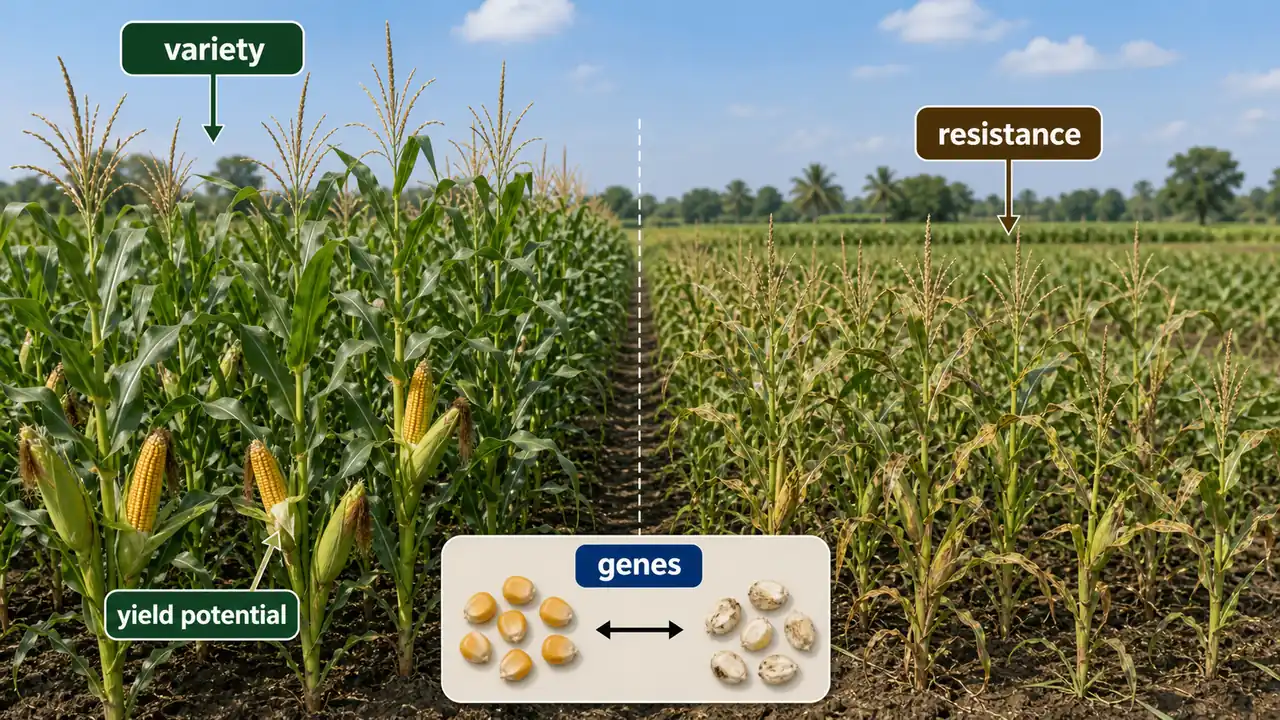
The genetic makeup of a crop variety determines its yield potential, disease resistance, drought tolerance, maturity duration, and quality traits. These are controlled by genes, chromosomes, and genomes, independent of environment.
Example: BT cotton carries the cry gene from Bacillus thuringiensis, providing inbuilt bollworm resistance -- a genetic factor that conventional cotton varieties lack.
Types of Farming
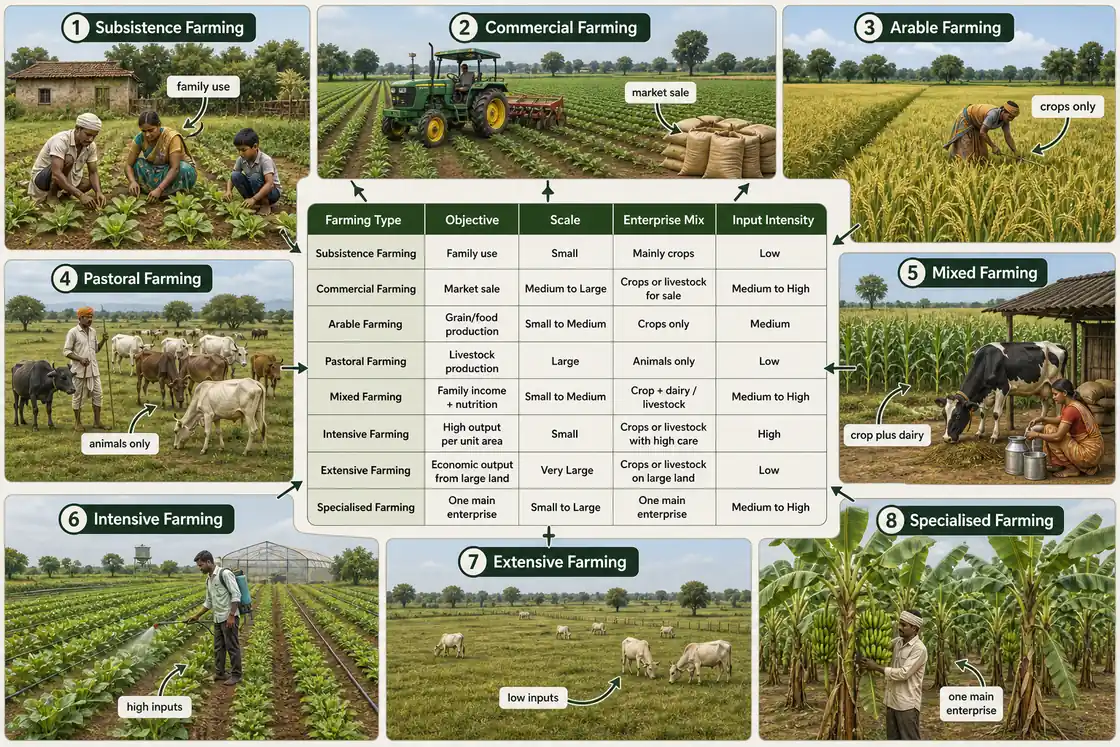
Different combinations of climate, resources, capital, and market access give rise to distinct farming systems. Now that we understand what factors affect crop production, the next question is: how do farmers organise their farming in response to these factors? The answer depends on climate, resources, market access, and objectives -- giving rise to distinct types of farming.
| Type | Definition |
|---|---|
| Commercial Farming | Growing crops / rearing animals to make a profit |
| Subsistence Farming | Producing just enough food for the farmer's own family |
| Arable Farming | Involves growing crops only |
| Pastoral Farming | Involves rearing animals only |
| Intensive Farming | Small farm, high inputs per unit area |
| Extensive Farming | Very large farm, low inputs per unit area |
| Mixed Farming | Crop + livestock/dairying inter-dependent |
| Diversified Farming | Income from a single product < 50% of total |
| Specialised Farming | Income from a single product ≥ 50% of total |
| Dry Farming | Profitable crop production without irrigation on ≤ 50 cm annual rainfall |
| Shifting Agriculture | Clearing forest, cultivating until soil is exhausted, then moving to fresh land. Called Jhum in NE India |
| Ranching | Grazing livestock on natural vegetation of range land |
| Fallow | Land left without sowing after ploughing to restore soil fertility and moisture |
NOTE
Exam distinction: Mixed farming = crop + livestock interdependent. Diversified = no single enterprise dominates (< 50%). Specialised = one enterprise dominates (≥ 50%).
Real-world example: A farmer managing a large rainfed tract in western Rajasthan may practice extensive dry farming because rainfall is low and irrigation is scarce. A small or medium farmer in Punjab or Haryana may practice intensive mixed/commercial farming because canal irrigation, fertile alluvial soils, market access, and mechanisation support high input use. The same set of production factors (climate, soil, capital, market) determines which type of farming a region adopts.
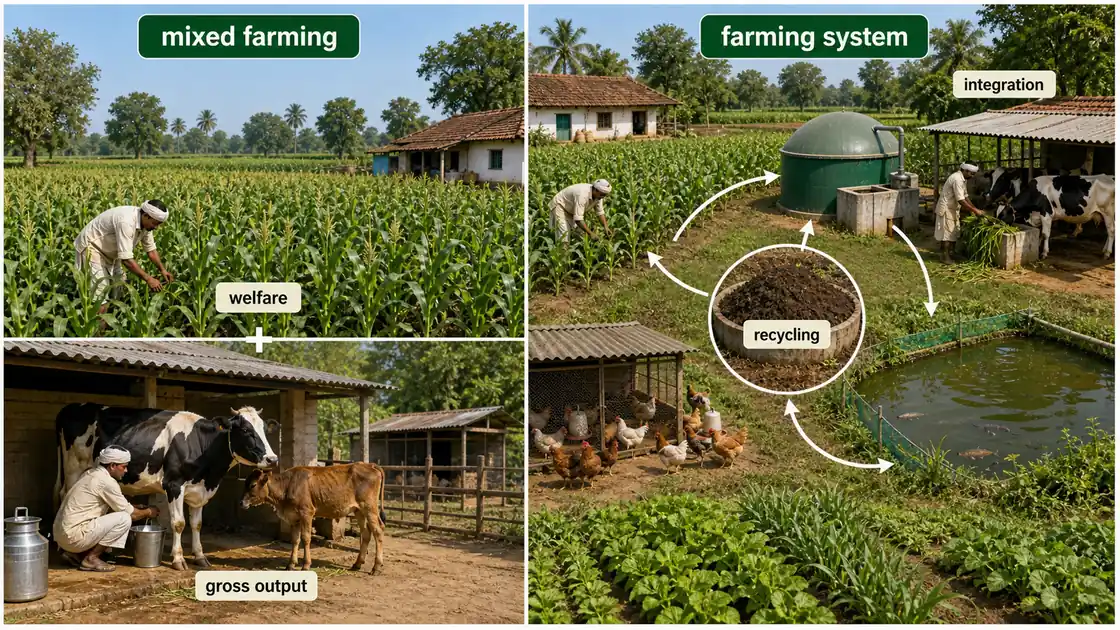
Mixed Farming vs Farming System
| Aspect | Mixed Farming | Farming System |
|---|---|---|
| Objective | Subsistence and welfare | Higher profitability + ecological balance |
| Emphasis | On gross output | On the system as a whole |
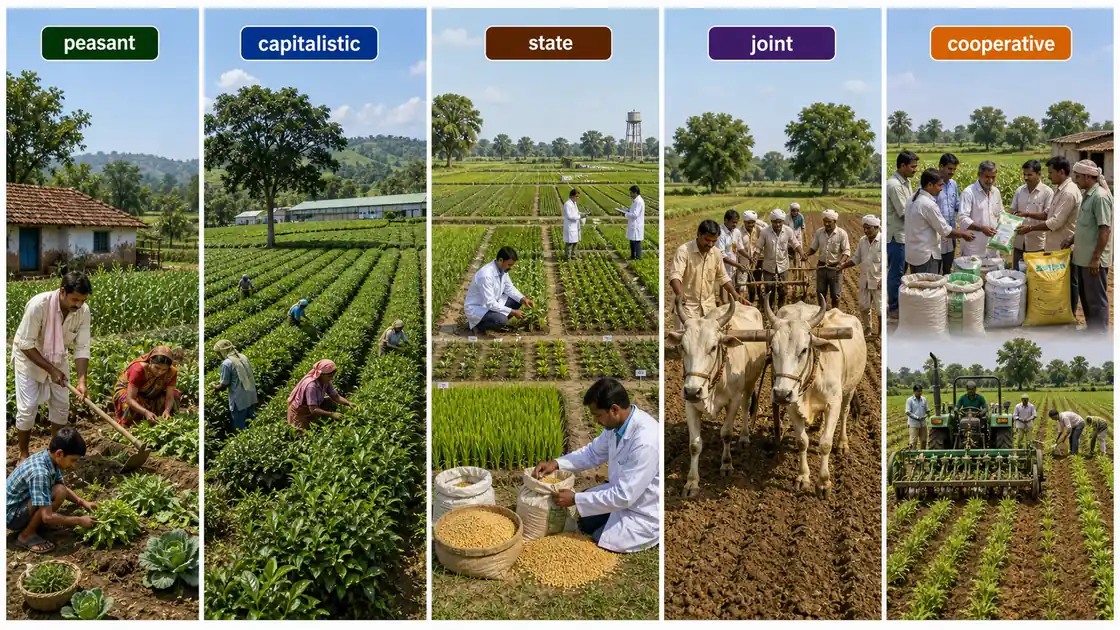
Farming Systems by Ownership
| System | Key Features |
|---|---|
| Individual / Peasant | Farmer is manager; family assists; objective is family need. This remains the dominant field-level farming pattern in India. |
| Capitalistic | Capital is key; profit maximisation; restricted to tea, coffee, rubber in India. |
| State Farming | Government-managed; research, demonstration, seed production. |
| Corporate Farming | Corporate sector; large acreage and capital. |
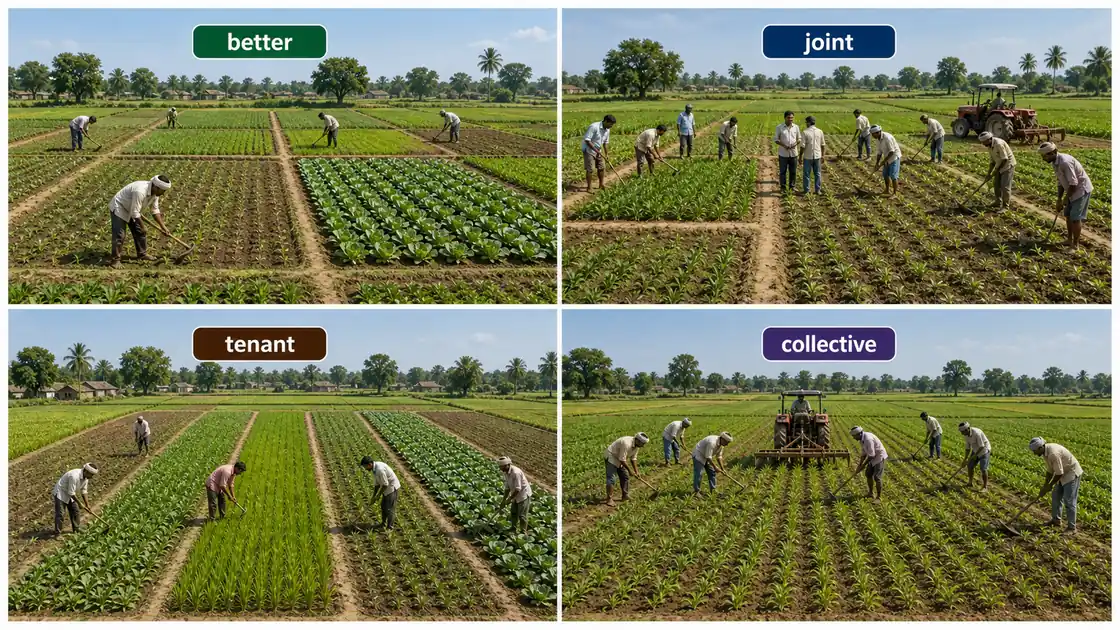
| Joint Farming | Two or more farmers pool resources, divide produce in pre-fixed ratio. |
| Collective Farming | Ownership in society; labour-brigades; popular in Russia & China. Forms: Toz, Kholkhos, Commune. |
| Cooperative Farming | Voluntary pooling of land, labour, capital for mutual benefit. |
Types of Cooperative Farming
| Type | Land Ownership | Operations |
|---|---|---|
| Better Farming | Individual | Individual |
| Joint Farming | Individual | Collective |
| Tenant Farming | Collective | Individual |
| Collective Farming | Collective | Collective |
TIP
Exam shortcut: Remember I-I, I-C, C-I, C-C (Better, Joint, Tenant, Collective).
Types of Agriculture -- Input-Output
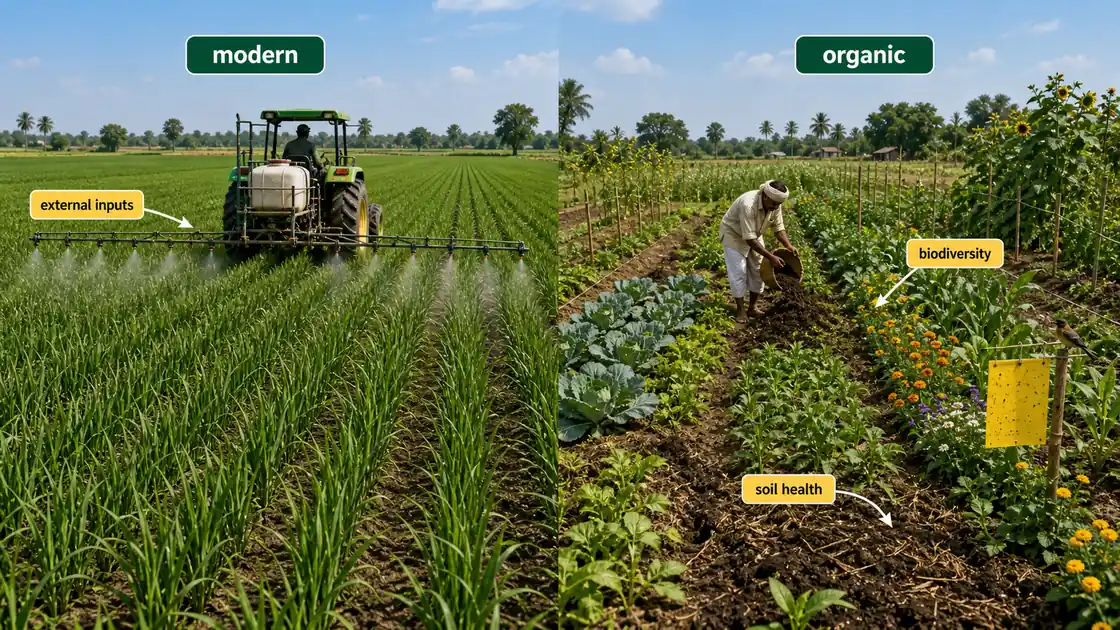
| Production Factor | Modern | Organic |
|---|---|---|
| Productivity | High | High |
| Sustainability | Low | High |
| Farming system | Simple | Complex |
| Biodiversity | Uniform | Diverse |
| Production orientation | Market | Subsistence / Market |
| Usage of external inputs | High | Low |
| Fertilization | Inorganic | Organic |
| Plant protection | Curative and inorganic | Preventive and organic |
| Energy balance | Negative | Positive |
| Type | Objective | Input | Output |
|---|---|---|---|
| Subsistence | Sustain family | Low | Low |
| Commercial | High income | High | High |
| Sustainable | Ecological balance | Low | High |
IMPORTANT
Sustainable agriculture = meeting present needs without endangering future resources. In exam shorthand, it is often grouped with ecofarming, organic farming, natural farming, and permaculture; conceptually, however, these are related approaches, not exact synonyms. The common goal is resource conservation, resilience, and long-term productivity.
Agricultural Land Terminology
Land-use statistics underpin every discussion of India's agricultural output. These definitions are critical for understanding agricultural statistics and are frequently tested in exams. These terms are essential for understanding India's production statistics covered in the next lesson.
| Term | Definition |
|---|---|
| Operational Holding | All land used for agricultural production operated as one unit by one person |
| Net Area Sown | Total cultivated area in a year — areas cropped more than once counted only once |
| Gross Cropped Area | Total area sown, counting multiple sowings separately — also called total cropped area |
| Current Fallow | Land usually cropped but not cultivated in reference year; was cultivated previous year |
| Culturable Waste | Land available for cultivation but not used for 5+ years |
| Gross Irrigated Area | Area irrigated under various crops, counting multi-crop irrigation separately |
| Net Irrigated Area | Area irrigated through any source in a year for a particular crop |
| Culturable Command Area (CCA) | Area that can be irrigated from a scheme and is fit for cultivation |
IMPORTANT
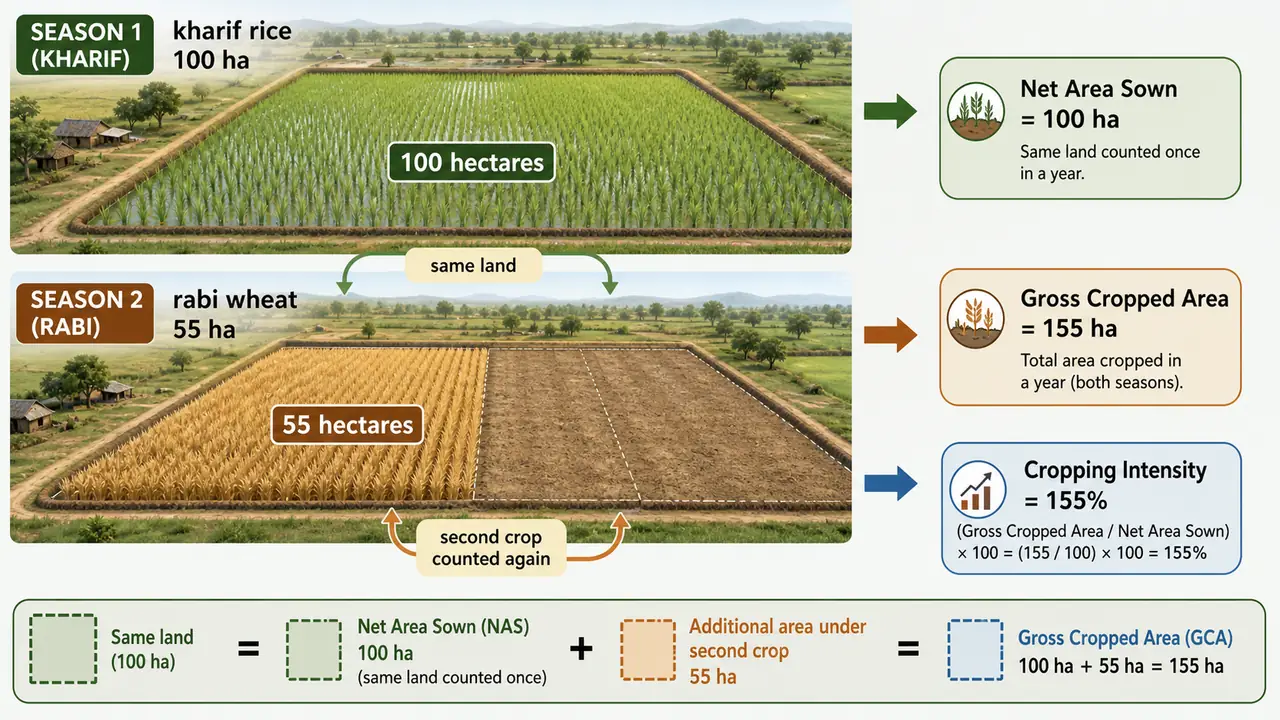
Cropping Intensity = (Gross Cropped Area / Net Area Sown) × 100. In the latest officially published all-India land-use tables, cropping intensity is reported as 155.4% for 2021-22. [2] That means, on average, the same net sown land was cropped about 1.55 times in that year.
Worked Example: Net Area Sown vs Gross Cropped Area
Suppose a farmer has 100 ha of net area sown:
- In kharif, all 100 ha is used for rice.
- In rabi, 55 ha of the same land is used again for wheat.
Then:
- Net Area Sown (NAS) = 100 ha
- Gross Cropped Area (GCA) = 100 + 55 = 155 ha
- Cropping Intensity = (155 / 100) × 100 = 155%
TIP
Common confusion: Net area sown counts a piece of land once, even if cropped many times. Gross cropped area counts every sowing separately.
Summary Cheat Sheet
| Concept / Topic | Key Details / Explanation |
|---|---|
| Agriculture etymology | Latin — agri (soil) + cultūra (cultivation) |
| Nature of Agriculture | Science + Art + Business — systematic knowledge, skilled judgement, and profit motive |
| 7 Branches of Agriculture | Agronomy, Horticulture, Forestry, Animal Husbandry, Fishery Science, Agricultural Engineering, Home Science (mnemonic: A H F A F A H) |
| Silviculture | Study of forest development |
| Viticulture / Moriculture | Production of grapes / mulberry |
| Sericulture | Rearing of silk worm |
| Pomology / Olericulture / Floriculture | Study of fruits / vegetables / flowers |
| Apiculture / Vermiculture | Study of honey bee / agricultural earthworm |
| Agrostology | Study of grasses |
| Hydroponics | Growing plants in water (soilless cultivation) |
| Agriculture started | 10,000 B.C. — dog domesticated for hunting |
| First crops cultivated | Wheat and Barley — 7500 B.C. |
| Plough invented | 2900 B.C. — irrigated farming also started |
| Maize / Rice / Potato | Cultivated from 4400 B.C. / 4000 B.C. / 3500 B.C. |
| Portuguese introductions (1600 AD) | Potato, Tomato, Chillies, Groundnut, Tobacco, Rubber, Cashewnut, Papaya to India |
| IMD established | 1875 at Pune |
| Evolution of Man | Hunting → Pastoral → Crop Culture → Trade |
| Francis Bacon | Started experimentation technique; water as plant nutrient |
| Van Helmont | Famous Pot experiment — first quantitative plant nutrition study |
| Jethro Tull | Fine soil particle as nutrient; invented seed drill; Father of Tillage |
| Justus von Liebig | Law of Minimum; Father of Agricultural Chemistry |
| Gregor Mendel (1866) | Discovered laws of heredity — foundation of plant breeding |
| Blackman (1905) | Theory of optima and limiting factors |
| Mitscherlich (1909) | Law of diminishing returns |
| Agronomy meaning | Greek: Agros (field) + Nomos (manage) = art of managing fields |
| Father of Agronomy | Pietro de'Crescenzi |
| Mother branch of agriculture | Agronomy |
| Central theme of Agronomy | Soil-Crop-Environment relationship |
| 3 Branches of Agronomy | Crop Science, Soil Science, Environmental Science |
| Scope of Agronomy | Yield maximisation, reduced cost, better WUE, tillage, soil fertility management, reduced post-harvest loss, intensive cropping & IFS |
| 8 Principles of Agronomy | Planning, Crop variety, Tillage, Multiple/intercropping, Water management, Plant protection, Intercultural ops, Harvesting & post-harvest (PCTWPHA) |
| Agronomy today | Classical principles now extend into digital advisories, AI pest surveillance, climate-smart farming, and natural farming [3][4][5] |
| Crop Production | Total output in tonnes / quintals |
| Crop Productivity | Output per unit area — q/ha, kg/ha, or t/ha; production = total output, productivity = per-unit efficiency |
| External factors (5 types) | Climatic, Edaphic, Biotic, Physiographic, Socio-economic |
| Climatic factors | Temperature, RH, Precipitation, Solar Radiation, Wind, Atmospheric Gases |
| Edaphic (Soil) factors | Moisture, Temperature, Organisms, OM, Minerals, pH (ideal 6.0–7.5), Soil Air |
| Biotic factors | Flora (weeds, companion plants) and Fauna (pollinators, pests) |
| Physiographic factors | Altitude, Slope, Aspect — affect drainage, soil depth, sunlight |
| Socio-economic factors | Farm size, capital, market access, govt. policy |
| Internal (Genetic) factors | Genes, chromosomes, genomes — e.g. BT cotton cry gene from Bacillus thuringiensis |
| Farmer categories | Marginal (< 1 ha), Small (1–2 ha), Medium (2–10 ha), Large (> 10 ha) |
| Commercial Farming | Growing crops/animals for profit |
| Subsistence Farming | Producing food for family consumption |
| Arable / Pastoral Farming | Growing crops only / Rearing animals only |
| Intensive Farming | Small farm, high inputs per unit area |
| Extensive Farming | Large farm, low inputs per unit area |
| Mixed Farming | Crop + livestock interdependent |
| Diversified Farming | Single product income < 50% of total |
| Specialised Farming | Single product income ≥ 50% of total |
| Dry Farming | Without irrigation, ≤ 50 cm annual rainfall |
| Shifting Agriculture | Clear, cultivate, abandon — called Jhum in NE India |
| Ranching | Grazing livestock on natural vegetation of range land |
| Fallow | Land left unsown after ploughing to restore fertility & moisture |
| Mixed Farming vs Farming System | Mixed = gross output focus; Farming System = profitability + ecological balance |
| Individual / Peasant farming | Dominant field-level farming pattern in India |
| Capitalistic farming in India | Restricted to tea, coffee, rubber |
| Collective farming | Popular in Russia & China — forms: Toz, Kholkhos, Commune |
| 4 Cooperative farming types | Better (I-I), Joint (I-C), Tenant (C-I), Collective (C-C) — land ownership / operations |
| Sustainable agriculture | Long-term resource-conserving agriculture; often grouped in exams with ecofarming, organic farming, natural farming, and permaculture, though these are related approaches rather than exact synonyms |
| Operational Holding | All land operated as one unit by one person |
| Net Area Sown | Total cultivated area — multiple croppings counted only once |
| Gross Cropped Area | Total area sown — multiple sowings counted separately |
| Worked logic of cropping intensity | If 100 ha is sown in kharif and 55 ha of the same land is resown in rabi, GCA becomes 155 ha and cropping intensity becomes 155% |
| Current Fallow | Not cultivated in reference year; was cultivated previous year |
| Culturable Waste | Land available but not used for 5+ years |
| Gross Irrigated Area | Multi-crop irrigation counted separately |
| Net Irrigated Area | Area irrigated for a particular crop in a year |
| Culturable Command Area (CCA) | Irrigable area fit for cultivation |
| India's Cropping Intensity | (GCA / NAS) × 100 = 155.4% in the latest officially published all-India land-use tables for 2021-22 [2] |
TIP
Exam tip: "Pietro = Father of Agronomy" and "Agronomy = Mother of Agriculture" are direct one-liners frequently asked in IBPS, FCI, and exams.
TIP
Next: Lesson 02 maps India's 15 agro-climatic zones — the geographic foundation that determines which crops grow where. Every production statistic you encounter later traces back to these zones.
References
5 sources • [1] [2] [3] [4] [5]
References
Used for: updated foodgrain production example
Land Use Statistics at a Glance
OfficialUsed for: latest officially published cropping intensity figure
Used for: Digital Agriculture Mission current-policy update
Used for: current agronomy applications in AI, Farmer IDs, crop plots, pest surveillance and forecasting
Used for: natural farming policy update