🚜 Tillage and Field Preparation
Learn tillage types, implements, tilth, seedbed preparation, crop stand basics, and conservation tillage.
With India's agro-climatic zones and production landscape established, we now turn to how fields are prepared for cultivation.
Why Tillage Matters
Before a single seed enters the ground, the soil must be prepared. A farmer in the Indo-Gangetic plains ploughing heavy clay soil after rice harvest faces a very different challenge from one cultivating sandy loam in Rajasthan. Tillage -- the mechanical manipulation of soil -- creates the ideal environment for seed germination, root growth, and crop establishment. Understanding tillage systems also helps in choosing conservation practices that protect soil health for future seasons.
What is Tillage?
- Derived from Anglo-Saxon words tilian and teolian (to plough and prepare soil for seed).
- Definition: Tillage is the mechanical manipulation of soil to obtain conditions ideal for seed germination, seedling establishment, and crop growth.
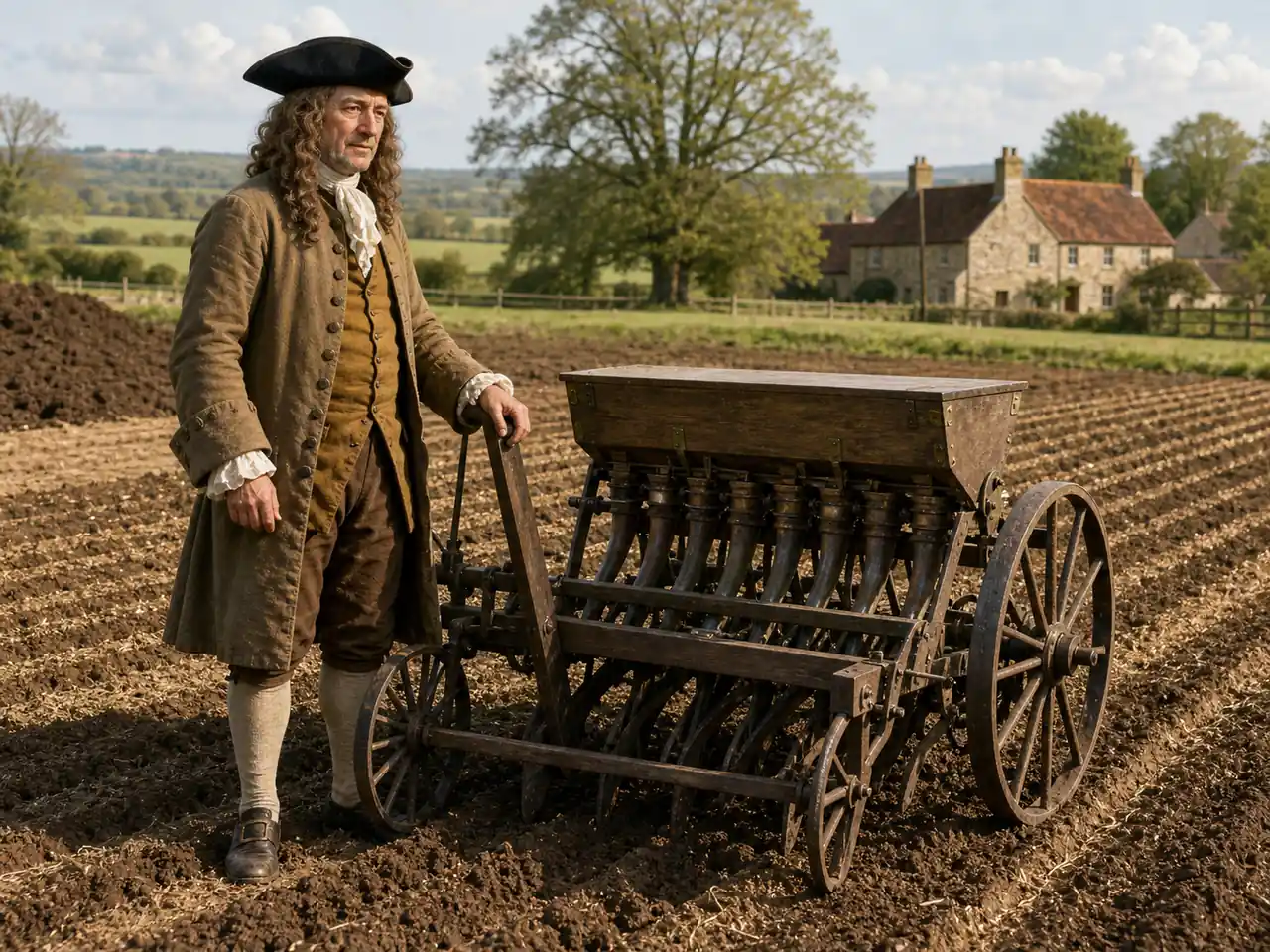
- Jethro Tull is the Father of Tillage -- an 18th-century English agriculturist who pioneered systematic soil cultivation and invented the seed drill (1701).
Tilth -- The Result of Tillage
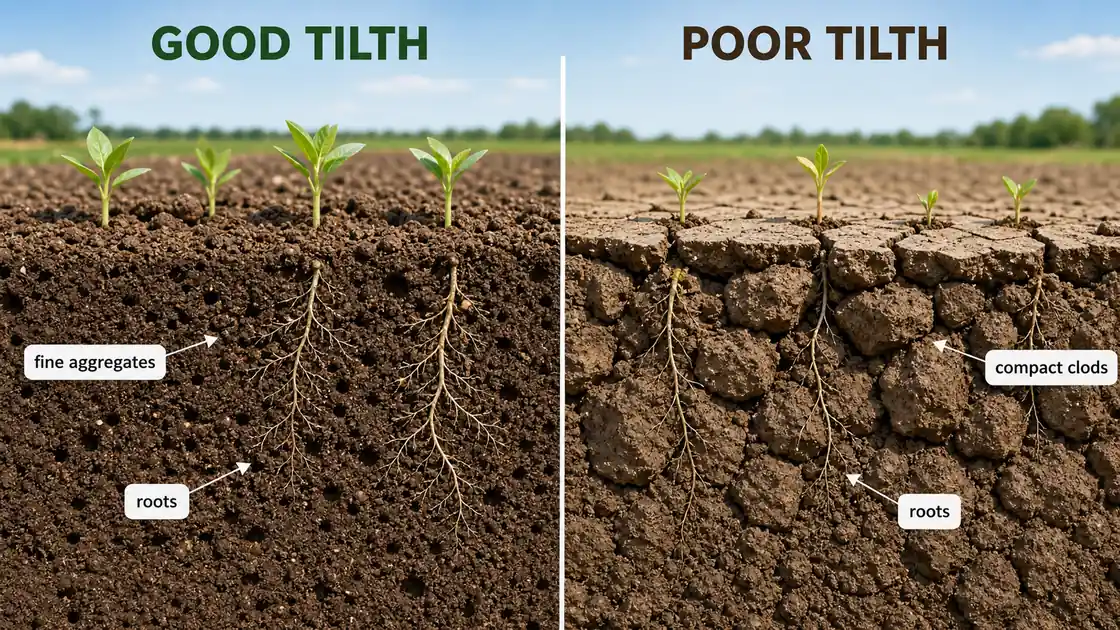
| Property | Good Tilth | Poor Tilth |
|---|---|---|
| Soil condition | Loose, friable, well-aerated, uniform structure | Compact, cloddy, hard |
| Aggregate size | 0-5 mm (ideal balance of water retention and aeration) | > 5 mm (too coarse for fine-seeded crops) |
| Pore ratio | 50:50 (1:1) capillary : non-capillary | Imbalanced -- either waterlogged or too dry |
| Bulk density | Decreases (more air spaces) | Increases (compaction) |
- Under irrigated conditions, aggregates > 5 mm may be acceptable for crop growth.
- Roots generally occupy about 1/10th of the soil mass.
Objectives of Tillage
TIP
Pro Content Locked
Upgrade to Pro to access this lesson and all other premium content.
Charged once for one year · ₹1188 total
Save ₹100/month vs ₹2388/year launch price
- All Agriculture & Banking Courses
- AI Lesson Questions (100/day)
- AI Doubt Solver (50/day)
- Glows & Grows Feedback (30/day)
- AI Section Quiz (20/day)
- 22-Language Translation (100/day)
- Recall Questions (20/day)
- AI Quiz (15/day)
- AI Quiz Paper Analysis (100/day)
- AI Step-by-Step Explanations (100/day)
- Spaced Repetition Recall (FSRS)
- AI Tutor
- Immersive Text Questions
- Audio Lessons — Hindi & English
- Mock Tests & Previous Year Papers
- Summary & Mind Maps
- XP, Levels, Leaderboard & Badges
- Generate New Classrooms
- Voice AI Teacher (AgriDots Live)
- AI Revision Assistant
- Knowledge Gap Analysis
- Interactive Revision (LangGraph)
🔒 Secure one-time yearly payment via Razorpay · No hidden fees
With India's agro-climatic zones and production landscape established, we now turn to how fields are prepared for cultivation.
Why Tillage Matters
Before a single seed enters the ground, the soil must be prepared. A farmer in the Indo-Gangetic plains ploughing heavy clay soil after rice harvest faces a very different challenge from one cultivating sandy loam in Rajasthan. Tillage -- the mechanical manipulation of soil -- creates the ideal environment for seed germination, root growth, and crop establishment. Understanding tillage systems also helps in choosing conservation practices that protect soil health for future seasons.
What is Tillage?
- Derived from Anglo-Saxon words tilian and teolian (to plough and prepare soil for seed).
- Definition: Tillage is the mechanical manipulation of soil to obtain conditions ideal for seed germination, seedling establishment, and crop growth.
- Jethro Tull is the Father of Tillage -- an 18th-century English agriculturist who pioneered systematic soil cultivation and invented the seed drill (1701).
Tilth -- The Result of Tillage
| Property | Good Tilth | Poor Tilth |
|---|---|---|
| Soil condition | Loose, friable, well-aerated, uniform structure | Compact, cloddy, hard |
| Aggregate size | 0-5 mm (ideal balance of water retention and aeration) | > 5 mm (too coarse for fine-seeded crops) |
| Pore ratio | 50:50 (1:1) capillary : non-capillary | Imbalanced -- either waterlogged or too dry |
| Bulk density | Decreases (more air spaces) | Increases (compaction) |
- Under irrigated conditions, aggregates > 5 mm may be acceptable for crop growth.
- Roots generally occupy about 1/10th of the soil mass.
Objectives of Tillage
TIP
Mnemonic -- "ASWLWPMH": Aeration, Seed-soil contact, Weed-free, Light to seedlings, Low density soil, Pest-free, Mix manures, Hard pan removal.
- Improve soil aeration for gaseous exchange in seed and root zone (Primary Objective)
- Ensure adequate seed-soil contact for water flow to seeds and roots
- Prevent soil crusting so seedlings can emerge
- Create low-density soil that permits root elongation
- Provide a weed-free environment for adequate light to seedlings
- Create a pest and pathogen-free environment
- Mix applied manures and fertilizers with soil
- Remove hard pans to increase soil depth for water absorption
Seed Bed
A soil brought to ideal crop-growing condition is called a seed bed and is said to be in good tilth. The ideal seed bed has an optimum balance between water-holding pores (capillary) and freely drained pores (non-capillary) in equal proportion. A well-prepared seed bed ensures uniform germination, good stand establishment, and strong early root development.
Classification of Tillage
Tillage operations are classified by when they are performed relative to the crop, which season they occur in, and how much they disturb the soil. This classification determines the implements used and the residue left on the surface.
| Basis | Types |
|---|---|
| Time (relative to crop) | Preparatory cultivation, After-cultivation |
| Season | On-season, Off-season |
| Modern concept | Conventional, Conservation |
Preparatory Tillage
Tillage done before sowing to prepare the field. It involves deep opening and loosening of soil to bring desirable tilth and incorporate/uproot weeds and stubble.
Types of Preparatory Tillage
| Type | Purpose | Depth |
|---|---|---|
| Primary | First and deepest tillage after harvest; breaks compact soil | Deep (25-30 cm) |
| Secondary | Finer operations to create seedbed from cloddy surface | Shallow |
| Layout of seed bed | Field configuration for irrigation and sowing | Crop-specific |
Primary Tillage
- First operation after harvest to bring land under cultivation; also called ploughing.
- Ensures soil inversion when necessary (burying surface weeds, bringing deeper soil up).
- Includes deep tillage, subsoil tillage, year-round tillage.
Primary Tillage Implements:
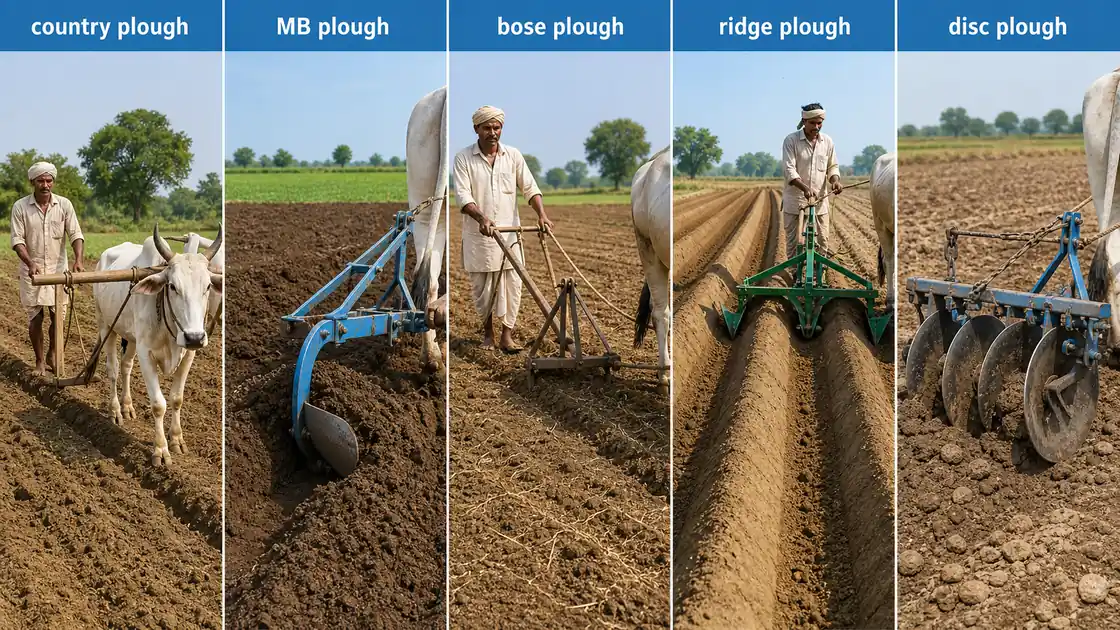
| Implement | Use |
|---|---|
| Country/Desi Plough | Traditional shallow ploughing |
| Mould Board (MB) Plough | Deep ploughing with soil inversion |
| Bose Plough | Improved desi plough |
| Ridge Plough | Making ridges and furrows |
| Disc Plough | Hard, stony, or root-infested soils |
Secondary Tillage
- Lighter, finer operations after primary tillage to prepare seedbed for sowing.
- Harrowing -- shallow depth to crush clods and uproot remaining weeds.
- Planking -- crushes hard clods, smoothens and lightly compacts soil surface; levels field for uniform irrigation.
- Sowing operations are generally included in secondary tillage.
Explore More
Secondary Tillage Implements:
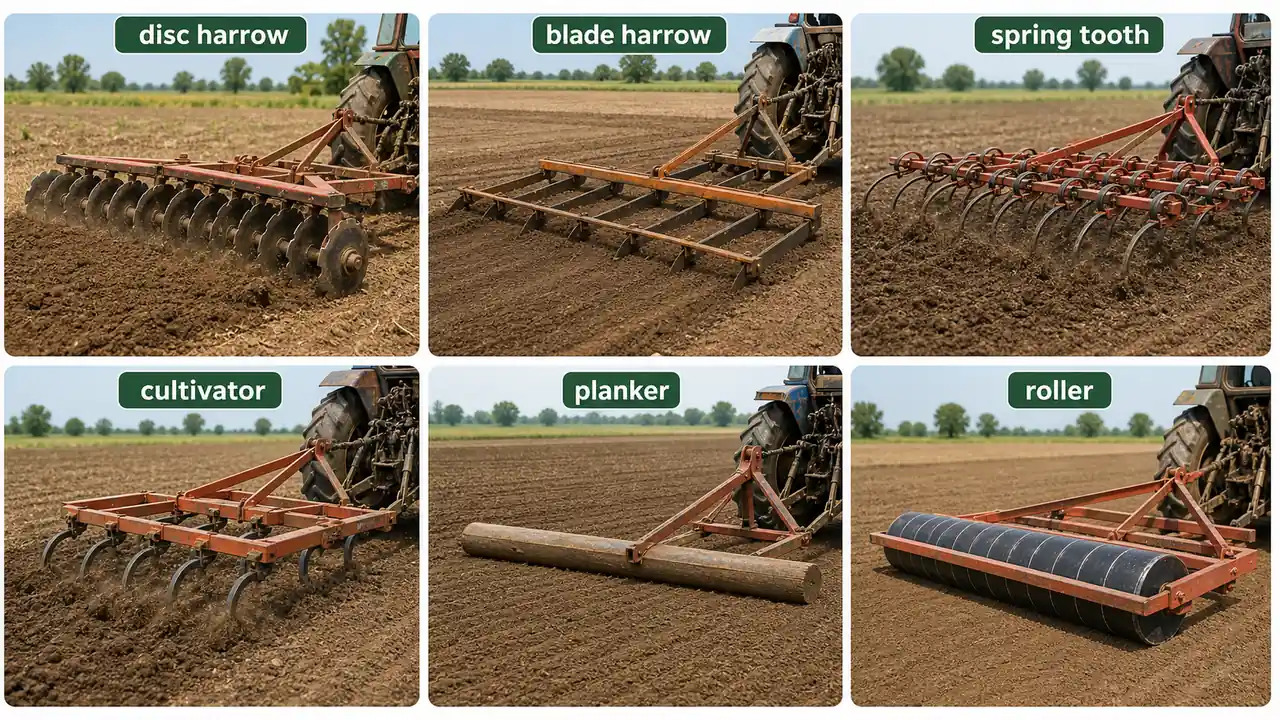
| Implement | Function |
|---|---|
| Disc Harrow | Cuts and mixes soil, breaks clods |
| Blade Harrow | Shallow cutting of weeds |
| Spring Tooth Harrow | Loosens compacted soil |
| Cultivator | Inter-row weeding and soil loosening |
| Planker | Levels and lightly compacts |
| Roller | Crushes clods and firms seedbed |
Layout of Seed Bed
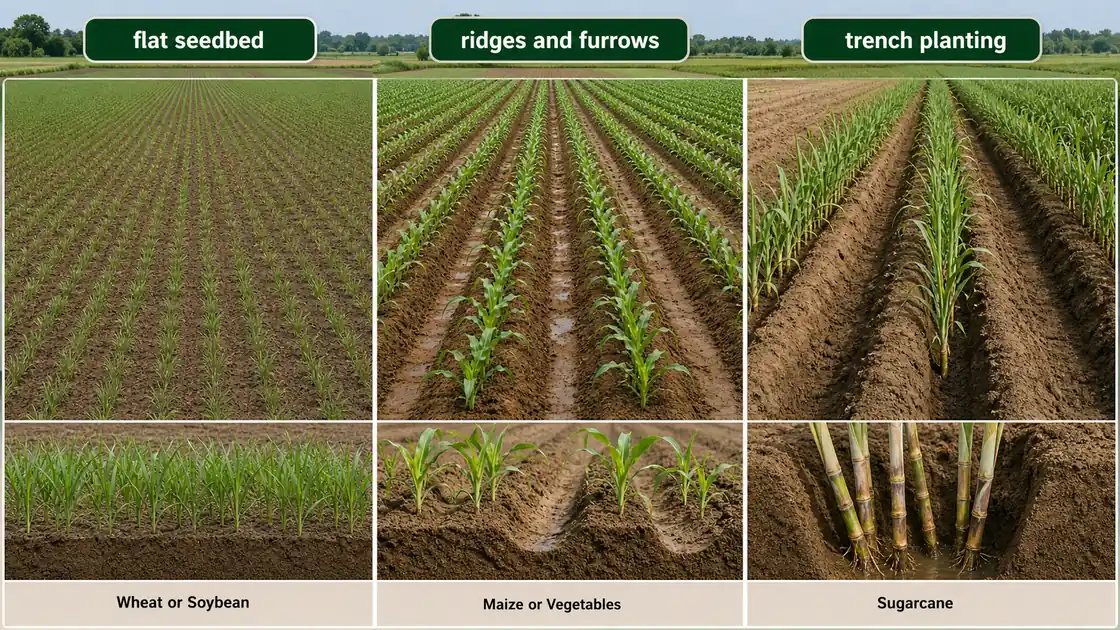
| Crop Type | Seed Bed Layout | Examples |
|---|---|---|
| Most field crops | Flat, levelled seedbed | Wheat, soybean, pearl millet, groundnut, castor |
| Row crops | Ridges and furrows | Maize, vegetables |
| Furrow/trench planting | Planted in furrows | Sugarcane |
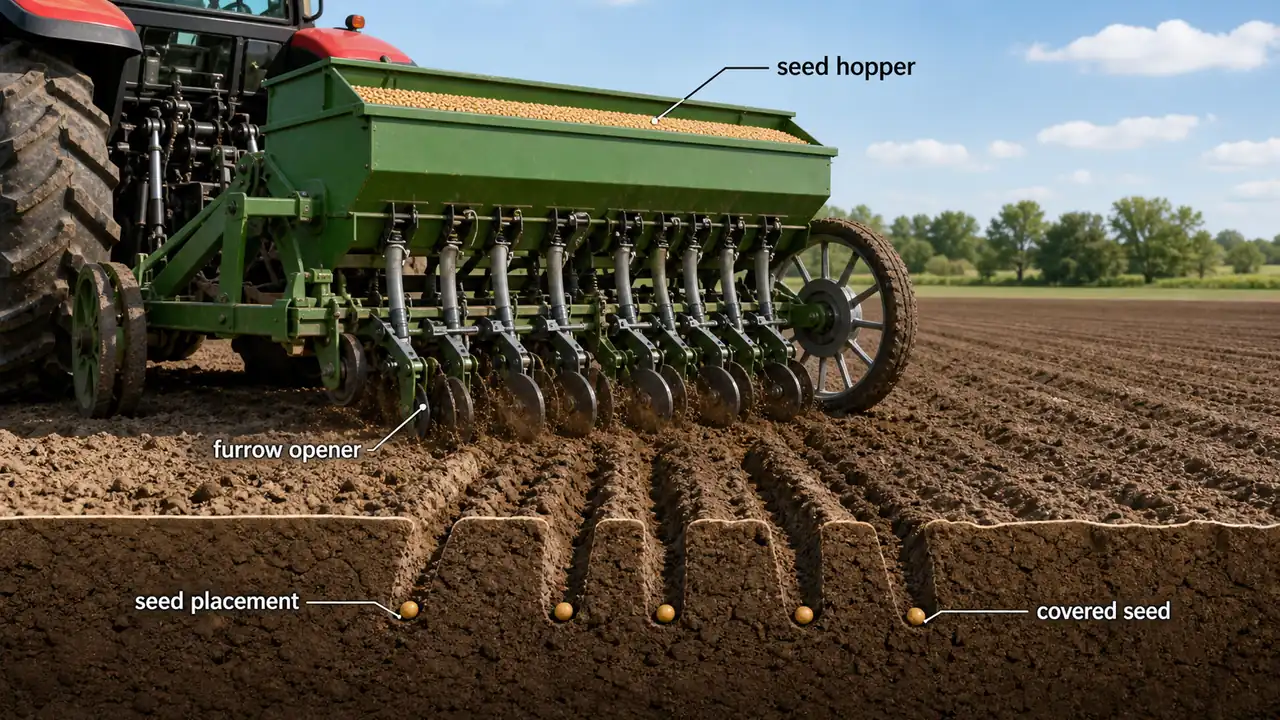
Seed Drill -- drops seeds in furrow lines at proper depth and spacing, then covers with soil. Invented by Jethro Tull in 1701, it revolutionized agriculture by enabling uniform seed placement and significantly improving germination rates.
After-Cultivation (Inter-cultivation)
Once the crop is sown, tillage does not stop. Operations performed in a standing crop maintain plant population, control weeds, and improve root zone conditions. These are collectively called after-cultivation or inter-culturing.
Tillage operations in a standing crop are called after-tillage or inter-culturing. They facilitate aeration and better root development.
- Blind cultivation -- cultivation after planting and before crop emergence; destroys early-germinating weeds before the crop appears.
Three Main Inter-cultivation Practices
| Practice | Purpose | Timing |
|---|---|---|
| Thinning & Gap filling | Maintain optimum plant population | 7-15 days after sowing |
| Weeding & Hoeing | Remove weed competition; create dust mulch | Simultaneous; 15-20 day intervals |
| Earthing up | Provide support / soil volume for tubers | 6-8 weeks after sowing |
Thinning and Gap Filling
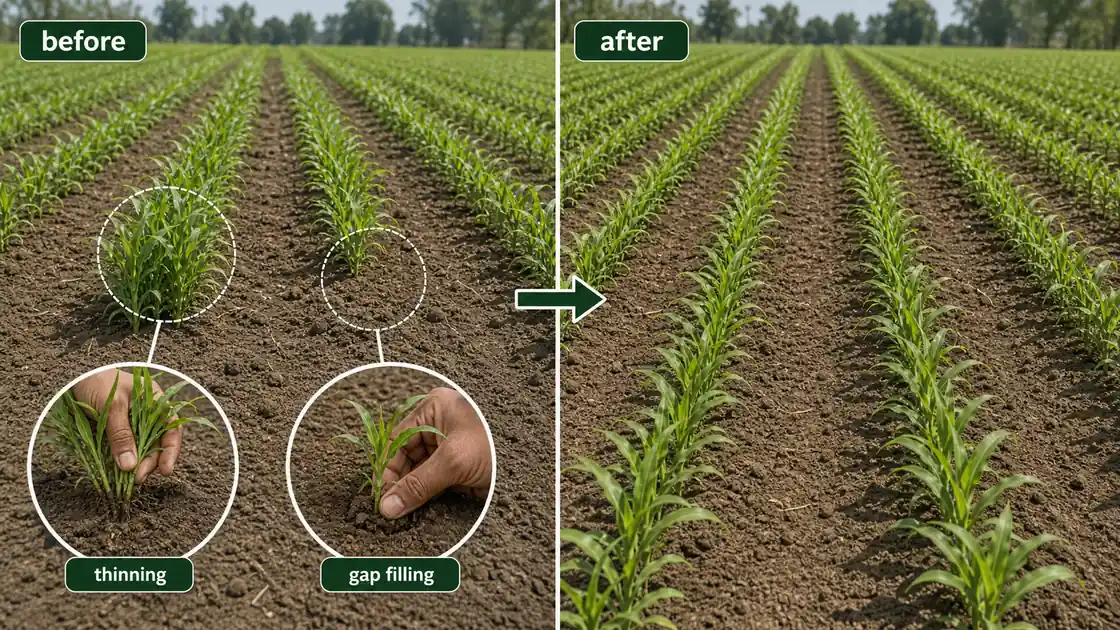
- Thinning = removing excess plants, leaving healthy seedlings.
- Gap filling = sowing seeds or transplanting seedlings where earlier seeds failed.
- Both are simultaneous; in dryland agriculture, gap filling is done first.
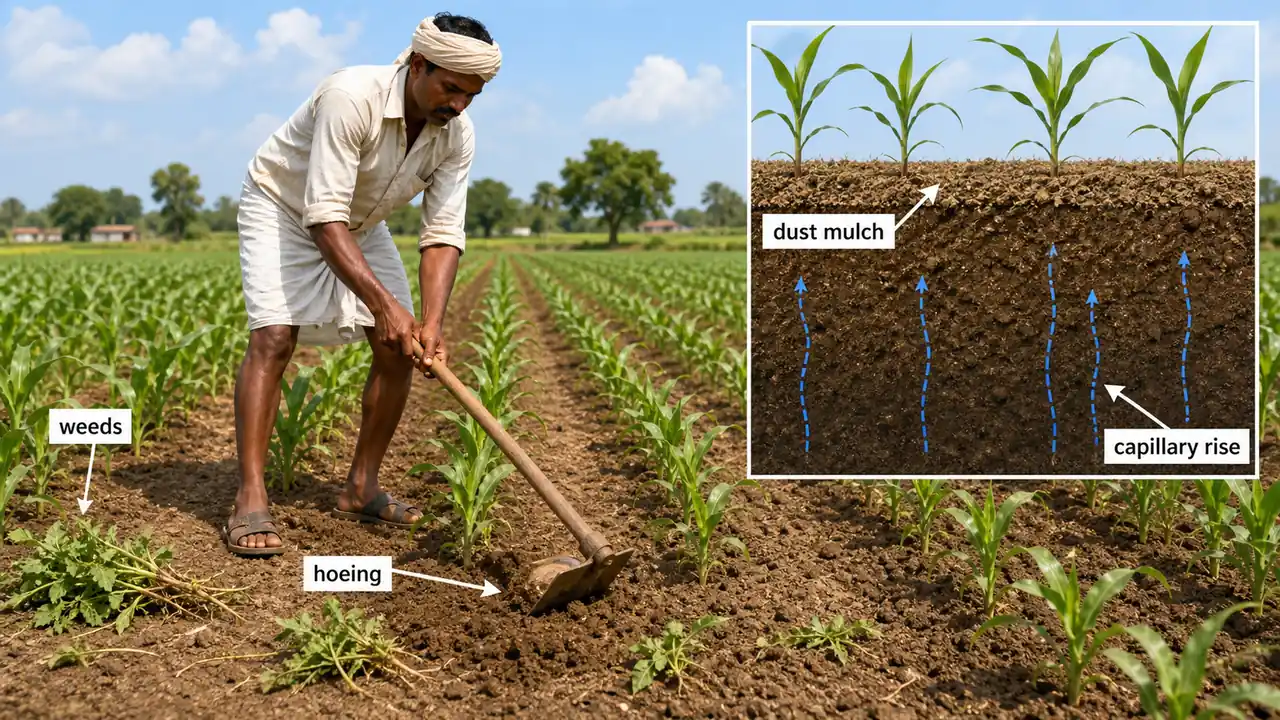
Weeding and Hoeing
- Weeding eliminates competition of unwanted plants for nutrition and moisture.
- Hoeing disturbs topsoil, creating a dust mulch that reduces evaporation and breaks capillary water rise.
- Both are simultaneous operations.
Earthing Up
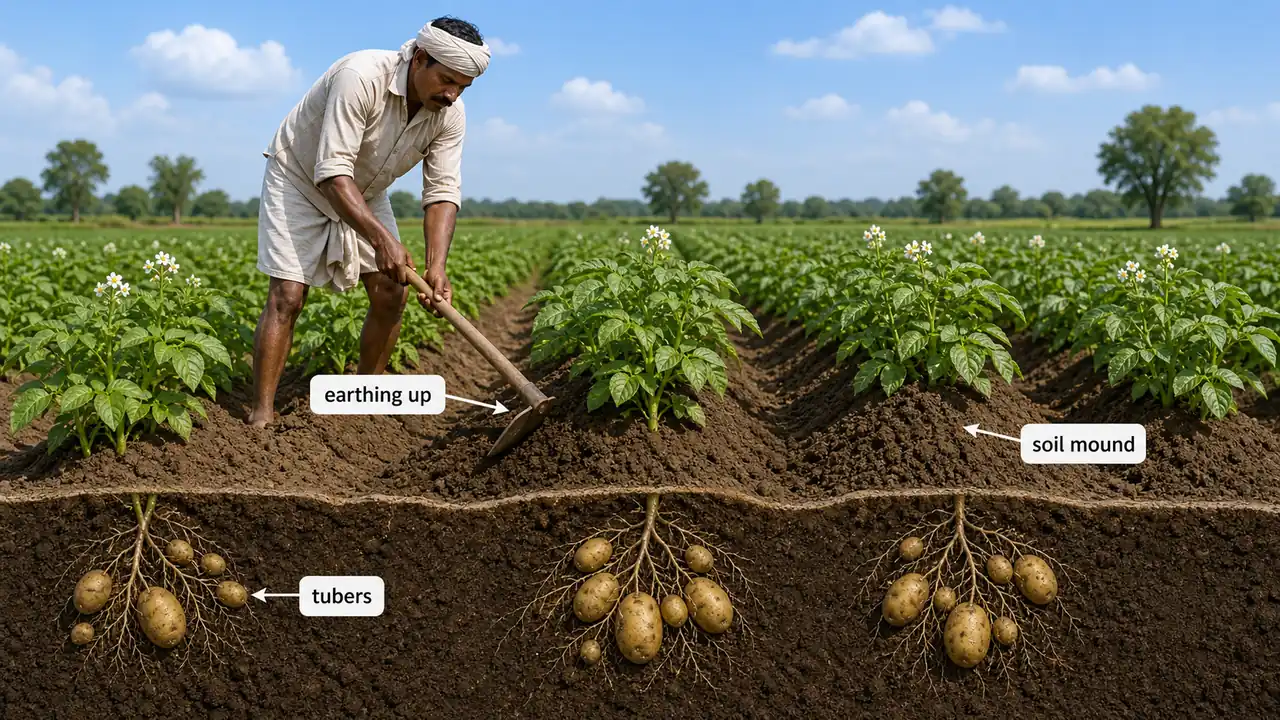
| Crop | Reason for Earthing Up |
|---|---|
| Sugarcane, Papaya, Banana | Prevent lodging (stem displacement) |
| Potato, Cassava | Provide soil volume for tuber growth; prevent greening (solanine) |
| Vegetables | Facilitate irrigation |
- Done in wide-spaced, deep-rooted crops, around 6-8 weeks after sowing/planting.
Lodging = permanent displacement of stems from upright position, reducing yield and making harvest difficult.
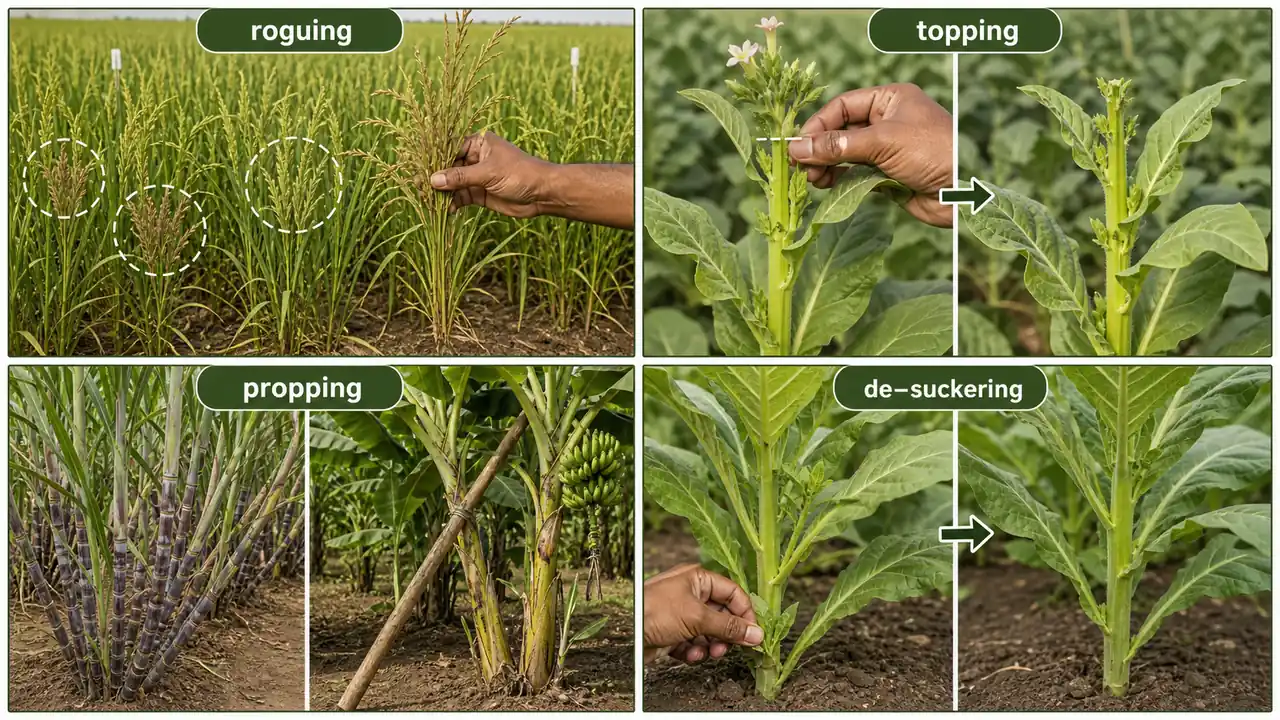
Other Inter-cultivation Practices
| Practice | Description | Crop Example |
|---|---|---|
| Harrowing | Stirring surface soil in inter/intra-row spacing | General field crops |
| Roguing | Removing off-type plants to maintain genetic purity (essential in seed production) | Certified seed crops |
| Topping | Removing terminal buds/flowers to stimulate lateral growth | Cotton, Tobacco |
| Propping | Tying leaves/stalks together to check lodging | Sugarcane, Banana |
| De-trashing | Removing older leaves for better air circulation and light | Sugarcane |
| De-suckering | Removing non-essential auxiliary buds/branches | Tobacco |
Explore More
Tillage Based on Season
| Type | Definition | Purpose |
|---|---|---|
| On-season | Done for raising crops in the same season | Normal preparatory + after-cultivation |
| Off-season | Done to condition soil for forthcoming main season | Takes advantage of summer heat / winter frost to improve soil, kill pests, control weeds |
Off-season types: Post-harvest tillage, Summer tillage, Winter tillage, Fallow tillage.
Modern Concepts of Tillage
Modern tillage science recognises that excessive soil disturbance degrades structure, destroys organic matter, and accelerates erosion. The key distinction is between conventional tillage (full inversion) and conservation tillage (minimal disturbance with residue retention). Exam questions frequently test the residue-cover thresholds that distinguish these systems.
IMPORTANT
Key thresholds:
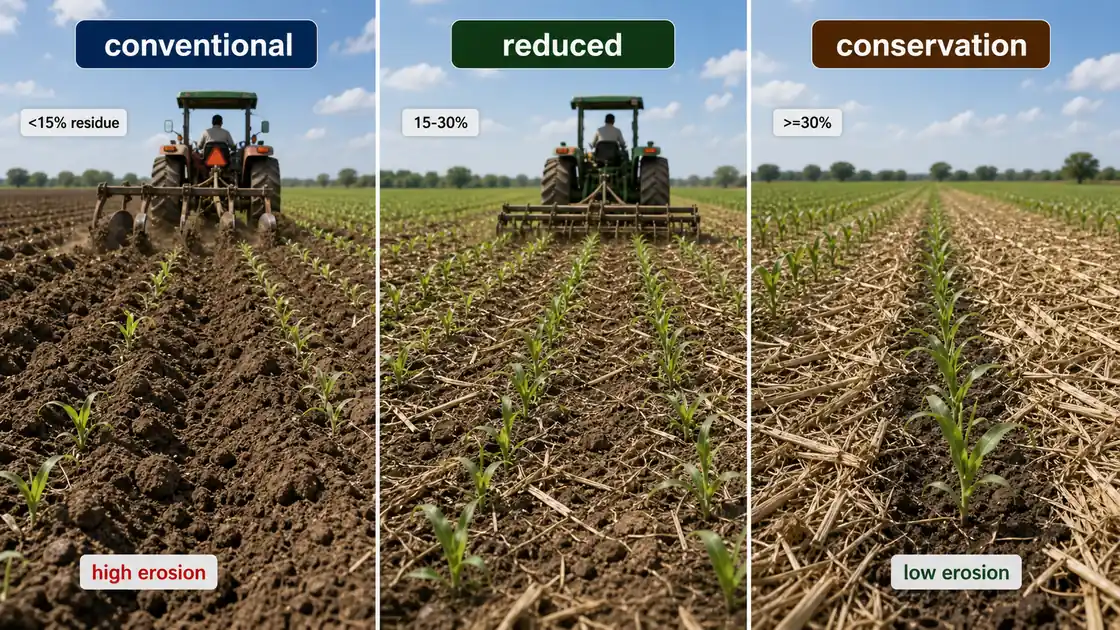
- Conservation tillage: retains ≥30% crop residue on surface
- Reduced tillage: retains 15-30%
- Conventional tillage: retains <15%
Conventional Tillage
- Primary tillage (ploughing) followed by secondary tillage for seedbed.
- With herbicide introduction, the need for tillage as weed control has reduced.
- Problems: Creates hard pan with continuous heavy ploughing; susceptible to runoff and erosion; capital intensive; increases soil degradation.
Conservation Tillage
Tillage systems that leave significant crop residue on the soil surface to protect from erosion and conserve moisture. Also called Eco-fallow.
Any system retaining 30% or more residue cover (or at least 1,120 kg/ha of flat small-grain residue equivalent) after planting is conservation tillage.
| Sub-type | Description |
|---|---|
| No-till | Soil undisturbed from harvest to planting except nutrient injection |
| Ridge-till | Planting on ridges prepared with sweeps/coulters |
| Mulch-till | Soil disturbed before planting; includes zone-till and strip-till |
| Minimum tillage | Only tillage needed for seed placement at proper depth |
Conservation tillage is most relevant in the Indo-Gangetic rice-wheat belt where burning rice residue before wheat sowing causes severe air pollution — zero tillage allows wheat sowing directly into rice stubble.
Minimum Tillage
- Only the minimum tillage necessary for good seedbed, rapid germination, and satisfactory stands.
- Concept started in USA.
- Tillage reduced by: (a) omitting low-benefit operations, (b) combining operations (e.g., seeding + tillage).
| Advantages | Disadvantages |
|---|---|
| Improved soil condition from in-situ residue decomposition | Lower seed germination |
| Higher water infiltration | More N needed (slow OM decomposition) |
| Less surface runoff | Nodulation affected in some legumes (pea, beans) |
| Less soil compaction and erosion | Sowing difficult with ordinary implements |
| Satisfactory crop stand | Continuous herbicide use causes pollution and perennial weed dominance |
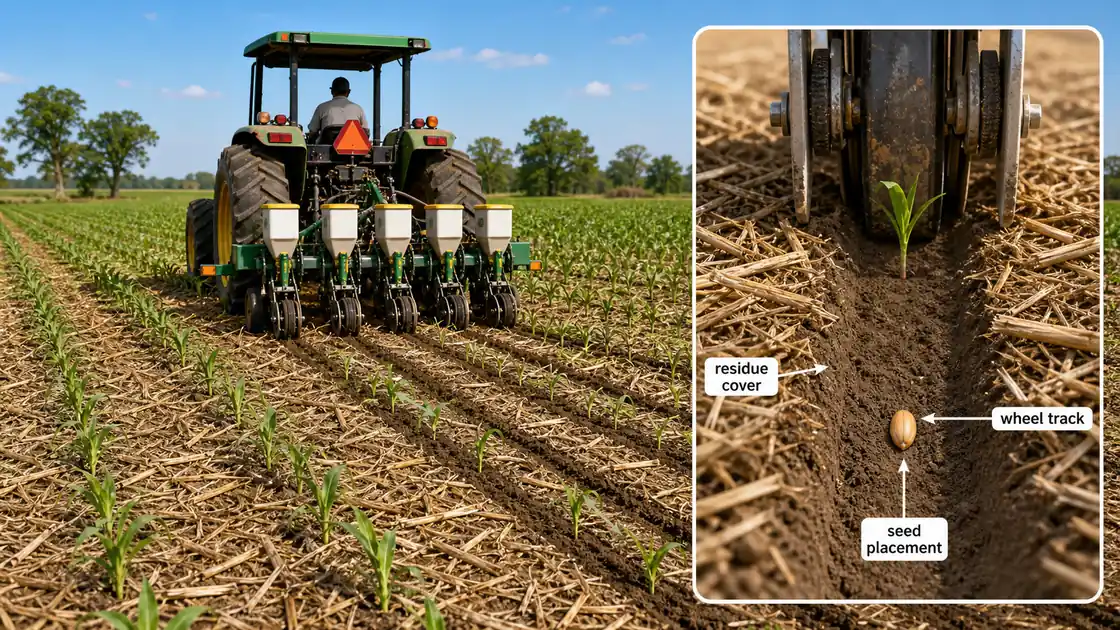
Methods: Row Zone Tillage, Plough Plant Tillage, Wheel Track Planting
Zero Tillage (No Tillage)
- Crop planted in unprepared soil by opening a narrow slot of sufficient width/depth for seed coverage. Weeds controlled chemically only.
- Term coined by Jethro Tull. First introduced in USA. Father of Zero Tillage: Triplet.
- Contact herbicides used: Paraquat and Diquat.
Suitable conditions: Coarse-textured surface, good internal drainage, adequate residue as mulch.
Problems: Low seed germination, low mineralization, buildup of volunteer plants.
🏆 UPSC Prelims 2020: What is/are the advantage(s) of zero tillage in agriculture?
1. Sowing of wheat is possible without burning the residue of previous crop.
2. Without the need for nursery of rice saplings, direct planting of paddy seeds in the wet soil is possible.
3. Carbon sequestration in the soil is possible.
Select the correct answer:
(a) 1 and 2 only  (b) 2 and 3 only  (c) 3 only  (d) 1, 2 and 3
Answer: (d)
Tillage System Comparison
| Parameter | Conservation | Reduced | Conventional |
|---|---|---|---|
| Residue cover after planting | ≥30% | 15-30% | <15% |
| Residue weight (small grain equivalent) | ≥1,120 kg/ha | 560-1,120 kg/ha | <560 kg/ha |
| Soil erosion risk | Low | Medium | High |
| Fuel/energy need | Low | Medium | High |
TIP
Exam one-liners:
- Clean tillage = working entire field so no living plant is left undisturbed (IBPS 2018)
- Puddling = ploughing with 5-10 cm standing water to create impervious layer for rice; reduces deep percolation (NABARD 2021)
- Stubble mulch tillage = stubbles form protective cover on surface
Puddling is specific to rice cultivation in high-rainfall zones because rice requires an impervious layer to retain standing water.
Depth of Tillage
- 1 cm of surface soil over 1 ha weighs about 150 tonnes -- deep tillage requires enormous energy.
- CRIDA (Hyderabad) classification:
| Category | Depth | Use |
|---|---|---|
| Shallow | 5-6 cm | Surface weed control |
| Medium | 15-20 cm | Most field crops |
| Deep | 25-30 cm | Root crops (sugarbeet, potato, carrot) |
Summer deep ploughing exposes large clods to heat; alternate heating-cooling crumbles them, improves structure, kills rhizomes of problematic weeds (Cynodon, Cyperus) and pests.
IMPORTANT
Hard Pan — a semi-impervious compacted layer formed at ~15 cm depth from continuous ploughing at the same depth. It restricts root penetration, water infiltration, and drainage. Broken by subsoiling (deep tillage at 45-60 cm) or chiselling.
Germination
Good tillage culminates in successful germination — the process by which a seed breaks dormancy and develops into a seedling. The quality of the seedbed directly determines germination percentage and uniformity.
| Factor | Effect on Germination |
|---|---|
| Temperature | Above/below optimum reduces germination rate |
| Light | Red light (662 nm) promotes germination; 730 nm inhibits (phytochrome system) |
| Seed size vs tilth | Small seeds need fine tilth; large seeds tolerate coarser tilth |
| Sowing depth | Thumb rule: 3-4 times seed diameter; optimum depth for most crops: 3-5 cm |
Optimum Plant Population
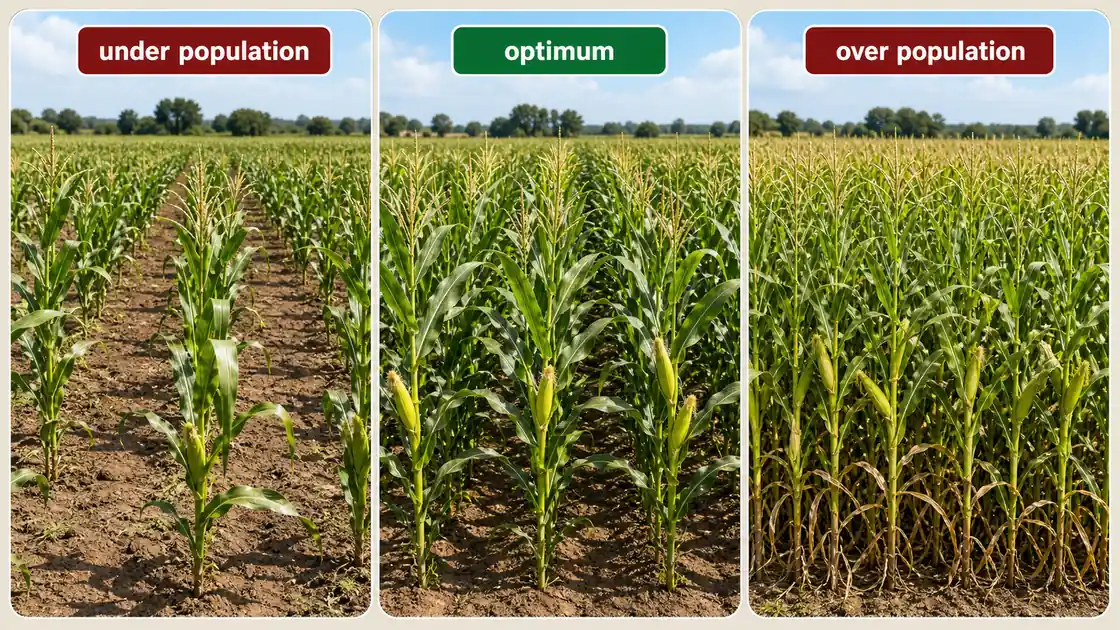
Plant population = total number of plants per unit area. Optimum plant population = the number that produces maximum output per unit area.
- As population increases, yield per plant decreases but yield per unit area increases -- up to the optimum. Beyond this, total yield declines.
Factors Affecting Plant Population
| Factor | Details | Example |
|---|---|---|
| Plant size | Larger plants need wider spacing | Cotton (100x100 cm) vs Wheat (continuous rows) |
| Elasticity | Indeterminate plants (branching) tolerate wider population range | Red gram: 55,000-1,33,000 plants/ha |
| Foraging area | Quick canopy closure suppresses weeds | Rice at 20x15 cm |
| Dry matter partitioning | Beyond optimum density, harvest index decreases | Excessive maize density = more stalk, less grain |
| Time of sowing | Early/late sowings = lower population (seedling mortality) | -- |
| Irrigation | Higher population under irrigated conditions | -- |
| Fertilizer | Higher fertilizer = can support higher population | -- |
Crop Plant Population Examples
| Crop | Spacing | Population (plants/ha) |
|---|---|---|
| Rice (short duration) | 15 x 10 cm | 6,66,666 |
| Rice (medium duration) | 20 x 10 cm | 5,00,000 |
| Rice (long duration) | 20 x 15 cm | 3,33,000 |
| BT Cotton | 100 x 100 cm | 10,000 |
| Hybrid Cotton | 100 x 60 cm | 67,000 |
| Desi Cotton | 60 x 15 cm | 1,11,111 |
| Maize (composite) | 60 x 20 cm | 83,333 |
| Maize (hybrid) | 60 x 35 cm | 47,620 |
BT Cotton has the widest spacing because each plant has strong branching with indeterminate growth — fewer, more productive plants are more economical.
TIP
Quick formula: Plant population = Area (cm²) / (Row spacing x Plant spacing) = 10,00,00,000 / (R x P in cm)
Plant Geometry (Crop Geometry)
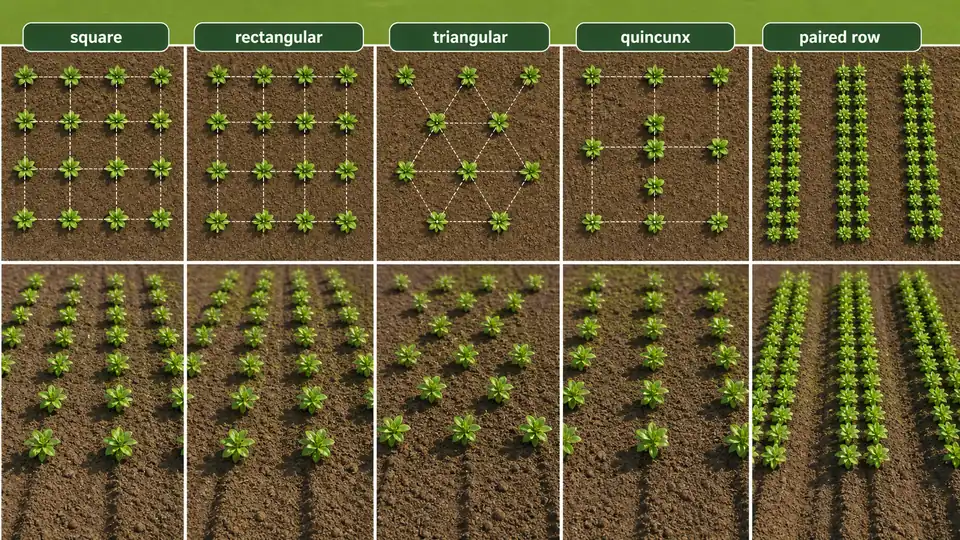
How plants are arranged in the field determines how efficiently they capture sunlight, water, and nutrients. Different geometries suit different crops and farming systems. The arrangement of plants in rows and columns to utilise natural resources (sunlight, water, nutrients) efficiently.
Types of Plant Geometry
| Geometry | Description | Best For |
|---|---|---|
| Random / Broadcasting | Random scattering of seeds over the soil surface — simplest sowing method but gives uneven plant stand | Subsistence, pastures, rice and wheat in some regions |
| Square | Equal distance on all sides | Perennials (coconut 7.5x7.5 m), tree crops |
| Rectangular | Row spacing > plant spacing | Most annual field crops |
| Triangular | Plants at vertices of equilateral triangles; ~15% more plants/ha than square | Wide-spaced crops (coconut, mango) |
| Quincunx / Diamond | Square of 4 main-crop plants + 1 filler crop at centre | Orchards with short-duration filler |
| Paired Row | Two rows close together, then a wide gap | Intercropping between paired rows |
Rectangular Sub-types
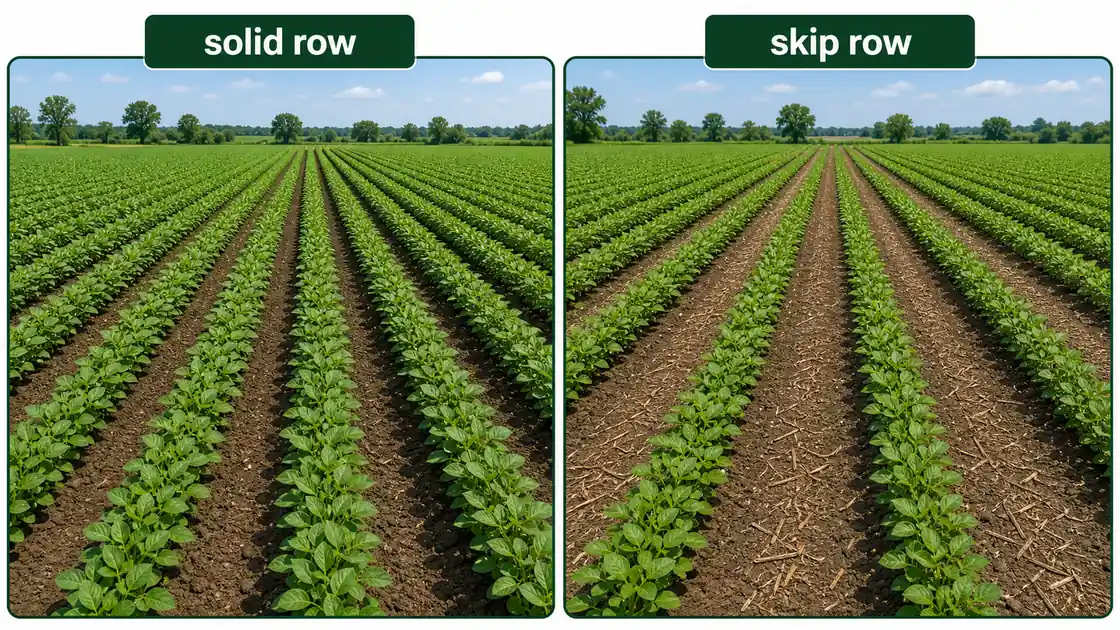
| Sub-type | Feature | Example |
|---|---|---|
| Solid row | No proper in-row spacing; rows defined | Wheat |
| Skip row | Alternate rows skipped for intercrop; used in dryland | Sorghum + pigeon pea |
Recommended Spacing of Field Crops
| Crops | Spacing (cm) | Plant population/ha |
|---|---|---|
| Rice | ||
| Transplanting | 20 x 10 | 5,00,000 |
| Hybrid rice | 20 x 15 | 3,33,333 |
| SRI method | 25 x 25 | 1,16,000 |
| Wheat | 22.5 (RxR) Soli Row Planting | |
| Maize | 60 x 25 | 67,000 |
| Moong/Urd | 40 x 10 | 2,50,000 |
| Cotton | ||
| Desi | 60 x 15 | 1,11,111 |
| Hybrid | 100 x 60 | 67,000 |
| BT Cotton | 100 x 100 | 10,000 |
| Sorghum | 45 x 15 | 1,48,000 |
| Gram/Pea/Cowpea/Sunhemp/French Bean | 30 x 10 | 3,33,000 |
| Potato | 50 x 20 & 60 x 25 | 1,00,000 & 67,000 |
| Sunflower | 60 x 20 | 83,333 |
| Groundnut/Til/Soybean/Kodo millet | 45 x 5 | 4,44,444 |
| Jute | 20 x 7 | 7,14,286 |
| Castor | 60 x 45 & 45 x 60 | 37,111 |
| Sugarcane | 75-90 (R x R) | 33,000-45000 |
| Lentil | 30 x 5 | 6,66,666 |
Tillage Decision Guide: Which System for Which Situation?
An exams officer advising farmers should match tillage to soil and crop conditions:
| Situation | Recommended Tillage | Why | Key Implement |
|---|---|---|---|
| Heavy clay soil after rice (Indo-Gangetic) | Conventional (deep ploughing + 2-3 harrowings) | Break puddled layer; improve drainage for rabi crop | MB plough → cultivator → planker |
| Light sandy soil (Rajasthan, Gujarat) | Minimum tillage | Already loose; excessive tillage causes wind erosion | One pass with cultivator |
| Rice-wheat rotation (Punjab, Haryana) | Zero tillage for wheat after rice | Saves 30-35 days between crops; reduces cost; conserves moisture | Happy Seeder (sows into rice stubble) |
| Dryland/rainfed areas | Conservation tillage (30%+ residue retained) | Moisture conservation critical; reduce evaporation | Chisel plough, sweep cultivator |
| Sugarcane/potato (heavy feeder, tuber crop) | Deep tillage (30-45 cm) | Deep root zone needed; ridges and furrows for tubers | Subsoiler → disc plough → ridger |
| Orchards/perennial crops | No tillage or shallow intercultivation | Avoid root damage to established trees | Rotavator between rows only |
Zero tillage economics (verified, CIMMYT-ICAR data): In rice-wheat systems of NW India, zero tillage for wheat saves approximately ₹2,000-3,000/ha in tillage costs and enables sowing 10-15 days earlier, which can improve yield by 5-7% due to timely sowing.
Analogy: Think of tillage like preparing a bed for sleeping — a heavy person on a hard floor needs thick mattressing (deep tillage for clay), while someone on a soft surface needs only a sheet (minimum tillage for sandy soil). Over-preparing wastes effort and can damage the base.
Summary Cheat Sheet
| Concept / Topic | Key Details / Explanation |
|---|---|
| Tillage definition | Mechanical manipulation of soil for seed germination, seedling establishment, and crop growth |
| Father of Tillage | Jethro Tull — invented the seed drill in 1701 |
| Good tilth aggregate size | 0-5 mm (ideal balance of water retention and aeration) |
| Ideal pore ratio | 50:50 capillary : non-capillary (1:1) |
| Primary objective of tillage | Improve soil aeration for gaseous exchange |
| Seed bed | Soil in ideal crop-growing condition with optimum pore balance |
| Tillage classification (by time) | Preparatory cultivation (before sowing) and After-cultivation (in standing crop) |
| Tillage classification (by season) | On-season (same season) and Off-season (conditioning for next) |
| Primary tillage | First and deepest operation after harvest; depth 25-30 cm; implements: MB Plough, Disc Plough, Desi Plough |
| Secondary tillage | Lighter, finer operations; harrowing, planking, cultivator, roller |
| Seed bed layouts | Flat (wheat, soybean), ridges & furrows (maize, vegetables), trench (sugarcane) |
| After-cultivation practices | Thinning & gap filling (7-15 DAS), weeding & hoeing (15-20 day intervals), earthing up (6-8 weeks) |
| Blind cultivation | Cultivation after planting but before crop emergence; destroys early weeds |
| Earthing up crops | Sugarcane, banana (prevent lodging); potato (prevent greening/solanine) |
| Roguing | Removing off-type plants for genetic purity in seed production |
| Topping | Removing terminal buds to stimulate lateral growth — cotton, tobacco |
| Conservation tillage threshold | Retains ≥30% crop residue on surface (also called Eco-fallow) |
| Reduced tillage | Retains 15-30% residue cover |
| Conventional tillage | Retains <15% residue cover |
| Conservation tillage sub-types | No-till, Ridge-till, Mulch-till (zone-till, strip-till), Minimum tillage |
| Minimum tillage origin | Concept started in USA |
| Zero tillage | Crop planted in unprepared soil; weeds controlled chemically only |
| Father of Zero Tillage | Triplet; term coined by Jethro Tull; first introduced in USA |
| Zero tillage herbicides | Paraquat and Diquat (contact type) |
| Clean tillage | Entire field worked so no living plant left undisturbed |
| Puddling | Ploughing with 5-10 cm standing water to create impervious layer for rice |
| Stubble mulch tillage | Stubbles form protective cover on soil surface |
| 1 cm soil over 1 ha | Weighs approximately 150 tonnes |
| Shallow tillage depth | 5-6 cm (surface weed control) |
| Medium tillage depth | 15-20 cm (most field crops) |
| Deep tillage depth | 25-30 cm (root crops: sugarbeet, potato, carrot) |
| Hard pan | Compacted layer at ~15 cm from continuous ploughing; broken by subsoiling (45-60 cm) |
| Sowing depth rule | 3-4 times seed diameter; optimum for most crops: 3-5 cm |
| Red light & germination | 662 nm promotes germination; 730 nm inhibits (phytochrome system) |
| Optimum plant population | Number producing maximum output per unit area |
| Plant population formula | 10,00,00,000 / (R x P in cm) |
| BT Cotton spacing | 100 x 100 cm = 10,000 plants/ha (widest spacing, indeterminate growth) |
| Rice spacing (medium) | 20 x 10 cm = 5,00,000 plants/ha |
| SRI rice spacing | 25 x 25 cm = 1,16,000 plants/ha |
| Jute spacing | 20 x 7 cm = 7,14,286 plants/ha (highest population) |
| Broadcasting | Random seed scattering — simplest sowing method but uneven plant stand |
| Square geometry | Equal spacing all sides — perennials (coconut 7.5 x 7.5 m) |
| Rectangular geometry | Row spacing > plant spacing — most annual field crops |
| Triangular geometry | Plants at triangle vertices; ~15% more plants/ha than square at same spacing |
| Quincunx / Diamond | 4 main-crop plants at square corners + 1 filler crop at centre (orchards) |
| Paired row | Two close rows then wide gap — facilitates intercropping |
TIP
Exam tip: Questions on tillage often test thresholds (30% for conservation tillage), definitions (clean tillage, puddling, blind cultivation), and the father of tillage (Jethro Tull).
TIP
Next: Lesson 05 covers cropping systems and patterns — once the field is prepared and planted, the next decision is what sequence and combination of crops to grow across seasons.