🧊 Agricultural Drainage -- Surface, Sub-Surface, and Mole Drain Systems
Complete guide to agricultural drainage methods including surface drainage (bedding, BBF, parallel ditch), sub-surface drainage (tile, mole, vertical), waterlogging causes, effects, and drainage coefficient for competitive exams.
From Waterlogged Fields to Productive Farms
The previous lessons covered how to bring water to the crop -- distribution, scheduling, methods, quality, and measurement. But what happens when there is too much water? This lesson covers the other side of water management: removing excess water through drainage.
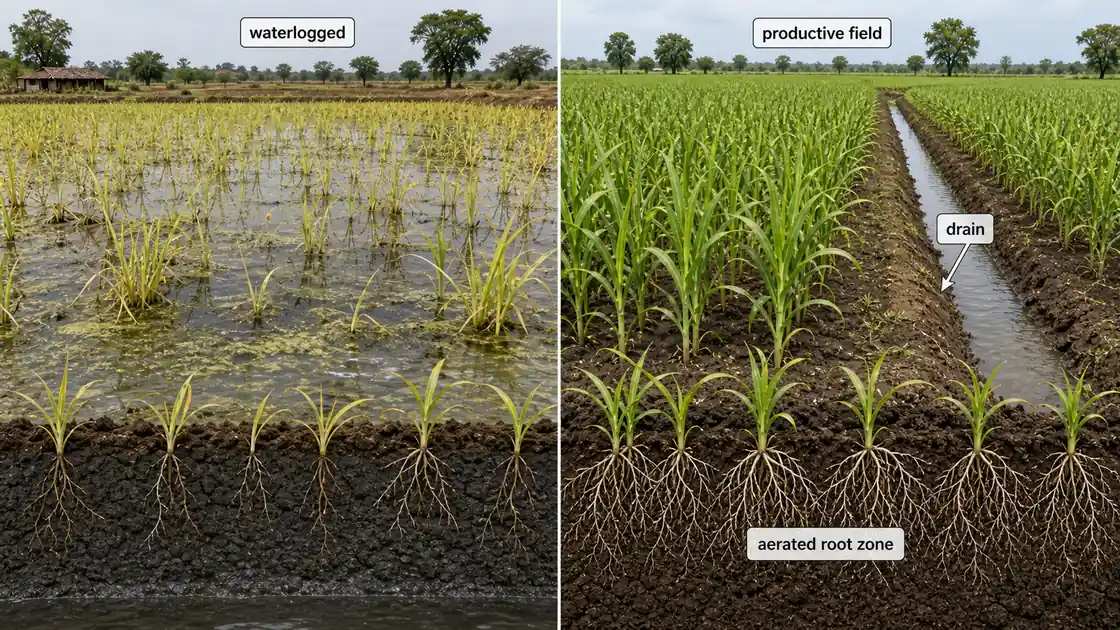
A rice farmer in coastal Odisha watches helplessly as his rabi pulse crop drowns in standing water weeks after the monsoon ends. The flat terrain, poor natural drainage, and a clay subsoil layer trap water in the root zone, turning productive fields into swamps. His neighbour, who installed a herringbone tile drain system two years ago, harvests a healthy chickpea crop from identical soil. The difference is agricultural drainage -- one of the most undervalued yet critical components of water management in Indian agriculture.
What is Agricultural Drainage?
Agricultural drainage is the removal of excess water known as free water or gravitational water from the surface or below the surface of farmland to create favourable soil conditions for plant growth. Just as irrigation supplies water when there is too little, drainage removes water when there is too much.
Pro Content Locked
Upgrade to Pro to access this lesson and all other premium content.
Charged once for one year · ₹1188 total
Save ₹100/month vs ₹2388/year launch price
- All Agriculture & Banking Courses
- AI Lesson Questions (100/day)
- AI Doubt Solver (50/day)
- Glows & Grows Feedback (30/day)
- AI Section Quiz (20/day)
- 22-Language Translation (100/day)
- Recall Questions (20/day)
- AI Quiz (15/day)
- AI Quiz Paper Analysis (100/day)
- AI Step-by-Step Explanations (100/day)
- Spaced Repetition Recall (FSRS)
- AI Tutor
- Immersive Text Questions
- Audio Lessons — Hindi & English
- Mock Tests & Previous Year Papers
- Summary & Mind Maps
- XP, Levels, Leaderboard & Badges
- Generate New Classrooms
- Voice AI Teacher (AgriDots Live)
- AI Revision Assistant
- Knowledge Gap Analysis
- Interactive Revision (LangGraph)
🔒 Secure one-time yearly payment via Razorpay · No hidden fees
From Waterlogged Fields to Productive Farms
The previous lessons covered how to bring water to the crop -- distribution, scheduling, methods, quality, and measurement. But what happens when there is too much water? This lesson covers the other side of water management: removing excess water through drainage.
A rice farmer in coastal Odisha watches helplessly as his rabi pulse crop drowns in standing water weeks after the monsoon ends. The flat terrain, poor natural drainage, and a clay subsoil layer trap water in the root zone, turning productive fields into swamps. His neighbour, who installed a herringbone tile drain system two years ago, harvests a healthy chickpea crop from identical soil. The difference is agricultural drainage -- one of the most undervalued yet critical components of water management in Indian agriculture.
What is Agricultural Drainage?
Agricultural drainage is the removal of excess water known as free water or gravitational water from the surface or below the surface of farmland to create favourable soil conditions for plant growth. Just as irrigation supplies water when there is too little, drainage removes water when there is too much.
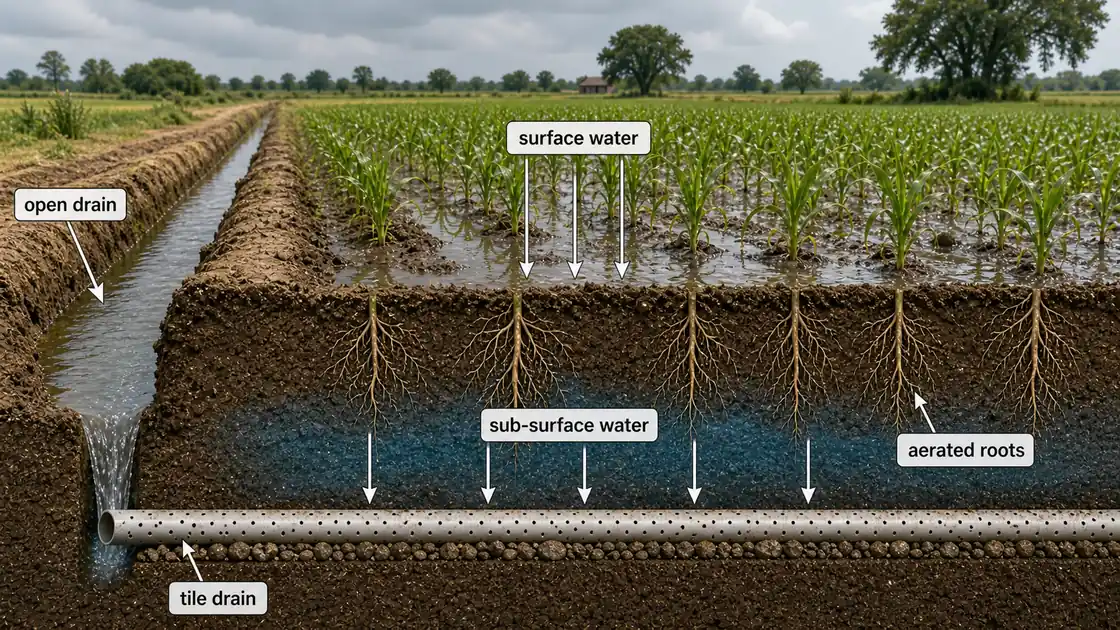
Agricultural example: In the canal-irrigated areas of Haryana and Punjab, rising water tables from decades of over-irrigation have waterlogged millions of hectares. Drainage systems are the only long-term solution to reclaim these lands for productive farming.
TIP
Exam mnemonic -- "DRAINAGE = Drain Rain And Irrigated Nonsense, Assure Growth Everywhere." Remember that drainage addresses excess water from both rainfall and over-irrigation.
Waterlogging
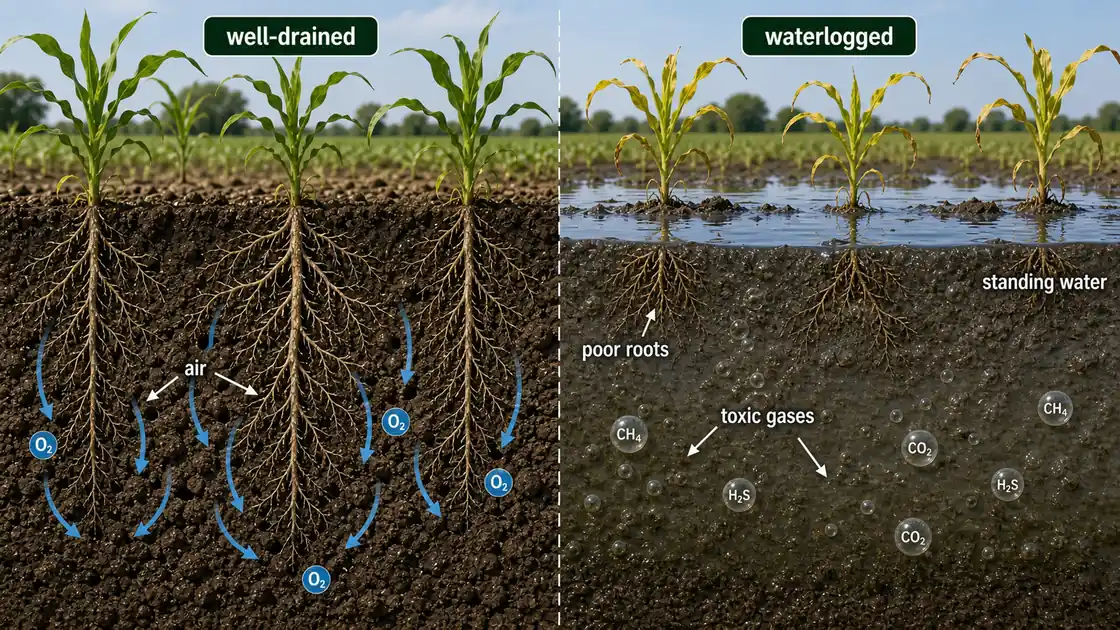
A land is called waterlogged when water stagnates or flows over the soil surface. Waterlogging deprives plant roots of oxygen and can quickly lead to crop failure if not addressed.
Causes of Waterlogging
| Category | Cause | Agricultural Example |
|---|---|---|
| Natural | Poor natural drainage of subsoil (impermeable layers) | Black cotton soils (vertisols) of Maharashtra trap water above the clay pan |
| Natural | Submergence under floods | Kosi river floods in Bihar submerge farmland for weeks |
| Artificial | High intensity irrigated agriculture without drainage planning | Canal-irrigated wheat-rice belt of Haryana |
| Artificial | Heavy seepage from unlined canals and watercourses | Indira Gandhi Canal area in Rajasthan |
| Artificial | Enclosing irrigated fields with embankments, choking natural drainage | Road and railway embankments blocking natural flow in UP |
| Artificial | Hydraulic pressure from upper saturated areas at higher elevations | Foothills of Shivalik range pushing water to plains |
| Artificial | Non-maintenance or blocking of natural drainage channels | Encroachment on natural nalas in peri-urban areas |
Effects of Poor Drainage
Poor drainage has wide-ranging negative effects on soil health, nutrient availability, and crop growth:
- Poor root growth -- roots need oxygen; waterlogged soils are oxygen-depleted
- Accumulation of excess soluble salts in shallow water table as surface evaporation leaves salts behind
- Reduction of soil strength -- soil loses load-bearing capacity
- Oxygen diffusion is 10,000 times lesser in waterlogged soil than in well-drained soil. This dramatic reduction is the primary reason waterlogging is so harmful to crops
- Redox potential drops to -400 mV. At such low values, the soil becomes strongly reducing, forming toxic compounds
- Accumulation of CO2, CH4, HCO3-, CO32- and H2S
- Change in pH and natural stabilization
- Anaerobic microbes dominate, replacing beneficial aerobic organisms (low energy level)
- Reduced nutrient availability -- iron and manganese toxicity increases
- Accumulation of toxicants (H2S, CH4)
- Poor crop growth, nutritional disorders, and yield reduction
- Impairs N-nutrition of legumes by interfering with nodulation (nitrogen-fixing bacteria need oxygen)
- Waterlogging injury caused primarily by Mn toxicity occurs in plant species with low inherent Mn tolerance, e.g. Lucerne (alfalfa)
Agricultural example: In waterlogged fields of western UP, wheat yields drop by 30-50% because roots cannot access nutrients, iron toxicity develops, and soil-borne diseases like root rot proliferate.
TIP
Exam tip: Remember the key numbers -- oxygen diffusion is 10,000x slower in waterlogged soil, and redox potential drops to -400 mV. These are frequently tested facts.
Drainage Coefficient (DC)
Drainage coefficient (DC) is the depth of water (cm) to be drained in a 24-hour period from the entire drainage area.
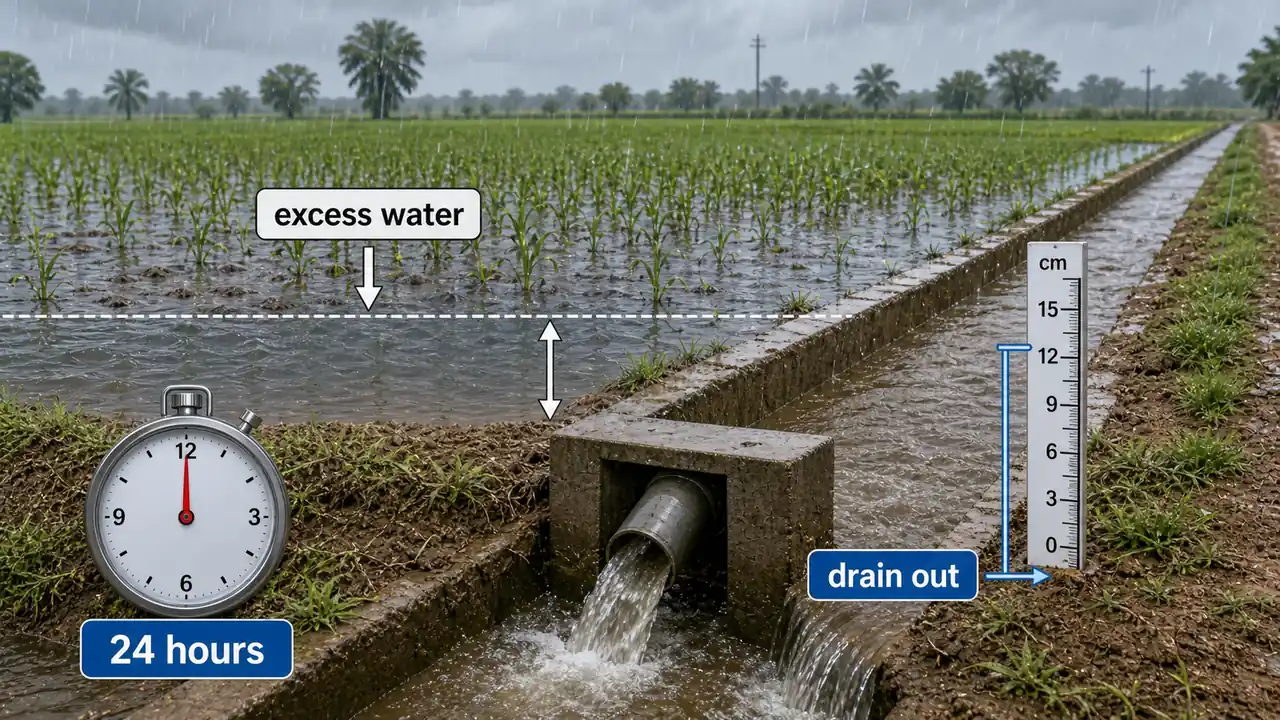
- Drainage of one ha-cm (105 litres) in 24 hours equals 1.157 litres per second (lps)
- DC helps determine drainage depth (drain size)
- For open ditches in small areas, DC ranges from 0.6 to 2.5 cm
- The DC value depends on local rainfall intensity, soil type, and crop tolerance to excess water
Agricultural example: For a rice-wheat system in eastern India receiving 150 mm rainfall in a single day, engineers design drains with a higher DC (around 2.0-2.5 cm) to remove water quickly and protect the succeeding wheat crop.
Methods of Drainage
| Category | Methods | Principle |
|---|---|---|
| Surface Drainage | Lift, Gravity, Field surface, Ditch, BBF | Remove water from soil surface |
| Sub-surface Drainage | Tile/Pipe, Mole, Vertical wells, Deep open, Buried, Combination | Lower ground water table below root zone |
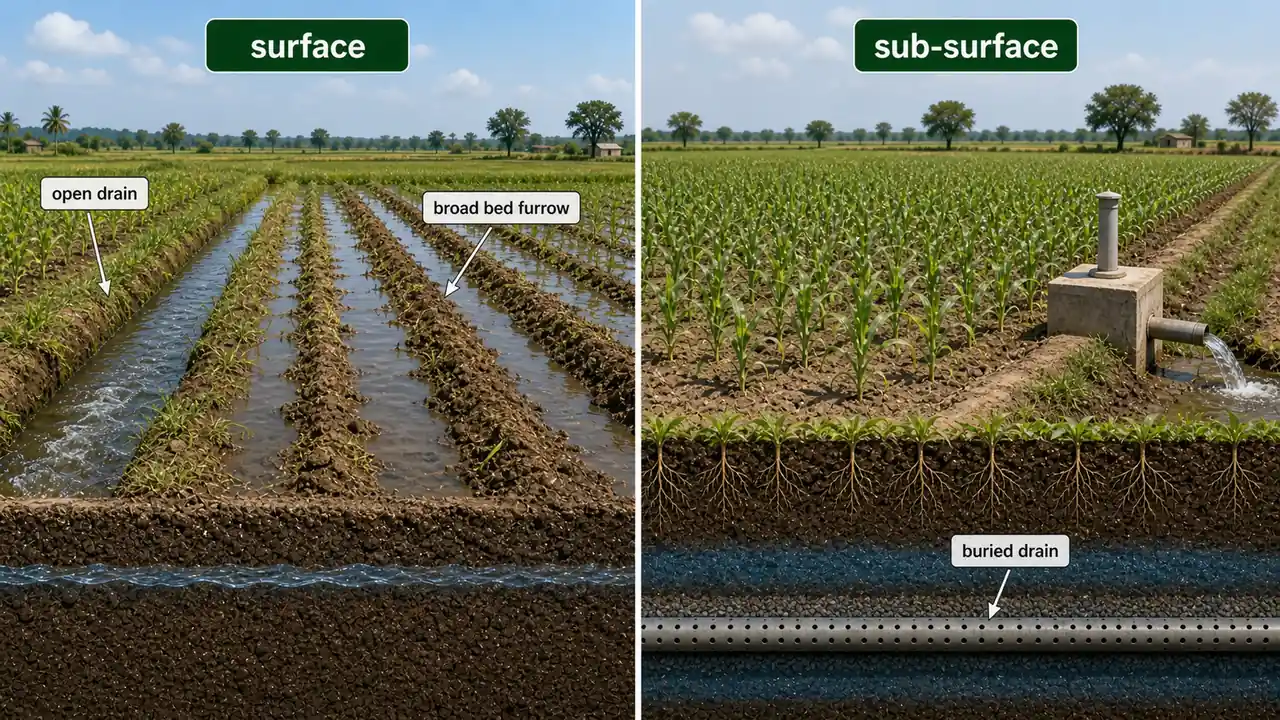
1) Surface Drainage
Simplest and most common method in India -- achieved by digging open drains at suitable intervals and depth. Surface drainage removes water that collects on the soil surface before it causes damage.
Types of Surface Drainage
| Type | Description | Agricultural Example |
|---|---|---|
| Lift drainage | Used in low-lying areas or areas with standing water due to embankments; water is lifted by pumping | Pump-based drainage in low-lying coastal Andhra Pradesh |
| Gravity drainage | Water drains from higher to lower elevation by regulated gravity flow; practised in wet land rice | Gentle-slope paddy fields of Kerala and Tamil Nadu |
| Field surface drainage | Irrigated basins or furrows connected to drainage at lower elevation, linked to main outlet and farm pond | Canal-irrigated sugarcane fields in Karnataka |
| Ditch drainage | Ditches of different dimensions; may be interceptors or relief drains; adopted in nurseries, seed beds and rainfed crops | Vegetable nurseries in the Indo-Gangetic plains |
Advantages and Disadvantages of Surface Drainage
| Advantages | Disadvantages |
|---|---|
| Cheap to construct and maintain | Some land is wasted for open drains |
| Defects visible and easily rectified | Causes hindrance to field preparation and intercultivation |
| Requires less available fall or grade for adequate outlet | Periodical de-silting is necessary |
| Heavy weed growth in and around drains | |
| May be damaged by rodents and farm animals |
Surface drainage has three functional parts: Collection, Disposal, and Outlet systems.
(a) Drainage of Flat Areas (Slope less than 2%)
Two processes are used for flat areas:
1. Smoothing / Grading / Forming (Land Leveling)
Elevated areas are cut and excess soil is spread over lower areas so that the surface becomes even with uniform slope. Excess runoff is collected and conveyed into field ditches. This process is also called land leveling or land grading.
Agricultural example: Laser land leveling in the rice-wheat systems of Punjab creates a uniform 0.1% slope, enabling efficient surface drainage and saving 20-25% irrigation water.
2. Field Ditch Systems:
(a) Bedding system: Small furrows formed at known intervals parallel to the slope for draining water. These furrows are called dead furrows and the land between them is called beds. The bedding system is one of the simplest and most economical surface drainage methods.

Agricultural example: Groundnut fields in Anantapur (Andhra Pradesh) use the bedding system during kharif to quickly drain monsoon water from the sandy loam soil.
(b) Parallel field ditch: Similar to bedding but with deeper drains and channels spaced farther apart. Most effective system, suited for both irrigated and rainfed conditions. Drains need not be equally spaced and water may move in only one direction. Minimum ditch depth: 0.2 m; minimum cross-sectional area: 0.5 m².

(c) Parallel, open field ditch: Deeper and with steeper side slopes than the parallel field ditch, hence the name "open" -- also called diversion ditch system. Used for both surface and sub-surface drainage. Minimum size for open ditches: 0.3 m.
(d) Broad Bed and Furrow System (BBF):
| Parameter | Specification |
|---|---|
| Bed width | 120-150 cm |
| Furrow width | 45 cm |
| Bed height (raised) | 15 cm |
| Slope for free drainage | 0.5% |
| Crop rows per bed | Two or more |
| Best suited soil | Vertisols (black cotton soils) |
Crops are sown on beds having two or more rows each. BBF is widely practised for groundnut in clay soil. This system is particularly effective in vertisols where waterlogging is a common problem during the monsoon.

Agricultural example: At ICRISAT Hyderabad, the BBF system on vertisols increased soybean yield by 40% compared to flat-bed sowing by preventing waterlogging during heavy monsoon rains.
TIP
Exam mnemonic -- "BBF = Beds Beat Flooding." Remember BBF dimensions: beds 120-150 cm wide, furrows 45 cm wide, beds raised 15 cm, slope 0.5%.
(b) Drainage of Ponded Areas
Micro ponds or depressions are connected by shallow channels or ditches. Drainage is achieved through a random field ditch system. This approach is used when the field has irregular low spots that collect water.

Agricultural example: In the uneven terrain of Jharkhand's tribal farmlands, random field ditches connect scattered depressions to a common outlet, allowing upland rice cultivation during kharif.
(c) Drainage of Sloping Areas (Slope > 2%)
Achieved by interception system or cross-slope ditch system. These ditches are placed across the slope to intercept water flowing downhill and divert it safely to an outlet, preventing both waterlogging and soil erosion. The side slope of the ditch is usually not less than 10:1.

Agricultural example: Tea gardens in the Nilgiris use cross-slope interception ditches to prevent both waterlogging and topsoil erosion on the hilly terrain.
Comparison of Surface Drainage Systems by Terrain
| Terrain | System Used | Key Feature |
|---|---|---|
| Flat (< 2% slope) | Bedding, Parallel field ditch, BBF, Land leveling | Water removed by creating artificial slope |
| Ponded/Depressed areas | Random field ditch | Connects irregular low spots to outlet |
| Sloping (> 2%) | Cross-slope / Interception ditch | Intercepts and diverts downhill flow; side slope minimum 10:1 |
Flow Rate from Soil to Drains Depends On:
- Hydraulic conductivity of the soil (HC) -- how easily water moves through the soil
- Depth of the drains
- Horizontal spacing between drains
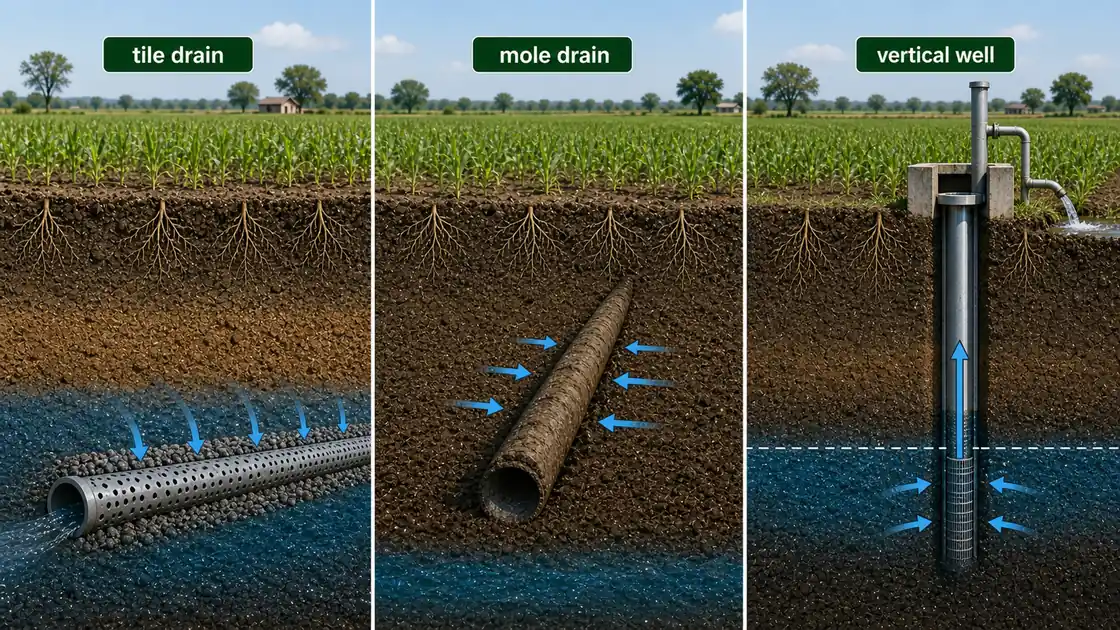
2) Sub-Surface Drainage
The purpose of sub-surface drainage is to lower the ground water table below the root zone. This is necessary when the water table is naturally high or has risen due to excessive irrigation.
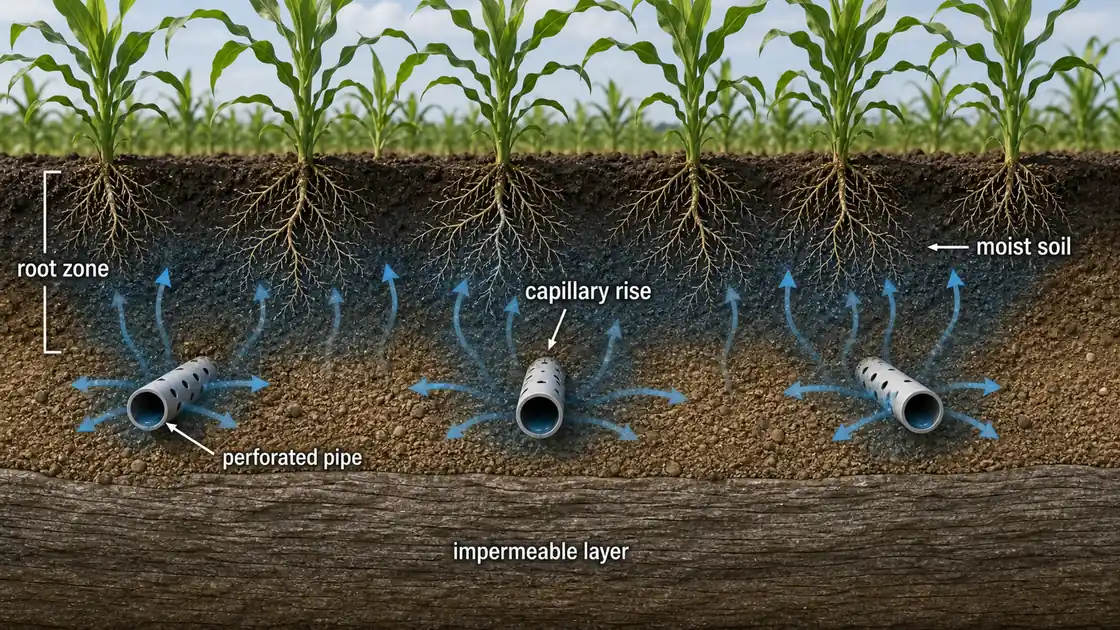
A) Tile Drains / Pipe Drains
- Used where slope is less than 2 per cent
- Includes perforated PVC pipes placed at 0.3 m below the desired highest level of the water table
- Minimum recommended tile size: 10 to 15 cm
- Laterals collect water from soil and drain into sub-main then main then outlet
- Tiles made with burnt clay and concrete, strong enough to withstand pressure and resist erosive action of chemicals in soil water
- Tile drains are the most common form of subsurface drainage used worldwide (exams-2022)
Tile Drain Layout Patterns
| Layout | Description | Best For |
|---|---|---|
| Natural / Random | Tiles laid in irregular patterns connecting wet spots to outlet | Isolated wet areas |
| Gridiron | Laterals enter main drain from one side only (like teeth of a comb) | Uniform rectangular fields |
| Herringbone | Laterals on both sides of mains (resembles fish skeleton) | Most common and effective layout |
| Double main | Two parallel main drains | Wide flat areas where single main is insufficient |
| Cut-off / Interceptor | Intercepts seepage moving down a slope; placed at upper boundary of wet area | When water source is from hilly land |
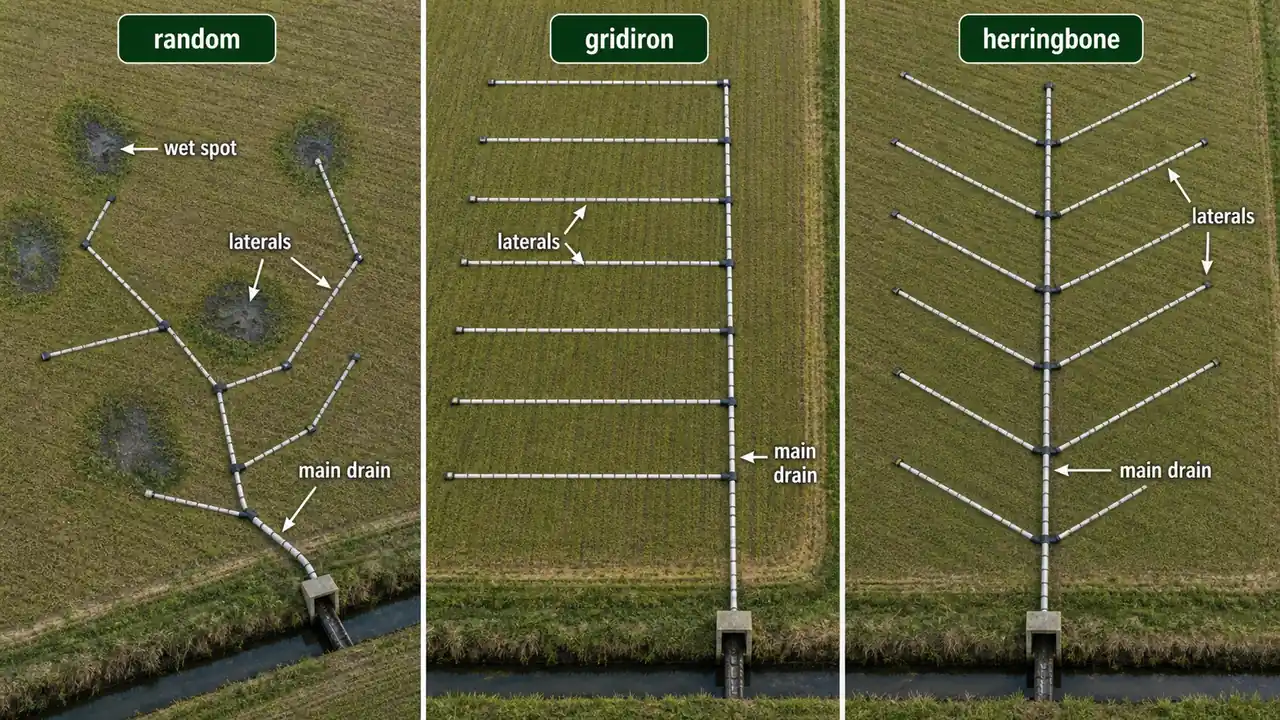
Agricultural example: In the Indira Gandhi Canal command area of Rajasthan, herringbone tile drains lowered the water table from 1 m to 3 m depth, reclaiming thousands of hectares of salt-affected land for wheat and mustard cultivation.
TIP
Exam mnemonic -- "HERRING = HERe, RIght and left, IN Goes water." The herringbone pattern has laterals on BOTH sides, unlike gridiron (one side only).
B) Mole Drains
A mole is an egg-shaped drain made in clay soil using a Mole plough (a long blade-like shank with a cylindrical bullet-nosed plug). These are pipe-less drains -- unlined circular earthen channels formed within the soil.
| Parameter | Specification |
|---|---|
| Depth | 45-120 cm |
| Spacing | 2-5 metres (closer than tile drains) |
| Lifespan | 10-15 years (must be renewed) |
| Best suited soil | Stable clayey soils |
| Not suitable for | Loose soils (channels collapse); heavy plastic soils (mole seals soil) |
| Primary purpose | Rapid removal of excess surface water (not controlling water table) |
| Outlet | Discharges into an open ditch; last portion should be provided with pipe |

Agricultural example: In the heavy clay soils (vertisols) of Madhya Pradesh, mole drains created using tractor-drawn mole ploughs enable soybean cultivation during kharif by rapidly removing surface water after heavy rains.
C) Vertical Drainage / Drainage Wells
Drainage by wells is called vertical drainage -- the disposal of drainage water through wells into porous layers of earth (e.g. river beds). A tube well drainage system consists of a network of tube wells to lower the water table, including provisions for pumps and surface drains for excess water disposal. Used in areas with high soil permeability and preferably fresh groundwater that can be reused for irrigation.
Agricultural example: In SCARP (Salinity Control and Reclamation Project) areas of Pakistan and similar projects in Haryana, tube well drainage pumps out groundwater to lower the water table while simultaneously providing irrigation water.

D) Deep Open Drainage
Deep open drains collect water by seepage from the field. They function as both surface and subsurface drains, effectively lowering the water table in the surrounding area.
E) Buried Drainage
The draining channel is made below the ground surface. After construction, drains are filled with tiles, fibres, or plastics. This method combines the benefits of subsurface drainage with minimal land surface disruption.
F) Combination of Tile and Open Drains
Often the most practical approach -- uses open drains as main collectors and tile drains as laterals, combining the advantages of both systems for effective and economical drainage.
Comparison of Sub-Surface Drainage Methods
| Method | Principle | Best Soil | Lifespan | Cost | Key Feature |
|---|---|---|---|---|---|
| Tile / Pipe drains | Perforated pipes collect water | All soils (< 2% slope) | Long (permanent) | High initial | Most common sub-surface method |
| Mole drains | Unlined earthen channels (egg-shaped) | Stable clay soils only | 10-15 years | Low | Pipe-less; made by mole plough |
| Vertical / Wells | Tube wells lower water table | High permeability soils | Continuous (with maintenance) | Very high | Pumped water can be reused for irrigation |
| Deep open drains | Seepage collection | Various | Long | Moderate | Dual surface + sub-surface function |
| Buried drains | Below-ground channels filled with filter material | Various | Long | Moderate | Minimal surface disruption |
| Combination | Open mains + tile laterals | Various | Long | Moderate-High | Most practical and economical |
Summary Table
| Topic | Key Point |
|---|---|
| Agricultural drainage | Removal of excess free/gravitational water from farm land |
| Waterlogging causes | Natural (poor subsoil drainage, floods) + Artificial (over-irrigation, unlined canals, blocked drainage) |
| O₂ diffusion in waterlogged soil | 10,000 times slower than in well-drained soil |
| Redox potential (waterlogged) | -400 mV (strongly reducing, toxic compounds form) |
| Mn toxicity | Affects low-tolerance species like Lucerne |
| Drainage coefficient (DC) | Depth of water (cm) drained in 24 hours; 1 ha-cm/24 hr = 1.157 lps |
| DC range (open ditches) | 0.6 to 2.5 cm |
| Surface drainage types | Lift, Gravity, Field surface, Ditch |
| BBF dimensions | Beds 120-150 cm, furrows 45 cm, raised 15 cm, slope 0.5% |
| BBF best crop/soil | Groundnut in clay soil (vertisols) |
| Flat area drainage | Slope < 2%; bedding, parallel ditch, BBF |
| Sloping area drainage | Slope > 2%; cross-slope interception; side slope minimum 10:1 |
| Tile drains | Most common sub-surface method; perforated PVC at 0.3 m below water table; size 10-15 cm |
| Herringbone | Laterals on both sides of main (fish skeleton pattern); most common tile layout |
| Gridiron | Laterals on one side only (comb pattern) |
| Mole drains | Egg-shaped, pipe-less; mole plough; depth 45-120 cm; spacing 2-5 m; clay soils only; last 10-15 years |
| Vertical drainage | Tube wells lower water table; pumped water can be reused for irrigation |
| Parallel field ditch | Most effective system; min depth 0.2 m; min area 0.5 m² |
Summary Cheat Sheet
| Concept / Topic | Key Details |
|---|---|
| Agricultural drainage | Removal of excess free/gravitational water from farm land |
| O₂ diffusion in waterlogged soil | 10,000 times slower than well-drained soil |
| Redox potential (waterlogged) | -400 mV (strongly reducing; toxic compounds form) |
| Drainage coefficient range | 0.6 to 2.5 cm (open ditches) |
| 1 ha-cm/24 hr | = 1.157 lps |
| BBF dimensions | Beds 120-150 cm, furrows 45 cm, raised 15 cm, slope 0.5% |
| BBF best for | Groundnut in clay soil (vertisols) |
| Tile drains | Most common sub-surface; perforated PVC; 0.3 m below water table |
| Herringbone layout | Laterals on both sides of main (fish skeleton); most common |
| Gridiron layout | Laterals on one side only (comb pattern) |
| Mole drains | Egg-shaped, pipe-less; clay soils only; last 10-15 years |
| Vertical drainage | Tube wells lower water table; pumped water reused for irrigation |
| Flat area drainage | Slope < 2%; bedding, parallel ditch, BBF |
| Sloping area drainage | Slope > 2%; cross-slope interception |
| Mn toxicity | Affects low-tolerance species like Lucerne |
| Combination system | Open mains + tile laterals — most practical and economical |
TIP
Next chapter: The next section covers Dryland Agriculture -- farming without irrigation, where the entire focus shifts from managing water supply to conserving every drop of rain that falls.