🧩 Irrigation Water Measurement -- Devices, Methods, and Calculations
Complete guide to irrigation water measurement methods including volumetric, velocity-area (float, water meters), measuring structures (orifices, weirs, Parshall flume), and tracer methods with formulas and exam-focused tips.
You Cannot Manage What You Cannot Measure
In the previous lesson, we assessed irrigation water quality -- salinity, sodicity, and ion toxicity. Once we know the water is suitable, the next practical question is: how do we measure how much water we are actually delivering to the field?
A canal officer in the Bhakra command area of Haryana needs to ensure that each farmer in his distributary receives a fair share of water. Without accurate measurement, upstream farmers take excess water while tail-end farmers face chronic shortages. He installs a Parshall flume at the head of each minor canal -- now he can read the water level on a simple gauge and instantly know the discharge. This single intervention improves water equity across 500 hectares. Irrigation water measurement is the foundation of efficient water distribution, fair allocation, and scientific scheduling.
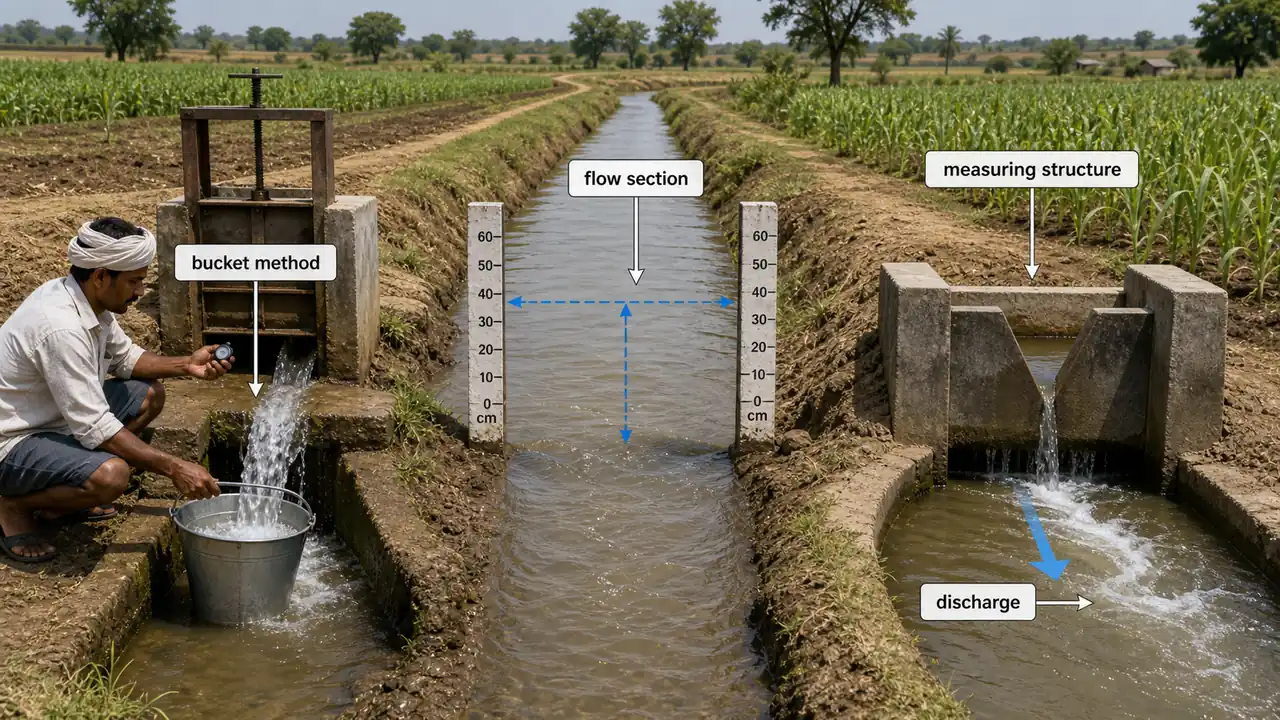
Why Measure Irrigation Water?
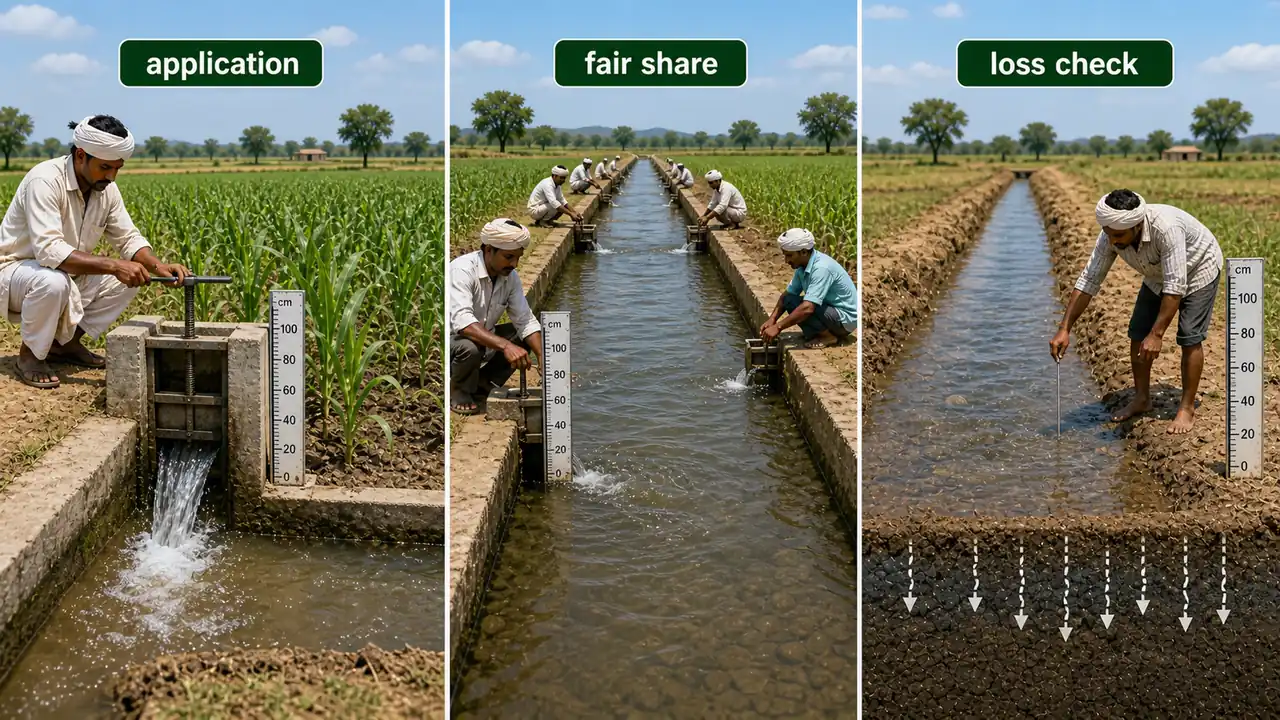
| Purpose | Agricultural Example |
|---|---|
| Control application rates -- avoid over/under-irrigation | Wheat farmer applies exactly 6 cm per irrigation instead of guessing |
| Improve efficiency -- identify and reduce losses | Canal engineers detect 30% seepage loss in an unlined stretch |
| Fair distribution -- equitable allocation among users | Warabandi system in Punjab relies on measured flow rates |
| Water billing -- charge based on actual consumption | Tube well cooperatives in Gujarat bill per cubic metre |
| Research -- determine crop water requirements | ICAR stations use lysimeters and flow meters for IW/CPE studies |
Four Categories of Measurement Methods
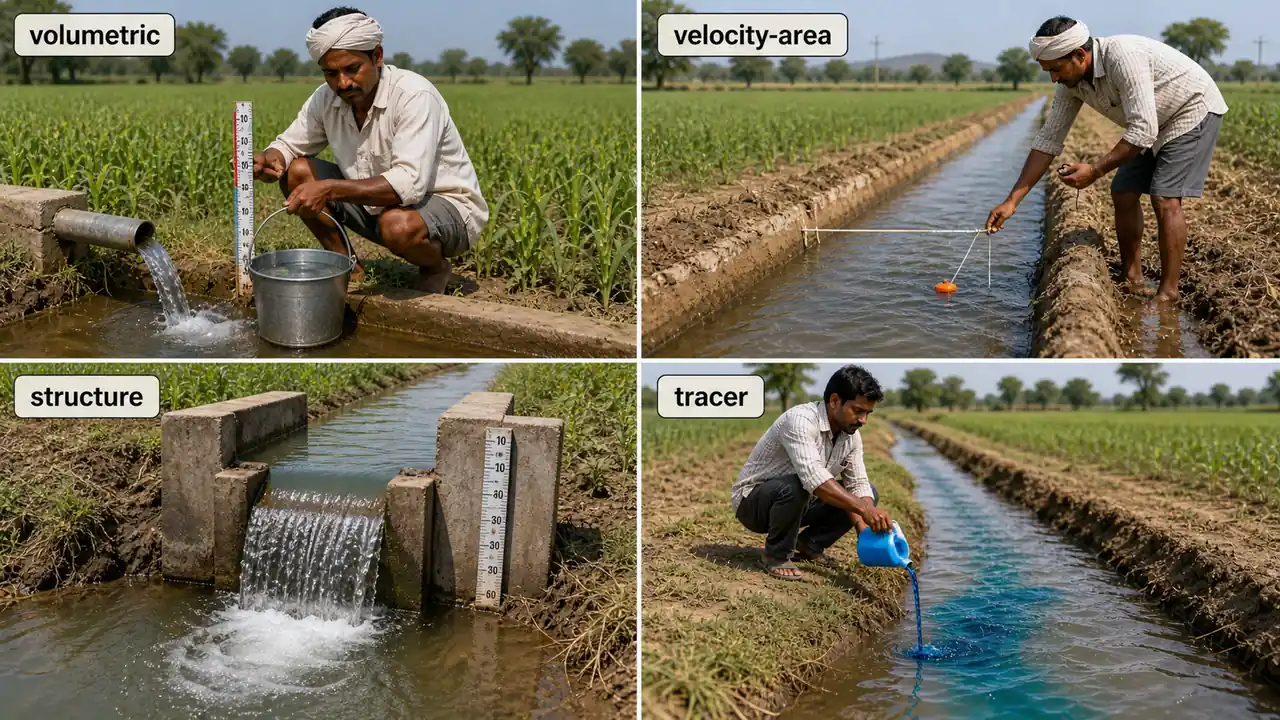
| Category | Principle | Methods | Best For |
|---|---|---|---|
| Volumetric | Collect flow in a known container; time it | Bucket/barrel method | Small streams (well discharge, tube well) |
| Velocity-Area | Q = A x V (discharge = area x velocity) | Float method, Water meters | Open channels, pipe flows |
| Measuring Structures | Fixed structures creating known hydraulic conditions | Orifices, Weirs, Flumes | Canal systems, permanent installations |
| Tracer | Measure dilution of a known substance | Salt, dye, radioactive isotopes | Irregular channels, no fixed structures needed |
TIP
Pro Content Locked
Upgrade to Pro to access this lesson and all other premium content.
Charged once for one year · ₹1188 total
Save ₹100/month vs ₹2388/year launch price
- All Agriculture & Banking Courses
- AI Lesson Questions (100/day)
- AI Doubt Solver (50/day)
- Glows & Grows Feedback (30/day)
- AI Section Quiz (20/day)
- 22-Language Translation (100/day)
- Recall Questions (20/day)
- AI Quiz (15/day)
- AI Quiz Paper Analysis (100/day)
- AI Step-by-Step Explanations (100/day)
- Spaced Repetition Recall (FSRS)
- AI Tutor
- Immersive Text Questions
- Audio Lessons — Hindi & English
- Mock Tests & Previous Year Papers
- Summary & Mind Maps
- XP, Levels, Leaderboard & Badges
- Generate New Classrooms
- Voice AI Teacher (AgriDots Live)
- AI Revision Assistant
- Knowledge Gap Analysis
- Interactive Revision (LangGraph)
🔒 Secure one-time yearly payment via Razorpay · No hidden fees
You Cannot Manage What You Cannot Measure
In the previous lesson, we assessed irrigation water quality -- salinity, sodicity, and ion toxicity. Once we know the water is suitable, the next practical question is: how do we measure how much water we are actually delivering to the field?
A canal officer in the Bhakra command area of Haryana needs to ensure that each farmer in his distributary receives a fair share of water. Without accurate measurement, upstream farmers take excess water while tail-end farmers face chronic shortages. He installs a Parshall flume at the head of each minor canal -- now he can read the water level on a simple gauge and instantly know the discharge. This single intervention improves water equity across 500 hectares. Irrigation water measurement is the foundation of efficient water distribution, fair allocation, and scientific scheduling.
Why Measure Irrigation Water?
| Purpose | Agricultural Example |
|---|---|
| Control application rates -- avoid over/under-irrigation | Wheat farmer applies exactly 6 cm per irrigation instead of guessing |
| Improve efficiency -- identify and reduce losses | Canal engineers detect 30% seepage loss in an unlined stretch |
| Fair distribution -- equitable allocation among users | Warabandi system in Punjab relies on measured flow rates |
| Water billing -- charge based on actual consumption | Tube well cooperatives in Gujarat bill per cubic metre |
| Research -- determine crop water requirements | ICAR stations use lysimeters and flow meters for IW/CPE studies |
Four Categories of Measurement Methods
| Category | Principle | Methods | Best For |
|---|---|---|---|
| Volumetric | Collect flow in a known container; time it | Bucket/barrel method | Small streams (well discharge, tube well) |
| Velocity-Area | Q = A x V (discharge = area x velocity) | Float method, Water meters | Open channels, pipe flows |
| Measuring Structures | Fixed structures creating known hydraulic conditions | Orifices, Weirs, Flumes | Canal systems, permanent installations |
| Tracer | Measure dilution of a known substance | Salt, dye, radioactive isotopes | Irregular channels, no fixed structures needed |
TIP
Exam mnemonic -- "VVMT" = Volumetric (container), Velocity-area (Q=AV), Measuring structures (weirs/flumes), Tracer (dilution). These are the four categories of irrigation water measurement.
1) Volumetric Method (Using a Container)
The simplest method for measuring a small irrigation stream. The flow is collected in a container of known volume for a measured period.
- An ordinary bucket or barrel is used as the container
- Time to fill is recorded with a stopwatch or wristwatch
- Suitable for small flows such as well discharges and tube well outlets
Formula:
Discharge (Q) = Volume of container / Time to fill
Agricultural example: A farmer with a Persian wheel (rahat) wants to know his water supply rate. He places a 24-litre bucket under the discharge and times how long it takes to fill.
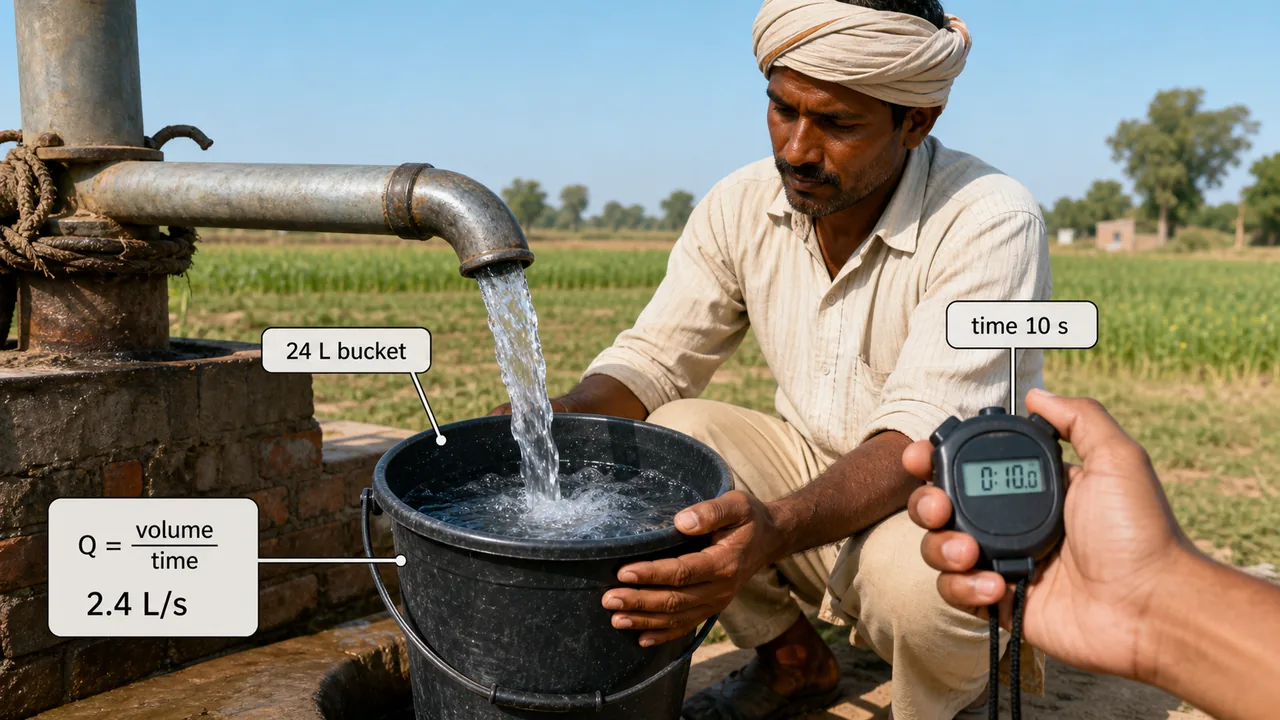
Solved Problem
A 24-litre capacity bucket is filled in 10 seconds by discharge from a Persian wheel. What is the rate of flow?
Solution:
- Q = 24 litres / 10 seconds = 2.4 litres/second = 144 litres/minute
This tells the farmer he is getting 2.4 lps, which he can use to calculate how long he needs to irrigate his field to apply a desired depth of water.
2) Velocity-Area Method
Based on the principle that discharge (Q) equals the cross-sectional area (A) of the flow multiplied by the velocity (V) of the water. Widely used for measuring flow in open channels and streams.
Q = A x V
Where:
- Q: Discharge rate (m³/sec)
- A: Cross-sectional area of channel (m²)
- V: Velocity of flow (m/s)
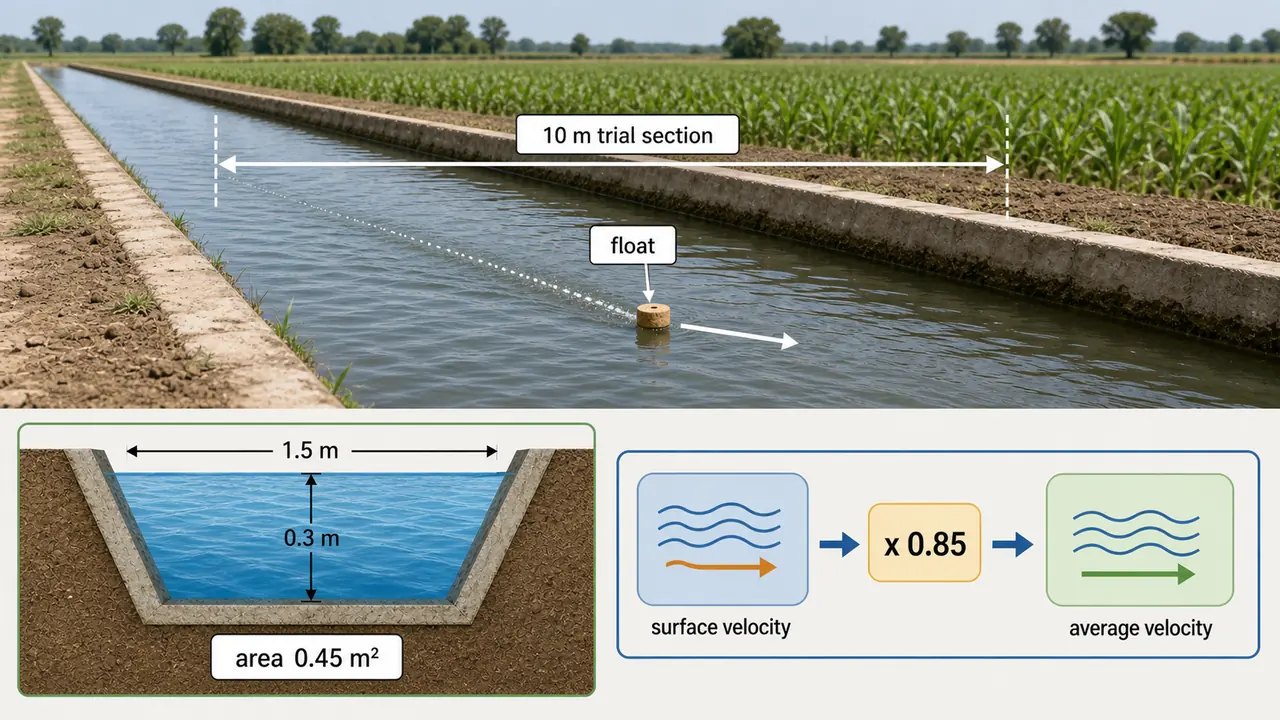
(a) Float Method
To determine the velocity of water at the surface of a channel:
- Measure a known trial section length along the channel
- Drop a float (piece of wood, cork, or bottle) and time its passage through the trial section
- Surface velocity = Length / Time
Important correction: Surface velocity is greater than average velocity of the stream because water flows faster at the surface than near the channel bed and sides. A correction factor of 0.85 is applied:
Average velocity = Surface velocity x 0.85
Then: Q = A x V (corrected)
Agricultural example: An irrigation officer measures a field channel in Bihar. The channel is 1.5 m wide and 0.3 m deep (A = 0.45 m²). A float travels 10 m in 8 seconds (surface velocity = 1.25 m/s). Average velocity = 1.25 x 0.85 = 1.06 m/s. Discharge Q = 0.45 x 1.06 = 0.48 m³/s = 480 litres/second.
TIP
Exam tip: The float correction factor is 0.85 (not 0.80 or 0.90). Surface velocity is always higher than average velocity because of friction at bed and sides. Remember "Float = Fast at surface, 0.85 corrects it."
(b) Water Meters
Water meters use a multi-blade propeller (metal, plastic, or rubber) rotating in a vertical or horizontal plane, geared to a totalizer that counts flow in desired volumetric units.
Requirements for accurate operation:
- The pipe must flow full at all times
- The rate of flow must exceed the minimum for the rated range
- No debris or foreign materials should obstruct the propeller
- Factory-calibrated; field adjustments usually not required
When installed in open channels, flow must be brought through pipes of known cross-sectional area.
Agricultural example: A tube well cooperative in Gujarat installs water meters on each member's outlet pipe. Monthly readings allow fair billing based on actual water consumed, encouraging conservation. Farmers using meters reduce water consumption by 15-20% compared to unmetered neighbours.
| Advantages | Disadvantages |
|---|---|
| Convenient for total volume measurement | Needs full pipe flow |
| Useful for water billing and efficiency monitoring | Propeller can be blocked by debris |
| Factory calibrated -- no field adjustment | Not suitable for open channel without pipe |

3) Water Measuring Structures / Devices
Fixed structures installed in channels that create a known hydraulic condition, allowing discharge to be calculated from simple depth measurements (head readings).
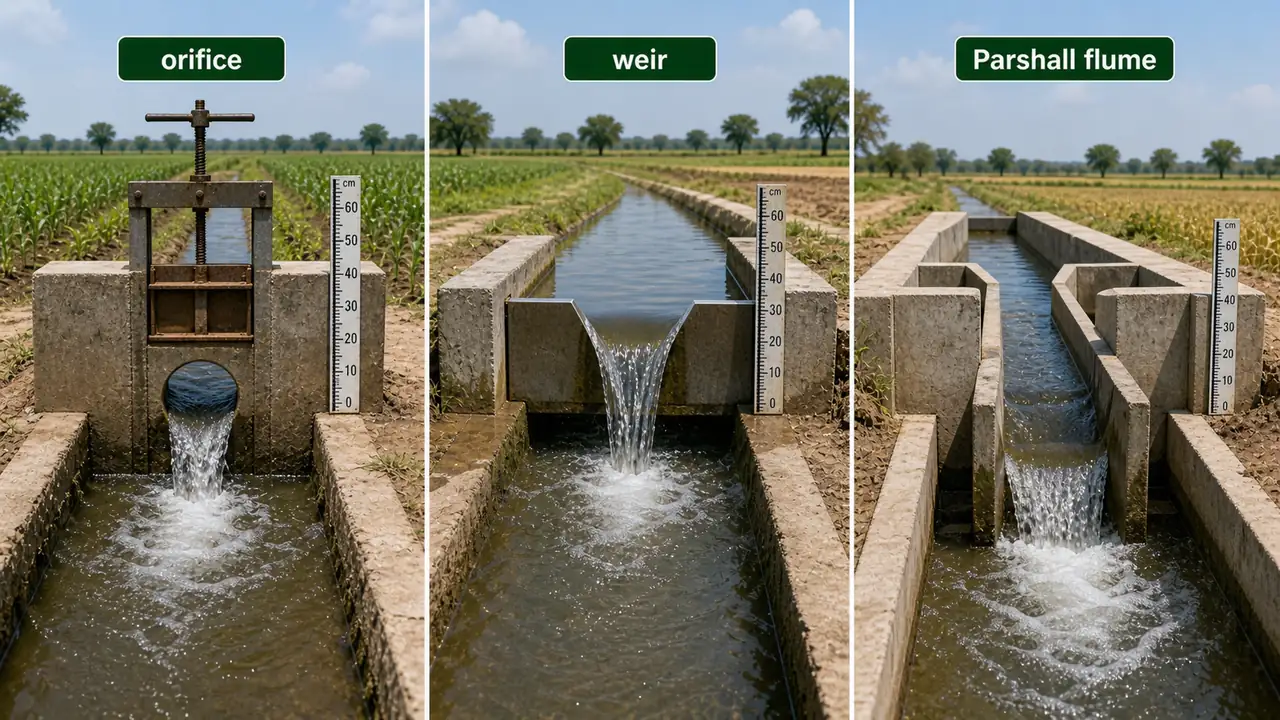
Orifices
- Circular or rectangular openings in a vertical bulkhead through which water flows
- Edges are sharp, often constructed of metal
- Cross-sectional area of orifice is small relative to stream cross-section
- May operate under free flow (downstream level below opening) or submerged flow (downstream level above opening)
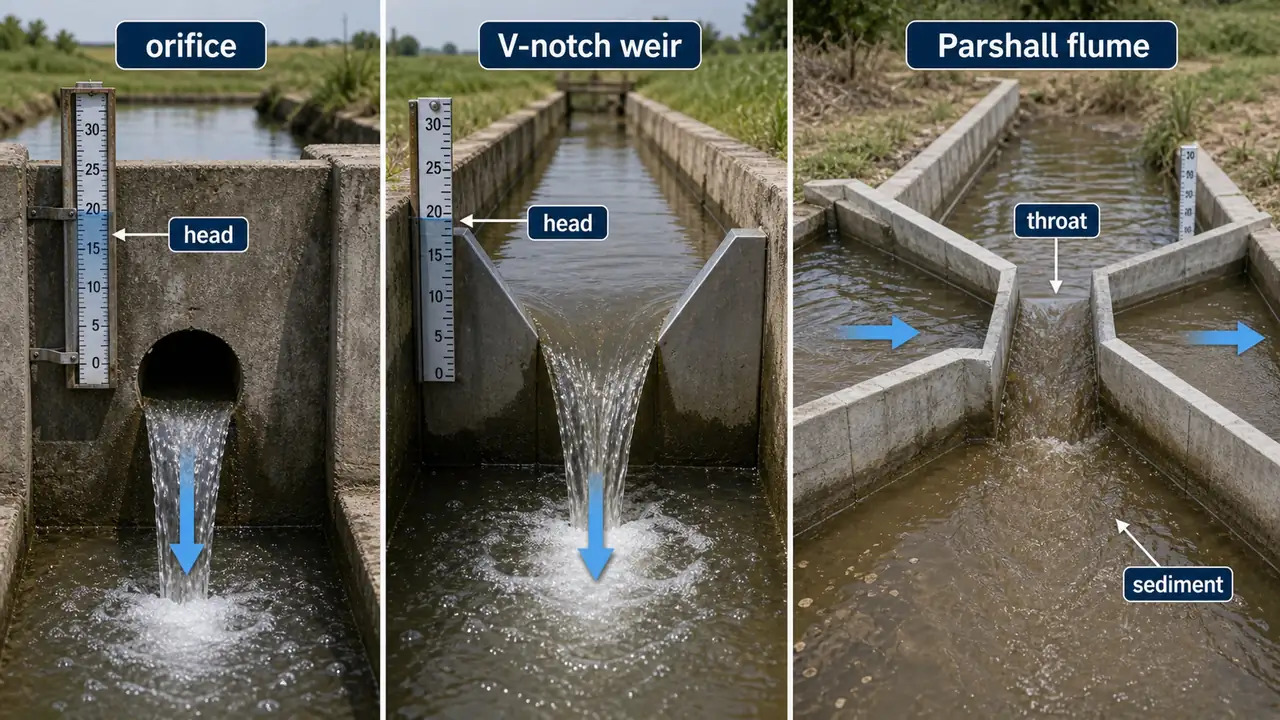
Agricultural example: In the Warabandi system of north India, orifices (called "mogha" or "nakka") are installed at canal outlets to deliver a measured flow to each farmer's watercourse.
Weirs
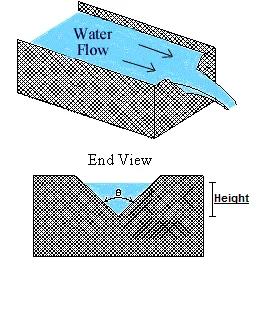
A weir is a notch in a wall built across a stream, used to measure flow in an irrigation channel or the discharge of a well or canal outlet. Weirs are among the most reliable and widely used flow measurement structures.
Types of Weirs
| Weir Type | Shape | Best For | Agricultural Example |
|---|---|---|---|
| Rectangular | Rectangular notch | Measuring uniform flow of water | Canal distributary in stable-flow conditions |
| Trapezoidal | Trapezoidal notch | Measuring uniform flow | Large canal outlets with steady discharge |
| 90° V-notch (Triangular) | V-shaped notch | Highly variable flow and greater accuracy; small and medium streams | Farm well discharge that varies with pump speed |
| Parabolic | Parabolic notch | Highly variable flow with greater accuracy | Research station flow measurement |
TIP
Exam tip: For uniform flow -- use Rectangular or Trapezoidal weir. For variable flow and greater accuracy -- use Triangular (V-notch) or Parabolic weir. Remember "RT for Regular, TP for Tricky/variable."
Additional weir types for canal measurement:
- Broad-crested weir -- used in canal systems
- Cut-throat weir -- simplified design for field use
Parshall Flume (Venturi Flume)
The most common water flow measuring device for open conduits.
| Feature | Detail |
|---|---|
| Principle | Measures loss in head caused by forcing water through a throat (converging section) with a depressed bottom |
| Accuracy | Within 5 per cent |
| Throat width range | 3 inches to 10 feet |
| Discharge range | 1/30 to 200 cusecs |
| Common field sizes | 3, 6, and 9 inch throat width |
| Key advantage | Handles sediment-laden water without clogging (unlike weirs where sediment accumulates upstream) |
| Head loss | Very small -- energy efficient |

Agricultural example: In the Chambal command area of Rajasthan, Parshall flumes installed at minor canal heads measure discharge accurately even when the canal carries sediment after monsoon flows -- a situation where weirs would become unreliable due to sediment buildup.
TIP
Exam tip: Parshall flume is the most common flow measuring device for open channels. Its key advantage over weirs is handling sediment-laden water. Remember "Parshall = Popular, handles Particles (sediment)."
Cut-Throat Flumes
- Developed as a simplified alternative to Parshall flumes
- Have no throat section (zero throat) -- hence the name "cut-throat"
- Simpler to construct and install compared to Parshall flumes
- Used for field-level water measurement
Comparison of Measuring Structures
| Structure | Best For | Sediment Handling | Accuracy | Cost |
|---|---|---|---|---|
| Orifice | Small, controlled outlets | Poor (can clog) | Good | Low |
| Rectangular/Trapezoidal weir | Uniform, steady flow | Poor (sediment accumulates) | High | Moderate |
| V-notch (90°) weir | Variable flow, small-medium streams | Poor | Very high (especially at low flows) | Moderate |
| Parshall flume | Open conduits, sediment-laden water | Excellent | Good (within 5%) | Higher |
| Cut-throat flume | Field-level, simplified measurement | Good | Good | Lower than Parshall |
4) Tracer Methods
Independent of stream cross-section and suitable for field measurements without installing fixed structures. Particularly useful in irregular or difficult-to-access channels.
How it works:
- A substance (tracer) in concentrated form is introduced into flowing water
- The tracer mixes thoroughly with the stream
- The concentration of tracer is measured at a downstream section
- Only the quantity of water needed for dilution is involved -- no need to measure velocity, depth, head, cross-section, or any other hydraulic factor
Common tracers:
- Salt (NaCl) -- measured by electrical conductivity
- Fluorescent dyes -- measured by fluorimeter
- Radioactive isotopes -- measured by radiation counter
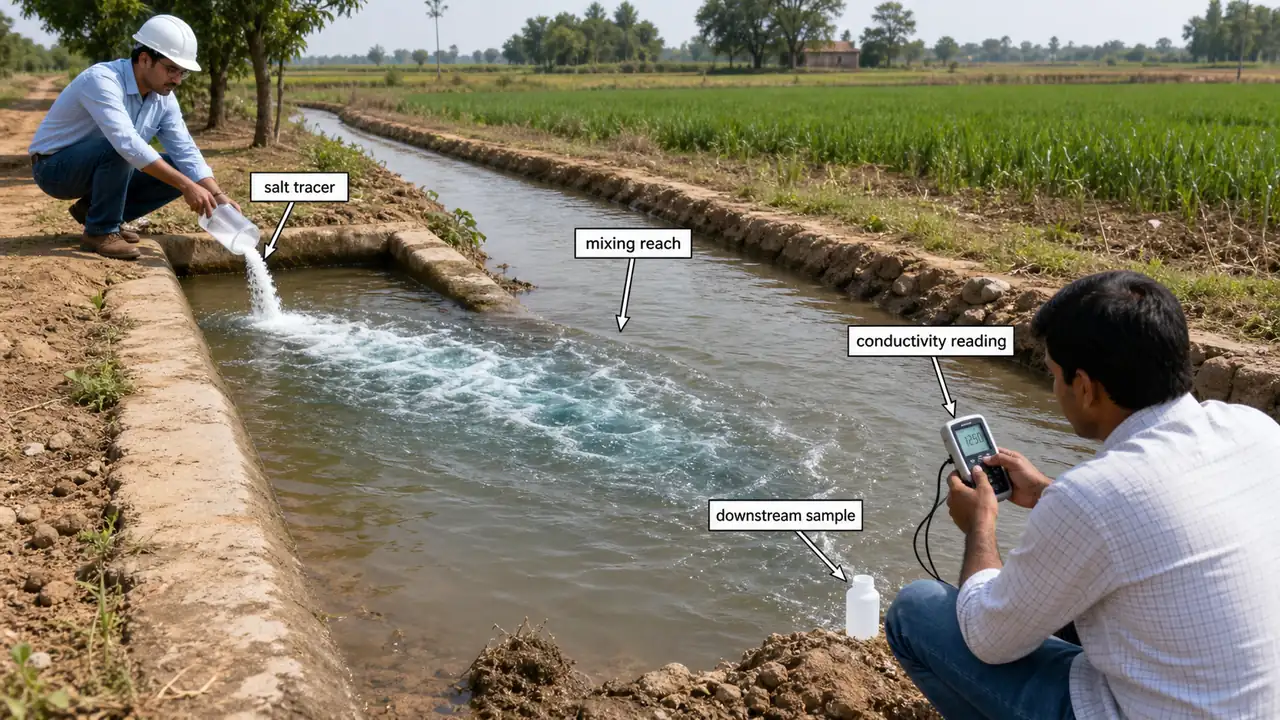
Agricultural example: In a rocky mountain stream feeding terraced rice fields in Uttarakhand, the irregular channel shape makes weirs and flumes impractical. An engineer dissolves a known amount of salt, measures the downstream conductivity, and calculates the stream discharge accurately.
The Irrigation Depth-Area-Time Formula
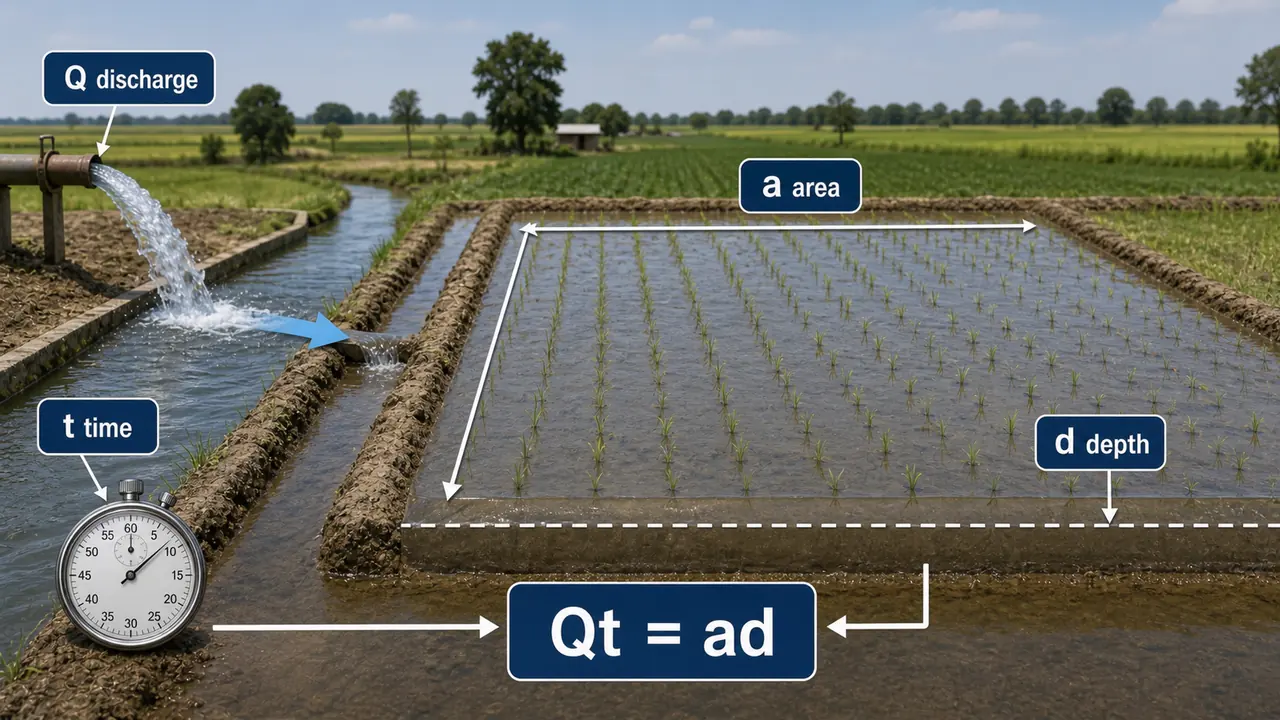
The relationship between stream size, time of application, area irrigated, and depth of water applied:
Qt = ad
Where:
- Q: Size of stream or discharge (litres/second or ha-cm/hour)
- t: Time of application of water (seconds or hours)
- a: Area to be irrigated (m² or hectares)
- d: Depth of water to be applied (cm)
This formula is a practical tool -- if you know any three of the four variables, you can calculate the fourth.
Solved Example
A farmer has a tube well discharge of 10 litres/second and wants to apply 6 cm of water to a 0.5 hectare field. How long should he irrigate?
Solution:
- Q = 10 lps = 0.36 ha-cm/hour (since 1 lps = 0.036 ha-cm/hr)
- a = 0.5 ha, d = 6 cm
- Qt = ad → t = ad/Q = (0.5 x 6) / 0.36 = 8.33 hours
The farmer needs to run his tube well for approximately 8 hours and 20 minutes to apply 6 cm of water to 0.5 hectare.
TIP
Exam tip: The formula Qt = ad is frequently tested. Remember it as "Quantity x Time = Area x Depth" -- all four variables are interconnected.
Summary Table
| Topic | Key Point |
|---|---|
| Four measurement categories | Volumetric, Velocity-area, Measuring structures, Tracer |
| Volumetric method | Simplest; fill a container and time it; for small streams |
| Velocity-area formula | Q = A x V (discharge = area x velocity) |
| Float correction factor | 0.85 (surface velocity > average velocity) |
| Water meters | Multi-blade propeller + totalizer; pipe must flow full; factory calibrated |
| Orifice | Circular/rectangular opening; free flow or submerged flow |
| Rectangular/Trapezoidal weir | For uniform flow measurement |
| V-notch (90°) weir | For variable flow and greater accuracy; small-medium streams |
| Parshall flume | Most common open-channel measuring device; handles sediment; accuracy within 5% |
| Parshall flume sizes (field) | 3, 6, and 9 inch throat width |
| Cut-throat flume | Zero throat; simpler than Parshall; easier to construct |
| Tracer method | Independent of stream cross-section; uses salt, dye, or isotopes; no fixed structure needed |
| Irrigation formula | Qt = ad (discharge x time = area x depth) |
| 1 ha-cm in 24 hours | = 1.157 lps |
Summary Cheat Sheet
| Concept / Topic | Key Details |
|---|---|
| Four measurement categories | Volumetric, Velocity-area, Measuring structures, Tracer |
| Volumetric | Simplest; fill container and time it; for small streams |
| Velocity-area formula | Q = A × V (discharge = area × velocity) |
| Float correction factor | 0.85 (surface > average velocity) |
| Parshall flume | Most common open-channel device; handles sediment; 5% accuracy |
| Parshall flume sizes | 3, 6, 9 inch throat width (field) |
| Cut-throat flume | Zero throat; simpler than Parshall |
| V-notch (90°) weir | For variable flow; greater accuracy; small-medium streams |
| Rectangular weir | For uniform flow |
| Tracer method | Independent of cross-section; uses salt, dye, isotopes |
| Irrigation formula | Qt = ad (discharge × time = area × depth) |
| 1 ha-cm in 24 hours | = 1.157 lps |
| Water meters | Multi-blade propeller + totalizer; pipe must flow full |
| Orifice | Circular/rectangular opening; free or submerged flow |
TIP
Next: Lesson 08 covers Agricultural Drainage -- the flip side of irrigation. When there is too much water, drainage systems (surface, tile, mole, vertical) remove the excess to protect crops and soil.