🧪 Irrigation Water Quality: Salinity, Sodicity, Ion Toxicity, and Reclamation
Complete guide to assessing irrigation water quality through EC, SAR, RSC, boron hazard, and specific ion toxicity. Classification tables, reclamation methods for saline and sodic soils, and exam-focused mnemonics for competitive exams.
When Good Water Goes Bad
In the previous lesson, we covered irrigation methods -- from surface flooding to precision drip. But even the best irrigation method fails if the water itself is poor quality. This lesson examines how to assess whether irrigation water is safe for crops and soil.
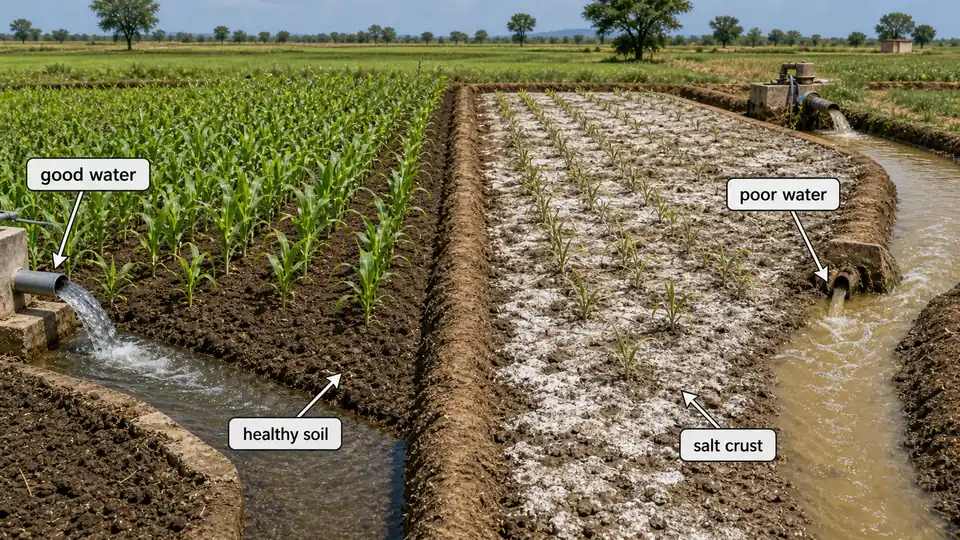
A farmer in Haryana irrigates wheat with tube-well water year after year. The first few seasons, yields are excellent. Gradually, white salt crusts appear on the soil surface, the crop thins out, and the once-fertile field becomes progressively unproductive. The culprit? Poor-quality irrigation water with high sodium and salts that accumulated in the soil over time. By the time the damage is visible, the soil may need years of reclamation. Understanding water quality before using it for irrigation can prevent such irreversible damage -- and this chapter covers exactly how to assess, classify, and manage irrigation water quality.
What is Irrigation Water Quality?
Irrigation water quality refers to the kind and amount of salts present in water and their effects on crop growth and soil.
Pro Content Locked
Upgrade to Pro to access this lesson and all other premium content.
Charged once for one year · ₹1188 total
Save ₹100/month vs ₹2388/year launch price
- All Agriculture & Banking Courses
- AI Lesson Questions (100/day)
- AI Doubt Solver (50/day)
- Glows & Grows Feedback (30/day)
- AI Section Quiz (20/day)
- 22-Language Translation (100/day)
- Recall Questions (20/day)
- AI Quiz (15/day)
- AI Quiz Paper Analysis (100/day)
- AI Step-by-Step Explanations (100/day)
- Spaced Repetition Recall (FSRS)
- AI Tutor
- Immersive Text Questions
- Audio Lessons — Hindi & English
- Mock Tests & Previous Year Papers
- Summary & Mind Maps
- XP, Levels, Leaderboard & Badges
- Generate New Classrooms
- Voice AI Teacher (AgriDots Live)
- AI Revision Assistant
- Knowledge Gap Analysis
- Interactive Revision (LangGraph)
🔒 Secure one-time yearly payment via Razorpay · No hidden fees
When Good Water Goes Bad
In the previous lesson, we covered irrigation methods -- from surface flooding to precision drip. But even the best irrigation method fails if the water itself is poor quality. This lesson examines how to assess whether irrigation water is safe for crops and soil.
A farmer in Haryana irrigates wheat with tube-well water year after year. The first few seasons, yields are excellent. Gradually, white salt crusts appear on the soil surface, the crop thins out, and the once-fertile field becomes progressively unproductive. The culprit? Poor-quality irrigation water with high sodium and salts that accumulated in the soil over time. By the time the damage is visible, the soil may need years of reclamation. Understanding water quality before using it for irrigation can prevent such irreversible damage -- and this chapter covers exactly how to assess, classify, and manage irrigation water quality.
What is Irrigation Water Quality?
Irrigation water quality refers to the kind and amount of salts present in water and their effects on crop growth and soil.
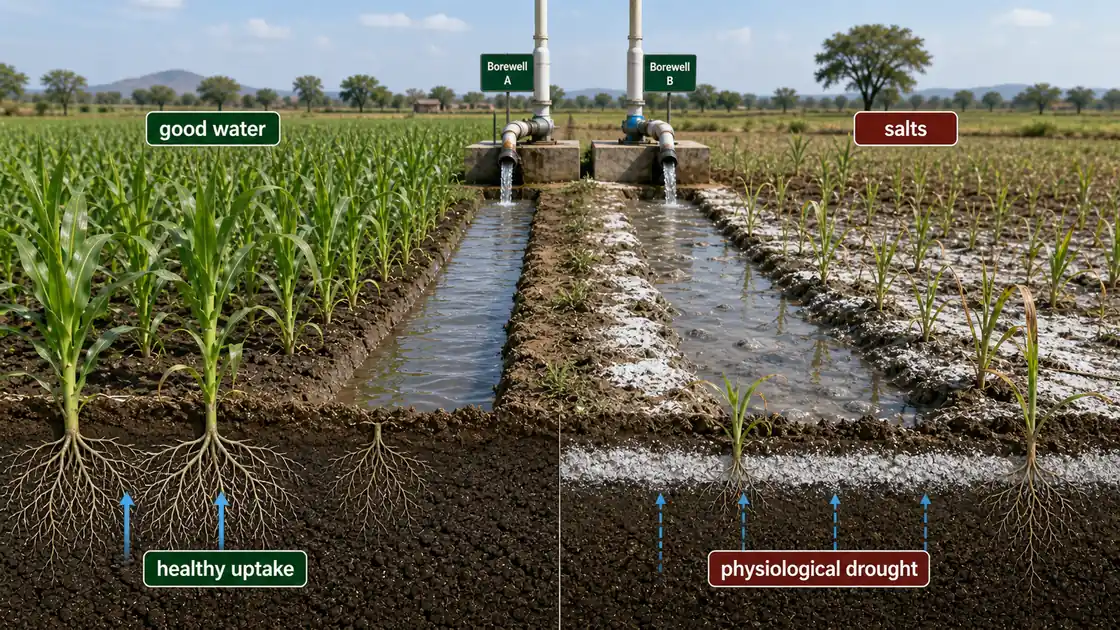
- Water from precipitation or ground sources is never pure -- it picks up atmospheric gases, salts, minerals, and even heavy metals as it moves through soil and rock.
- High salt concentrations affect osmotic pressure of the soil solution, making it difficult for plants to absorb water. Even moist soil can cause physiological drought if salt content is too high.
- Evaluating water quality before irrigation prevents harm to plant productivity and groundwater recharge.
Agricultural example: Two borewells on the same farm in Rajasthan can have completely different water quality. One may have EC of 0.4 (excellent) while the other, just 200 metres away but tapping a different aquifer, may have EC of 4.0 (poor). Testing before use is essential.
Key Parameters for Water Quality Assessment
The following parameters are used to evaluate whether water is safe for irrigation. Each parameter measures a specific type of hazard.
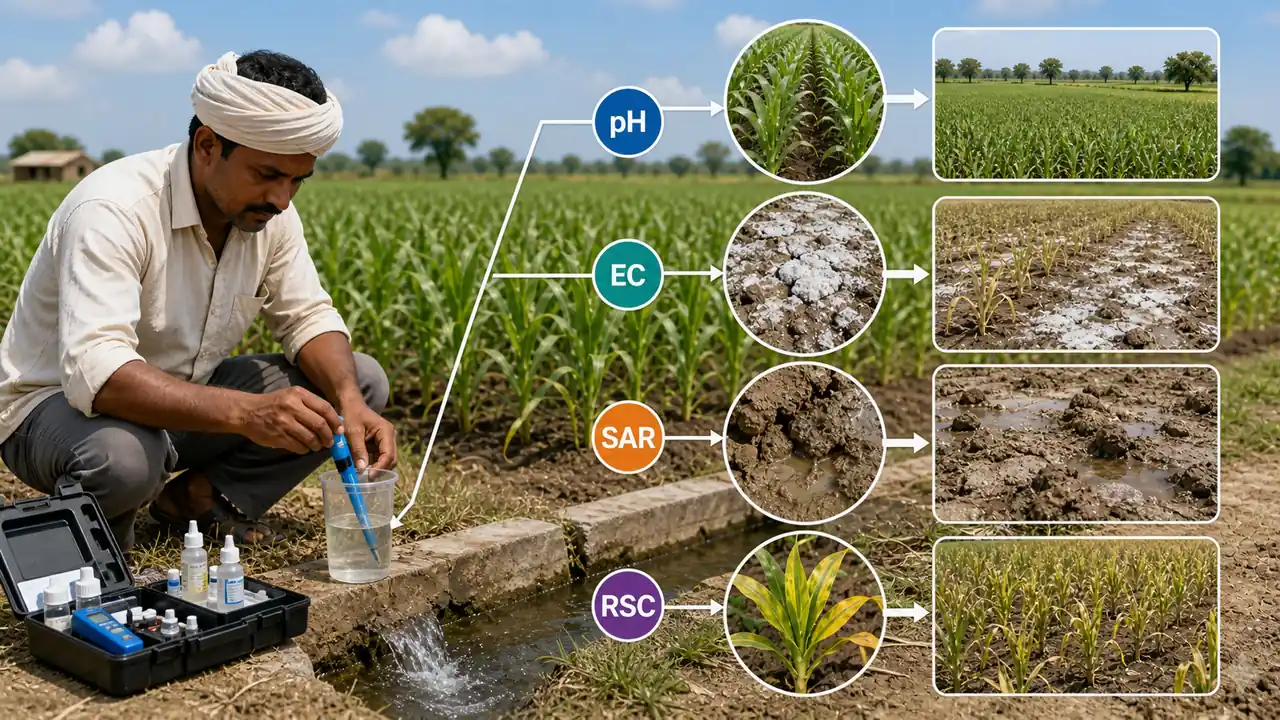
| Parameter | What It Measures | Hazard Type |
|---|---|---|
| pH | Degree of acidity or alkalinity | General suitability |
| EC (Electrical Conductivity) | Total dissolved salts | Salinity hazard |
| SAR (Sodium Adsorption Ratio) | Sodium relative to Ca + Mg | Sodium hazard |
| RSC (Residual Sodium Carbonate) | Excess carbonate over Ca + Mg | Alkalinity hazard |
| PI (Permeability Index) | Effect on soil permeability | Infiltration hazard |
| TH (Total Hardness) | Ca + Mg concentration | Scaling and soil effects |
| Specific ions | Na, Cl, B, F, NO3, Li, Mg | Ion toxicity |
TIP
Exam mnemonic -- "ESRP": The four key parameters to remember: EC (salinity), SAR (sodium), RSC (alkalinity), PH (acidity). These appear in nearly every water quality question.
Classification of Irrigation Water


Water quality is classified using multiple parameters. The USSL (United States Salinity Laboratory) classification system combines EC (salinity hazard, classes C1--C4) with SAR (sodium hazard, classes S1--S4) to give a combined rating like C2-S1 (medium salinity, low sodium). The comprehensive classification below integrates all key parameters.
Comprehensive Water Quality Classification
| Quality | EC (mmhos/cm) | pH | Na (%) | Cl (me/l) | SAR |
|---|---|---|---|---|---|
| Excellent | 0.5 | 6.5--7.5 | 30 | 2.5 | 1.0 |
| Good | 0.5--1.5 | 7.5--8.0 | 30--60 | 2.5--5.0 | 1.0--2.0 |
| Fair | 1.5--3.0 | 8.0--8.5 | 60--75 | 5.0--7.5 | 2.0--4.0 |
| Poor | 3.0--5.0 | 8.5--9.0 | 75--90 | 7.5--10 | 4.0--8.0 |
| Very Poor | 5.0--6.0 | 9.0--10 | 80--90 | 10.0--12.5 | 8.0--15 |
| Unsuitable | > 6.0 | > 10 | > 90 | > 12.5 | > 15 |
TIP
Exam shortcut: Excellent water: EC < 0.5, pH 6.5--7.5, SAR < 1. Unsuitable: EC > 6, pH > 10, SAR > 15. Remember the extremes -- exams love boundary values. SAR measures sodium hazard; EC measures salinity hazard.
Agricultural example: A farmer testing his borewell water finds EC = 2.0 mmhos/cm and SAR = 5.0. This classifies as "Fair" salinity and "Poor" sodium hazard -- he should use gypsum amendment and practice periodic leaching to prevent soil degradation. Without testing, he would not know the sodium problem exists until crop damage appears.
Reclamation of Problem Soils
Different problem soils require different reclamation approaches. The key is to match the method to the specific problem.
| Soil Type | Problem | Reclamation Method | Agricultural Example |
|---|---|---|---|
| Saline soil | Excess soluble salts | Leaching/flushing with good quality water; needs good drainage | Rice cultivation in coastal Andhra Pradesh with canal water flushing |
| Alkali (Sodic) soil | Excess exchangeable sodium | Add amendments: Gypsum (CaSO4), Calcium chloride, Sulphuric acid, Ferrous sulphate, Aluminium sulphate | Gypsum application in sodic soils of UP and Haryana |
| Saline-Alkali soil | Both salts and sodium | First remove exchangeable Na (like alkali), then leach out excess salts | Combined gypsum + leaching in Indo-Gangetic plains |
NOTE
Gypsum is the most commonly used amendment for reclamation of alkali/sodic soils. It replaces Na+ with Ca2+ on the soil exchange complex, improving soil structure and permeability. The reaction: Na-clay + CaSO4 --> Ca-clay + Na2SO4 (which is then leached out).
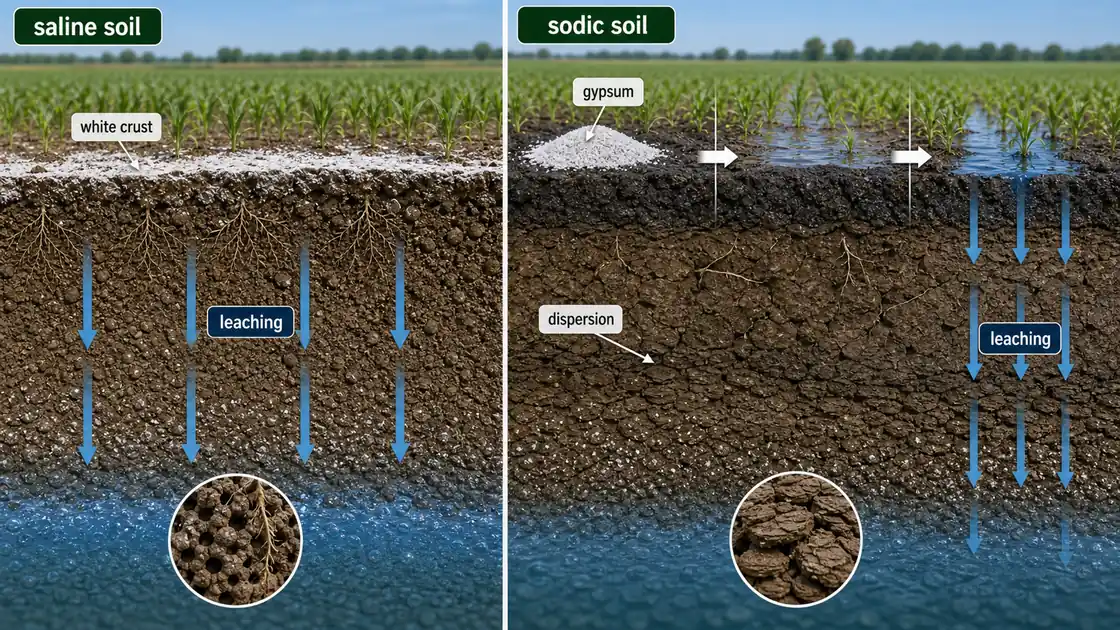
Saline vs Sodic Soil -- Comparison
| Feature | Saline Soil | Sodic (Alkali) Soil |
|---|---|---|
| Problem | Excess soluble salts | Excess exchangeable Na |
| EC | > 4 dS/m | < 4 dS/m |
| pH | < 8.5 | > 8.5 |
| ESP | < 15 | > 15 |
| Surface appearance | White crust ("white alkali") | Black crust ("black alkali") |
| Reclamation | Leaching with good water | Chemical amendment (gypsum) + leaching |
| Soil structure | Generally good | Dispersed and impermeable |
TIP
Exam mnemonic: "White = Wash, Black = Break" -- Saline soil (white crust) can be fixed by washing (leaching). Sodic soil (black crust) needs chemical breaking of Na bonds (gypsum) before washing.
Residual Sodium Carbonate (RSC)
RSC measures the alkalinity hazard of irrigation water. Here is how it develops:
- Carbonate quickly associates with Ca and Mg to form CaCO3 and MgCO3 (which precipitate out).
- When carbonates exceed Ca + Mg, the excess carbonate combines with Na to form Na2CO3 -- this increases sodium proportion and causes sodium hazard called RSC.

- The RSC Index indicates the alkalinity hazard for soil.
- High RSC water causes soil to become sodic -- leading to crusting, poor infiltration, and dispersed soil structure where roots cannot penetrate.
| RSC Value (me/l) | Water Quality | Action Needed |
|---|---|---|
| < 1.25 | Safe | Use freely |
| 1.25 -- 2.50 | Marginal | Use with gypsum amendment |
| > 2.50 | Unsuitable | Do not use without blending |
Agricultural example: In parts of Rajasthan, high RSC groundwater (>5 me/l) has made soils impermeable. Farmers now blend canal water with tube-well water to reduce RSC before irrigating. Some farmers also apply gypsum directly to the soil to counteract the sodium buildup.
Sodium Hazard -- SAR
Sodium destroys soil structure by replacing calcium and magnesium on the soil exchange complex. The result is compact, impermeable soil that restricts root growth and water movement.
- Sodium Adsorption Ratio (SAR) = Na / sqrt((Ca + Mg) / 2), where all cations are measured in meq/L.

- All cations measured in milliequivalents per liter (meq/L).
- High SAR leads to high soil Na, causing the soil to become compact and impermeable -- restricting root growth and water movement.
Sodicity Hazard Classification
| Class | SAR Range | Hazard Level | Suitability |
|---|---|---|---|
| S1 | < 10 | Low | Safe for most soils |
| S2 | 10--18 | Medium | Needs gypsum on fine-textured soils |
| S3 | 18--26 | High | Unsuitable for most soils |
| S4 | > 26 | Very high | Unsuitable for irrigation |
(exams)

Agricultural example: Canal water in Rajasthan typically has SAR of 2--4 (S1--S2, safe), while deep tube-well water in the same area may have SAR of 12--18 (S3--S4, hazardous). This is why canal water is preferred for irrigation in these regions, and why farmers with only tube-well access must apply gypsum regularly.
Boron Hazard
Boron is an essential micronutrient, but the range between deficiency and toxicity is very narrow -- making it a unique hazard.

- Even small excess causes leaf burn and reduces yields.
- Sensitive crops: citrus, grapes, beans.
- Tolerant crops: beet, alfalfa, onion.
Agricultural example: A citrus orchard in Andhra Pradesh irrigated with borewell water containing 2.5 ppm boron developed marginal leaf burn and yellowing. Switching to canal water (boron < 0.5 ppm) resolved the problem within one season.
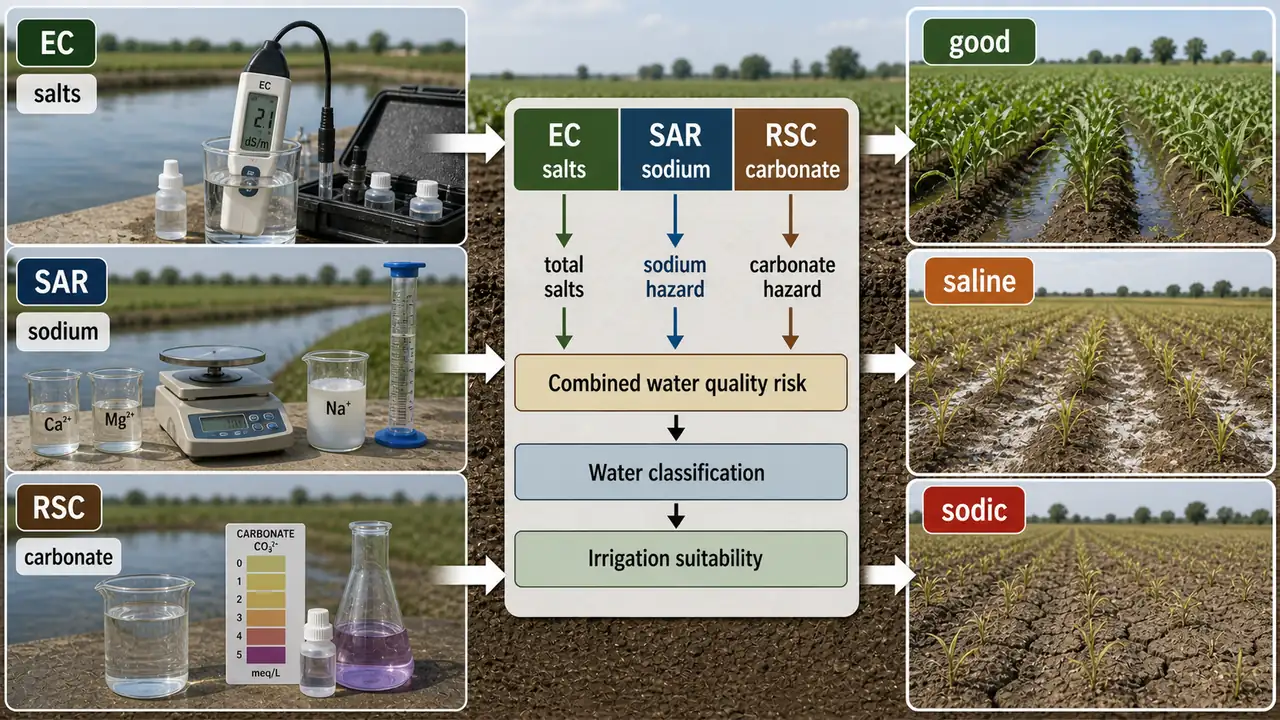
Relationship between EC, SAR, and RSC
These three parameters work together to determine overall water quality. High EC combined with high SAR is worse than either alone.
Specific Ion Toxicity Hazard
Beyond overall salinity and sodicity, certain specific ions can be directly toxic to plants even at relatively low concentrations. Each ion has a different mechanism of damage.

Sodium
- Most hazardous soluble constituent of irrigation water.
- Excess Na makes water saline (with Cl/SO4) or alkaline (with CO3/HCO3).
- Previously evaluated using Soluble Sodium Percentage (SSP) = (Na / (Ca + Mg + Na + K)) x 100.

- High SSP = soft water; low SSP = hard water.
- Water with SSP = 66 or higher is hazardous for irrigation.
- Sodium soils are: impermeable to air and water, hard when dry, plastic and sticky when wet.
- Sodium toxicity symptoms: leaf burn, necrosis, stunted growth.
Agricultural example: In Indo-Gangetic alluvial plains, usar (sodic) soils with high sodium have been successfully reclaimed using gypsum application at 5--10 tonnes/hectare followed by rice cultivation. Rice tolerates waterlogging and helps leach sodium out of the profile.
Magnesium
- High Mg relative to total divalent cations affects soil physical properties.
- Harmful effect when Ca:Mg ratio declines below 50.
- Mg dominance causes soil to become dispersed and less permeable (similar to sodium effect).

Chlorides
- Increases with higher EC and Na ions -- most dominant in very high salinity water.
- Does not affect soil physical properties or get adsorbed by soil.
- Directly taken up by plants, causing leaf burn in sensitive crops.
- Generally not included in modern classification systems.


Sulphate
- Less harmful than chlorides.
- About half of sulphates precipitate as CaSO4; only the remaining soluble Na-MgSO4 contributes to salinity.
- Potential salinity formula: Cl- + 1/2 SO4 2-
Specific Ions -- Comparison Table
| Ion | Hazard Level | Effect on Soil | Effect on Plants | Key Threshold |
|---|---|---|---|---|
| Sodium (Na) | Most hazardous | Disperses clay, reduces permeability | Leaf burn, necrosis | SSP > 66 |
| Magnesium (Mg) | Moderate | Disperses soil when Ca:Mg < 50 | Indirect (soil effects) | Ca:Mg < 50 |
| Chloride (Cl) | Direct toxicity | None | Leaf burn in sensitive crops | Varies by crop |
| Sulphate (SO4) | Less harmful | Minimal | Lower salinity effect | Half precipitates |
| Boron (B) | Narrow safe range | None | Leaf burn, yield reduction | Varies (0.5--4 ppm) |
| Fluorine (F) | Low concern for agriculture | None significant | Wheat unaffected up to 25 mg/L | Surface water < 0.3 mg/L |
| Nitrate (NO3) | Moderate | Alters soil properties | Acts as N fertilizer (excess pollutes groundwater) | Varies |
| Lithium (Li) | Trace element | None | Toxic to citrus at 0.05--0.1 ppm | 0.05--0.1 ppm (citrus) |

TIP
Exam mnemonic -- "Na is King": Sodium is the most hazardous ion. It affects both soil (structure destruction) and plants (leaf burn). Chloride is second most important for direct plant toxicity but has no soil effect. Remember: Na = soil + plant damage; Cl = plant damage only.
Fluorine
- Sparingly soluble; surface water usually < 0.3 mg/L.
- Irrigation with fluoride-saline water (up to 25 mg/L) does not affect wheat yield.
- Unlikely to need monitoring for agricultural purposes in India.
Nitrate
- Groundwater frequently contains high nitrate.
- Acts as a nitrogen fertilizer source for crops.
- Main concern: contamination of drinking water and eutrophication of water bodies.

Agricultural example: In vegetable-growing belts of Punjab and Haryana, excessive nitrogen fertilizer application has raised groundwater nitrate levels above safe limits (>45 mg/L). While this nitrogen-rich water acts as a free fertilizer for crops, it poses serious health risks when used for drinking.
Lithium
- Trace element found in saline groundwater and irrigated soils.
- 0.05--0.1 ppm produces toxic effects on citrus.
- Indian saline soils contain up to 2.5 ppm, but most crop germination is unaffected at this level.
State-wise Brackish Water Resources
Brackish water contains more dissolved salts than freshwater but less than seawater. In arid and semi-arid regions, it may be the only resource for irrigation.

Agricultural example: In the Thar Desert of Rajasthan, farmers use brackish water (EC 2--6 dS/m) to grow salt-tolerant crops like barley, mustard, and castor. They apply extra water for leaching and select crop varieties bred specifically for saline conditions.
Ground Water Quality
Groundwater quality in India varies dramatically by region. The Indo-Gangetic alluvial plains generally have good quality freshwater, while western Rajasthan, coastal Andhra Pradesh, and parts of Haryana and Punjab have significant brackish and saline groundwater zones. The Central Ground Water Board (CGWB) monitors groundwater quality across India, classifying it by EC, fluoride, nitrate, and arsenic levels. Farmers must test borewell water before committing to irrigation, as poor groundwater quality is one of the leading causes of soil degradation in arid and semi-arid India.
Major River Basins of India

India has 20 major river basins and 12 major rivers with catchment areas exceeding 20,000 km². The Ganga basin is the largest (26% of India's land area), followed by Godavari, Krishna, and Mahanadi. These basins collectively receive about 400 M ha-m of annual precipitation, of which approximately 187 M ha-m is available as surface water. The inter-linking of rivers is a long-discussed national strategy to transfer water from surplus basins (Brahmaputra, Mahanadi) to deficit basins (Cauvery, Pennar).
Summary Table
| Topic | Key Point |
|---|---|
| Water quality | Kind and amount of salts; their effect on crops and soil |
| EC | Measures total salts (salinity hazard); excellent < 0.5, unsuitable > 6.0 mmhos/cm |
| SAR | Measures sodium hazard; ratio of Na to sqrt(Ca + Mg); S1 (safe) to S4 (hazardous) |
| RSC | Excess carbonate over Ca + Mg; indicates alkalinity hazard; safe < 1.25 me/l |
| SSP | Soluble Sodium Percentage; > 66 is hazardous |
| Boron | Essential micronutrient; narrow deficiency-toxicity range; citrus most sensitive |
| Gypsum | Most common amendment for sodic/alkali soil reclamation; replaces Na with Ca |
| Saline soil | White crust; EC > 4; pH < 8.5; reclaimed by leaching |
| Sodic soil | Black crust; ESP > 15; pH > 8.5; reclaimed by gypsum + leaching |
| Na (most hazardous ion) | Destroys soil structure; causes leaf burn, necrosis; SSP > 66 hazardous |
| Chloride | Direct plant toxicity; no soil effect; not in modern classification |
| Sulphate | Less harmful than Cl; half precipitates as CaSO4 |
| Potential salinity | Cl- + 1/2 SO4 2- |
| Physiological drought | Plants wilt in saline soil even when moisture is present |
| Brackish water | More salts than freshwater; important in arid/semi-arid regions |
| ESRP mnemonic | EC, SAR, RSC, pH -- the four key water quality parameters |
Summary Cheat Sheet
| Concept / Topic | Key Details |
|---|---|
| Water quality | Kind and amount of salts; effect on crops and soil |
| EC | Measures total salts (salinity hazard); excellent < 0.5 mmhos/cm |
| SAR | Measures sodium hazard; Na / sqrt(Ca + Mg); S1 (safe) to S4 |
| RSC | Excess carbonate over Ca + Mg; alkalinity hazard; safe < 1.25 me/l |
| SSP | Soluble Sodium Percentage; > 66 is hazardous |
| Boron | Essential micronutrient; narrow range; citrus most sensitive |
| Gypsum | Most common amendment for sodic/alkali soil reclamation |
| Saline soil | White crust; EC > 4; pH < 8.5; reclaimed by leaching |
| Sodic soil | Black crust; ESP > 15; pH > 8.5; reclaimed by gypsum + leaching |
| Na (most hazardous ion) | Destroys soil structure; causes leaf burn, necrosis |
| Potential salinity | Cl⁻ + 1/2 SO₄²⁻ |
| Physiological drought | Plants wilt in saline soil even with moisture present |
| ESRP mnemonic | EC, SAR, RSC, pH — four key water quality parameters |
| Chloride | Direct plant toxicity; no soil effect |
| Sulphate | Less harmful than Cl; half precipitates as CaSO₄ |
TIP
Next: Lesson 07 covers Irrigation Water Measurement -- the devices and methods (volumetric, float, weirs, Parshall flume, tracer) used to measure how much water is actually being delivered.