🐳 Irrigation Methods -- Surface, Sub-Surface, and Micro Irrigation
Complete guide to irrigation methods including flood, basin, border strip, furrow, sprinkler, and drip irrigation with crop suitability, efficiency, PMKSY subsidy details, and exam-focused comparison tables.
Choosing the Right Way to Water
In the previous lesson, we established how much water each crop needs and when that water is most critical. Now we turn to the how -- what are the different methods of delivering water to the field, and which method suits which situation?
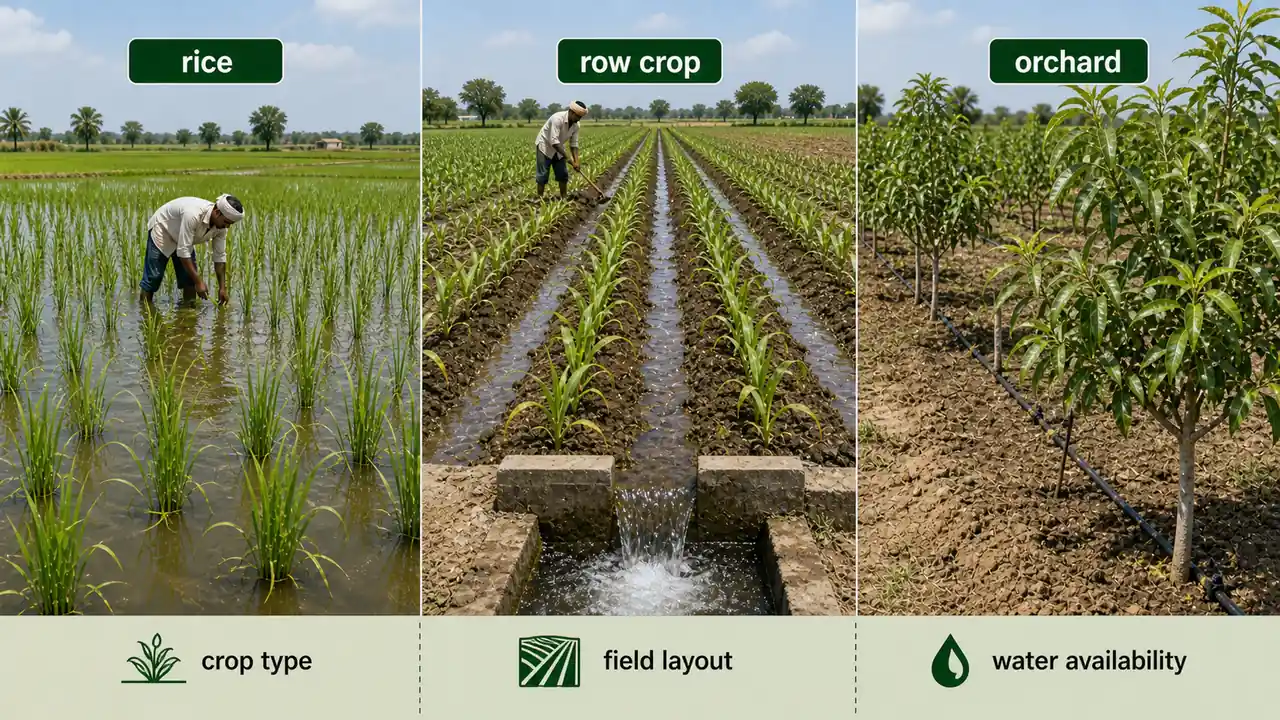
A paddy farmer in Tamil Nadu floods his entire field, while a pomegranate grower in Maharashtra uses drip emitters delivering 2 litres per hour directly to each tree's roots. Both are irrigating, but the methods, efficiency, and economics differ dramatically. Choosing the right irrigation method depends on the crop, soil type, topography, water availability, and economics.
Three Categories of Irrigation
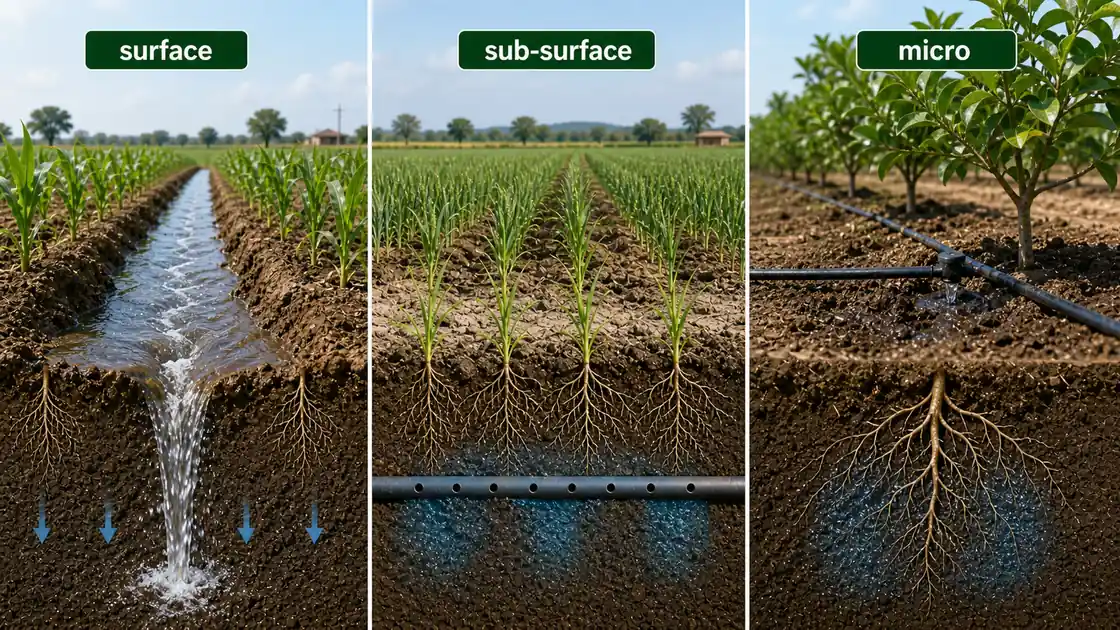
| Category | Mechanism | Efficiency | Best Suited For |
|---|---|---|---|
| Surface Methods | Water distributed by gravity over soil surface | ~60% | Abundant water, flat land, rice |
| Sub-Surface Methods | Water applied below ground to root zone | Moderate | Specific soil conditions |
| Micro Methods | Water delivered under pressure in precise amounts | 75--95% | Water-scarce areas, high-value crops |
TIP
Pro Content Locked
Upgrade to Pro to access this lesson and all other premium content.
Charged once for one year · ₹1188 total
Save ₹100/month vs ₹2388/year launch price
- All Agriculture & Banking Courses
- AI Lesson Questions (100/day)
- AI Doubt Solver (50/day)
- Glows & Grows Feedback (30/day)
- AI Section Quiz (20/day)
- 22-Language Translation (100/day)
- Recall Questions (20/day)
- AI Quiz (15/day)
- AI Quiz Paper Analysis (100/day)
- AI Step-by-Step Explanations (100/day)
- Spaced Repetition Recall (FSRS)
- AI Tutor
- Immersive Text Questions
- Audio Lessons — Hindi & English
- Mock Tests & Previous Year Papers
- Summary & Mind Maps
- XP, Levels, Leaderboard & Badges
- Generate New Classrooms
- Voice AI Teacher (AgriDots Live)
- AI Revision Assistant
- Knowledge Gap Analysis
- Interactive Revision (LangGraph)
🔒 Secure one-time yearly payment via Razorpay · No hidden fees
Choosing the Right Way to Water
In the previous lesson, we established how much water each crop needs and when that water is most critical. Now we turn to the how -- what are the different methods of delivering water to the field, and which method suits which situation?
A paddy farmer in Tamil Nadu floods his entire field, while a pomegranate grower in Maharashtra uses drip emitters delivering 2 litres per hour directly to each tree's roots. Both are irrigating, but the methods, efficiency, and economics differ dramatically. Choosing the right irrigation method depends on the crop, soil type, topography, water availability, and economics.
Three Categories of Irrigation
| Category | Mechanism | Efficiency | Best Suited For |
|---|---|---|---|
| Surface Methods | Water distributed by gravity over soil surface | ~60% | Abundant water, flat land, rice |
| Sub-Surface Methods | Water applied below ground to root zone | Moderate | Specific soil conditions |
| Micro Methods | Water delivered under pressure in precise amounts | 75--95% | Water-scarce areas, high-value crops |
TIP
Exam mnemonic -- "SSM = Surface (gravity), Sub-surface (below ground), Micro (pressure)." Efficiency increases from surface to micro methods.
Surface Irrigation Methods
The oldest and most widely practised form of irrigation worldwide. Water flows over the field by gravity.

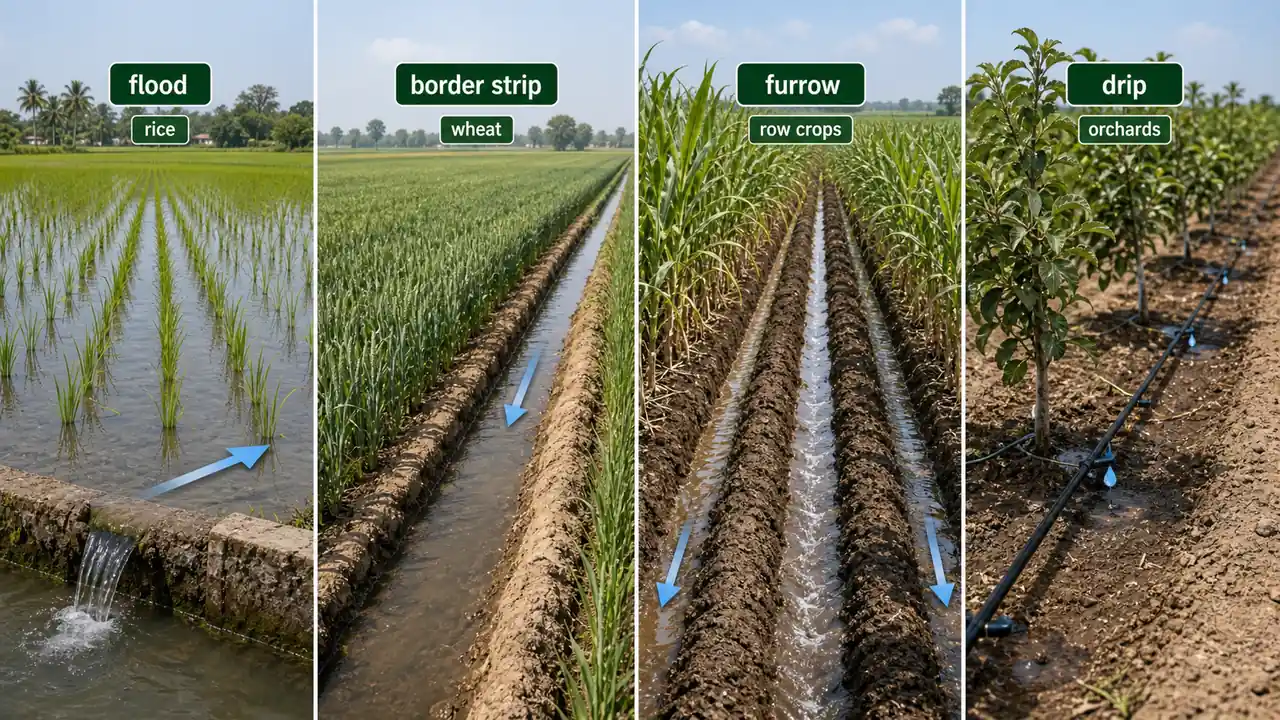
Flood Irrigation
- Used for lowland rice and similar crops
- Water flows from the channel into the field without much control
- Bund height: 15 cm for effective rainfall use
- Minimum labour required
- Suitable for uniform surface soils with good water holding capacity
| Advantages | Disadvantages |
|---|---|
| Less labour required | Uneven water distribution |
| No extra care needed | Low water application efficiency |
| Large streams easily managed | Significant deep percolation and runoff losses |
Agricultural example: In the lowland paddy areas of eastern India, flood irrigation is the default method because rice thrives in standing water and the flat terrain suits gravity flow.
Basin Irrigation
Basins are flat areas surrounded by low bunds that prevent water from flooding adjacent fields. Water is retained until it infiltrates into the soil. Two types: Check Basin and Ring Basin.

Check Basin Method


- Most common irrigation method in India
- Land divided into small plots surrounded by levees (low bunds)
- Each plot has a nearly level surface; water fills to desired depth and infiltrates
- Irrigation efficiency: 30--40% UPPSC 2021
- Water conveyed through supply channels and lateral field channels
- Suitable for: paddy (best method), maize, pearl millet, groundnut
- Useful when leaching is required to remove salts
- Not suitable for crops sensitive to wet soil around the stem
Agricultural example: In the alluvial plains of Bihar, paddy farmers divide their fields into small check basins of 10 m x 10 m, filling each basin to 5 cm depth. The standing water also suppresses weeds -- a bonus for rice cultivation.
TIP
Exam tip: Check basin has the lowest efficiency (30-40%) among commonly tested methods, but it is the most common method in India. Do not confuse "most common" with "most efficient."
Ring Basin Method
- Used for growing trees in orchards
- Each tree gets a separate circular basin
- Water supplied from a supply channel through small field channels
| Advantages | Disadvantages |
|---|---|
| Uniform water application | More labour for field layout |
| Suitable for large, unlevel fields | ~5% land wasted for bunding |
Agricultural example: Mango orchards in Uttar Pradesh use ring basins around each tree, concentrating water where the root zone needs it most.
Border Strip Irrigation

- Land divided into long parallel strips separated by low ridges
- Uniform gentle slope in irrigation direction; water flows by gravity, infiltrating as it advances
- Strip width: 3--15 m
| Feature | Detail |
|---|---|
| Soil suitability | Moderately low to moderately high infiltration rates |
| Crop suitability | Close-growing crops: wheat, barley, fodder, legumes |
| Not suitable for | Rice; coarse sandy soils; heavy clay soils |
| Key advantage | Highest WUE among surface methods |
| Key disadvantage | Non-uniform distribution; not for sandy soils |
Agricultural example: Wheat farmers in the canal-irrigated areas of Punjab use border strips -- the gentle slope and close crop spacing make this the most water-efficient surface method for wheat.
TIP
Exam tip: Border strip = highest WUE among surface methods. Remember "Border = Best (surface)" for efficiency.
Furrow Irrigation

- Small channels carry water between crop rows down the slope
- Water infiltrates from sides and bottom of furrow, wetting the root zone
- Crops grown on ridges between furrows
- Suitable for all row crops and crops that cannot tolerate prolonged standing water
Key advantage: Water contacts only one-half to one-fifth of land surface, reducing puddling, crusting, and evaporation.
Not suitable for sandy soils (high infiltration, poor lateral distribution).
Types of Furrow Irrigation
| Classification | Type | Description | Agricultural Example |
|---|---|---|---|
| By alignment | Straight furrows | Uniform, gently sloping fields | Cotton in flat fields of Gujarat |
| Contour furrows | Along contour lines on sloping terrain; reduces erosion | Groundnut on sloping red soils of Andhra Pradesh | |
| By size | Deep furrows | Widely spaced crops with deep root systems | Sugarcane in Maharashtra |
| Corrugations | Small, shallow furrows for close-growing crops | Wheat and groundnut in semi-arid regions |
Agricultural example: Sugarcane in Maharashtra is irrigated through ridges and furrows -- the crop grows on raised ridges while water flows through the furrows, providing moisture without waterlogging the root crown.
Surge Irrigation

- Intermittent water application with alternating ON and OFF cycles
- During the OFF cycle, the soil surface seals slightly, causing water to advance faster and more evenly during the next ON cycle
| Advantage | Why |
|---|---|
| Increased infiltration uniformity | Wetting-drying cycles create surface seal |
| Reduced deep percolation | Less total water applied for same coverage |
| Efficiency: 85--90% | Much higher than continuous furrow |
Agricultural example: In the USA and increasingly in progressive Indian farms, surge valves automatically alternate water between two sets of furrows, achieving 85-90% efficiency -- comparable to sprinkler systems but at lower cost.
Surface Methods -- Comparison
| Method | Efficiency | Labour | Best Crops | Limitation |
|---|---|---|---|---|
| Flood | Low (~60%) | Low | Rice | Uneven distribution |
| Check Basin | 30--40% | Moderate | Paddy, maize, groundnut | Low efficiency |
| Border Strip | Highest among surface | Low | Wheat, barley, fodder | Not for rice or sandy soils |
| Furrow | Moderate | Moderate | Row crops, sugarcane | Not for sandy soils |
| Surge | 85--90% | Low (automated) | Row crops | Needs surge valve |

Sub-Surface Irrigation
Water applied below ground, creating an artificial water table at 30--75 cm depth. Moisture rises to roots through capillary action.
Laterals laid 15--30 m apart. Two types:
Natural Sub-Surface Irrigation
Favourable when:
- Root zone soil is quite permeable
- Impermeable substratum below water table prevents deep percolation
- Abundant salt-free water available (otherwise salt incrustation occurs on surface)
Agricultural example: In parts of the Nile Delta, natural sub-surface irrigation occurs where a shallow water table provides moisture to root zones through capillary rise, supporting wheat and clover crops without direct surface irrigation.
Artificial Sub-Surface Irrigation
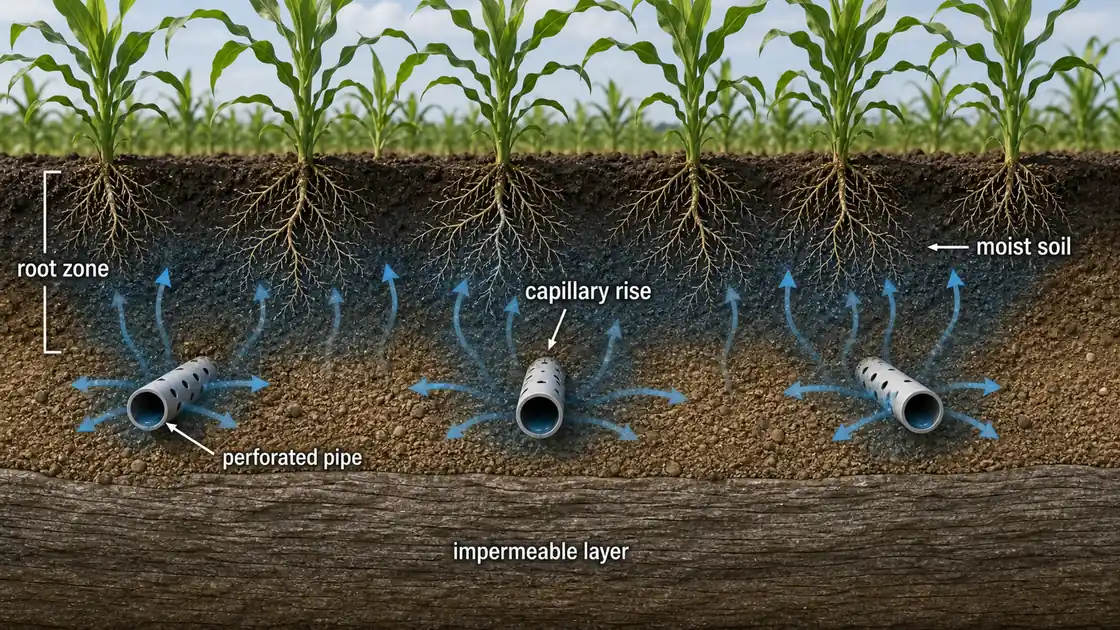
- Perforated pipes laid in a network below soil surface
- Requires soil with high horizontal permeability and low vertical permeability
- Not very popular due to high cost, unsuitable moisture distribution in many cases, and risk of pipe clogging
Micro-Irrigation Methods
Also known as Pressurized Irrigation Systems. Deliver water precisely where needed, dramatically reducing waste.
Under PMKSY-PDMC (2018-19):
- Total area under micro irrigation: 11.58 lakh ha
- Sprinkler: 5.83 lakh ha
- Drip: 5.75 lakh ha

Sprinkler Irrigation

Water applied as a thin spray resembling rainfall through nozzles on risers connected to a pumping unit.
| Feature | Detail |
|---|---|
| Suitable crops | All crops except rice and jute |
| Suitable soils | All except heavy clay |
| Best for | Undulating topography, sandy soils, hilly areas |
| Discharge rate | > 1000 lit/hr |
| Pressure | 2.5--4.5 kg/cm² |
| Water saving | 25--50% vs surface methods |
| Land saving | 10--20% (no channels/bunds needed) |
| Irrigated area increase | 40% more area with same water |
| Labour saving | 40--60% vs surface methods |
| WUE | Up to 60% |

Additional benefit: Protects crops against frost (spray releases latent heat) and high temperatures.
| Advantages | Disadvantages |
|---|---|
| Works on undulating terrain and sandy soils | Not suitable in wind > 12 km/hr |
| Saves 25--50% water | High initial cost |
| Saves 10--20% land | High energy requirement |
| Protects against frost | Spreads foliar diseases |
| 40--60% labour saving | Not for rice, jute, or heavy soils |
Agricultural example: Potato farmers in the sandy soils of Deesa, Gujarat use sprinkler irrigation on undulating terrain where surface irrigation would cause severe erosion. They save 30% water and achieve uniform tuber development.
TIP
Exam tip: Sprinkler is NOT for rice, jute, heavy clay, or windy conditions (> 12 km/hr). Remember "Sprinkler Skips Rice, Jute, Clay, Wind."
Drip Irrigation

Also called Trickle Irrigation -- the most water-efficient method available.
| Feature | Detail |
|---|---|
| Origin | Introduced from Israel |
| Inventor | Plastic emitter developed by Simcha Blass and son Yeshayahu exams-19 |
| Mechanism | Water delivered drop by drop at or near root zone |
| Discharge rate | 1--4 lit/hr per dripper |
| Pressure | 1.5--2.5 kg/cm² |
| Water saving | 60--70% |
| WUE | 95% IBPS 2018 -- highest among all methods |
| Components | Main line, sub-pipeline, laterals, emitters |
| Discharge from | Emitters |
| Best for | Water-scarce areas, salt problems |
| Provides water in | Root zone, preventing losses Exams |
| Advantages | Disadvantages |
|---|---|
| Ideal for acute water shortage | Clogging of emitters (most common problem) |
| Minimizes erosion, percolation, runoff | Damage by rodents |
| Maintains water at field capacity | Salt accumulation near plants |
| Enables fertigation and herbigation | High initial cost |
| Less disease and weed infestation | Inadequate root development (roots concentrate in wetted zone) |
| No land leveling needed | Best suited for wider-spaced orchard crops and sugarcane |
| Lower salt concentration (frequent applications) |
Agricultural example: Pomegranate orchards in Solapur, Maharashtra switched from flood to drip irrigation, saving 65% water while increasing fruit yield by 25% and improving fruit quality due to consistent moisture.
TIP
Exam tip: Drip irrigation = 95% WUE (highest), from Israel (Simcha Blass), discharge 1-4 lit/hr, most common problem is emitter clogging. Remember "DICE = Drip from Israel, Clogging is Enemy."
Sprinkler vs Drip -- Comparison

| Feature | Sprinkler | Drip |
|---|---|---|
| Water delivery | Spray (resembles rain) | Drop by drop at root zone |
| Efficiency | ~75% | 90--95% |
| Discharge rate | > 1000 lit/hr | 1--4 lit/hr |
| Pressure | 2.5--4.5 kg/cm² | 1.5--2.5 kg/cm² |
| Water saving vs surface | 25--50% | 60--70% |
| Not suitable for | Rice, jute, heavy clay | -- |
| Main problem | Wind drift | Emitter clogging |
| Best for | Close-growing field crops, undulating land | Orchards, row crops, water-scarce areas |
| Origin | -- | Israel |
Drip Irrigation Types
Surface Drip
- Water applied to soil surface through emitters at predetermined distances
- Known as online drippers
- Two subtypes: online type and integral type
- Integral dripline is recommended for sugarcane
Subsurface Drip (SDI)
- Water applied below soil surface through emitters molded inside the dripline
- Discharge: 1.0--3.0 LPH
- Laterals buried at desired depth along crop rows
- Known as inline drippers
- Minimal surface evaporation loss
- Types: Biwall and Typhoon
Drip Irrigation in Sugarcane
- Applied once in three days based on evapotranspiration demand
Agricultural example: In Tamil Nadu, subsurface drip irrigation in sugarcane increased cane yield by 20% and saved 40% water compared to furrow irrigation. The integral dripline placed at 15 cm depth delivers water directly to the root zone without any surface losses.
Typhoon System
- A type of drip irrigation using thin-wall dripper line with very low flow rate
- Used in flat terrain and row crops
- Cost-effective drip solution for field crops

Irrigation Methods Suitable for Different Crops
Commonly Used Irrigation by Crop
| Crop | Irrigation Method |
|---|---|
| Sorghum | Flat bed system (weather/eye judgment) |
| Pearl millet | Beds and channel irrigation |
| Finger millet | Flat bed system (weather/eye judgment) |
| Maize | Flat bed system (weather/eye judgment) |
| Pulses | Beds and channels with excess irrigation |
| Groundnut | Beds and channel (weather/eye judgment) |
| Ginger | Flat bed system with copious irrigation |
| Sunflower | Flat bed system |
| Coconut | Check basin with copious irrigation |
| Cotton | Beds and channels |
| Banana | Trench and mounds method |
| Acid lime | Basin irrigation |
| Tomato | Beds and channels |
| Sugarcane | Excess irrigation through ridges and furrows |
Crop with Highest Irrigated Area
| Rank | Crop | Note |
|---|---|---|
| 1 | Wheat | Requires reliable moisture throughout growth |
| 2 | Rice | 50% of total irrigated area |
TIP
Exam tip: Wheat has the highest irrigated area (not rice). But rice accounts for 50% of total irrigated area in terms of water consumed. This distinction is a common exam trap.
Irrigated Area to Net Sown Area
| Rank | Crop | Ratio |
|---|---|---|
| 1 | Sugarcane | 93% -- almost entirely dependent on irrigation |
| 2 | Wheat | 85% |
PMKSY -- Pradhan Mantri Krishi Sinchayee Yojana
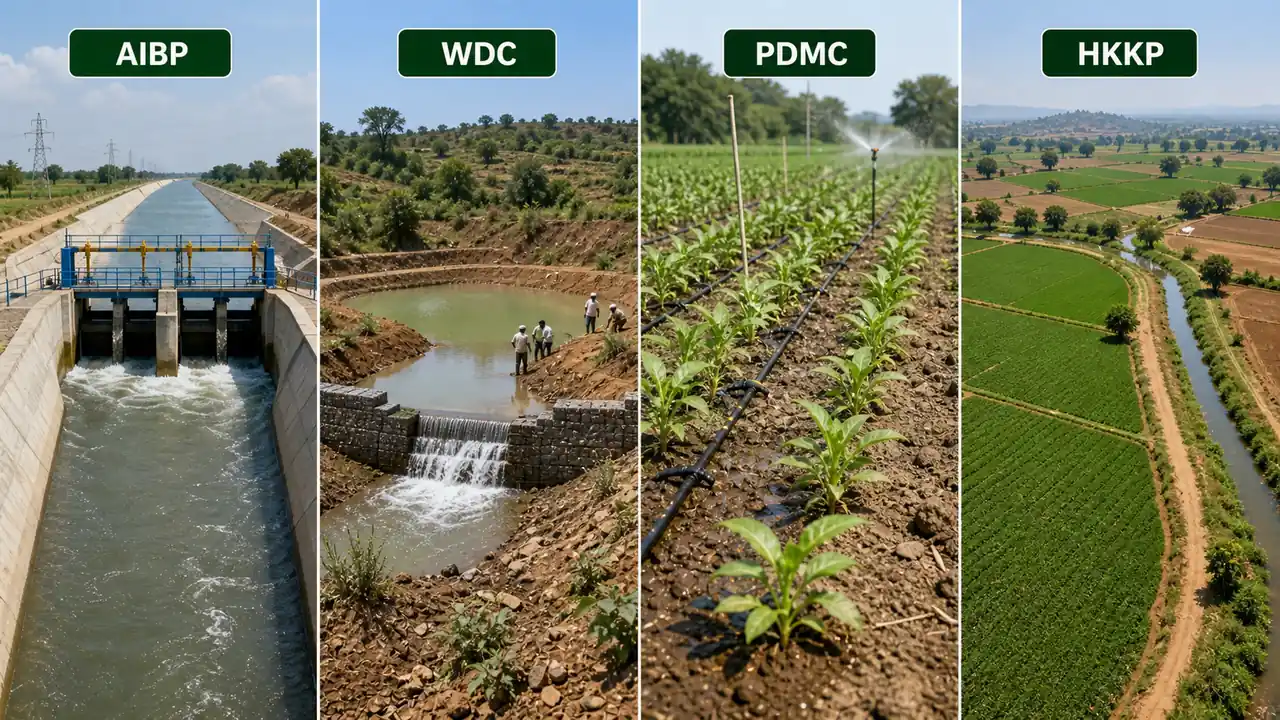
PMKSY is India's flagship irrigation scheme, launched in 2015-16 by merging three existing schemes:
| Merged Scheme | Full Name | Focus |
|---|---|---|
| AIBP | Accelerated Irrigation Benefits Programme | Complete ongoing irrigation projects |
| IWMP | Integrated Watershed Management Programme | Rainfed area / watershed development |
| OFWM | On Farm Water Management | Micro-irrigation, field efficiency |
Twin goals (tagline):
- "Har Khet Ko Paani" -- water to every field (source creation + distribution)
- "More Crop Per Drop" -- improve water use efficiency
Four Components of PMKSY
| # | Component | Nodal Ministry | Focus |
|---|---|---|---|
| 1 | AIBP (Accelerated Irrigation Benefits Programme) | Jal Shakti (CWC) | Complete long-pending major/medium irrigation projects |
| 2 | WDC-PMKSY (Watershed Development Component) | Agriculture & FW | Integrated watershed development in rainfed areas |
| 3 | PDMC (Per Drop More Crop) | Agriculture & FW | Micro-irrigation -- drip & sprinkler; on-farm efficiency |
| 4 | HKKP (Har Khet Ko Pani) | Jal Shakti (CGWB) | Expand irrigated coverage -- surface + groundwater + repair of water bodies |
NOTE
Exam tip: AIBP and HKKP are under Jal Shakti Ministry; WDC and PDMC are under Agriculture Ministry. This split ministry structure is frequently asked.
Component Details
Component 1 -- AIBP
- Launched: 1996-97 (oldest component, pre-dates PMKSY)
- Focus: Complete incomplete major and medium irrigation projects to unlock already-created potential
- 60 priority projects identified for completion under PMKSY (out of 99 ongoing)
- Projects must create Irrigation Potential of ≥ 10,000 ha (major) or 2,000--10,000 ha (medium)
- Funding: 90:10 (Centre:State) for special category states; 60:40 for others
Component 2 -- WDC-PMKSY (Watershed Development)
- Formerly IWMP (Integrated Watershed Management Programme, 2009-10)
- Cost norms: Rs 12,000/ha (plains); Rs 15,000/ha (hills/difficult terrain)
- Project period: 5--7 years per watershed project
- Treats rainfed/degraded land: soil conservation, moisture retention, check dams, farm ponds
- Also covers Neeranchal National Watershed Project (World Bank assisted) for capacity building
Component 3 -- PDMC (Per Drop More Crop)
- Promotes drip and sprinkler micro-irrigation at farm level
- Subsidy structure:
| Farmer Category | Subsidy |
|---|---|
| Small & Marginal Farmers (≤2 ha) | 55% |
| Other Farmers | 45% |
- Centre:State share: 60:40 (general states); 90:10 (NE + Himalayan states)
- Micro Irrigation Fund (MIF): Rs 5,000 crore corpus created at NABARD (2018-19) to enable states to provide top-up subsidy beyond PDMC norms
- Covers: drip laterals, emitters, filters, fertigation units, sprinkler sets, rain guns
Component 4 -- HKKP (Har Khet Ko Pani)
- Aims to expand net irrigated area through:
- Creation of new water sources (surface + groundwater)
- Distribution network to uncovered areas
- Repair, Renovation and Restoration (RRR) of traditional water bodies
- Groundwater development in underutilized aquifer areas
- Pradhan Mantri Fasal Bima Yojana (PMFBY) integration for risk coverage

Key Statistics
| Feature | Detail |
|---|---|
| Net sown area (India) | ~140.13 million hectares |
| Under irrigation | ~68.38 M ha (~47%) |
| Un-irrigated (target area) | ~71.74 M ha |
| Launched | 2015-16 |
| PDMC subsidy (S&M farmers) | 55% |
| PDMC subsidy (others) | 45% |
| Centre:State (general) | 60:40 |
| Centre:State (NE/Himalayan) | 90:10 |
| MIF corpus (NABARD) | Rs 5,000 crore |
| WDC cost norm (plains) | Rs 12,000/ha |
| WDC cost norm (hills) | Rs 15,000/ha |
Latest Developments (2021 onwards)
| Development | Detail |
|---|---|
| PMKSY extended 2021--26 | Cabinet approved continuation with Rs 93,068 crore total outlay (includes central share + state share + NABARD loans) |
| AIBP -- 60 priority projects | Target to complete 60 priority major/medium irrigation projects creating 13.88 M ha irrigation potential |
| Command Area Development | Focus shifted to CAD (field channels, land levelling, on-farm development) alongside source creation |
| PM KUSUM + PMKSY convergence | Solar pump sets promoted under Har Khet Ko Pani for energy-efficient groundwater lifting |
| Digital water mapping | ISRO + NWA mapping of irrigation potential, coverage gaps via satellite for HKKP targeting |
| Jal Jeevan Mission linkage | HKKP water bodies also support drinking water recharge for JJM |
| PDMC expansion | Secondary horticulture crops added; precision irrigation (soil moisture sensors) included under PDMC |
| State top-up via MIF | Several states (Gujarat, Maharashtra, AP, Telangana) used NABARD MIF to provide additional 15-25% top-up, effectively making micro-irrigation near-free for small farmers |
TIP
Exam mnemonic: "AIBP-WDC-PDMC-HKKP" = "All Water Produces Harvest Khet Ko Paani" Numbers: 55/45 subsidy | 60:40 / 90:10 funding | Rs 5,000 cr MIF | Rs 12,000/ha WDC plains | Rs 93,068 cr 2021-26 outlay
Agricultural example: Under PMKSY-PDMC, a small farmer in Andhra Pradesh installing drip irrigation for chilli receives 55% subsidy + 20% state top-up (via MIF), paying only 25% — saving 60--70% water and boosting yield by 30--40%.
Summary Table
| Topic | Key Point |
|---|---|
| Three categories | Surface (gravity), Sub-surface (below ground), Micro (pressurized) |
| Check basin | Most common in India; 30--40% efficiency; best for paddy |
| Border strip | Highest WUE among surface methods; for wheat, barley, fodder |
| Furrow | For row crops; water contacts 1/5 to 1/2 of surface |
| Surge irrigation | ON/OFF cycles; 85--90% efficiency |
| Sprinkler | Resembles rainfall; not for rice/jute/heavy clay; >1000 lit/hr; saves 25--50% water |
| Drip | Most efficient (95% WUE); from Israel (Simcha Blass); 1--4 lit/hr; saves 60--70% water |
| Emitter clogging | Most common drip irrigation problem |
| Integral dripline | Recommended for sugarcane |
| Highest irrigated crop area | Wheat (1st), Rice (2nd) |
| Highest irrigated:sown ratio | Sugarcane (93%) |
| PMKSY | Merged AIBP+IWMP+OFWM (2015-16); 4 components: AIBP, WDC, PDMC, HKKP; extended 2021-26 (Rs 93,068 cr) |
| Sprinkler exclusions | Rice, jute, heavy clay, wind > 12 km/hr |
| Drip origin | Israel; Simcha Blass invented plastic emitter |
| Sub-surface irrigation | Artificial water table at 30-75 cm; capillary rise to roots |
| Natural sub-surface | Needs permeable root zone + impermeable substratum + salt-free water |
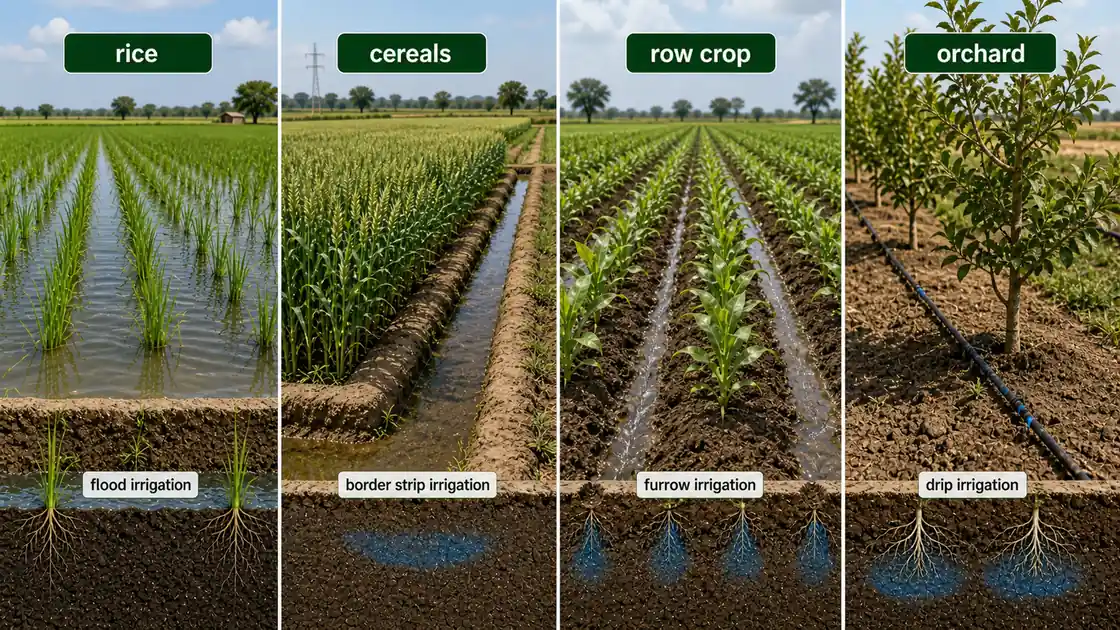
Irrigation Method Selection: Practical Decision Guide
Which irrigation method to recommend? Match crop + water + economics:
| If the Farmer Has... | Recommend | Efficiency | Why |
|---|---|---|---|
| Rice on flat land + abundant water | Check basin (flooding) | 30-40% | Rice needs standing water; most practical for paddy |
| Wheat/cereals on flat land + canal water | Border strip | 50-60% | Uniform wetting for closely spaced row crops |
| Row crops (sugarcane, maize, potato) | Furrow irrigation | 60-70% | Water in furrows, ridges stay dry; reduces waterlogging |
| Orchards/vegetables + limited water | Drip irrigation | 90-95% | Precise delivery to each plant; saves 60-70% water vs flood |
| Undulating terrain + any crop except rice | Sprinkler | 70-80% | Works on uneven land; simulates rainfall; saves 25-50% water |
| High-value crops (pomegranate, grape, banana) | Drip + fertigation | 90-95% | Water + nutrients delivered together; highest WUE and return on investment |
PMKSY subsidy for micro-irrigation: Under PMKSY (Pradhan Mantri Krishi Sinchayee Yojana), small/marginal farmers get 55% subsidy and other farmers get 45% subsidy on drip and sprinkler systems. This makes micro-irrigation economically attractive even for medium-sized holdings.
When NOT to use sprinkler: Avoid sprinkler for rice (needs standing water), jute (needs waterlogged conditions), heavy clay soils (poor infiltration rate), and when wind speed exceeds 12 km/hr (causes uneven distribution).
Summary Cheat Sheet
| Concept / Topic | Key Details |
|---|---|
| Three irrigation categories | Surface (gravity), Sub-surface, Micro (pressurized) |
| Check basin | Most common in India; 30-40% efficiency; best for paddy |
| Border strip | Highest WUE among surface methods; for wheat, barley, fodder |
| Surge irrigation | ON/OFF cycles; 85-90% efficiency |
| Sprinkler | Resembles rainfall; not for rice/jute/heavy clay; saves 25-50% water |
| Drip irrigation | Most efficient (95% WUE); from Israel (Simcha Blass) |
| Drip flow rate | 1-4 lit/hr; saves 60-70% water |
| Emitter clogging | Most common drip problem |
| Integral dripline | Recommended for sugarcane |
| Highest irrigated crop | Wheat (1st), Rice (2nd) |
| Highest irrigated:sown ratio | Sugarcane (93%) |
| PMKSY | Merged AIBP+IWMP+OFWM (2015-16); 4 components; extended 2021-26 (Rs 93,068 cr) |
| PMKSY-PDMC subsidy | 55% small/marginal; 45% others; MIF Rs 5,000 cr at NABARD |
| Centre:State funding | 60:40 (general states); 90:10 (NE/Himalayan) |
| WDC-PMKSY cost norms | Rs 12,000/ha (plains); Rs 15,000/ha (hills) |
| Sub-surface irrigation | Artificial water table at 30-75 cm; capillary rise to roots |
| Sprinkler exclusions | Rice, jute, heavy clay, wind > 12 km/hr |
TIP
Next: Lesson 06 covers Irrigation Water Quality -- how to assess water for salinity (EC), sodicity (SAR), alkalinity (RSC), boron hazard, and specific ion toxicity before using it for irrigation.