🚿 Crop Water Requirement, Critical Irrigation Stages, and Water Use Efficiency
Water requirements of major Indian crops (rice, wheat, sugarcane, cotton, pulses), critical irrigation stages for each crop, water use efficiency types, consumptive use, fertigation, and irrigation terminologies for competitive exams.
Why Every Drop Counts
In the previous lesson, we learned how to schedule irrigation -- the IW/CPE method, soil moisture depletion, and plant-based approaches. Now we apply those scheduling principles to specific crops: how much water does each crop need, and at which growth stage is water most critical?
A rice farmer in West Bengal uses 1200 mm of water per season, while a neighbouring pearl millet farmer needs only 350 mm. Why this vast difference? Each crop has a unique water requirement driven by its physiology, growth duration, and climate. A sugarcane grower in Maharashtra requires over 2000 mm across a full year -- nearly twice what the rice farmer uses. Understanding these requirements -- and knowing exactly when water is most critical -- is the key to producing more crop per drop. This chapter covers the water needs of all major crops, their critical irrigation stages, and the efficiency concepts that help us use water wisely.
Pro Content Locked
Upgrade to Pro to access this lesson and all other premium content.
₹99 charged monthly · Cancel anytime
- All Agriculture & Banking Courses
- AI Lesson Questions (100/day)
- AI Doubt Solver (50/day)
- Glows & Grows Feedback (30/day)
- AI Section Quiz (20/day)
- 22-Language Translation (100/day)
- Recall Questions (20/day)
- AI Quiz (15/day)
- AI Quiz Paper Analysis (100/day)
- AI Step-by-Step Explanations (100/day)
- Spaced Repetition Recall (FSRS)
- AI Tutor
- Immersive Text Questions
- Audio Lessons — Hindi & English
- Mock Tests & Previous Year Papers
- Summary & Mind Maps
- XP, Levels, Leaderboard & Badges
- Generate New Classrooms
- Voice AI Teacher (AgriDots Live)
- AI Revision Assistant
- Knowledge Gap Analysis
- Interactive Revision (LangGraph)
🔒 Secure via Razorpay · Cancel anytime · No hidden fees
Why Every Drop Counts
In the previous lesson, we learned how to schedule irrigation -- the IW/CPE method, soil moisture depletion, and plant-based approaches. Now we apply those scheduling principles to specific crops: how much water does each crop need, and at which growth stage is water most critical?
A rice farmer in West Bengal uses 1200 mm of water per season, while a neighbouring pearl millet farmer needs only 350 mm. Why this vast difference? Each crop has a unique water requirement driven by its physiology, growth duration, and climate. A sugarcane grower in Maharashtra requires over 2000 mm across a full year -- nearly twice what the rice farmer uses. Understanding these requirements -- and knowing exactly when water is most critical -- is the key to producing more crop per drop. This chapter covers the water needs of all major crops, their critical irrigation stages, and the efficiency concepts that help us use water wisely.
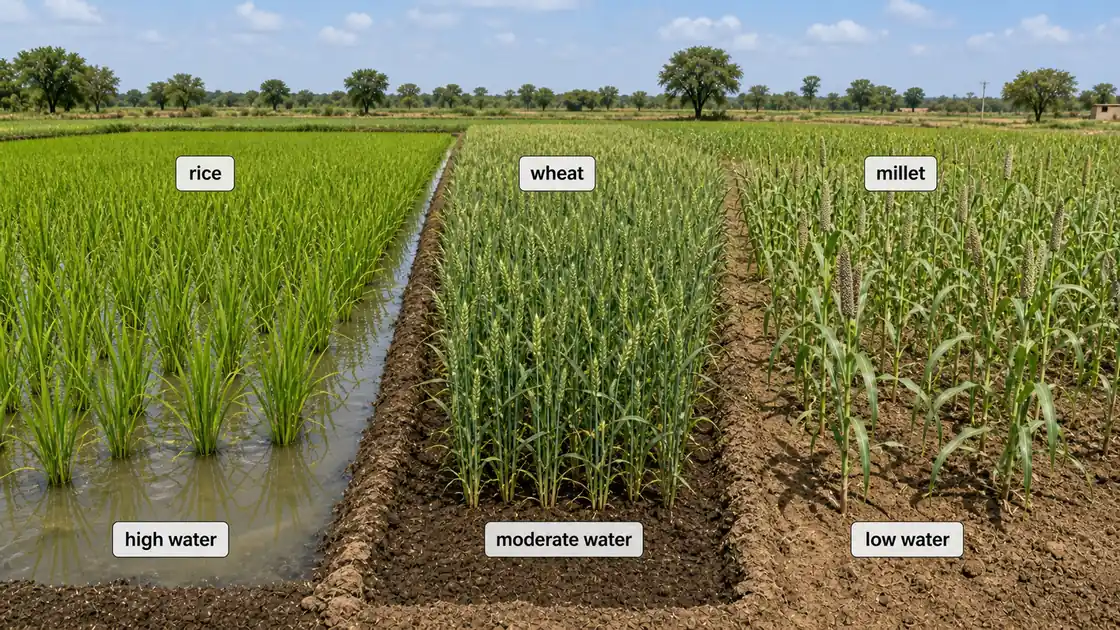
What is Crop Water Requirement?
The quantity of water needed for normal crop growth and yield in a given period, supplied by precipitation, irrigation, or both.
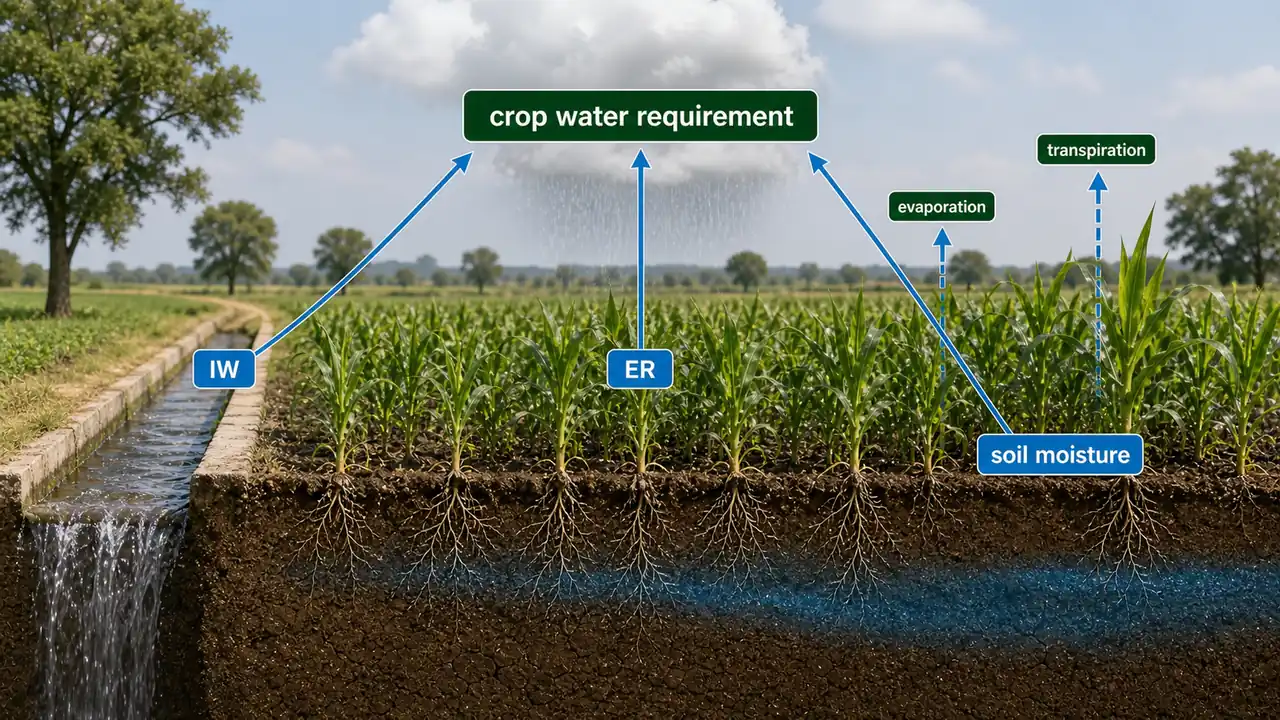
Water is needed mainly for three processes:
- Evaporation (E) from soil surface
- Transpiration (T) from plant leaves
- Metabolic activity of the plant
Together, these are called Consumptive Use (CU).
Formula: Water Requirement = IW + ER + S
| Symbol | Meaning | Example |
|---|---|---|
| IW | Irrigation Water (cm) | Water applied through canal or tube-well |
| ER | Effective Rainfall (cm) | Monsoon rainfall actually available to the crop |
| S | Soil profile contribution (cm) | Residual moisture from previous season |
Agricultural example: If a wheat crop needs 500 mm total water, and effective monsoon-season residual moisture provides 100 mm while winter rains add 150 mm, the farmer needs to supply 250 mm through irrigation.
Water Requirements of Major Crops
Rice
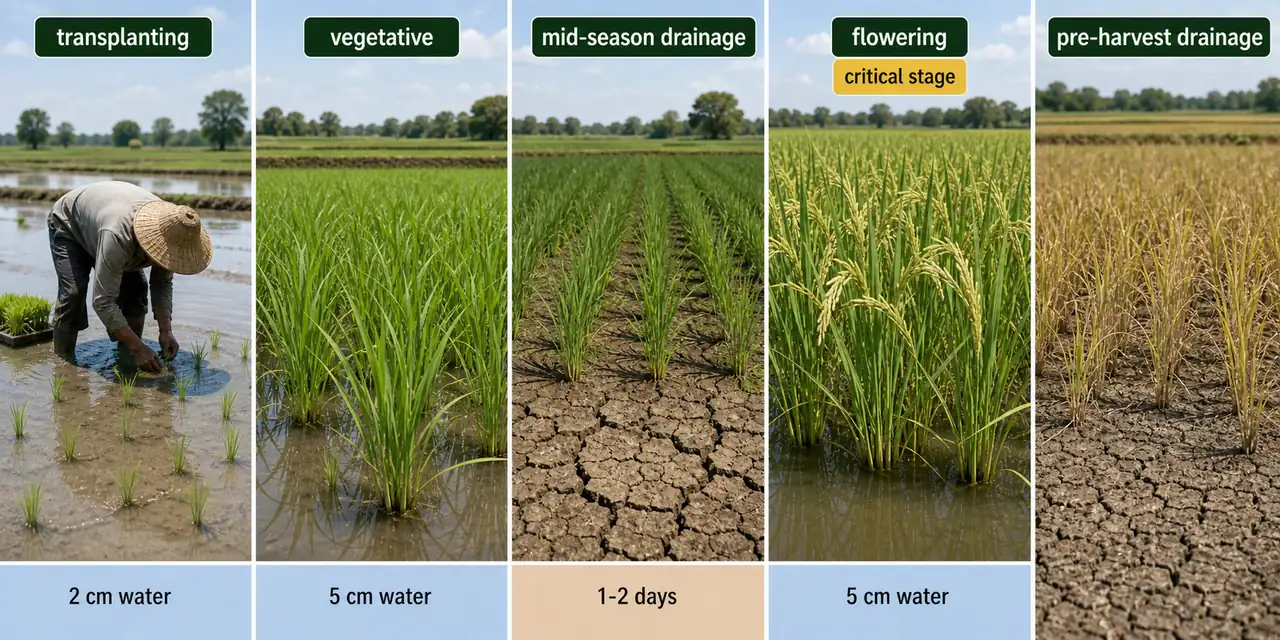
Rice is the most water-intensive cereal crop in India. Understanding its stage-wise water management is critical for both farming and exams.
- Daily consumptive use: 6--10 mm; total water: 1100--1250 mm.
- Water distribution: 3% (40 mm) for nursery, 16% (200 mm) for land preparation/puddling, 81% (1000 mm) for field irrigation.
| Growth Stage | Water Management |
|---|---|
| Transplanting | 2 cm shallow submergence for 7 days |
| Vegetative phase | 5 cm submergence for tiller production |
| Maximum tillering | Drain field for 1--2 days (mid-season drainage) -- improves root respiration, checks non-effective tillers |
| Flowering (Critical stage) | 5 cm submergence maintained Exams |
| Booting | Excess water >5 cm delays heading |
| Ripening | Less water needed; not necessary after yellow ripening |
| Pre-harvest | Drain 15--21 days before harvest |
TIP
Water-saving tip: Irrigating to 5 cm at saturation (or 1--2 days after ponded water disappears) saves 30% water compared to continuous submergence. This is the basis of Alternate Wetting and Drying (AWD) technique promoted across Asia.
Groundnut
- Total water requirement: 500--550 mm.
- ET is low during first 35 days and last 35 days; peak requirement between peg penetration and pod development.
- Second irrigation: 25 days after sowing (4--6 days after first hoeing).
- Interval: 15 days up to peak flowering; 7--10 days during critical stages; 15 days at maturity.
Agricultural example: In Gujarat's Saurashtra region, groundnut farmers time irrigation carefully around peg penetration. If the soil is dry and hard when pegs try to enter, pod formation fails entirely -- leading to a "pops" (empty shells) problem.

Finger Millet (Ragi)
- Total water requirement: 350 mm.
- Drought tolerant crop -- one of the most water-efficient cereals.
- Pre-planting irrigation: 7--8 cm.
- Life-saving irrigation on day 3 after transplanting.
- Water withheld for 10--15 days after establishment (encourages deeper rooting).
- Three essential irrigations: primordial initiation, flowering, and grain filling.
Sorghum
- Total water requirement: 350--500 mm.
- Relatively drought-tolerant cereal, well-suited for dryland and semi-arid regions.
Agricultural example: In the Deccan Plateau of Maharashtra and Karnataka, sorghum (jowar) is the staple rabi crop precisely because its low water requirement matches the limited post-monsoon moisture availability.

Sugarcane
- Total water requirement: 1800--2200 mm -- one of the most water-demanding crops.
- Formative phase (120 days from planting) is the critical period.
- Lesser quantity at more frequencies preferred for uniform emergence and optimum tillers.
- Grand growth period: maintain optimum moisture (no secondary thickening of stem).
- Ripening phase: gradually decrease moisture to check growth and increase sucrose content.
Agricultural example: In Maharashtra's Marathwada region, sugarcane occupies only 4% of cropped area but consumes nearly 70% of irrigation water. This is why the state promotes drip irrigation in sugarcane -- which can save 40--50% water while maintaining yields.
Maize
- Total water requirement: 500--600 mm.
- Very efficient in water use (high dry matter per unit water).
- Growth stages: sowing, four-leaf, knee-high, grand growth, tasseling, silking, early dough, late dough.
- Critical periods: tasseling, silking, and early dough.
- Water stress during tasseling/silking causes poor pollination and significantly reduced grain yield.
Agricultural example: A maize farmer in Bihar who misses irrigation during the silking stage (when silks emerge to catch pollen) can lose 50--70% of grain yield because unfertilized ovules produce no grain. This is the single most water-sensitive week in the entire maize crop cycle.
Cotton
- Total water requirement: 550--600 mm.
- Sensitive to soil moisture conditions (both excess and deficit).
- Water use increases from 3 mm/day to a peak of 10 mm/day when loaded with flowers and bolls.
- Only 10% used during emergence and early growth.
- Critical stages: flowering and boll development.
- Caution: Excess water at non-critical stages encourages vegetative growth (indeterminate plant), reducing boll setting.
- Stop irrigation when first boll of last flush opens.
Agricultural example: In Punjab's cotton belt, farmers who over-irrigate during vegetative growth get tall, leafy plants with few bolls -- the plant "goes vegetative" instead of producing cotton lint. Controlled deficit irrigation during vegetative phase and adequate water during boll development gives the best results.
Pulses
- Total water requirement: 200--450 mm -- low water-requiring crops, ideal for water-scarce regions.
- Mostly grown under rainfed conditions.
- Summer irrigated pulses (redgram, blackgram, greengram) need 3--4 irrigations at critical stages: germination, flowering, and pod formation.
Agricultural example: In Bundelkhand's water-scarce districts, farmers grow lentil (masur) as a rabi crop with just 1--2 irrigations because its total water need (200--300 mm) can be largely met by residual soil moisture from the monsoon.
Crop Water Requirement -- Comparison Table
Water Requirement of Major Crops
| S.No. | Crop | Duration (days) | Water Requirement (mm) | No. of Irrigations |
|---|---|---|---|---|
| 1 | Rice | 135 | 1200 | 18 |
| 2 | Wheat | 110 | 500--650 | 5--7 |
| 3 | Groundnut | 105 | 400--600 | 10 |
| 4 | Sorghum | 100 | 450--650 | 6 |
| 5 | Maize | 110 | 500--800 | 8 |
| 6 | Sugarcane | 365 | 2000 | 24 |
| 7 | Ragi | 100 | 350 | 6 |
| 8 | Cotton | 165 | 700--1300 | 11 |
| 9 | Blackgram | 80--90 | 280 | -- |
| 10 | Soybean | 110--120 | 320 | 5--7 |
| 11 | Sesame | 90--120 | 250--600 | 3--4 |
| 12 | Sunflower | 120--130 | 300--500 | 5--6 |
| 13 | Pulses | 90--120 | 350 | 4 |
| 14 | Banana | -- | 1200--2200 | -- |
TIP
Most asked: Rice has the highest water requirement among cereals (1200 mm). Sugarcane has the highest overall (2000 mm). Banana needs 1200--2200 mm. Among rabi crops, wheat needs 500--650 mm with 5--7 irrigations. Pulses are the most water-efficient (200--450 mm).
Water Requirement Ranking (High to Low)
| Rank | Crop | Water Need (mm) | Memory Aid |
|---|---|---|---|
| 1 | Sugarcane | 2000 | "Sugar drinks the most" |
| 2 | Banana | 1200--2200 | "Banana is always thirsty" |
| 3 | Rice | 1200 | "Rice lives in water" |
| 4 | Cotton | 700--1300 | "Cotton needs water for bolls" |
| 5 | Wheat | 500--650 | "Wheat is moderate" |
| 6 | Maize | 500--600 | "Maize is efficient" |
| 7 | Groundnut | 400--600 | "Groundnut is middle" |
| 8 | Pulses | 200--450 | "Pulses are frugal" |
Critical Stages of Crops for Irrigation
The critical stage is when water requirement is at its peak -- any water stress here causes irreversible yield damage. Missing irrigation at this stage is far more damaging than missing it at any other time.
Critical Stages -- Quick Reference Table
| S.No. | Crop | Critical / Moisture Sensitive Stage |
|---|---|---|
| Cereals and Millets | ||
| 1 | Rice | Panicle initiation (critical), Heading and Flowering |
| 2 | Wheat | Crown root initiation (CRI), Tillering and Booting |
| 3 | Sorghum | Flowering and Grain formation |
| 4 | Maize | Tasseling and Silking |
| 5 | Ragi (Finger millet) | Primordial initiation and Flowering |
| Oilseeds | ||
| 6 | Groundnut | Flowering, Peg initiation, penetration and pod development |
| 7 | Sesame | Blooming to maturity |
| 8 | Sunflower | Head formation and Early grain filling |
| 9 | Safflower | Rosette to flowering |
| 10 | Soybean | Flowering and Pod filling |
| 11 | Castor | Full growing period |
| Cash Crops | ||
| 12 | Cotton | Flowering and Boll formation |
| 13 | Sugarcane | Maximum vegetative stage |
| 14 | Tobacco | Topping |
| Legumes | ||
| 15 | Alfalfa (Lucerne) | Immediately after cutting (hay); Flowering (seed) |
| 16 | Beans | Flowering and Pod setting |
| 17 | Peas | Flowering and Pod setting |
| Vegetables | ||
| 18 | Onion | Bulb formation to maturity |
| 19 | Tomato | Flowering and Fruit setting |
| 20 | Chillies | Flowering |
| 21 | Cabbage | Head formation to maturity |
| Others | ||
| 22 | Coconut | Nursery stage, Root enlargement |
| 23 | Potato | Tuber initiation and maturity |
| 24 | Banana | Throughout the growth period |
| 25 | Citrus | Flowering, Fruit setting and enlargement |
| 26 | Coffee | Flowering and Fruit development |
| 27 | Flower crops | Bud formation and development |
| 28 | Ornamental | Flowering |
WARNING
Highest frequency exam questions: Rice = Panicle initiation. Wheat = Crown root initiation (CRI). Maize = Tasseling and Silking. Groundnut = Peg initiation and pod development. Sugarcane = Maximum vegetative stage. Cotton = Flowering and Boll formation.
TIP
Exam mnemonic -- "RPW-CTS-GFB": The six most-tested critical stages:
- Rice = Panicle initiation
- Wheat = Crown root initiation (CRI)
- Maize = Tasseling and Silking
- Groundnut = Peg initiation
- Cotton = Flowering and Boll formation
Notice the pattern: most critical stages occur during reproductive development (flowering, grain/pod/boll formation) because this is when the plant is building the harvestable product.
Irrigation Terminologies
Water Use Efficiency (WUE)
- Yield of marketable crop per unit of water used in evapotranspiration.
- Expressed as kg/ha-mm (cm).
- India's WUE: about 30--40% -- one of the lowest in the world (China: 55%).
Agricultural example: India produces roughly 0.5 kg grain per cubic metre of water, while Israel produces over 1.5 kg. Improving WUE through better irrigation methods and scheduling is one of India's biggest agricultural priorities.
Two Types of WUE
| Type | Formula | What It Measures |
|---|---|---|
| Field Water Use Efficiency | Yield / (ET + S + D) | Ratio to total water used in field (includes all losses) |
| Crop Water Use Efficiency | Yield / (E + T + G) | Ratio to water depleted by crop only (more precise) |
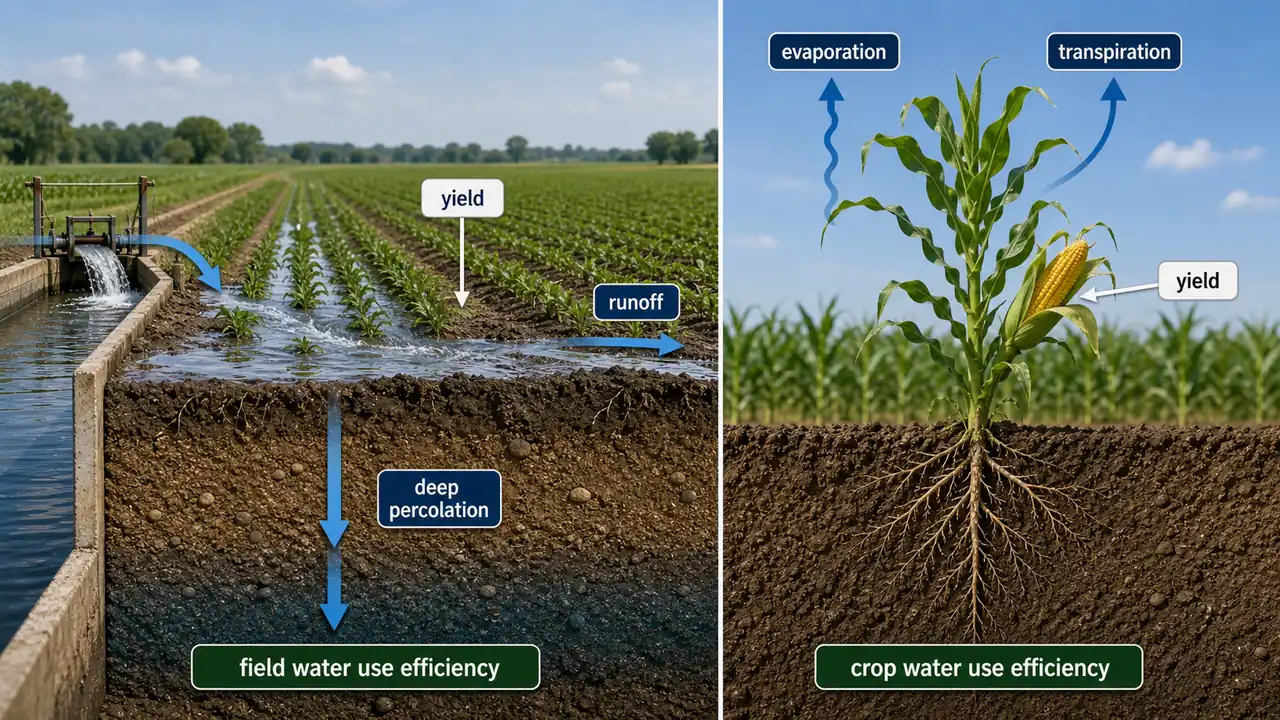
Where: ET = Evapotranspiration, S = Groundwater contribution, D = Deep percolation, E = Evaporation, T = Transpiration, G = Metabolic use.
Water Use Efficiency of Major Field Crops

WUE varies significantly across crops. C4 crops like sugarcane and maize are inherently more water-efficient (producing more dry matter per unit water) than C3 crops like wheat and rice. Among field crops, maize typically has the highest WUE (15--25 kg grain/ha-mm), while rice has one of the lowest (4--8 kg grain/ha-mm) due to its standing water requirement.
Consumptive Water Use Efficiency
Ratio of consumptive water use by the crop to irrigation water stored in the root zone.

Where: Ecu = Consumptive use efficiency (%), Wcu = Normal consumptive use, Wd = Net water depleted from root zone.
Consumptive Use of Water
- Losses due to evapotranspiration plus water used for metabolic activities.
- CU = ET + water used in metabolic activities
- Since metabolic water use is less than 1% of ET, practically: Consumptive Use = Evapotranspiration.
TIP
Exam shortcut: For all practical purposes, CU = ET. The metabolic water component is negligible (<1%). Exams sometimes try to confuse by asking "Is CU same as ET?" -- the answer is "practically yes, theoretically CU includes metabolic use."
Irrigation Requirement
I.R. = W.R. - (E.R. + G.W.)
| Symbol | Meaning |
|---|---|
| W.R. | Water requirement |
| E.R. | Effective rainfall |
| G.W. | Groundwater contribution |
Irrigation only needs to supplement what nature does not provide.
Agricultural example: If wheat needs 500 mm (W.R.), effective rainfall is 150 mm, and groundwater contribution is 50 mm, then I.R. = 500 - (150 + 50) = 300 mm of irrigation. A farmer who applies 500 mm through irrigation without accounting for rainfall wastes 200 mm of water.
Irrigation Efficiency
Ratio of water consumed by crop to water delivered from source.

Most irrigation projects achieve only 12--34% efficiency -- indicating massive water losses during conveyance and application. This means for every 100 litres released from the reservoir, only 12--34 litres actually reach the crop.
Water Storage Efficiency
Ratio of water stored in root zone by irrigation to water needed to bring root zone to field capacity. Also called water storage factor.

Water Conveyance Efficiency
Ratio of water delivered at field outlet to water diverted into canal system.

About 21% losses occur in earthen watercourses alone. Lining canals and piped systems significantly reduce losses.
Efficiency Comparison Table
| Efficiency Type | What It Measures | Typical Range | How to Improve |
|---|---|---|---|
| Irrigation Efficiency | Water consumed by crop / water from source | 12--34% in most projects | Drip/sprinkler; canal lining |
| Water Storage Efficiency | Water stored in root zone / water needed to FC | Varies by soil type | Proper irrigation scheduling |
| Water Conveyance Efficiency | Water at field / water at canal head | ~79% (21% loss in earthen channels) | Canal lining; piped systems |
| Consumptive Use Efficiency | CU by crop / water stored in root zone | Higher with drip/sprinkler | Deficit irrigation; mulching |
Other Important Irrigation Terminologies
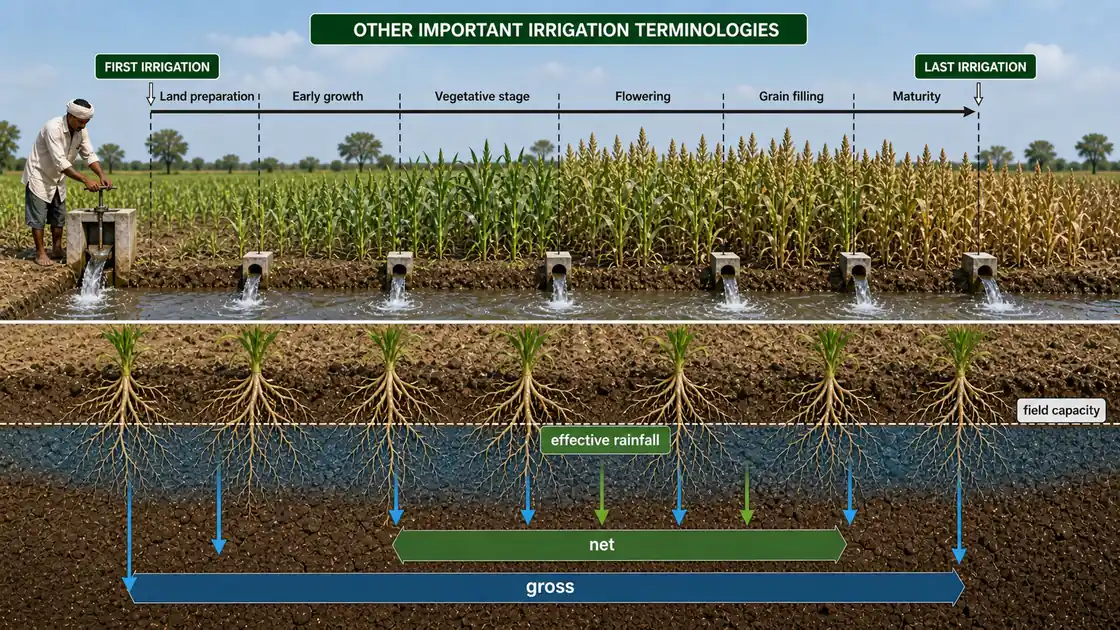
Command Area Terms
| Term | Definition | Key Difference |
|---|---|---|
| Gross Command Area (GCA) | Total area including cultivable land, forests, roads, wasteland Exams | Includes ALL land |
| Culturable Command Area (CCA) | Part of GCA fit for cultivation (excludes forest, barren land) | Only cultivable land |
| Gross Irrigated Area | Total area irrigated, counting multi-cropped land multiple times | Area irrigated x crops |
| Irrigation Potential Created | Total area proposed to be irrigated (design capacity) | What the project CAN do |
| Irrigation Potential Utilized | Area actually irrigated out of potential created | What is ACTUALLY done |
NOTE
The gap between potential created and potential utilized is a major concern in Indian irrigation, often caused by incomplete distribution networks, poor maintenance, or lack of farmer participation. India has created irrigation potential for over 115 million hectares but utilizes only about 90 million hectares.
Agricultural example: The Sardar Sarovar Project on the Narmada was designed to irrigate 18 lakh hectares (GCA) in Gujarat. However, the Culturable Command Area is only about 14 lakh hectares because the rest includes forests, roads, and habitations.
Transpiration Ratio
Transpiration Ratio = Water transpired by a crop / Dry matter produced
A higher transpiration ratio means the crop is less water-efficient — it uses more water to produce each unit of dry matter. C4 plants (sugarcane, maize) generally have lower transpiration ratios (more water-efficient) than C3 plants (wheat, rice).
TIP
Exam tip: Transpiration ratio is the inverse of water use efficiency. Lower transpiration ratio = higher WUE = better crop for water-scarce areas. C4 crops are more water-efficient than C3 crops.
Fertigation
Fertigation is applying fertilizers through the irrigation system -- delivers nutrients directly to the root zone, reducing waste and improving uptake. It is most effective with drip irrigation systems.
| Fertilizer | Grade (N-P-K) |
|---|---|
| Ammonium Nitrate | 34-0-0 |
| Ammonium Sulphate | 21-0-0 |
| Urea | 46-0-0 |
| Diammonium Phosphate | 18-46-0 |
| Potassium Chloride | 0-0-60 |
| Potassium Nitrate | 13-0-44 |
Agricultural example: A drip-irrigated banana plantation in Jalgaon (Maharashtra) uses fertigation with water-soluble NPK, achieving 20--30% higher yields with 30% less fertilizer compared to conventional application. The nutrients go directly to the root zone instead of being lost to leaching or runoff.

TIP
Exam tip: Fertigation = Fertilizer + Irrigation. It is most commonly associated with drip irrigation. Benefits: precise nutrient delivery, reduced fertilizer waste, higher nutrient use efficiency, lower groundwater contamination.
Summary Table
| Topic | Key Point |
|---|---|
| Water Requirement formula | WR = IW + ER + S |
| Irrigation Requirement formula | IR = WR - (ER + GW) |
| Highest water need (cereal) | Rice: 1200 mm, 18 irrigations |
| Highest water need (overall) | Sugarcane: 2000 mm, 24 irrigations |
| Lowest water need | Pulses: 200--450 mm |
| Rice critical stage | Panicle initiation; 5 cm submergence at flowering |
| Wheat critical stage | Crown root initiation (CRI) |
| Maize critical stage | Tasseling and Silking |
| Cotton critical stage | Flowering and Boll formation |
| Sugarcane critical stage | Formative phase (120 days from planting) |
| Groundnut critical stage | Peg initiation and pod development |
| India's WUE | 30--40% (China: 55%); one of the lowest globally |
| CU = ET | Metabolic use < 1% of ET, so CU is practically equal to ET |
| Irrigation efficiency (projects) | Only 12--34% in most Indian projects |
| Conveyance loss | ~21% in earthen watercourses |
| Fertigation | Fertilizer through irrigation; ideal for drip systems |
| GCA vs CCA | GCA includes all land; CCA only cultivable land |
| Water-saving in rice | AWD technique saves 30% water over continuous submergence |
Summary Cheat Sheet
| Concept / Topic | Key Details |
|---|---|
| Water Requirement formula | WR = IW + ER + S |
| Irrigation Requirement | IR = WR - (ER + GW) |
| Highest water need (cereal) | Rice: 1200 mm, 18 irrigations |
| Highest water need (overall) | Sugarcane: 2000 mm, 24 irrigations |
| Lowest water need | Pulses: 200-450 mm |
| Rice critical stage | Panicle initiation; 5 cm submergence at flowering |
| Wheat critical stage | Crown root initiation (CRI) |
| Maize critical stage | Tasseling and Silking |
| Cotton critical stage | Flowering and Boll formation |
| Sugarcane critical stage | Formative phase (120 days from planting) |
| Groundnut critical stage | Peg initiation and pod development |
| India's WUE | 30-40% (China: 55%); one of lowest globally |
| CU = ET | Metabolic use < 1% of ET |
| Irrigation efficiency | Only 12-34% in most Indian projects |
| Conveyance loss | ~21% in earthen watercourses |
| Fertigation | Fertilizer through irrigation; ideal for drip systems |
| AWD in rice | Saves 30% water over continuous submergence |
| Transpiration Ratio | Water transpired / dry matter produced — higher = less water-efficient |
| C4 vs C3 water efficiency | C4 crops have lower transpiration ratio (more efficient) than C3 |
TIP
Next: Lesson 05 covers Irrigation Methods -- surface (flood, basin, border strip, furrow), sub-surface, and micro-irrigation (sprinkler, drip) with efficiency comparisons and PMKSY subsidy details.