📊 Weed Indices, Seed Dispersal and Key Terminology
Master weed seed dispersal mechanisms, quantitative weed indices (WI, WCE, WSE), critical periods of crop-weed competition for all major crops, herbicide bioassay indicator plants, and essential weed science terminology.
Seeds That Travel Thousands of Kilometres
The previous lesson covered allelopathy, annidation, and crop rotation effects -- the chemical and ecological dimensions of weed science. This final lesson completes the weed science module with practical tools and terminology that tie everything together: how weed seeds disperse, how we measure weed control effectiveness, when weeding matters most, and the key terms that appear in competitive exams.
In the vast grasslands of Argentina, mature plants of Mexican prickly poppy (Argemone mexicana) dry up and break free from the soil. The wind rolls the entire dead plant across the plains like a tumbleweed, scattering seeds with every bounce. This dramatic censer mechanism can carry seeds for kilometres. Understanding how weed seeds travel is the foundation of preventive weed management -- if you know the pathways, you can block them.
Pro Content Locked
Upgrade to Pro to access this lesson and all other premium content.
Charged once for one year · ₹1188 total
Save ₹100/month vs ₹2388/year launch price
- All Agriculture & Banking Courses
- AI Lesson Questions (100/day)
- AI Doubt Solver (50/day)
- Glows & Grows Feedback (30/day)
- AI Section Quiz (20/day)
- 22-Language Translation (100/day)
- Recall Questions (20/day)
- AI Quiz (15/day)
- AI Quiz Paper Analysis (100/day)
- AI Step-by-Step Explanations (100/day)
- Spaced Repetition Recall (FSRS)
- AI Tutor
- Immersive Text Questions
- Audio Lessons — Hindi & English
- Mock Tests & Previous Year Papers
- Summary & Mind Maps
- XP, Levels, Leaderboard & Badges
- Generate New Classrooms
- Voice AI Teacher (AgriDots Live)
- AI Revision Assistant
- Knowledge Gap Analysis
- Interactive Revision (LangGraph)
🔒 Secure one-time yearly payment via Razorpay · No hidden fees
Seeds That Travel Thousands of Kilometres
The previous lesson covered allelopathy, annidation, and crop rotation effects -- the chemical and ecological dimensions of weed science. This final lesson completes the weed science module with practical tools and terminology that tie everything together: how weed seeds disperse, how we measure weed control effectiveness, when weeding matters most, and the key terms that appear in competitive exams.
In the vast grasslands of Argentina, mature plants of Mexican prickly poppy (Argemone mexicana) dry up and break free from the soil. The wind rolls the entire dead plant across the plains like a tumbleweed, scattering seeds with every bounce. This dramatic censer mechanism can carry seeds for kilometres. Understanding how weed seeds travel is the foundation of preventive weed management -- if you know the pathways, you can block them.
This lesson covers:
- Seed dispersal mechanisms -- autochory, wind, water, human, animal, bird
- Weed indices -- Weed Index, WCE, WSE formulas and interpretation
- Critical periods of crop-weed competition for all major crops
- Herbicide bioassay -- indicator plants for residue detection
- Key terminology -- adjuvant, safener, epinasty, and more
- Herbicide combination responses -- synergistic, antagonistic, additive
Dispersal of Weed Seeds
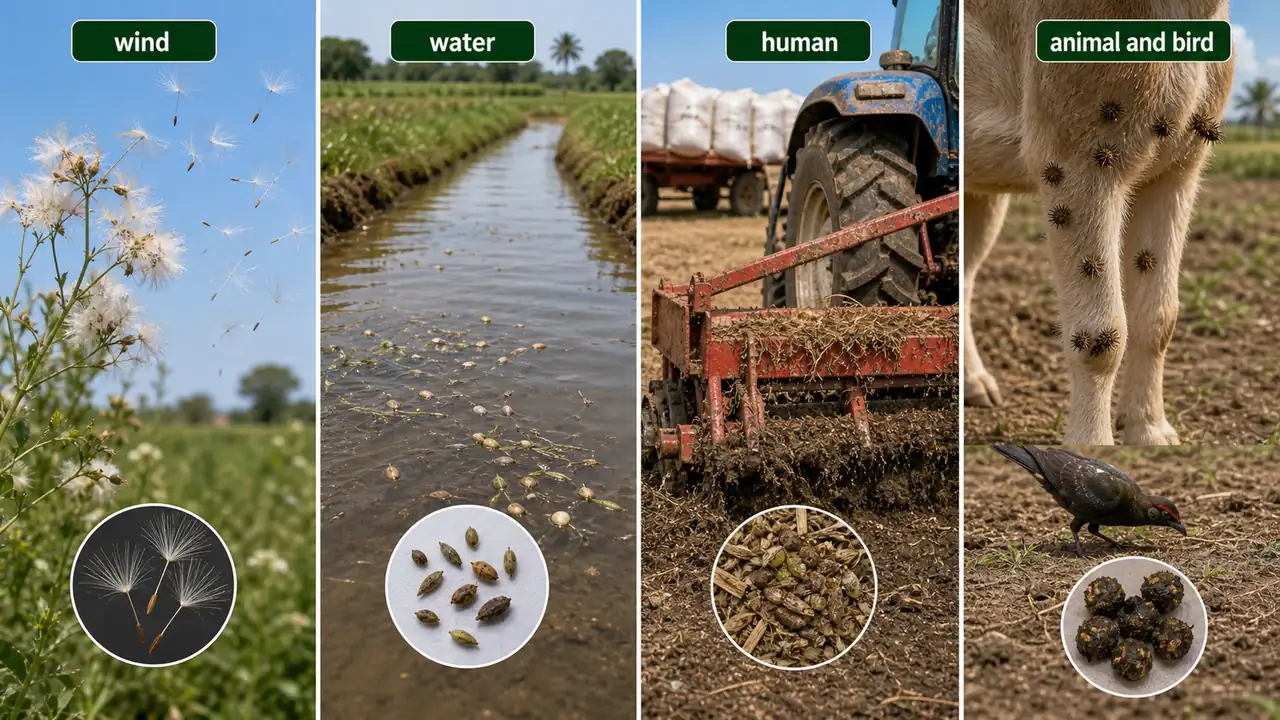
Seed dispersal is classified into two broad categories:
| Category | Mechanism | Key Feature |
|---|---|---|
| Autochory | Dispersal by the plant itself using special structures (pappus, wing, balloon, persistent style) | Dominant in legume seeds (explosive pod dehiscence) |
| Allochory | Dispersal by external agents -- wind, water, animals, birds, humans, manure, crop seed | Most weed seeds travel via allochory |
1. Wind Dispersal (Anemochory)
Seeds possess special floating or flight organs:
| Organ | Description | Example |
|---|---|---|
| Pappus | Feathery modification of calyx acting like a parachute | Asteraceae, Typhaceae |
| Comose | Silky hairs attached to seeds | Calotropis sp. |
| Feathery | Light structures for buoyancy | Saccharum spontaneum |
| Balloon | Inflated structures trapping air | Physalis |
Censer Mechanism: Wind detaches the whole plant and rolls it over long distances like a tumbleweed, dispersing seeds along the way. Common with Salsola (Russian weed) and Argemone mexicana.
2. Water Dispersal (Hydrochory)
Seeds with waterproof coats or air-filled structures float and are carried by irrigation channels, floods and rainfall runoff. Canal-bank weeds are major seed sources.
3. Human Dispersal (Anthropochory)
Through contaminated seed lots, farm machinery, transport of produce and movement between fields. This is the most significant dispersal agent in modern agriculture.
4. Bird Dispersal (Ornithochory)
Birds eat fleshy weed fruits and deposit viable seeds in droppings far from the parent plant. Loranthus (birdvine) is a classic example.
5. Animal Dispersal (Zoochory / Biotic)
0.2 to 9.6% of ingested weed seeds pass in viable form through animal excreta -- a significant pathway through grazing and manure application.
| Type | Mechanism |
|---|---|
| Endozoochory | Seeds eaten and passed through digestive system intact |
| Epizoochory | Seeds adhere to coat, hide or hooves |
| Myrmecochory | Dispersal by ants carrying seeds to nests |
6. Other Mechanisms
| Mechanism | Description |
|---|---|
| Through manures and silage | Incompletely composted manure is a major weed seed source |
| As admixtures | Mixed with crop seed, animal feed, hay and straw |
| Barochory | Dispersal by gravity -- heavy seeds fall and roll downhill |
TIP
Mnemonic for dispersal agents -- "WWHAB": Wind, Water, Human, Animal, Bird. Humans are the most significant in modern agriculture.
Weed Indices -- Quantitative Measures
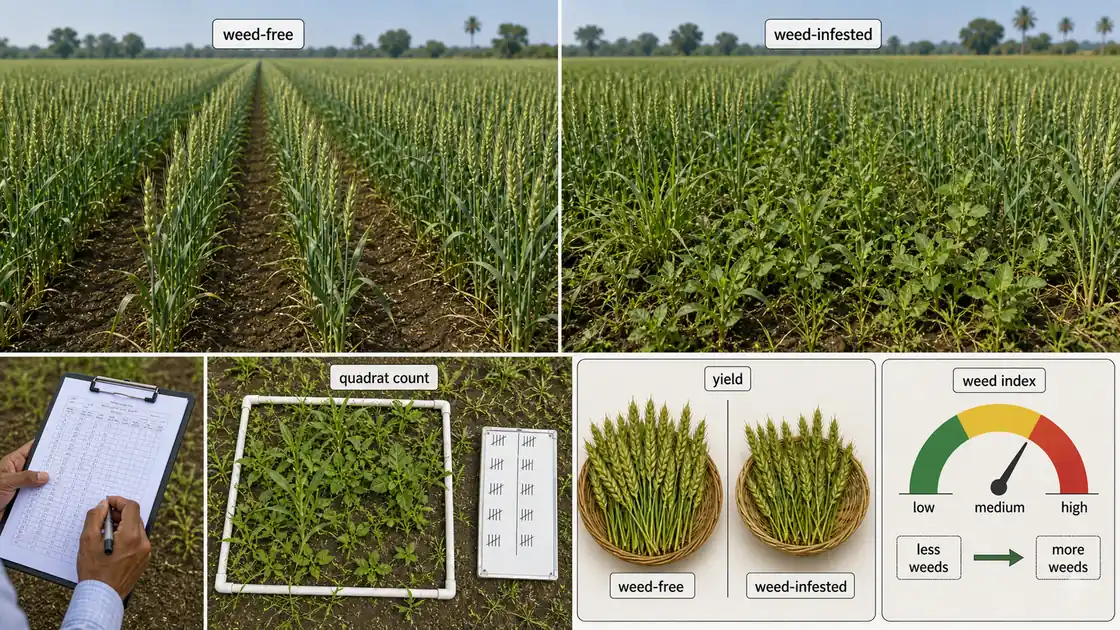
Once we understand how weeds disperse, we need ways to measure the severity of infestation and evaluate how well our control methods are working. Weed indices provide standardised formulas for this purpose. These formulas are frequently asked in competitive exams.
1. Weed Infestation (%)
Measures the percentage of weeds in total plant population:
Weed Infestation (%) = (Total weeds / (Total weeds + crop plants)) x 100
2. Weed Index / Weed Competition Index (RRB 2019)
Measures yield reduction due to weeds compared to a weed-free plot.
WI = (Yieldweed-free - Yieldtreated) / Yieldweed-free x 100
Lesser the weed index = better the herbicide efficiency. A weed index of zero means the treatment was as effective as keeping the field completely weed-free.
3. Weed Control Efficiency (WCE)
Measures percentage reduction in weed population (number) under treatment vs untreated control.
WCE (%) = (Weed countunweeded - Weed counttreated) / Weed countunweeded x 100
Higher WCE = better weed control.
4. Weed Smothering Efficiency (WSE) (Exams)
Measures the effect of intercropping on weed suppression compared to sole crop.
WSE (%) = (Weed dry wtsole crop - Weed dry wtintercropped) / Weed dry wtsole crop x 100
Comparison of Weed Indices
| Index | Measures | Numerator Basis | Interpretation |
|---|---|---|---|
| Weed Infestation | Weed proportion in total population | Weed count | Higher = worse infestation |
| Weed Index (WI) | Yield reduction due to weeds | Yield difference | Lower = better herbicide efficiency |
| WCE | Weed population reduction | Weed count difference | Higher = better control |
| WSE | Weed suppression by intercrop | Weed dry weight difference | Higher = better smothering |
IMPORTANT
WCE compares weed count (number), while WCI (Weed Competition Index) compares weed dry matter (biomass). Do not confuse the two -- they use different parameters.
TIP
Exam shortcut: For WI, remember "Less is Lovely" (lower WI = better). For WCE/WSE, "Higher is Happier" (higher = better control).
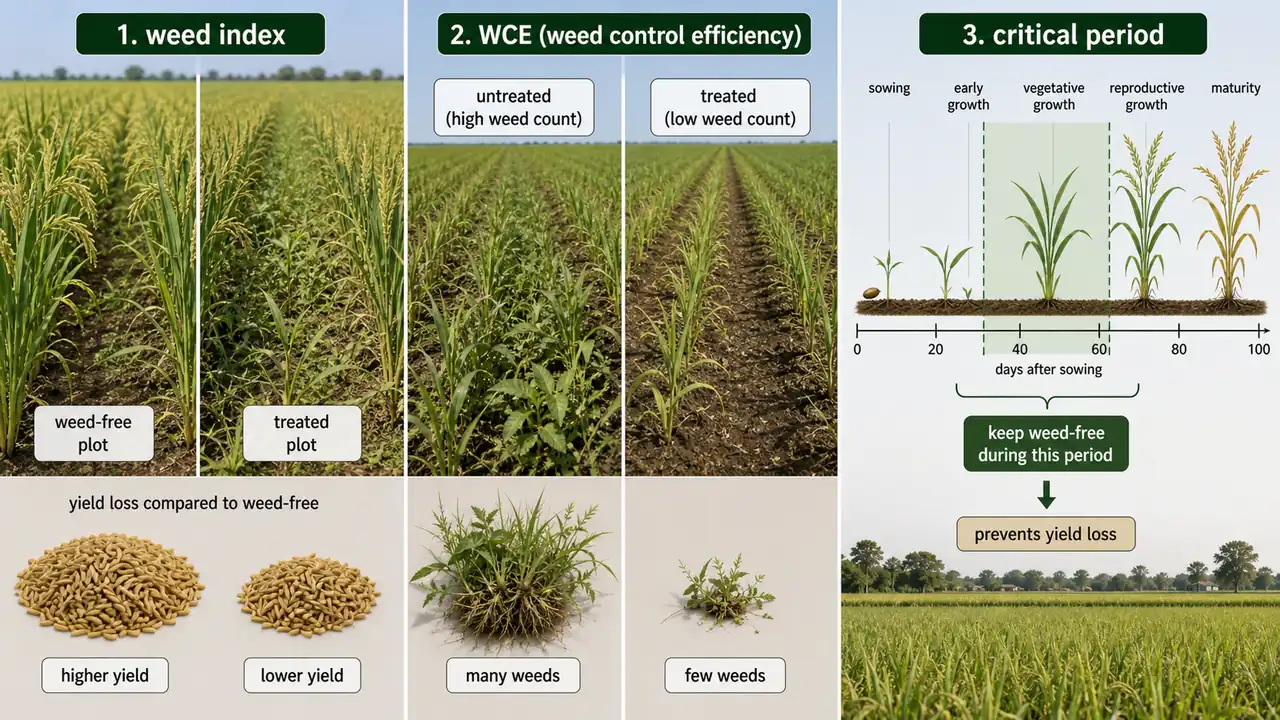
Critical Period of Crop-Weed Competition
Weed indices tell us how much damage weeds are causing. The next practical question is when to intervene. The critical period is the specific time window during which weed removal is most essential for preventing significant yield loss. Weeding outside this window has relatively less impact.
| Crop | Critical Period (DAS) | Crop | Critical Period (DAS) |
|---|---|---|---|
| Rice | 15-45 (avg. 30-35) | Pigeon pea | 30-60 |
| Wheat, Barley, Pearl millet | 30-50 | Green gram, Potato | 20-40 |
| Maize | 15-35 (avg. 20-30) | Black gram, Jute | 30-45 |
| Sorghum | 15-45 | Chickpea, Cotton | 15-60 |
| Soybean | 14-45 | Field Pea, Lentil | 20-60 |
| Groundnut | 15-35 | Sugarcane | 2-120 |
Sugarcane has the longest critical period (2-120 DAS) -- nearly four months. This is because sugarcane establishes canopy cover very slowly, leaving abundant space and light for weeds.
TIP
DAS = Days After Sowing. Key exam facts: sugarcane has the longest critical period. Closely spaced cereals (wheat, barley) start later (30 DAS) because their early dense canopy provides some weed suppression.
Herbicide Bioassay
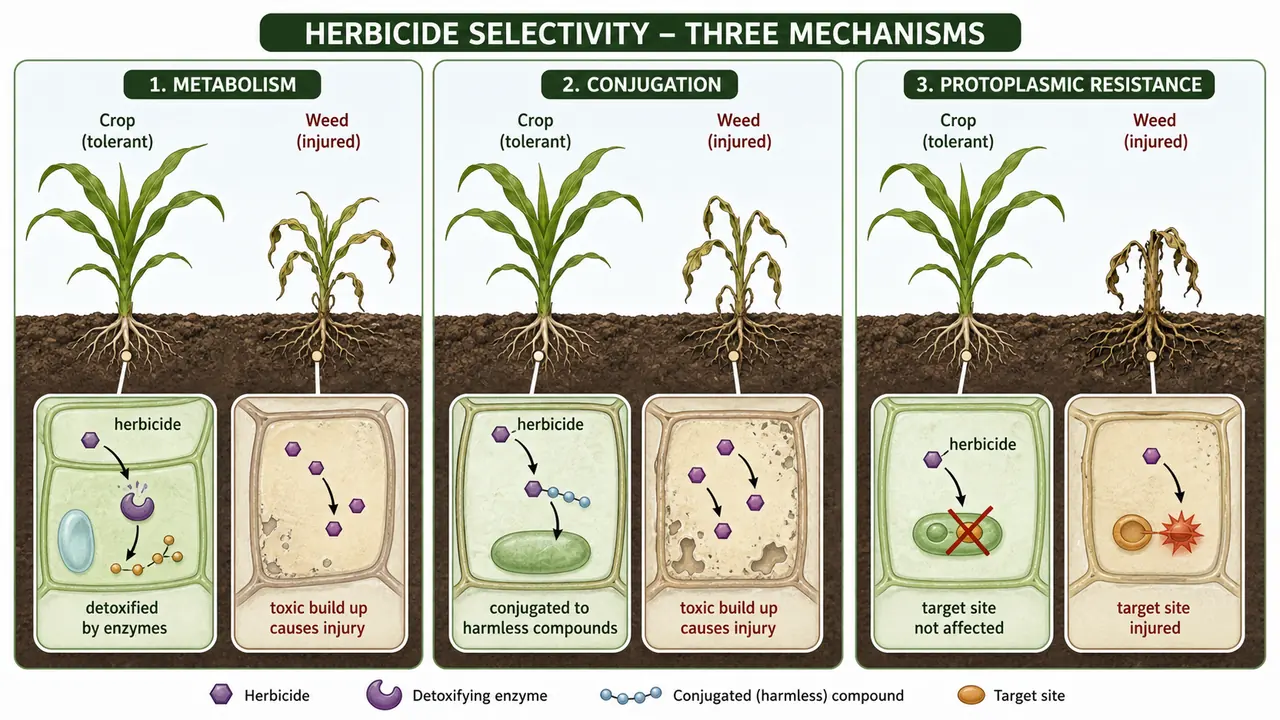
A bioassay determines if herbicide residues are present in soil at concentrations that affect plant growth. Sensitive indicator plants are grown in suspect soil -- toxicity symptoms confirm residues.
| Herbicide | Indicator Plants |
|---|---|
| Atrazine | Soybean, Oats, Cucumber |
| Fluchloralin | Maize, Millet |
| Oxadiazon | Sorghum |
| Pendimethalin | Maize, Millet |
| Simazine | Mustard, Oat |
| 2,4-D | Mustard & Rapeseed, Cucumber |
NOTE
Indicator plants are chosen because they are highly sensitive to the specific herbicide. Damage symptoms (stunting, chlorosis, epinasty) appear even at very low residue concentrations.
Key Terminology
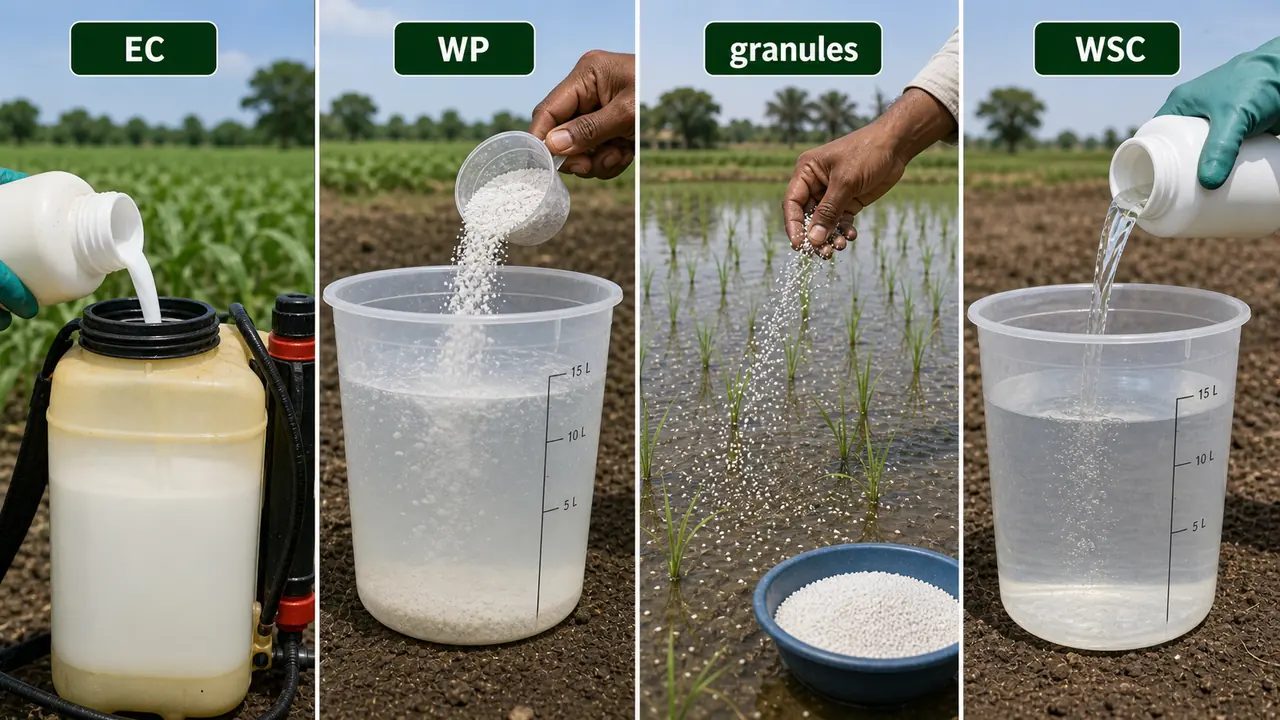
The following terms cover herbicide application, plant responses, and formulation additives. They appear frequently in competitive exams and are essential for precise communication in weed science:
| Term | Definition | Why It Matters |
|---|---|---|
| Adjuvant | Chemical added to improve herbicidal effect without being phytotoxic itself | Enhances performance, not toxicity |
| Safener | Reduces herbicide effect on crop plants, improving selectivity | Crop is protected while weed is still killed |
| Emulsifier | Allows petroleum-based pesticides (EC formulations) to mix with water | Essential for EC formulation preparation |
| Spreader | Facilitates uniform distribution of spray by reducing surface tension | Better coverage on waxy leaves |
| Thickener | Reduces spray drift by increasing droplet size | Important in windy conditions |
| Surfactant | Decreases surface tension (general category including spreaders and wetting agents) | Umbrella term for surface-active additives |
| Humicant | Prevents rapid drying of spray on foliage, extending absorption time | Improves herbicide uptake |
| Epinasty | Increased growth on upper surface of plant organ causing downward bending | Characteristic symptom of auxin herbicides (2,4-D) |
| Flaming | Momentary exposure of weeds to 1000 degrees C from flame throwers | Coagulates cell proteins |
TIP
Exam distinction: Adjuvant = helps the herbicide work better. Safener = protects the crop from the herbicide. They do opposite jobs!
Response Types in Herbicide Combinations
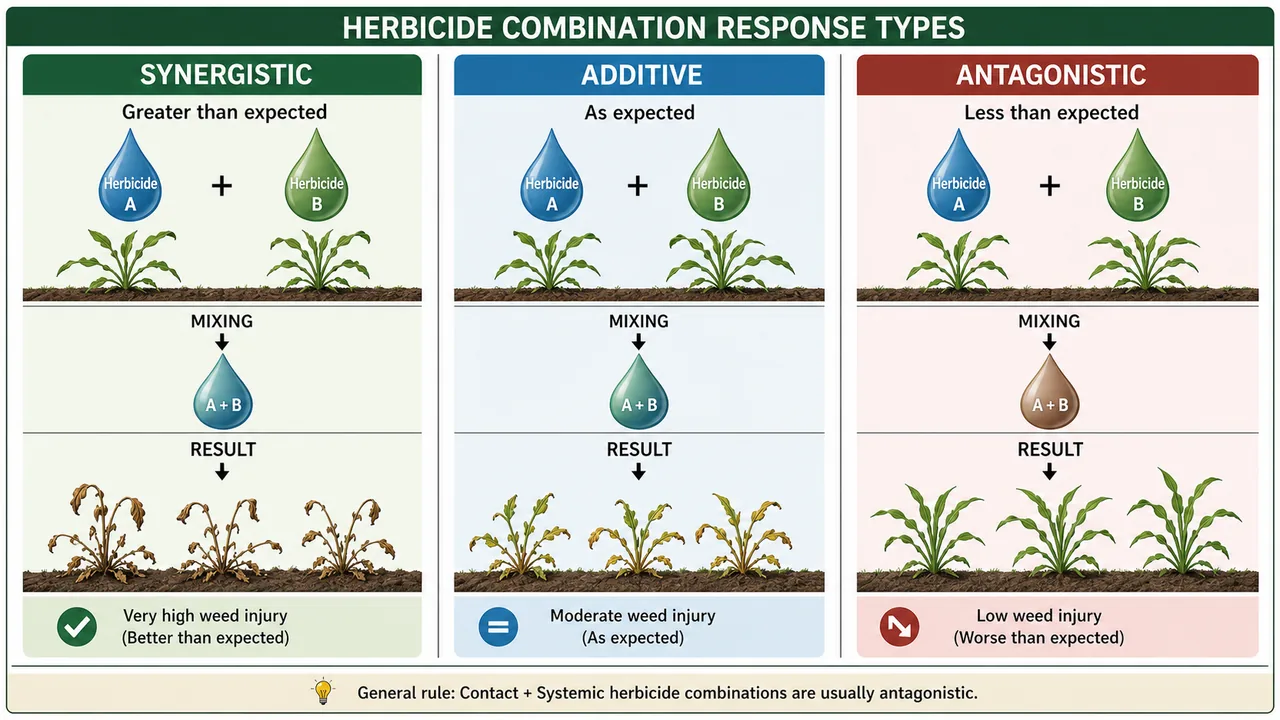
In IWM practice, herbicides are often tank-mixed for broader weed spectrum control. Understanding how two herbicides interact when combined is critical for avoiding wasted money and ensuring effective control. When two or more herbicides are mixed, their combined effect can take different forms:
| Response Type | Combined Effect | Analogy | Example |
|---|---|---|---|
| Additive | Sum of individual effects (2+3=5) | As expected | -- |
| Synergistic | Greater than sum (2+3=8) | Bonus effect | 2,4-D + Chlorpyriphos |
| Antagonistic | Less than the most active alone (2+3=1) | Cancelling out | EPTC + 2,4-D in sorghum |
| Independent | Equal to the most active alone (2+3=3) | No interaction | -- |
| Enhancement | Herbicide + non-toxic adjuvant performs better | Booster | Ammonium sulphate + Glyphosate |
Important Synergistic Combinations
| Combination | Benefit |
|---|---|
| Atrazine + 2,4-D | Broad-spectrum control at lower individual doses |
| Atrazine + Alachlor | Pre-emergence grassy + broadleaf weed control |
| Paraquat + Pentachlor | Enhanced contact + residual activity |
Important Antagonistic Combinations (Avoid)
| Combination | Problem |
|---|---|
| Dalapon + Atrazine | Reduced efficacy of both herbicides |
| TCA + 2,4-D | Antagonistic interaction reduces weed kill |
| TCA + MCPA | Similar antagonism as TCA + 2,4-D |
IMPORTANT
General rule: Contact + Systemic herbicide = generally Antagonistic. The contact herbicide kills surface tissue before the systemic can be absorbed and translocated, reducing overall efficacy. Avoid such tank mixes.
TIP
Synergistic combinations are desirable (better results with less chemical). Antagonistic combinations must be avoided (wasted money, poor control). Always check compatibility before tank mixing.
Autotoxy (Revisited)
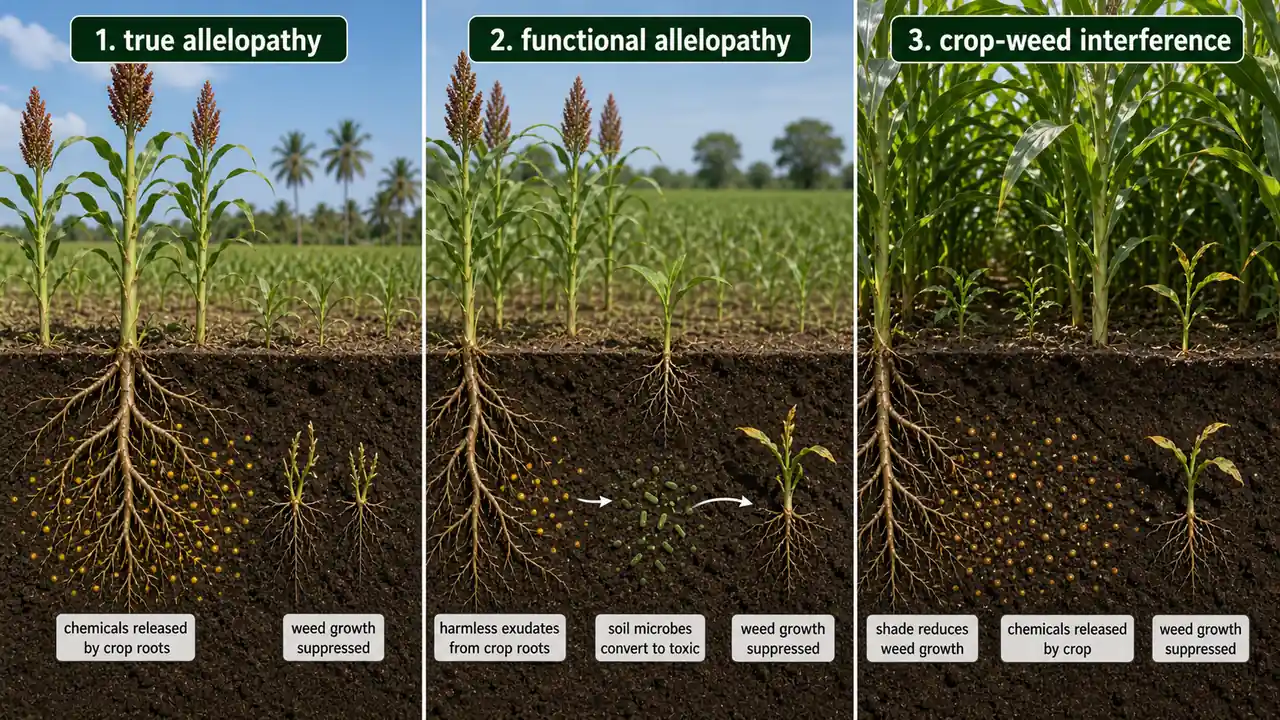
Autotoxy = self-toxicity -- where a plant's own allelochemicals inhibit its own species. Classic example: Parthenium daughter plants suppress parent plants, limiting colony density.
Summary Cheat Sheet
| Concept / Topic | Key Details |
|---|---|
| Two dispersal categories | Autochory (self) vs Allochory (external agents) |
| Most significant dispersal agent | Humans (anthropochory) |
| Censer mechanism | Whole plant rolls like tumbleweed (Salsola, Argemone) |
| Viable seeds in excreta | 0.2-9.6% of ingested seeds |
| Weed Index | Lower = better herbicide efficiency |
| WCE (Weed Control Efficiency) | Higher = better weed control |
| WSE | Measures intercropping's weed suppression effect |
| Longest critical period | Sugarcane (2-120 DAS) |
| Epinasty | Downward leaf bending — symptom of 2,4-D |
| Adjuvant | Helps herbicide performance |
| Safener | Protects crop from herbicide damage |
| Synergistic example | 2,4-D + Chlorpyriphos |
| Antagonistic example | EPTC + 2,4-D in sorghum |
| Autotoxy | Self-toxicity — plant inhibits its own species |
| Enhancement | Herbicide + non-toxic adjuvant performs better |
| Contact + Systemic rule | Generally antagonistic — contact kills tissue before systemic absorbs |
| Key synergistic combos | Atrazine + 2,4-D; Atrazine + Alachlor |
| Key antagonistic combos | Dalapon + Atrazine; TCA + 2,4-D |
| Flaming temperature | 1000°C — coagulates cell proteins |