🧬 Allelopathy, Annidation and Crop Rotation Effects
Understand allelopathy (true vs functional), allelochemicals, how weeds suppress crops and vice versa, autotoxy in Parthenium, annidation in intercropping, and the legume, sorghum and cotton effects in crop rotation.
The Invisible Chemical War in Fields
The previous lesson on Integrated Weed Management showed that combining multiple control strategies is superior to any single method. This lesson explores a natural phenomenon that can serve as one of those strategies: allelopathy -- the chemical warfare that plants wage on each other. Understanding allelopathy opens the door to using crops and their residues as biological weed suppressants.
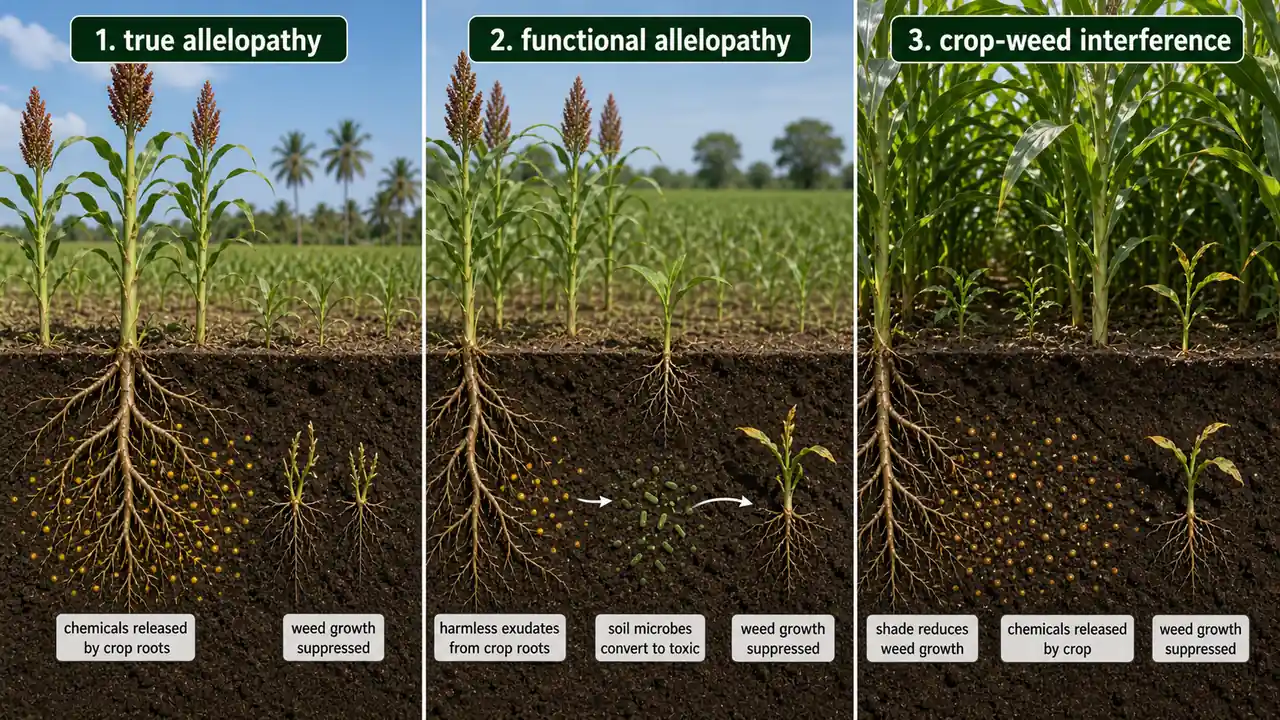
In a sorghum field in Maharashtra, a farmer notices that weeds like Setaria and Digitaria rarely thrive near his sorghum crop, even where hand weeding was skipped. The reason is not competition for water or nutrients -- it is allelopathy. The sorghum roots release chemicals called sorgoleone that suppress the growth of neighbouring plants. This chemical warfare happens silently in the soil, invisible to the eye but powerful enough to shape weed communities.
Pro Content Locked
Upgrade to Pro to access this lesson and all other premium content.
Charged once for one year · ₹1188 total
Save ₹100/month vs ₹2388/year launch price
- All Agriculture & Banking Courses
- AI Lesson Questions (100/day)
- AI Doubt Solver (50/day)
- Glows & Grows Feedback (30/day)
- AI Section Quiz (20/day)
- 22-Language Translation (100/day)
- Recall Questions (20/day)
- AI Quiz (15/day)
- AI Quiz Paper Analysis (100/day)
- AI Step-by-Step Explanations (100/day)
- Spaced Repetition Recall (FSRS)
- AI Tutor
- Immersive Text Questions
- Audio Lessons — Hindi & English
- Mock Tests & Previous Year Papers
- Summary & Mind Maps
- XP, Levels, Leaderboard & Badges
- Generate New Classrooms
- Voice AI Teacher (AgriDots Live)
- AI Revision Assistant
- Knowledge Gap Analysis
- Interactive Revision (LangGraph)
🔒 Secure one-time yearly payment via Razorpay · No hidden fees
The Invisible Chemical War in Fields
The previous lesson on Integrated Weed Management showed that combining multiple control strategies is superior to any single method. This lesson explores a natural phenomenon that can serve as one of those strategies: allelopathy -- the chemical warfare that plants wage on each other. Understanding allelopathy opens the door to using crops and their residues as biological weed suppressants.
In a sorghum field in Maharashtra, a farmer notices that weeds like Setaria and Digitaria rarely thrive near his sorghum crop, even where hand weeding was skipped. The reason is not competition for water or nutrients -- it is allelopathy. The sorghum roots release chemicals called sorgoleone that suppress the growth of neighbouring plants. This chemical warfare happens silently in the soil, invisible to the eye but powerful enough to shape weed communities.
This lesson covers:
- Allelopathy definition and types -- true vs functional, coined by Molisch (1937)
- Allelochemicals -- secondary metabolites that drive chemical interference
- Weed-on-crop, weed-on-weed, and crop-on-weed allelopathy -- practical examples
- Annidation -- complementary niche sharing in intercropping
- Crop rotation effects -- legume, sorghum, and cotton effects
What is Allelopathy?
- Term coined by Molisch (1937).
- Etymology: Greek allelo (each other) + patho (suffering/disease).
- Synonym: Allelopathy = Teletoxy.
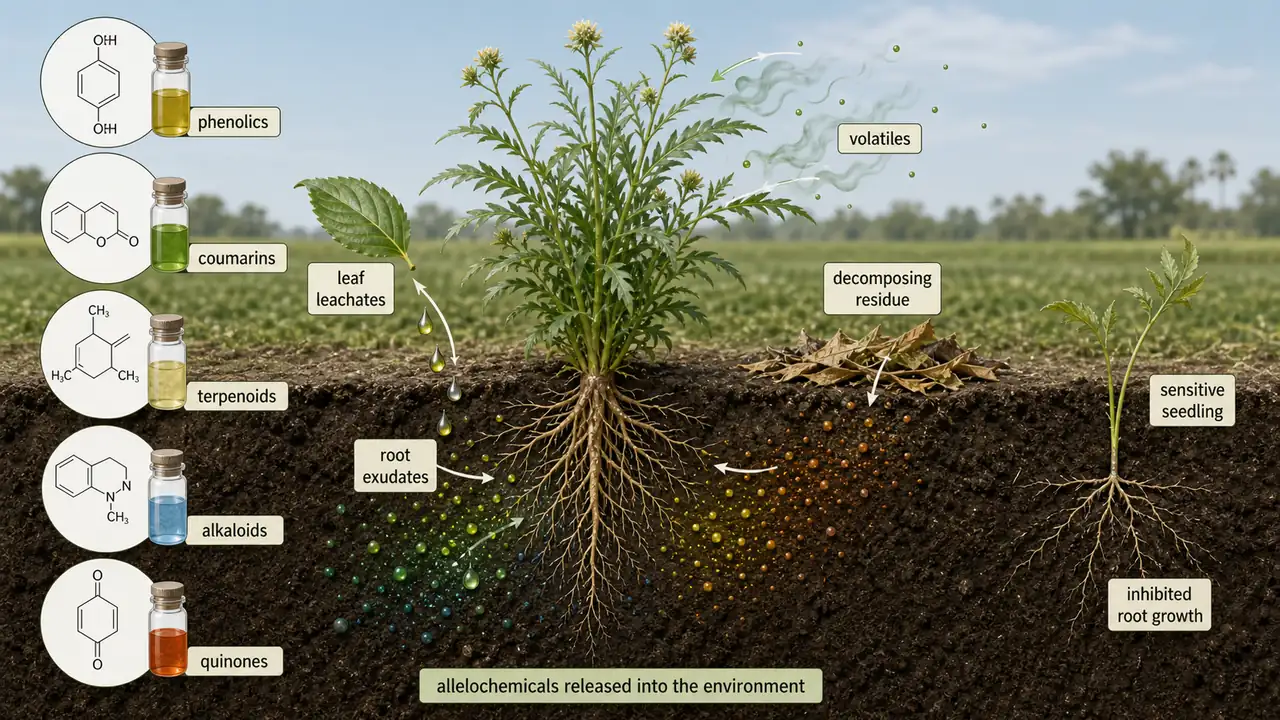
Allelopathy is a biological phenomenon where an organism produces biochemicals (allelochemicals) that influence the growth, survival and reproduction of other organisms. These chemicals are released through:
- Root exudates
- Leaf leachates
- Volatile emissions
- Decomposition of plant residues
Key Distinctions
| Concept | Definition |
|---|---|
| Allelopathy | Chemical inhibition or stimulation of one plant by another -- independent of resource availability |
| Competition | Struggle for the same limited resource (water, light, nutrients) |
| Crop-Weed Interference | The broader term that includes both competition and allelopathy working together |
NOTE
Critical exam distinction: Competition = fighting for the same resource. Allelopathy = chemical warfare, independent of resources. Both can occur simultaneously.
Types of Allelopathy
| Type | Mechanism | Example |
|---|---|---|
| True Allelopathy | Plant releases toxic substances directly from living or decaying tissue | Sorghum releasing sorgoleone from roots |
| Functional Allelopathy | Plant releases a harmless precursor that is converted into a toxic substance by soil microorganisms | Microbial transformation of plant exudates in soil |
TIP
Memory hook: True = toxin comes directly from the plant. Functional = soil microbes "function" as the converter to produce the toxin.
Allelochemicals -- The Chemical Arsenal
Allelochemicals are specific chemicals responsible for allelopathic effects. They are produced as end products, by-products and metabolites of plant metabolism.
| Chemical Group | Role |
|---|---|
| Phenolic acids | Most common group of allelochemicals |
| Benzoic acids | Aromatic inhibitors found in many allelopathic species |
| Cinnamic acids | Precursors to lignin; potent growth inhibitors |
| Coumarins | Lactone derivatives with germination-inhibiting properties |
| Hydroquinones | Oxidative stress inducers in target plants |
| Benzoquinones | Electron transport chain disruptors |
| Flavonoids | Aromatic defence compounds |
| Terpenoids | Volatile inhibitors |
| Steroids | Growth regulators |
| Alkaloids | Potent toxins |
| Organic cyanides | Toxic compounds (e.g., HCN) |
All are secondary metabolites -- not required for the plant's own basic metabolism (growth, development, reproduction). They serve as chemical defence and competitive tools.
Allelopathic Effects of Weeds on Crops
This table shows how specific weeds chemically suppress specific crops -- an important dimension beyond simple competition.
| Weed | Allelopathic Effect On | Type of Effect |
|---|---|---|
| Avena fatua, Phalaris minor | Germination of wheat | Inhibitory |
| Amaranthus sp. | Growth of maize and finger millet | Inhibitory |
| Parthenium (leaves and inflorescence) | Growth and germination of sorghum, maize; growth of wheat | Inhibitory |
| Cyperus esculentus (tubers) | Growth of maize and groundnut | Inhibitory |
| Cyperus esculentus (tubers) | Dry matter of wheat | Stimulatory (positive) |
| Argemone mexicana (leaves) | Growth and germination of wheat and finger millet | Inhibitory |
| Datura spp. | Growth and germination of sunflower | Inhibitory |
| Solanum (stem) | Germination and seedling growth of sorghum | Inhibitory |
| Cyperus rotundus | Germination of small grains, sorghum, soybean | Inhibitory |
| Celosia argentea | Growth and germination of pearl millet | Inhibitory |
| Canada thistle (root exudates) | Injured oat | Inhibitory |
| Euphorbia (root exudates) | Injured flax | Inhibitory |
| Quack grass (roots, leaves, seeds) | Nutrient uptake of maize | Inhibitory |
| Amaranthus retroflexus | Germination of cabbage and eggplant | Inhibitory |
TIP
Unique case: Cyperus esculentus inhibits maize and groundnut but stimulates wheat. Allelopathic effects are not always negative and can vary by target species. This is frequently asked in exams.
Weed-on-Weed Allelopathy
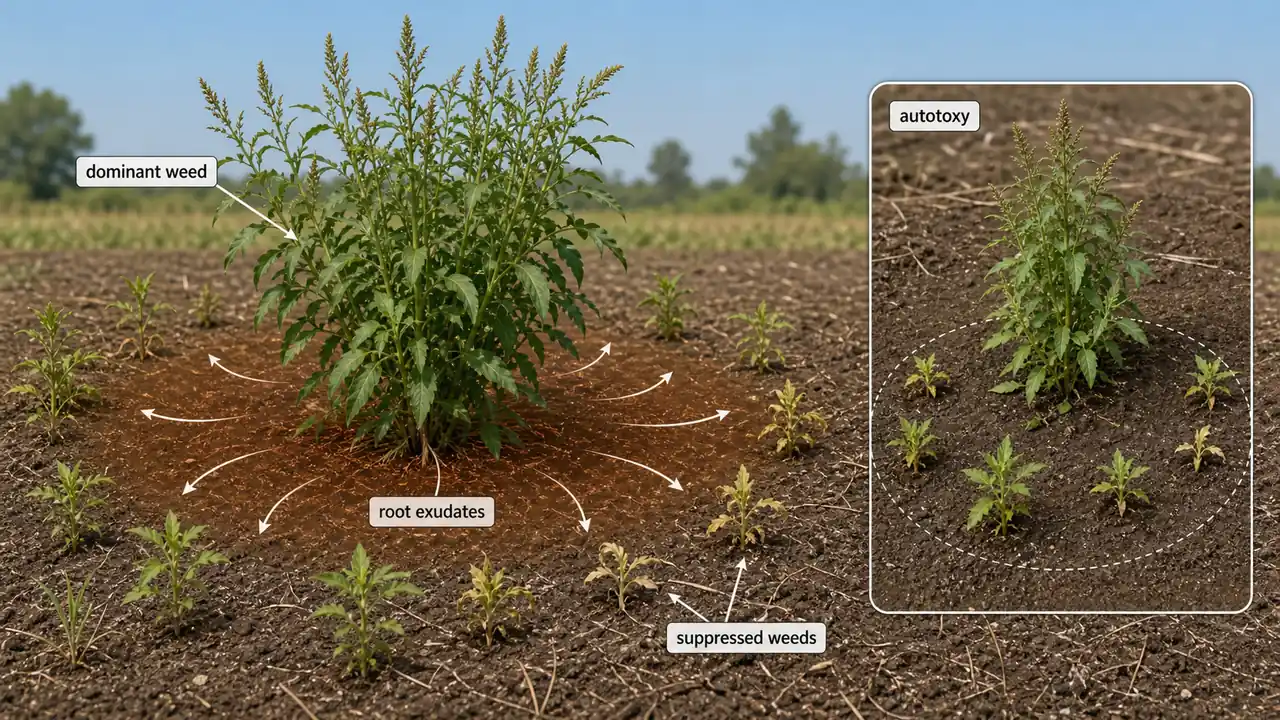
Weeds can suppress other weed species through allelopathy. A special case is autotoxy.
| Weed | Allelopathic Effect On |
|---|---|
| Cuscuta | Eichhornia crassipes |
| Sorghum halepense | Setaria, Digitaria, Amaranthus |
| Amaranthus, Trianthema | Echinochloa colonum |
| Imperata cylindrica | Borreria hispida |
| Eucalyptus | Cyperus rotundus, Cynodon dactylon |
Autotoxy
Autotoxy = self-toxicity -- where a plant's own allelochemicals inhibit its own species. The classic example: Parthenium daughter plants have an allelopathic effect on the parent plant, limiting colony density.
NOTE
The allelopathic effect of Eucalyptus on Cyperus rotundus and Cynodon dactylon is the basis for using Eucalyptus leaf mulch or agroforestry systems to suppress these difficult weeds -- a practical IWM application.
Crop-on-Weed Allelopathy
Allelopathy is not a one-way street -- crops can also suppress weeds:
| Crop Action | Effect | Practical Application |
|---|---|---|
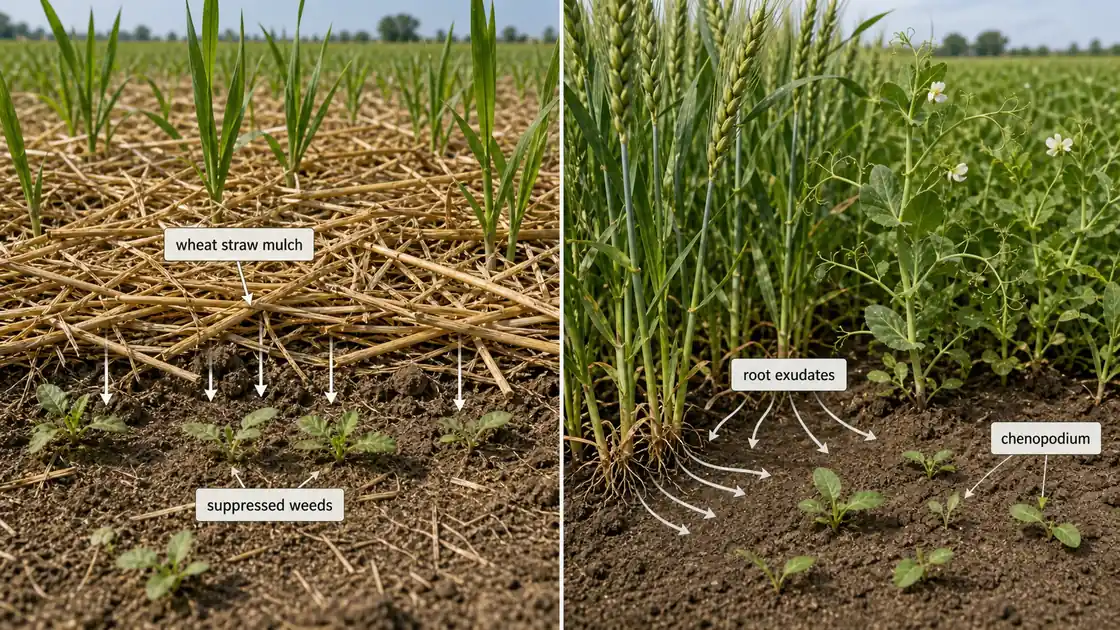
| Root exudates of wheat, oats and peas | Suppressed Chenopodium album | Explains why Bathua is less problematic in some rotations |
| Cold water extract of wheat straw | Reduces growth of Ipomoea and Abutilon | Supports use of wheat straw as allelopathic mulch |
TIP
Exam application: Allelopathic crops can be used strategically in crop rotations and as mulch to suppress specific problem weeds without chemicals.
Allelopathy as a Weed Control Tool
Allelopathic interactions can be harnessed practically for biological weed suppression -- an important component of IWM.
| Botanical Agent | Target Weed |
|---|---|
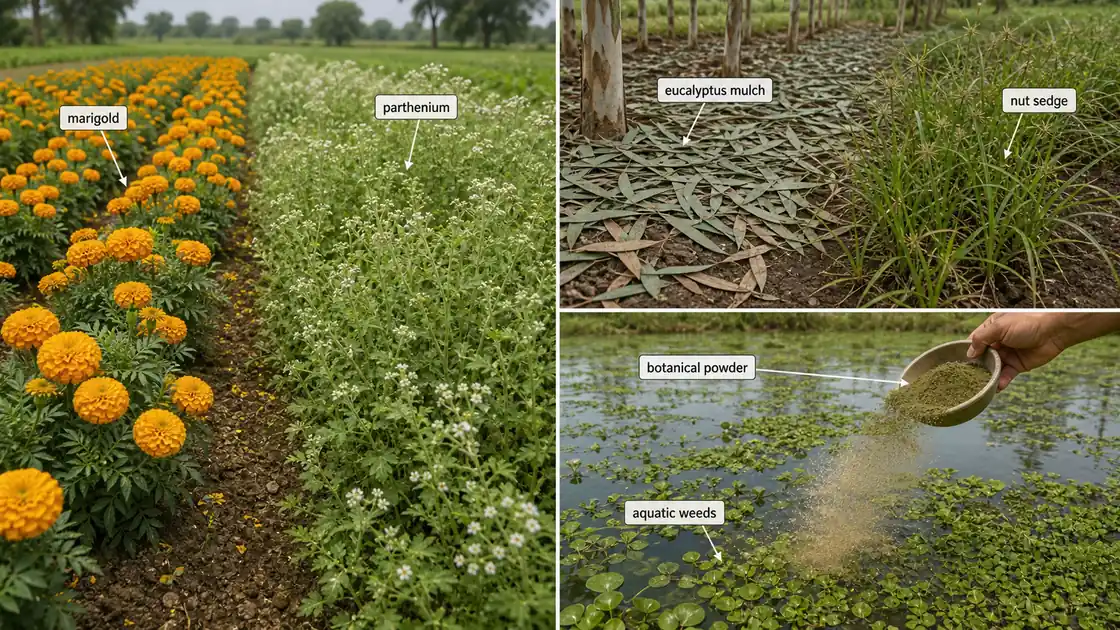
| Dry dodder powder | Water hyacinth (Eichhornia crassipes) |
| Carrot grass powder | Aquatic weeds |
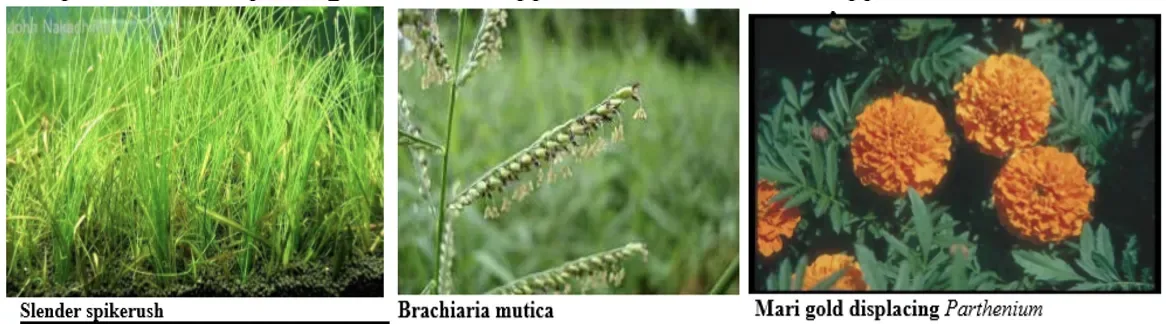
| Marigold (Tagetes erecta) | Parthenium spp. |
| Cassia spp. (coffeesenna) | Parthenium |
| Eucalyptus leaf leachates | Nut sedge (Cyperus rotundus), Bermuda grass (Cynodon dactylon) |
TIP
Exam tip: "Marigold controls Parthenium" and "Eucalyptus leachates suppress nut sedge and Bermuda grass" are frequently asked one-liners on allelopathic weed control.
Annidation -- Complementary Intercropping
While allelopathy describes chemical interactions between plants, annidation describes how plants can coexist productively by occupying different ecological niches. Both concepts are essential for designing effective intercropping systems.
Annidation refers to the complementary interaction between intercrops in an intercropping system. When two crops occupy different ecological niches, they avoid competition and coexist productively.
| Type | Interaction | Example |
|---|---|---|
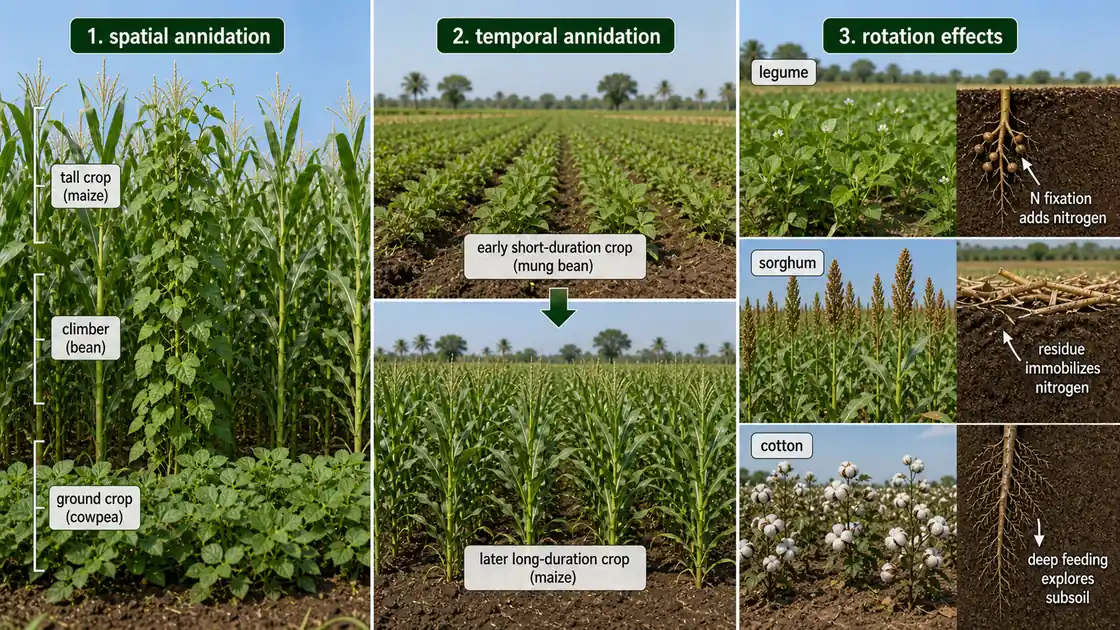
| Spatial Annidation (in space) | Different crops occupy different vertical layers | Multistorey cropping: coconut (tall) + black pepper (climber) + pineapple (ground level) |
| Temporal Annidation (in time) | Crops have different duration and peak demand periods for light and nutrients | Early-maturing pulse intercropped with late-maturing cereal |
TIP
Annidation = "niche differentiation" in intercropping. Spatial = different layers. Temporal = different timing. Both reduce competition.
Crop Rotation Effects

Allelopathy and annidation operate within a single season. Crop rotation effects extend this chemical and ecological thinking across seasons -- the residues and root activity of one crop alter soil conditions for the next. Three named effects are frequently tested in exams:
Legume Effect
- The beneficial effect of legumes in crop rotation is termed the Legume Effect
- Legumes save up to 25% of recommended nitrogen for the succeeding crop
- Legumes convert inorganic phosphorus into organic form, making insoluble soil phosphorus available for subsequent crops
Sorghum Effect
- Fast-growing cereals like sorghum exhaust soil nutrient status
- Crop residue with a wide C:N ratio decomposes slowly, temporarily immobilising soil nitrogen
- This creates nitrogen deficiency for the succeeding crop
- Remedy: Apply 25% more nitrogen at the first fertiliser dose of the succeeding crop
Cotton Effect
- Cotton feeds in the deeper soil layers, removing relatively small quantities of nutrients from the surface
- The succeeding crop with a shallow root system can tap the unused nutrient pool in surface layers
- This beneficial residual effect is the Cotton Effect
Comparison of Rotation Effects
| Effect | Mechanism | Impact on Succeeding Crop | Management Action |
|---|---|---|---|
| Legume Effect | N fixation + P mobilisation | Saves 25% N | Positive -- plan legumes before N-demanding crops |
| Sorghum Effect | N immobilisation from wide C:N residue | Temporary N deficiency | Apply 25% extra N to next crop |
| Cotton Effect | Deep feeding leaves surface nutrients unused | Surface nutrient pool available | Plant shallow-rooted crop after cotton |
Summary Cheat Sheet
| Concept / Topic | Key Details |
|---|---|
| Allelopathy coined by | Molisch (1937); synonym = Teletoxy |
| Allelopathy vs Competition | Allelopathy = chemical; Competition = resource-based |
| True allelopathy | Direct toxin release from plant |
| Functional allelopathy | Microbe converts precursor into toxin |
| Most common allelochemicals | Phenolic acids (secondary metabolites) |
| Unique interaction | Cyperus esculentus inhibits maize but stimulates wheat |
| Autotoxy | Self-toxicity — Parthenium daughter vs parent plant |
| Eucalyptus allelopathy | Suppresses Cyperus rotundus and Cynodon dactylon |
| Annidation types | Spatial (vertical layers) and Temporal (timing) |
| Legume Effect | Saves 25% N for succeeding crop (N-fixation + P mobilisation) |
| Sorghum Effect | N immobilisation from wide C:N residue; apply 25% more N |
| Cotton Effect | Deep feeding leaves surface nutrients for next shallow-rooted crop |
| Sorghum residue C:N | Wide ratio causes temporary N lock-up |
| Allelochemical release | Through root exudates, leaf leachates, decomposing residues, volatiles |