🔄 Integrated Weed Management and the World's Worst Weeds
Understand Integrated Weed Management (IWM) principles, advantages over single-method approaches, and the comprehensive list of the world's most problematic weeds with their global distribution data.
Why No Single Method Is Enough
The previous two lessons covered herbicide types, formulations, and application methods -- the chemical tools in the weed control arsenal. But as the story below illustrates, relying on chemicals alone is a recipe for failure. This lesson brings together all five control categories -- preventive, cultural, mechanical, biological, and chemical -- into a unified strategy.
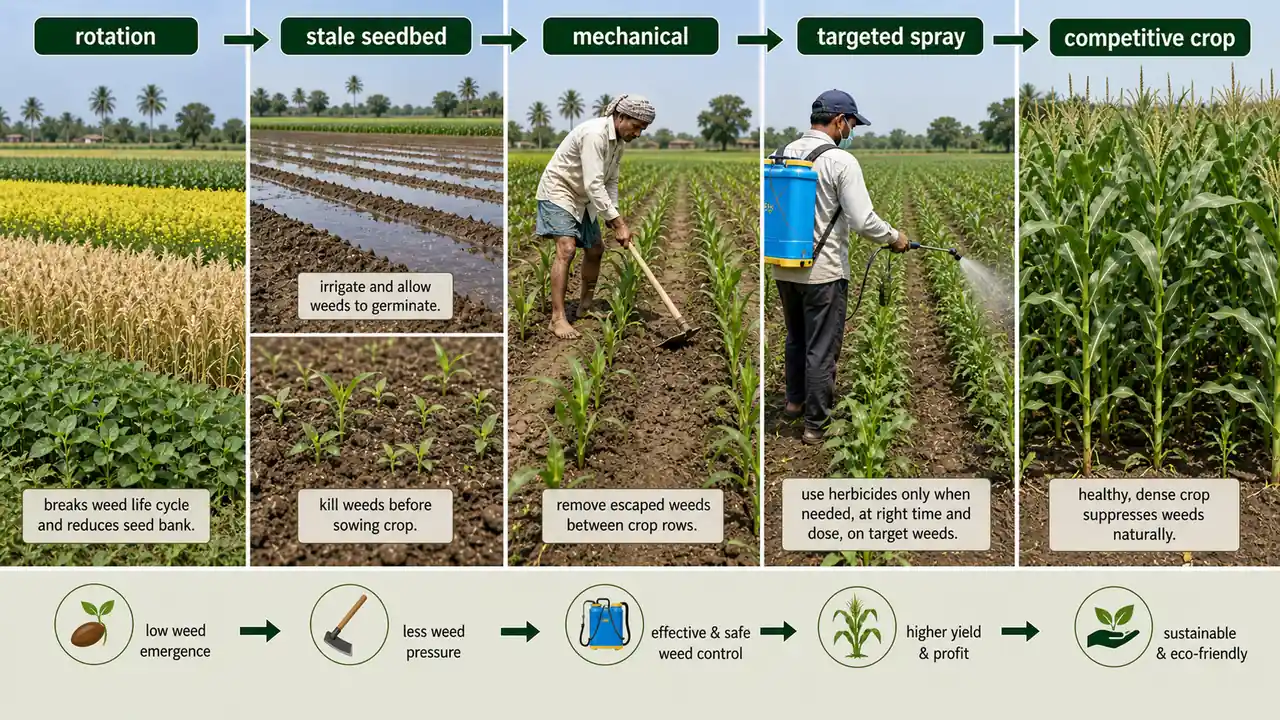
Consider the story of Phalaris minor in Haryana's wheat belt. For decades, farmers relied solely on isoproturon to control this grassy weed. By the late 1990s, Phalaris minor had developed widespread herbicide resistance, and yields crashed. The lesson was clear: depending on a single control method -- whether chemical, mechanical, or cultural -- eventually fails. Weeds adapt, shift species, or develop resistance.
This lesson covers:
- IWM definition and principles -- the threshold-based, eco-friendly framework
- Advantages over single-method approaches
- World's worst weeds -- global and Indian rankings
- IWM recommendations for rice, wheat, and soybean
- Herbicide resistance -- the growing threat that makes IWM essential
What is Integrated Weed Management?

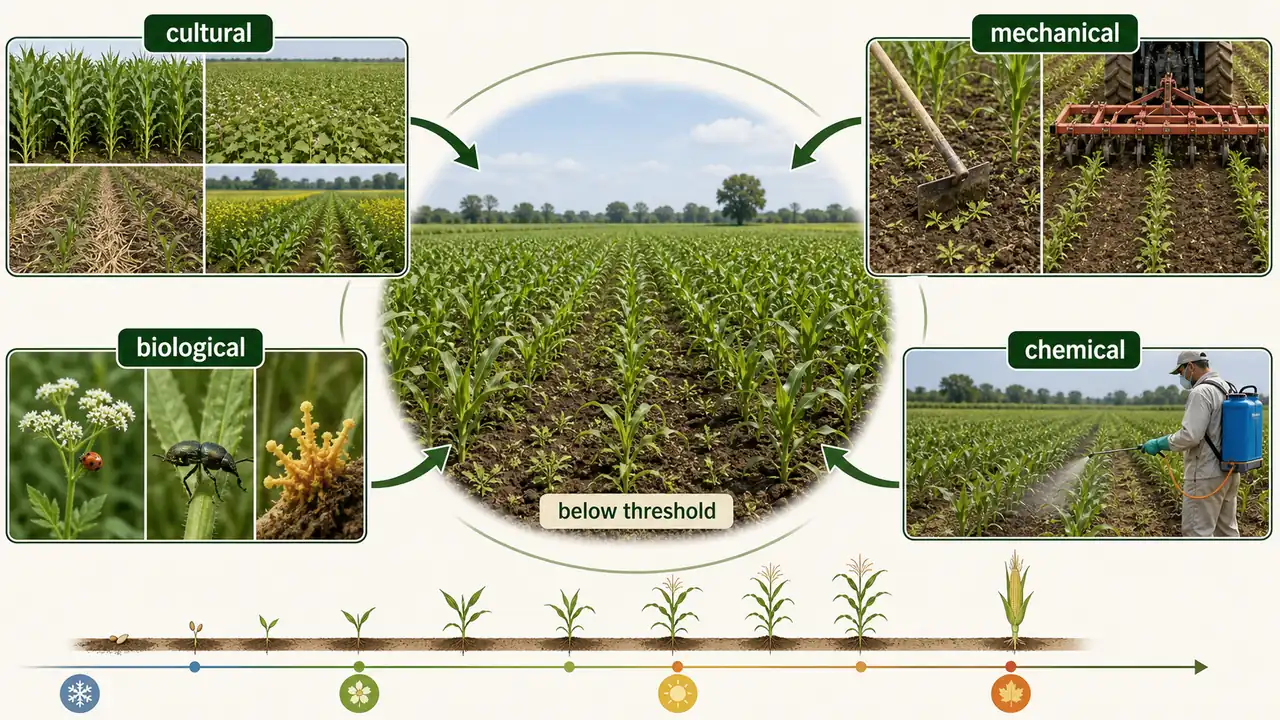
Integrated Weed Management (IWM) (asked in exams) is a holistic method whereby all economically, ecologically and toxicologically justifiable methods are employed to keep harmful organisms below the threshold level of economic damage, keeping in the foreground the conscious employment of natural limiting factors.
Pro Content Locked
Upgrade to Pro to access this lesson and all other premium content.
Charged once for one year · ₹1188 total
Save ₹100/month vs ₹2388/year launch price
- All Agriculture & Banking Courses
- AI Lesson Questions (100/day)
- AI Doubt Solver (50/day)
- Glows & Grows Feedback (30/day)
- AI Section Quiz (20/day)
- 22-Language Translation (100/day)
- Recall Questions (20/day)
- AI Quiz (15/day)
- AI Quiz Paper Analysis (100/day)
- AI Step-by-Step Explanations (100/day)
- Spaced Repetition Recall (FSRS)
- AI Tutor
- Immersive Text Questions
- Audio Lessons — Hindi & English
- Mock Tests & Previous Year Papers
- Summary & Mind Maps
- XP, Levels, Leaderboard & Badges
- Generate New Classrooms
- Voice AI Teacher (AgriDots Live)
- AI Revision Assistant
- Knowledge Gap Analysis
- Interactive Revision (LangGraph)
🔒 Secure one-time yearly payment via Razorpay · No hidden fees
Why No Single Method Is Enough
The previous two lessons covered herbicide types, formulations, and application methods -- the chemical tools in the weed control arsenal. But as the story below illustrates, relying on chemicals alone is a recipe for failure. This lesson brings together all five control categories -- preventive, cultural, mechanical, biological, and chemical -- into a unified strategy.
Consider the story of Phalaris minor in Haryana's wheat belt. For decades, farmers relied solely on isoproturon to control this grassy weed. By the late 1990s, Phalaris minor had developed widespread herbicide resistance, and yields crashed. The lesson was clear: depending on a single control method -- whether chemical, mechanical, or cultural -- eventually fails. Weeds adapt, shift species, or develop resistance.
This lesson covers:
- IWM definition and principles -- the threshold-based, eco-friendly framework
- Advantages over single-method approaches
- World's worst weeds -- global and Indian rankings
- IWM recommendations for rice, wheat, and soybean
- Herbicide resistance -- the growing threat that makes IWM essential
What is Integrated Weed Management?
Integrated Weed Management (IWM) (asked in exams) is a holistic method whereby all economically, ecologically and toxicologically justifiable methods are employed to keep harmful organisms below the threshold level of economic damage, keeping in the foreground the conscious employment of natural limiting factors.
In simpler terms, IWM does not aim to eliminate all weeds -- it aims to keep them below the level where they cause economic loss.
Core Characteristics
| Feature | What It Means |
|---|---|
| Environment-friendly | Minimises reliance on any single method, especially chemicals |
| Residue-conscious | Aims at minimising residue problems in plant, soil, air and water |
| Planned combination | Mechanical + chemical + cultural practices in a coordinated sequence |
| Ecosystem-safe | Designed not to disrupt the broader ecosystem |
IMPORTANT
IWM is the most recommended approach by modern agricultural scientists because it avoids the pitfalls of sole herbicide reliance (resistance, residues, pollution) while being more efficient than purely manual methods.
Five Principles of IWM
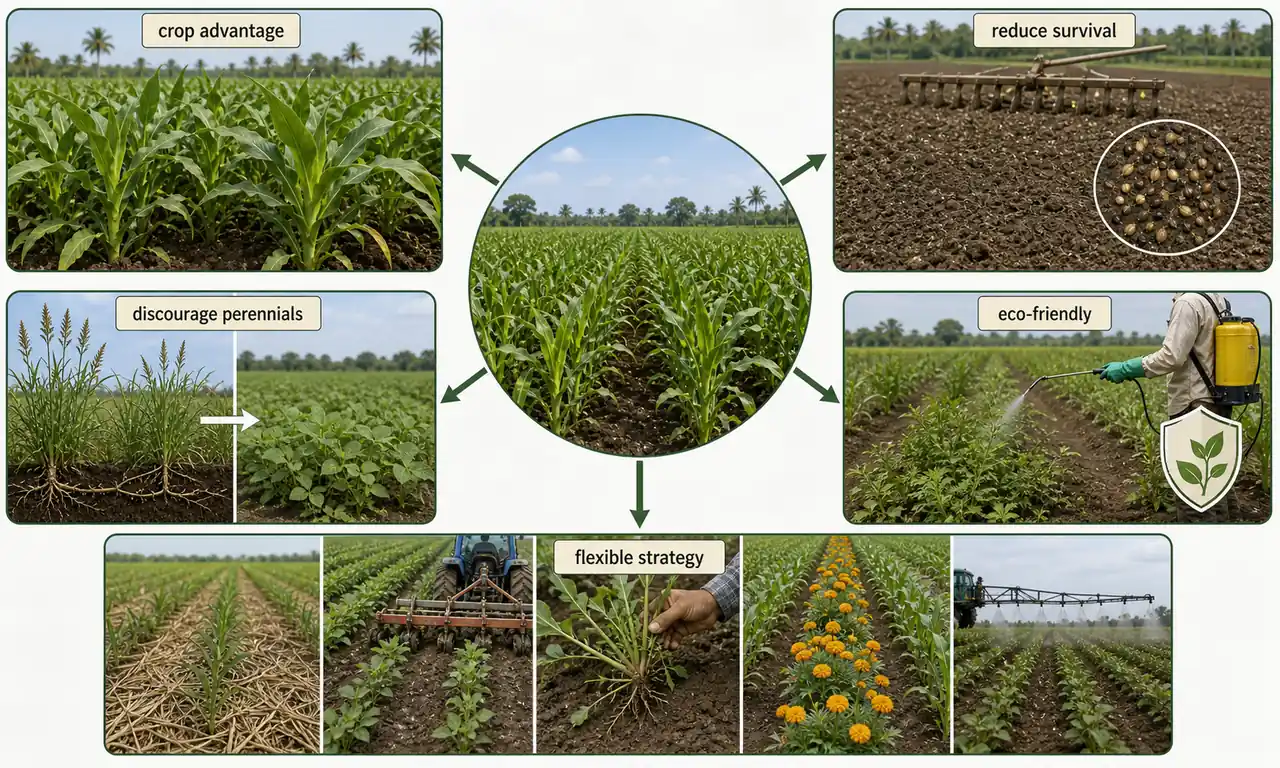
| # | Principle | Agricultural Application |
|---|---|---|
| 1 | Place the crop in competitive advantage using biological differences between crops and weeds | Use crop varieties with faster canopy closure |
| 2 | Reduce survival mechanisms of weeds in soil | Target the soil seed bank and vegetative propagules through tillage and stale seedbed |
| 3 | Discourage establishment of perennial and parasitic weeds | Crop rotation breaks host-parasite cycles |
| 4 | Every element must be eco-friendly | Minimise chemical load, protect water bodies and beneficial organisms |
| 5 | Practices should be flexible to accommodate innovations | IWM is an adaptable framework, not a rigid formula |
TIP
Mnemonic -- "CREDIT": Competitive advantage, Reduce survival, Eco-friendly, Discourage perennials, Innovation-flexible, Threshold-based. (The "T" reminds you IWM targets the economic threshold, not zero weeds.)
Advantages of IWM over Single-Method Approaches
| Advantage | Explanation |
|---|---|
| Shifts crop-weed competition in favour of crop | Multiple reinforcing strategies work together |
| Prevents weed shift towards perennials | Over-reliance on one method selects for harder-to-control species |
| Prevents herbicide resistance | Rotating herbicide groups and combining with non-chemical methods slows resistance |
| No herbicide residue danger | Chemical use is minimised and targeted |
| No environmental pollution | Reduced chemical load protects ecosystems |
| Higher net return | Optimised inputs reduce costs while maintaining effective control |
| Suitable for high cropping intensity | Works well with multiple crops per year |
Comparison: Single-Method vs IWM
| Feature | Single Method (e.g., herbicide only) | IWM |
|---|---|---|
| Resistance risk | High (weed adapts to one pressure) | Low (multiple pressures prevent adaptation) |
| Environmental impact | Higher chemical load | Minimal |
| Long-term sustainability | Poor | Excellent |
| Cost-effectiveness | Short-term savings, long-term losses | Consistent returns |
| Weed species shift | Common (e.g., grassy weeds replaced by sedges) | Prevented by diverse methods |
World's Worst (Most Problematic) Weeds
Understanding IWM principles is best reinforced by looking at the weeds that make IWM necessary. The following species cause heavy losses globally and cannot be easily controlled by any single method -- they are the very reason integrated approaches exist.
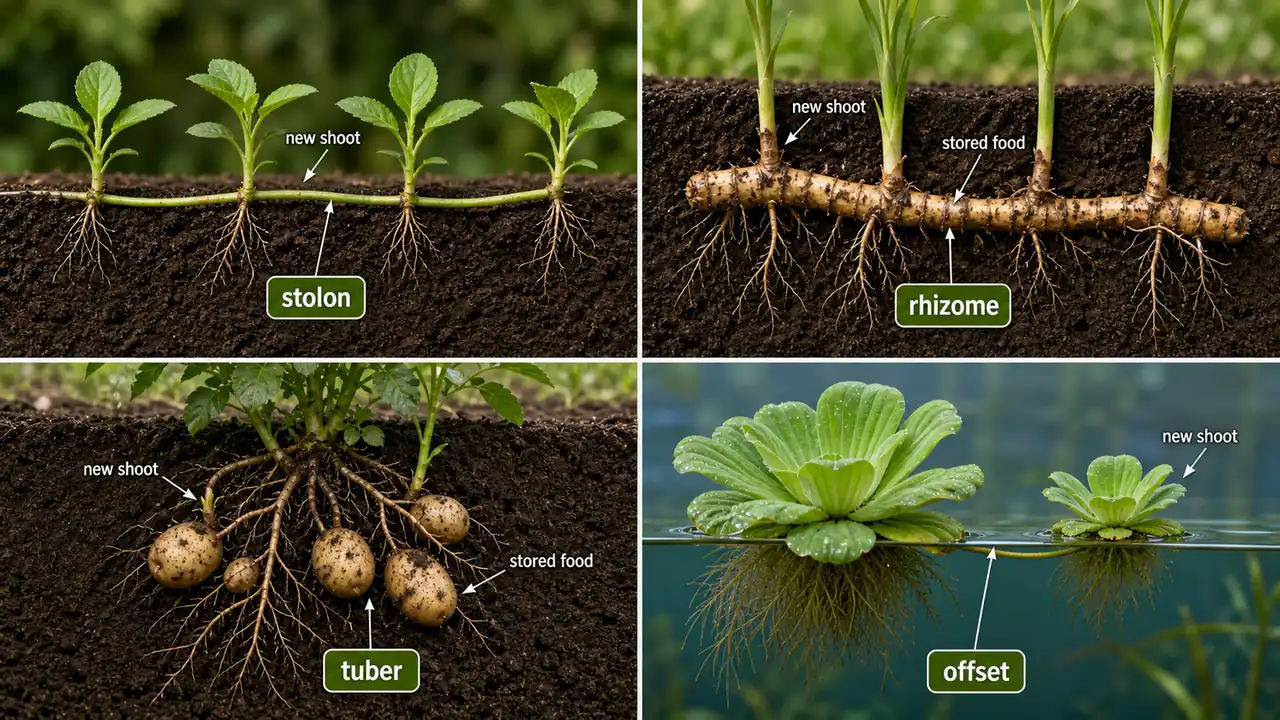
| Common Name | Scientific Name | Crops Affected | Countries Present |
|---|---|---|---|
| Nut grass | Cyperus rotundus | 52 | 92 |
| Bermuda grass | Cynodon dactylon | 40 | 80 |
| Fat hen | Chenopodium album | 40 | 47 |
| Barnyard grass | Echinochloa colonum | 36 | 61 |
| -- | Imperata cylindrica | 35 | 73 |
| Jungle grass | Echinochloa crusgalli | 35 | 60 |
| Field bindweed | Convolvulus arvensis | 32 | 44 |
| Johnson grass | Sorghum halepense | 30 | 53 |
| Water hyacinth | Eichhornia crassipes | -- | -- |
Cyperus rotundus is the world's worst weed -- found in 52 crops across 92 countries. Its tuber-based reproduction and dormancy make it nearly impossible to eradicate.
Salvinia molesta is considered the world's worst aquatic weed due to explosive vegetative growth.
TIP
Exam ranking -- top 3 by crops affected: Cyperus rotundus (52) > Cynodon dactylon (40) = Chenopodium album (40) > Echinochloa colonum (36).
Most Problematic Weeds in India
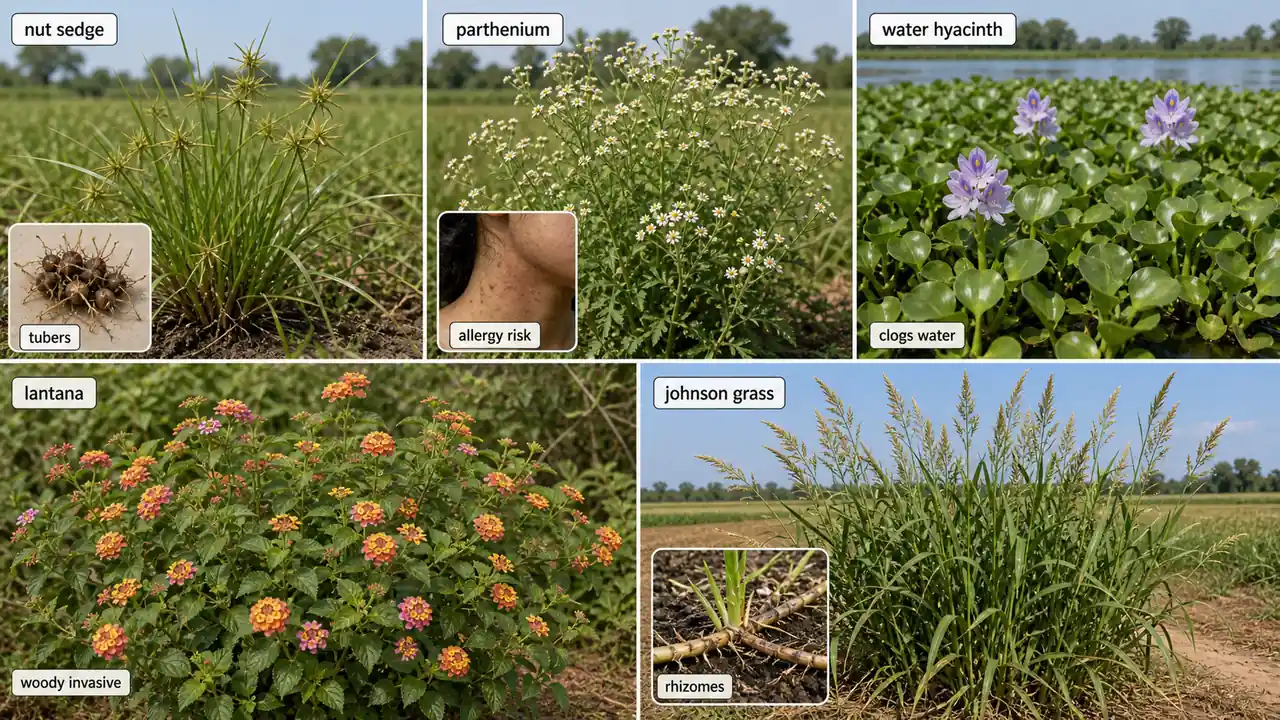
| Category | Weed | Key Problem |
|---|---|---|
| Worst terrestrial weed | Cyperus rotundus (motha) | Tuber-based, nearly indestructible |
| Worst aquatic weed | Salvinia molesta | Explosive vegetative growth |
| Perennial grass weed | Cynodon dactylon (doob) | Triple vegetative propagation |
| Major rice weed | Echinochloa colonum | Mimics rice in early stages |
| Aggressive rhizomatous weed | Sorghum halepense | Deep rhizome network |
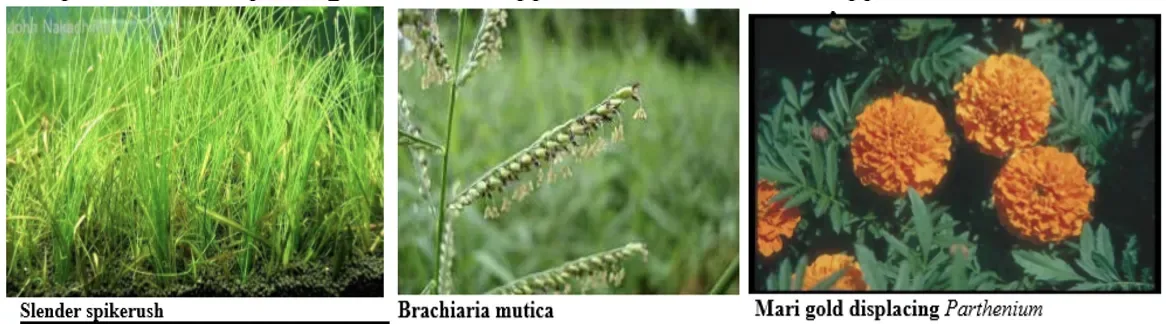
| Invasive exotic (human health) | Parthenium hysterophorus | Allergies, toxic to livestock |
| Aquatic menace | Eichhornia crassipes | Clogs water bodies, depletes oxygen |
| Aggressive grass | Imperata cylindrica | Fire-adapted, dominates wastelands |
| Woody invasive | Lantana camara | Dominates forests and wastelands |
IWM Recommendations for Major Crops
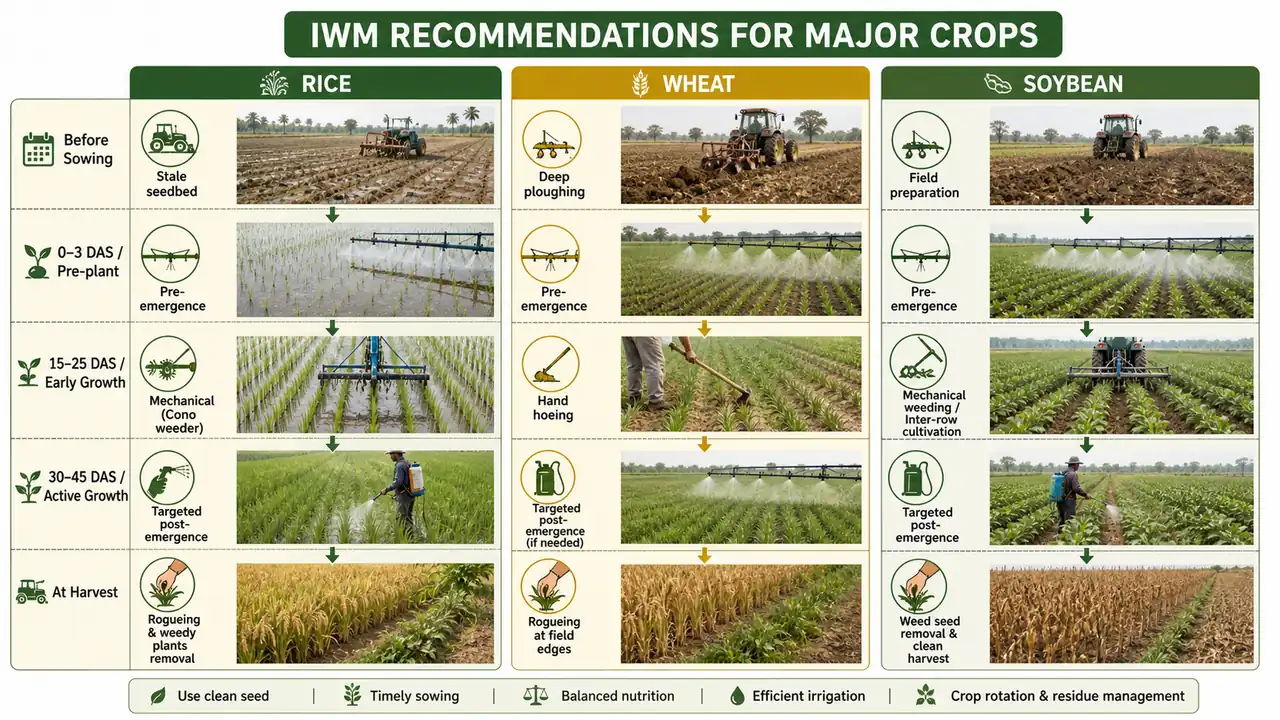
Putting IWM principles into practice requires crop-specific recommendations that combine tillage, cultural practices, herbicides, and manual weeding in a coordinated sequence. The following tables show recommended IWM packages for India's most important crops.
Rice
| Component | Practice |
|---|---|
| Tillage | Summer plough |
| Seedbed | Stale seedbed technique |
| Cropping system | Mono (Rice), Double (Rice + Wheat), Triple (Rice + Wheat + Vegetable) |
| Pre-emergence | Butachlor @ 1.0 kg ai/ha |
| Post-emergence | Anilofos (grasses) + 2,4-D (broadleaf); Propanil at 2-3 leaf stage |
| Manual | Hand weeding at 30 DAS |
| Rotation | Upland rice with lowland rice |
Wheat
| Component | Practice |
|---|---|
| Manual | Two hand weedings: 1st at 20-25 DAS, 2nd after 2 weeks |
| Seed rate | Higher to decrease Avena fatua competition |
| Sowing | Criss-cross at 22.5 cm spacing |
| Grasses | Fenoxaprop-ethyl @ 100 g ai/ha or Metasulfuron @ 4 g ai/ha at 30-35 DAS |
| Broadleaf | 2,4-D 80% Na salt @ 0.5 kg ai/ha at 30-35 DAS |
| Phalaris + Avena | Isoproturon @ 1.0-1.5 kg ai/ha at 35 DAS |
Soybean
| Component | Practice |
|---|---|
| Mechanical | 1-2 hoeing with khurpi or wheel hoe |
| Pre-emergence | Pendimethalin (Stomp) @ 0.45 kg ai/ha or Alachlor @ 1-2 kg ai/ha |
Herbicide Resistance -- A Growing Threat
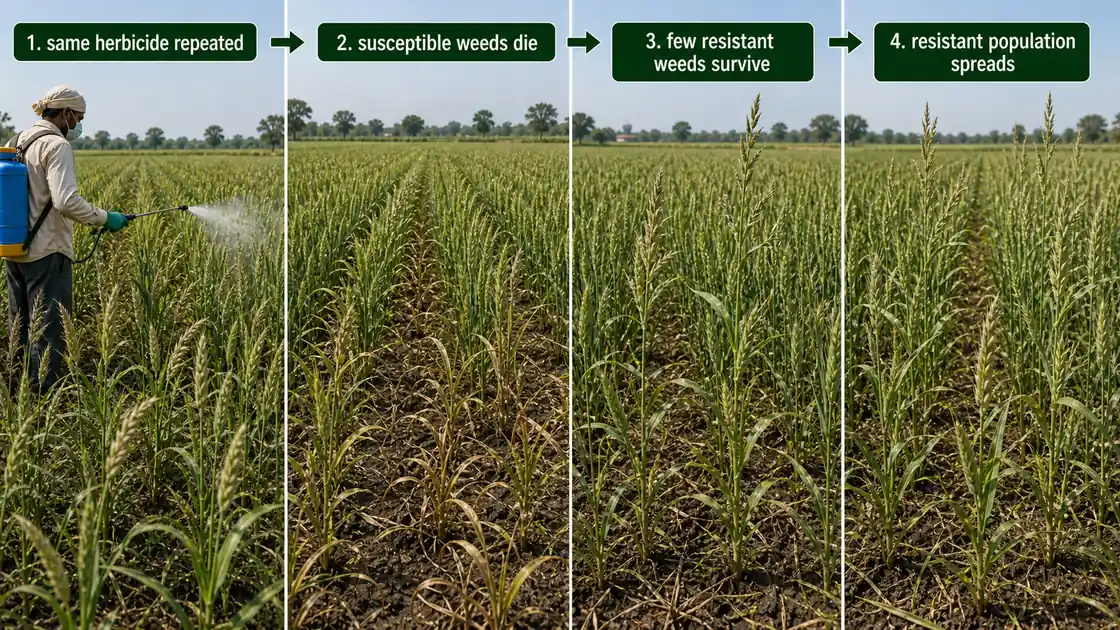
The most compelling argument for IWM comes from the consequences of ignoring it. Repeated use of the same herbicide over many years selects for naturally resistant weed biotypes through natural selection. Once resistance develops, the entire chemical tool becomes useless against that weed population.
| Weed | Resistant to | Region / Notes |
|---|---|---|
| Phalaris minor | Isoproturon | Punjab -- most serious case in India |
| Echinochloa sp. | Propanil | Rice-growing areas globally |
| Chenopodium album | Triazines | Widespread in temperate regions |
IMPORTANT
The Phalaris minor resistance to Isoproturon in Punjab's wheat belt is the textbook example of why herbicide rotation and IWM are essential. Yields crashed when the sole herbicide strategy failed.
Summary Cheat Sheet
| Concept / Topic | Key Details |
|---|---|
| IWM definition | Keep weeds below economic damage threshold using combined methods |
| IWM asked in | exams |
| Key advantage | Prevents resistance development |
| IWM principles | 5 — competitive advantage, reduce survival, eco-friendly, discourage perennials, flexible |
| World's worst weed | Cyperus rotundus — 52 crops, 92 countries |
| World's worst aquatic weed | Salvinia molesta |
| India's worst terrestrial | Cyperus rotundus (motha) |
| Most versatile perennial grass | Cynodon dactylon (3 vegetative methods) |
| Major rice weed | Echinochloa colonum — mimics rice early |
| Invasive exotic (health) | Parthenium hysterophorus — allergies, toxic |
| Aquatic menace | Eichhornia crassipes — clogs water bodies |
| Woody invasive | Lantana camara — dominates forests/wastelands |
| Fire-adapted grass | Imperata cylindrica — dominates wastelands |
| Aggressive rhizomatous | Sorghum halepense — deep rhizome network |
| Why single-method fails | Weed adaptation, species shift, resistance |
| Rice PE herbicide | Butachlor @ 1.0 kg ai/ha |
| Wheat grass herbicide | Fenoxaprop-ethyl @ 100 g ai/ha or Metasulfuron @ 4 g ai/ha |
| Wheat broadleaf herbicide | 2,4-D 80% Na salt @ 0.5 kg ai/ha |
| Soybean PE herbicide | Pendimethalin (Stomp) @ 0.45 kg ai/ha |
| Phalaris minor resistance | Resistant to Isoproturon in Punjab — textbook IWM case |
| IWM mnemonic | CREDIT — Competitive advantage, Reduce survival, Eco-friendly, Discourage perennials, Innovation-flexible, Threshold-based |